
Italian Comparatives and Superlatives: più, meno, il più
By Michael McGettrickUpdated 12 October 2026
Italian compares with (more) and (less) in front of the adjective: , taller. The adjective never changes its ending for the comparison. The real decision is the word for than, or . Add an article and you have the superlative: , the tallest.
Quick check
Three quick questions on what you have just read. The full practice is further down.
Spot the mistake
0/3Tap the mistake.
The whole system on one screen
| Job | Example | English |
|---|---|---|
| more than | Luca | taller than Luca |
| less than | | less dear than the film |
| two of a kind | | more friendly than pretty |
| the most | | the tallest in the school |
| as... as | Luca | as tall as Luca |
| very | | very tall |
Six rows, six jobs. Everything below is one row worked out in full.
The comparative: più and meno
Put or in front of the adjective. The adjective still agrees with its noun, exactly as it would on its own:
Marco Luca.- Marco is taller than Luca.Anna Luca.- Anna is taller than Luca..- The train is cheaper..- The houses here are dearer.
says less, which is often how English says cheaper or shorter without the word: , less dear.
When the second thing has an article, fuses with it, as it always does (articulated prepositions):
.- The book is better than the film.Roma .- Rome is bigger than my town.
After , a pronoun takes its stressed form: , , never .
.- My sister is younger than me.
Di or che: the choice that actually matters
goes before a name, a noun with its article, a pronoun or a number. goes between two things of the same kind that you weigh up for one subject:
| You compare | Example | English |
|---|---|---|
| two people | Maria Paolo. | Maria is taller than Paolo. |
| with a number | . | I have more than a hundred books. |
| two adjectives | Maria . | Maria is more friendly than pretty. |
| two verbs | . | Speaking is easier than writing. |
| two places | Roma Milano. | It's hotter in Rome than in Milan. |
| two amounts | . | I drink more water than wine. |
The superlative: add the article
The article turns taller into the tallest:
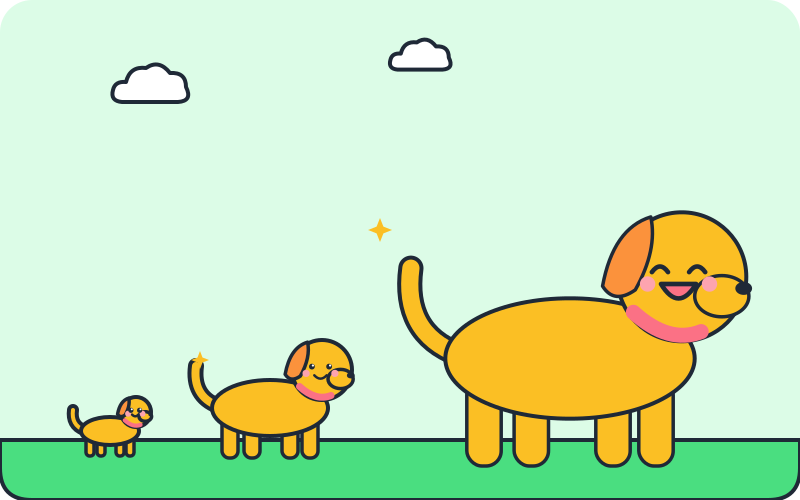
Three dogs. Piccolo: small. Più grande: bigger (than the first). Il più grande: the biggest of the three.
With a noun, the usual order is article, noun, , adjective. The group normally takes , fused with its article, or :
Marco .- Marco is the tallest in the school.Anna .- Anna is the tallest of all..- It's the best film of the year..- He's the youngest of the brothers.
English says in the school; Italian thinks of the group as the thing the best one is picked out of, so is the normal choice. works the same way: , the cheapest, literally the least dear.
The absolute superlative: -issimo
The ending -issimo means very, not the most. It compares nothing, so there is no and no :
| Base | -issimo | English |
|---|---|---|
| | very tall |
| | really beautiful |
| | delicious, very good |
| | very easy |
Drop the last vowel, add -issimo, then agree like any adjective in -o:
.- The house is really beautiful..- They are exhausted.
picks one out of a group; just turns the volume up on one description.
Equality: tanto... quanto and così... come
As... as uses a different pair of words, not or . The two pairs mean the same, and everyday speech usually drops the first word:
| Pair | Full form | Short form |
|---|---|---|
| ... | Paolo | Paolo |
| ... come | Paolo | Paolo |
All four mean as tall as Paolo:
Maria Paolo.- Maria is as tall as Paolo.
Before an adjective, and never change: , not . With a noun, and agree like quantity words:
.- I have as many male friends as female friends.
Adverbs, and the irregular few
Adverbs compare the same way, and with no gender they never agree:
.- I'm arriving later than you..- I study less than my brother..- I'll come as soon as possible.
Four common words have their own forms. and are adverbs (better, worse, after a verb); and are adjectives (better, worse, with a noun):
| Base | Comparative | Example |
|---|---|---|
| | . - I feel better today. |
| | . - It's going worse. |
| | - a better wine |
| | - the worst day |
is also everyday Italian, especially for food: . The full set is on adjectives and adverbs.
Mistakes English speakers make
| Wrong | Right | Why |
|---|---|---|
| after : me, | |
| two qualities: | |
| already means better | |
| -issimo already means very | |
| does not change here |
What to do next
Comparatives and superlatives are on the Pearson Edexcel GCSE Italian specification at Foundation and Higher tier.
- Compare two people you know in three sentences, each with
.... - Write one
sentence each with two adjectives, two verbs and two places. - Turn five adjectives into -issimo:
,.