Verbs of Becoming
English has one workhorse verb for change of identity - become - and props it up with get, go and turn when it wants shading: he got rich, he went mad, she turned professional. Spanish has no such workhorse. Ask a Spanish speaker to translate "become" cold and they cannot, because the choice of verb depends entirely on what kind of change you are describing. Get the kind of change right and the verb picks itself. Get it wrong and you have written the sort of sentence that marks you out as an English speaker translating word for word.
There are five main verbs, plus two shortcuts. This page takes them one at a time, then gives you a decision guide to choose under pressure.
ponerse + adjective: a sudden change of state or mood
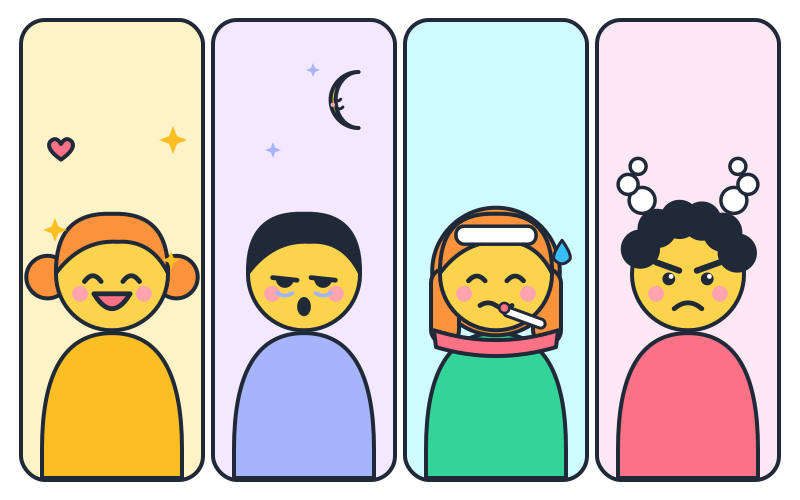
Ponerse is the verb of the passing mood and the momentary physical state. The change it describes is sudden, often involuntary, and almost always temporary - a flush of feeling or a shift of condition that will pass. It takes an adjective, never a noun.
- Se puso rojo. (He went red.) - a blush, gone in a minute.
- Me pongo nervioso antes de hablar en público. (I get nervous before speaking in public.)
- Se puso muy contenta con el regalo. (She got very happy with the present.)
- No te pongas triste. (Don't get sad.)
- Mi padre se puso furioso cuando lo oyó. (My father got furious when he heard it.)
- Te has puesto muy moreno este verano. (You've got very tanned this summer.)
If you can imagine the person being back to normal within the hour, ponerse is almost certainly your verb. It is the everyday, high-frequency choice for moods and colours and physical states, and it is the one you will reach for most.
volverse + adjective: a radical, lasting change of character
Volverse also takes an adjective, but the change could not be more different from ponerse. It is deep, radical, involuntary and lasting - a genuine shift in someone's or something's essential nature, not a passing mood.
- Se volvió loco. (He went mad.) - and stayed that way.
- Se ha vuelto muy serio desde que empezó a trabajar. (He has become very serious since he started working.)
- La ciudad se ha vuelto muy peligrosa. (The city has become very dangerous.)
- Con los años se volvió más tolerante. (Over the years he became more tolerant.)
- Te has vuelto muy desconfiado. (You've become very distrustful.)
The contrast with ponerse is the whole point. Se puso triste is a mood that will lift; se ha vuelto triste describes someone whose disposition has darkened for good. Se puso serio is the face he pulled for a moment; se ha vuelto serio is the person he now is. If the change has reshaped the character rather than coloured the afternoon, reach for volverse.
hacerse + adjective or noun: a gradual change through effort or process
Hacerse is the verb of change you work towards or that happens through a natural, gradual process. There is usually some element of will, effort or self-direction in it - or the slow inevitability of time. It takes either an adjective or a noun, and it is the default choice for professions, religions and ideologies.
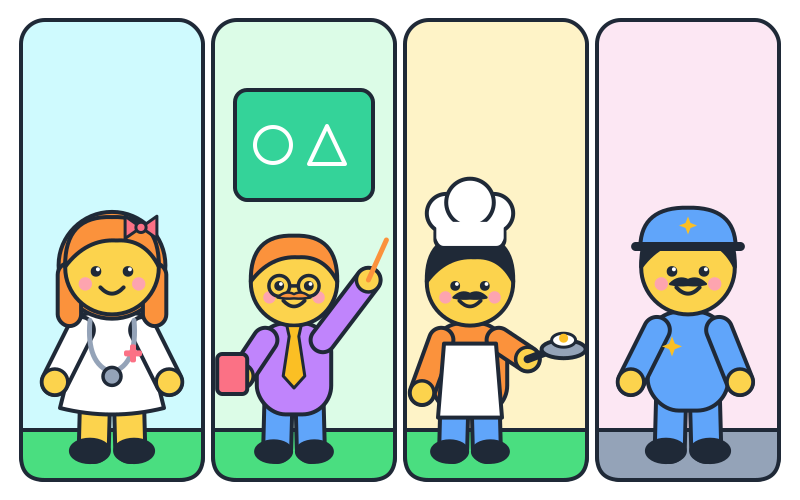
- Se hizo médico. (He became a doctor.) - years of study, a chosen path.
- Se hizo rico vendiendo pisos. (He got rich selling flats.)
- Se hizo budista a los treinta años. (He became a Buddhist at thirty.)
- Poco a poco se hicieron amigos. (Little by little they became friends.)
- Se está haciendo tarde. (It's getting late.) - a natural process, no will required.
- Con la práctica te harás más rápido. (With practice you'll get faster.)
The line between hacerse and ponerse is effort and permanence. Ponerse rico is not idiomatic; wealth is reached, not switched on, so it is hacerse rico. Where profession, faith or belief is concerned, hacerse is the standard: se hizo abogada (she became a lawyer), se hizo católico (he became a Catholic), se hizo del partido (he became a party member).
convertirse en + noun: a transformation into something new
Convertirse en describes a transformation - a change into a genuinely different thing or a new identity, often dramatic. It takes the preposition en and then a noun (never a bare adjective). It works for people and for things.
- Se convirtió en una estrella de la noche a la mañana. (She became a star overnight.)
- La oruga se convierte en mariposa. (The caterpillar turns into a butterfly.)
- El príncipe se convirtió en rana. (The prince turned into a frog.)
- Aquel pueblo tranquilo se ha convertido en una gran ciudad. (That quiet town has become a big city.)
- Se convirtió en el mejor jugador del equipo. (He became the best player in the team.)
Note that convertirse en overlaps with the religious sense of hacerse but is not the same: convertirse al islam (to convert to Islam) uses a, not en, and describes the act of religious conversion, while hacerse musulmán describes taking on the identity. For the everyday "turned into", convertirse en is your verb, and it is the one to reach for whenever a noun follows and the change is a real transformation.
llegar a ser + noun: an achievement reached over time
Llegar a ser literally means "to get to be", and that is exactly its flavour: it marks the end point of a long process, an achievement reached gradually and often against the odds. It takes a noun (or an adjective of standing), and it keeps the sense of arrival in view.
- Llegó a ser presidente del gobierno. (He became prime minister.) - the summit of a long climb.
- Con esfuerzo llegó a ser una de las mejores abogadas del país. (Through effort she became one of the best lawyers in the country.)
- Empezó de camarero y llegó a ser dueño del restaurante. (He started as a waiter and became the owner of the restaurant.)
- Nunca llegó a ser famoso, pero vivió feliz. (He never became famous, but he lived happily.)
Llegar a ser and hacerse are close, and often interchangeable for professions, but the emphasis differs. Se hizo médico simply reports that he qualified; llegó a ser jefe de cirugía foregrounds the climb and the arrival at the top. Where there is a peak reached after a long haul, llegar a ser is the more expressive choice.
Two shortcuts worth knowing
quedarse + adjective: a change that results from something. When a change is the result of an event - and especially when it involves a loss - Spanish often prefers quedarse. It stresses the state you are left in.
- Se quedó ciego tras el accidente. (He went blind after the accident.)
- Se quedó viuda muy joven. (She was widowed very young.)
- Me quedé sorprendido. (I was left surprised.)
- La casa se quedó vacía. (The house was left empty.)
Plain reflexives: the neatest option when one exists. Spanish very often has a single reflexive verb that means "become + adjective", and where it does, it is nearly always the most natural choice. Do not build ponerse enfadado when enfadarse exists.
- enfadarse (to get angry), not "ponerse enfadado" - se enfadó conmigo (he got angry with me).
- alegrarse (to become glad), not "ponerse alegre" in most cases - me alegré mucho (I was very glad).
- cansarse (to get tired) - me cansé de esperar (I got tired of waiting).
- aburrirse (to get bored), entristecerse (to grow sad), enriquecerse (to get rich).
When a dedicated reflexive exists, prefer it. The becoming verbs are for the many cases where one does not.
The decision guide
Under pressure, work from the kind of change, not the English word:
- Sudden mood or state, temporary? -> ponerse + adjective. Se puso nervioso.
- Radical, lasting change of character? -> volverse + adjective. Se volvió insoportable.
- Gradual change through effort or process; profession, religion, ideology? -> hacerse + adjective/noun. Se hizo ingeniero.
- Transformation into a new thing or identity (a noun follows)? -> convertirse en + noun. Se convirtió en líder.
- Achievement, the end point of a long climb? -> llegar a ser + noun. Llegó a ser ministro.
- A change that results from an event, often a loss? -> quedarse + adjective. Se quedó sordo.
- Is there a single reflexive verb for it? -> use that. enfadarse, cansarse, alegrarse.
Worked examples
- Cuando vio la nota, se puso pálido. (When he saw the mark, he went pale.) - sudden state, ponerse.
- Desde el divorcio se ha vuelto muy amargado. (Since the divorce he's become very bitter.) - lasting character change, volverse.
- Estudió de noche y se hizo profesora. (She studied at night and became a teacher.) - effort, profession, hacerse.
- La pequeña empresa se convirtió en una multinacional. (The small firm became a multinational.) - transformation into a noun, convertirse en.
- Tras años de lucha, llegó a ser alcalde. (After years of struggle, he became mayor.) - achievement over time, llegar a ser.
- Se quedó solo cuando todos se marcharon. (He was left alone when everyone left.) - resulting state, quedarse.
- No te enfades, no fue culpa suya. (Don't get angry, it wasn't his fault.) - dedicated reflexive.
Common mistakes English speakers make
Reaching for one verb for everything. There is no all-purpose "become", so the instinct to translate it with a single Spanish verb - usually a misused hacerse or a calqued volverse for every case - produces sentences that are grammatical but wrong-footed. Always sort by the kind of change first.
Putting a noun after ponerse or volverse. Both take adjectives only. "Se puso médico" and "se volvió médico" are not Spanish; a profession is a noun, so it is se hizo médico or llegó a ser médico. If a noun follows, your candidates are hacerse, convertirse en and llegar a ser, never ponerse or volverse.
Dropping the en after convertirse. The transformation sense always carries the preposition: se convirtió en actor, never "se convirtió actor". Leave out the en and the sentence breaks. Keep in mind the religious sense takes a instead: se convirtió al cristianismo.
Using ponerse for a permanent change. Se puso viejo for "he got old" mistakes a slow, lasting process for a passing mood. Ageing is gradual and permanent, so it is se hizo viejo or the reflexive envejeció. Reserve ponerse for what will pass within the hour.
Building a becoming verb where a reflexive exists. Ponerse enfadado is clumsy when enfadarse is sitting right there. Before assembling ponerse or volverse plus an adjective, check whether Spanish already packs the whole idea into one reflexive verb - it very often does.
See also
- Ser vs Estar - the two 'to be' verbs the becoming verbs deliver you into; llegar a ser and convertirse en both land on an identity that ser would then describe.
- The Spanish verbs page covers the full conjugation of ponerse, hacerse, volverse, convertirse and llegar (a ser) across all tenses.
- The Spanish grammar cheatsheet has the becoming-verbs decision guide on one card.