
French · For teachers
Every French printable, chapter by chapter
The whole French curriculum in one place, mapped to its 34 chapters and 717 lessons. Each lesson lists its downloads inline - worksheets with answer keys, infographics and PDFs - and each chapter's words fold out into their own per-word printable sets, so you can open and print any sheet for a class without hunting through the site.
Chapter 1 · Introduction to French
Chapter page →- Introduction to FrenchIntroduction
Read this first. The orientation: how French works, what it costs in hours, what the apps get wrong, and how to use this curriculum.
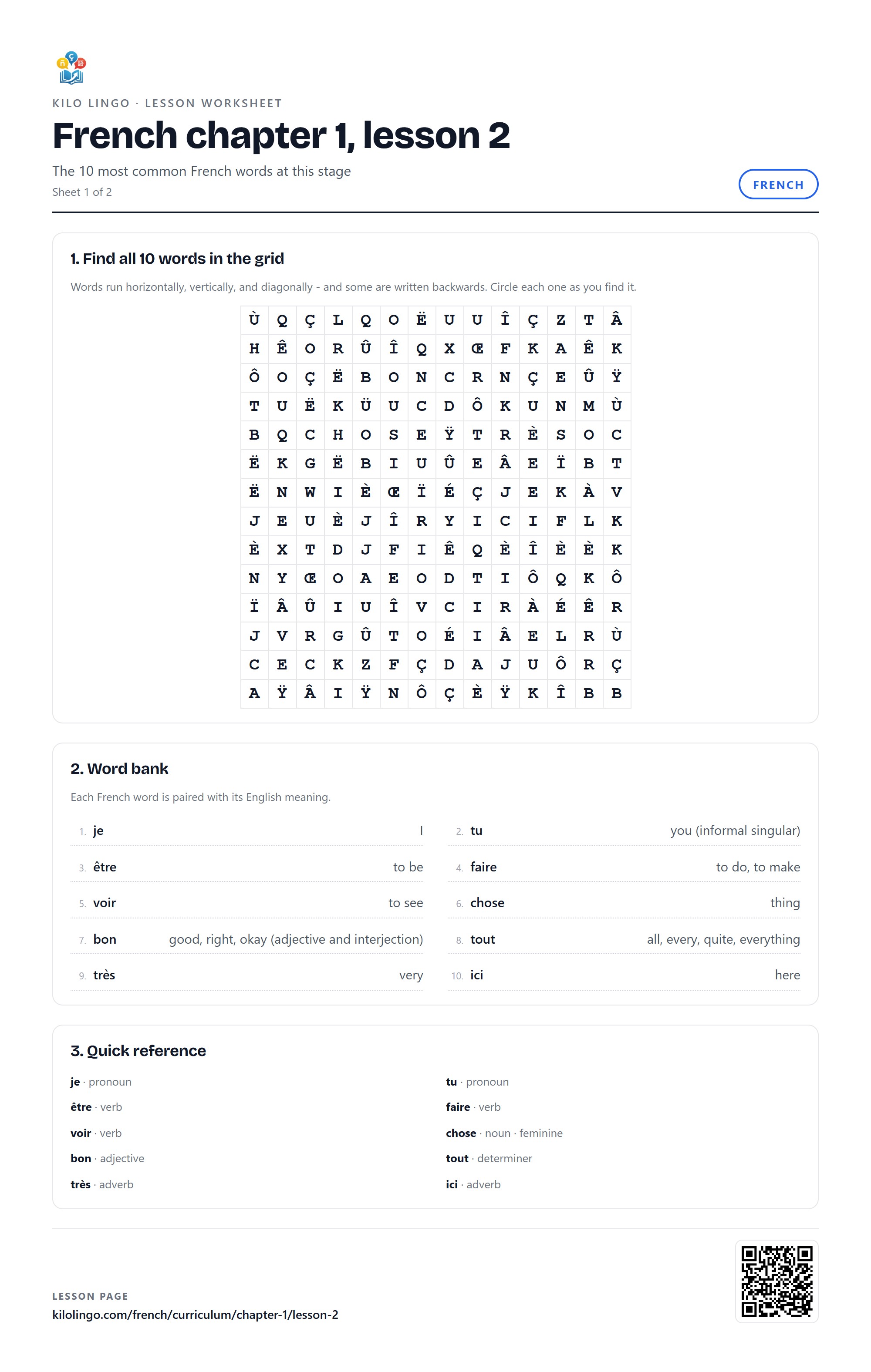
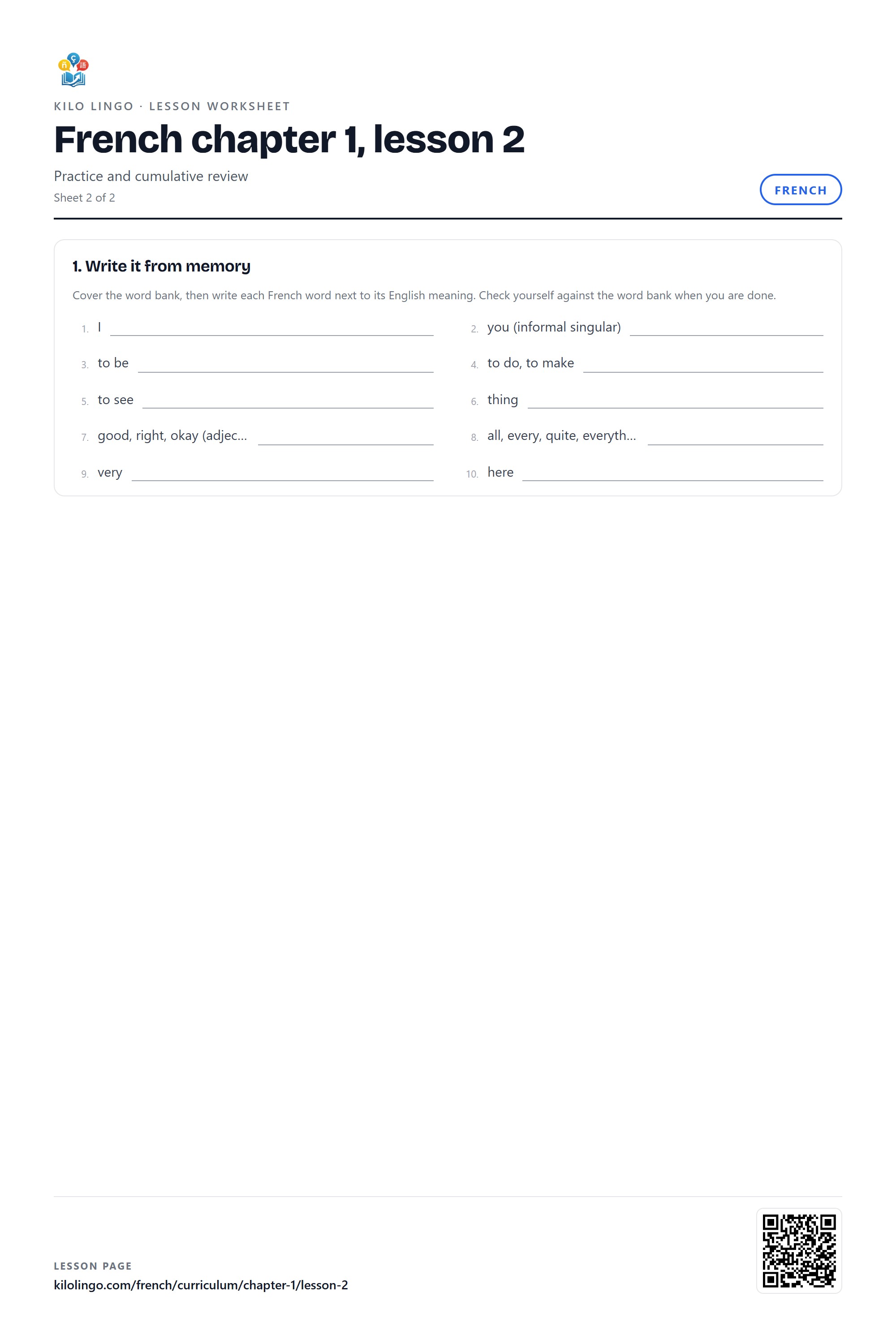
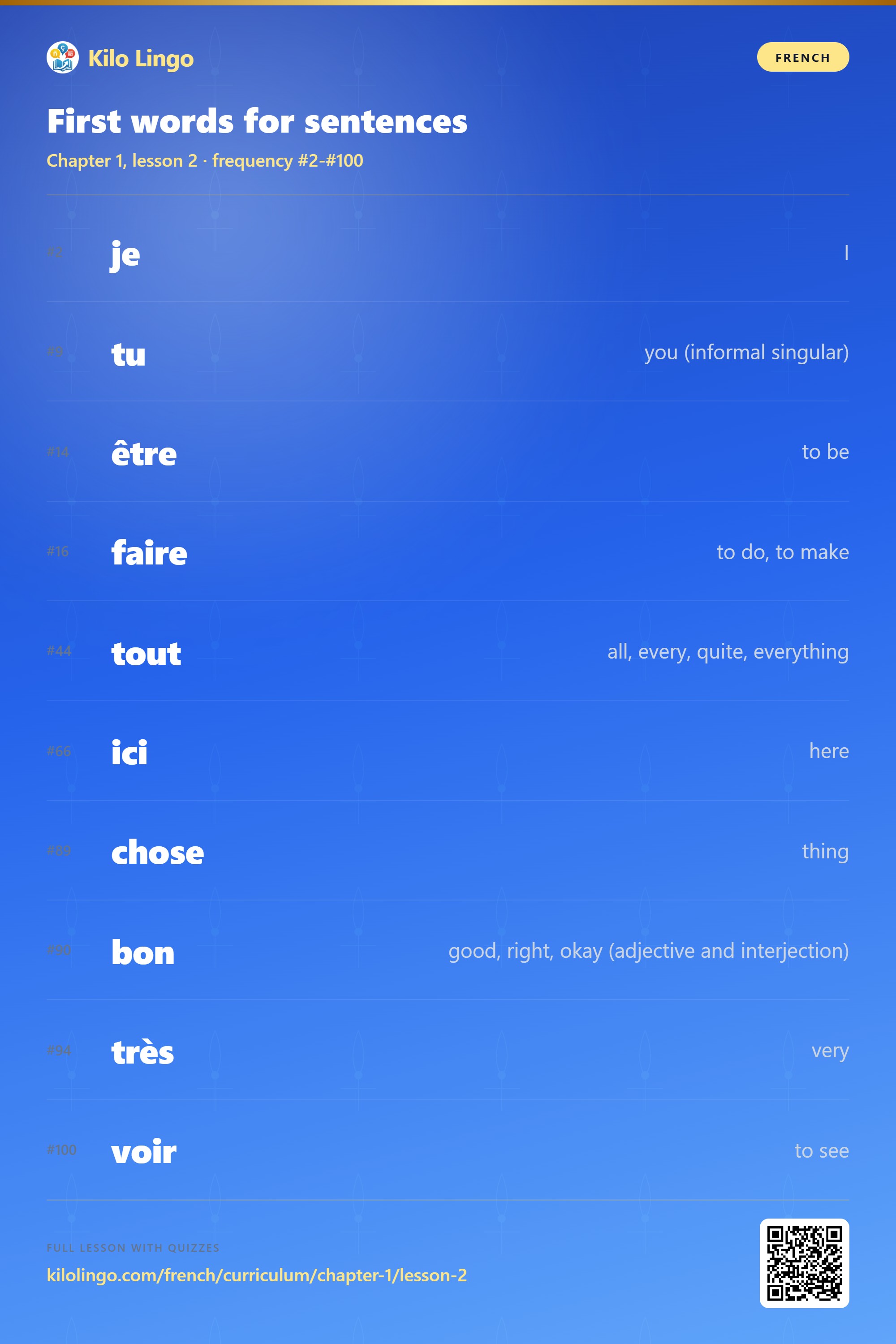
- First words for sentencesVocabulary
10 words · A pronoun, a few verbs, the things they act on. Enough to build a real French sentence by the end.
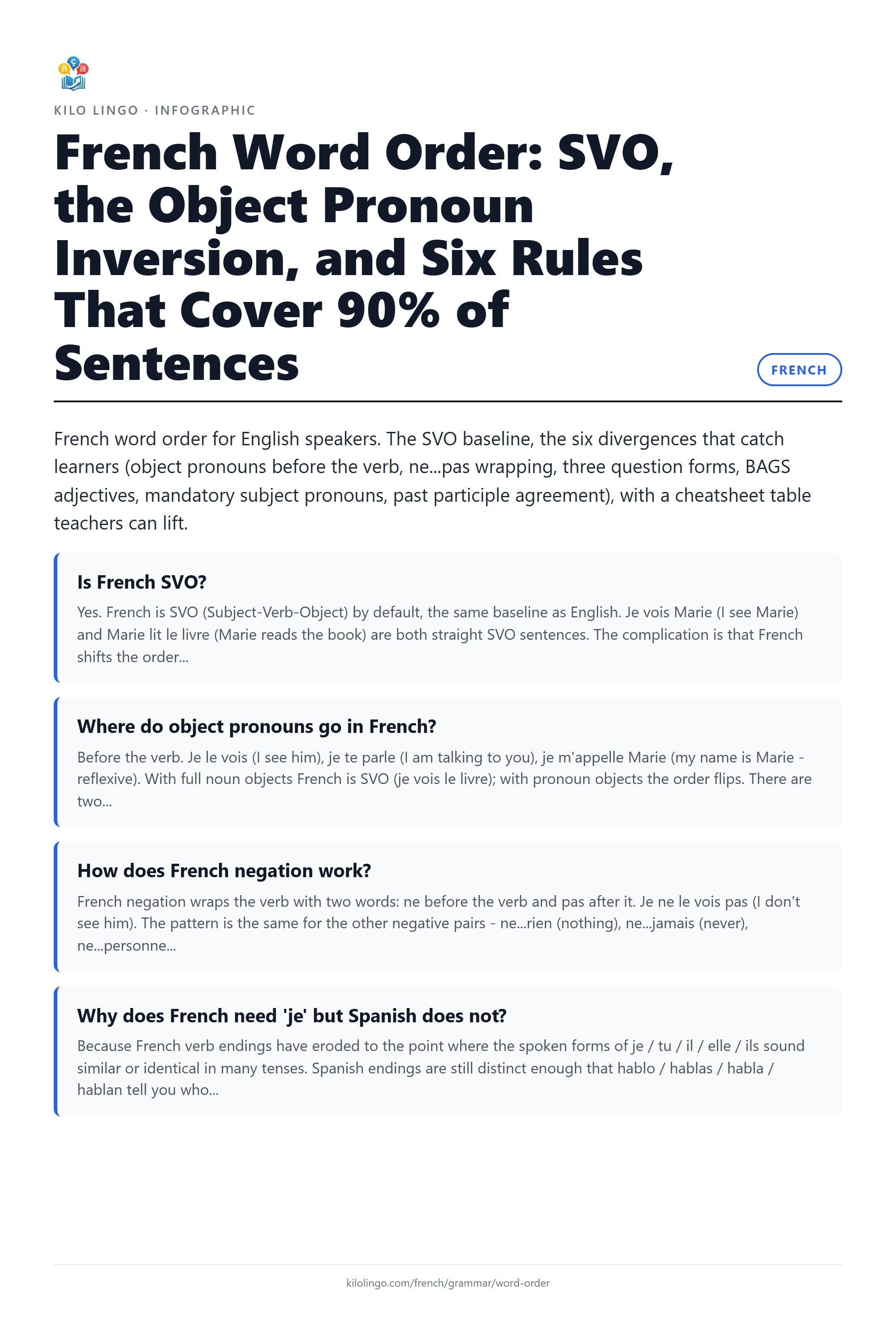
- Word order in FrenchGrammar
Subject, verb, object - and the moments French bends the English order.
- More people, more wordsVocabulary
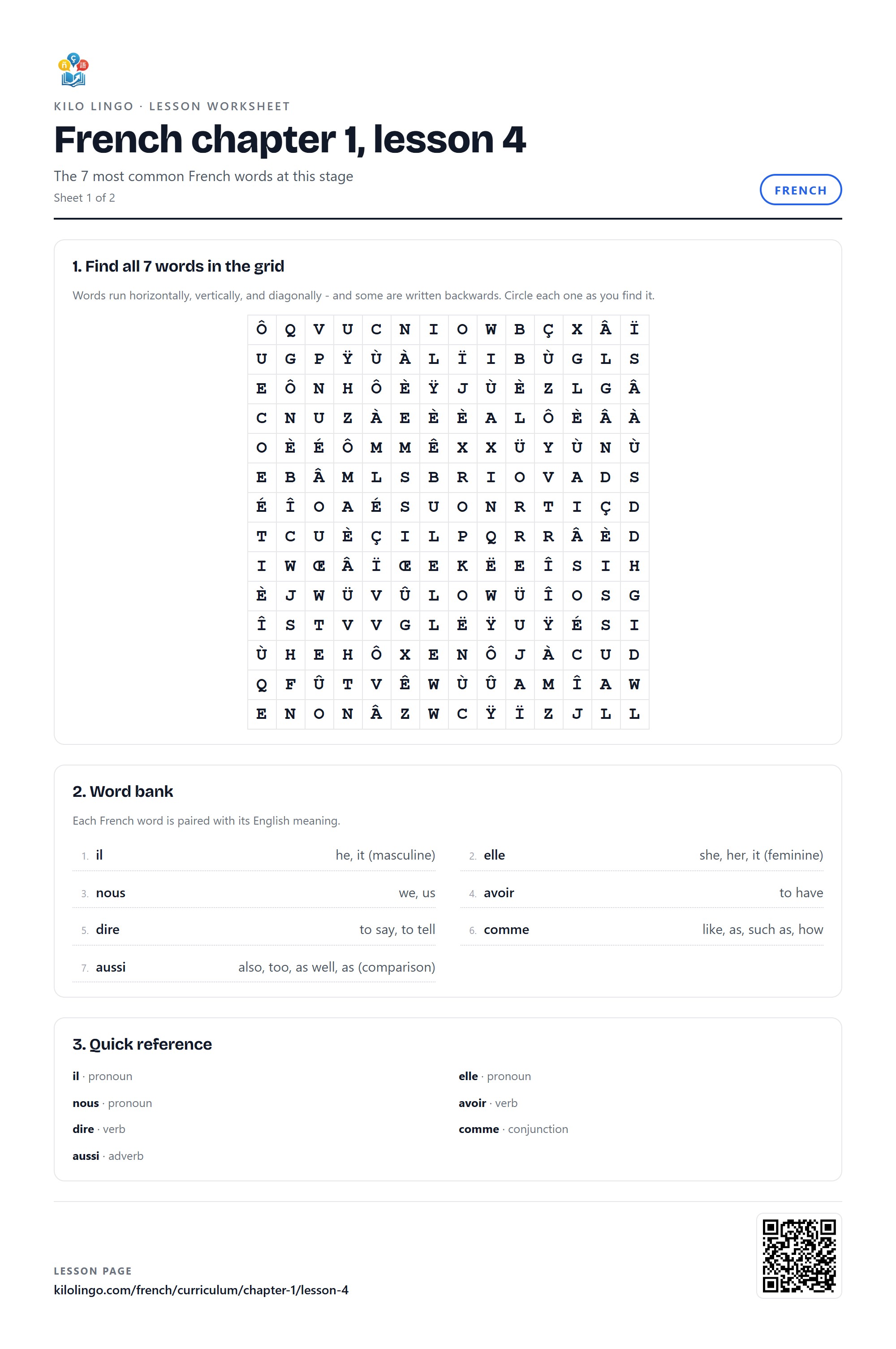
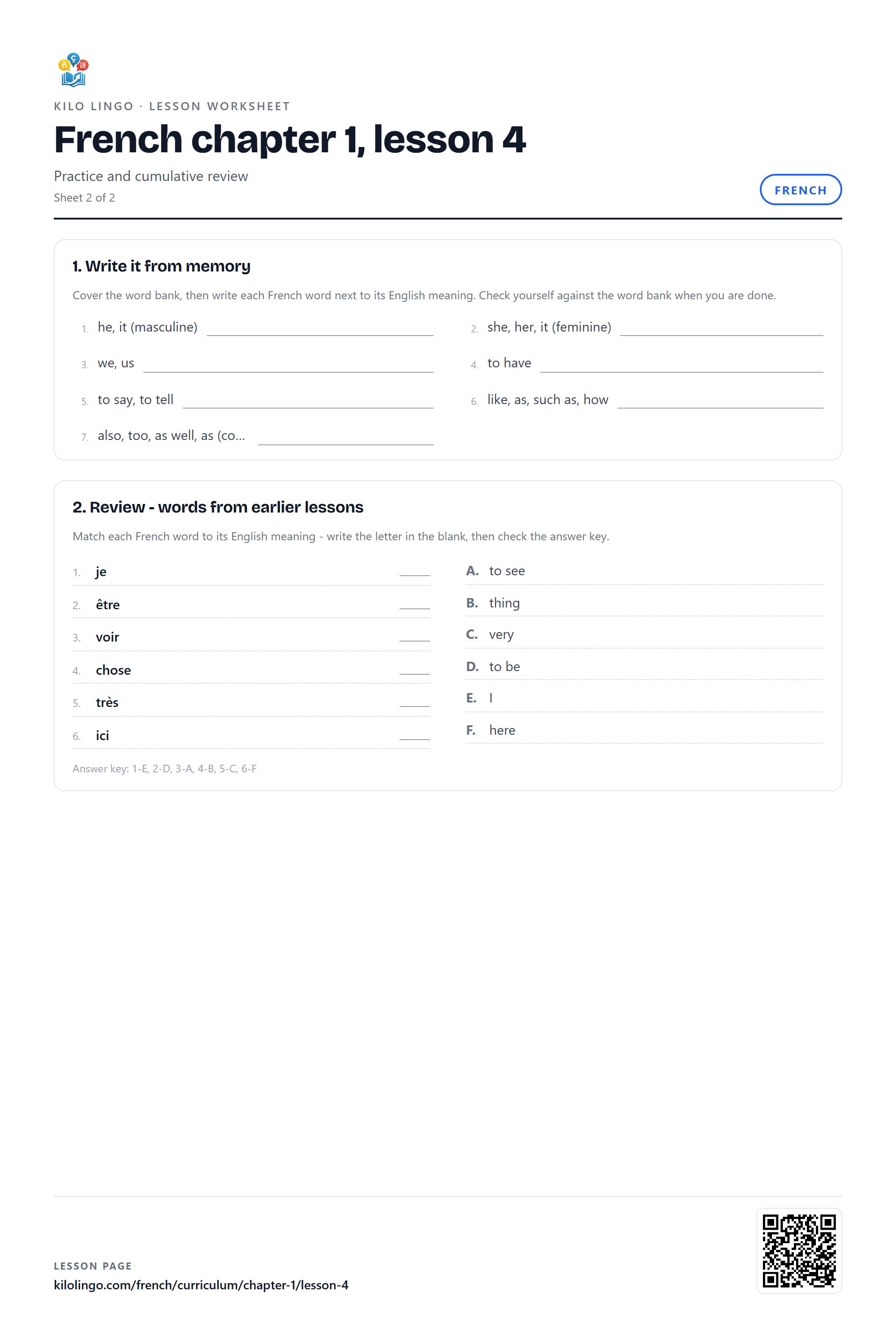
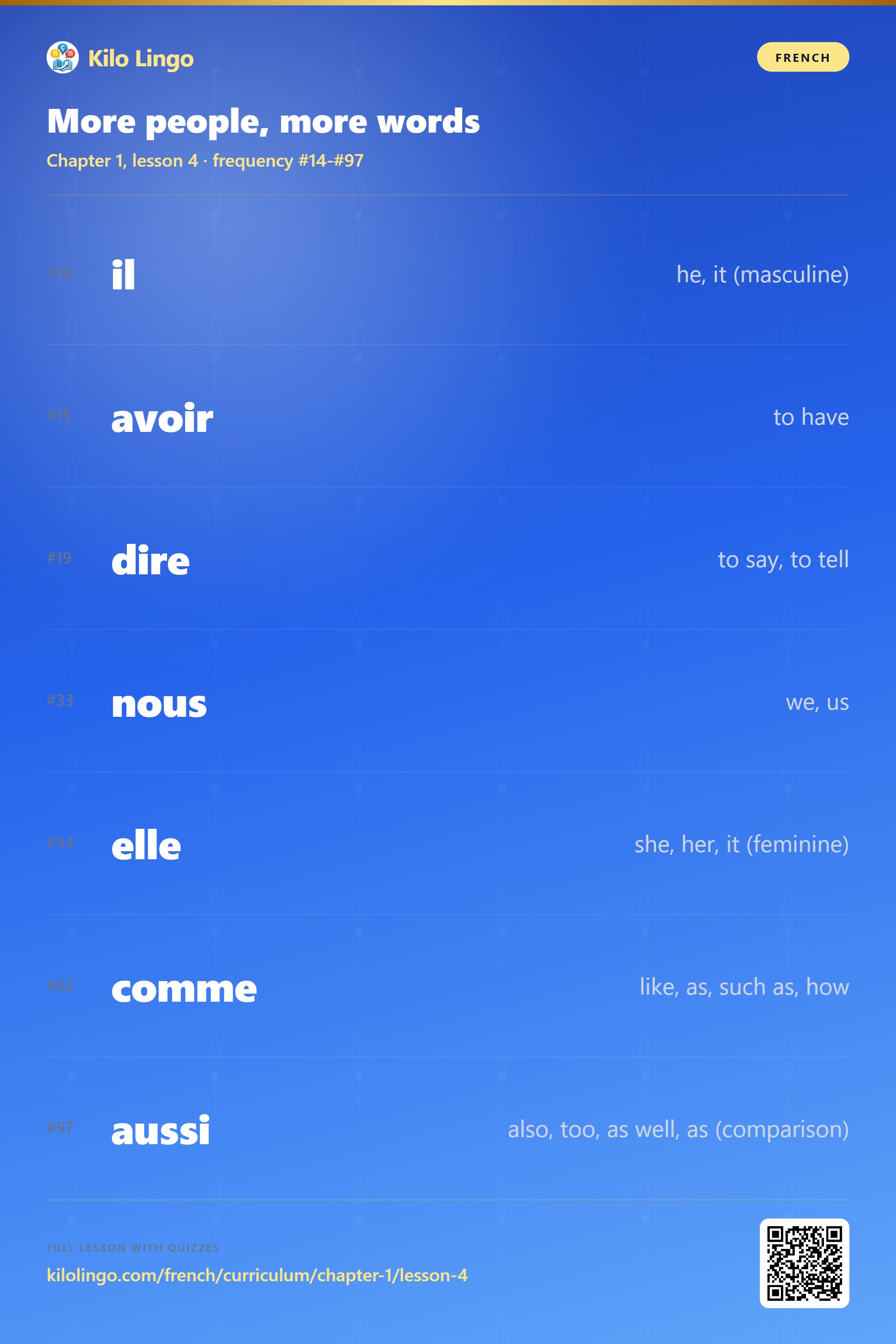
7 words · Subject pronouns for everyone else, plus the rest of the vocabulary you need for your first story.
- Your first story in FrenchGraded-reader story
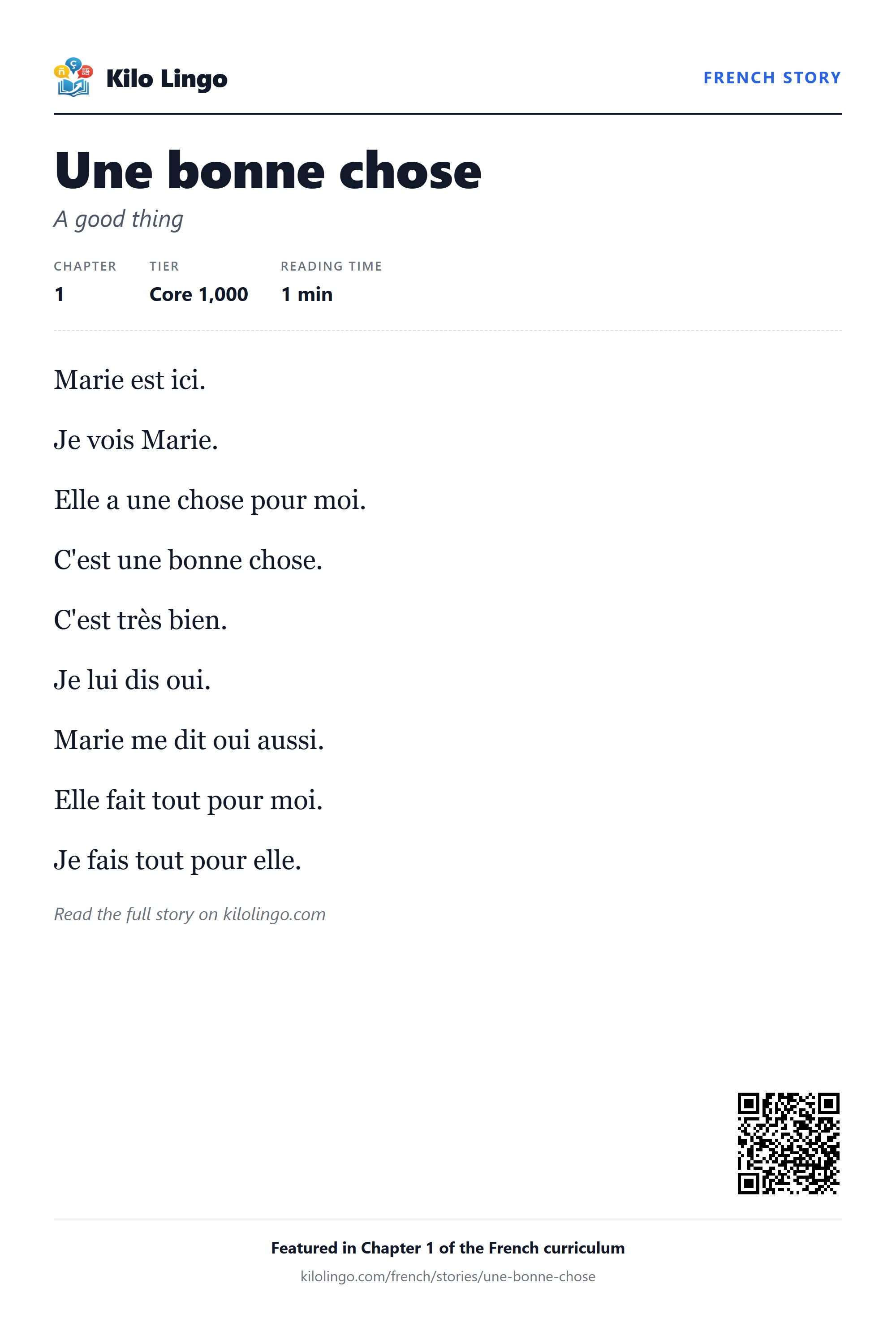
Every word in this story comes from the lessons you've just finished. No lookups required.
- French articlesVocabulary
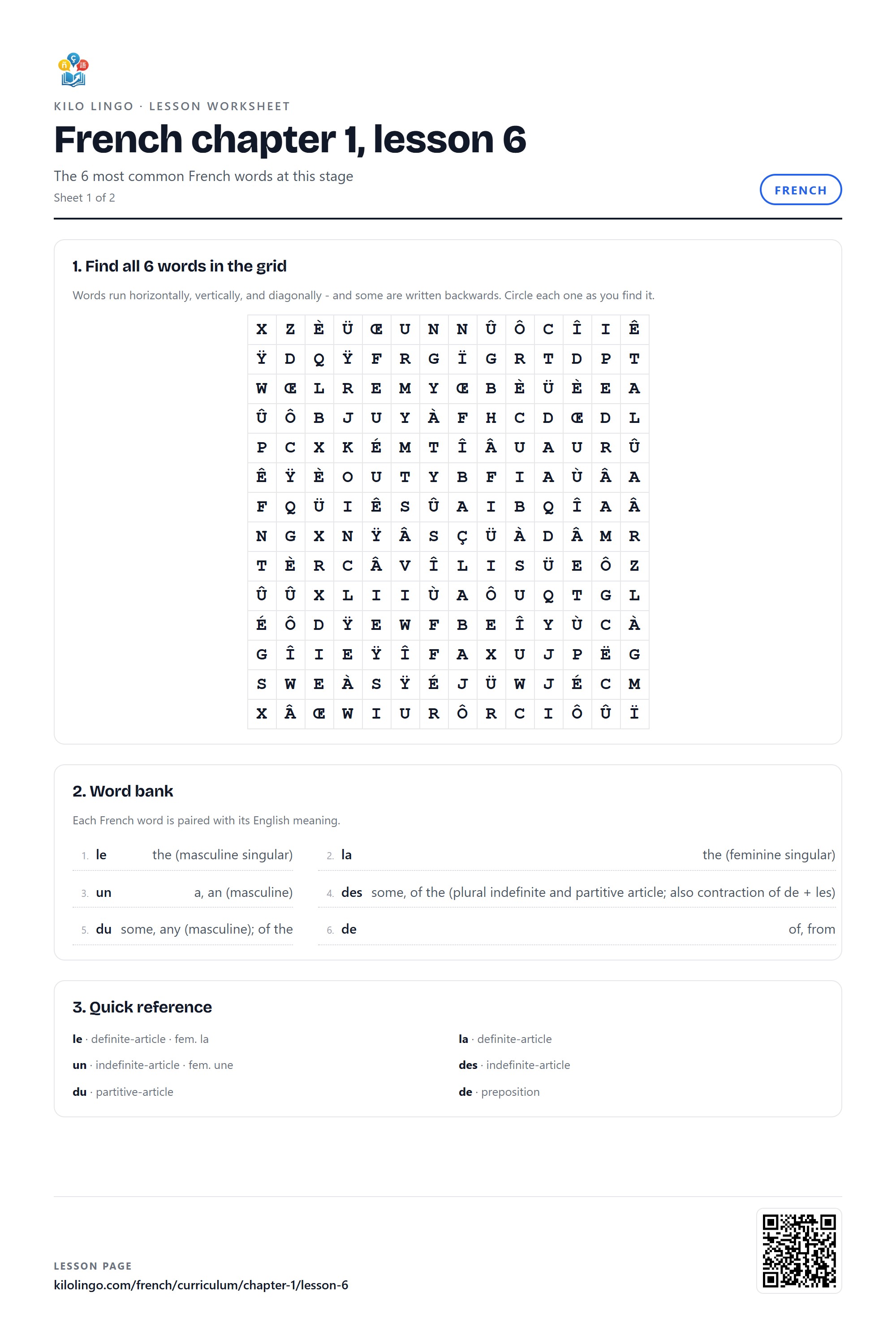
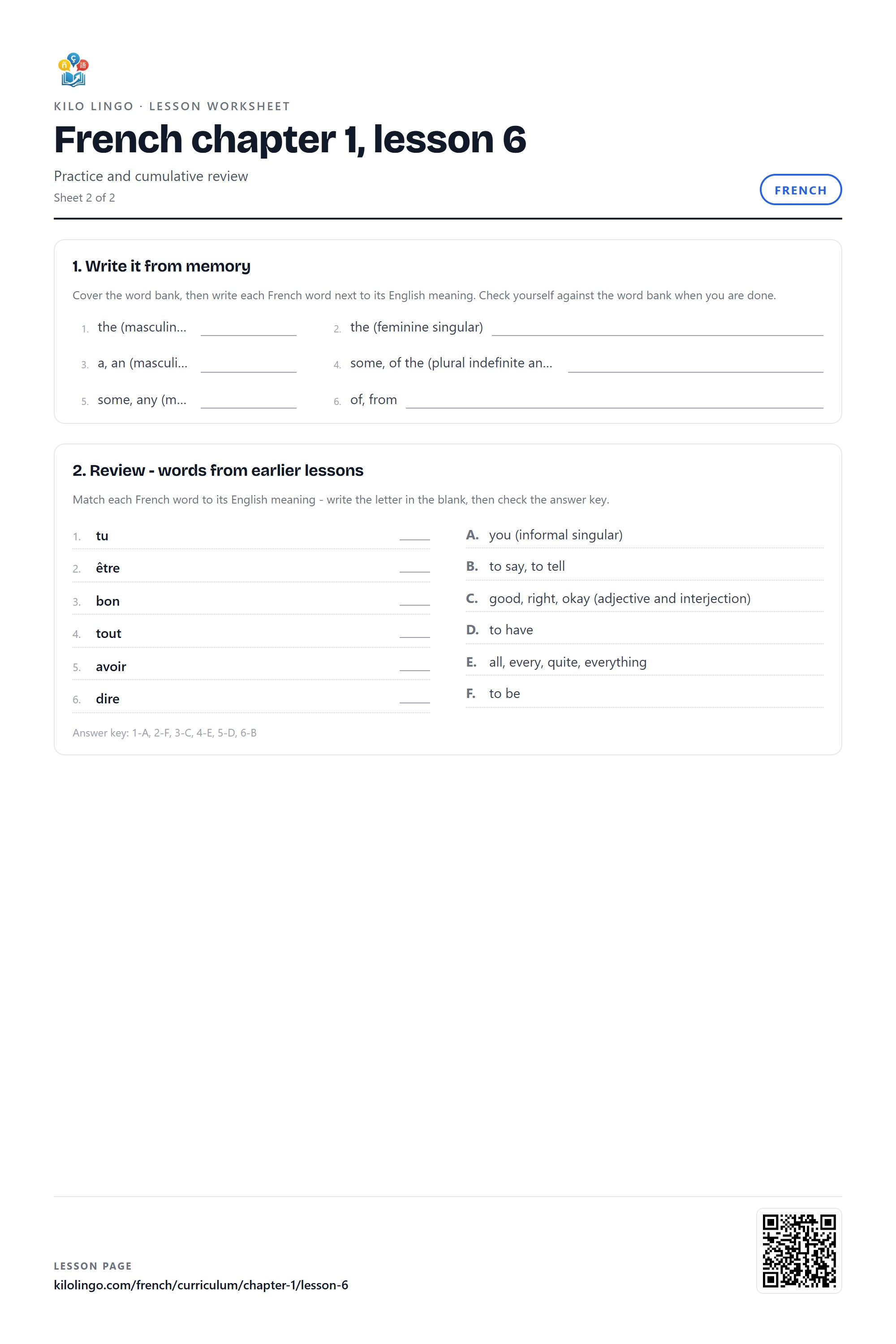
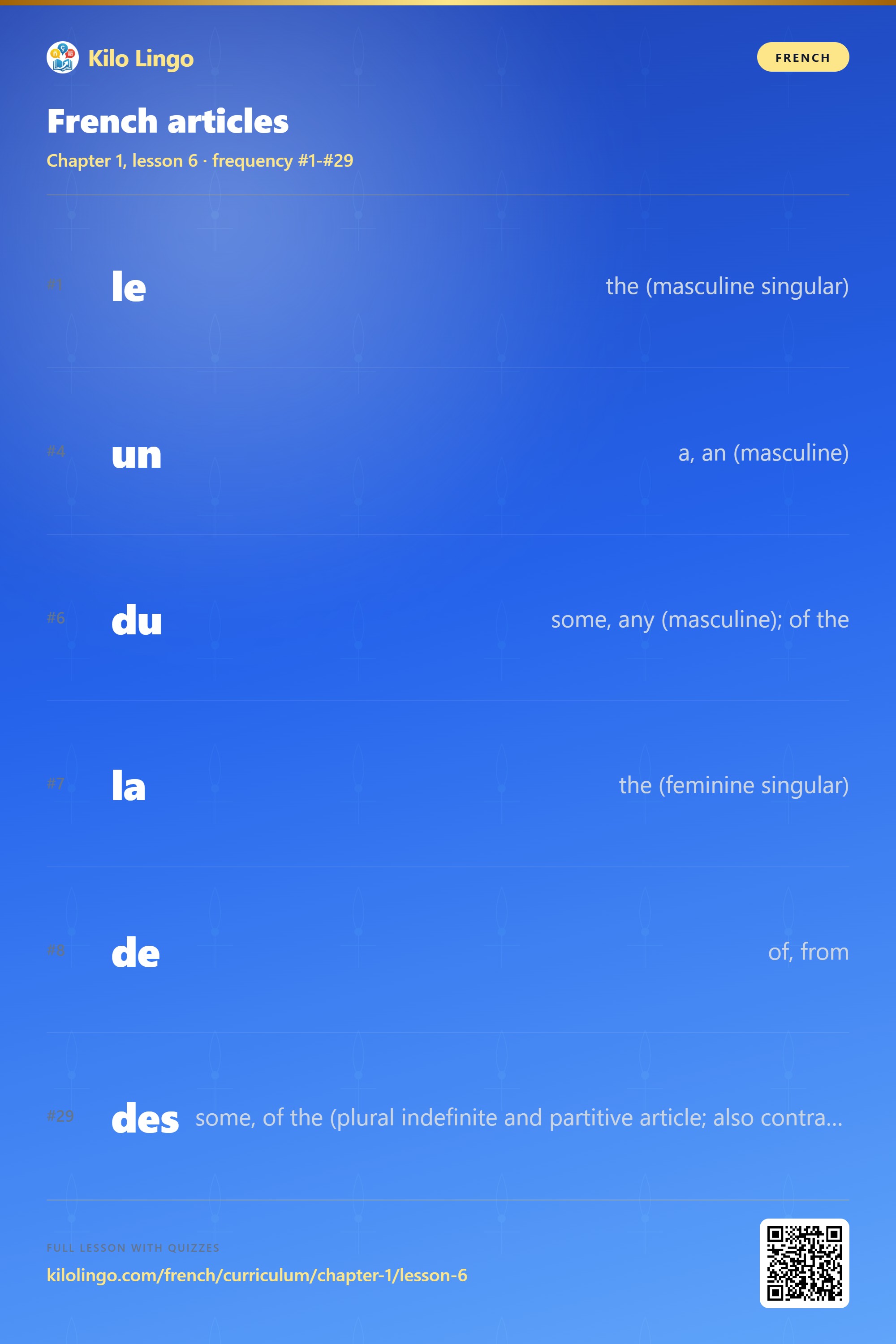
6 words · The definite, indefinite, and partitive articles in one place: le / la / un / des / du / de. The next lesson covers when to use which, including the partitive that English doesn't have.
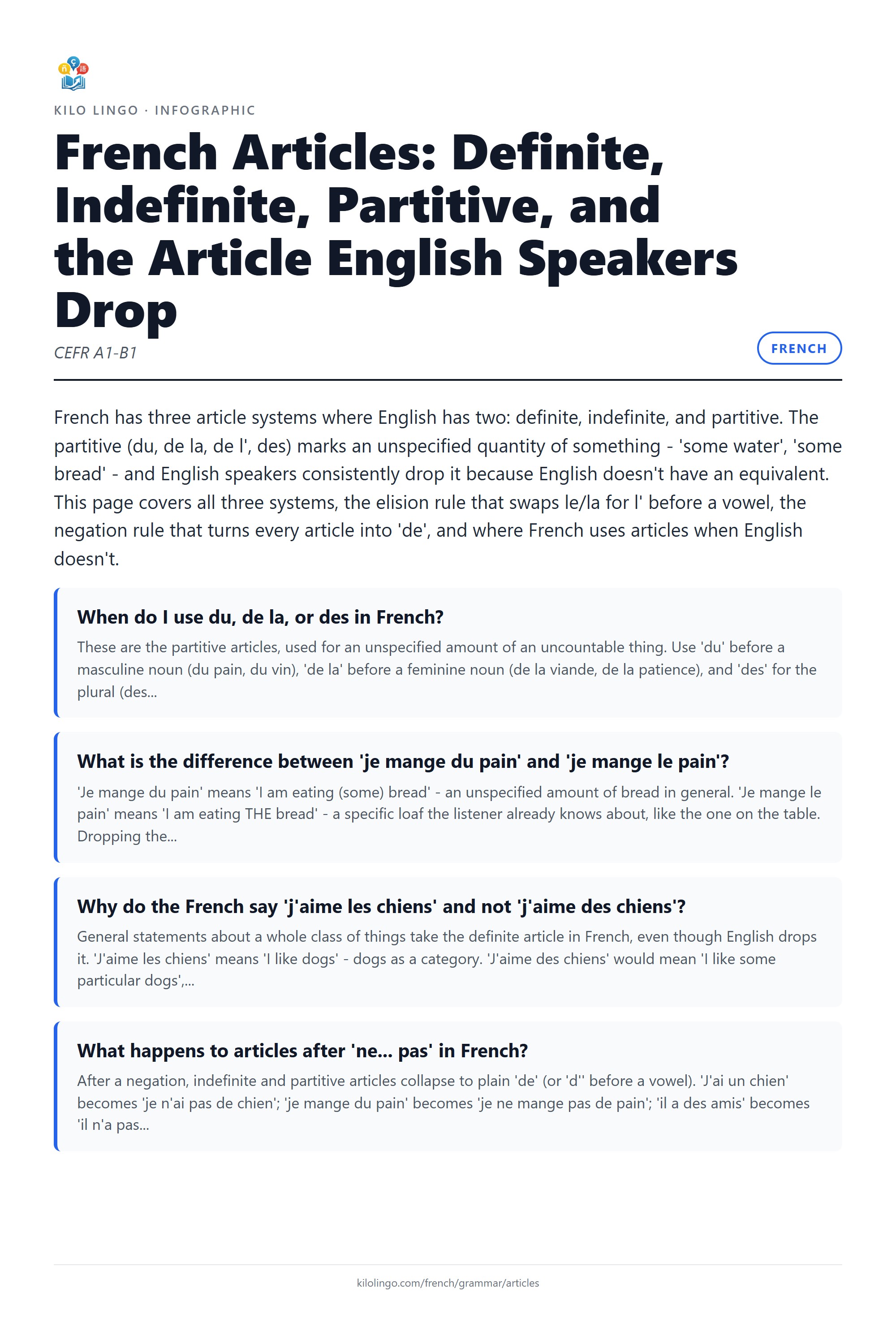
Definite vs indefinite vs partitive - including du / de la / des, the article English speakers consistently drop and shouldn't. Plus the elision rules (l'eau, d'un) that make the difference between French that sounds native and French that sounds wrong.
- The sounds of FrenchPronunciation
The r, the u, and the nasals - the four sounds that make French sound French, with the mouth shown from the inside.
A dozen fixed everyday phrases - bonjour, merci, je m'appelle - so you can greet a real French speaker before you have learned any grammar.
- Arcade reviewReview games
Replay this chapter's words as games - a different kind of repetition, and it counts.
Word printables
Per-word sheets23 words · a worksheet, infographic and listicle each



Chapter 2 · tu or vous?
Chapter page →- Word Bubbles review sessionReview games
Pop the words you just met by matching each one to its meaning. A couple of rounds and the batch is yours.
- Conjugation Sprint review sessionReview games
Sixty seconds on the endings of the verbs this chapter has drilled so far.
- tu or vous?Mistake clinic
Not a grammar question. Getting it wrong is a social mistake, not a linguistic one.
- Word Bubbles review sessionReview games
Pop the words you just met by matching each one to its meaning. A couple of rounds and the batch is yours.
- Noun gender: le or laGrammar
Why every noun is le or la, and the endings that give it away.
- Conjugation Sprint review sessionReview games
Sixty seconds on the endings of the verbs this chapter has drilled so far.
- Word Bubbles review sessionReview games
Pop the words you just met by matching each one to its meaning. A couple of rounds and the batch is yours.
- Conjugation Sprint review sessionReview games
Sixty seconds on the endings of the verbs this chapter has drilled so far.
- Word Bubbles review sessionReview games
Pop the words you just met by matching each one to its meaning. A couple of rounds and the batch is yours.
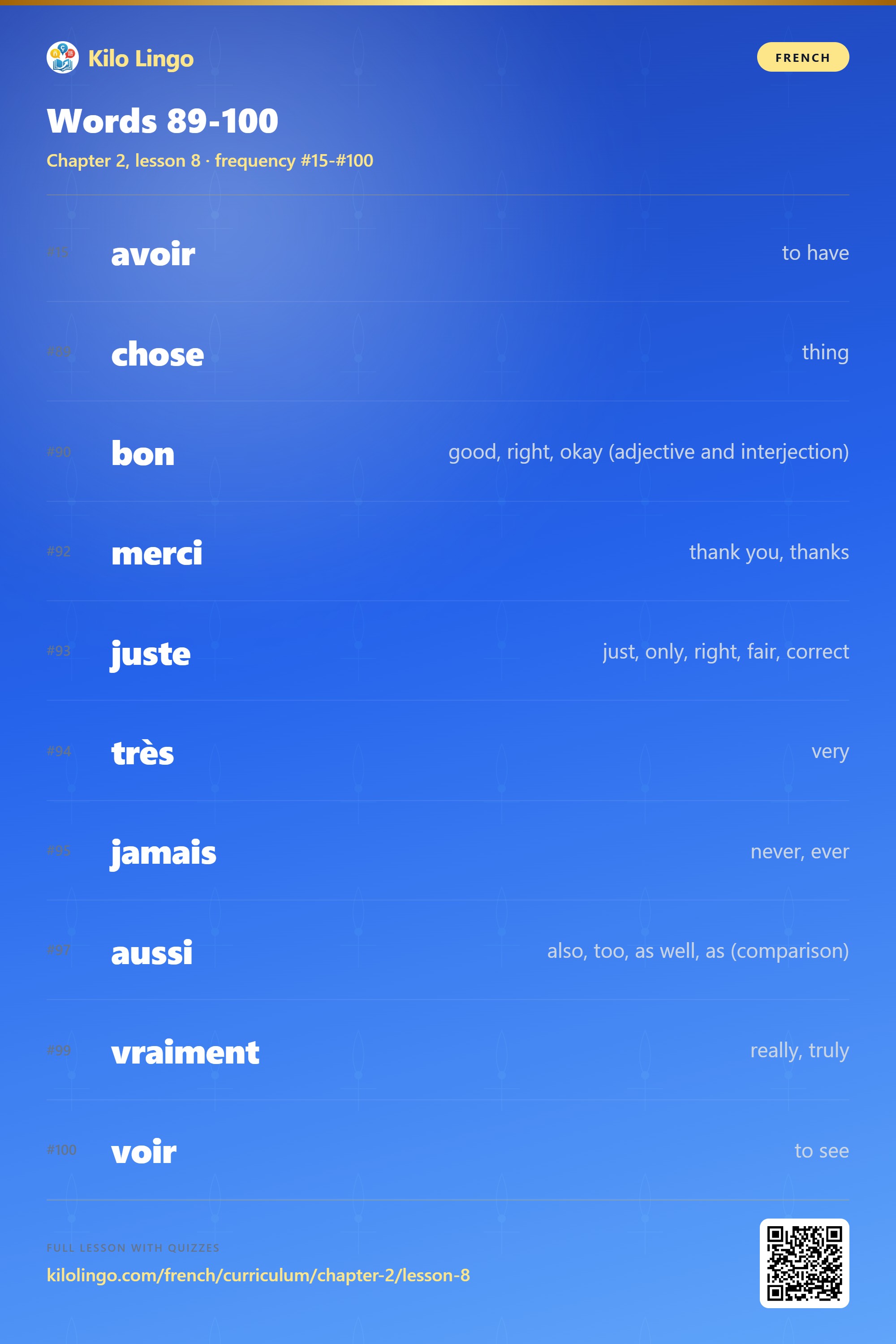
- Words 91-100Vocabulary
10 words · ranks 91-100
Add -s, say nothing - le/les and un/des carry the plural in speech.
- Story milestone: top 100 wordsGraded-reader story
You can read this story using only the words you've learned so far. Every content word sits at or above the rank-100 ceiling.
- The words you already knowGrammar
English took a third of its vocabulary from French. Six ending swaps hand most of it back.
- The pronoun house: who does whatVocabulary
9 words · All nine subject pronouns in one place - je to elles. Frequency scatters them; this house keeps the whole set together.
Matching this and that to gender, number and the vowel rule - the agreement drill, hands-on, before the forms fossilise wrong.
Learn the everyday French your textbook skips - mec, meuf, ouf, relou - and crack the verlan code behind it.
Forty members - 'les immortels' - have guarded French since 1635, and they publish the official dictionary. Look up a word you already know.
The worldwide network of French classes and culture, in over 130 countries - there is almost certainly one near you. Go and see.
- The KiloKombat dojoLesson
Learn 10 new words faster than a rival. Spar the training partner to earn your grams, then challenge a real person - winner takes a tooth.
- Arcade reviewReview games
Replay this chapter's words as games - a different kind of repetition, and it counts.
Word printables
Per-word sheets78 words · a worksheet, infographic and listicle each

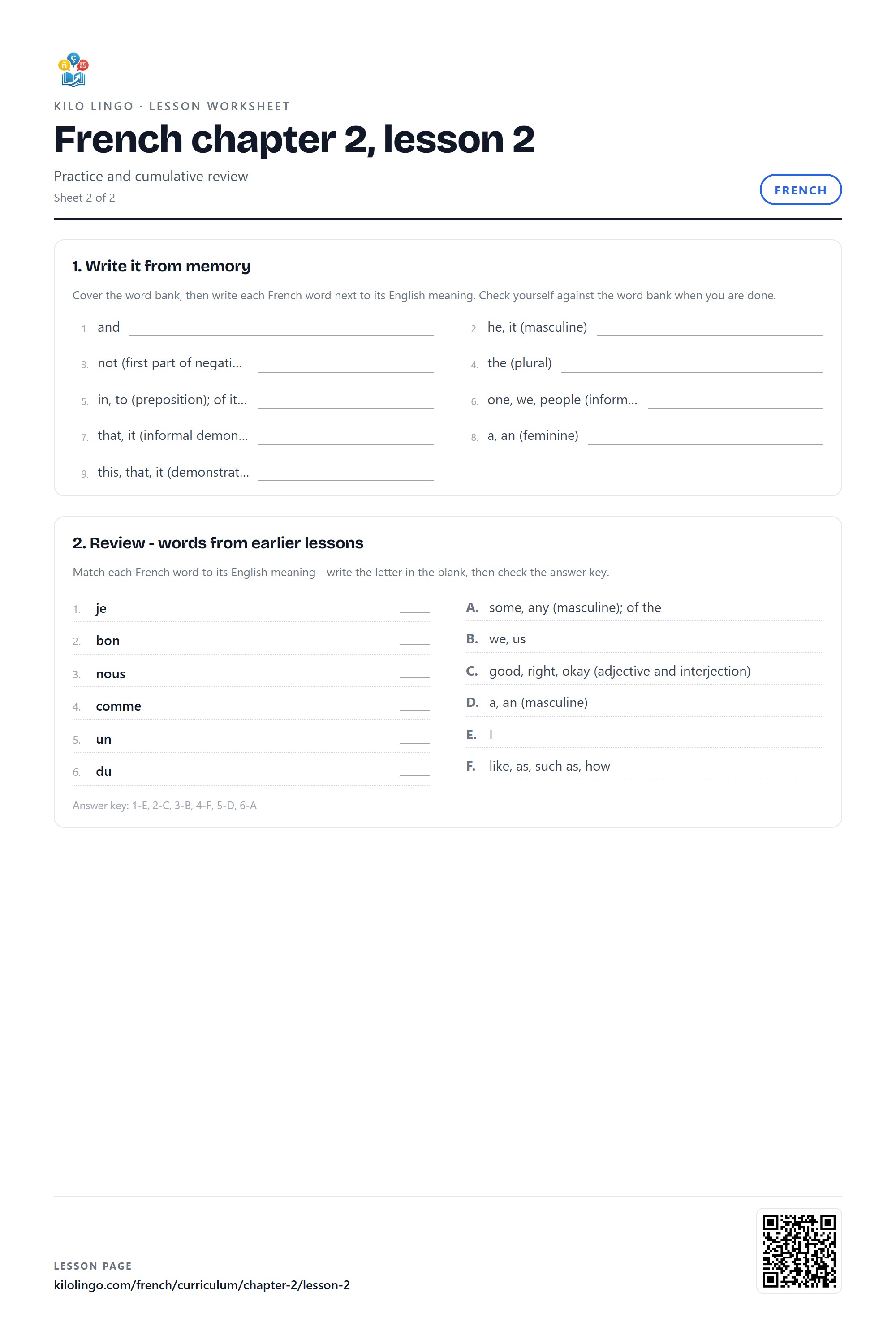

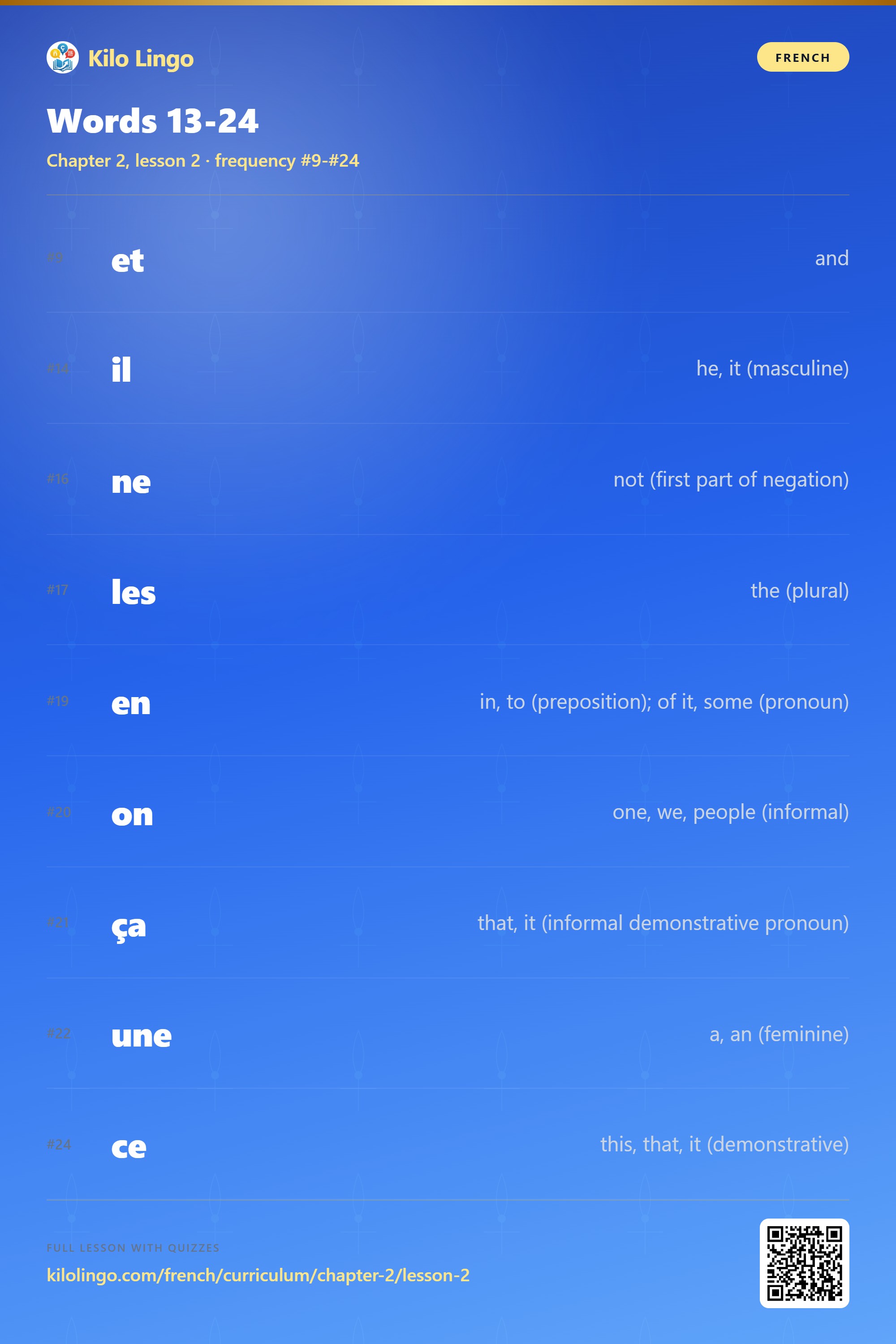
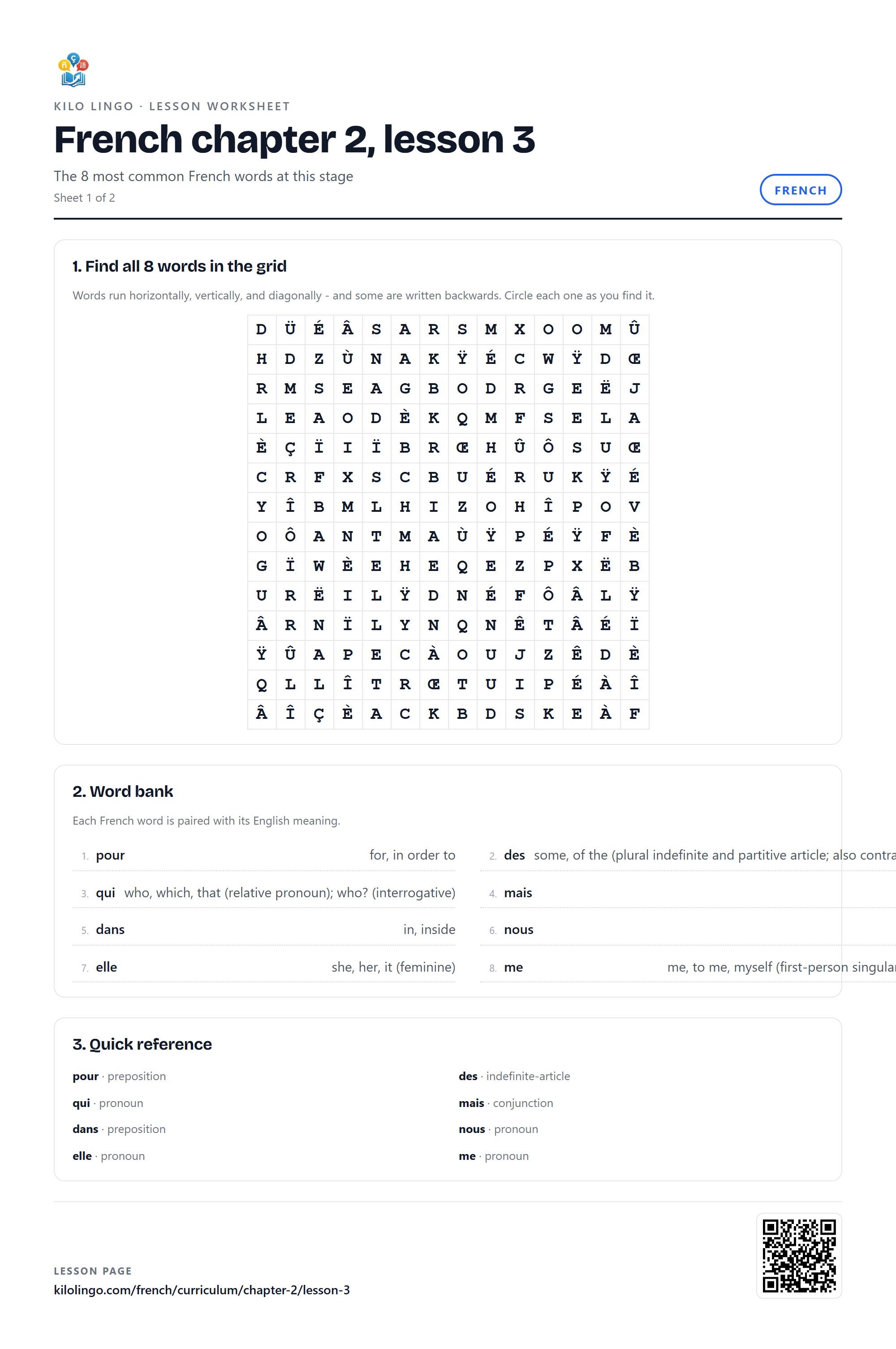
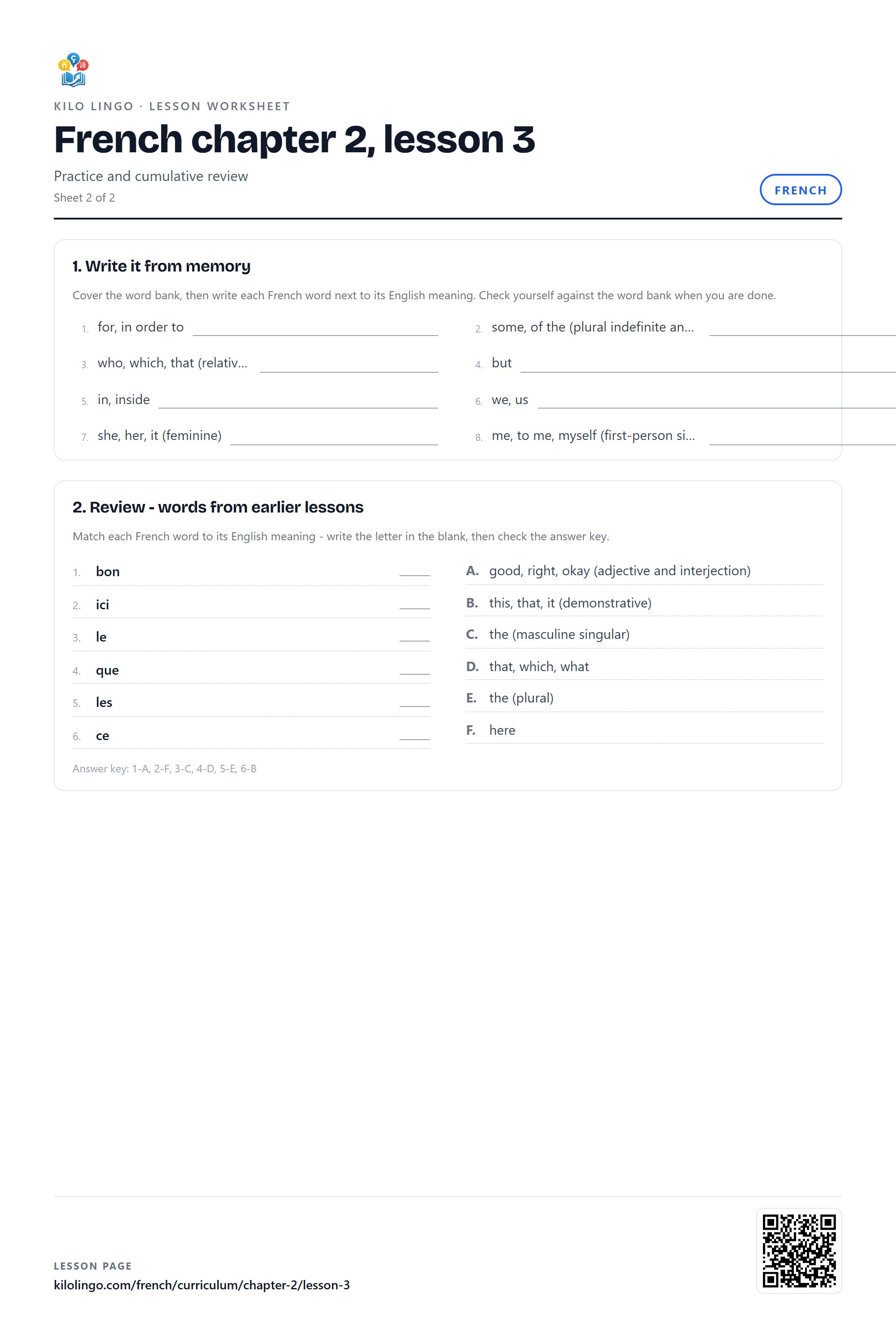

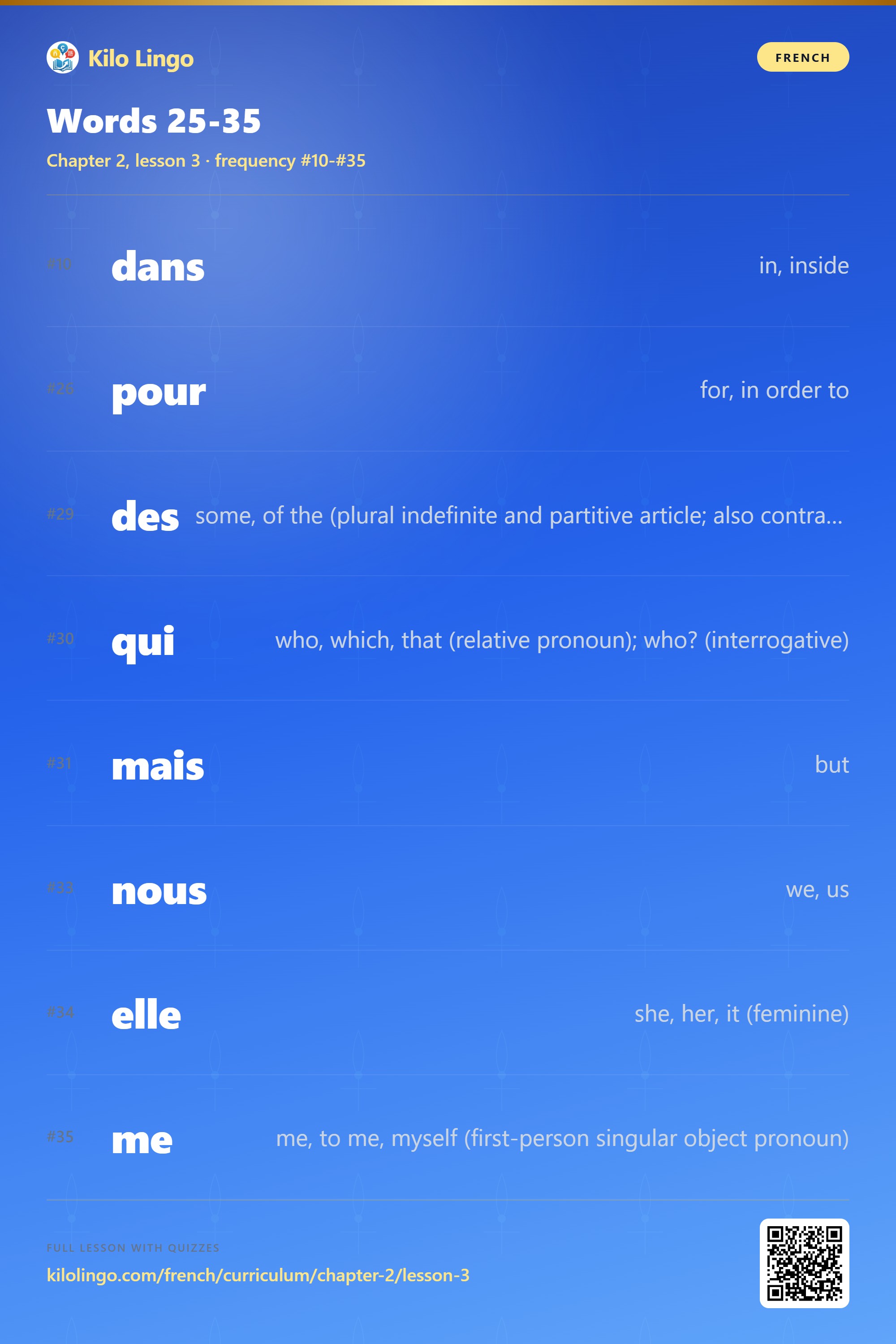
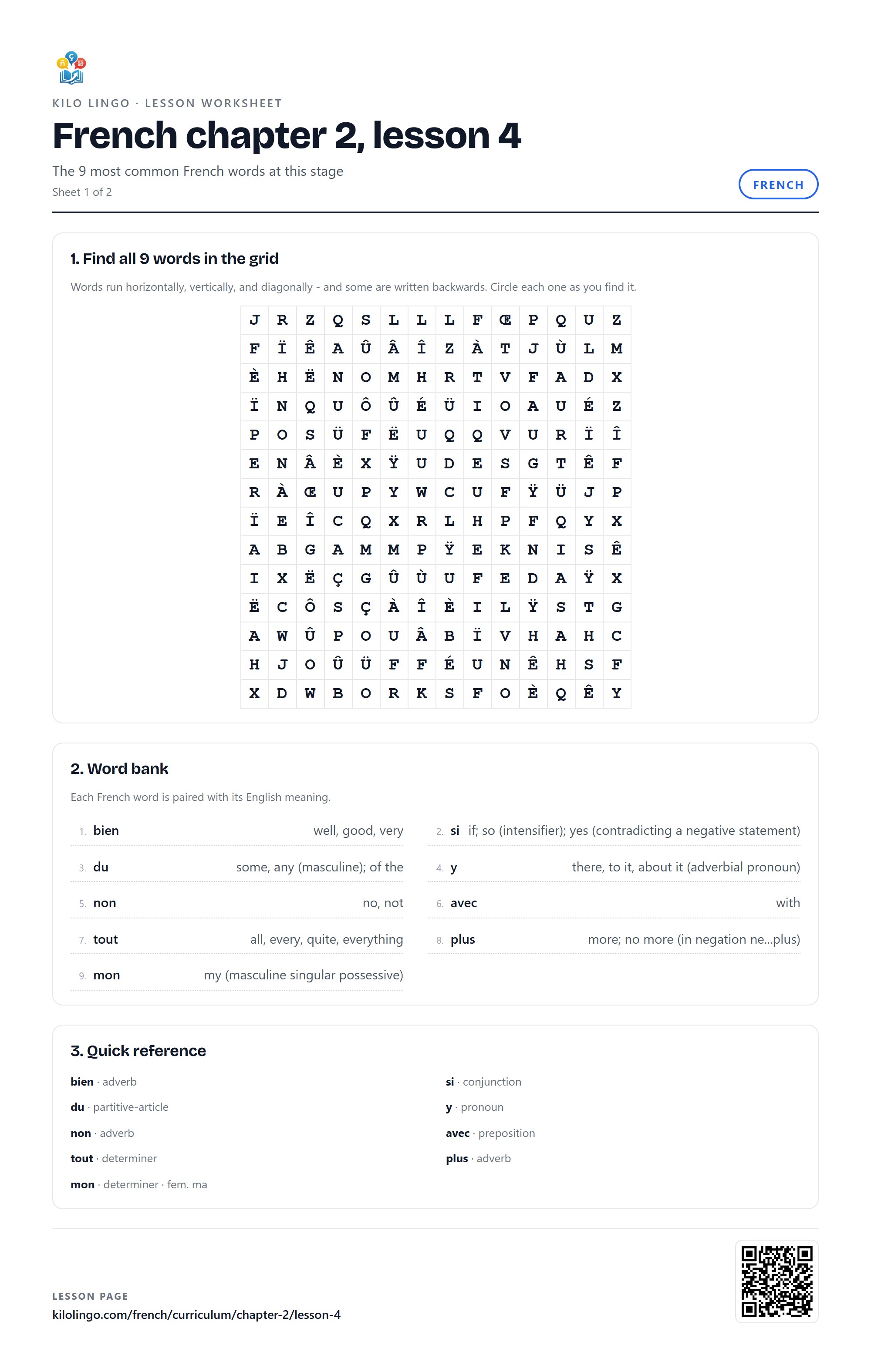
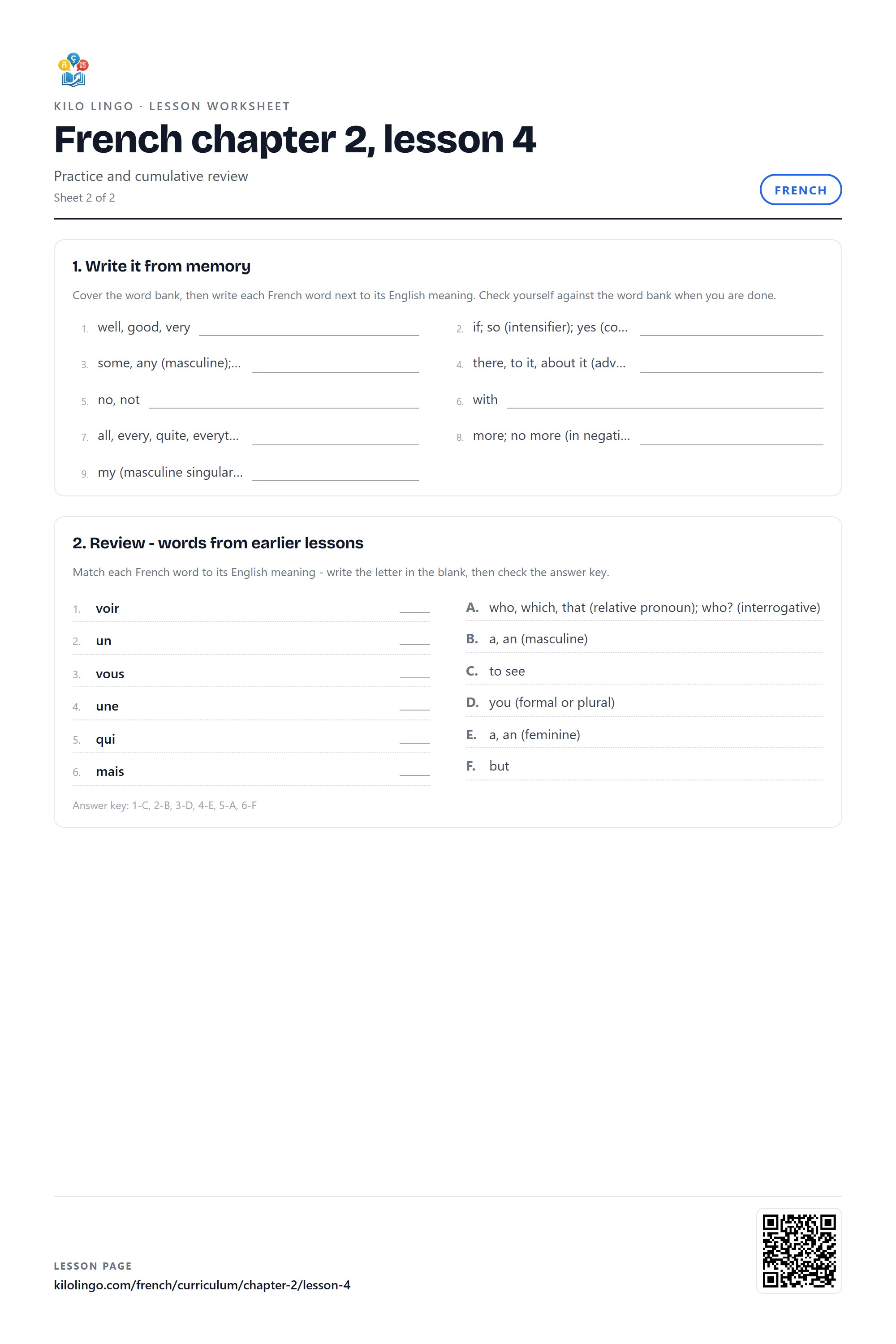

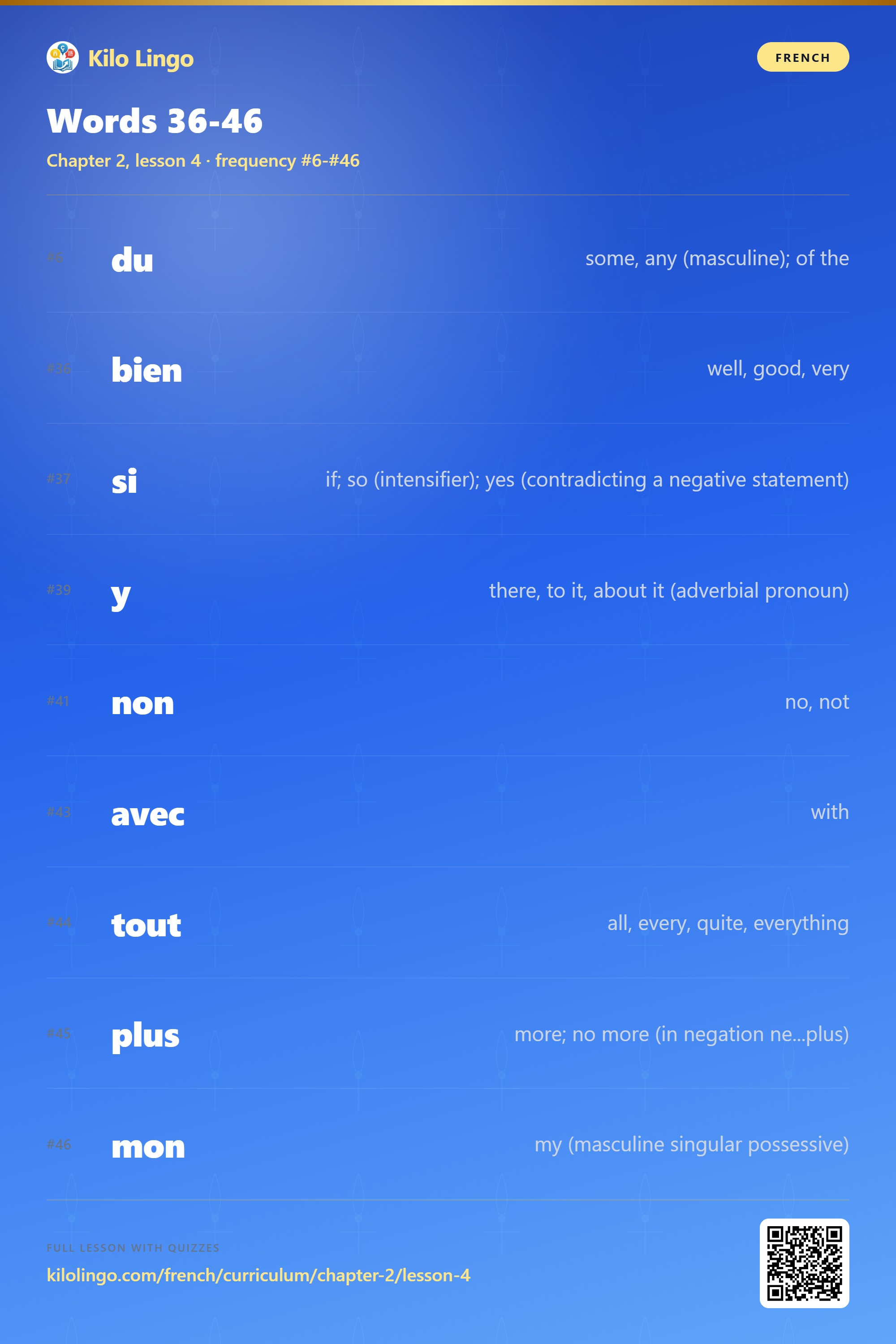
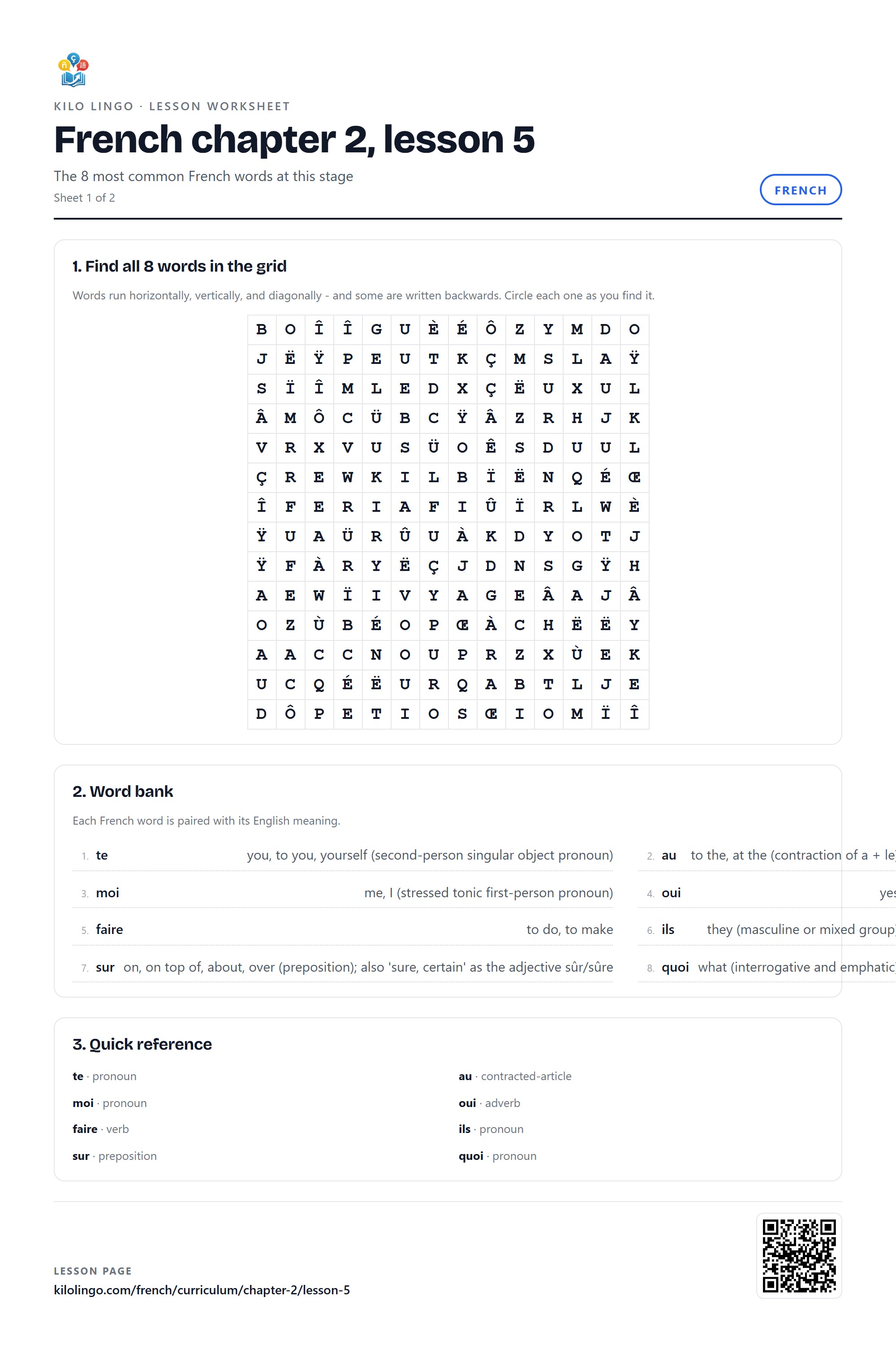
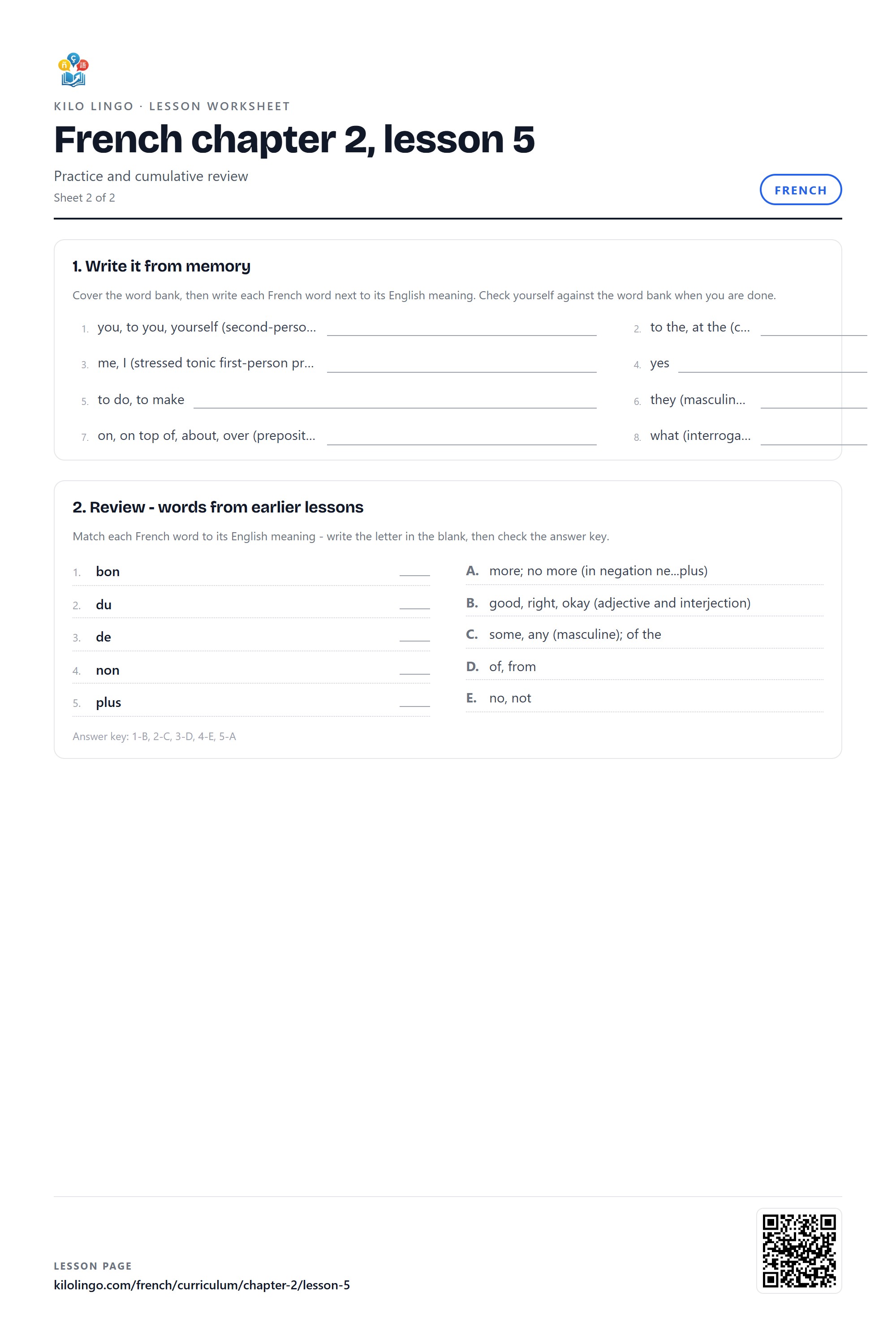

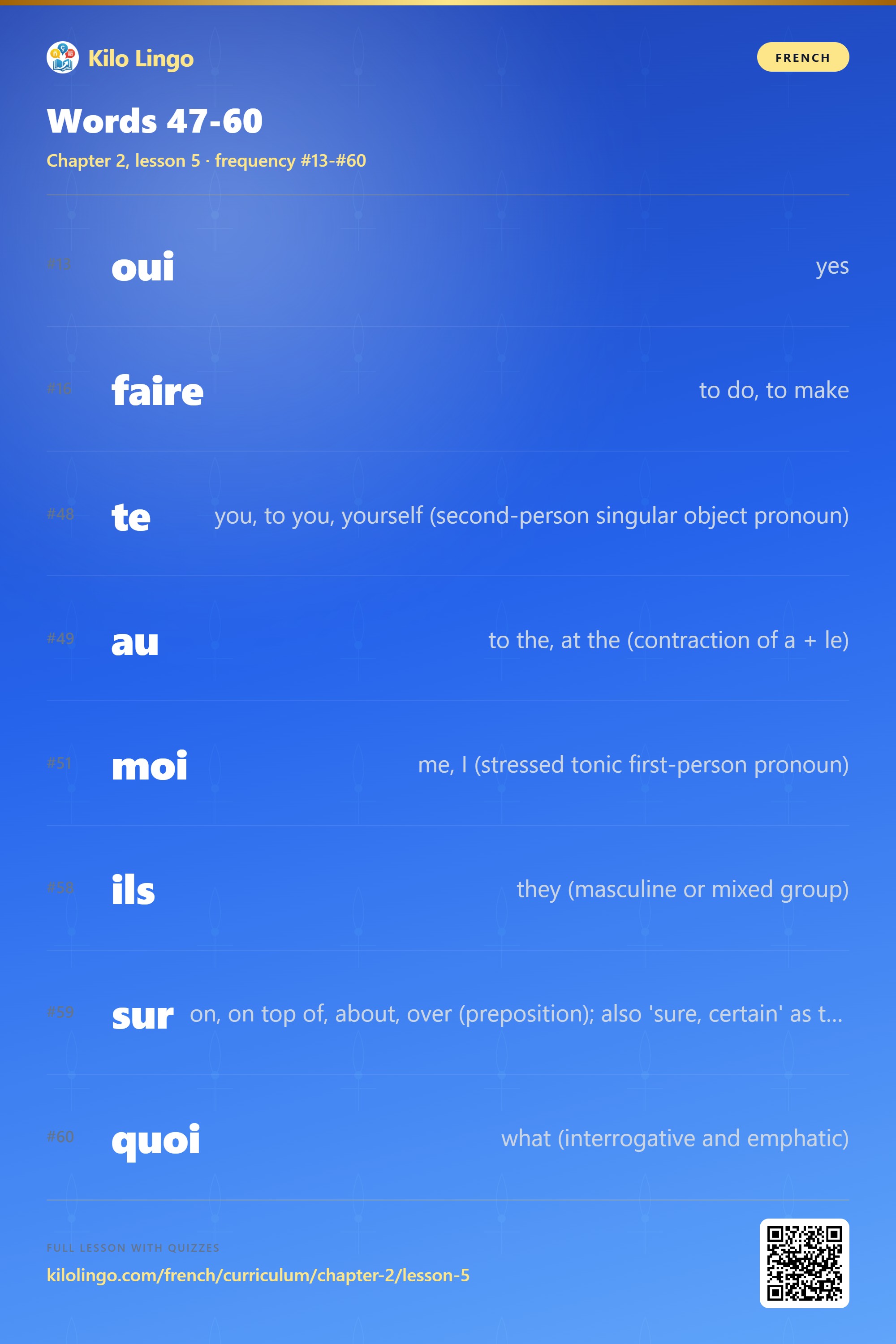
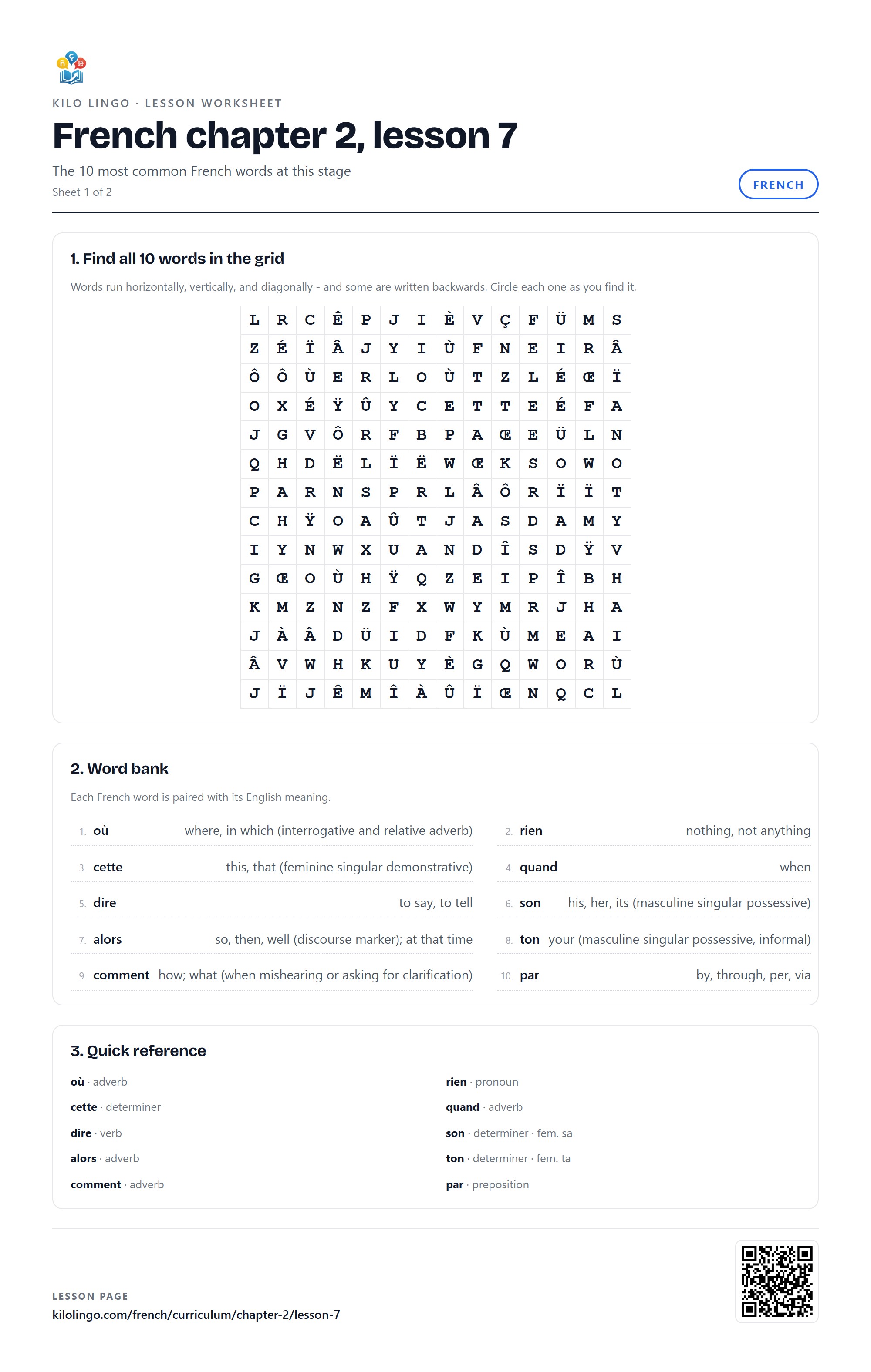




Chapter 3 · -er verbs
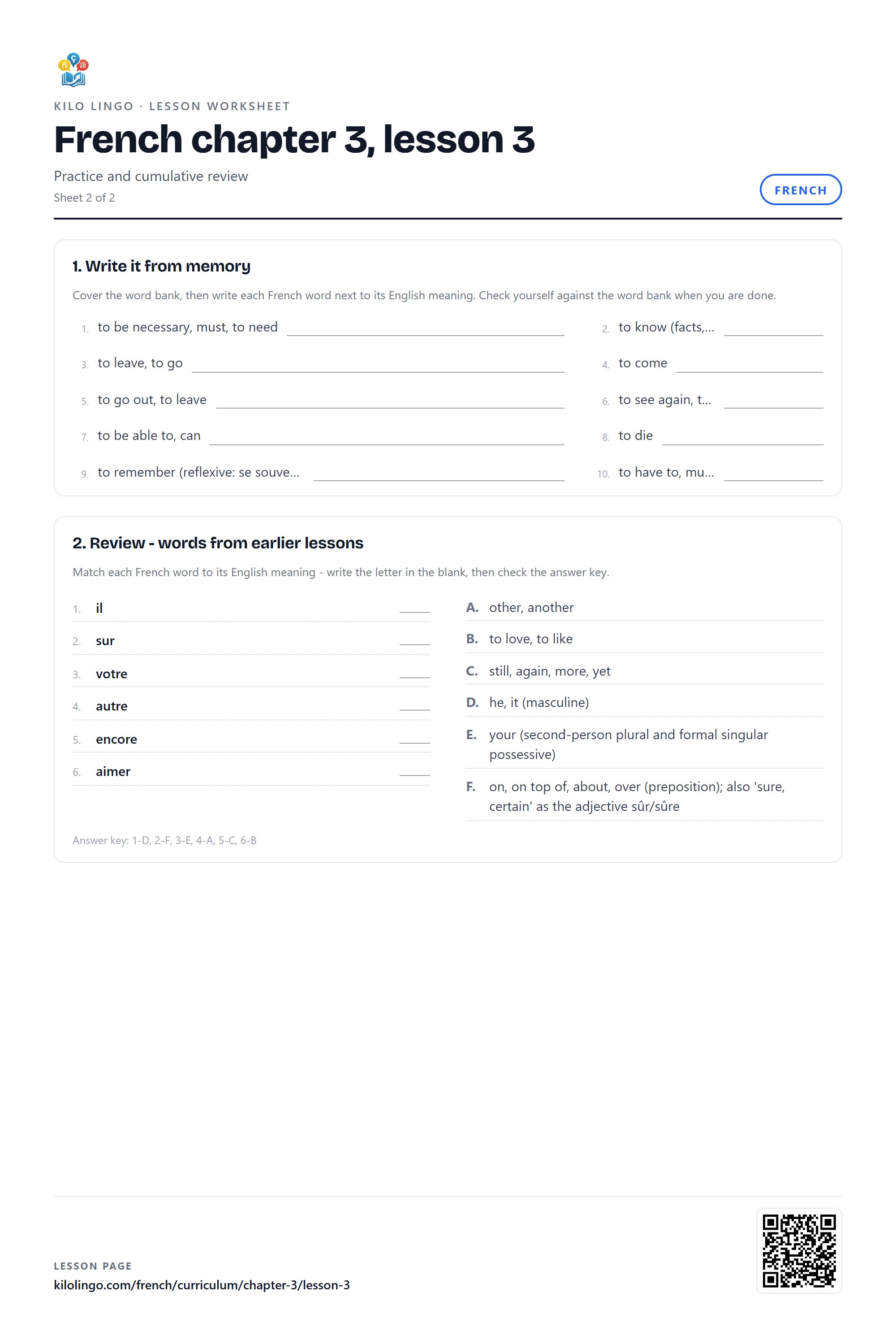
Chapter page →- -er verbsVocabulary
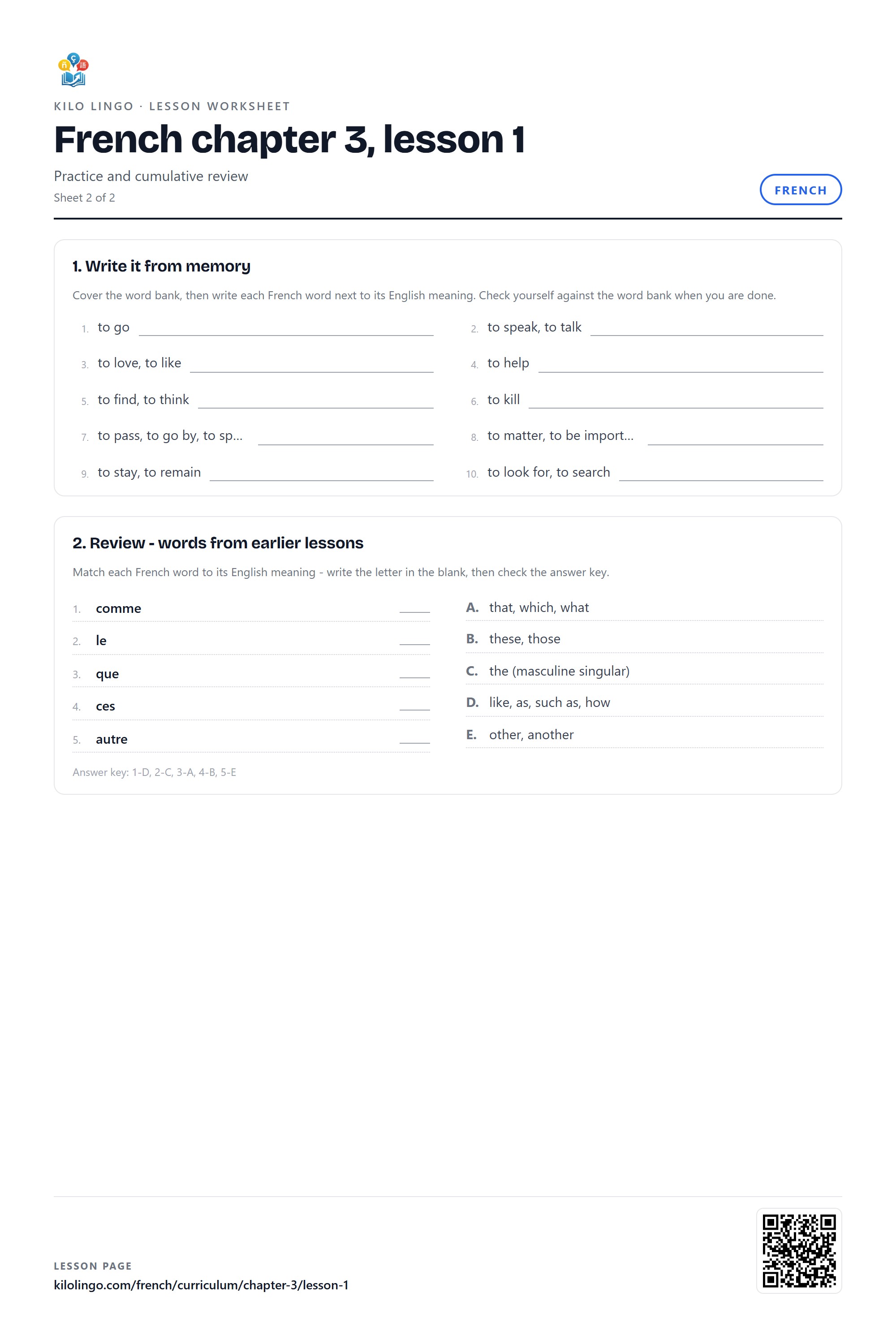
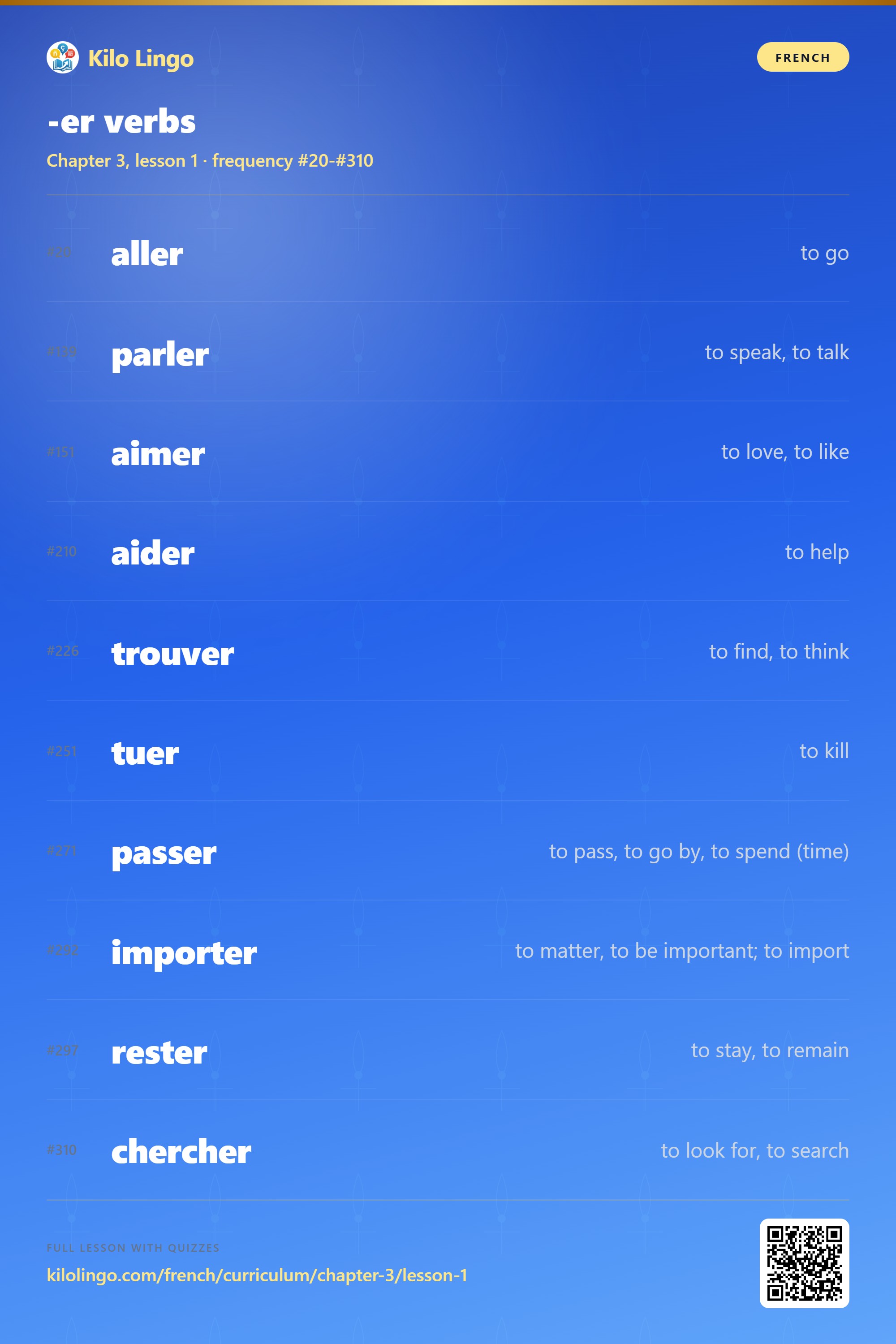
10 words · Memorise these 10 verb infinitives. The next lesson covers how to conjugate them.
- Conjugating -er verbsGrammar
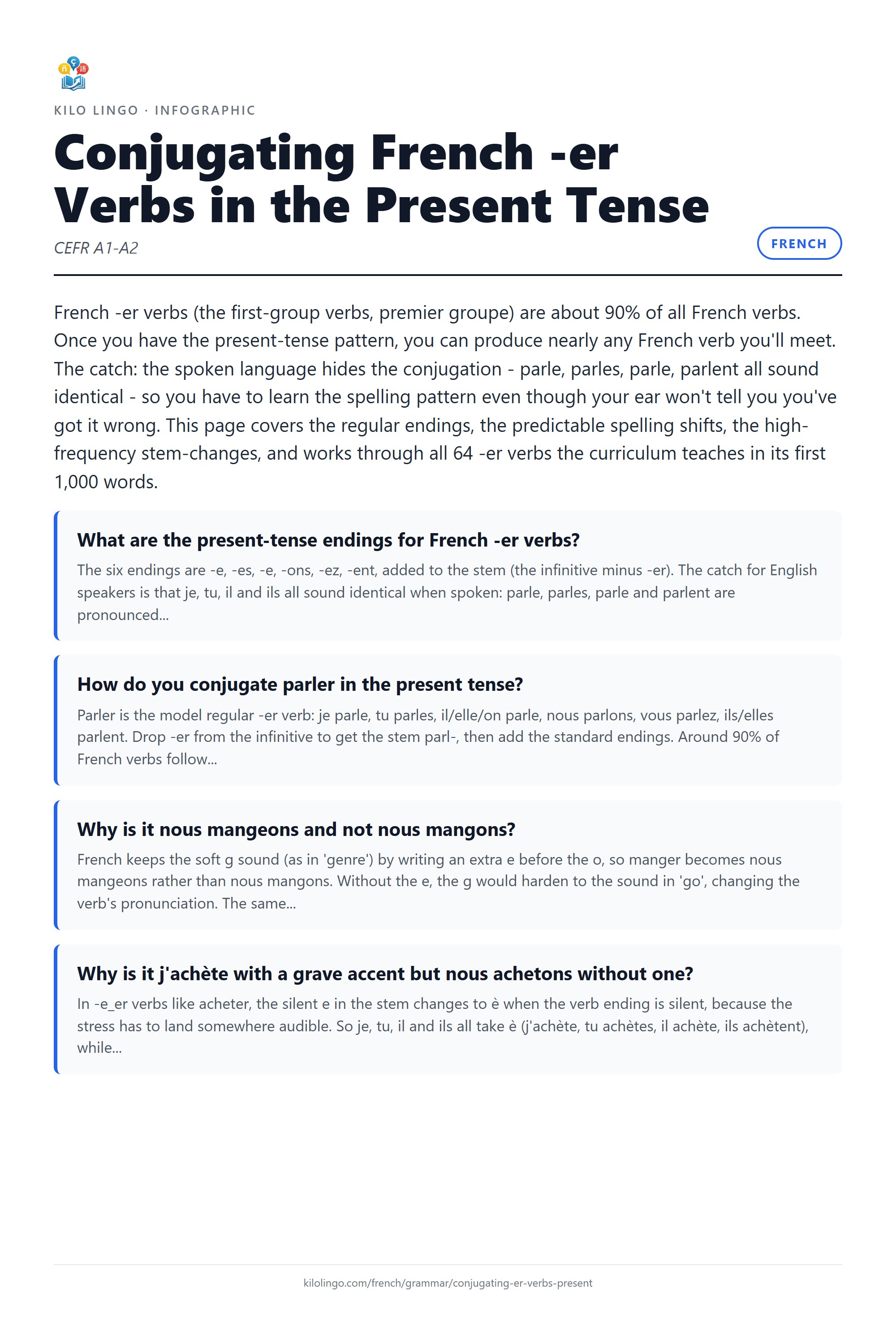
Present-tense conjugation for the verbs you just learned, with a worksheet to drill the endings.
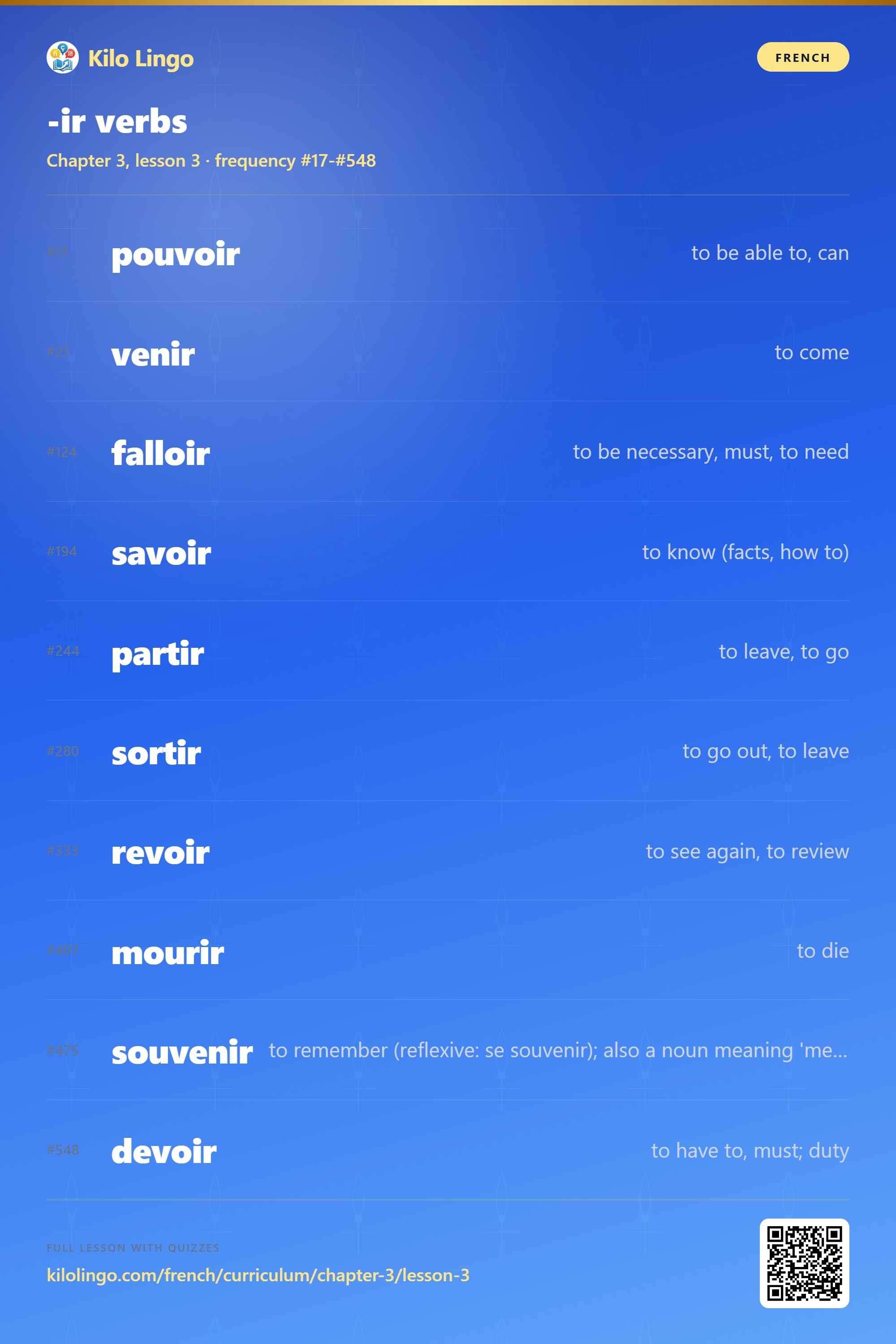
- -ir verbsVocabulary
10 words · Memorise these 10 verb infinitives. The next lesson covers how to conjugate them.
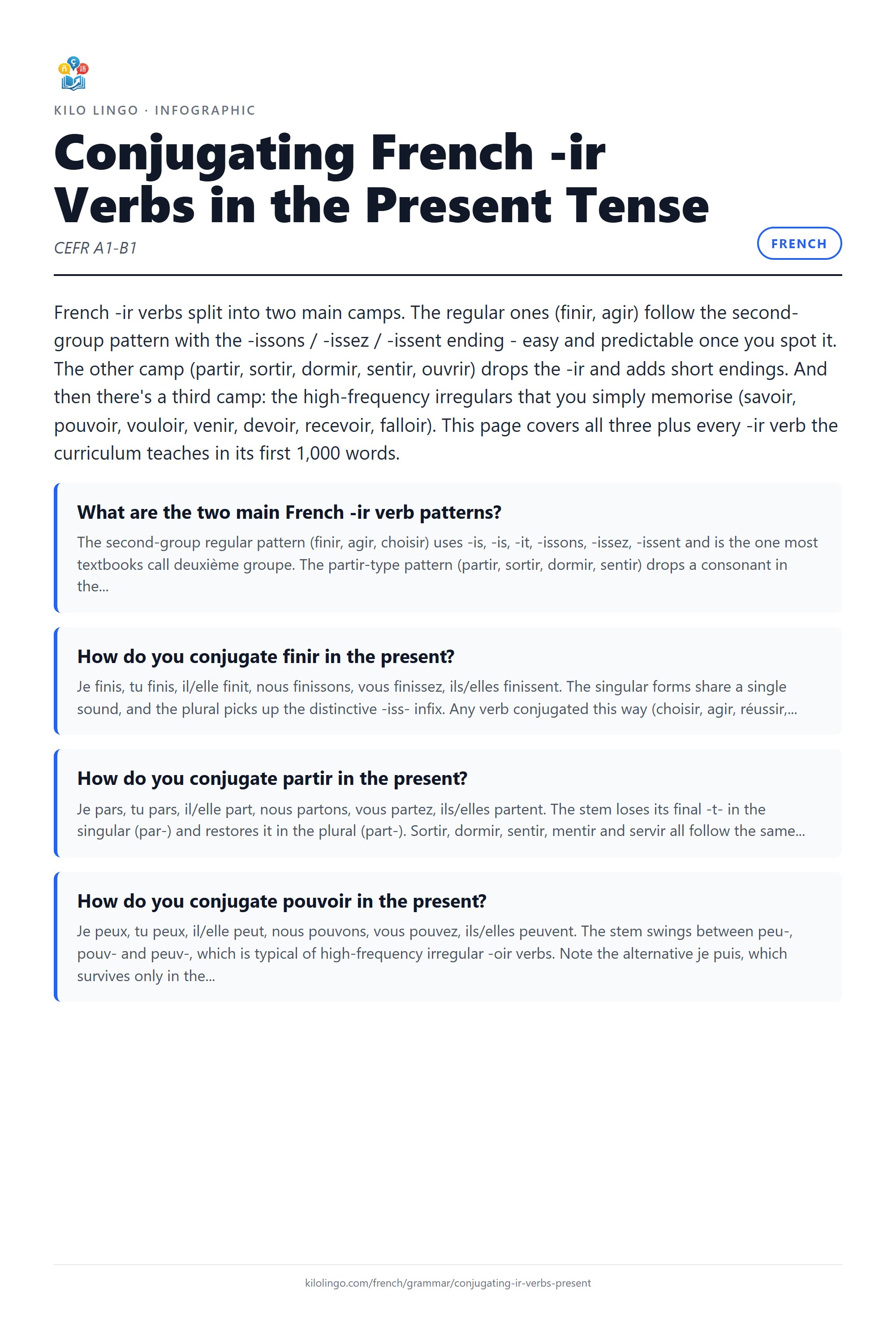
- Conjugating -ir verbsGrammar
Present-tense conjugation for the verbs you just learned, with a worksheet to drill the endings.
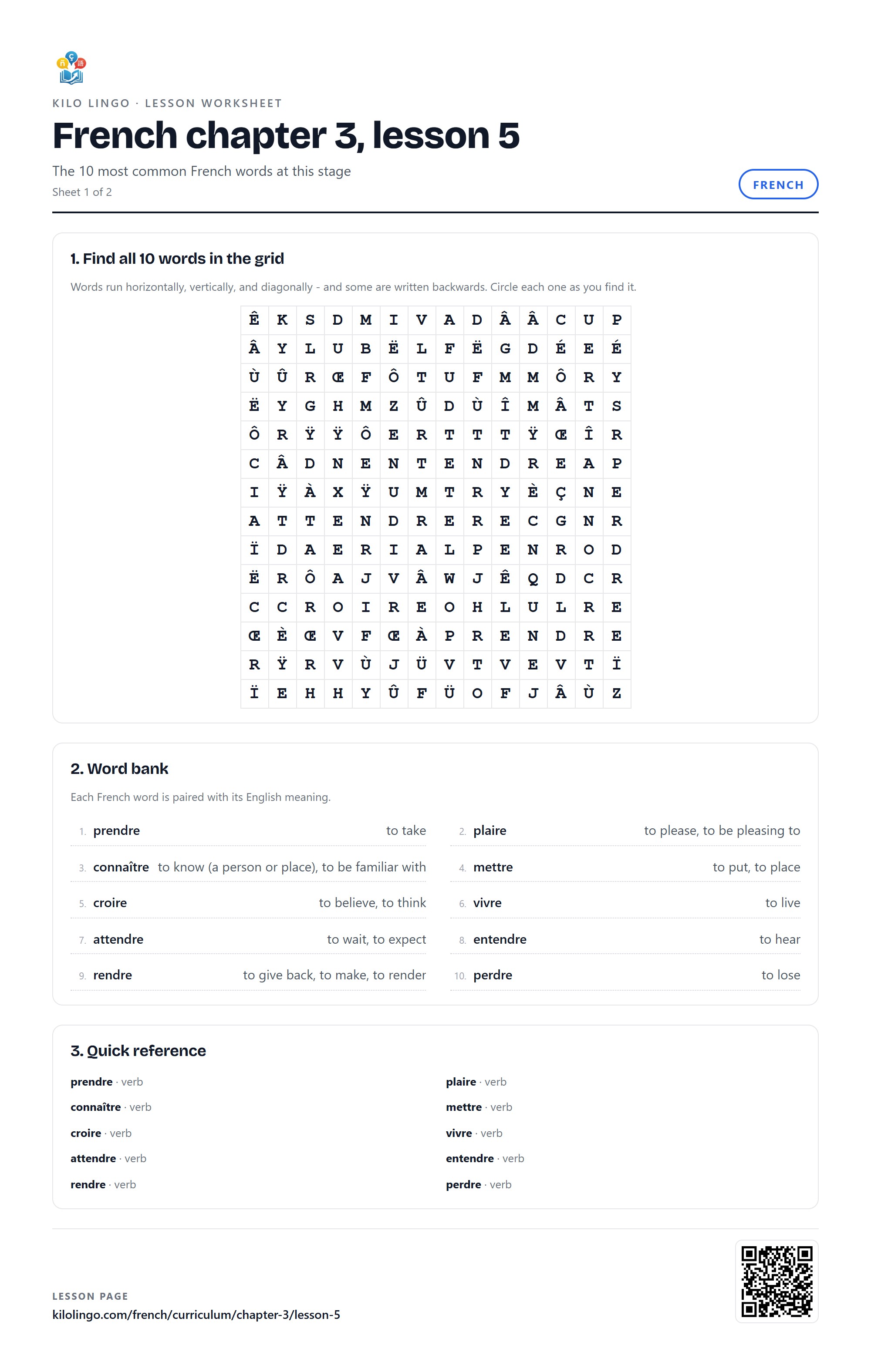
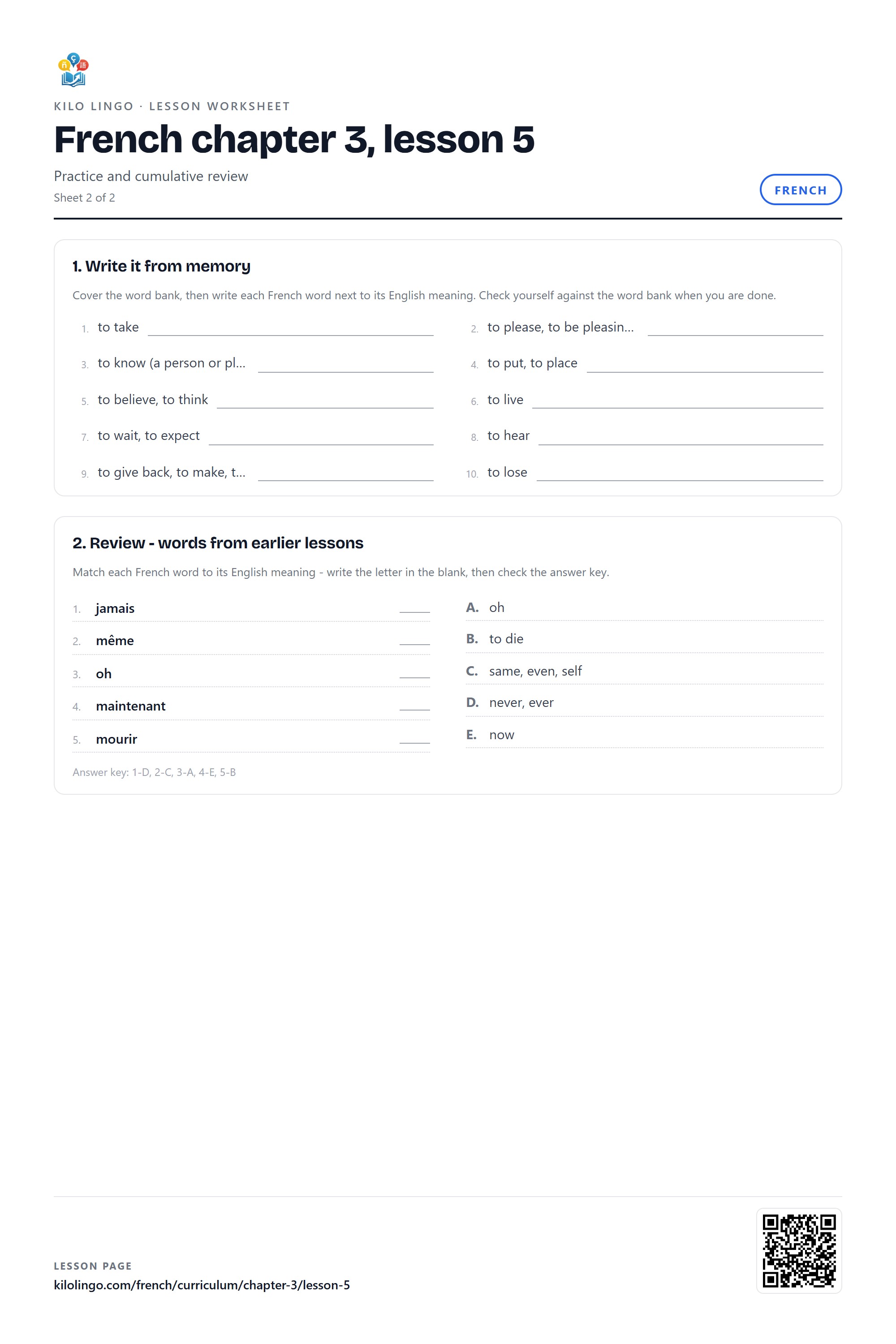
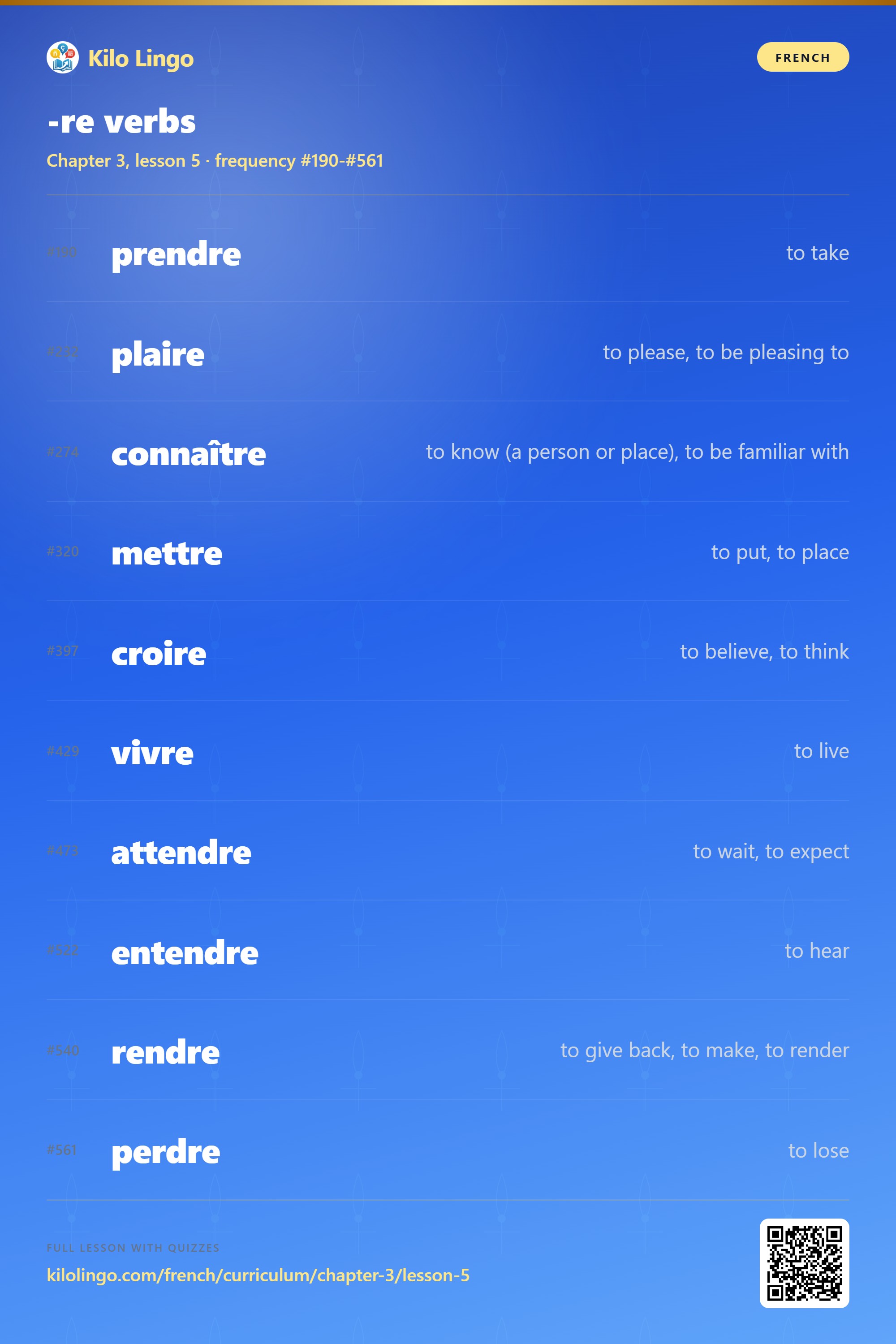
- -re verbsVocabulary
10 words · Memorise these 10 verb infinitives. The next lesson covers how to conjugate them.
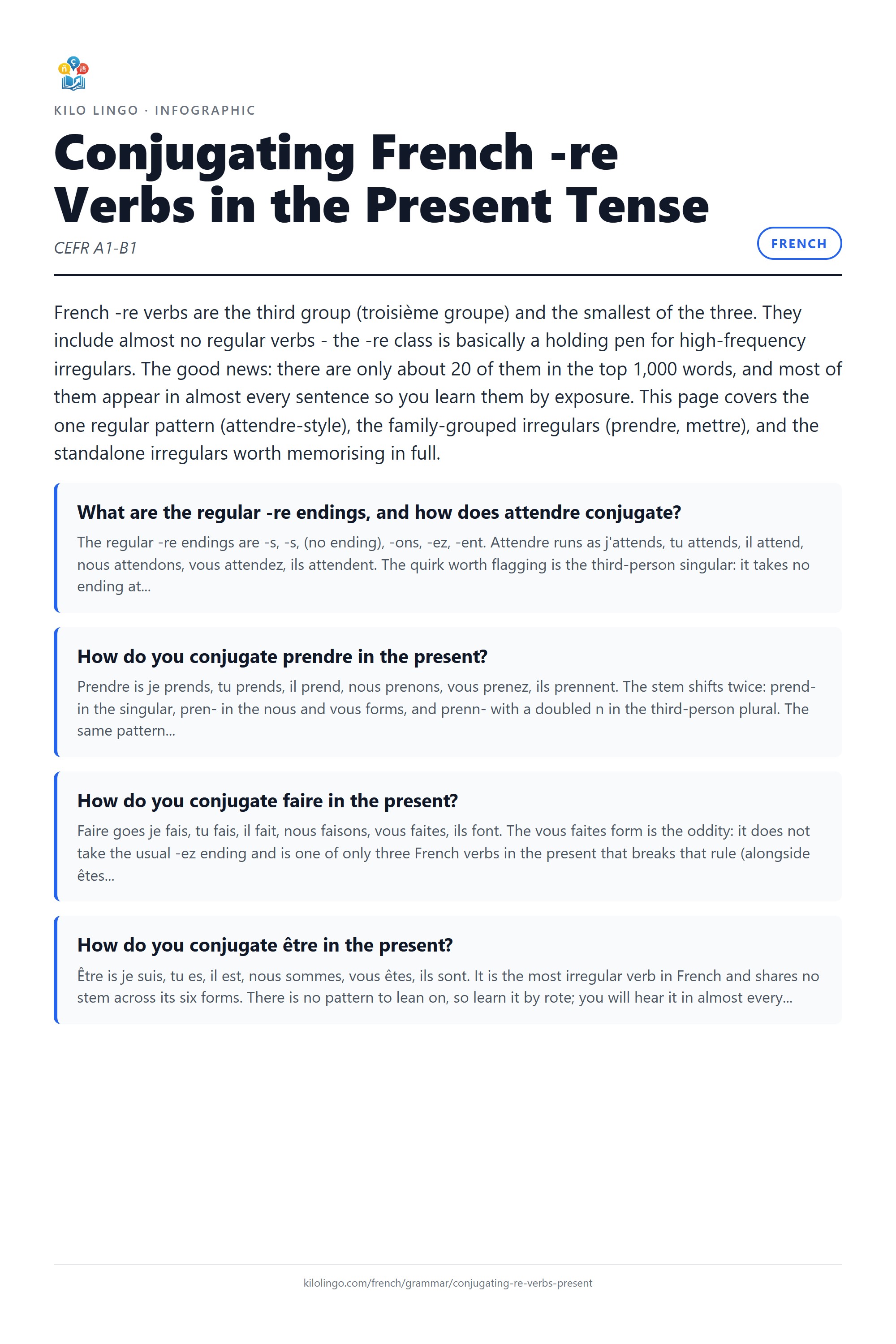
- Conjugating -re verbsGrammar
Present-tense conjugation for the verbs you just learned, with a worksheet to drill the endings.
- bon or bien?Mistake clinic
One describes a thing. The other describes how it goes.
- Arcade reviewReview games
Replay this chapter's words as games - a different kind of repetition, and it counts.
Word printables
Per-word sheets18 words · a worksheet, infographic and listicle each



Chapter 4 · Demonstratives: ce, cet, cette, ces
Chapter page →- Words 101-111Vocabulary
10 words · ranks 101-111
- Word Bubbles review sessionReview games
Pop the words you just met by matching each one to its meaning. A couple of rounds and the batch is yours.
- Words 112-123Vocabulary
10 words · ranks 112-123
- Conjugation Sprint review sessionReview games
Sixty seconds on the endings of the verbs this chapter has drilled so far.
- Words 124-134Vocabulary
10 words · ranks 124-134
This / that / these / those in French. The four forms, the cet-before-vowel rule, and the -ci / -la distinction for near vs far.
- Words 135-146Vocabulary
10 words · ranks 135-146
- Word Bubbles review sessionReview games
Pop the words you just met by matching each one to its meaning. A couple of rounds and the batch is yours.
- Words 147-157Vocabulary
10 words · ranks 147-157
- savoir or connaître?Mistake clinic
Both are
to know. French has no article on this, so this is where the course draws the line. - Possessive adjectivesGrammar
mon, ma, mes, ton, ta, tes, son, sa, ses, notre, nos, votre, vos, leur, leurs - and the mon-before-feminine-vowel rule English speakers miss.
- Words 159-169Vocabulary
10 words · ranks 159-169
- Conjugation Sprint review sessionReview games
Sixty seconds on the endings of the verbs this chapter has drilled so far.
- Words 171-181Vocabulary
10 words · ranks 171-181
How French wraps negation around the verb, the four core negative pairs, and the colloquial ne-drop you'll hear in spoken French.
- Merci, pardon, s'il vous plaitPhrase session
The six that cost nothing and buy more goodwill than any amount of grammar.
- Words 182-192Vocabulary
10 words · ranks 182-192
- Word Bubbles review sessionReview games
Pop the words you just met by matching each one to its meaning. A couple of rounds and the batch is yours.
- Words 194-200Vocabulary
6 words · ranks 194-200
- Story milestone: top 200 wordsGraded-reader story
You can read this story using only the words you've learned so far. Every content word sits at or above the rank-200 ceiling.
The interrogatives as a set - who, what, where, when, why and how much, and the drill that fixes which one asks what.
- Arcade reviewReview games
Replay this chapter's words as games - a different kind of repetition, and it counts.
Word printables
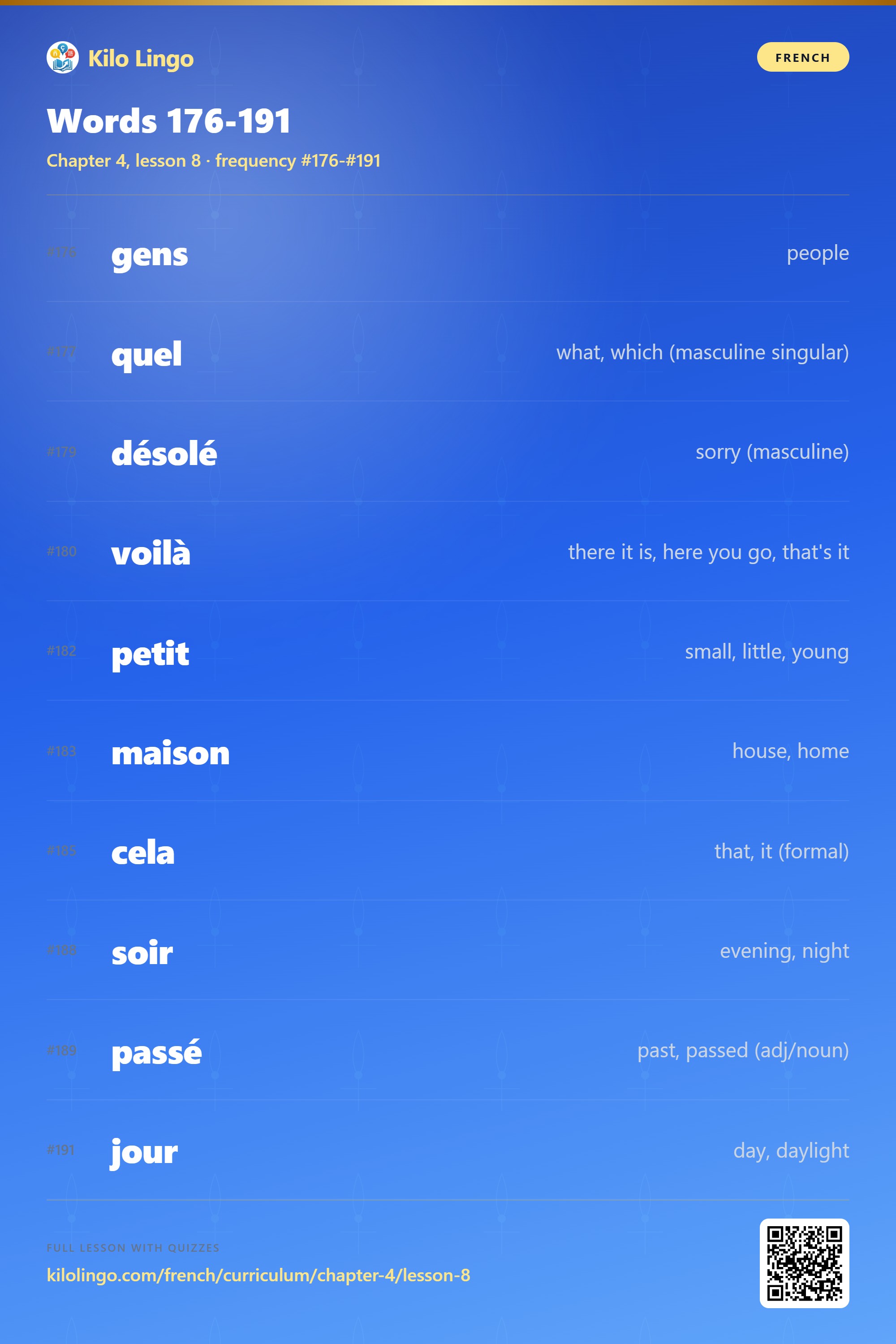
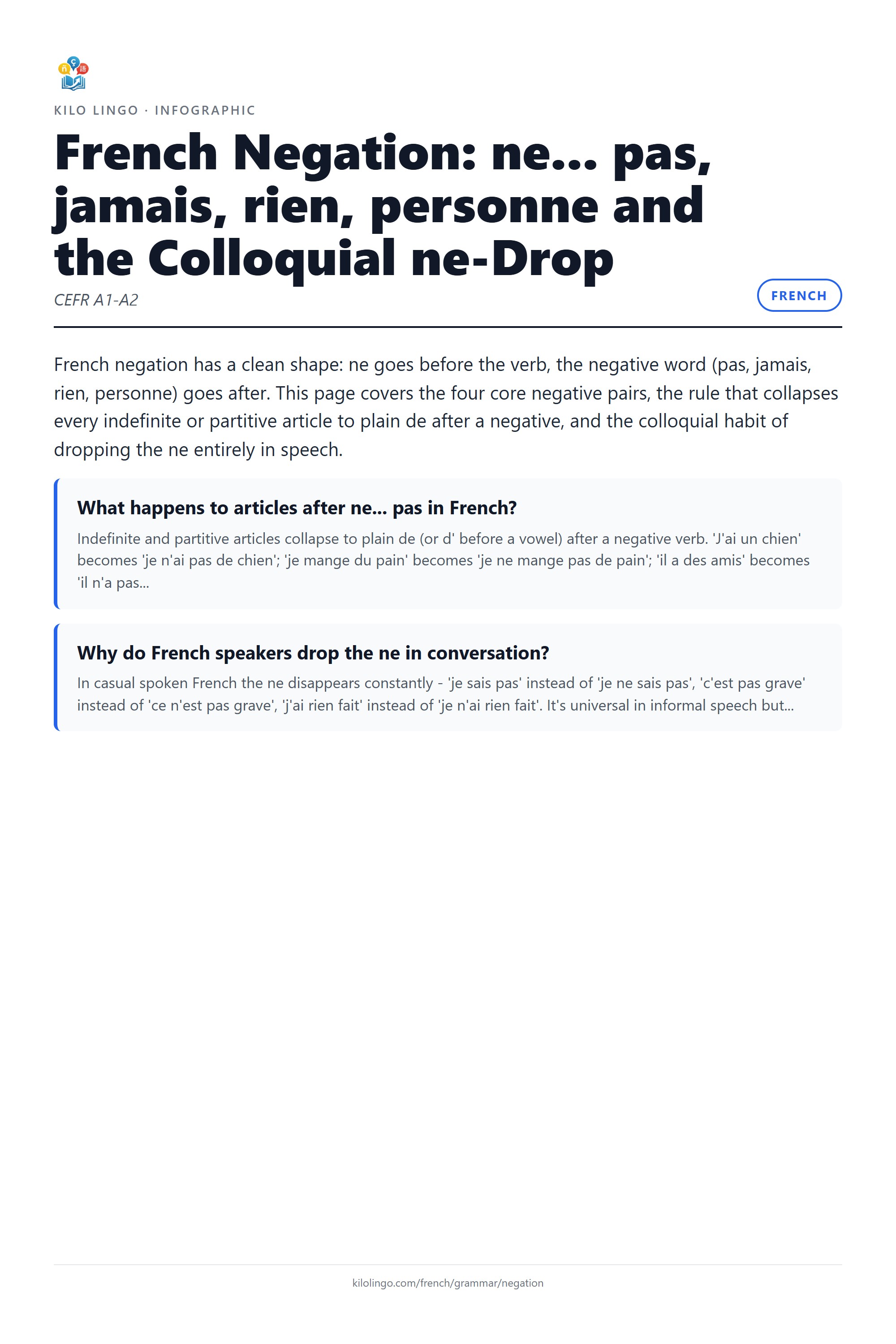
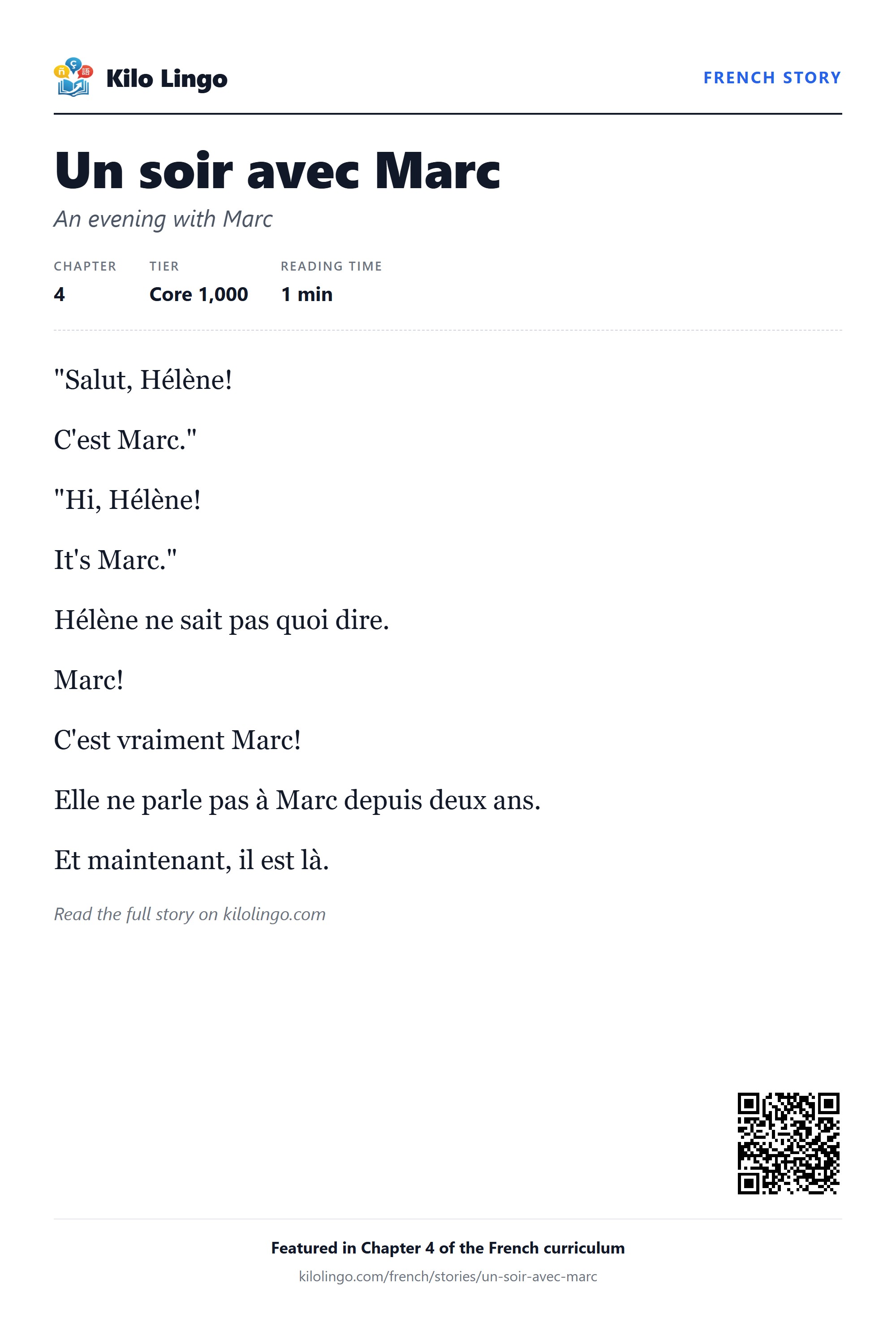
Per-word sheets86 words · a worksheet, infographic and listicle each
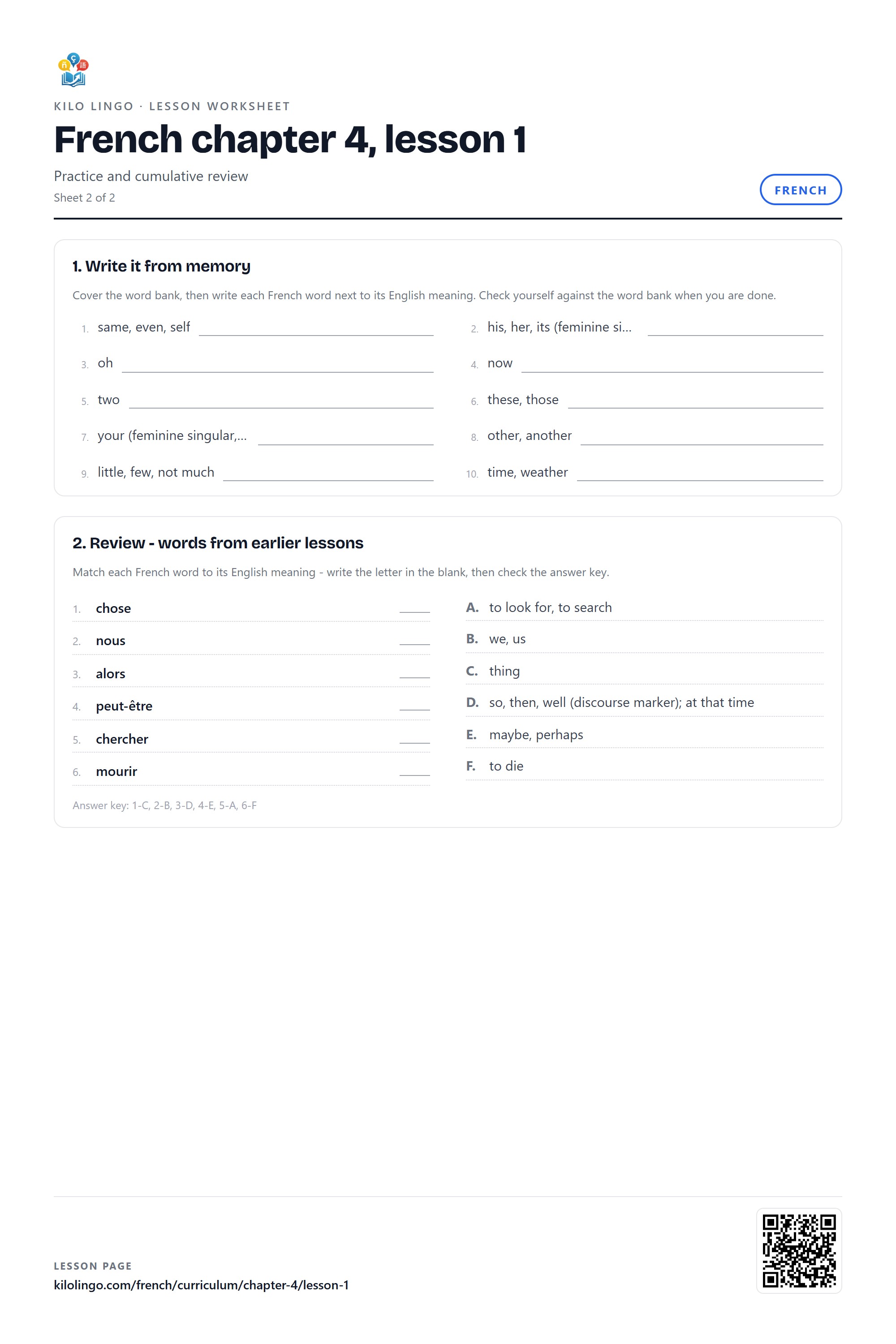

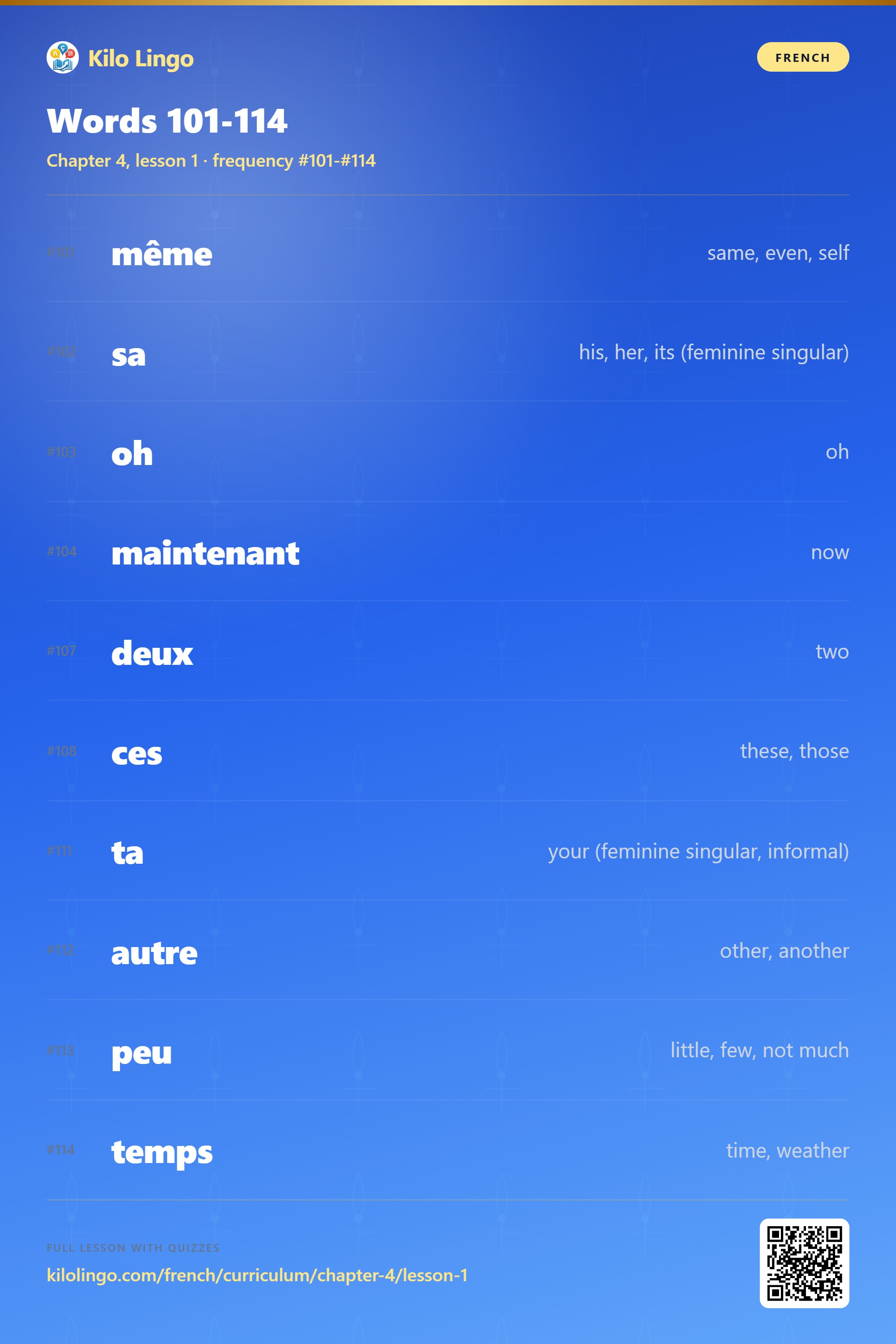
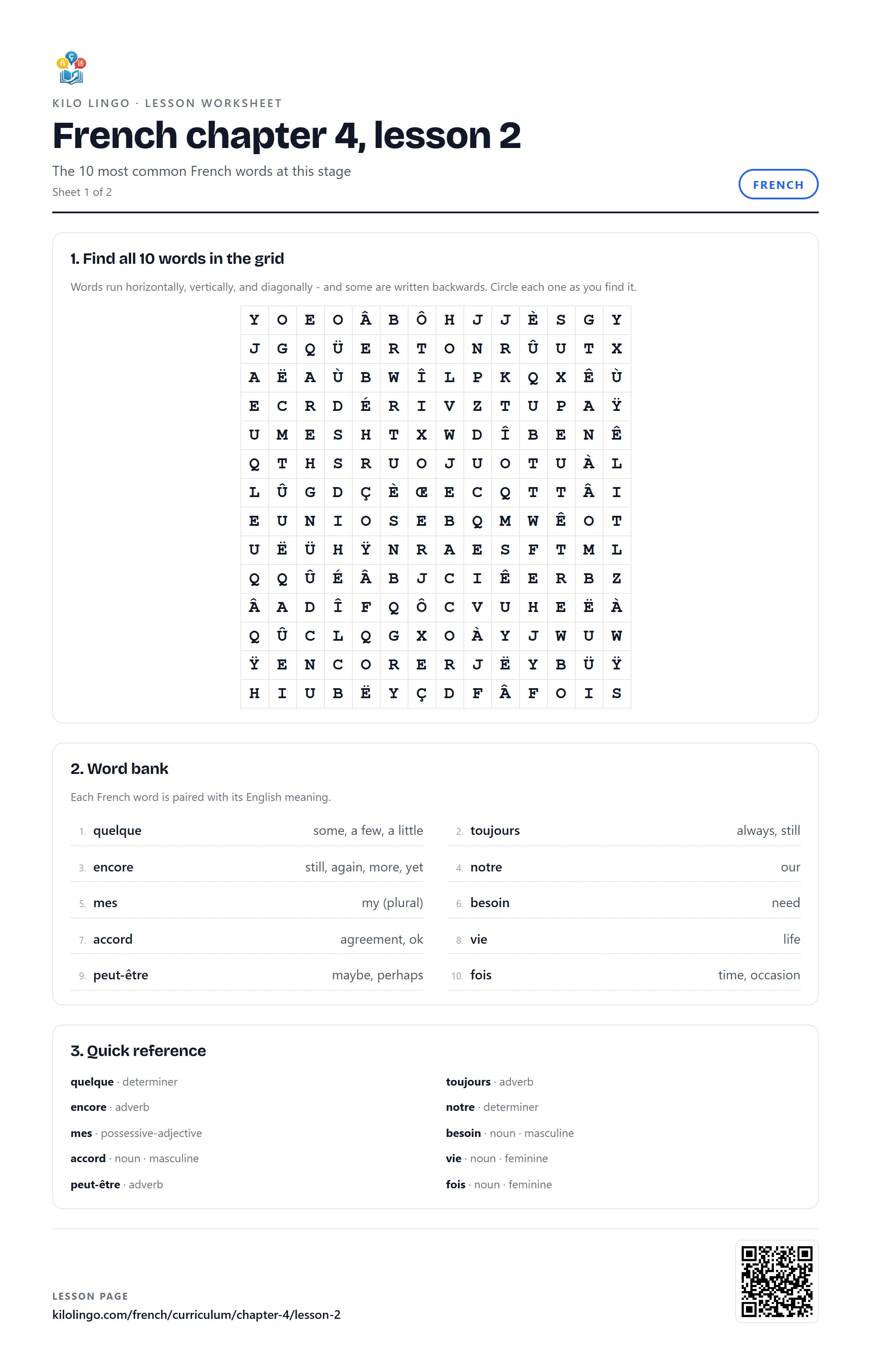
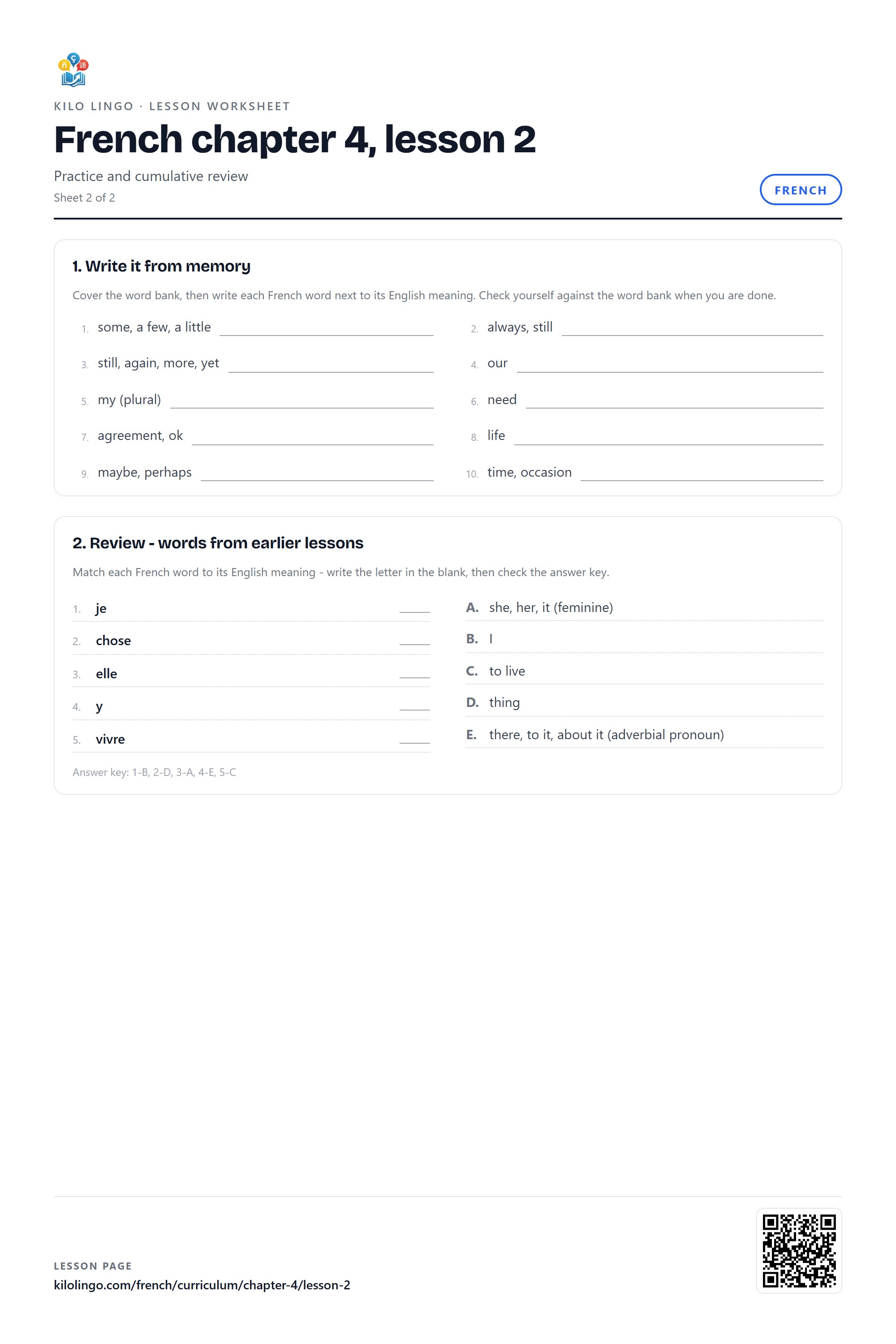


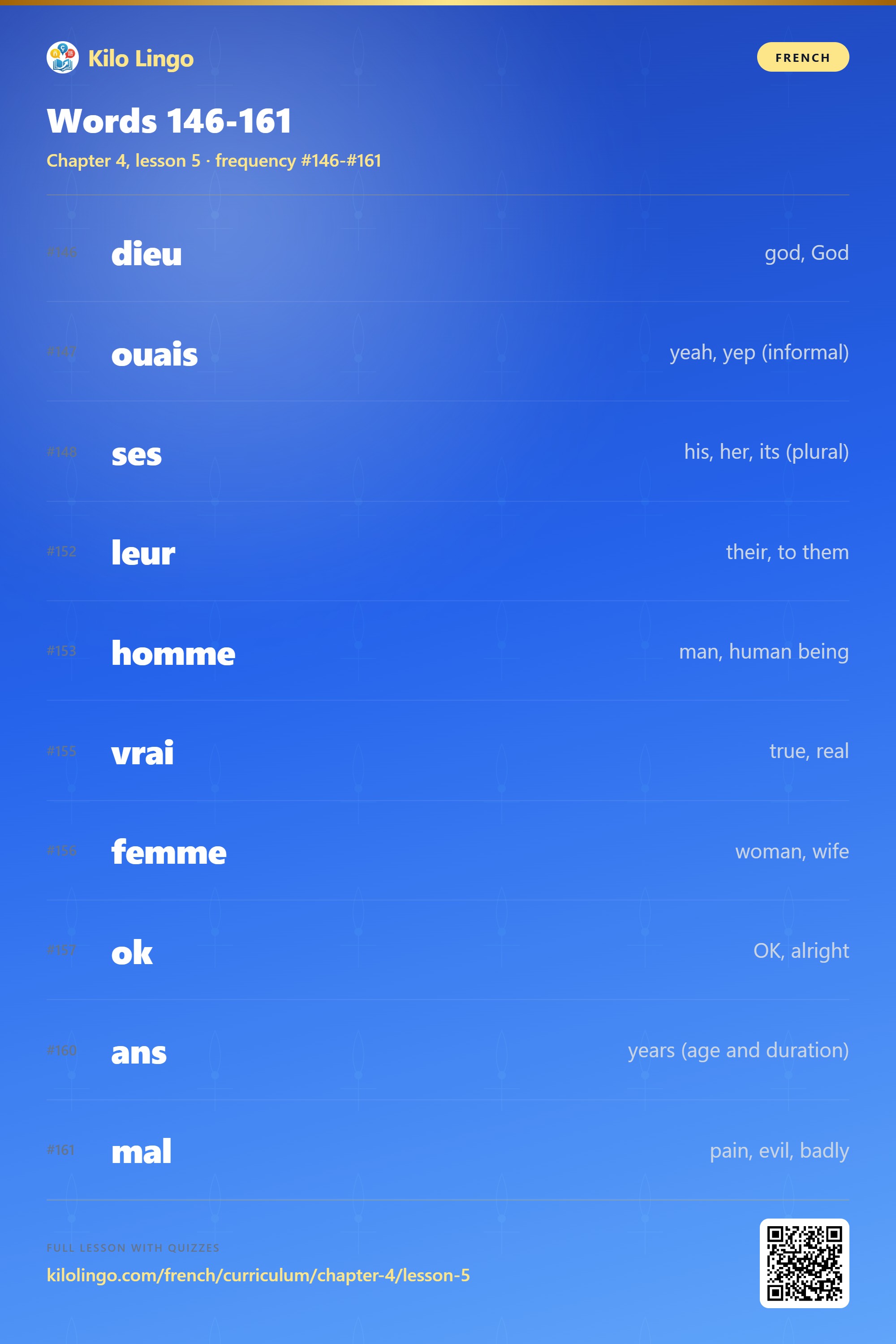
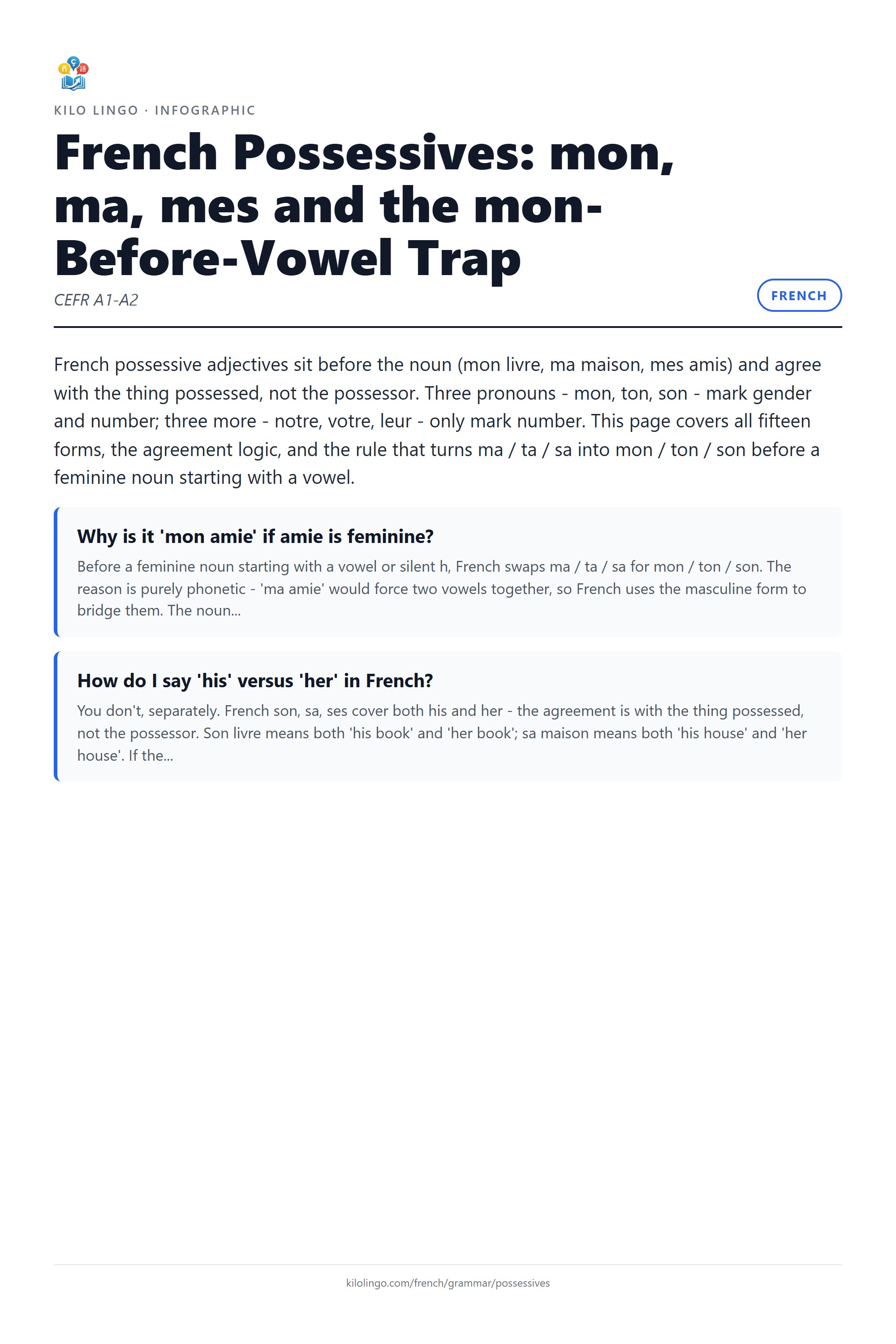
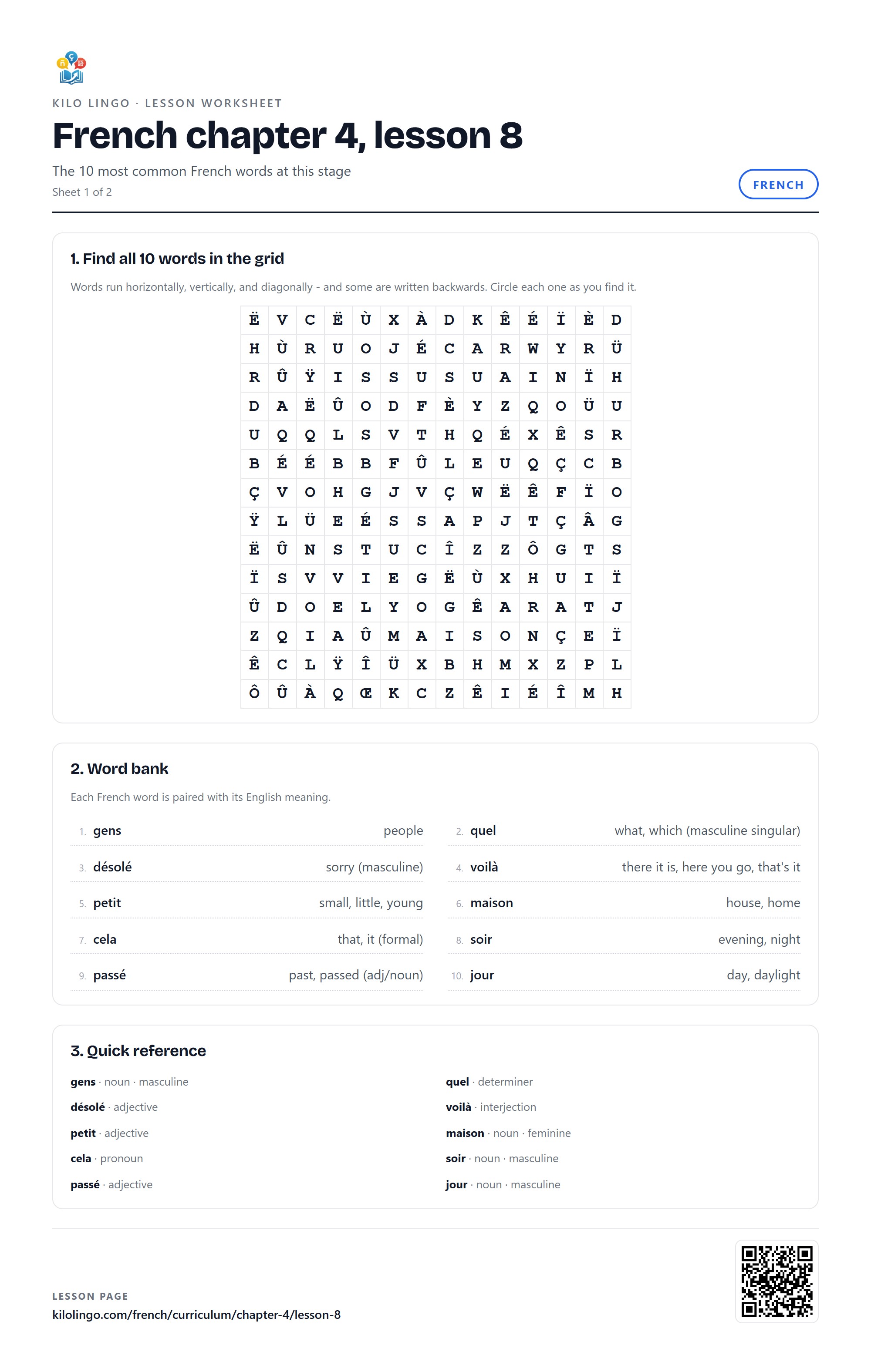
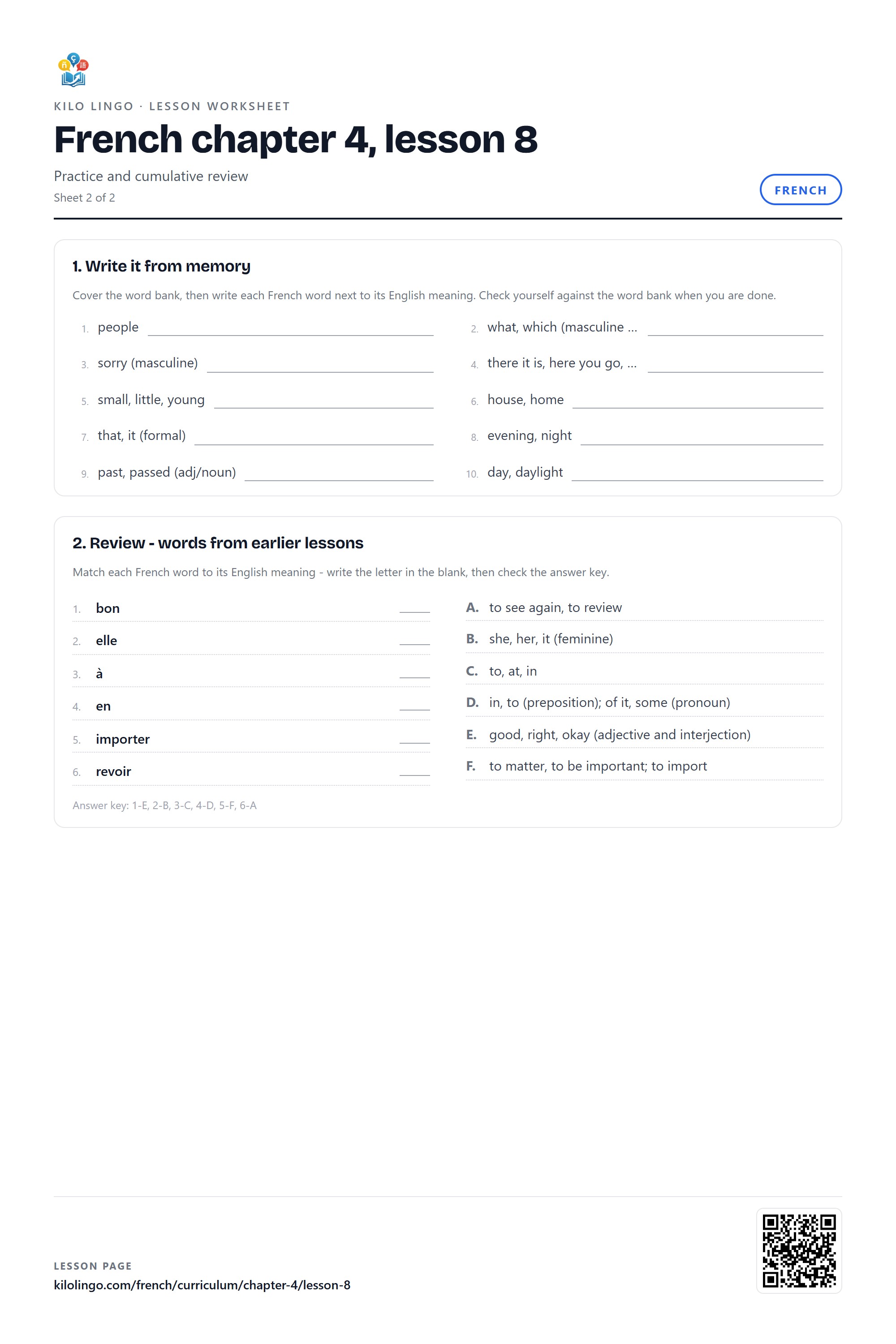

Chapter 5 · Adjective agreement
Chapter page →- Words 201-210Vocabulary
10 words · ranks 201-210
- Crossword review sessionReview games
Cross the words you just met, clued in English. Slower than a drill, and it sticks harder.
- Words 211-220Vocabulary
10 words · ranks 211-220
- Word Bubbles review sessionReview games
Pop the words you just met by matching each one to its meaning. A couple of rounds and the batch is yours.
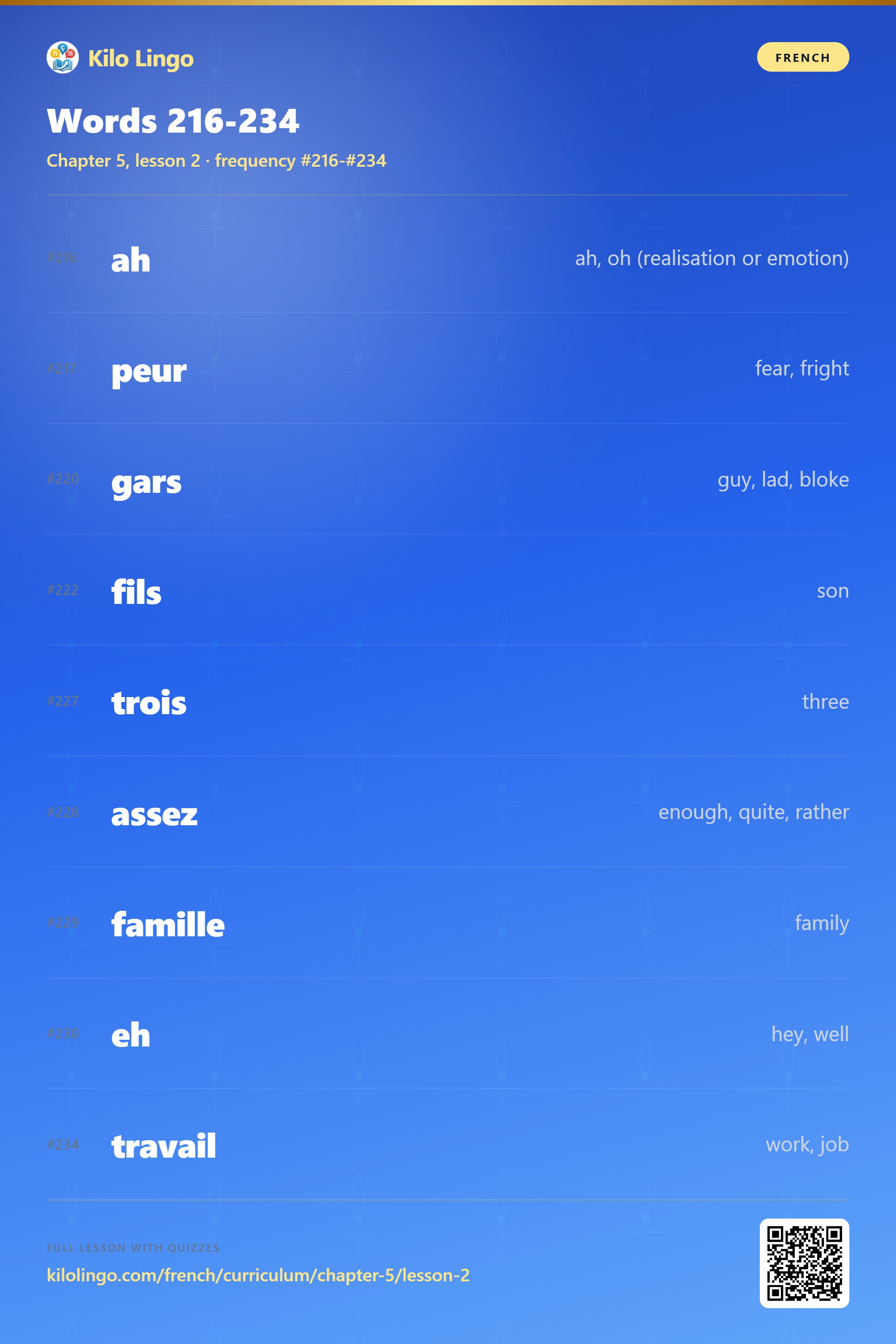
- Words 221-231Vocabulary
10 words · ranks 221-231
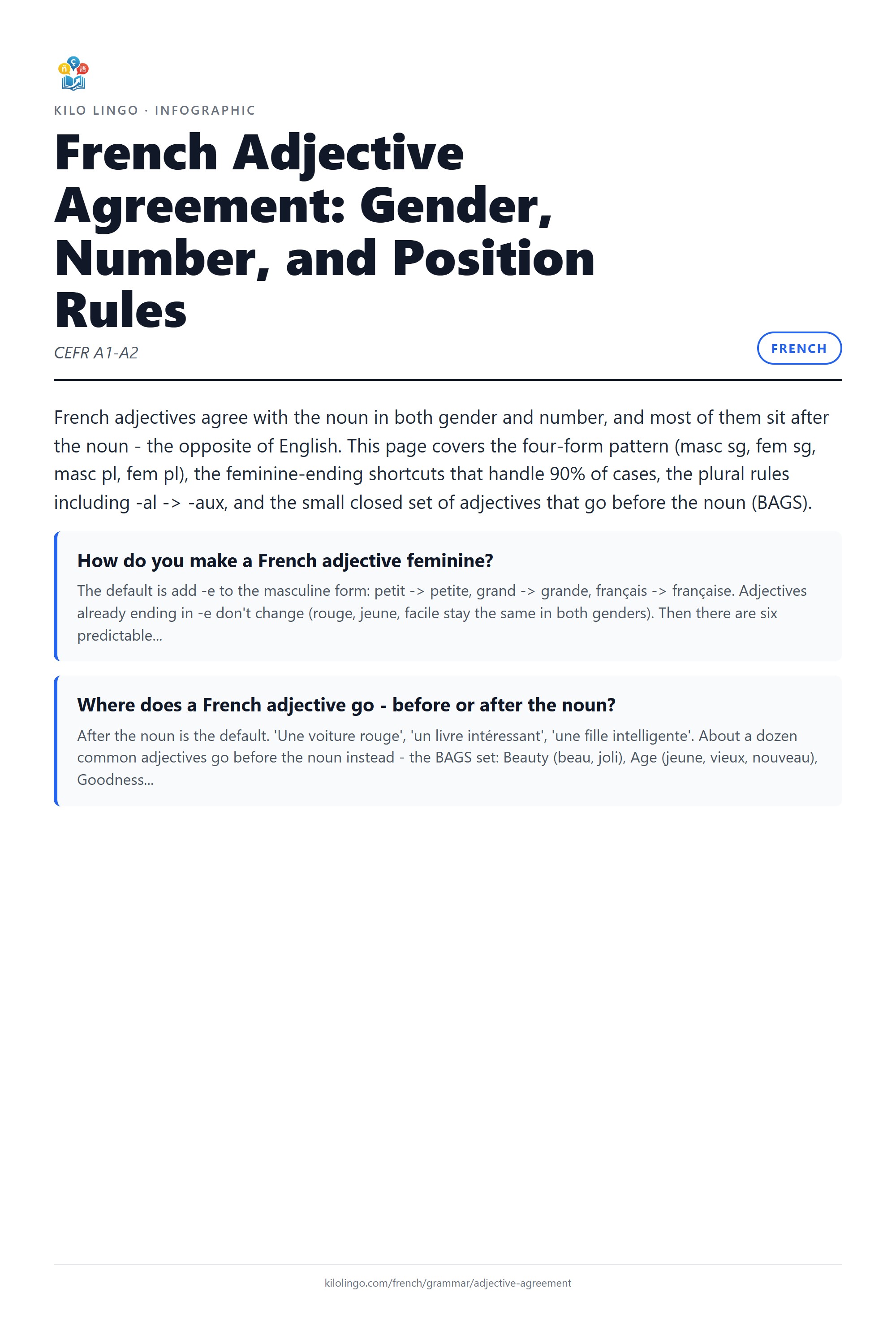
- Adjective agreementGrammar
Adjectives agree with the noun for gender and number. The feminine endings (-e default, -se, -lle, -nne, -ve, -ere), the plural rules, and the BAGS-set adjectives that go before the noun.
- voir or regarder?Mistake clinic
Seeing happens to you. Looking is something you do.
- Words 232-243Vocabulary
10 words · ranks 232-243
- Conjugation Sprint review sessionReview games
Sixty seconds on the endings of the verbs this chapter has drilled so far.
- Words 244-253Vocabulary
10 words · ranks 244-253
- Word Bubbles review sessionReview games
Pop the words you just met by matching each one to its meaning. A couple of rounds and the batch is yours.
- Words 254-264Vocabulary
10 words · ranks 254-264
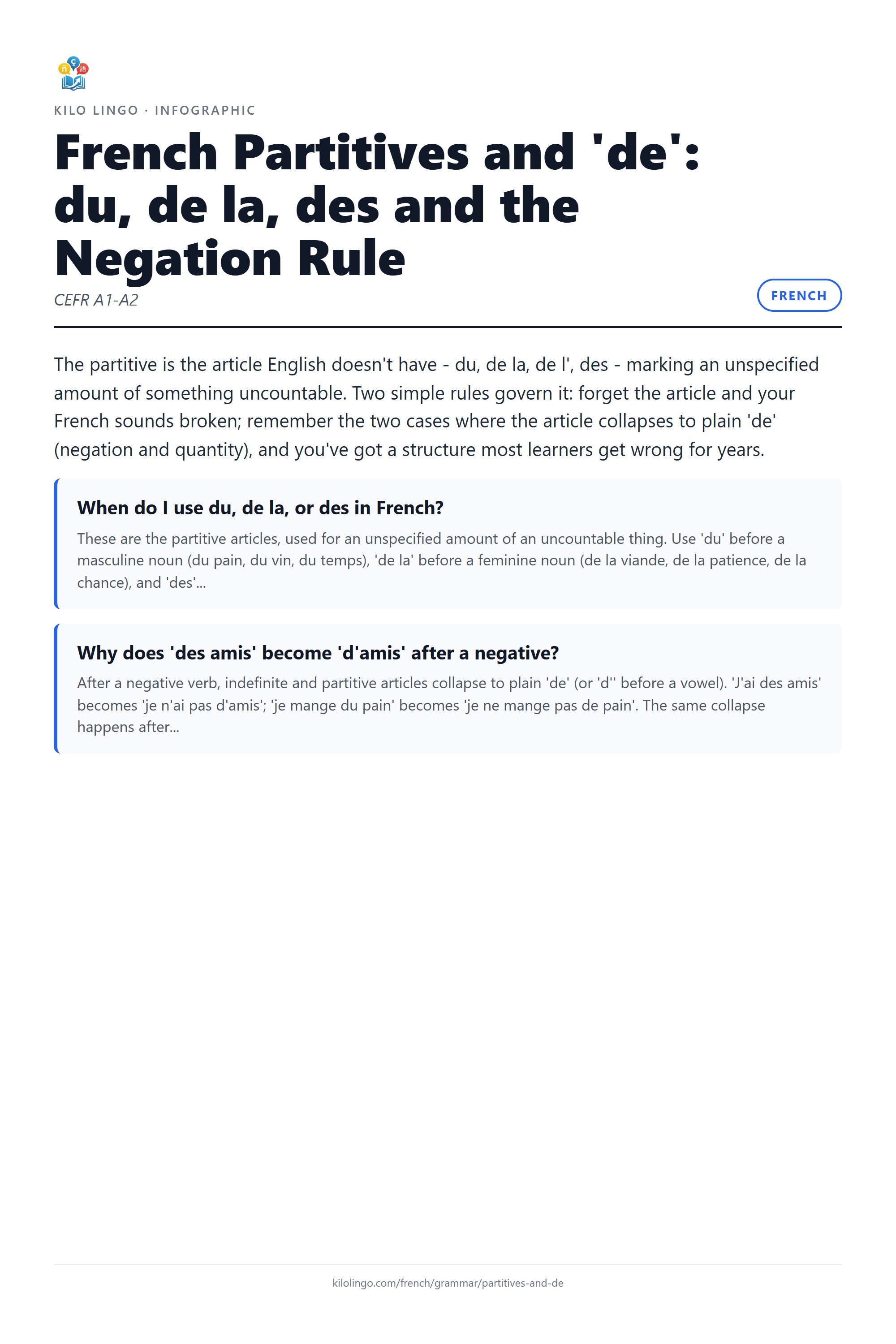
du, de la, de l', des as partitives - and the rule that turns every partitive into 'de' after a negative verb or a quantity expression.
- Words 265-275Vocabulary
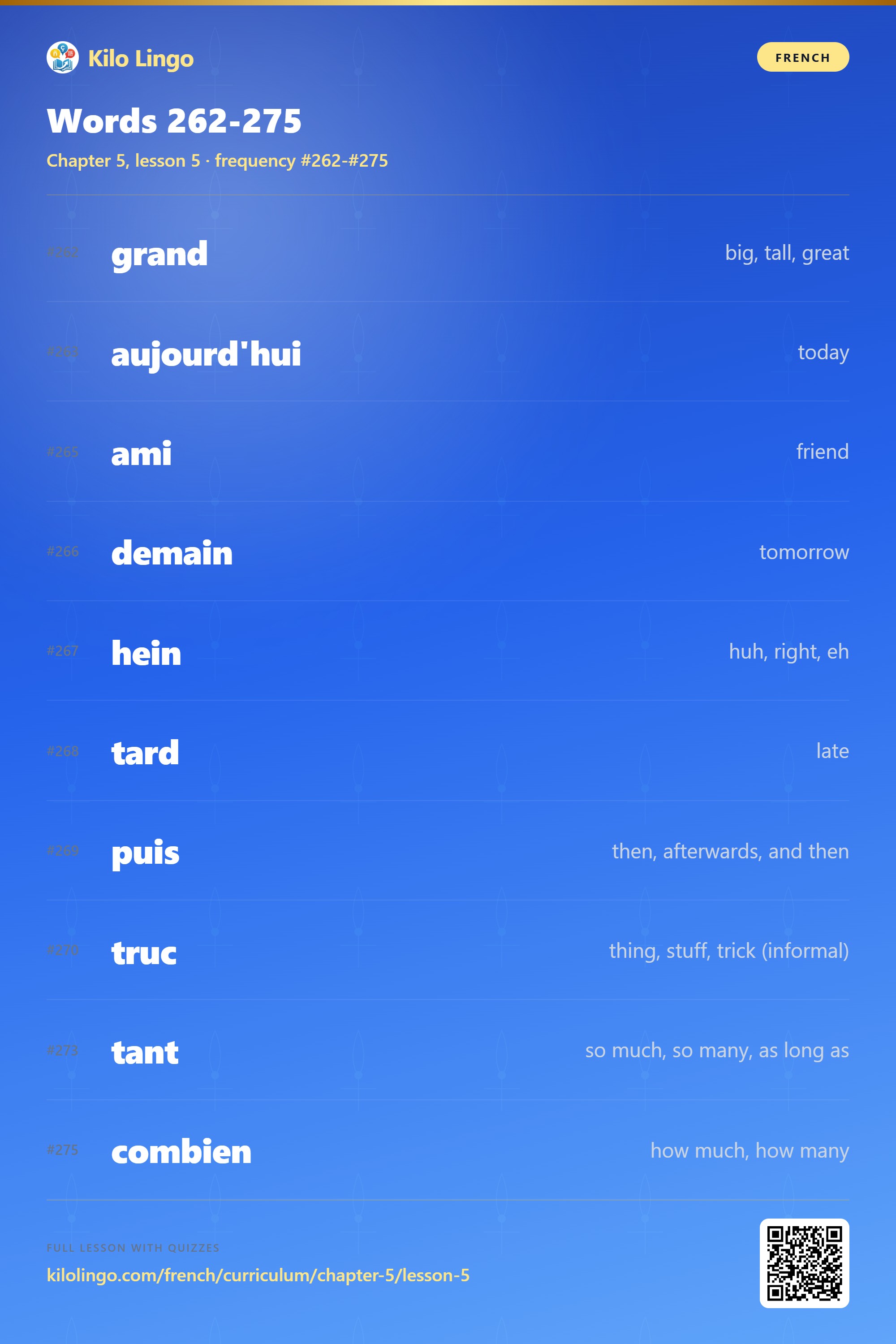
10 words · ranks 265-275
- Conjugation Sprint review sessionReview games
Sixty seconds on the endings of the verbs this chapter has drilled so far.
- Words 276-285Vocabulary
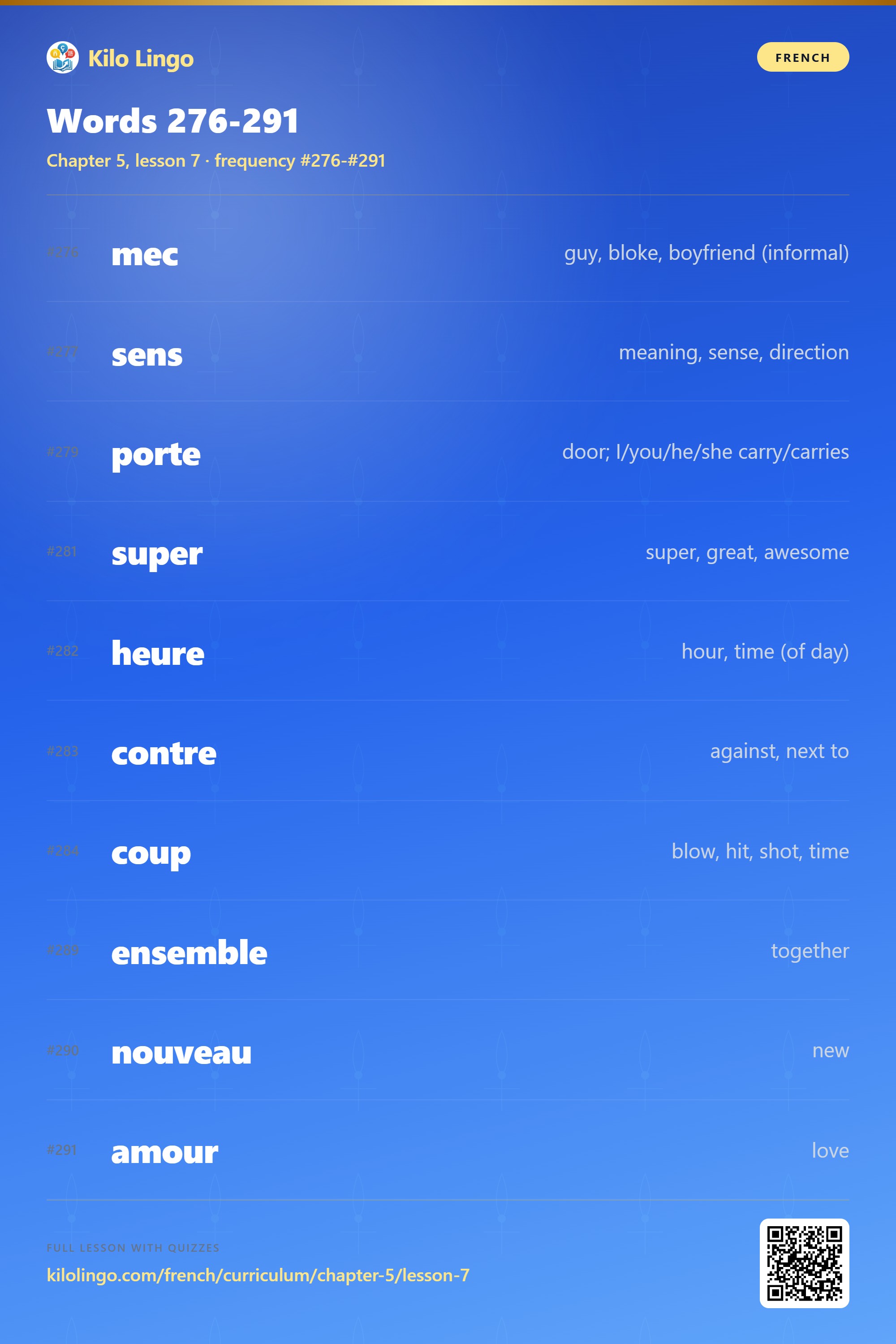
10 words · ranks 276-285
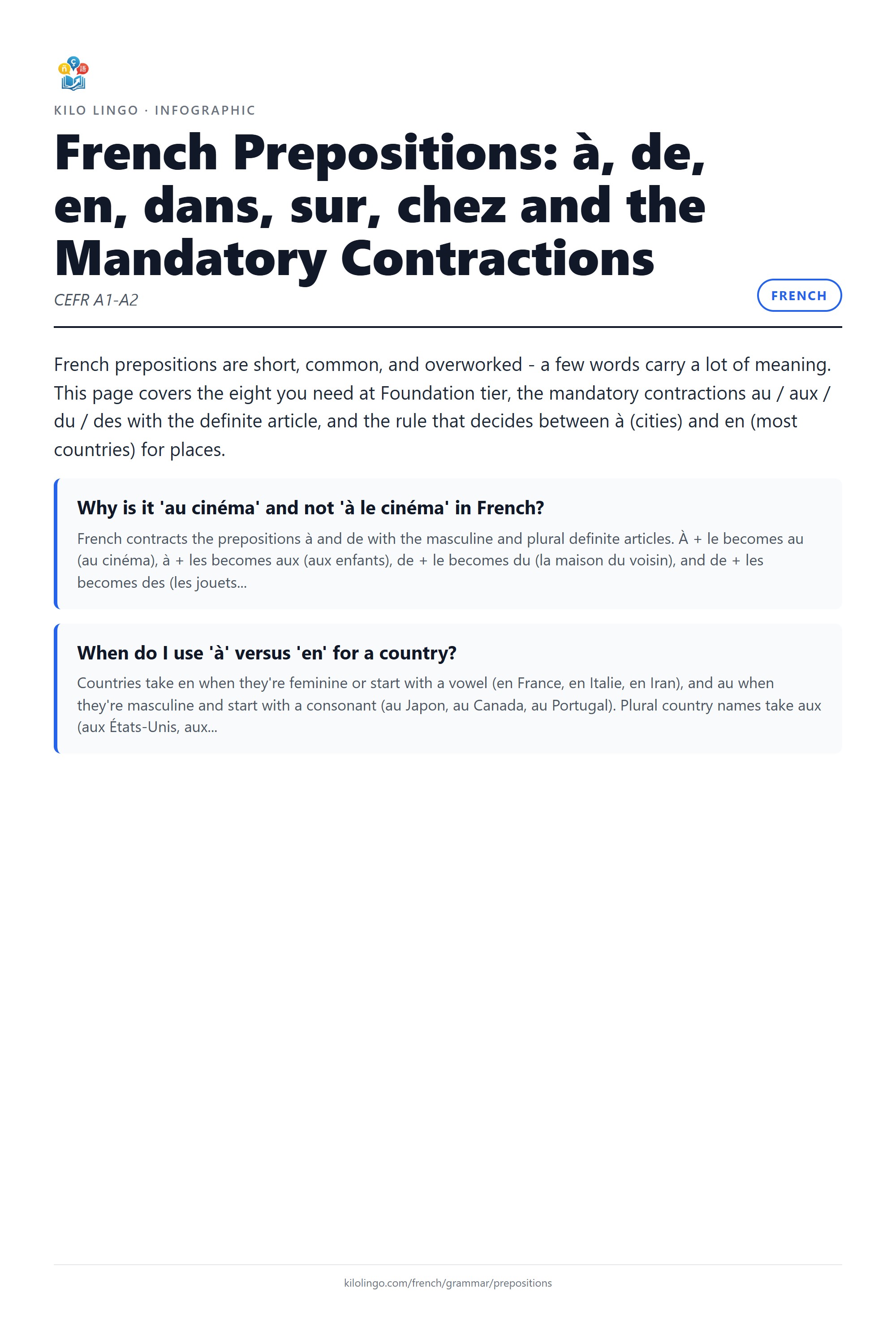
a, de, en, dans, sur, sous, chez - plus the mandatory contractions au, aux, du, des and the a / en split for countries and cities.
- Words 286-296Vocabulary
10 words · ranks 286-296
- Word Bubbles review sessionReview games
Pop the words you just met by matching each one to its meaning. A couple of rounds and the batch is yours.
- Words 297-300Vocabulary
4 words · ranks 297-300
- Story milestone: top 300 wordsGraded-reader story
You can read this story using only the words you've learned so far. Every content word sits at or above the rank-300 ceiling.
- La familleThemed review
Everyone you have met so far, gathered in one place. The first theme the course can build - by the end of chapter 5 the family is complete.
Post a hello to the French community, in French.
- Arcade reviewReview games
Replay this chapter's words as games - a different kind of repetition, and it counts.
Word printables
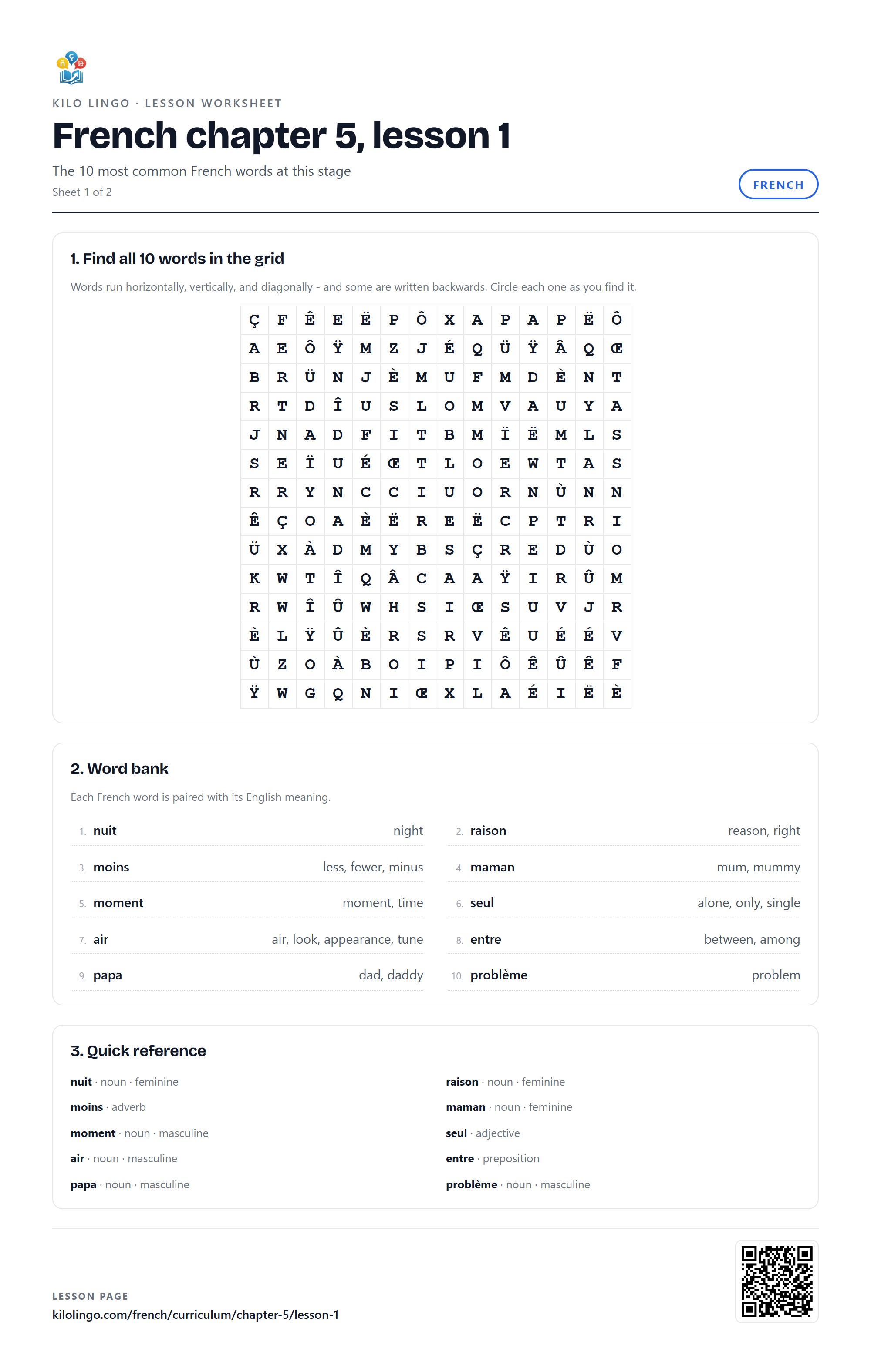
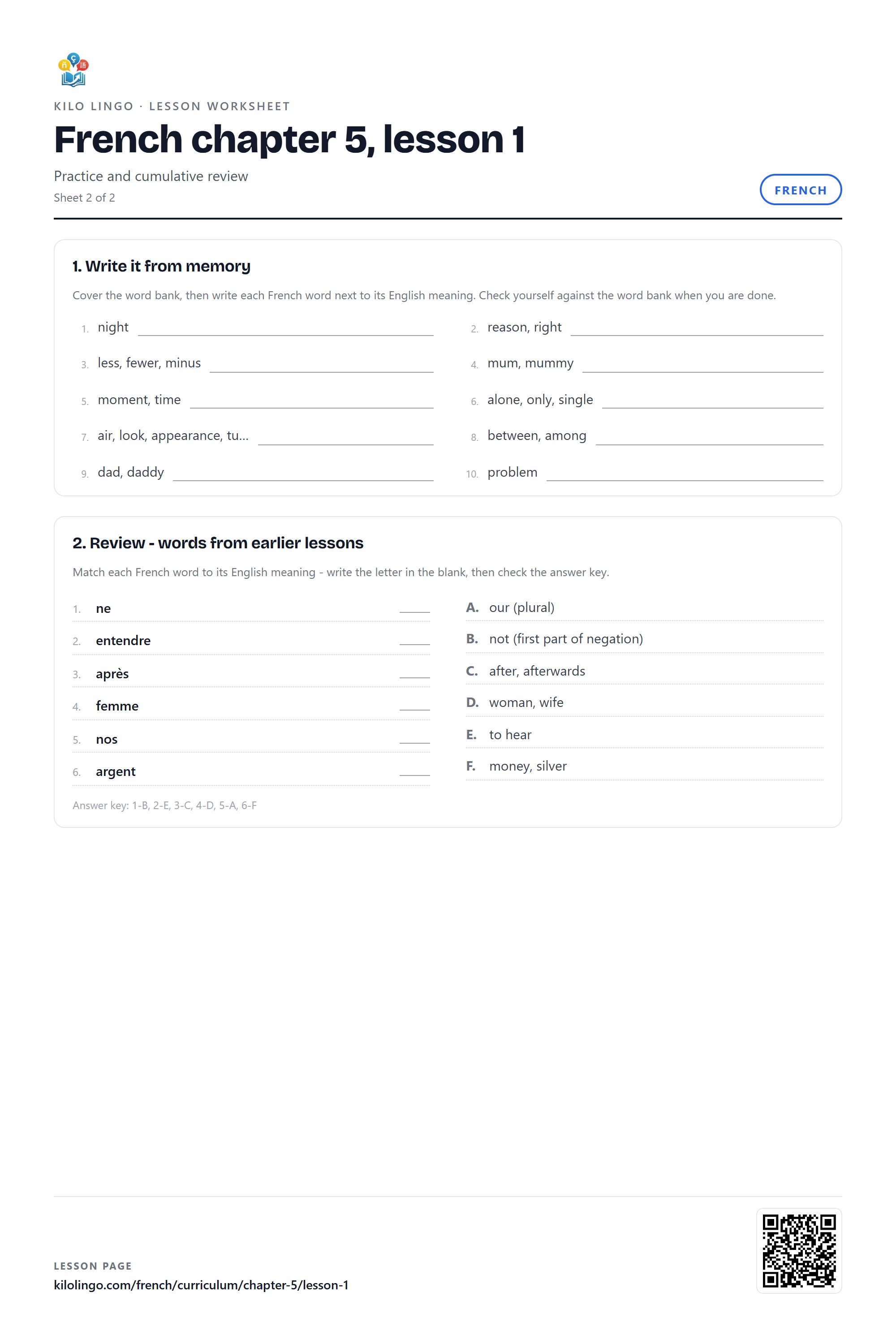
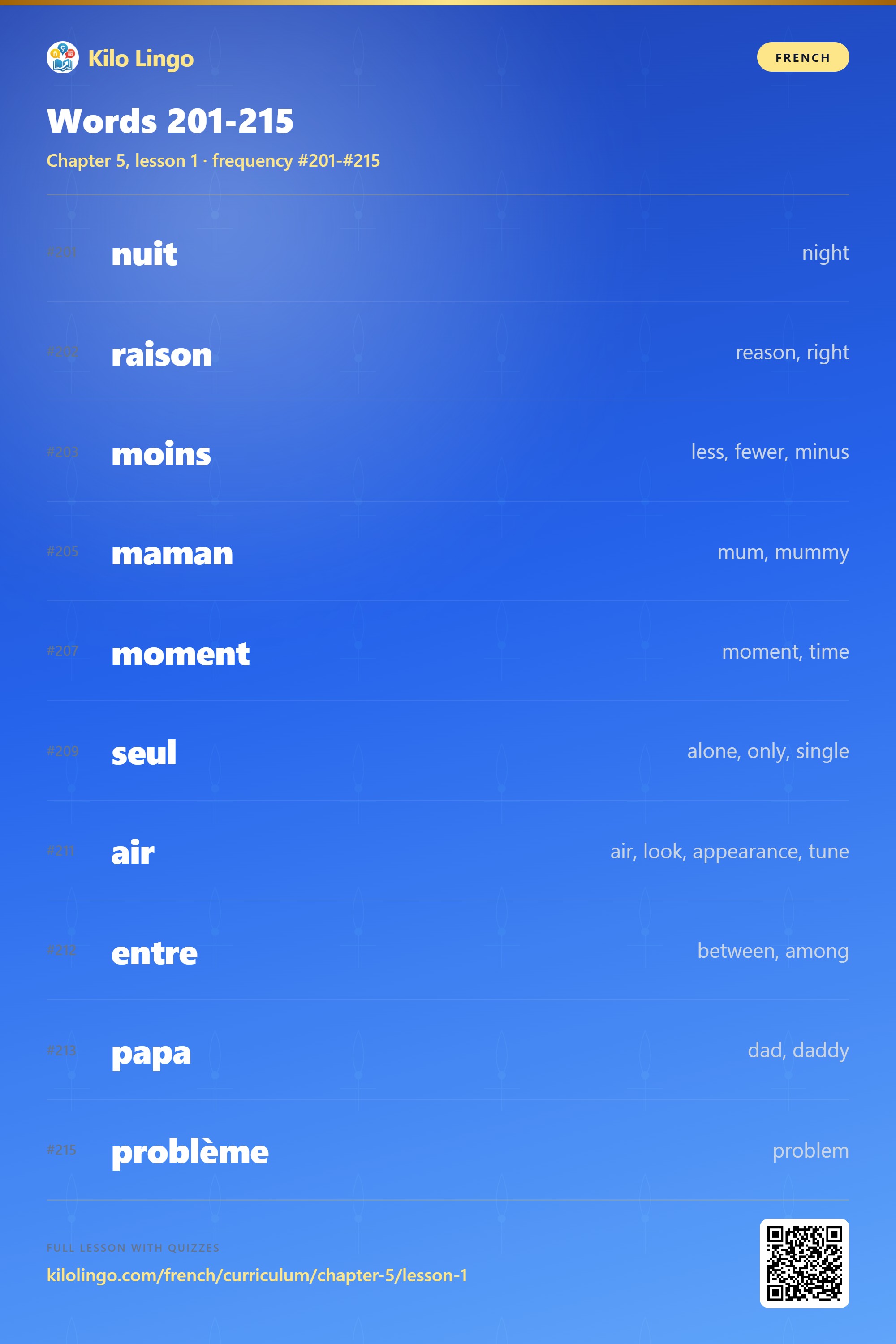
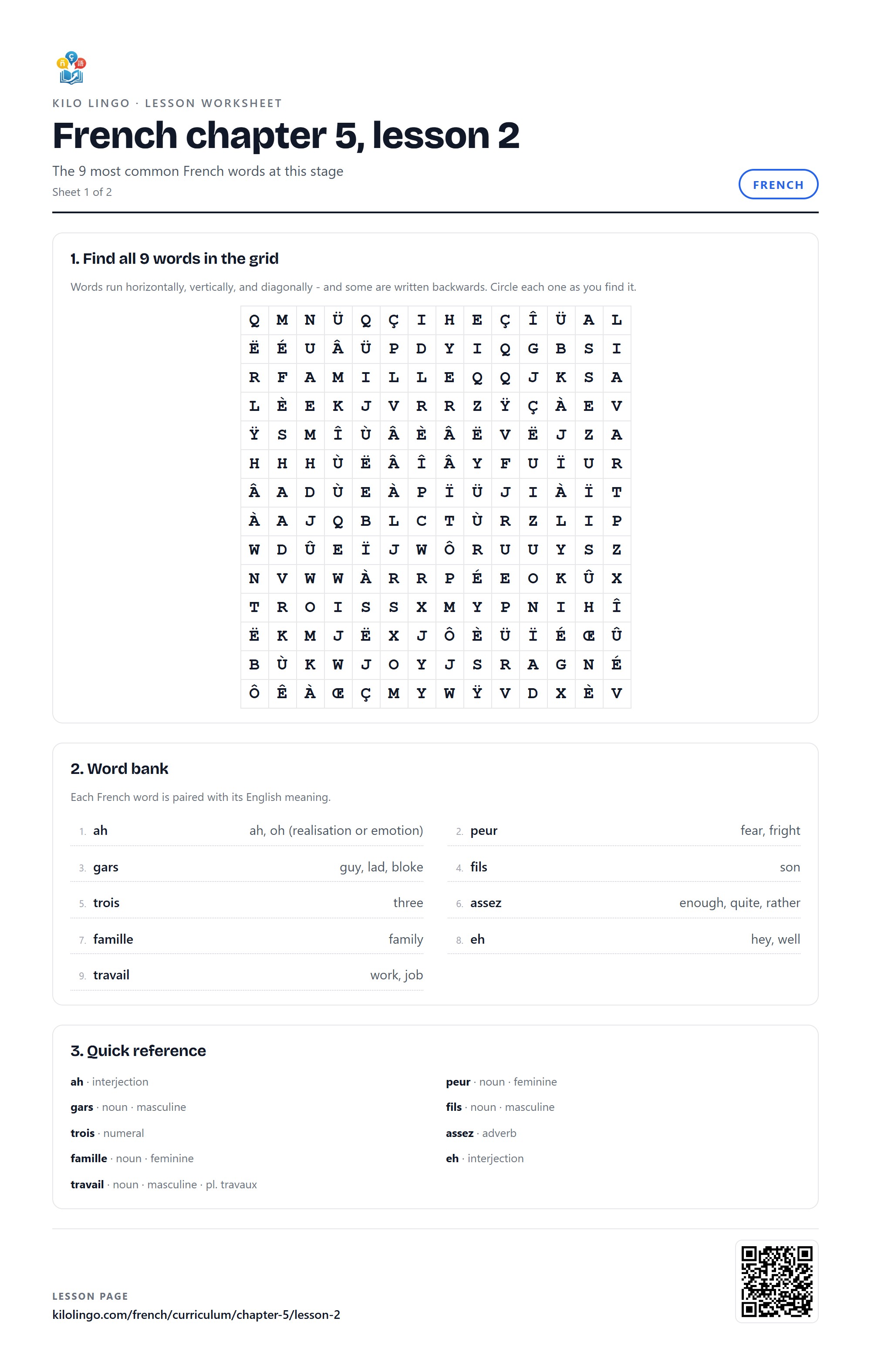
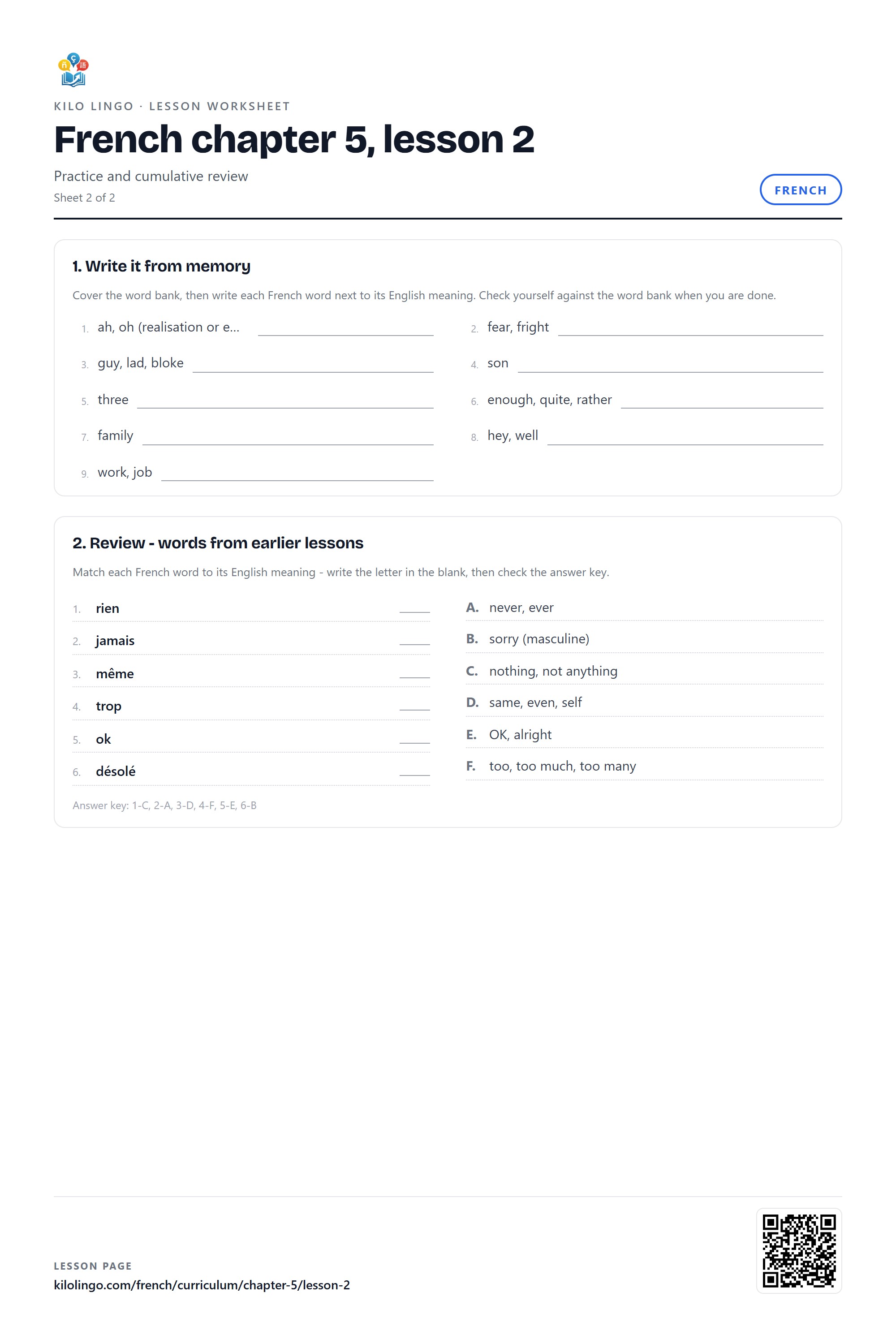
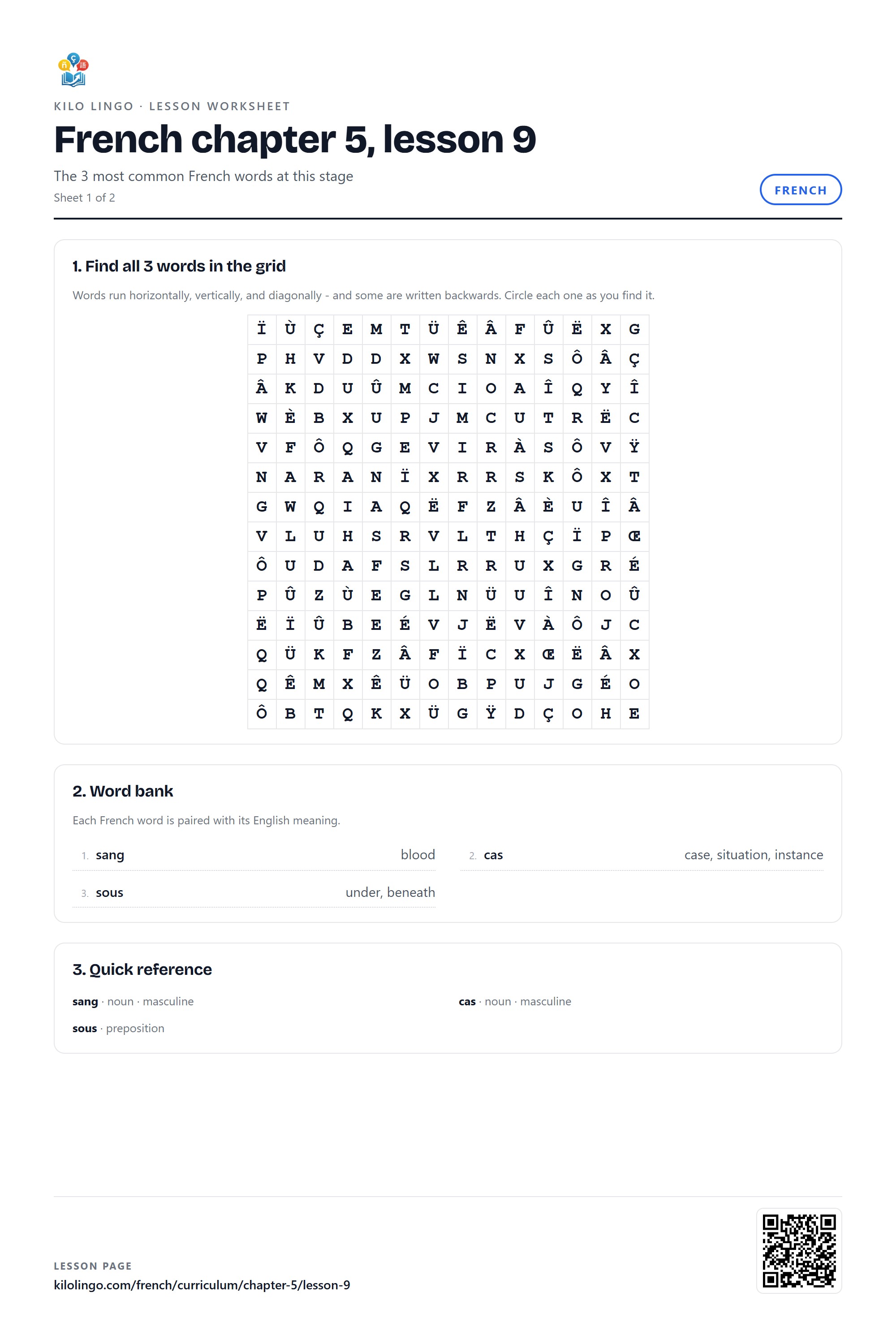
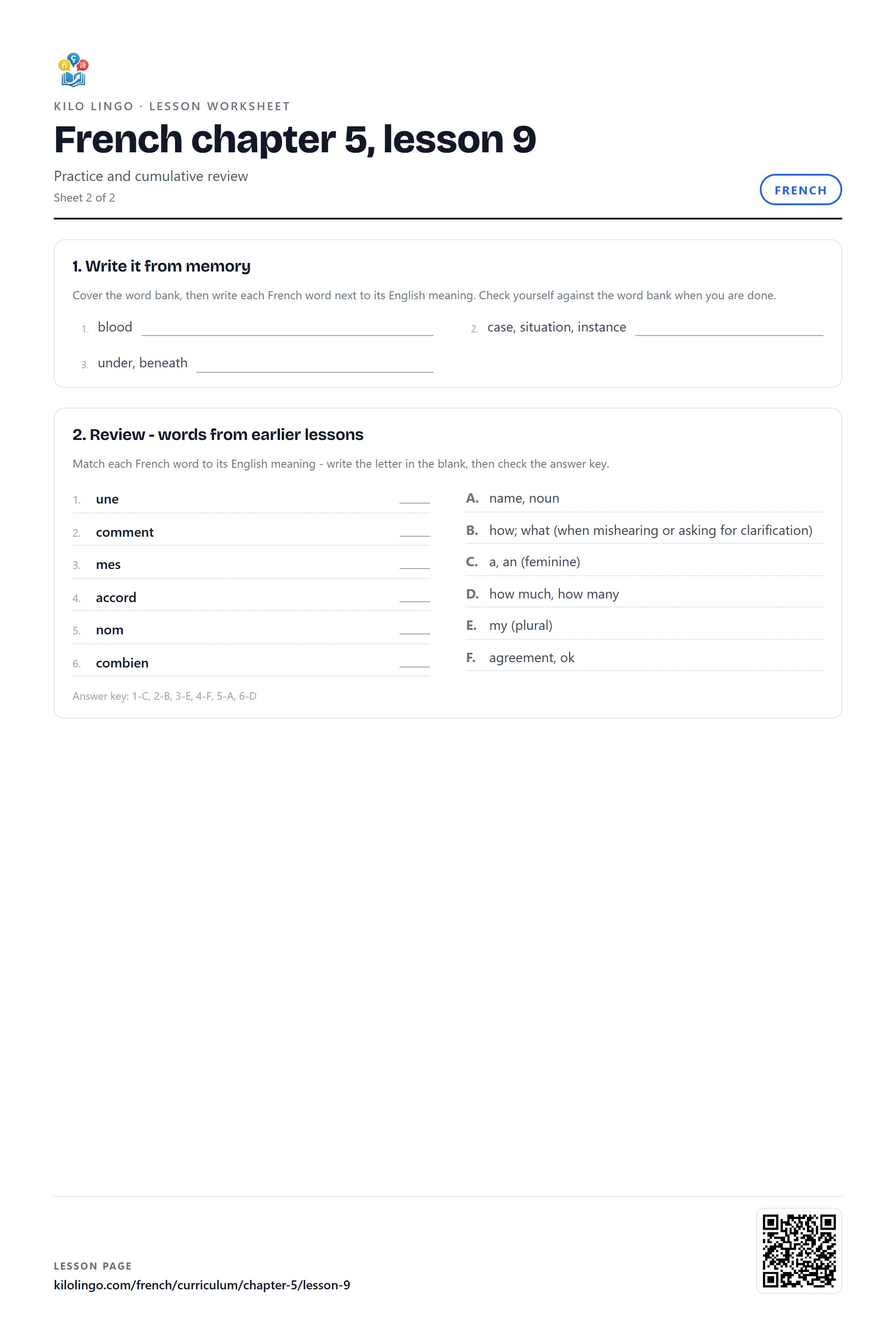
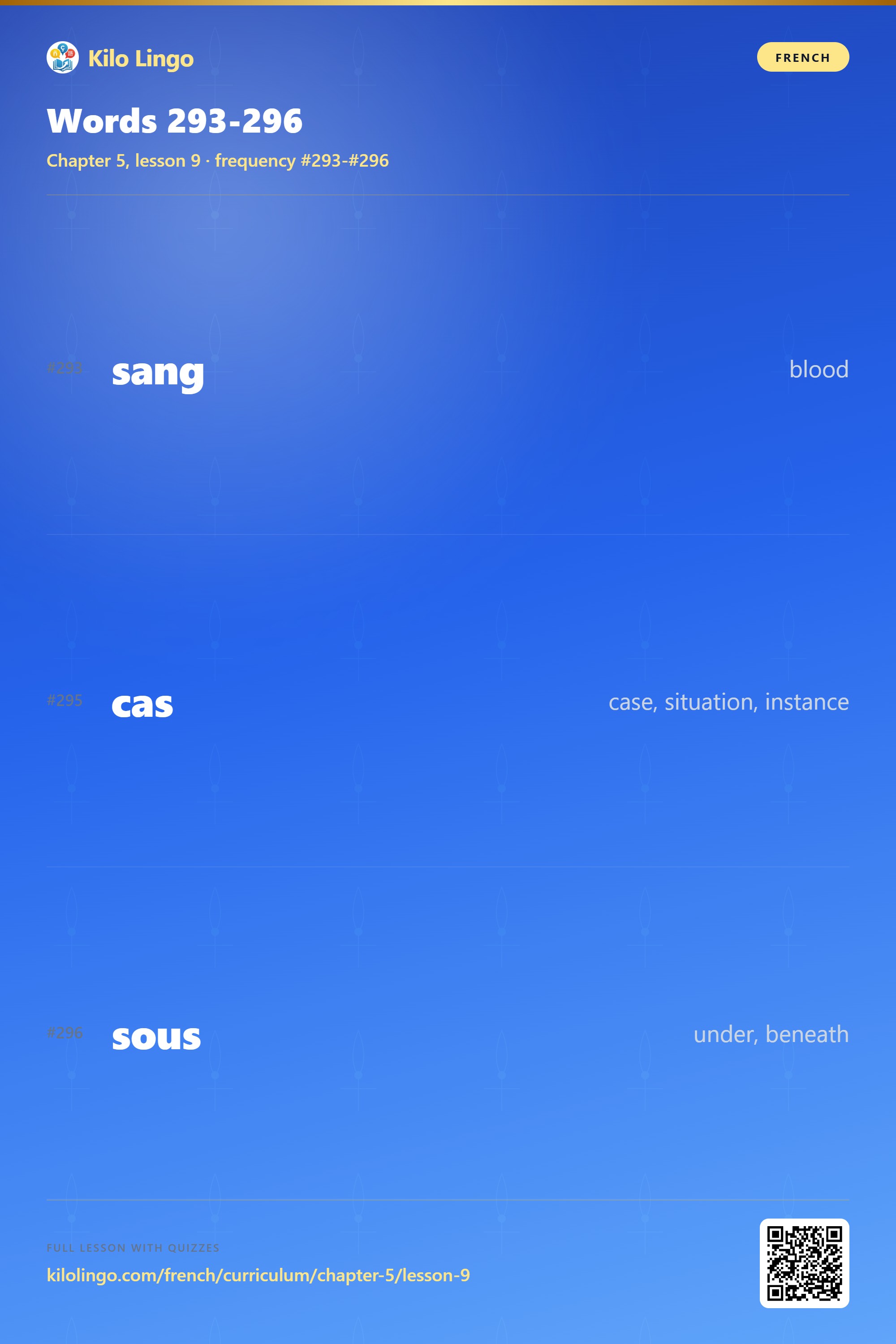
Per-word sheets93 words · a worksheet, infographic and listicle each





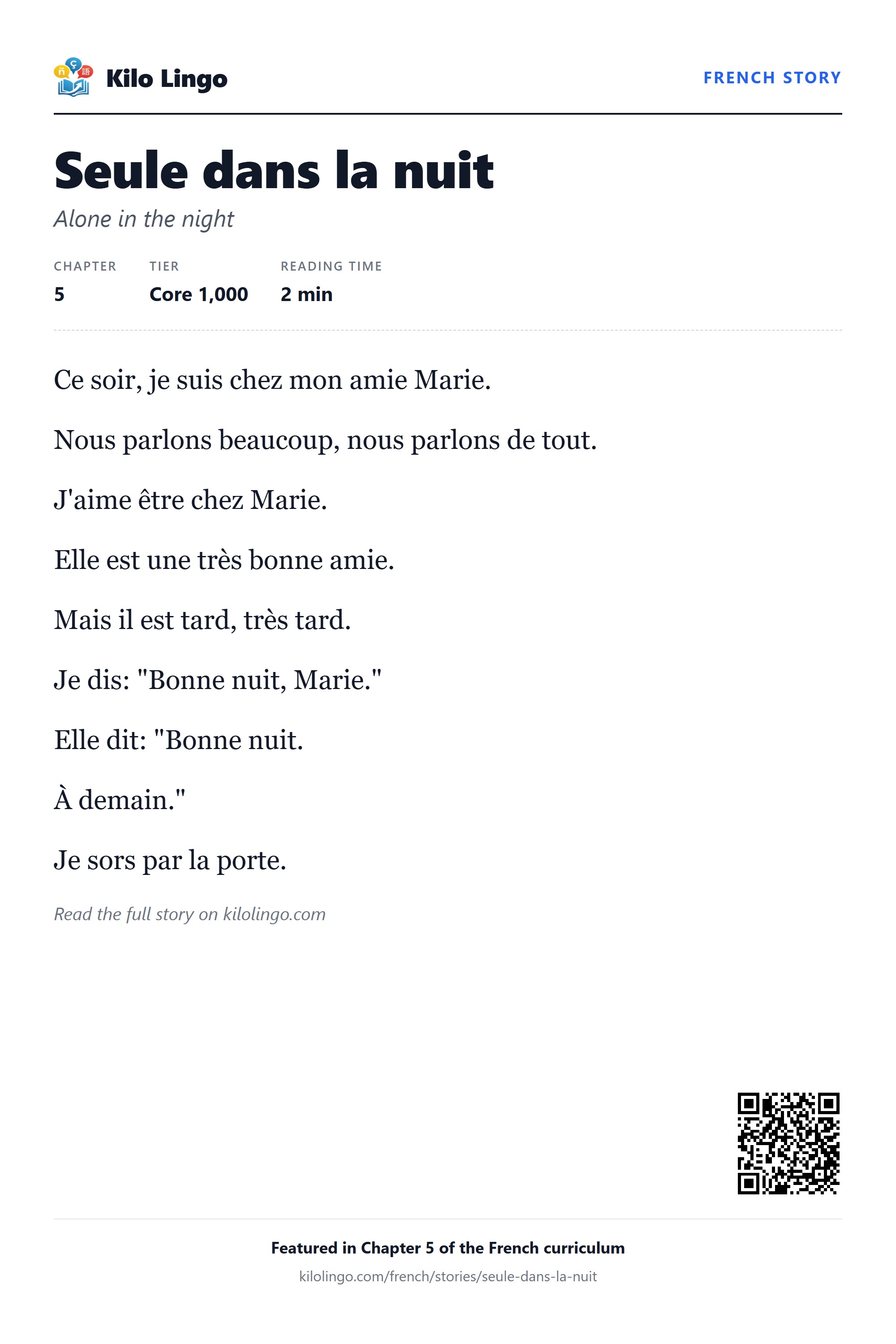
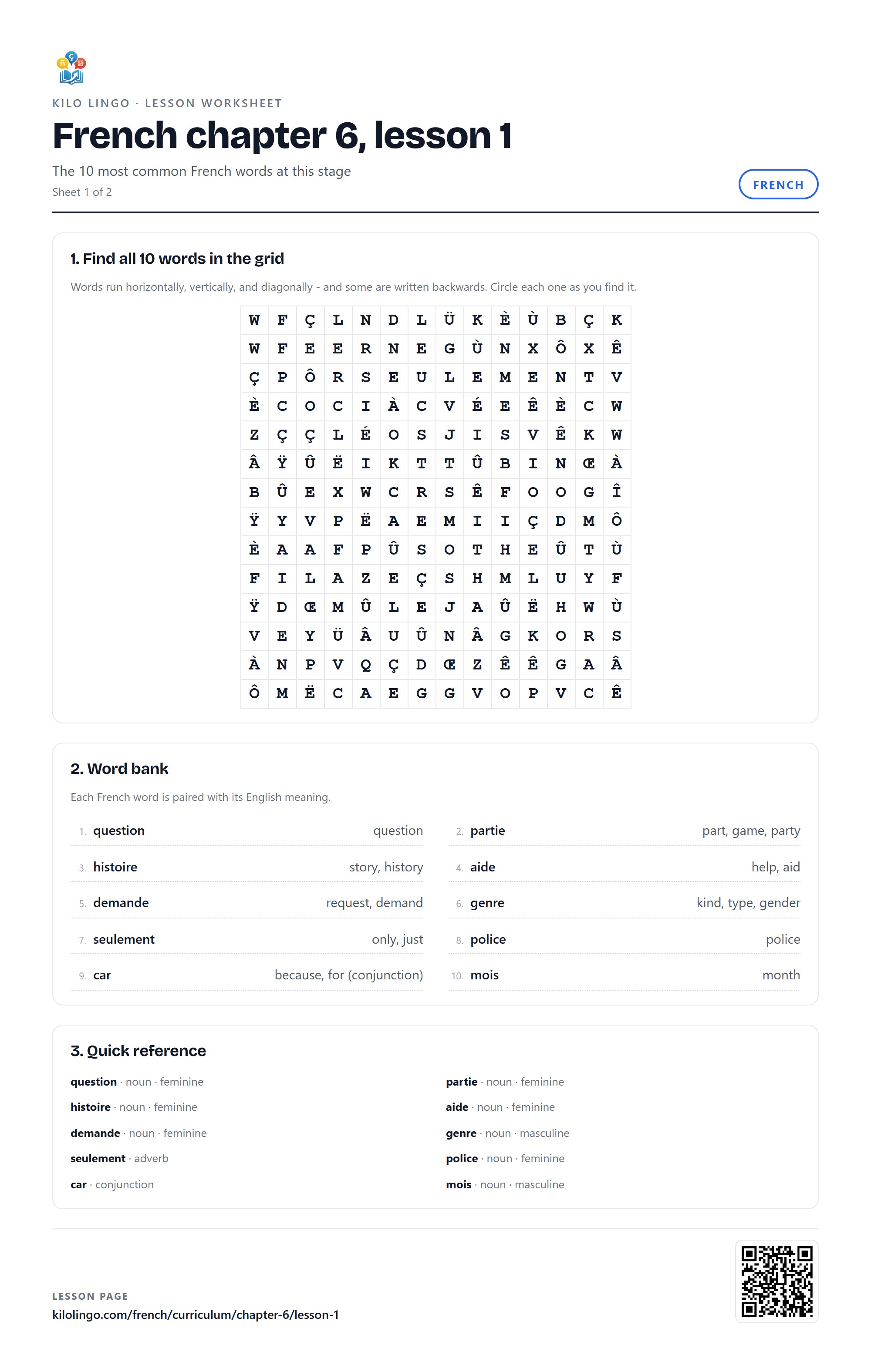
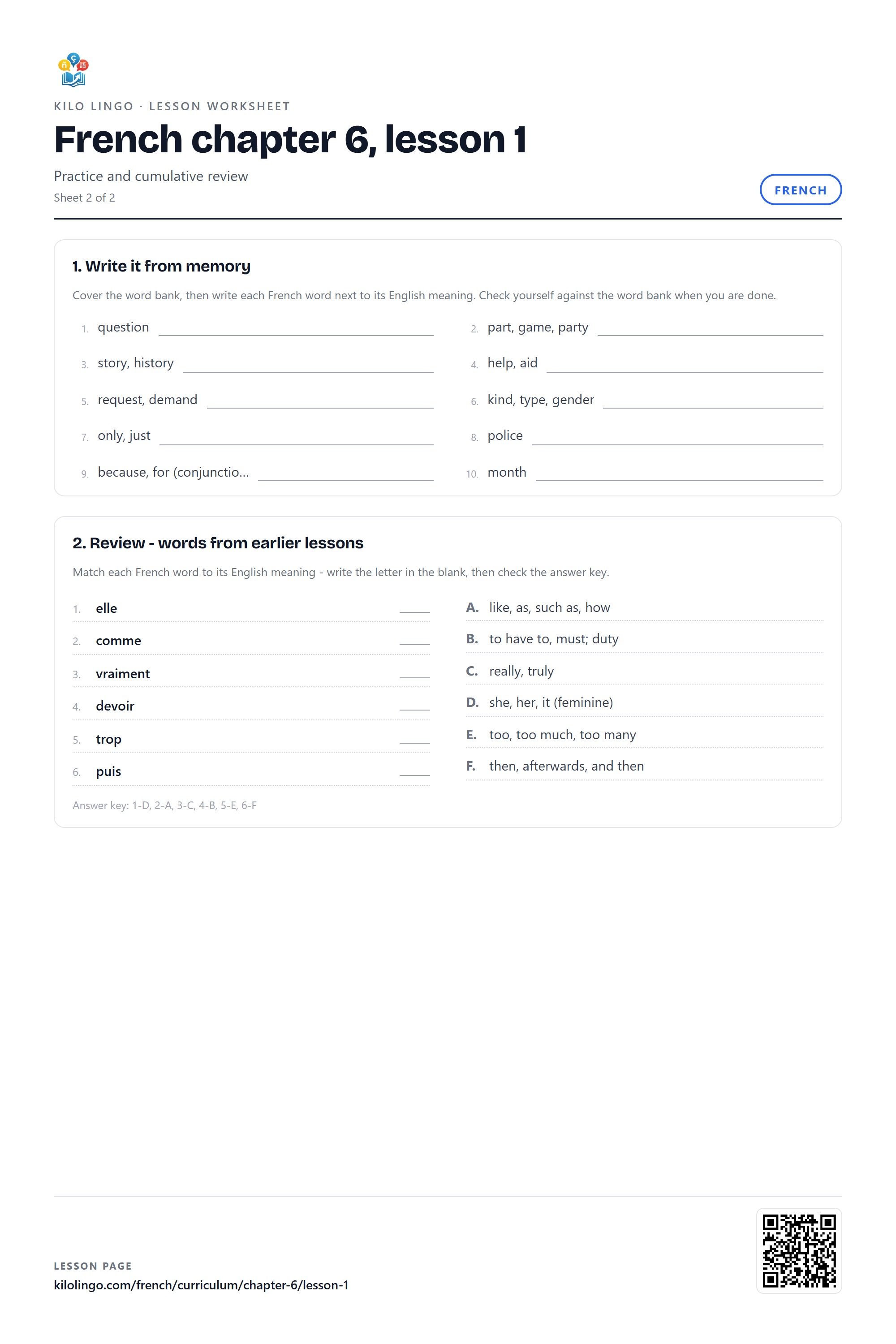
Chapter 6 · Direct and indirect object pronouns
Chapter page →- Words 301-310Vocabulary
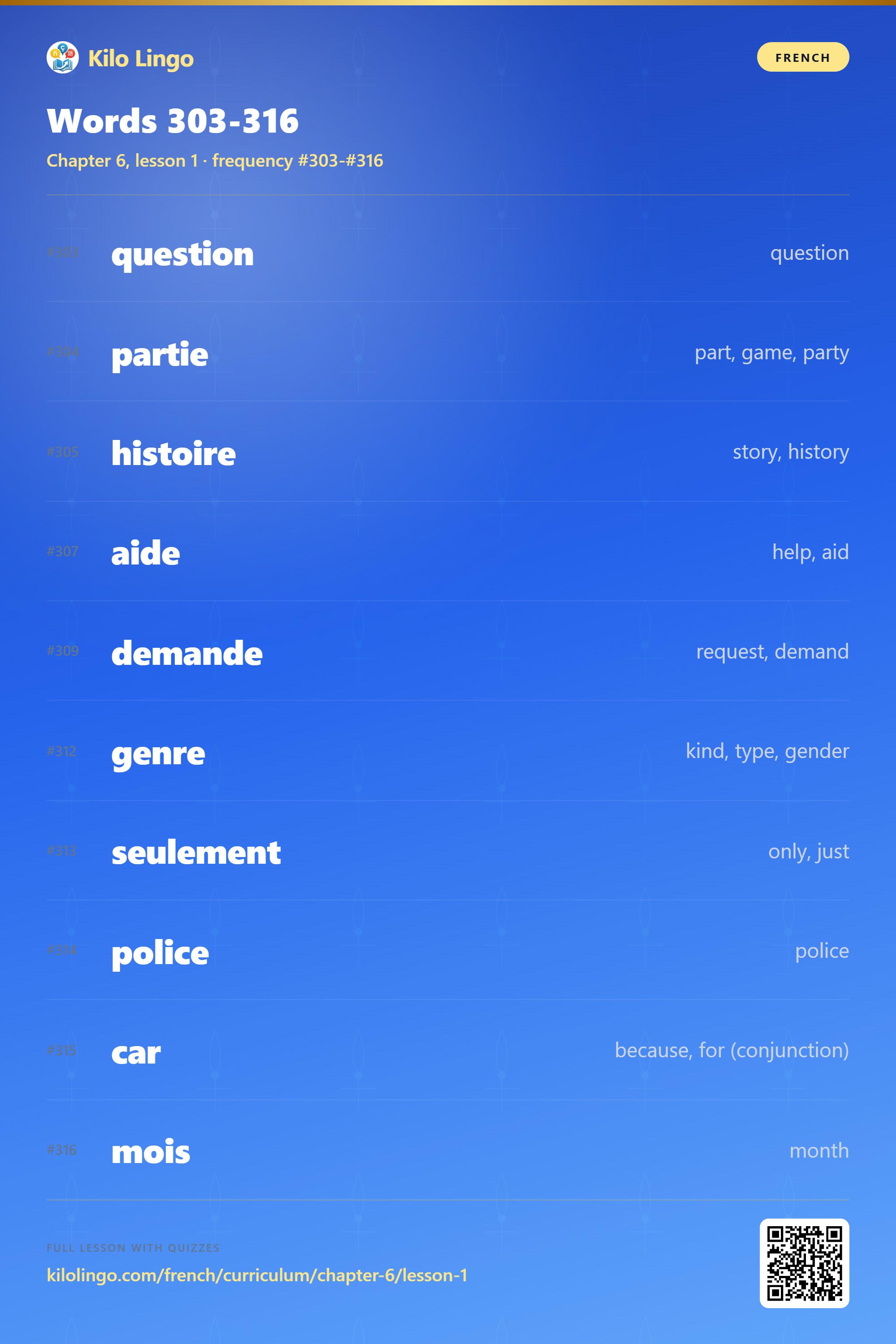
10 words · ranks 301-310
- Word Bubbles review sessionReview games
Pop the words you just met by matching each one to its meaning. A couple of rounds and the batch is yours.
- Words 311-320Vocabulary
10 words · ranks 311-320
- Conjugation Sprint review sessionReview games
Sixty seconds on the endings of the verbs this chapter has drilled so far.
- Words 321-330Vocabulary
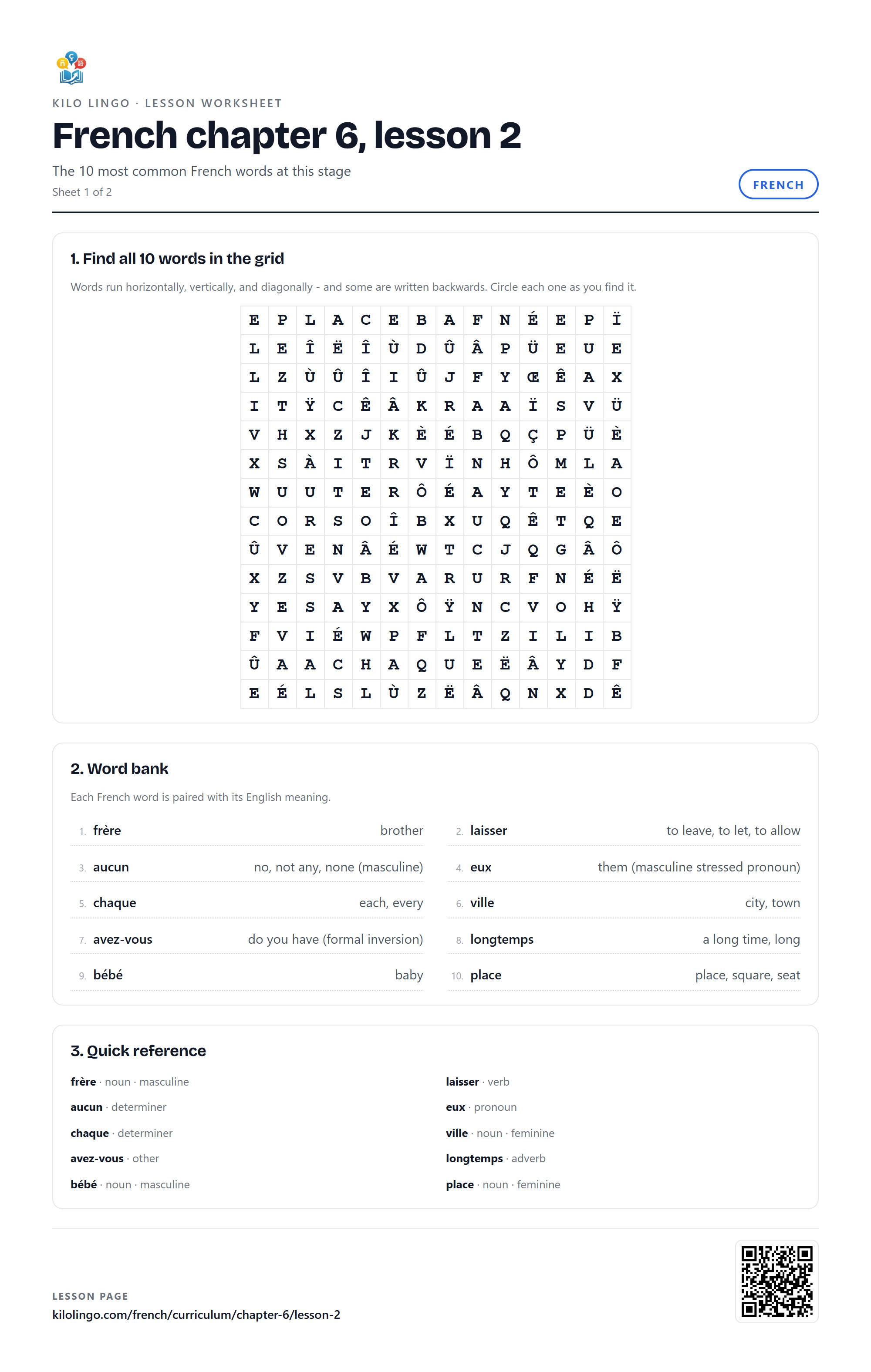
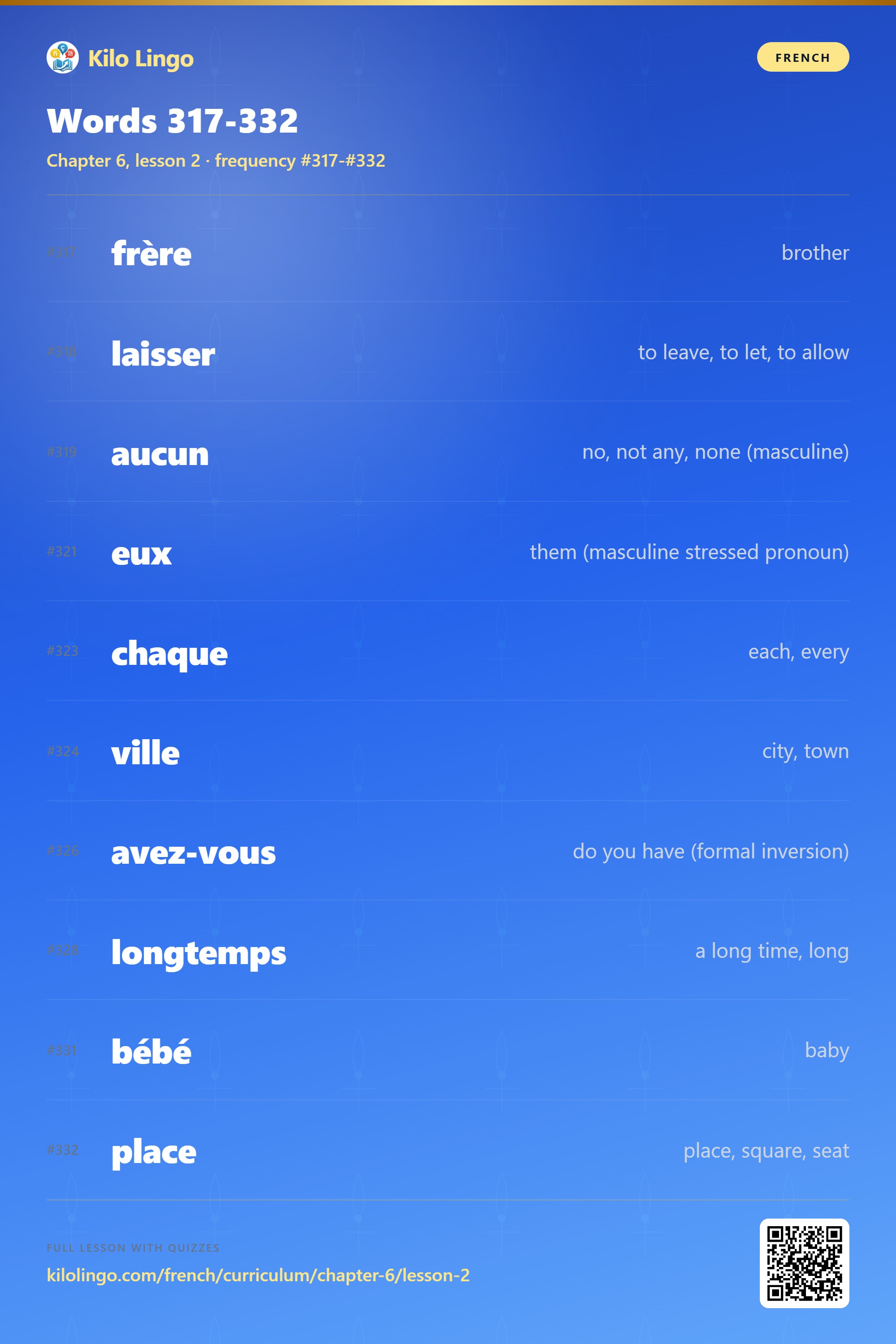
10 words · ranks 321-330
- Word Bubbles review sessionReview games
Pop the words you just met by matching each one to its meaning. A couple of rounds and the batch is yours.
- Words 331-340Vocabulary
10 words · ranks 331-340
- Conjugation Sprint review sessionReview games
Sixty seconds on the endings of the verbs this chapter has drilled so far.
- Words 341-350Vocabulary
10 words · ranks 341-350
- Word Bubbles review sessionReview games
Pop the words you just met by matching each one to its meaning. A couple of rounds and the batch is yours.
- Words 351-360Vocabulary
10 words · ranks 351-360
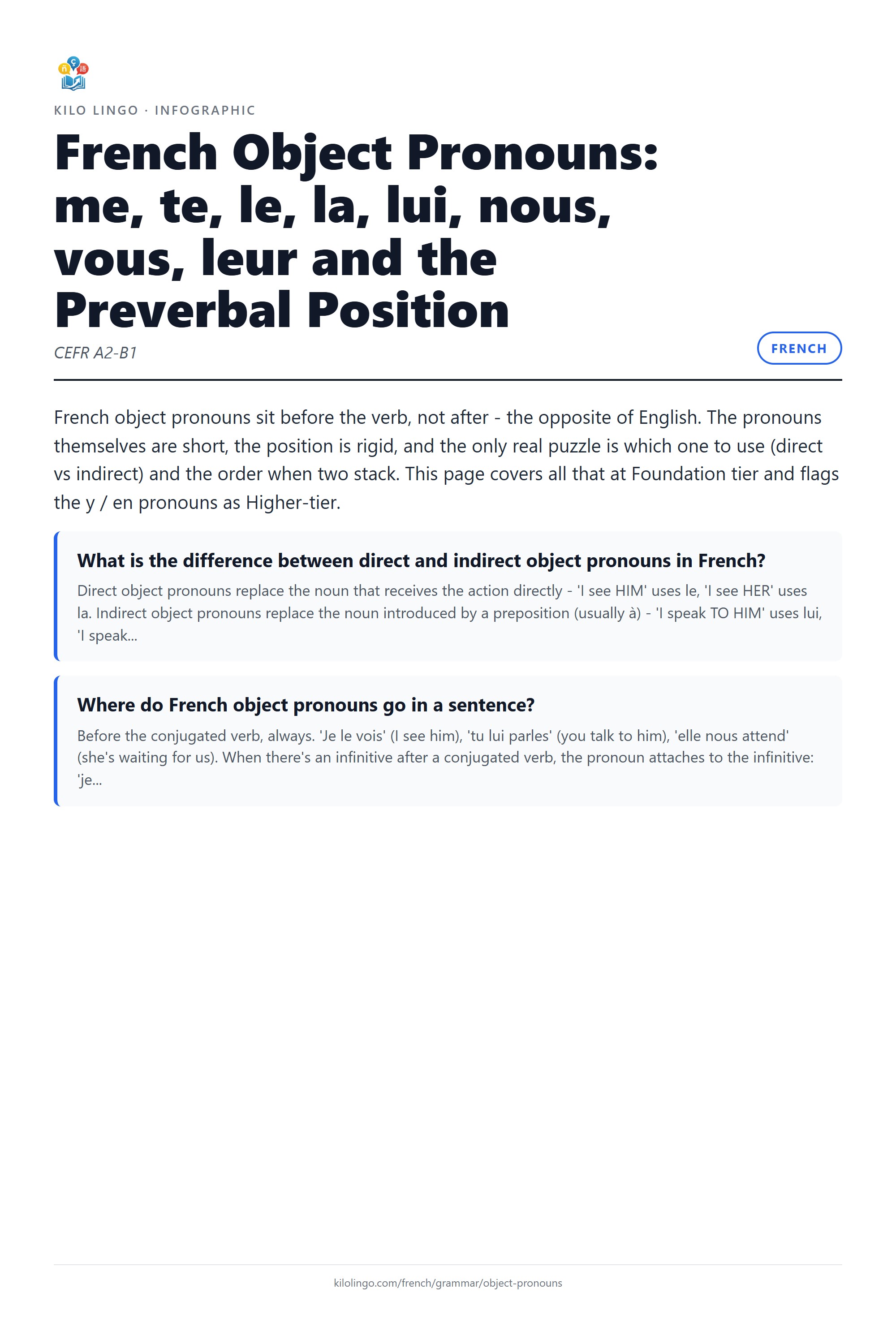
me, te, le, la, lui, nous, vous, leur - the words that replace 'him', 'her', 'it' and 'to him/her'. Preverbal position, the m'/t'/l' elision, and the order when two pronouns stack.
- Words 361-370Vocabulary
10 words · ranks 361-370
- Conjugation Sprint review sessionReview games
Sixty seconds on the endings of the verbs this chapter has drilled so far.
- Words 371-380Vocabulary
10 words · ranks 371-380
- Word Bubbles review sessionReview games
Pop the words you just met by matching each one to its meaning. A couple of rounds and the batch is yours.
- Words 381-390Vocabulary
10 words · ranks 381-390
- Conjugation Sprint review sessionReview games
Sixty seconds on the endings of the verbs this chapter has drilled so far.
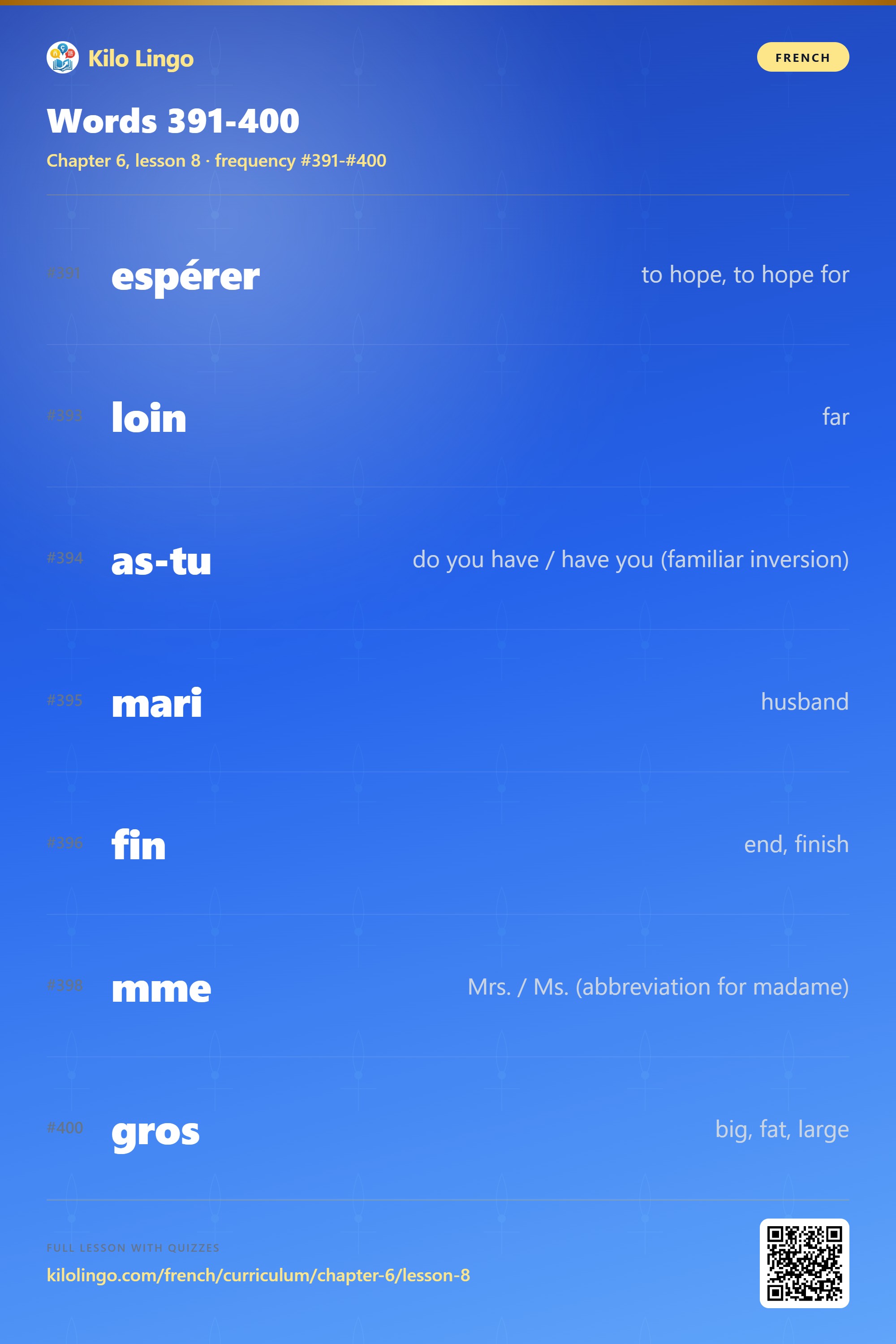
- Words 391-400Vocabulary
10 words · ranks 391-400
Play it, read along word by word, then answer the questions. Every word is at your level - the song page teaches the few that are new.
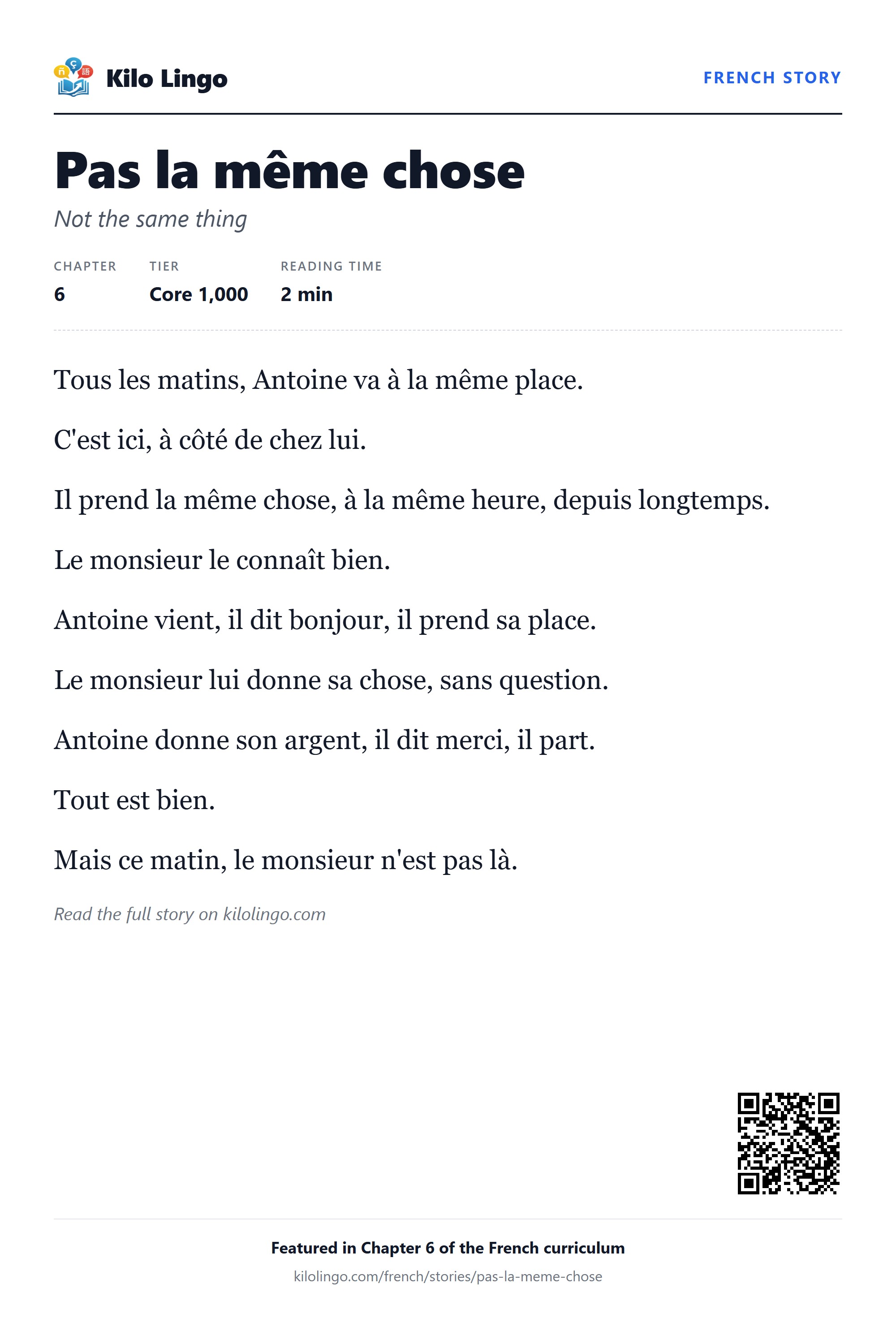
- Story milestone: top 400 wordsGraded-reader story
You can read this story using only the words you've learned so far. Every content word sits at or above the rank-400 ceiling.
- Le temps qui passeThemed review
Days, hours and the words for when. You have been using these since chapter 2 without ever seeing them laid out together.
Join a French community and introduce yourself in a general channel - a great way to practise SPEAKING without leaving the house.
- an or année?Mistake clinic
French has two words for year, two for day, two for morning and two for evening. One rule covers all four pairs.
- Arcade reviewReview games
Replay this chapter's words as games - a different kind of repetition, and it counts.
Word printables
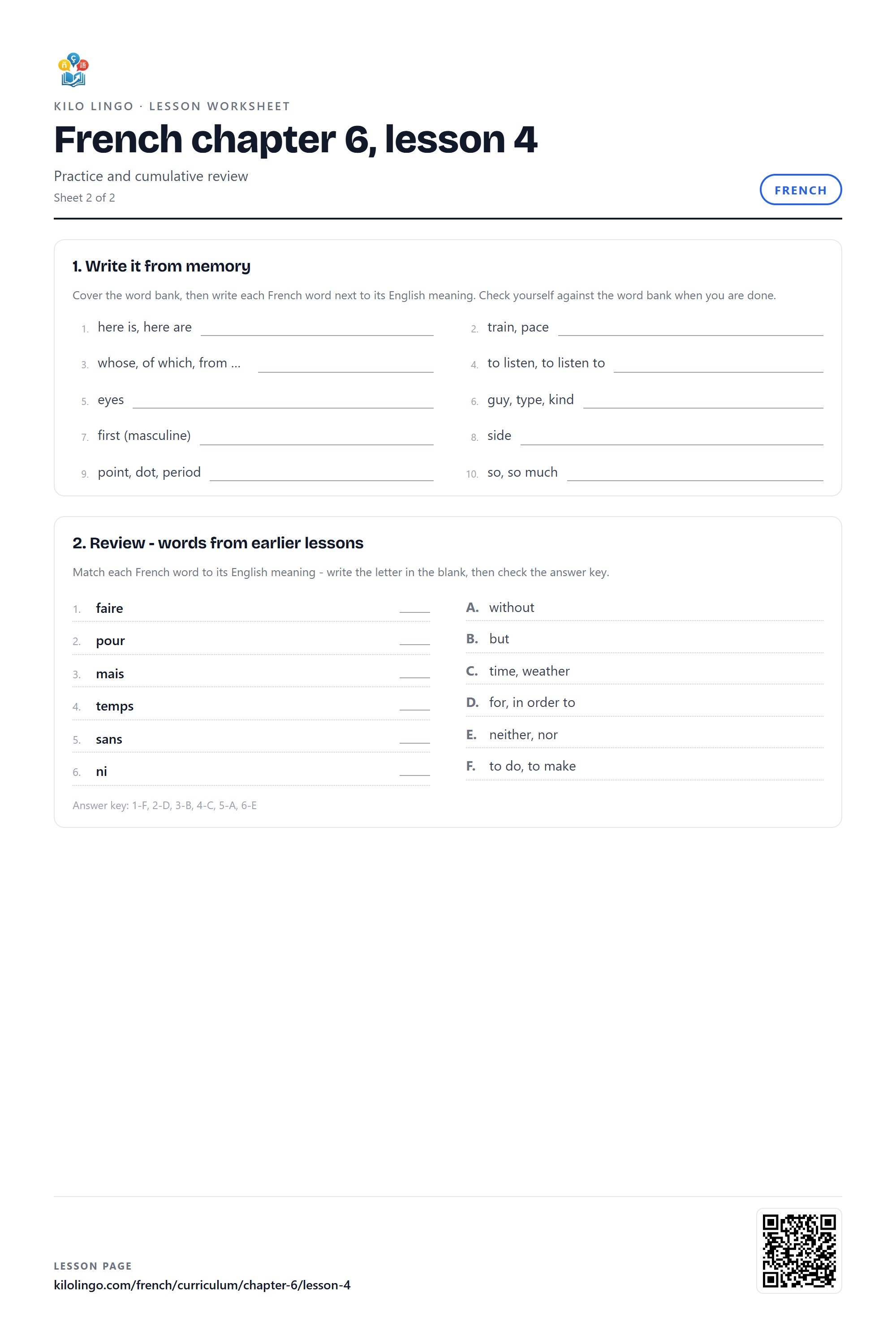
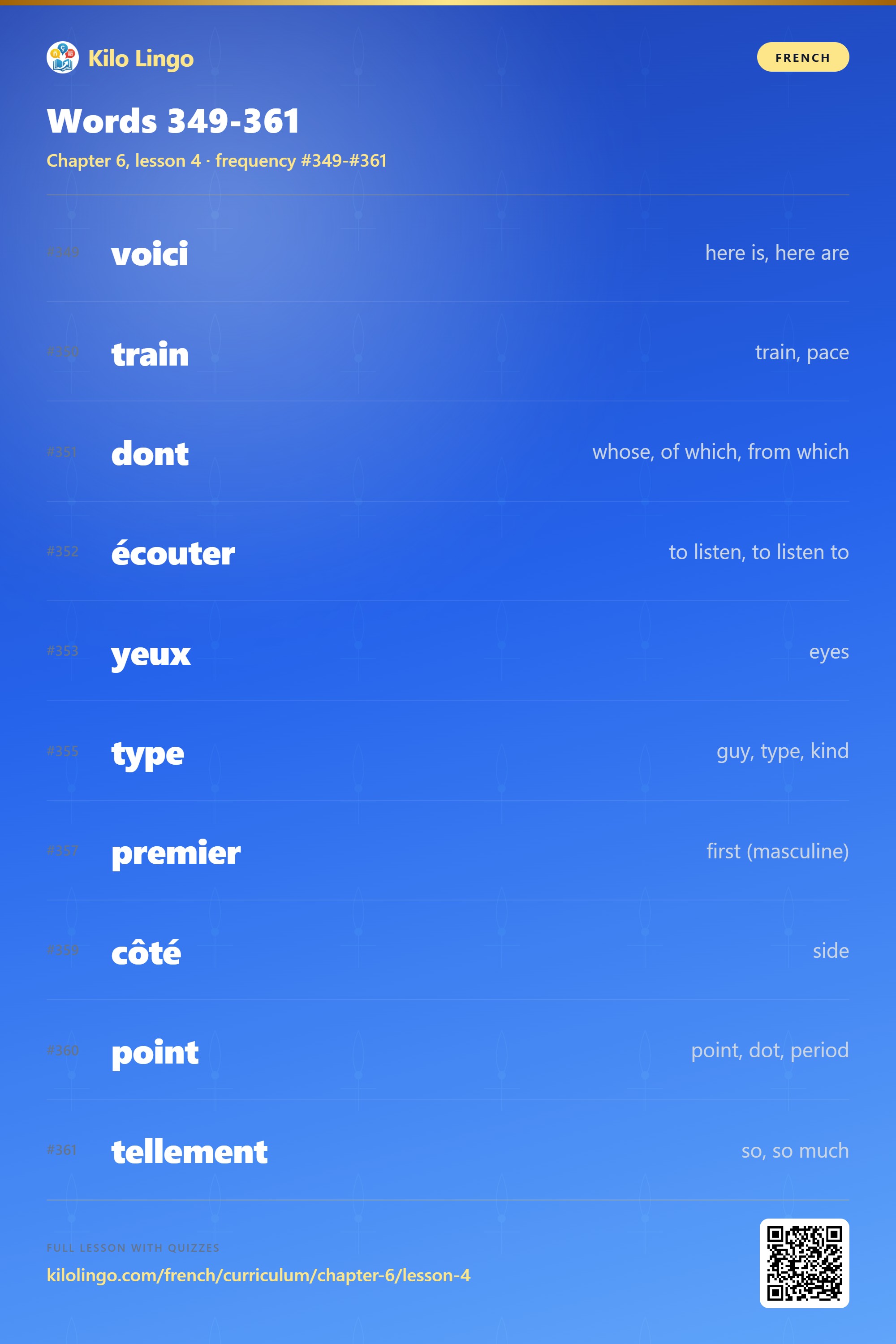
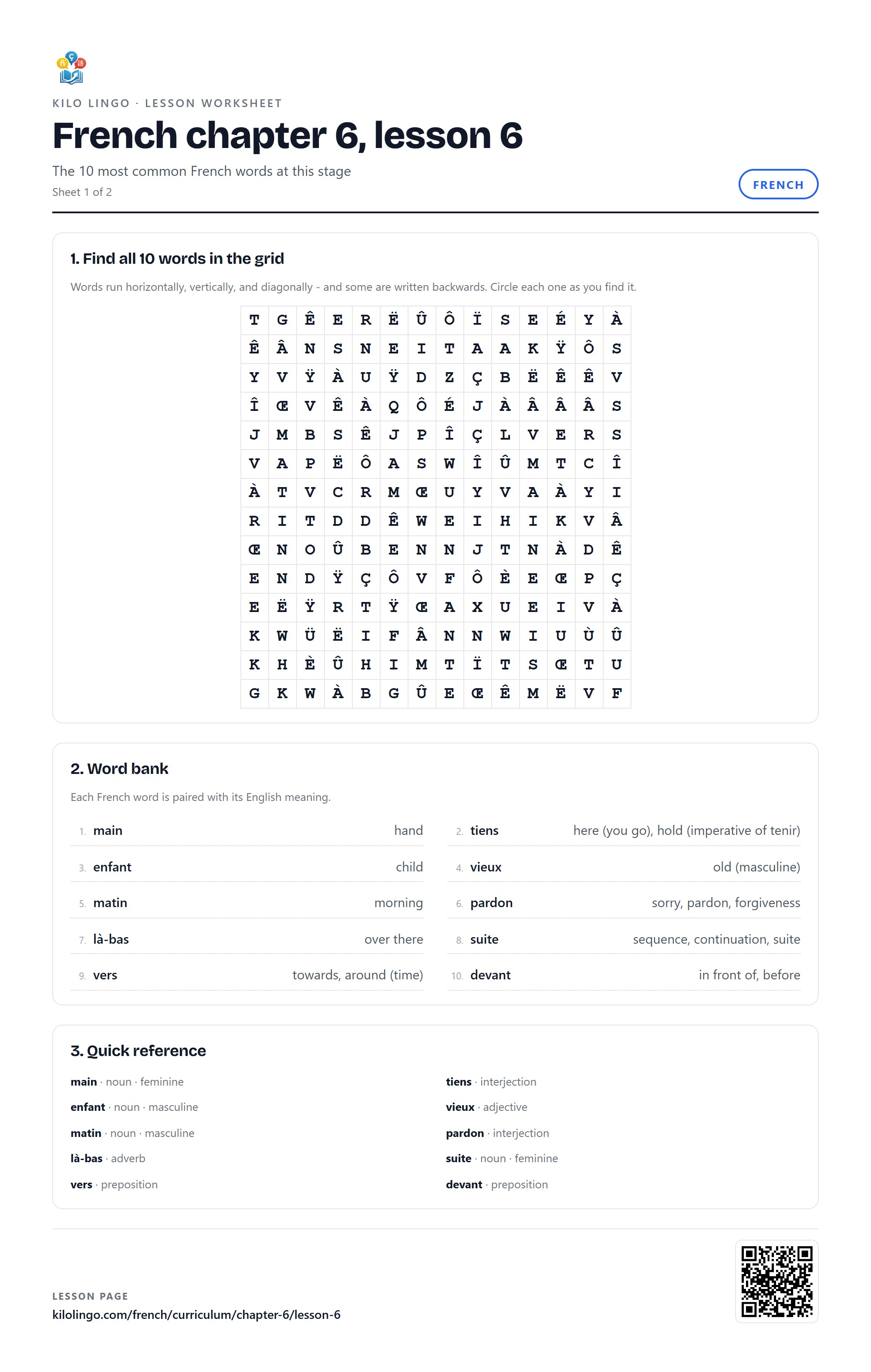
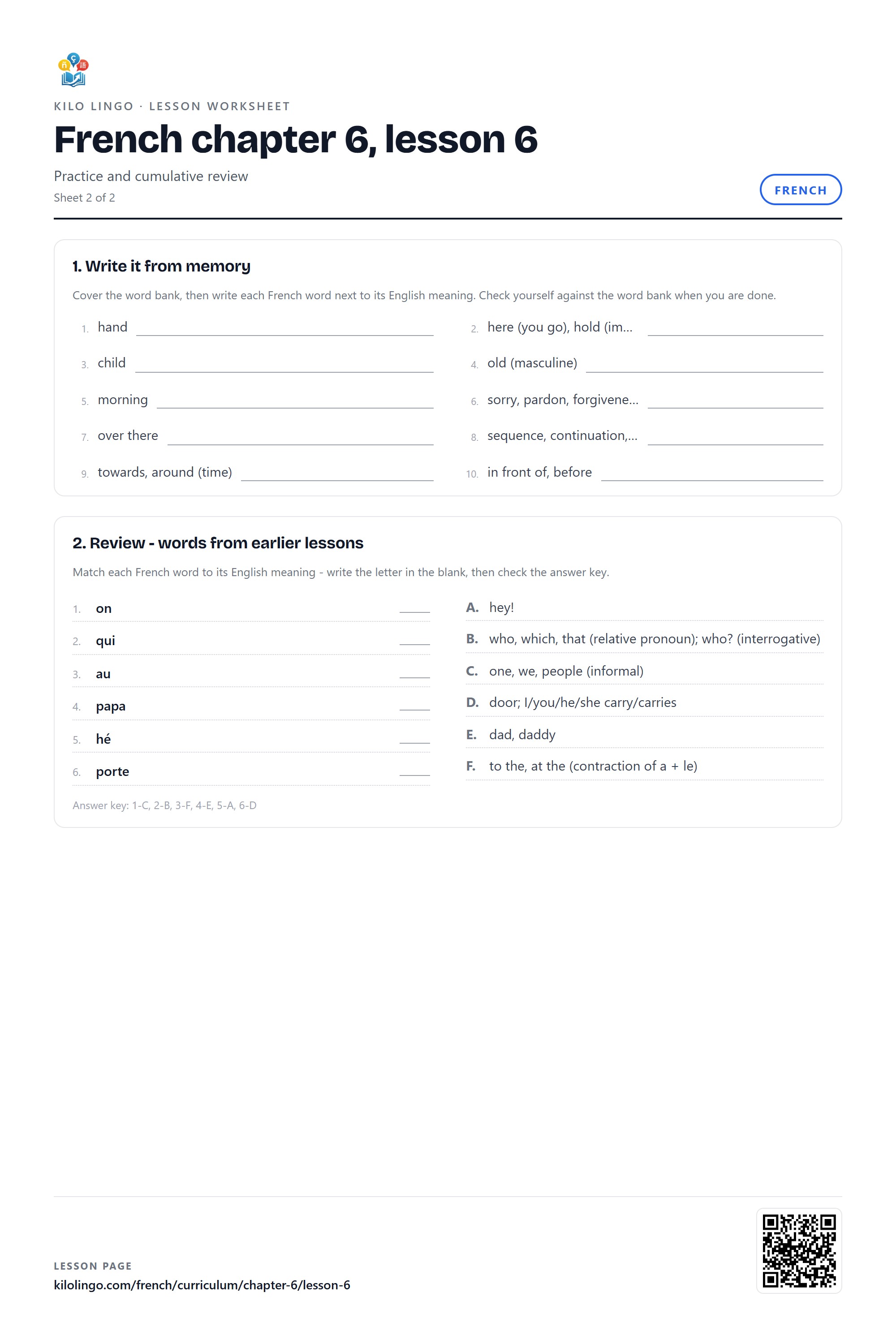
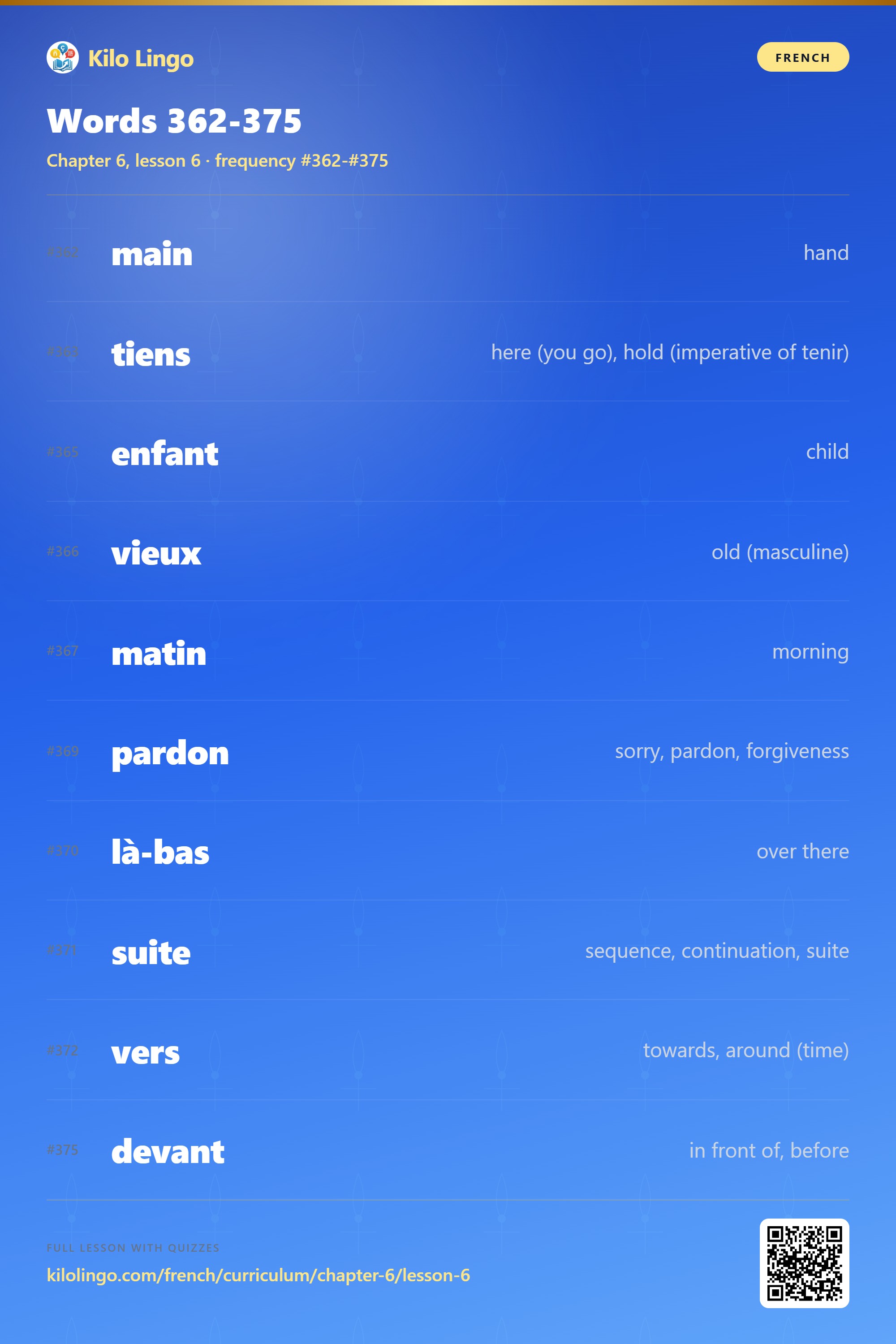
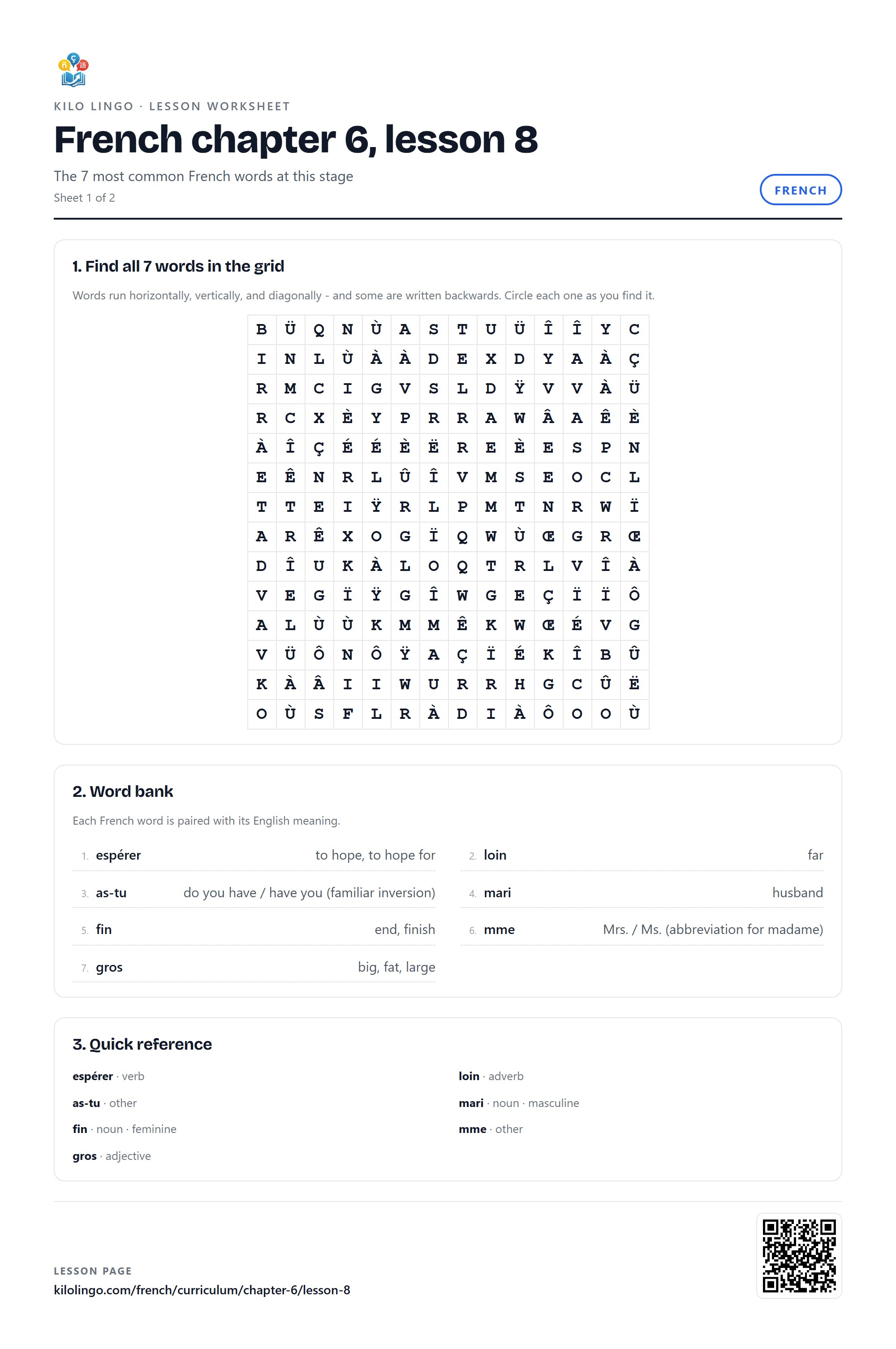
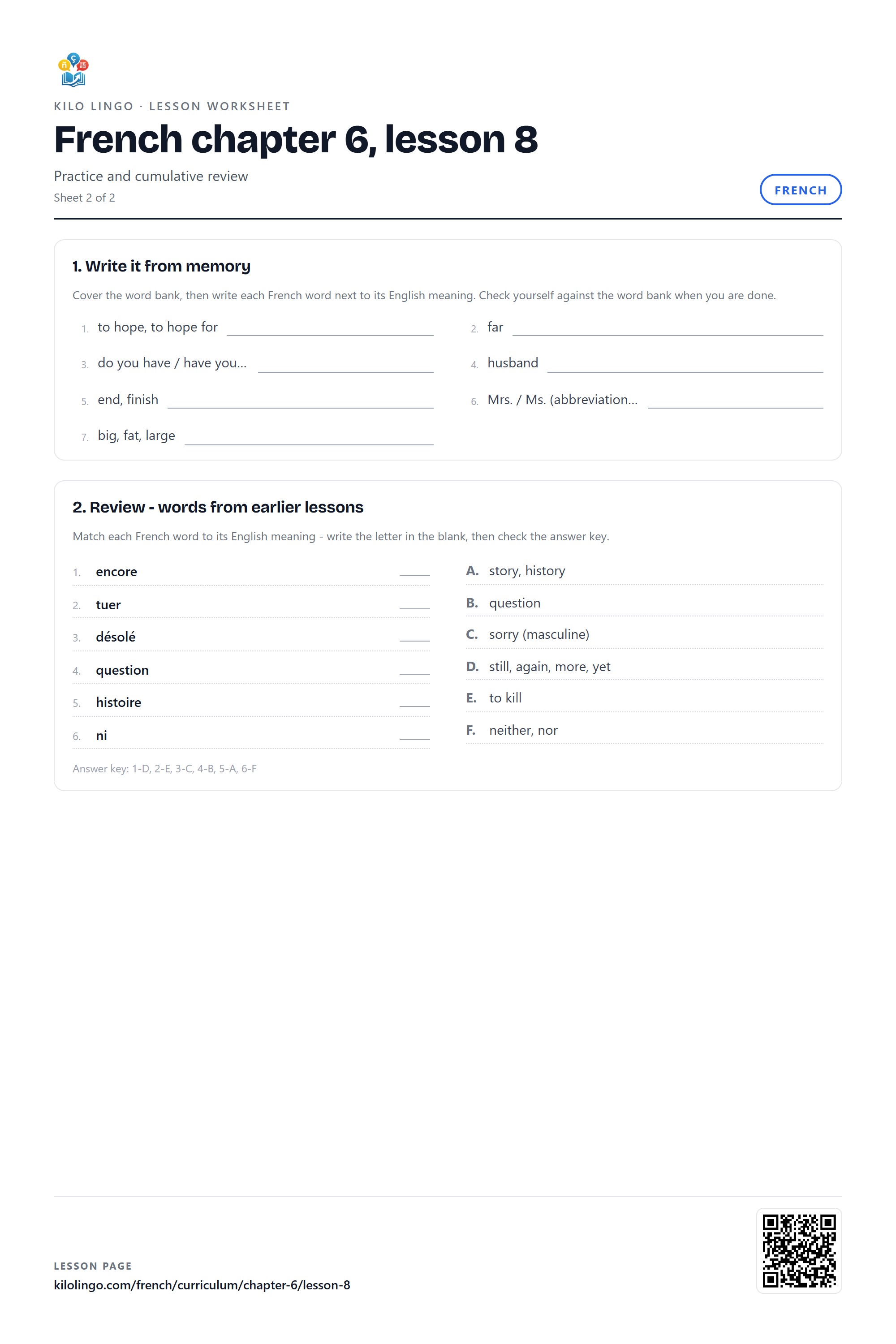
Per-word sheets100 words · a worksheet, infographic and listicle each


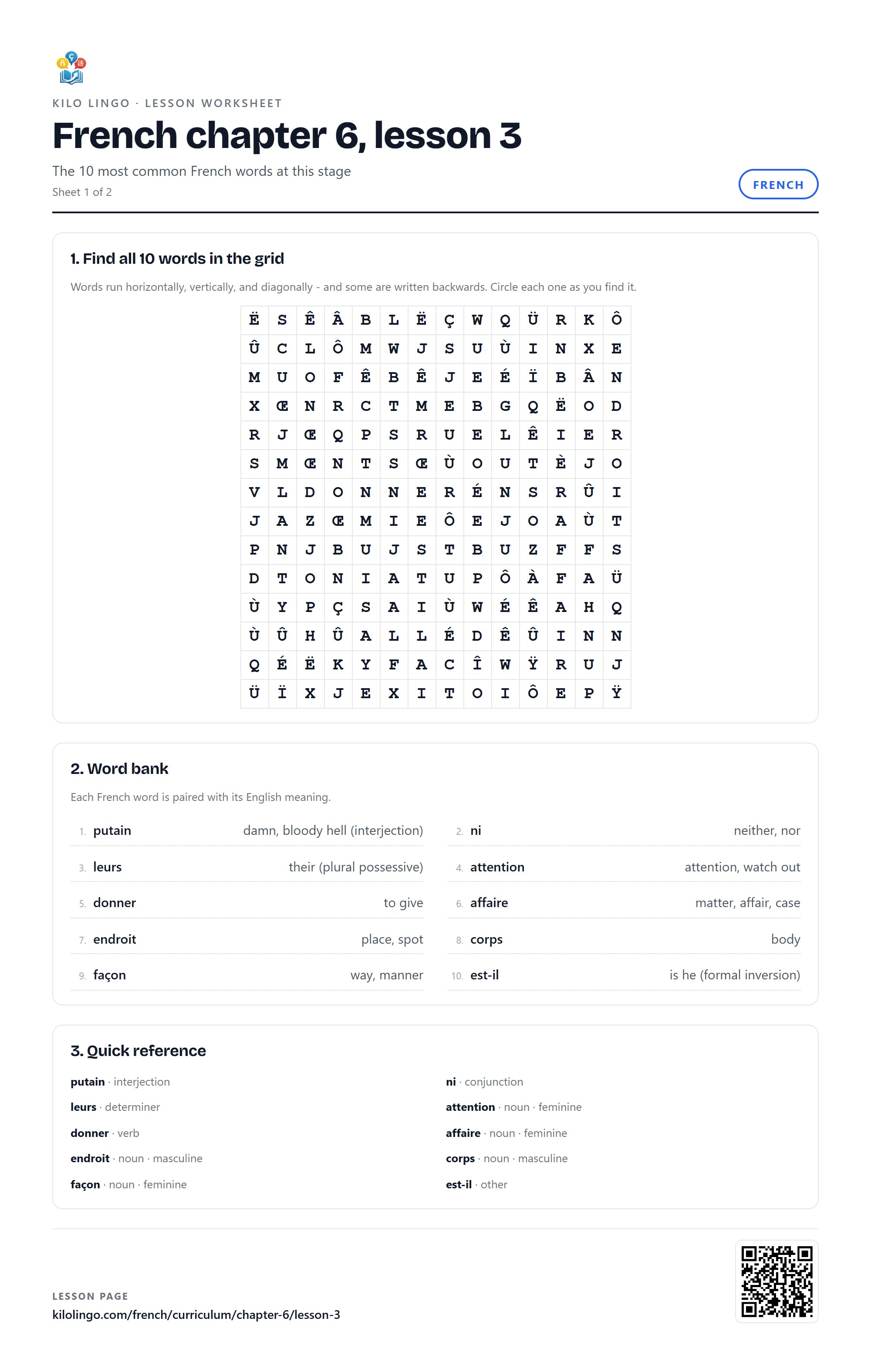
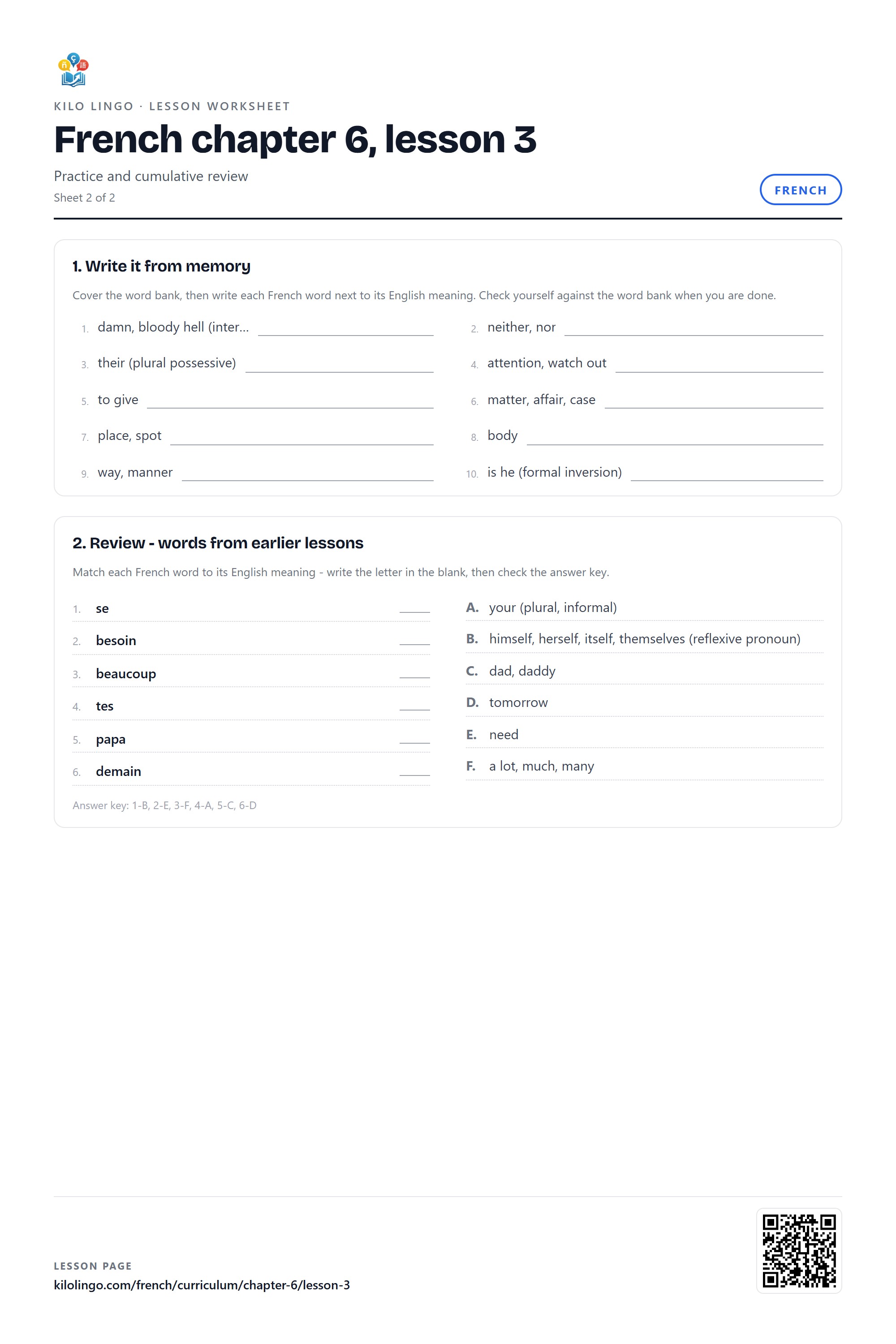

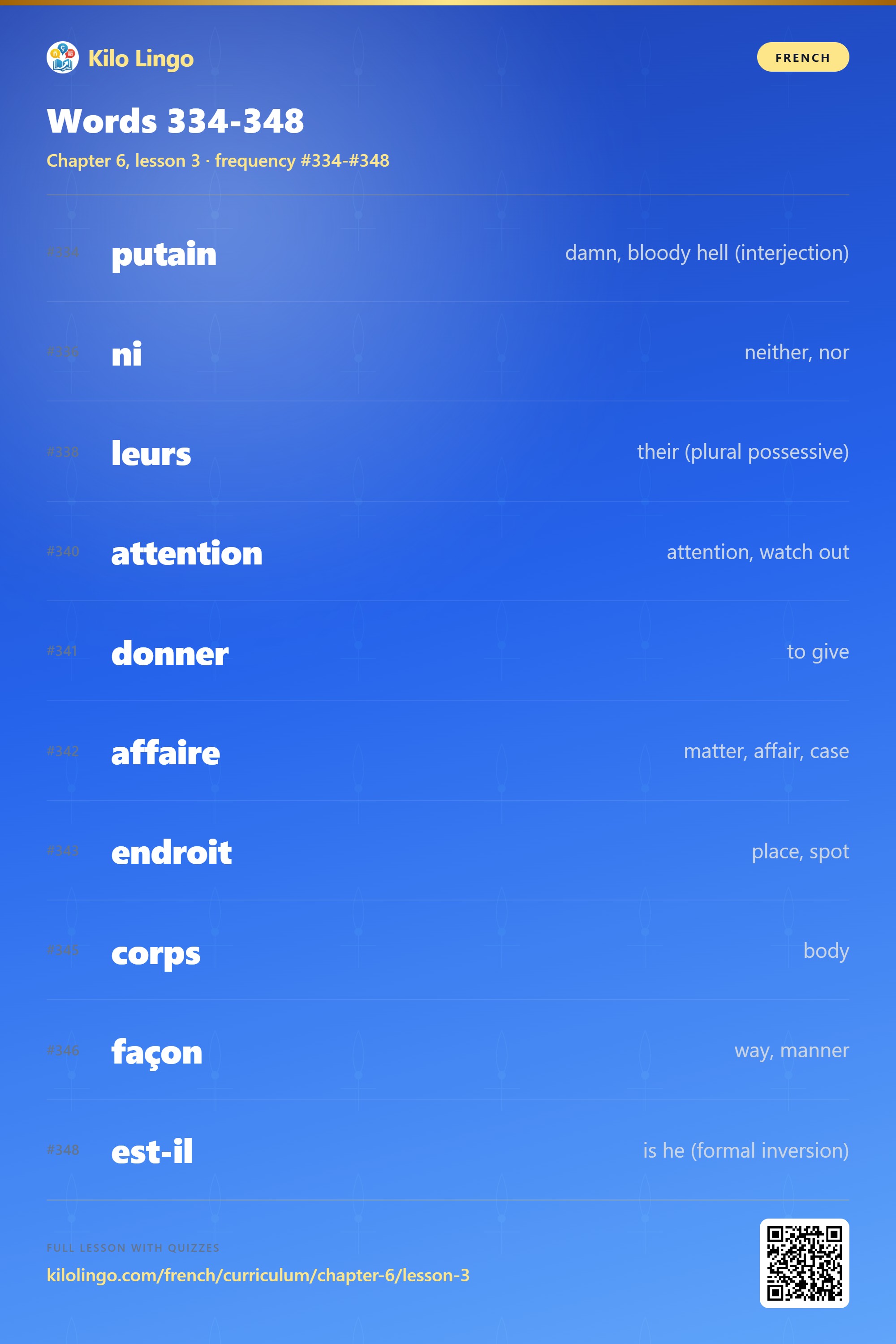
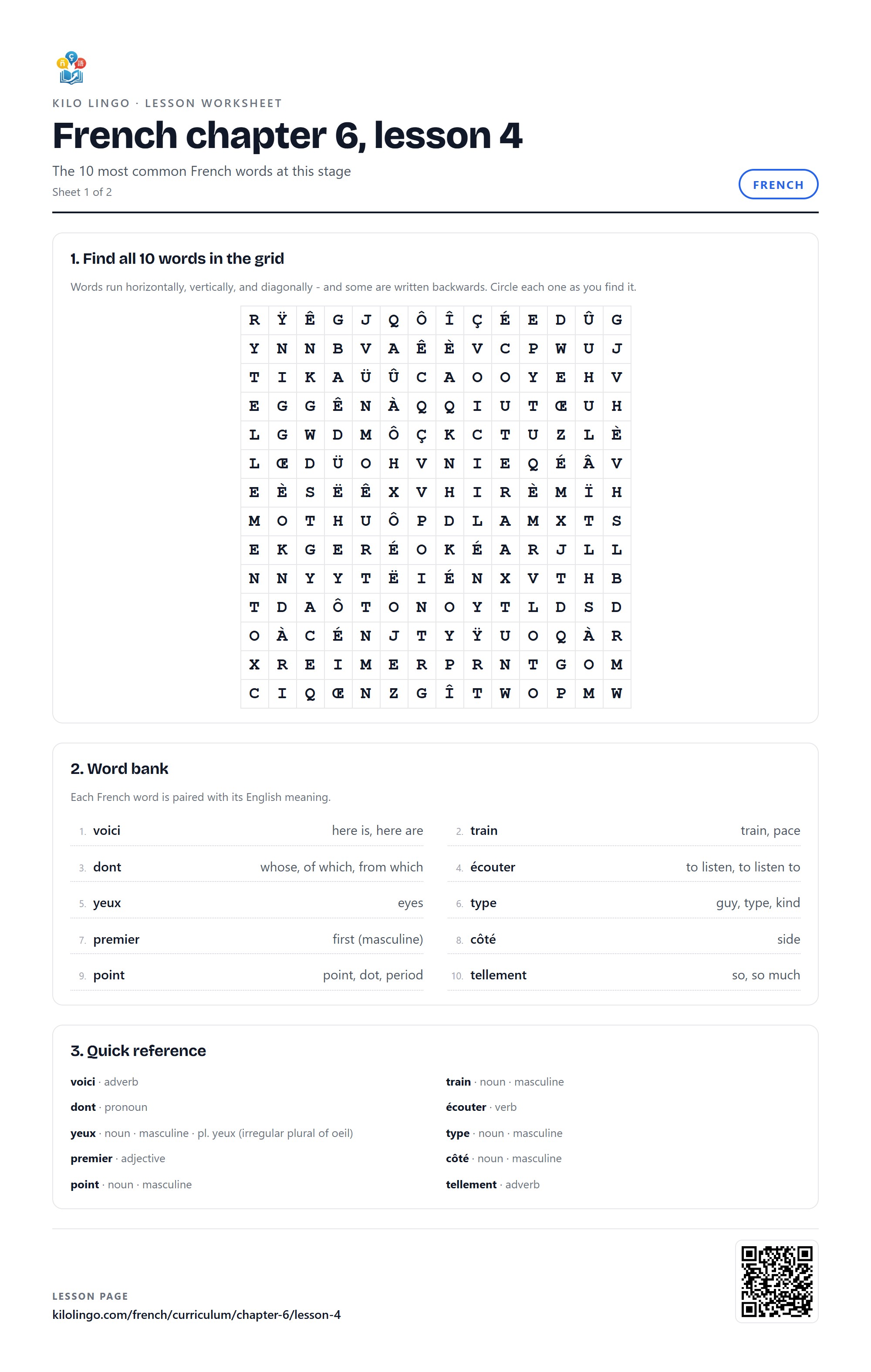



Chapter 7 · Reflexive verbs
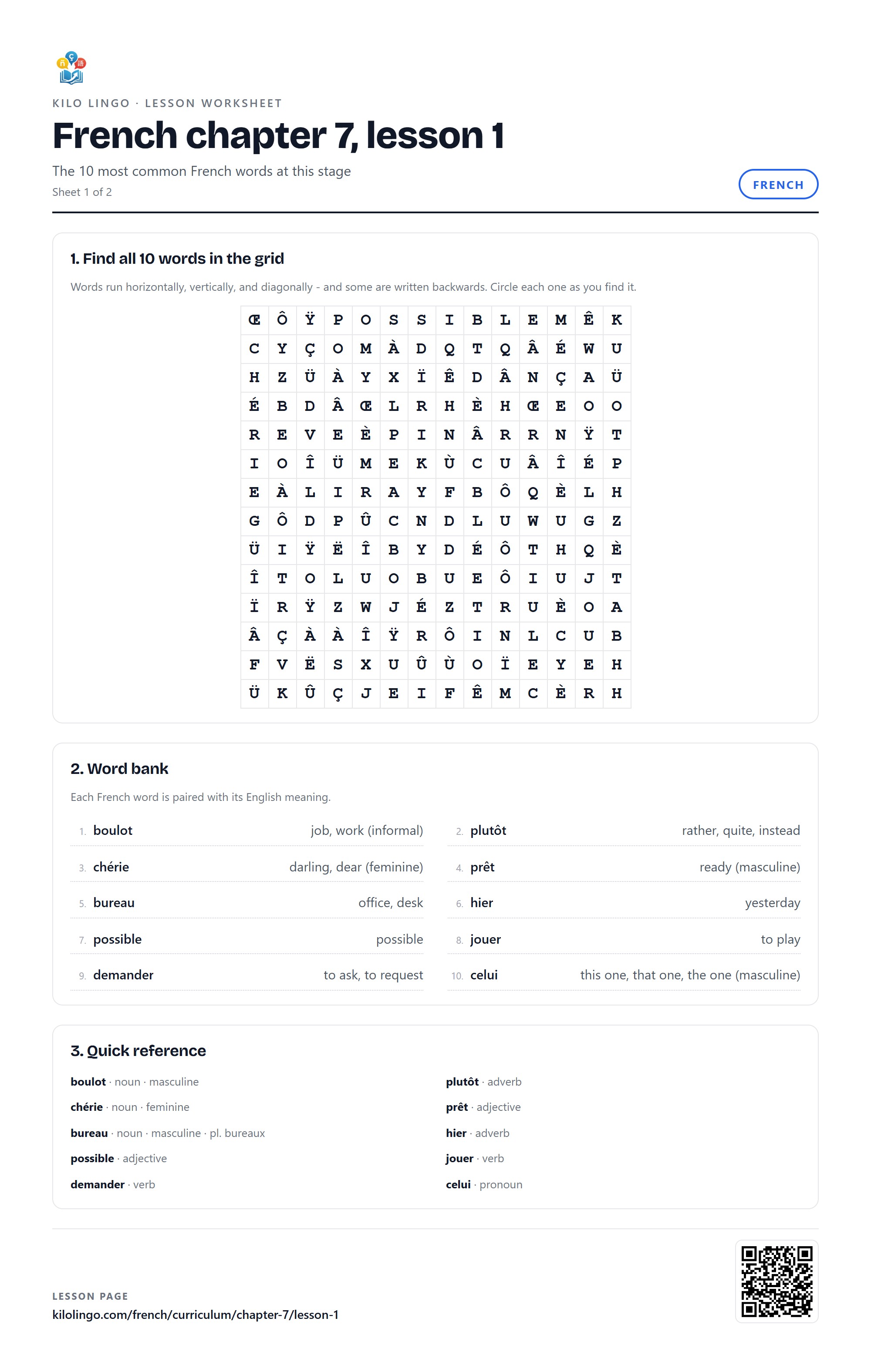
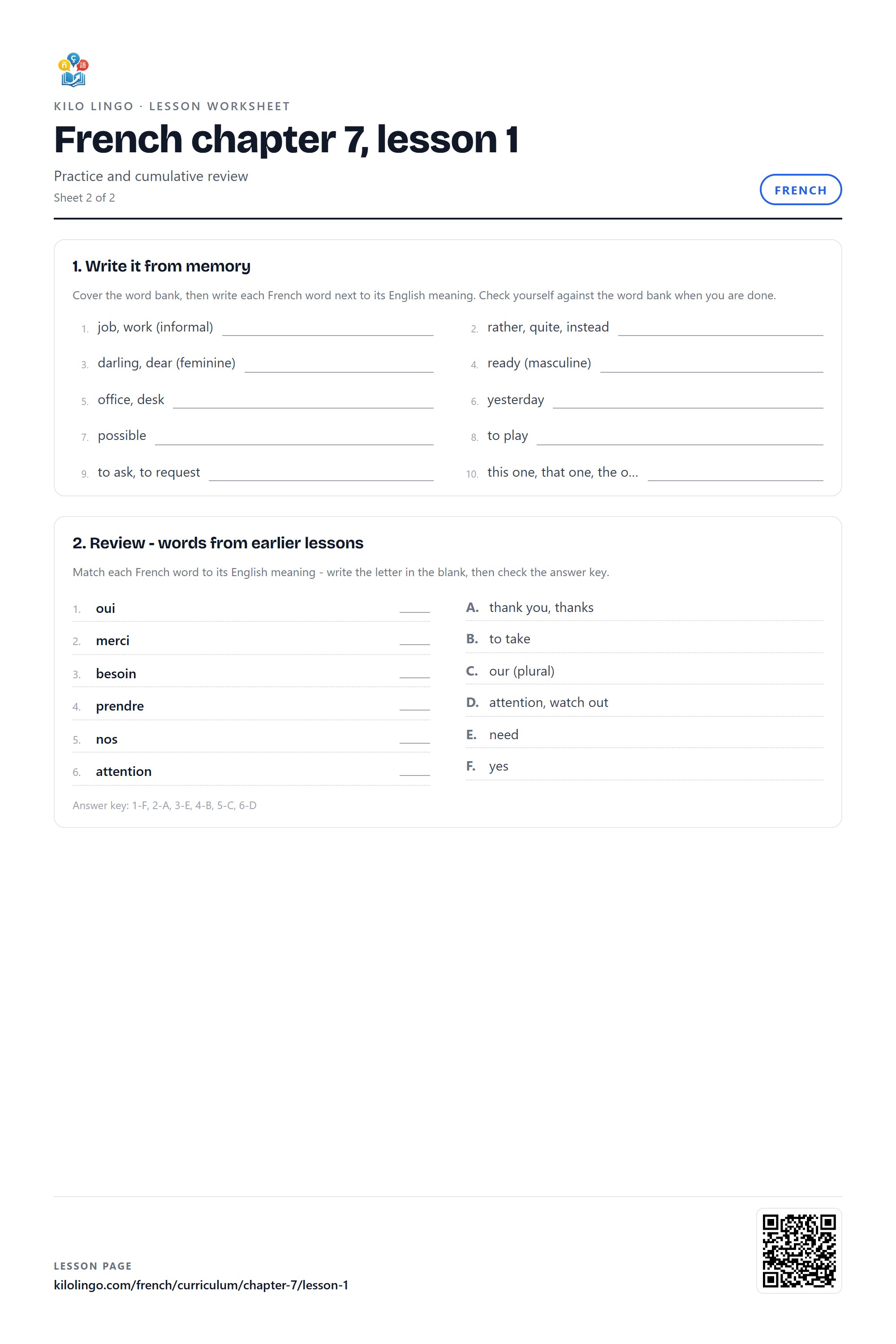
Chapter page →- Words 401-410Vocabulary
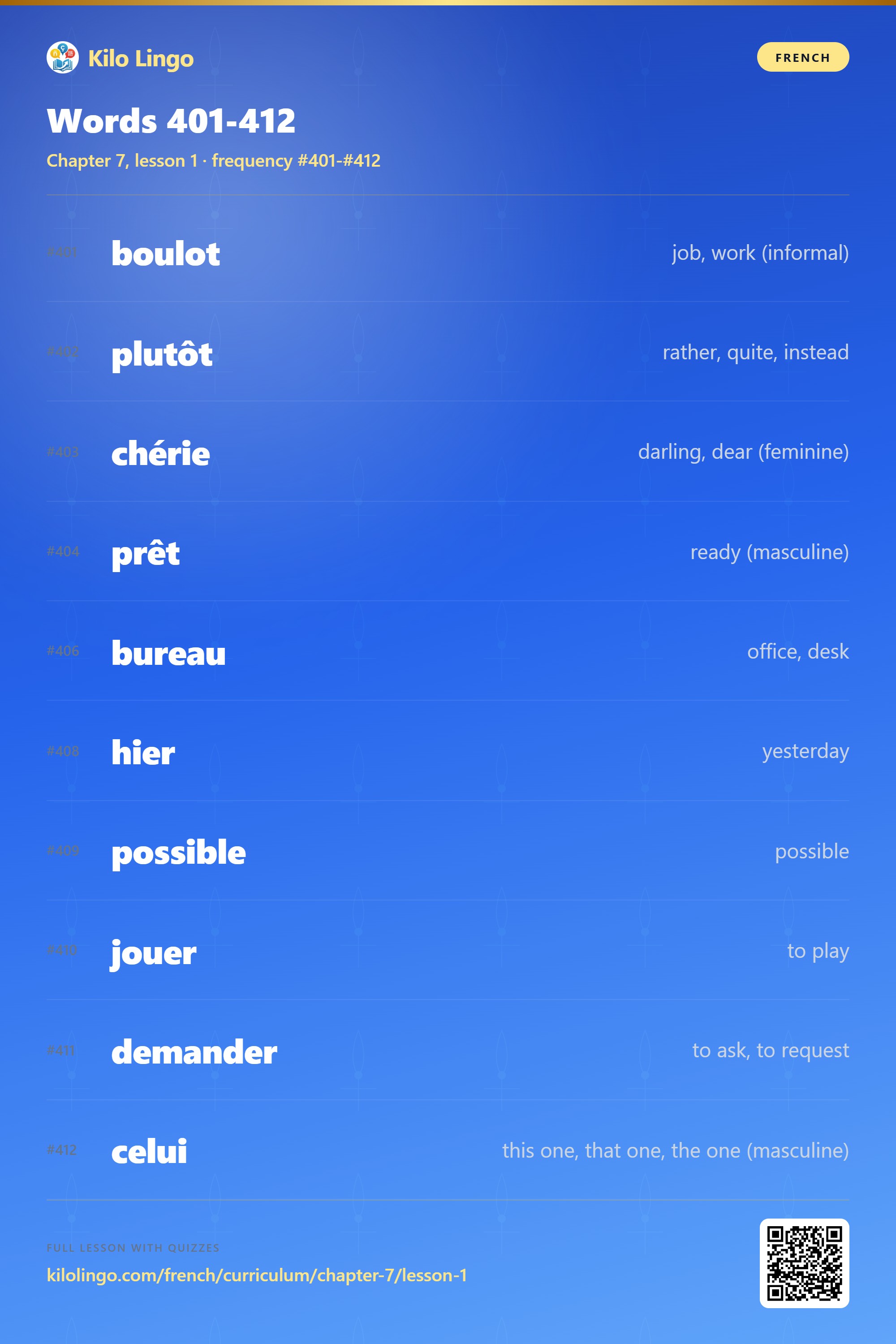
10 words · ranks 401-410
- Crossword review sessionReview games
Cross the words you just met, clued in English. Slower than a drill, and it sticks harder.
- Words 412-421Vocabulary
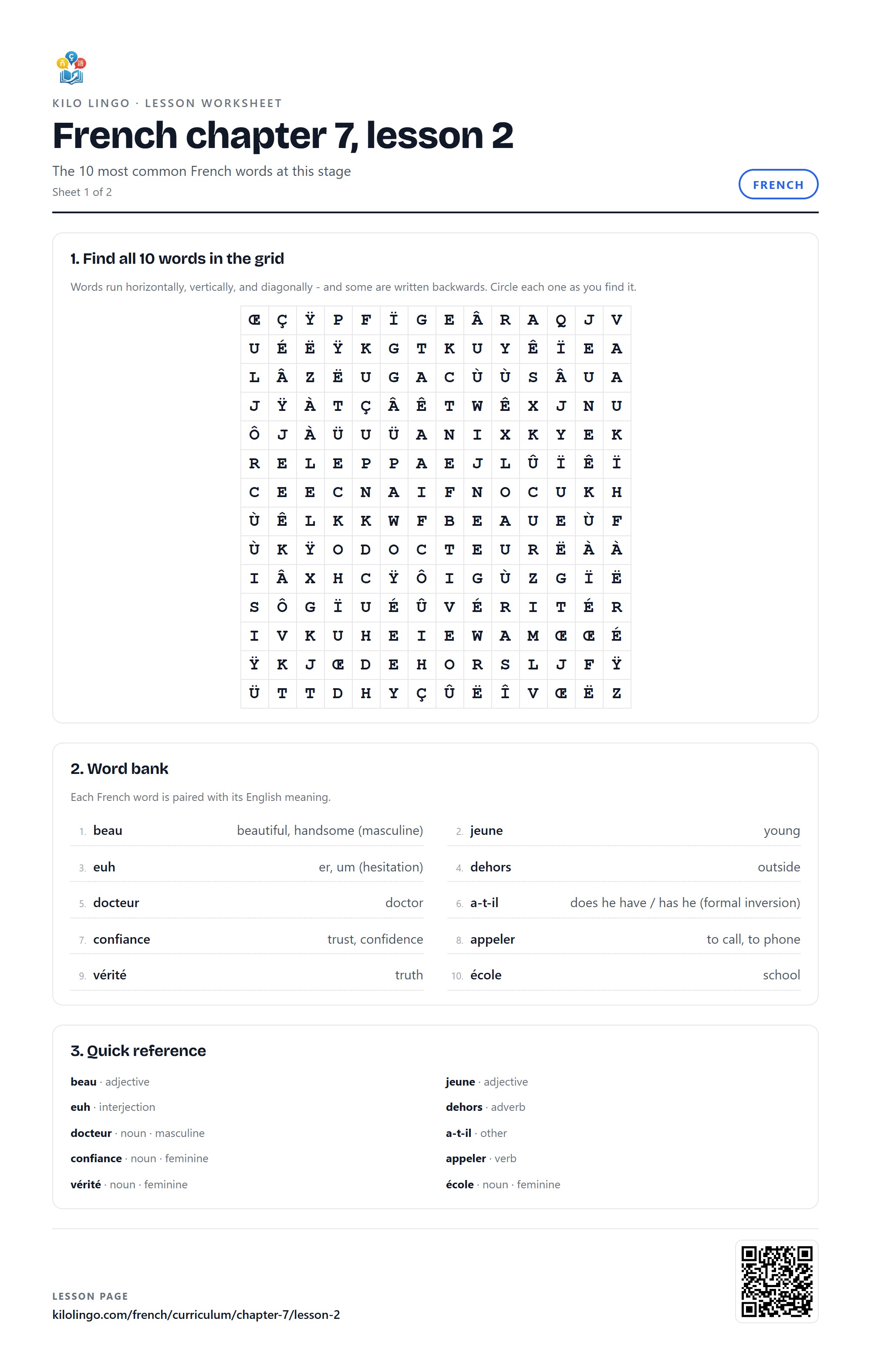
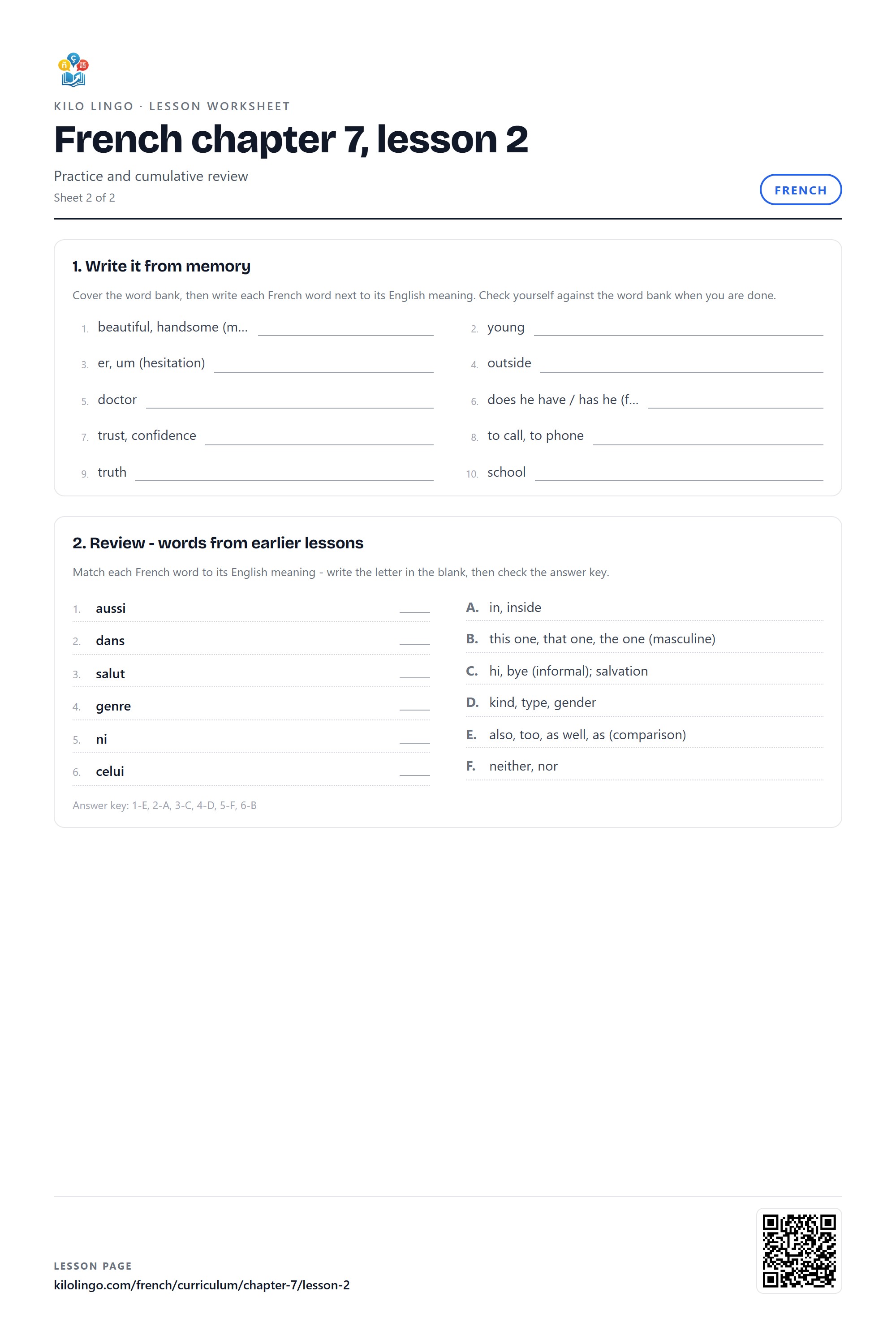
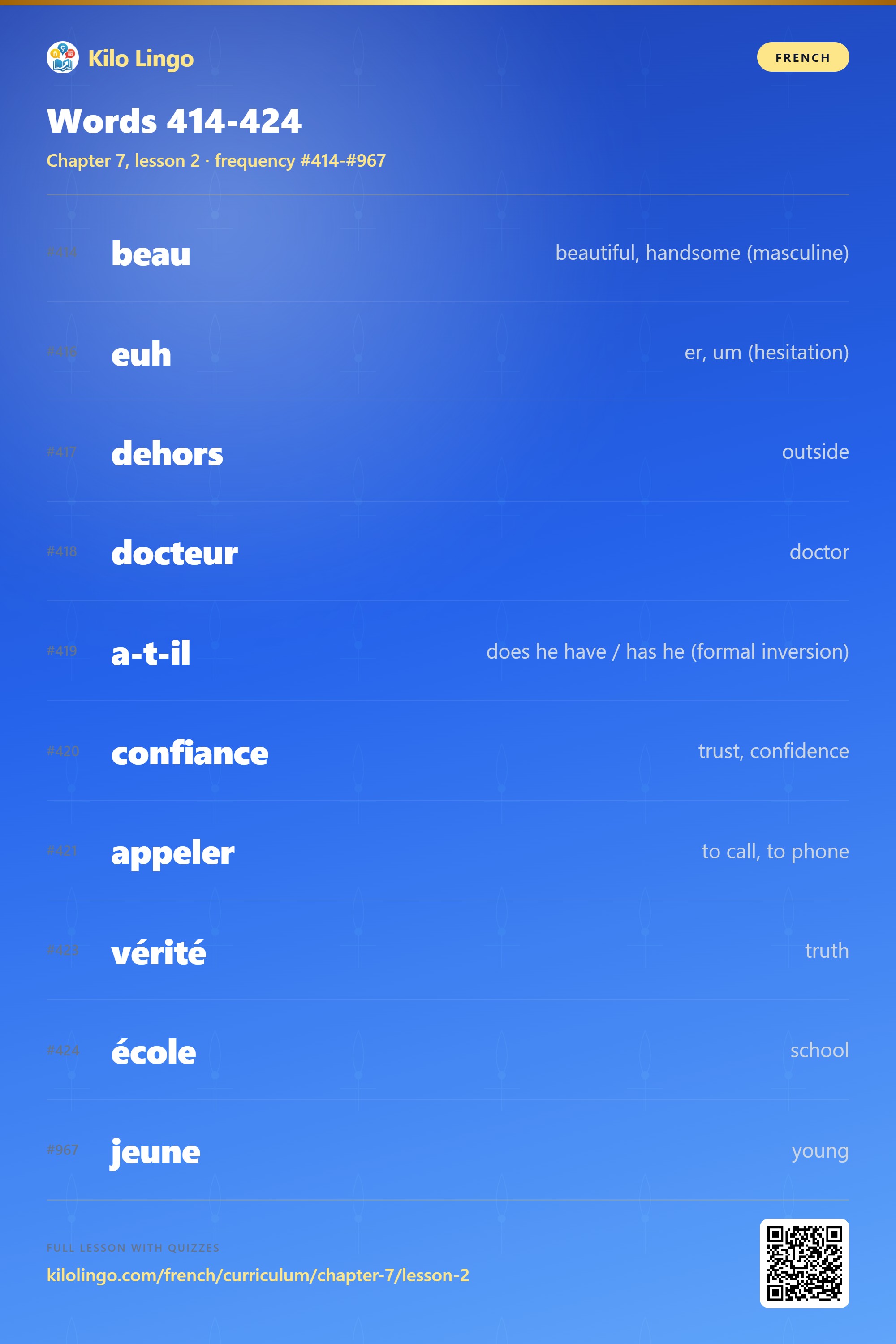
10 words · ranks 412-421
- Word Bubbles review sessionReview games
Pop the words you just met by matching each one to its meaning. A couple of rounds and the batch is yours.
- Words 422-431Vocabulary
10 words · ranks 422-431
- Reflexive verbsGrammar
Verbs where the subject acts on itself: se laver, se lever, s'appeler, se coucher. The me / te / se pronouns, present-tense use, and a flag that compound tenses need etre.
- Words 432-441Vocabulary
10 words · ranks 432-441
- entendre or écouter?Mistake clinic
The same distinction as voir and regarder, moved to the ears.
- Words 442-451Vocabulary
10 words · ranks 442-451
- Conjugation Sprint review sessionReview games
Sixty seconds on the endings of the verbs this chapter has drilled so far.
- Words 452-461Vocabulary
10 words · ranks 452-461
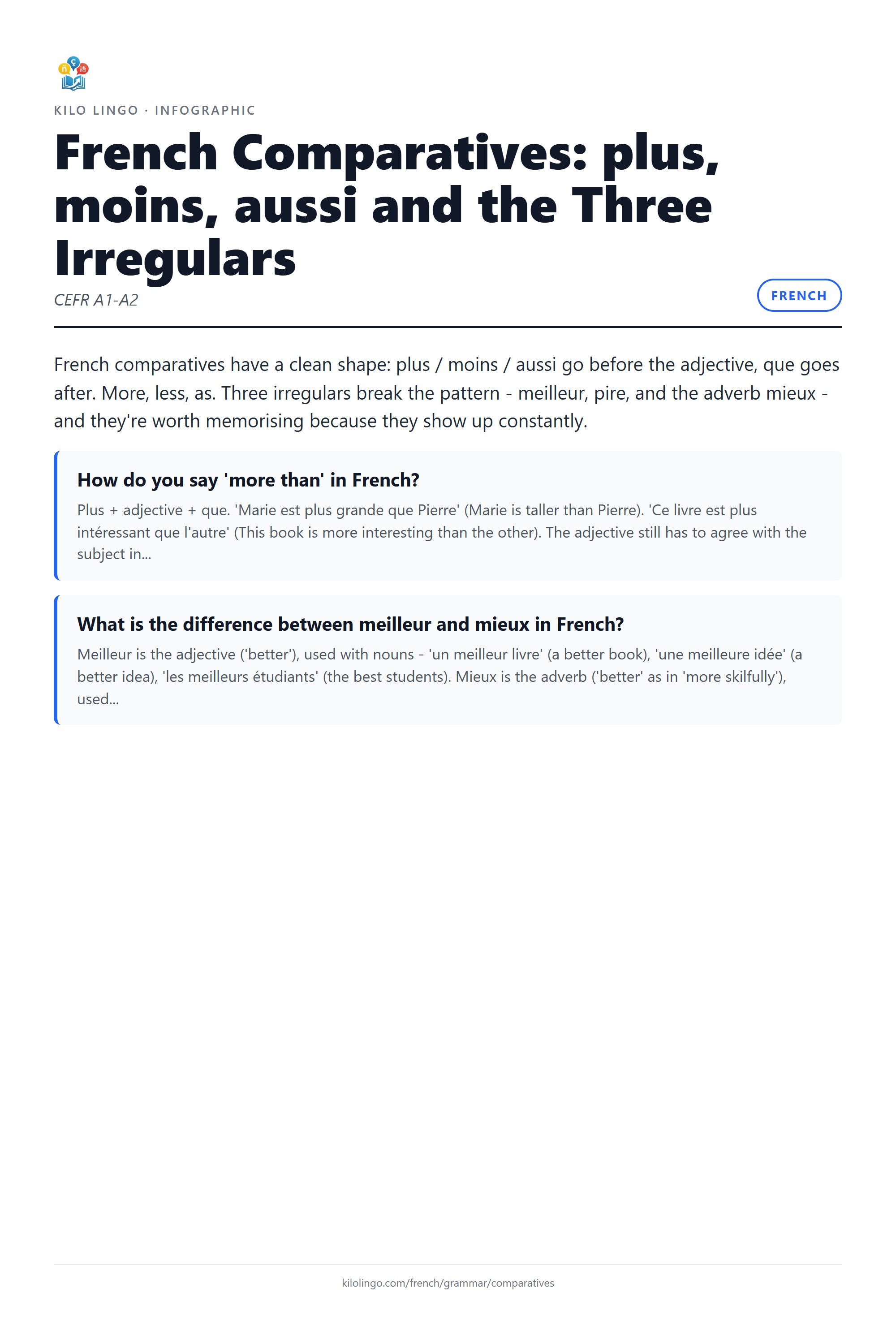
- ComparativesGrammar
plus / moins / aussi + adjective + que. The three irregulars meilleur (better), pire (worse), and mieux (the adverb).
- Words 462-471Vocabulary
10 words · ranks 462-471
- Word Bubbles review sessionReview games
Pop the words you just met by matching each one to its meaning. A couple of rounds and the batch is yours.
- Words 472-481Vocabulary
10 words · ranks 472-481
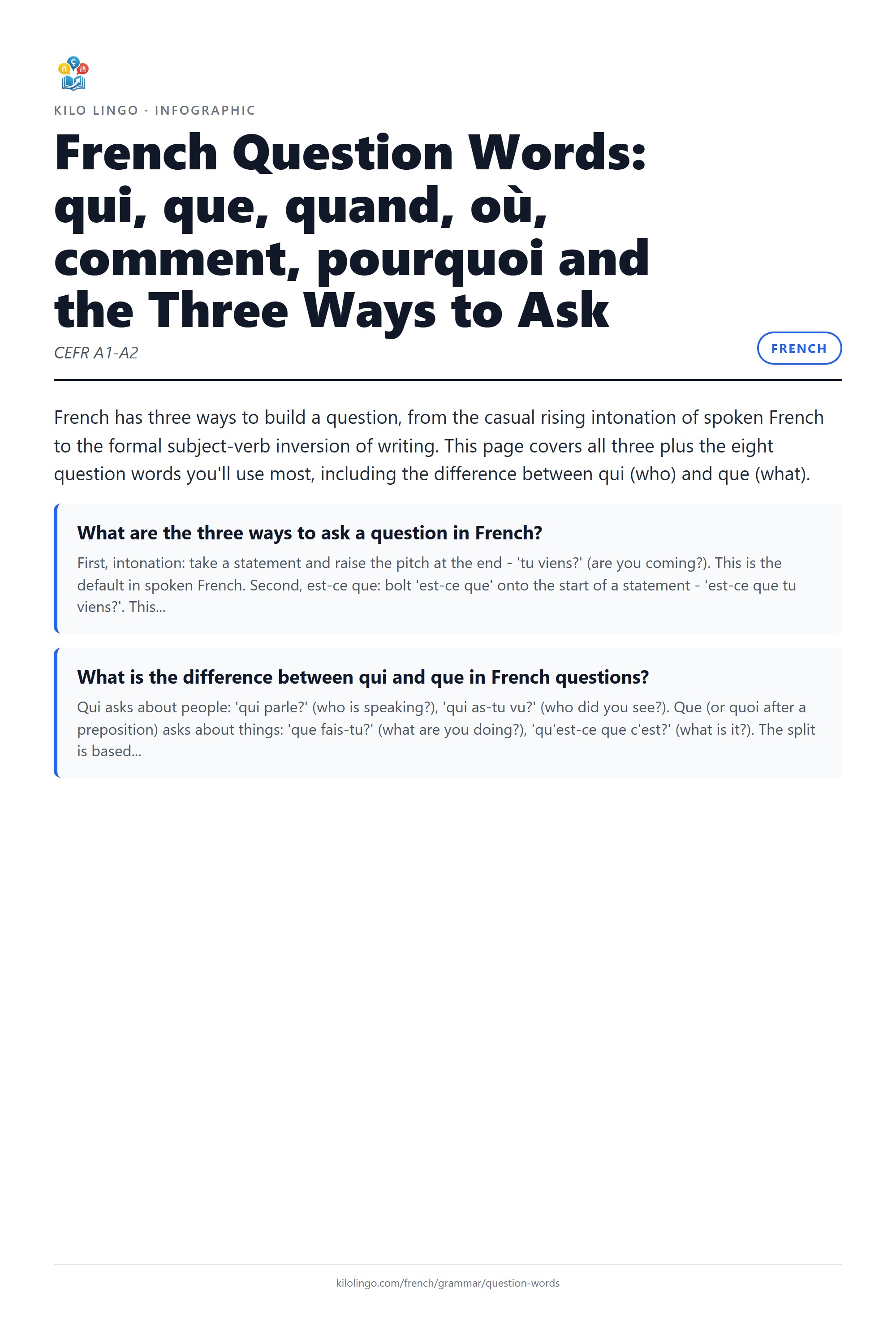
- Question wordsGrammar
qui, que, quoi, quand, ou, comment, combien, pourquoi - plus the three ways French builds a question: intonation, est-ce que, and inversion.
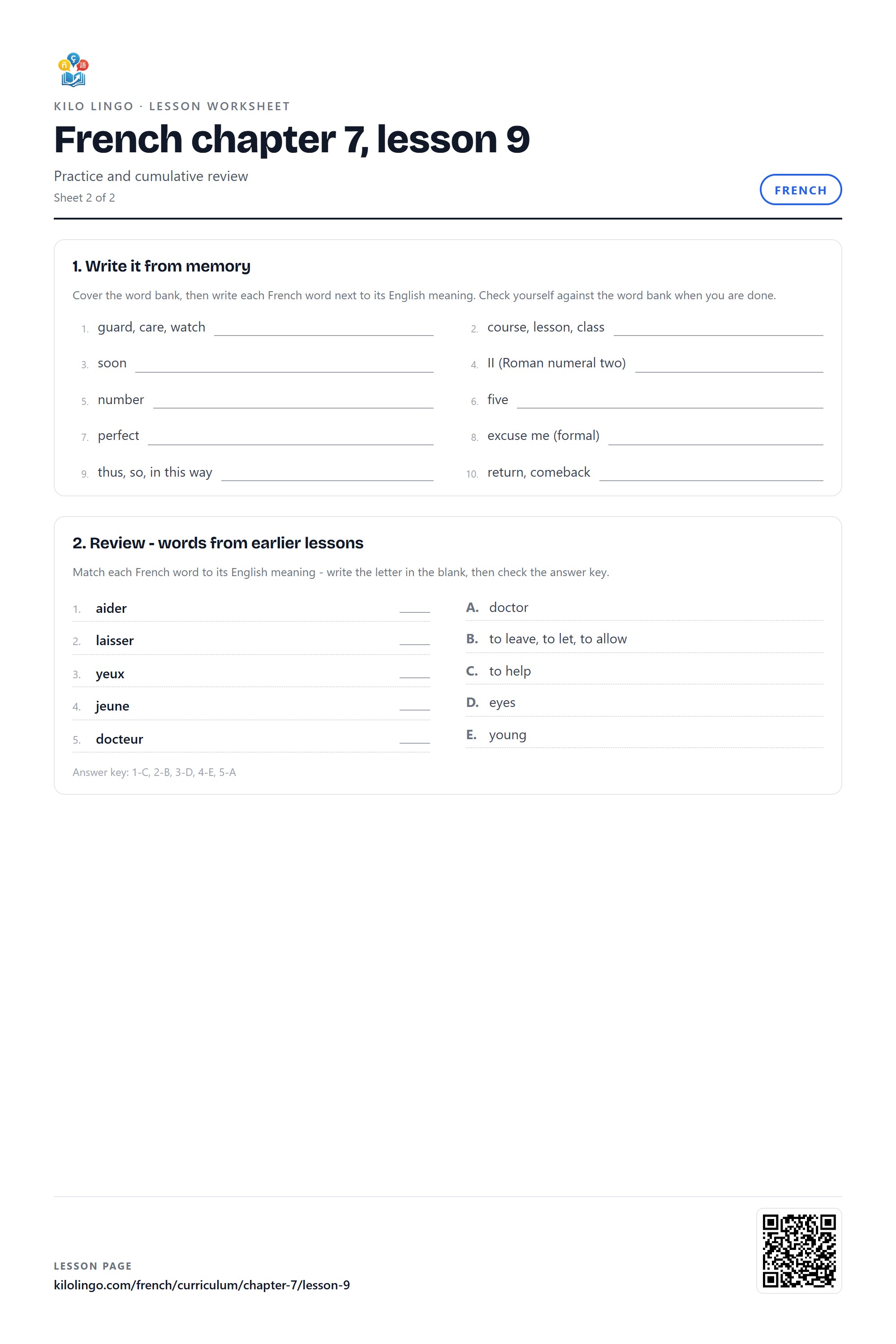
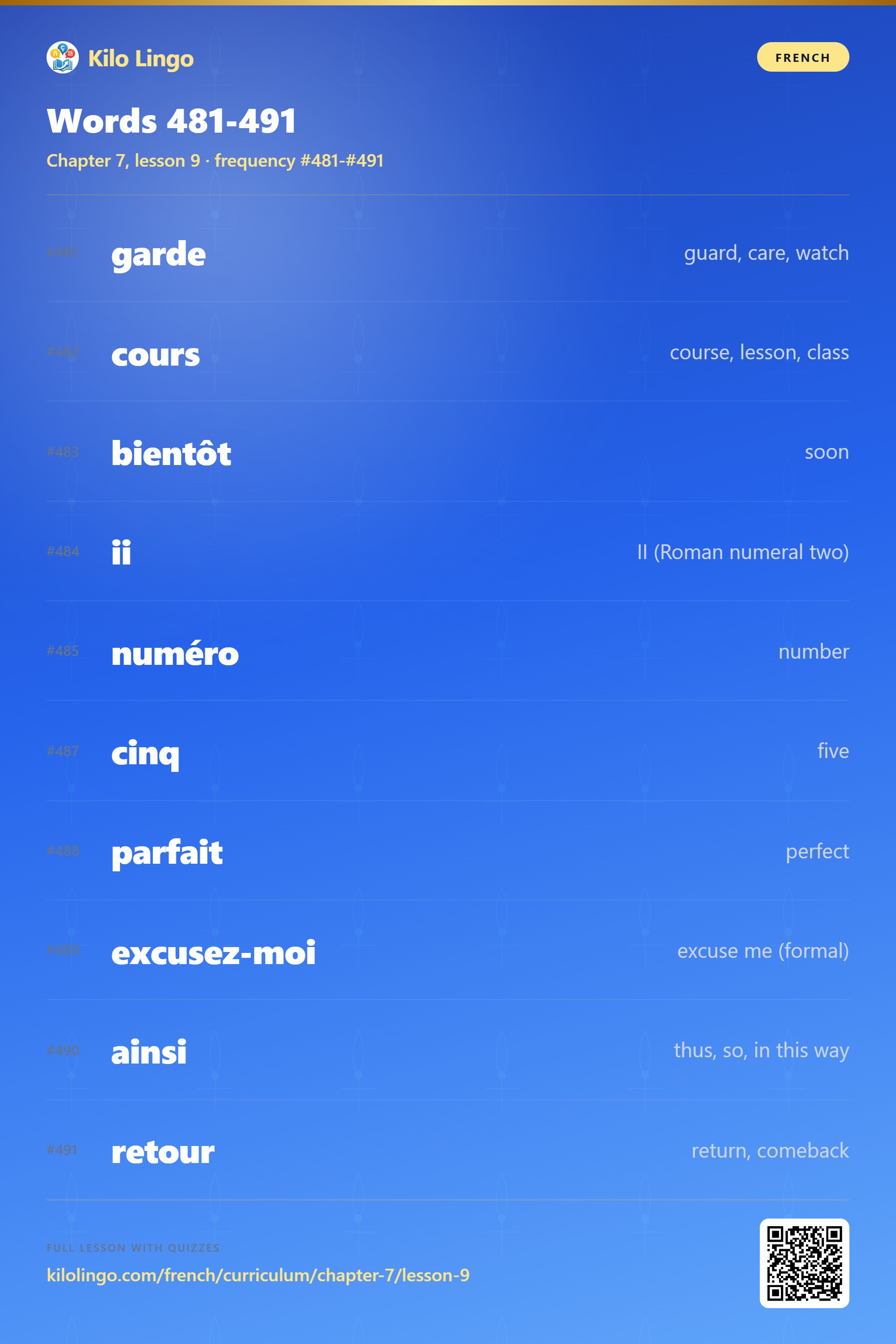
- Words 482-491Vocabulary
10 words · ranks 482-491
- Conjugation Sprint review sessionReview games
Sixty seconds on the endings of the verbs this chapter has drilled so far.
- Words 492-500Vocabulary
9 words · ranks 492-500
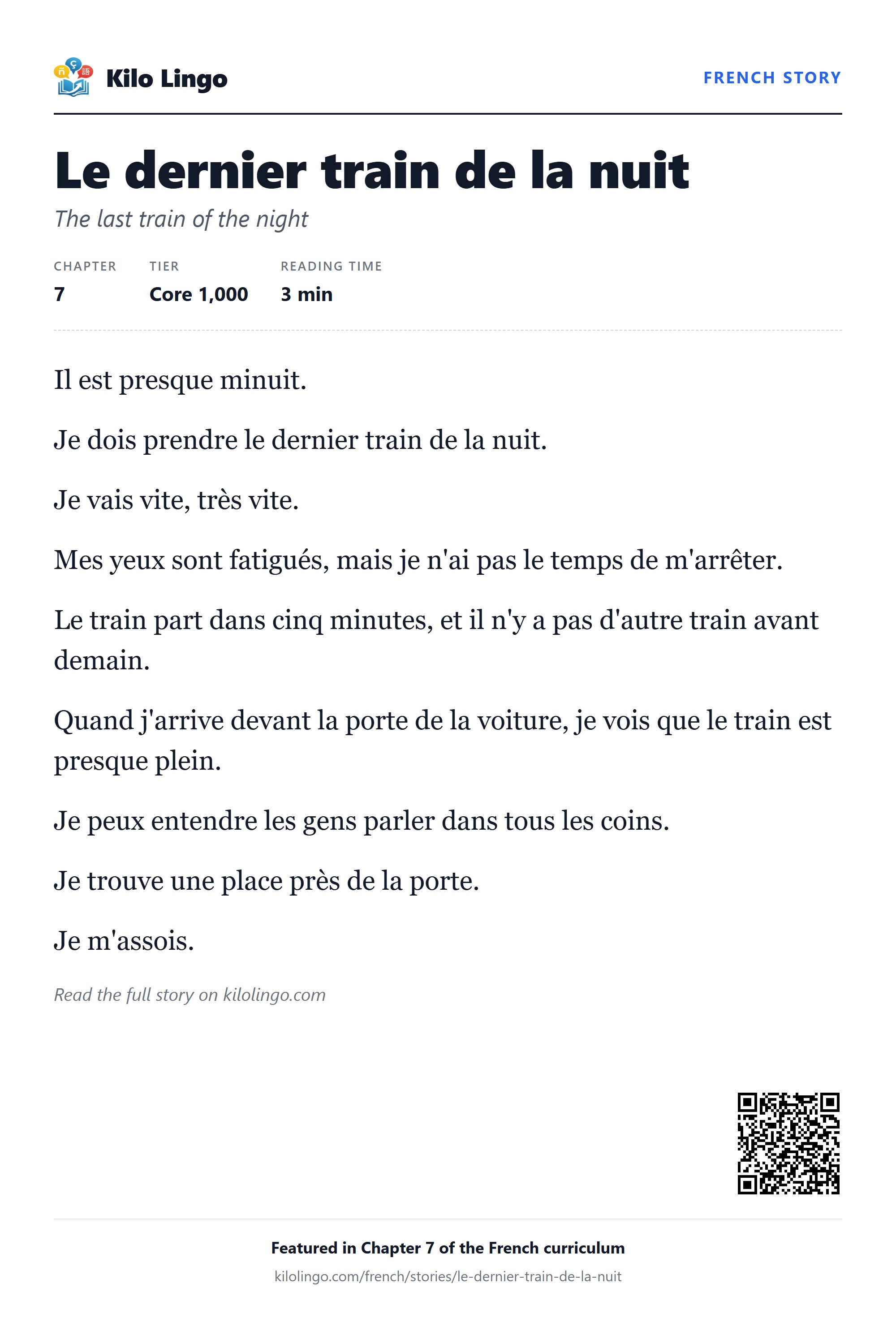
- Story milestone: top 500 wordsGraded-reader story
You can read this story using only the words you've learned so far. Every content word sits at or above the rank-500 ceiling.
- Parler et ecouterThemed review
Asking, answering and being understood.
demanderis to ask FOR something - asking a question isposer une question, which is the trap here. - Arcade reviewReview games
Replay this chapter's words as games - a different kind of repetition, and it counts.
Word printables
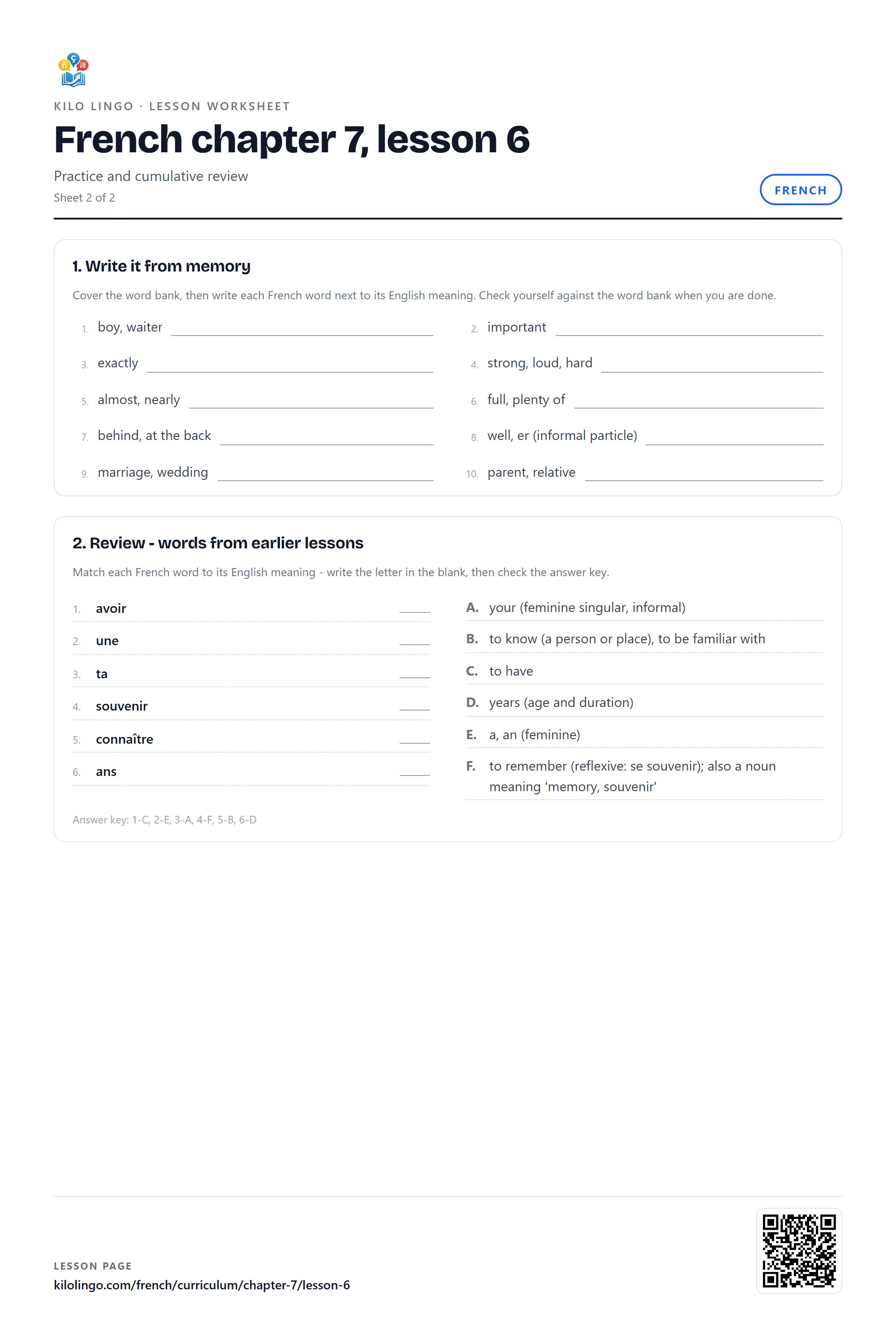
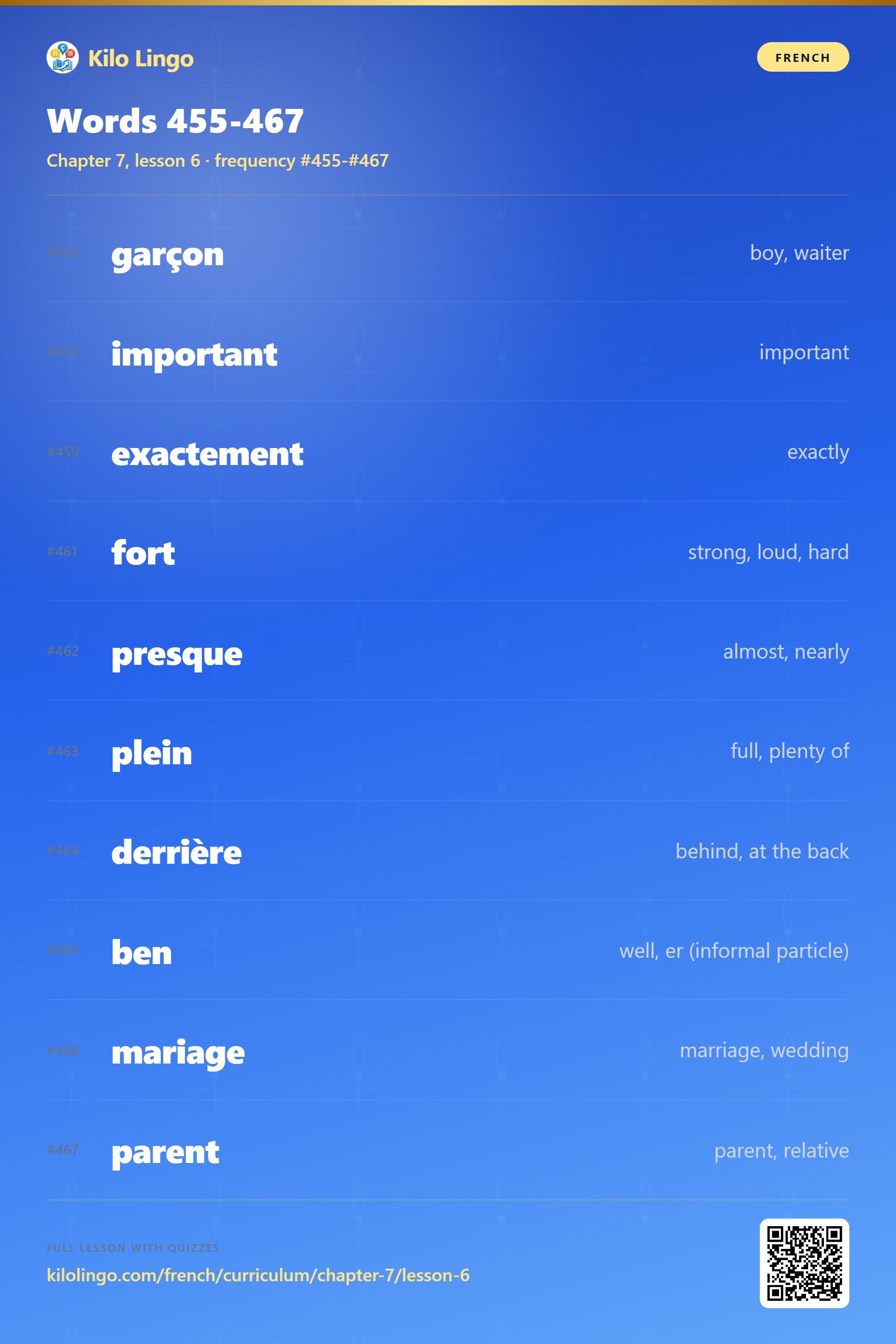
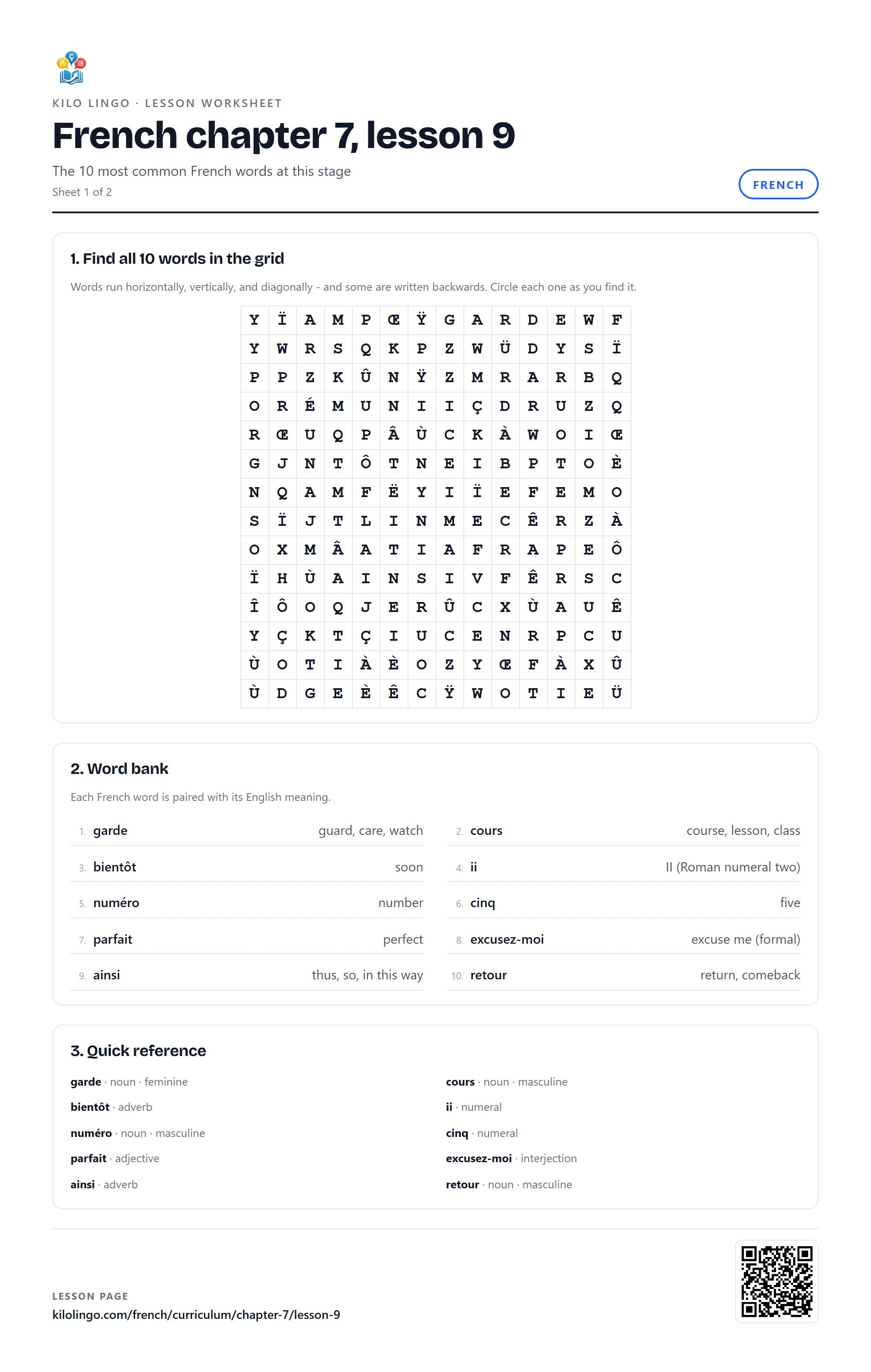
Per-word sheets99 words · a worksheet, infographic and listicle each


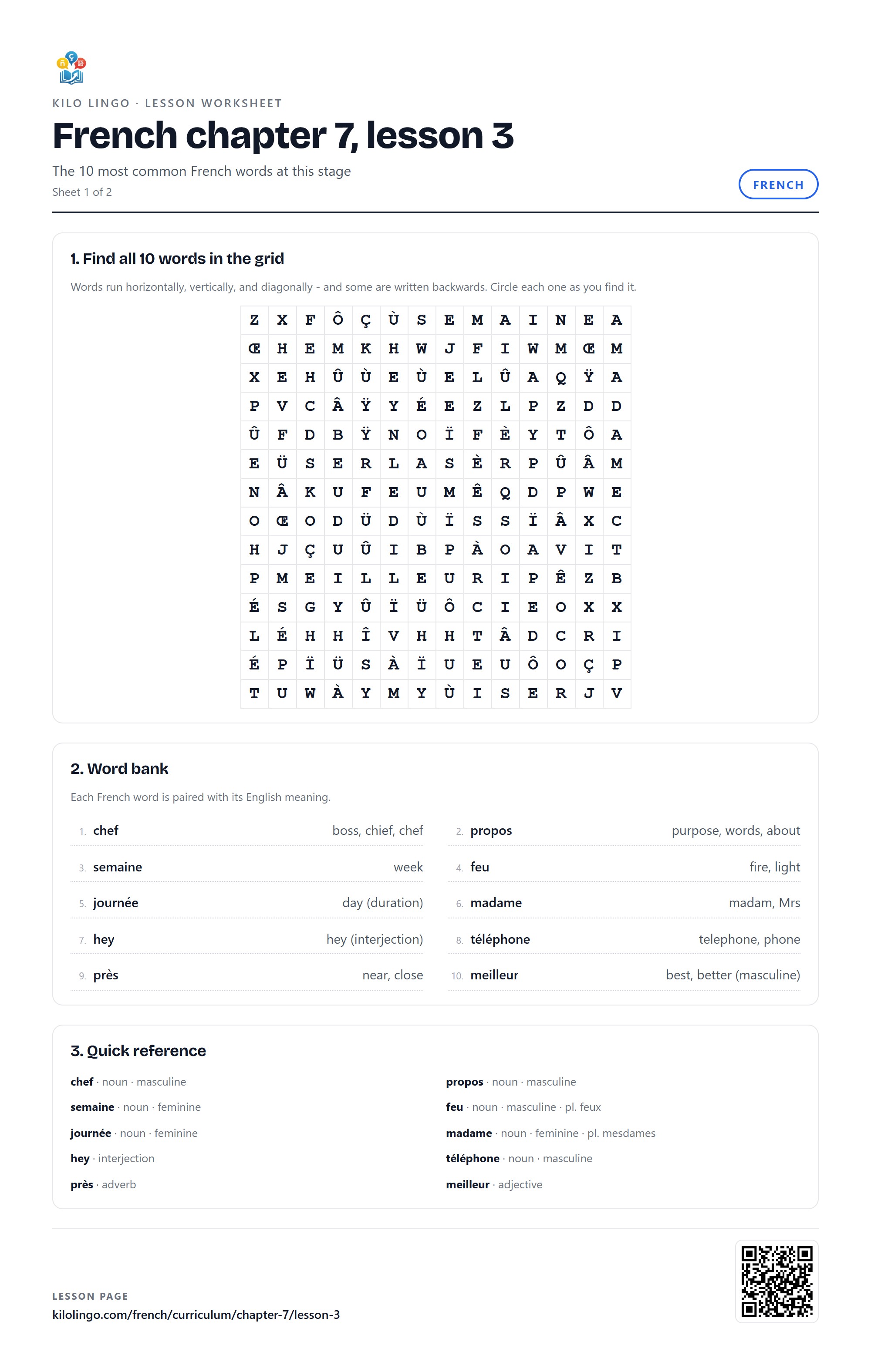
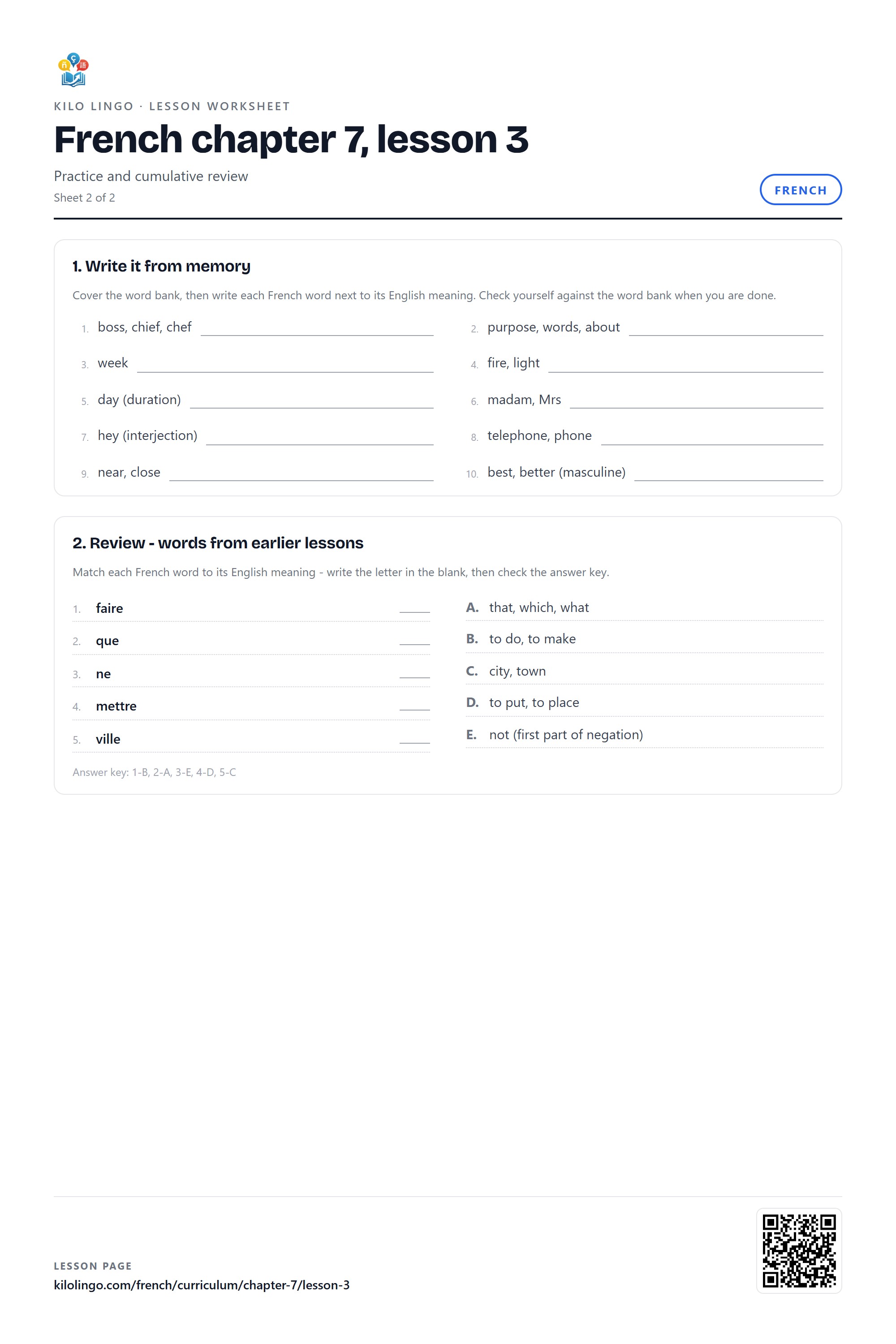

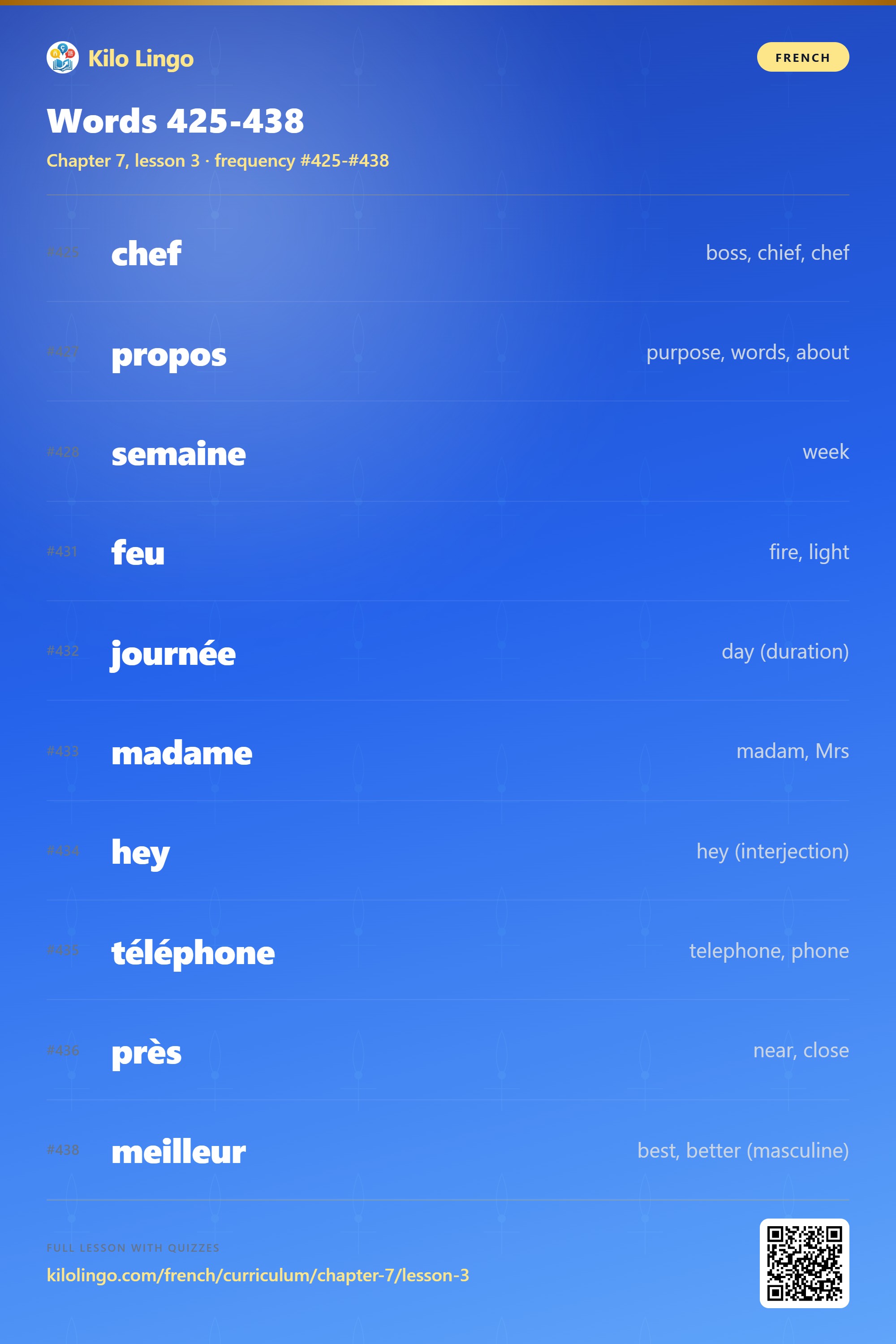
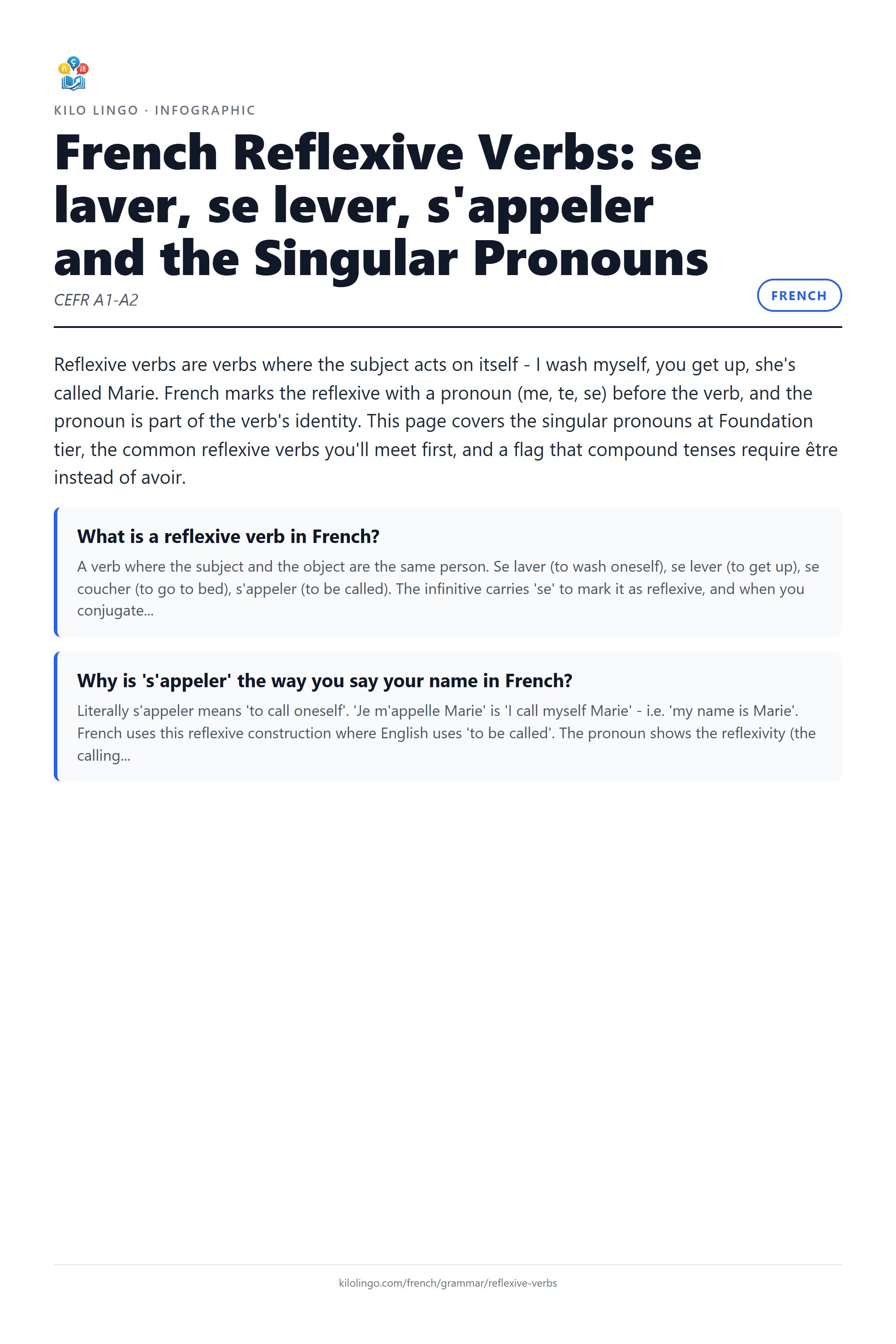
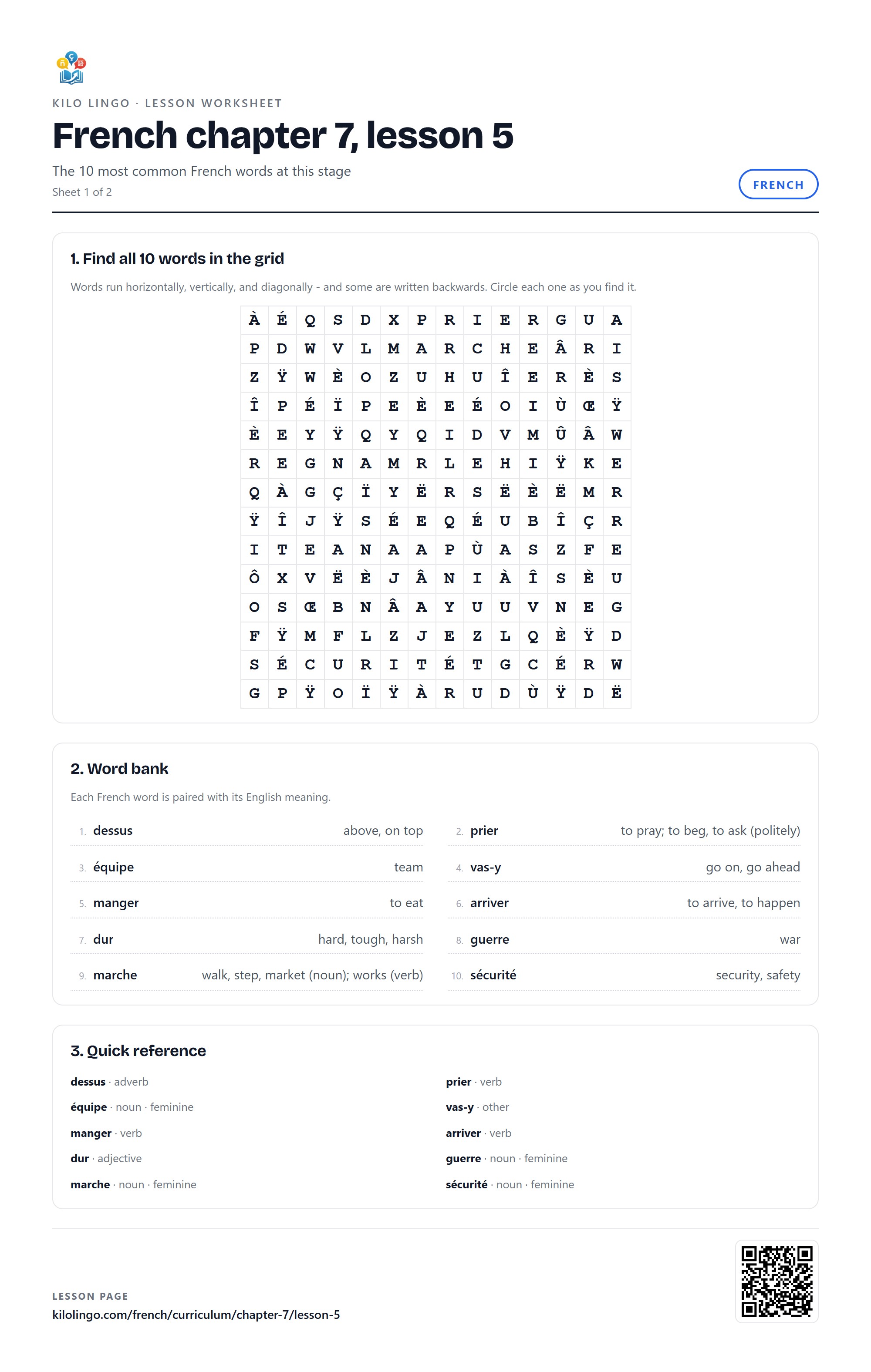
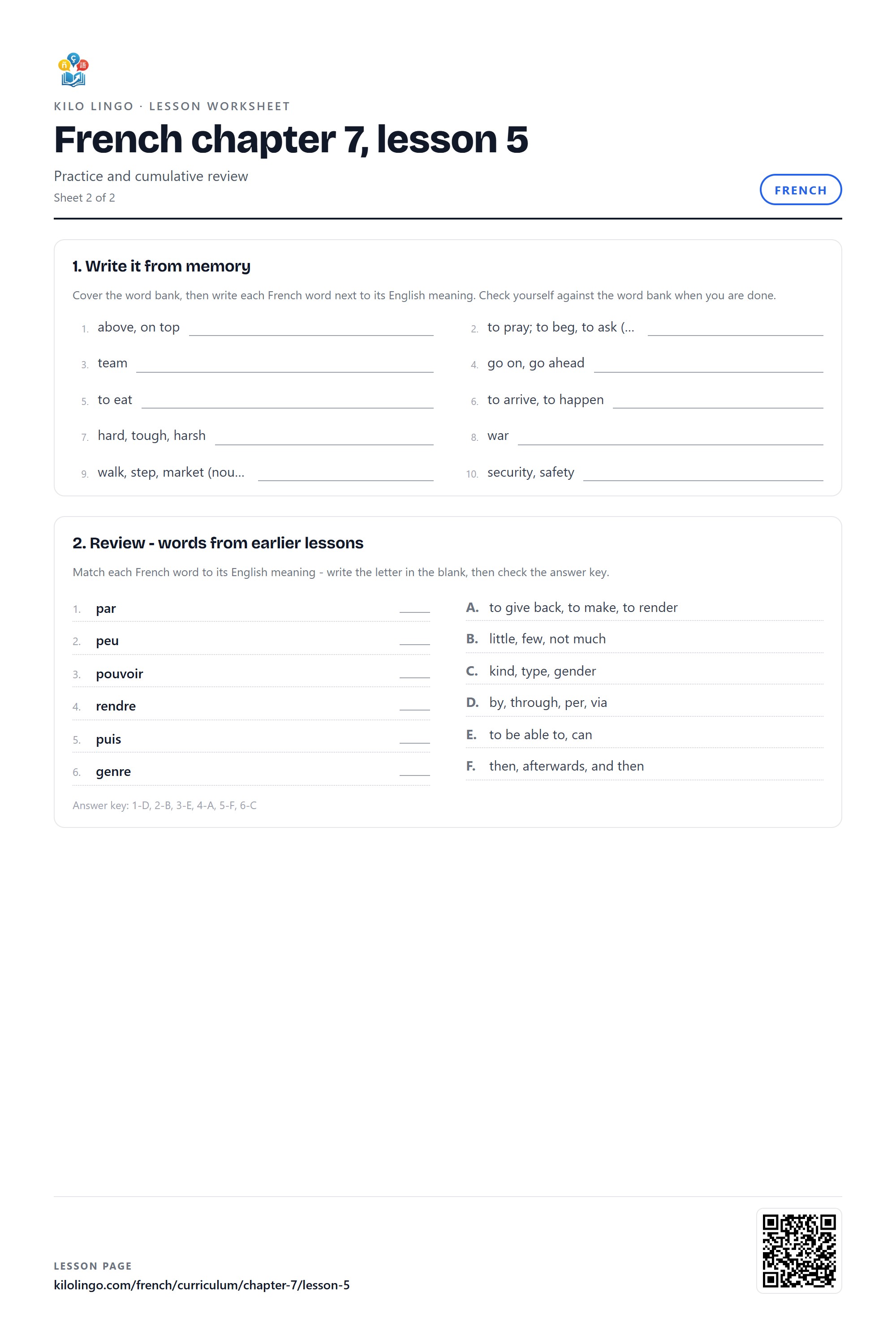

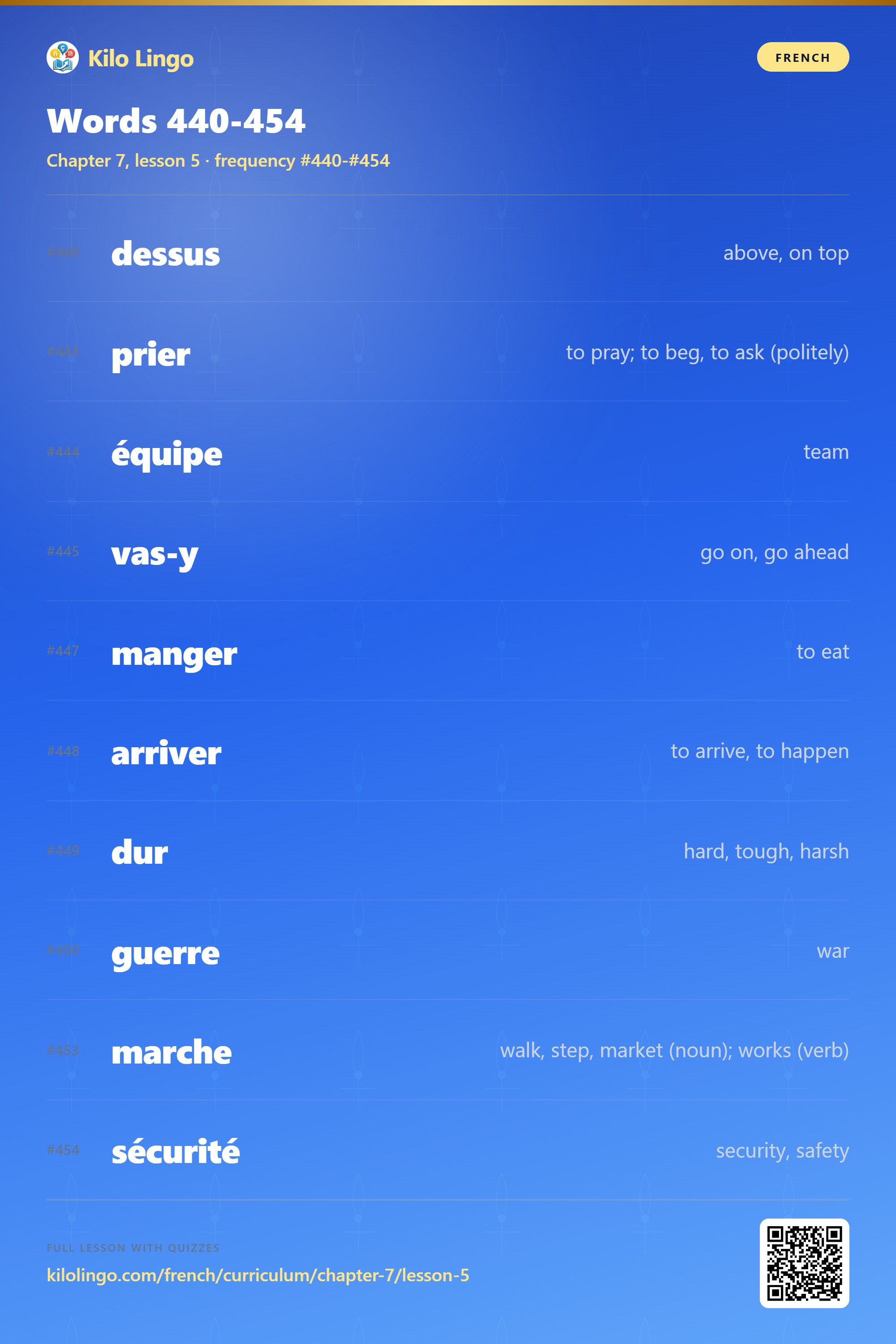
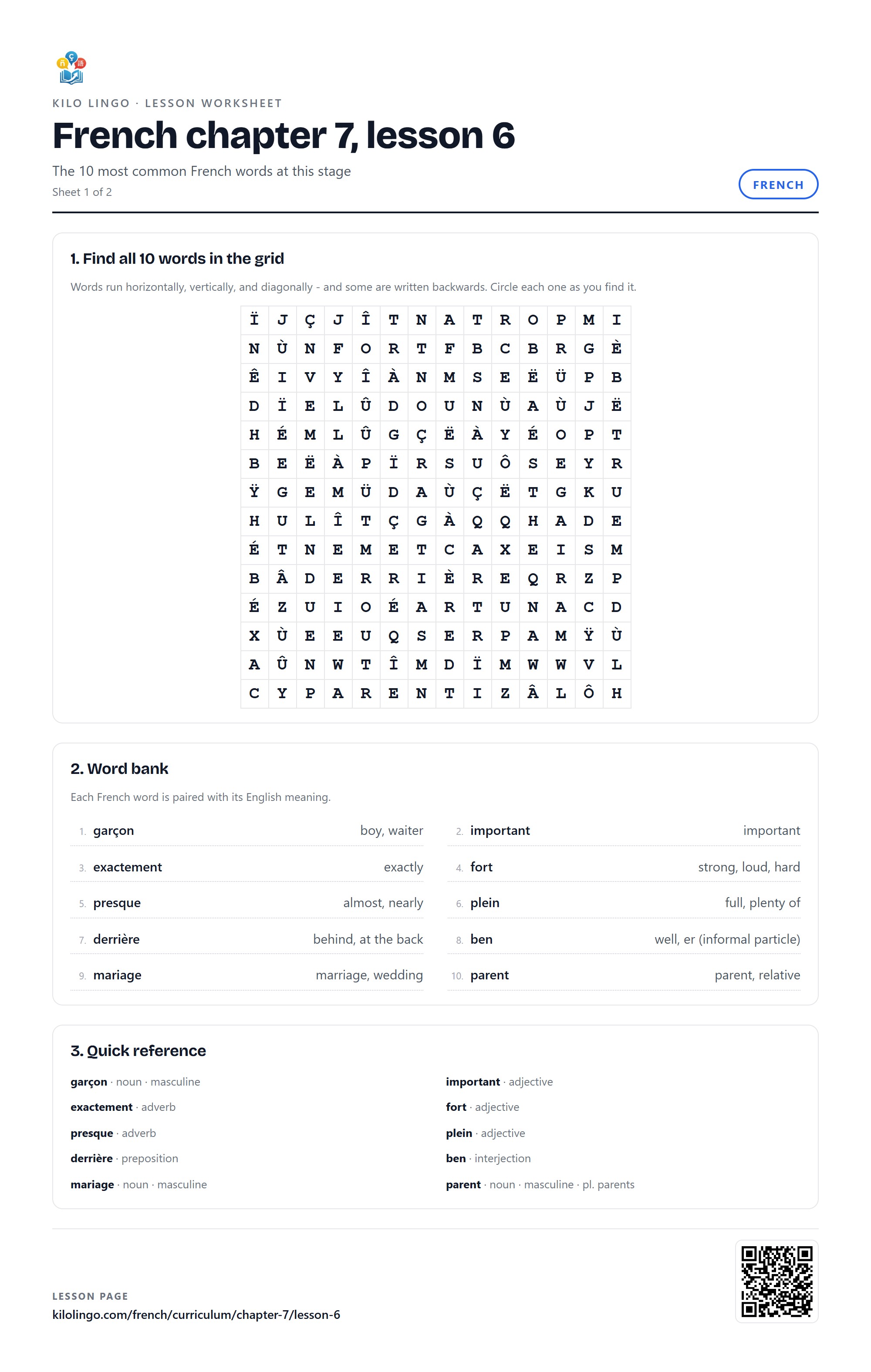


Chapter 8 · The passe compose with avoir
Chapter page →- Words 501-510Vocabulary
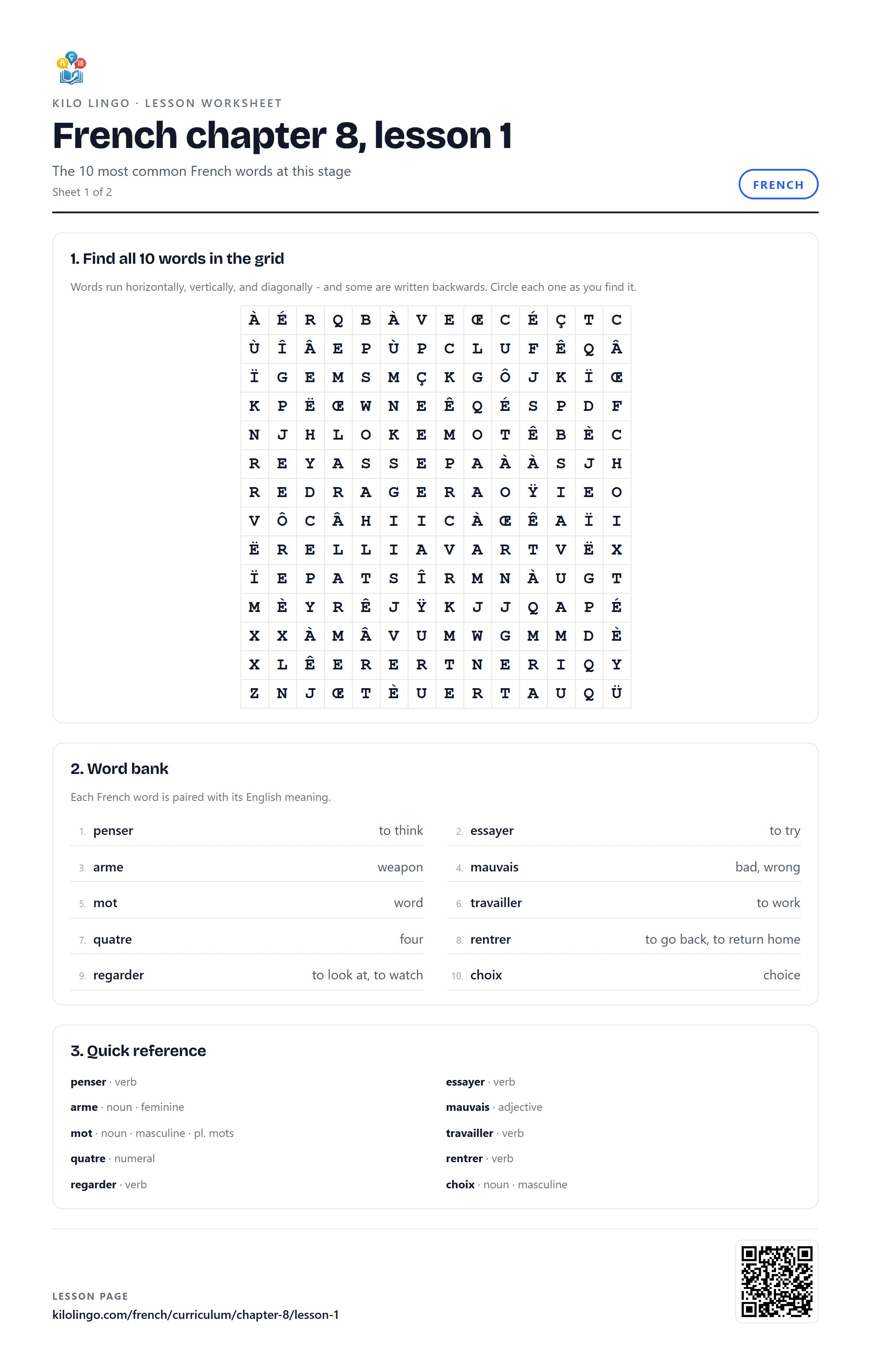
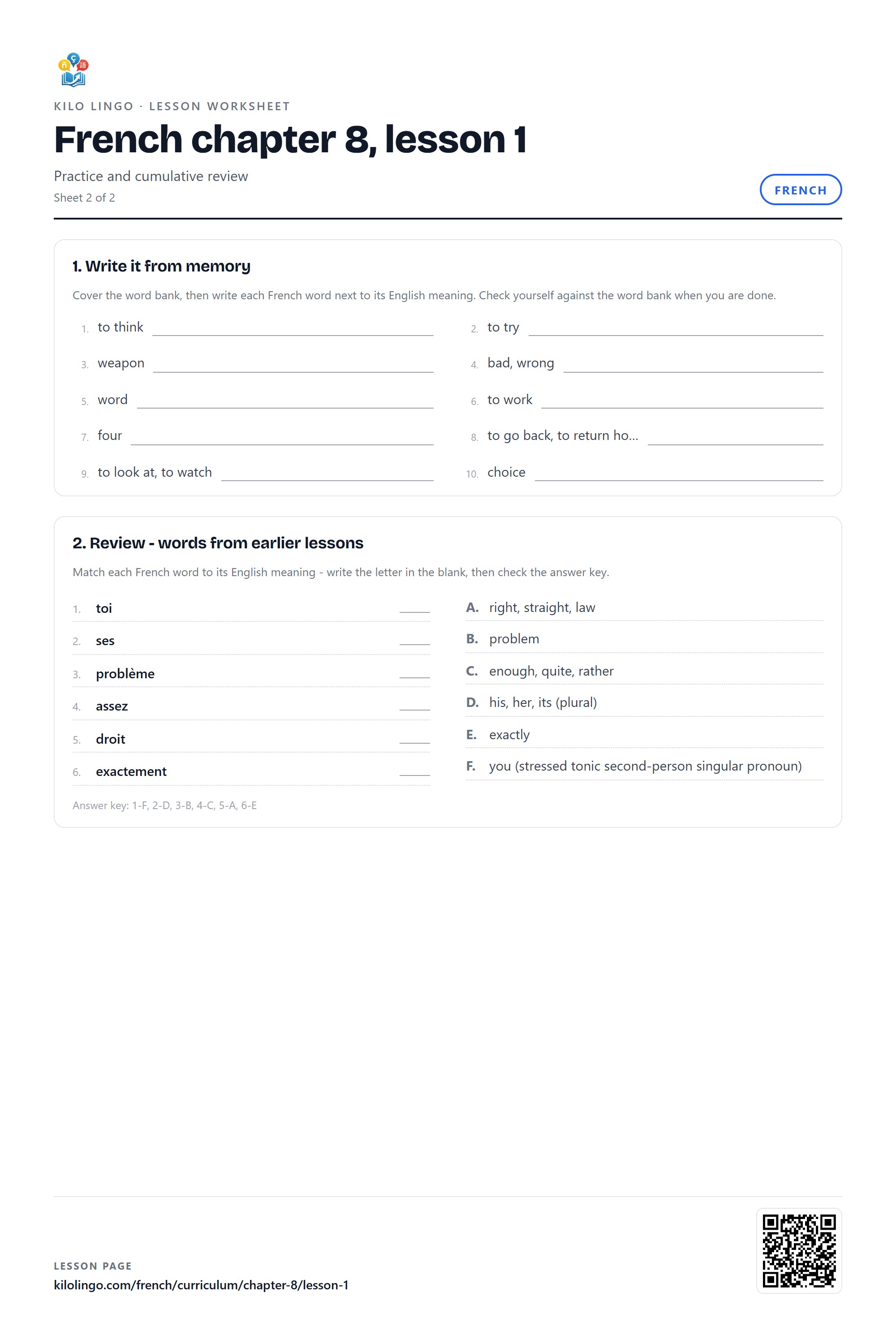
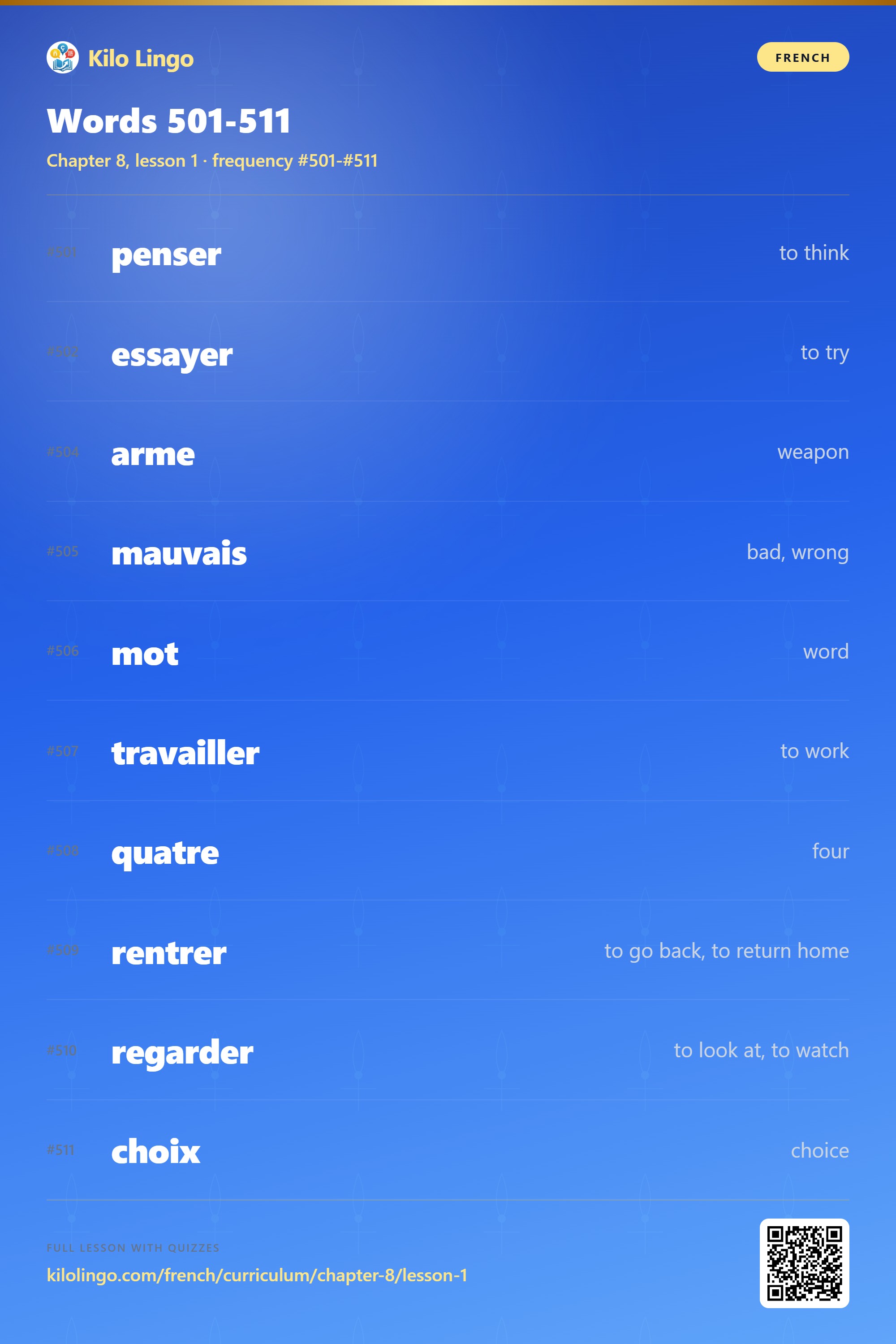
10 words · ranks 501-510
- Word Bubbles review sessionReview games
Pop the words you just met by matching each one to its meaning. A couple of rounds and the batch is yours.
- Words 511-520Vocabulary
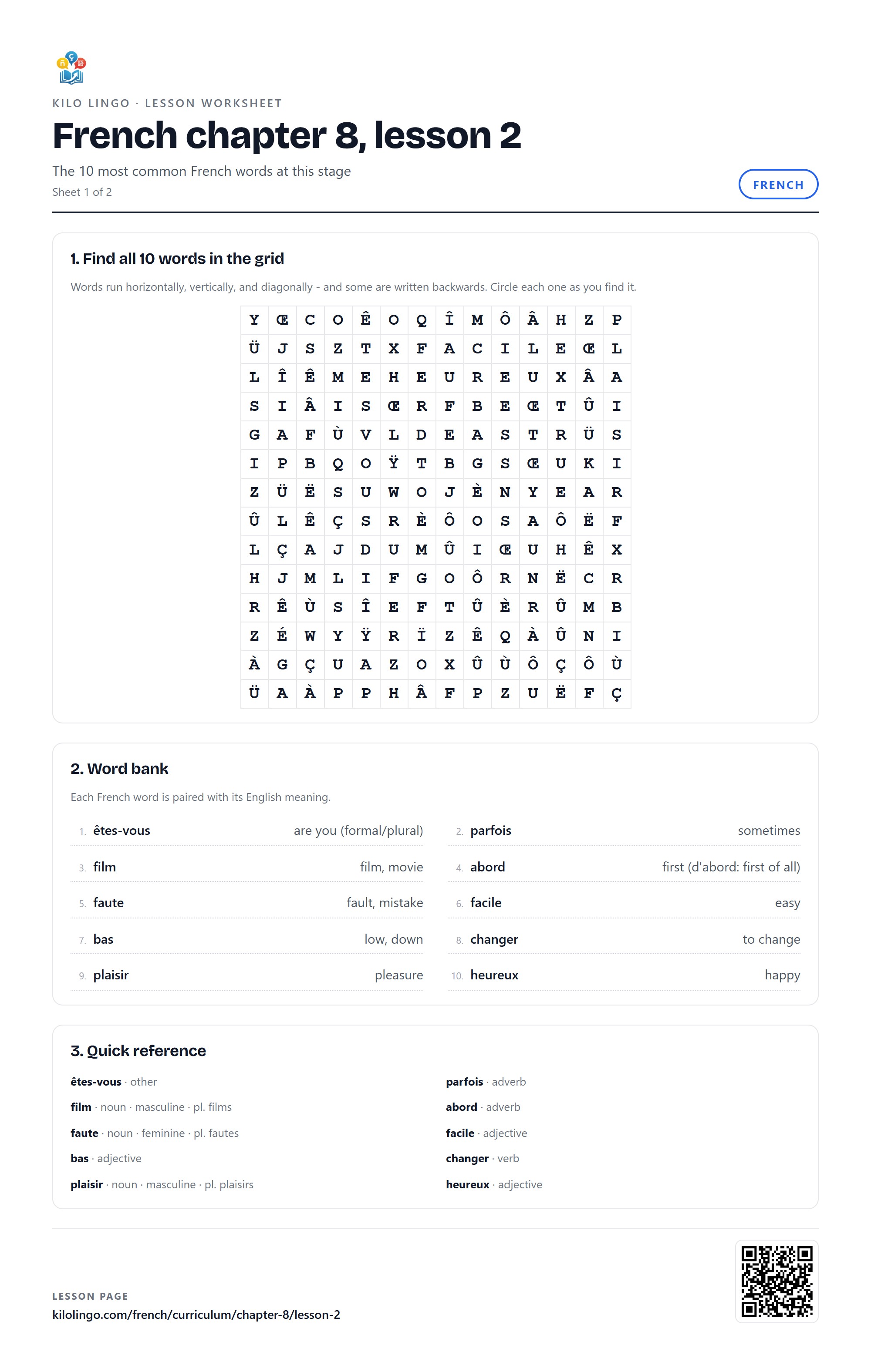
10 words · ranks 511-520
- Conjugation Sprint review sessionReview games
Sixty seconds on the endings of the verbs this chapter has drilled so far.
- Words 521-530Vocabulary
10 words · ranks 521-530
- Word Bubbles review sessionReview games
Pop the words you just met by matching each one to its meaning. A couple of rounds and the batch is yours.
- Words 531-540Vocabulary
10 words · ranks 531-540
- The passe compose with avoirGrammar
avoir + past participle. The default compound past, the regular participles -e / -i / -u, the three you must memorise (ete, eu, fait), and a flag that a small closed set of verbs takes etre instead.
- dire or parler?Mistake clinic
One takes what was said. The other takes who you said it to.
- Words 541-550Vocabulary
10 words · ranks 541-550
- Conjugation Sprint review sessionReview games
Sixty seconds on the endings of the verbs this chapter has drilled so far.
- Words 551-561Vocabulary
10 words · ranks 551-561
- Word Bubbles review sessionReview games
Pop the words you just met by matching each one to its meaning. A couple of rounds and the batch is yours.
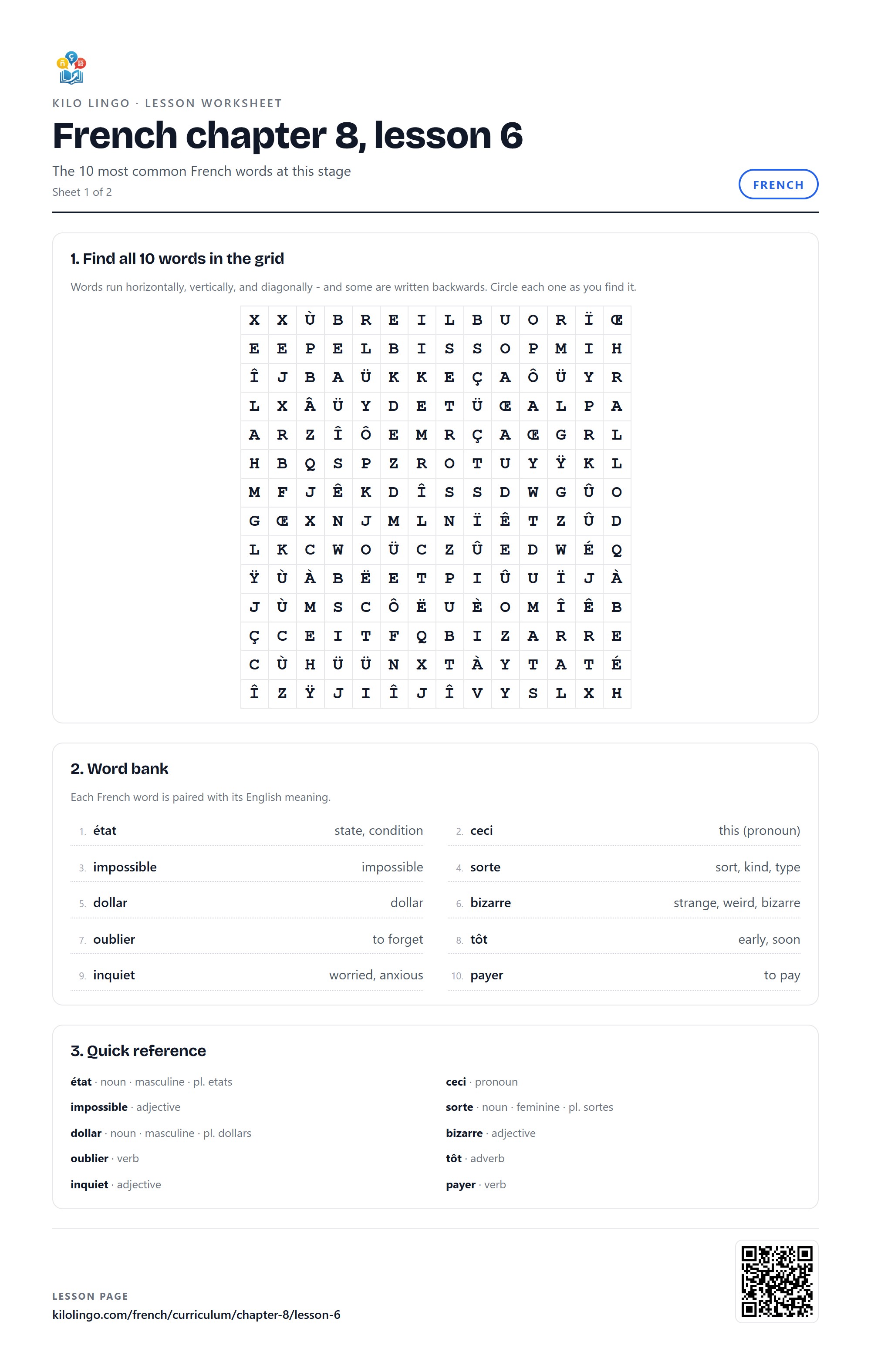
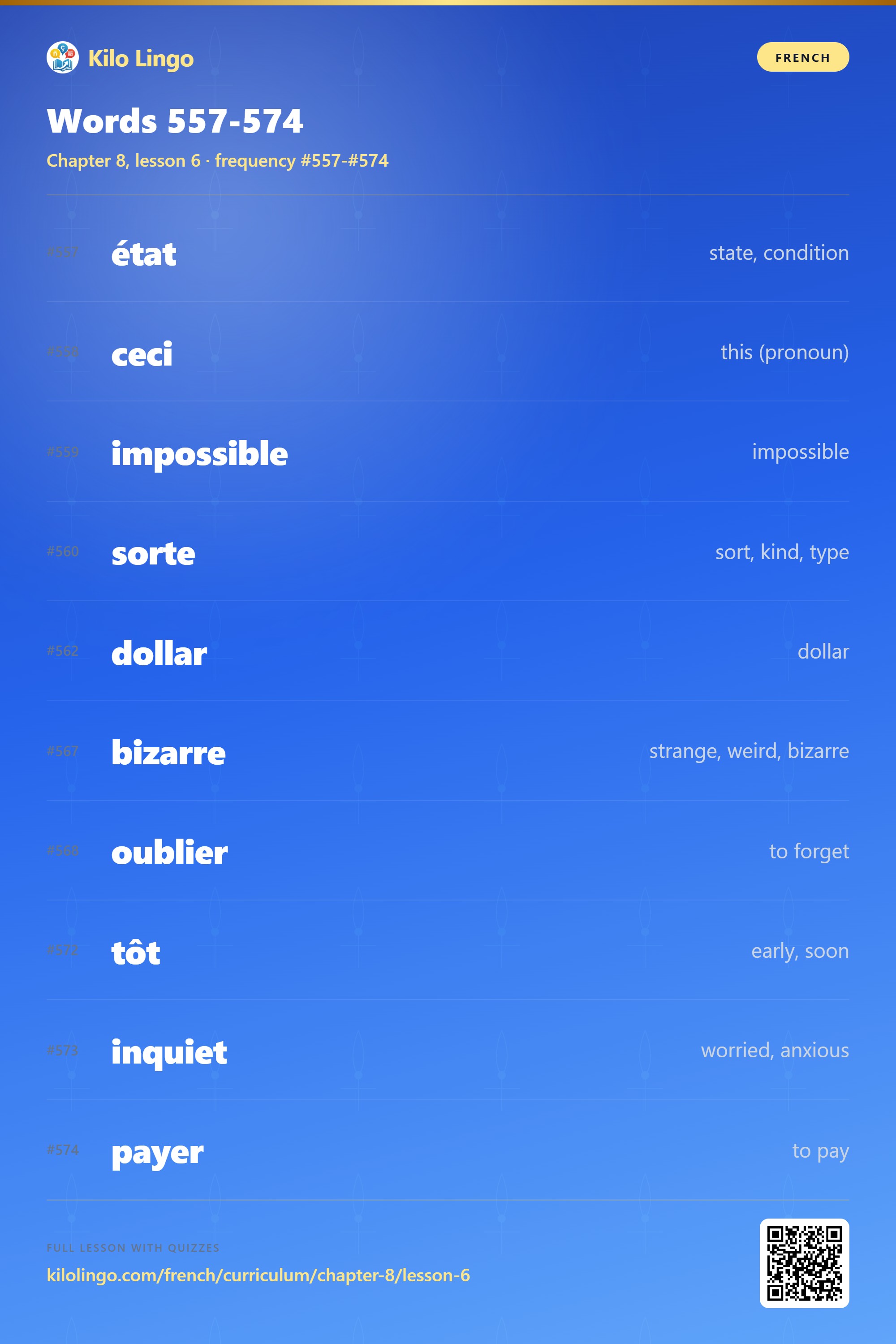
- Words 562-571Vocabulary
10 words · ranks 562-571
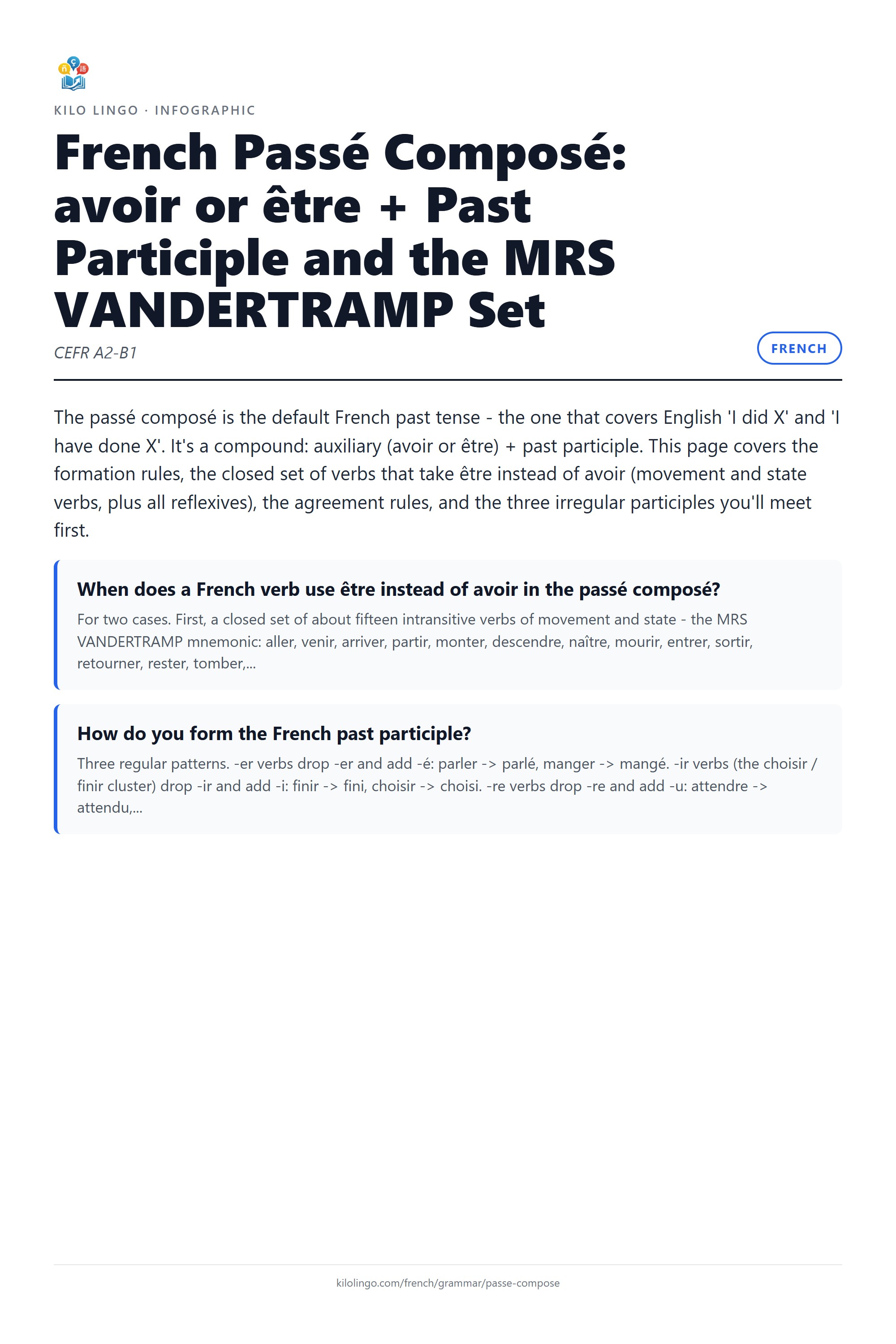
Most verbs take avoir. A closed set of seventeen movement and change-of-state verbs takes etre, and so does every reflexive verb without exception. With etre the past participle agrees with the subject, and six verbs take both auxiliaries with a change of meaning.
- Words 572-581Vocabulary
10 words · ranks 572-581
- When you have not understoodPhrase session
What rescues a conversation you have lost. Learn these before you need them.
- Words 582-591Vocabulary
10 words · ranks 582-591
- Conjugation Sprint review sessionReview games
Sixty seconds on the endings of the verbs this chapter has drilled so far.
- Words 592-600Vocabulary
9 words · ranks 592-600
- Story milestone: top 600 wordsGraded-reader story
You can read this story using only the words you've learned so far. Every content word sits at or above the rank-600 ceiling.
- À tableThemed review
Bread, water and wine - the oldest words in the language and the first ones you learned. Note
carte: the card and the map you already know is also the menu. - Email us in FrenchLesson
Tell us how your French is going - what you like and what you'd change - written only in French.
- Arcade reviewReview games
Replay this chapter's words as games - a different kind of repetition, and it counts.
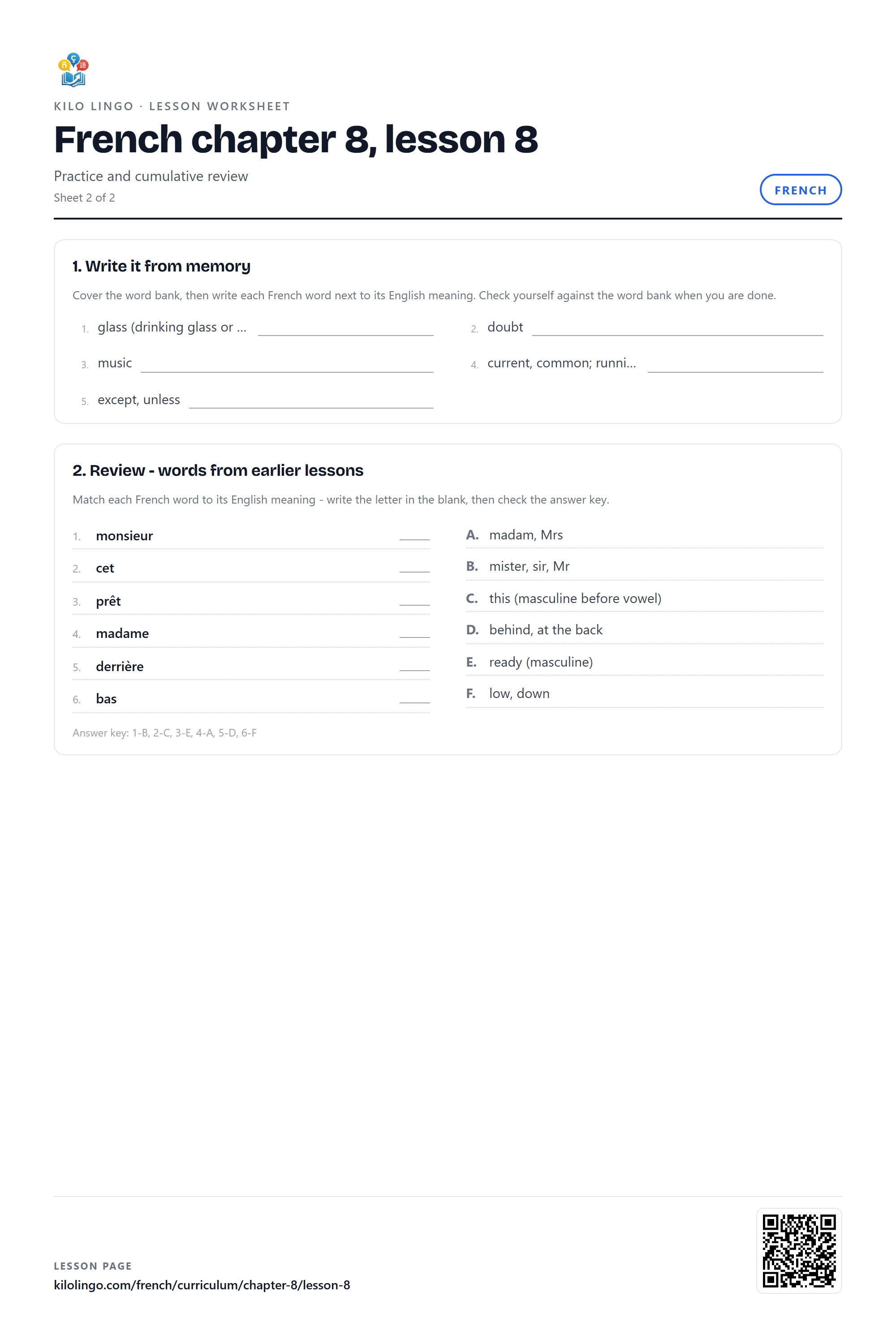
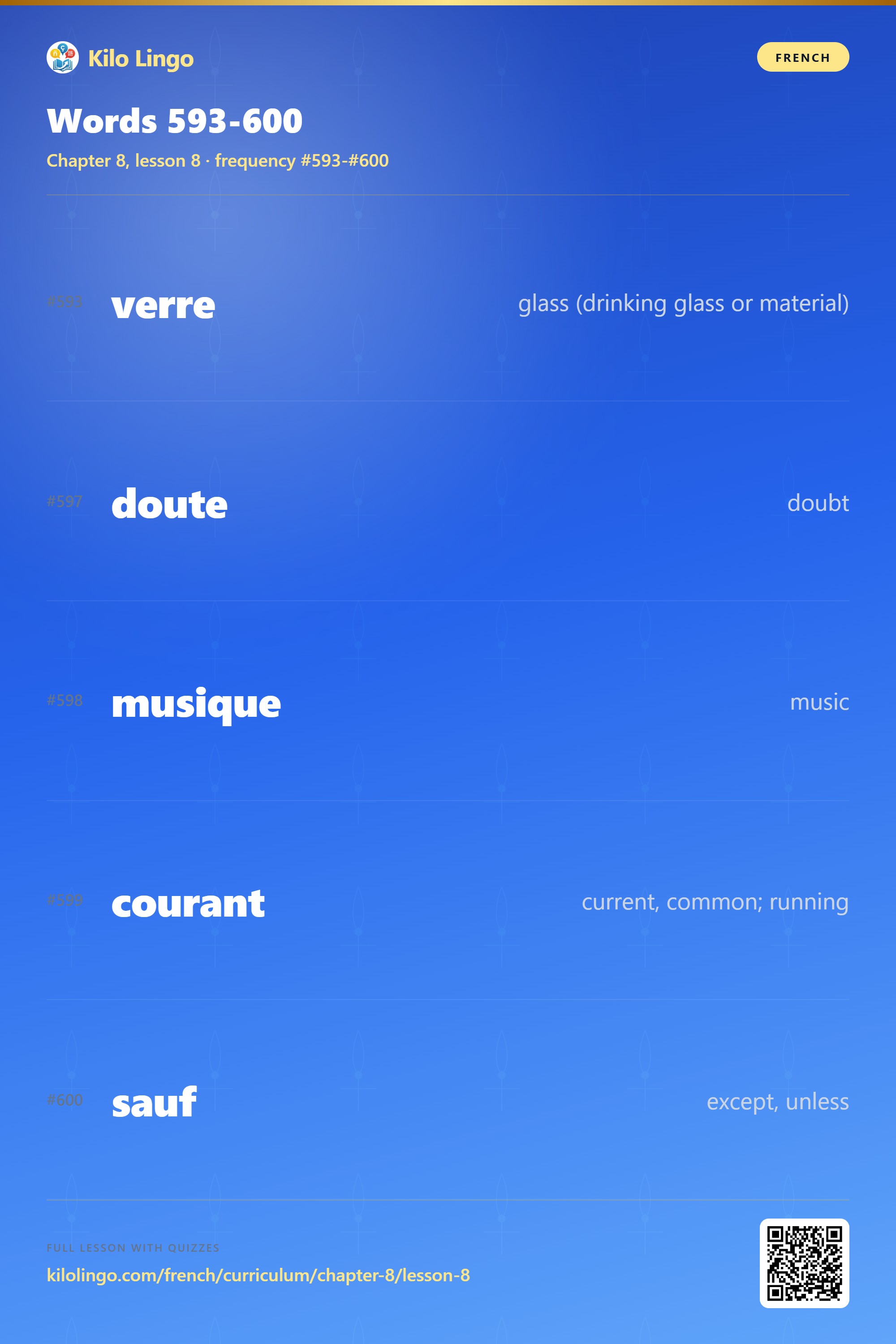
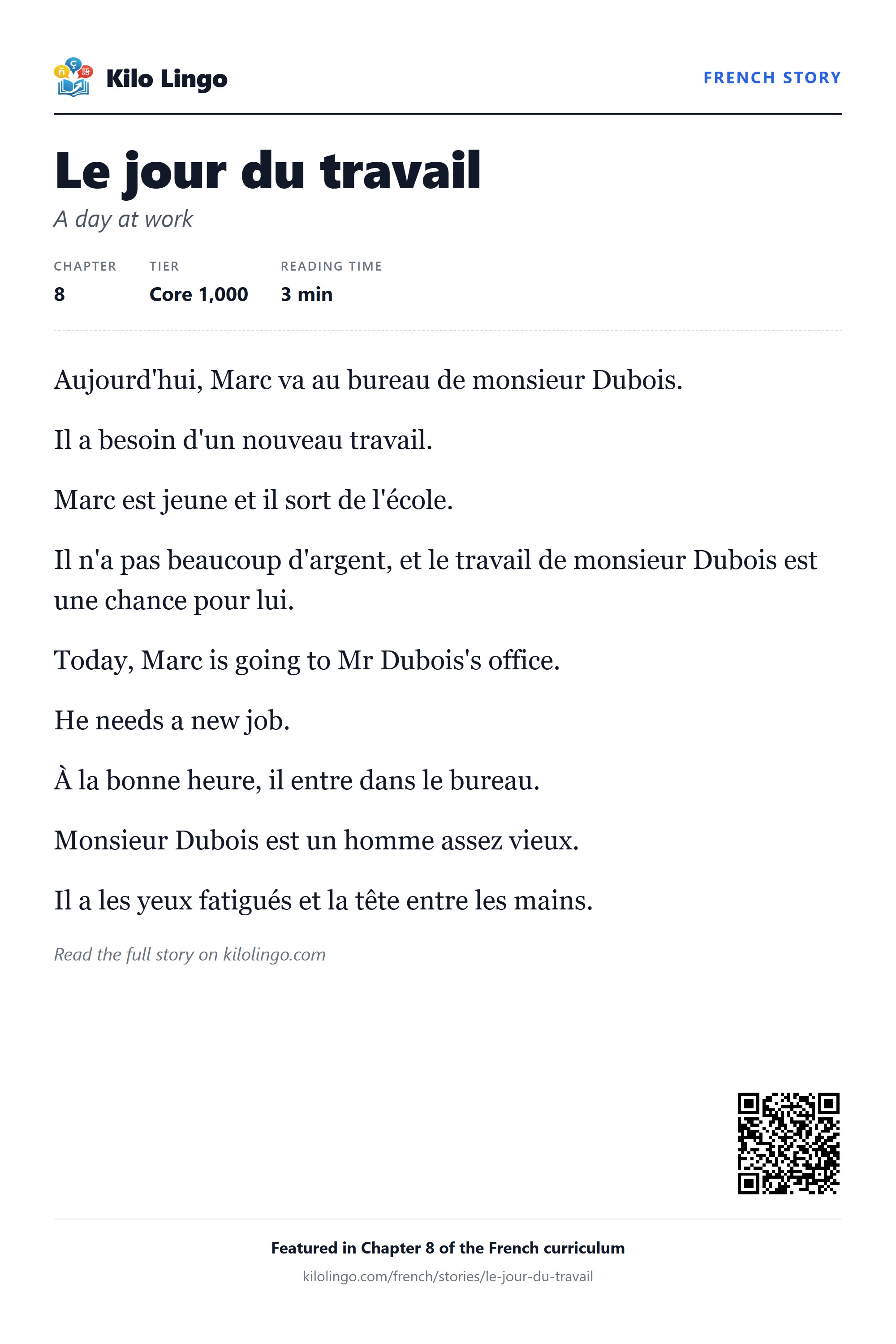
Word printables
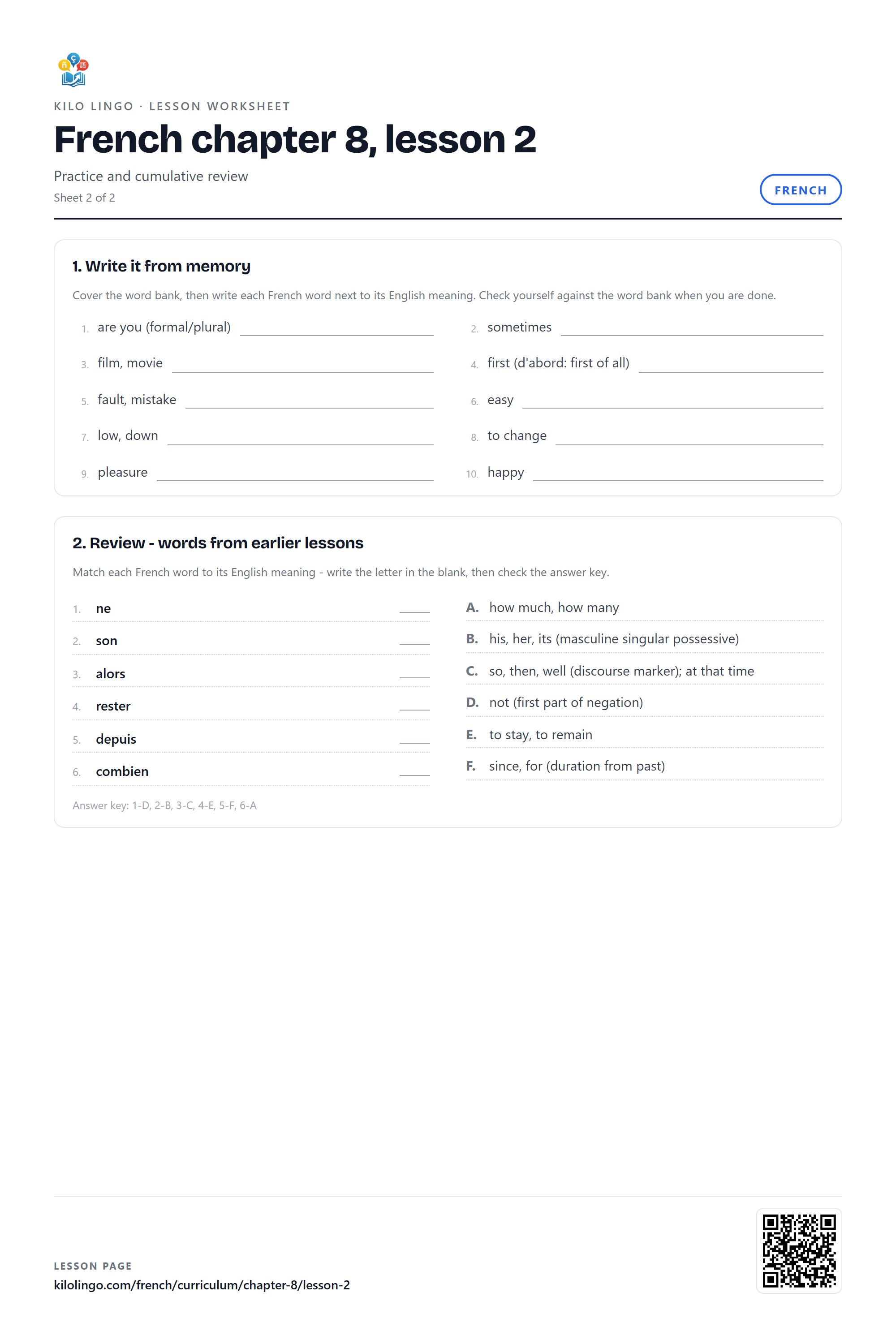
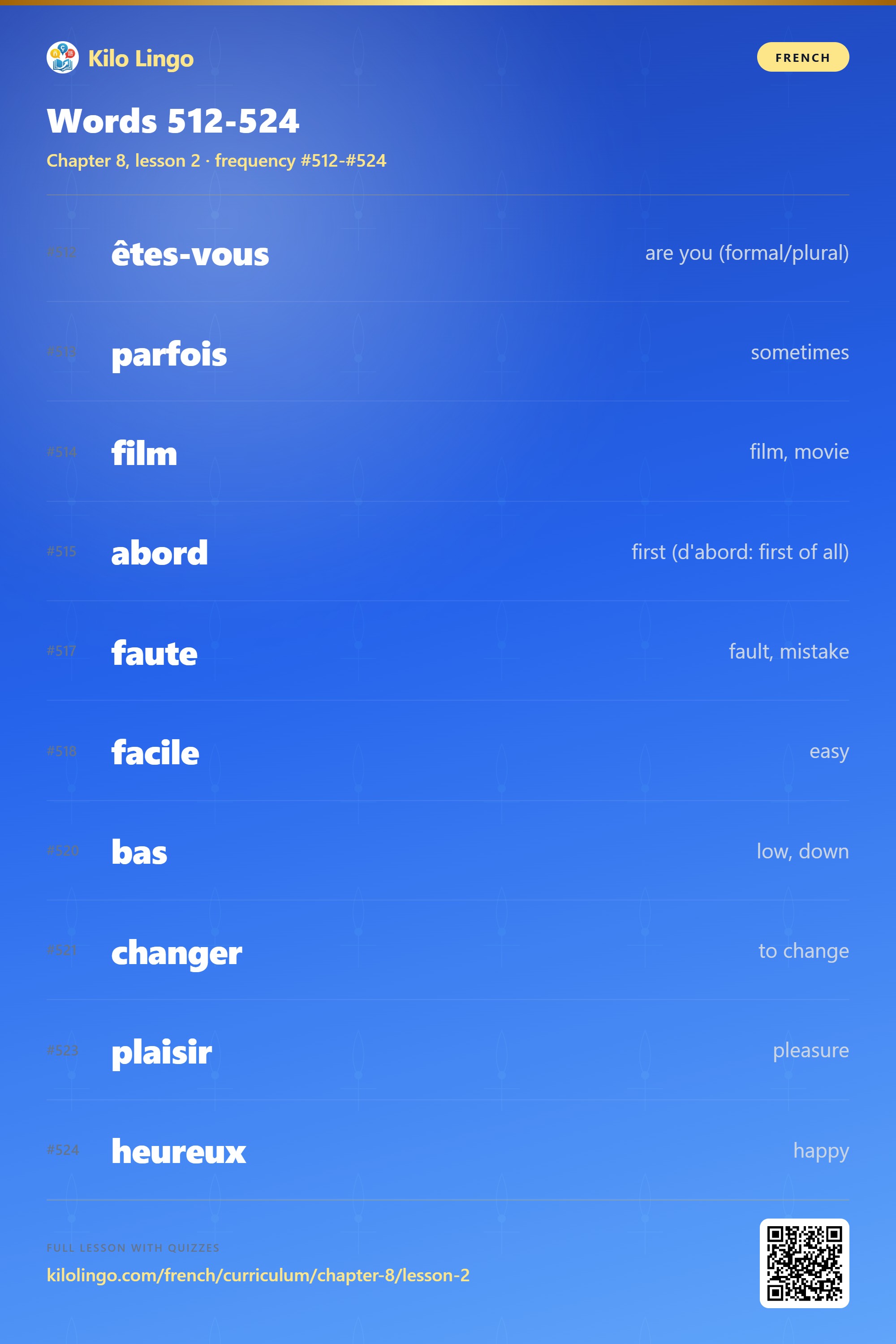
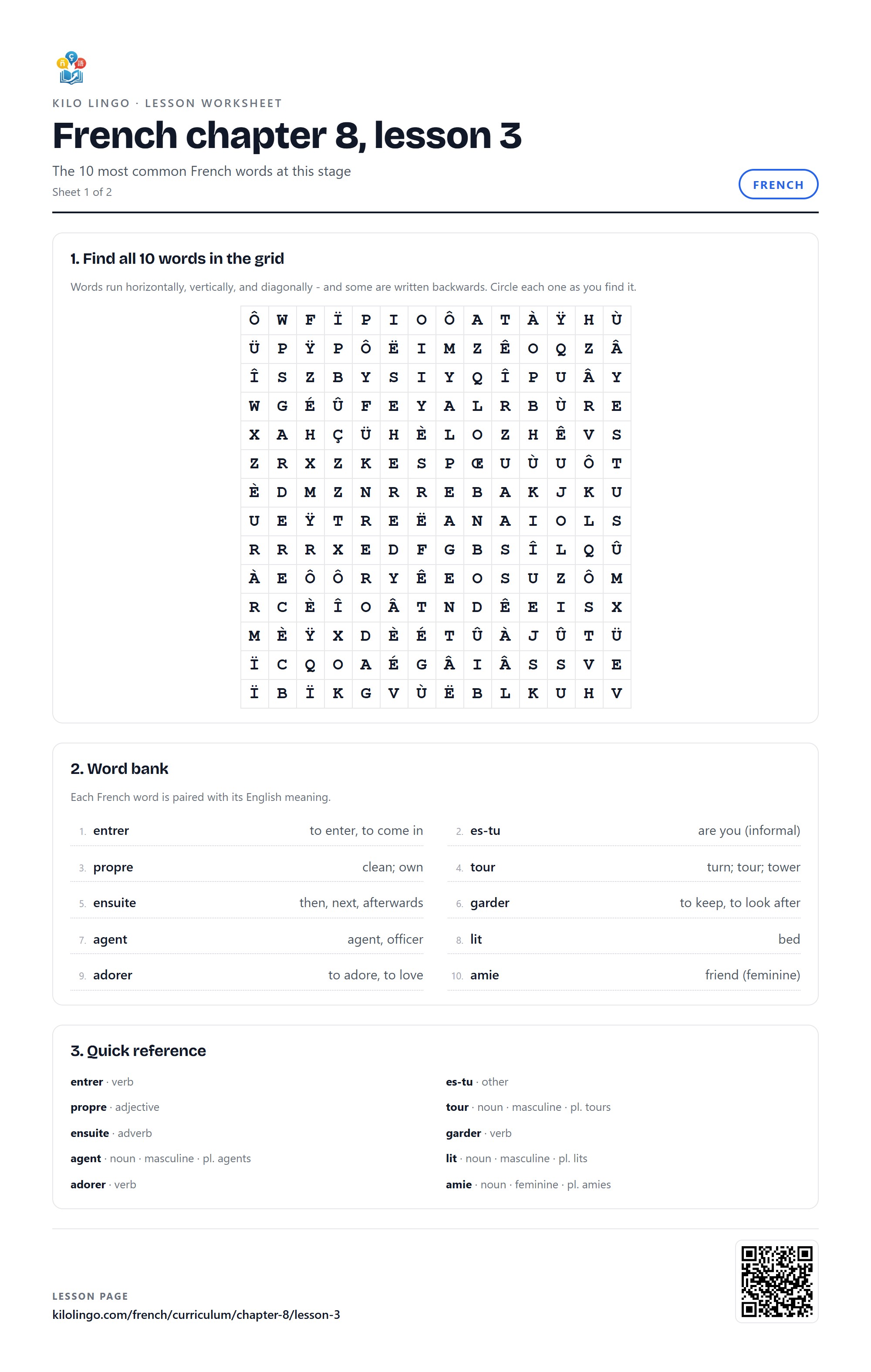
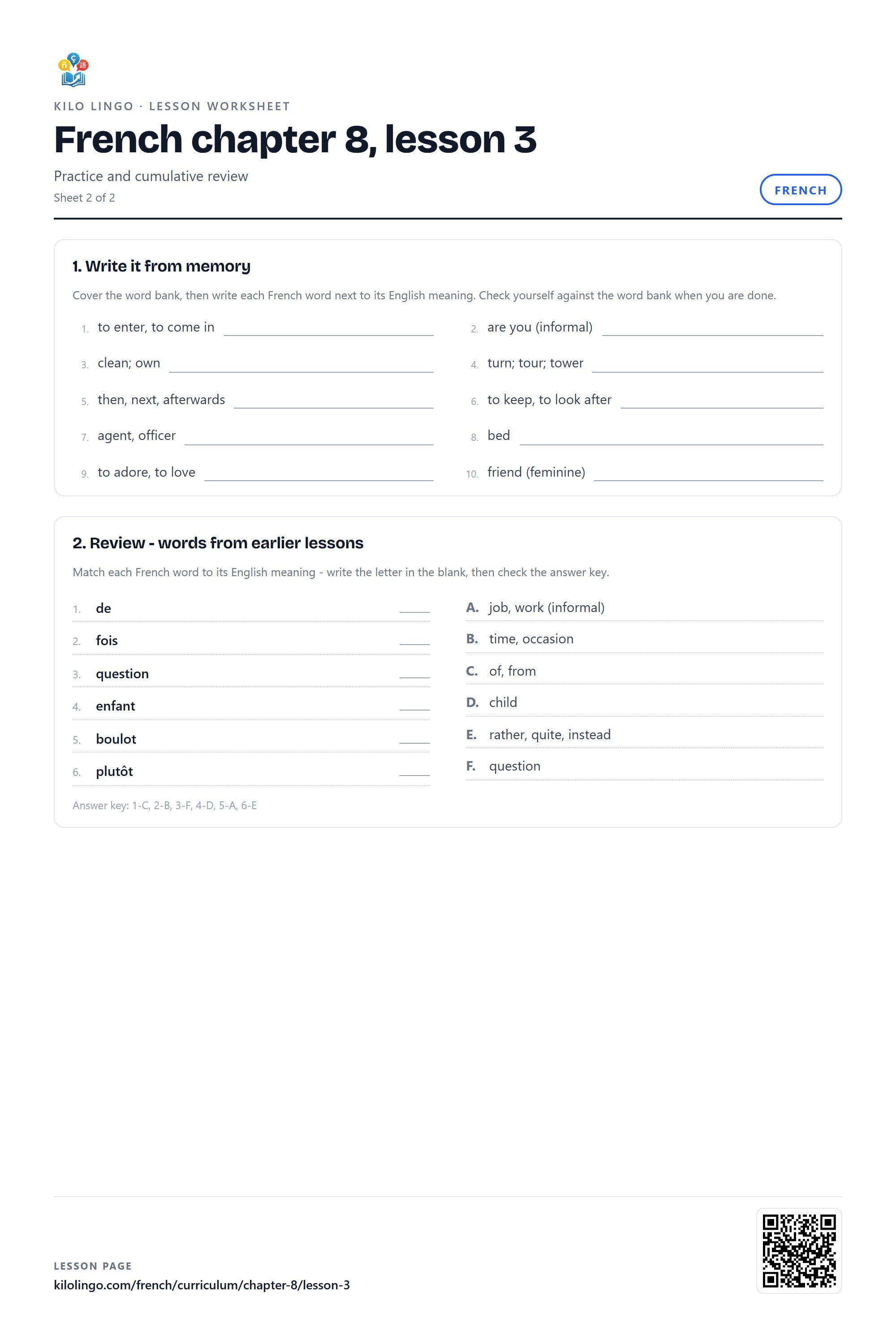
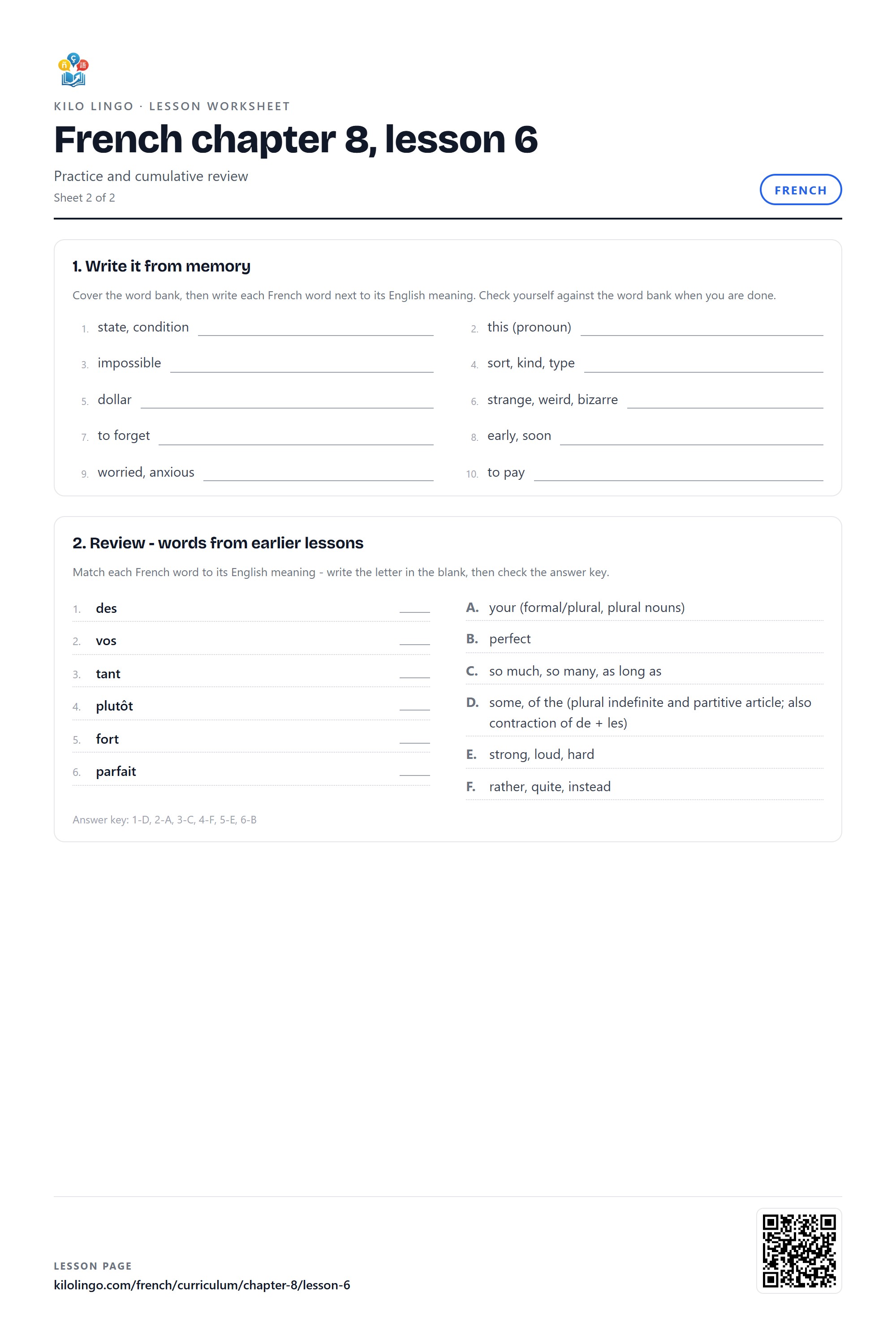
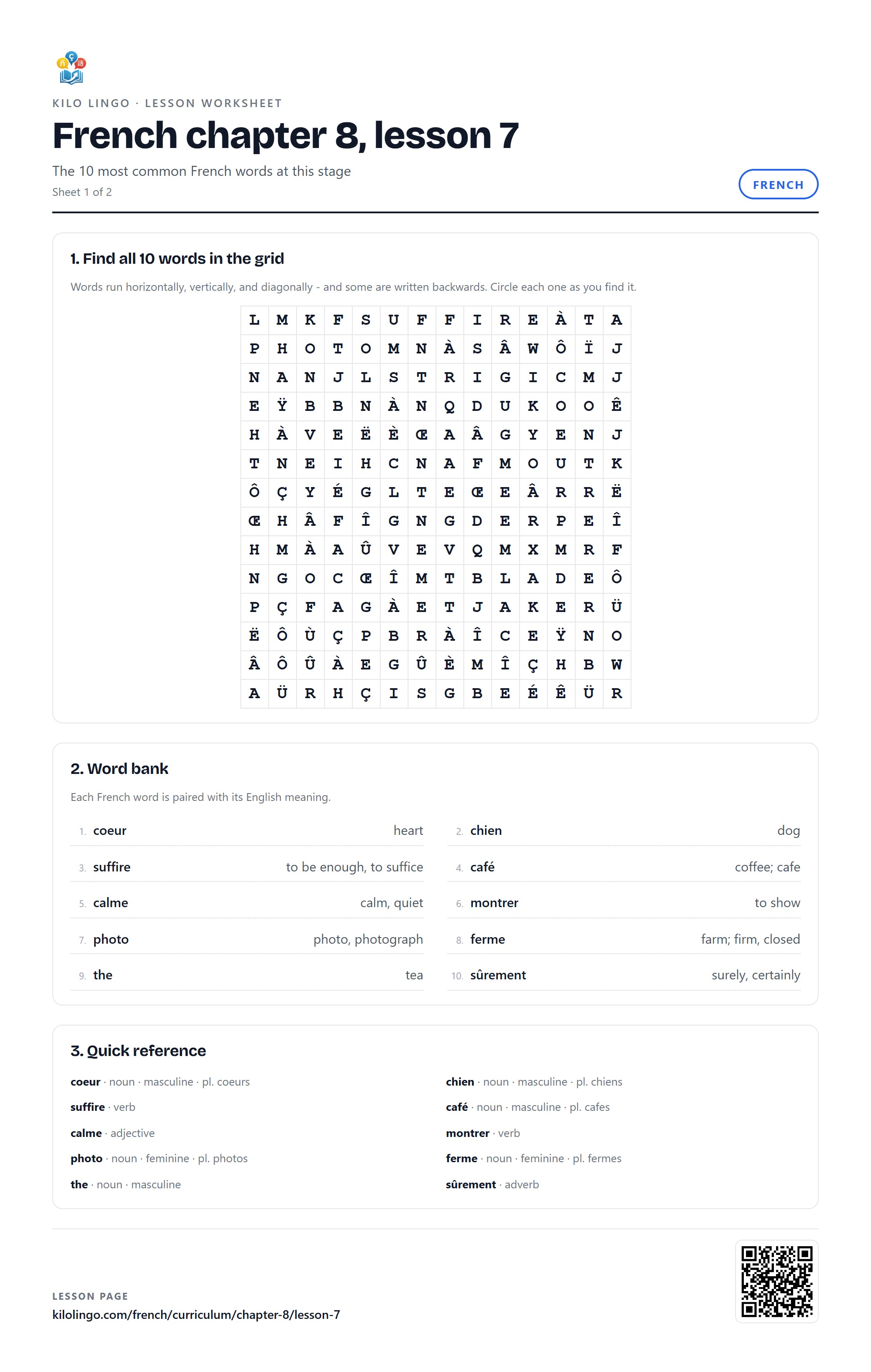
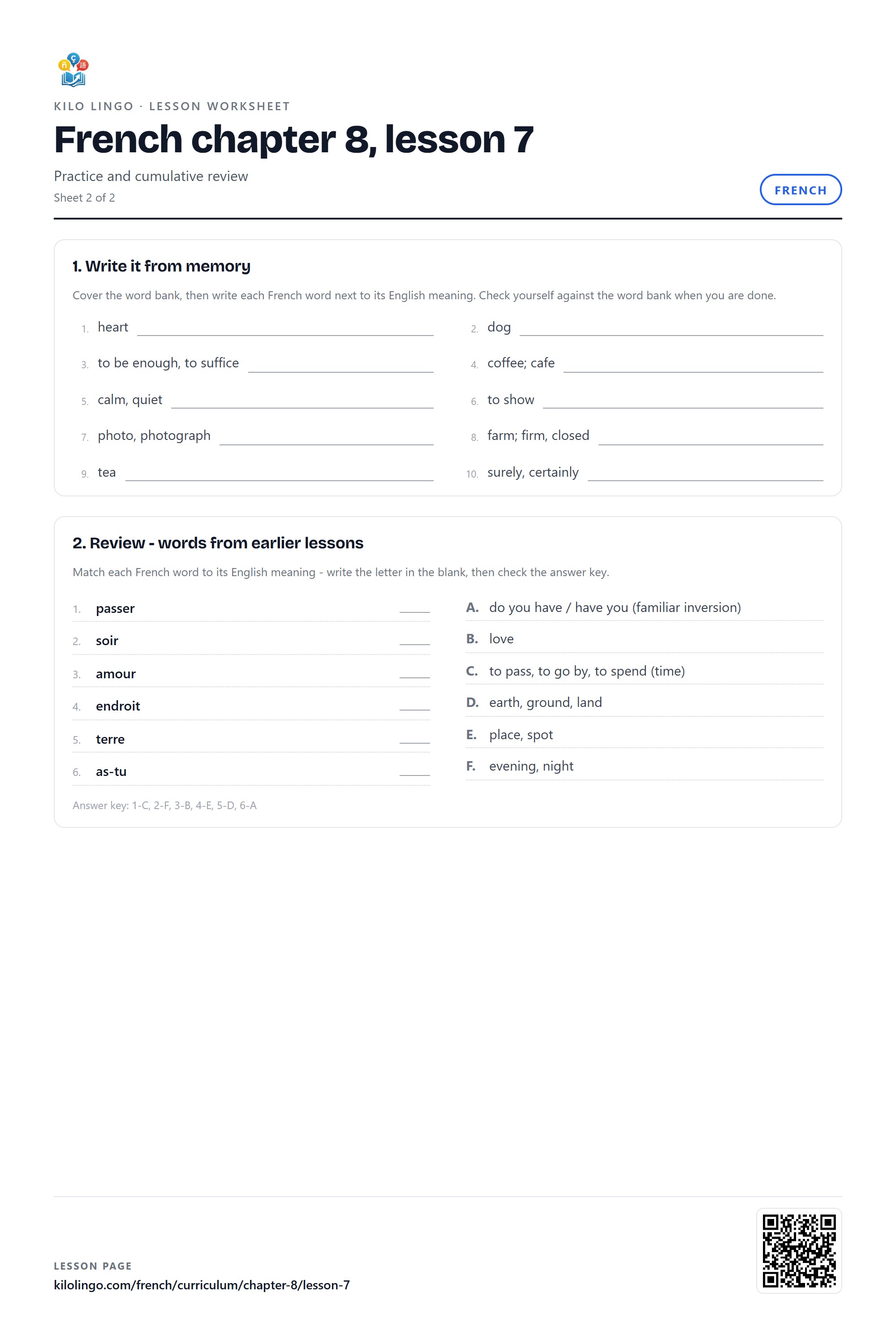
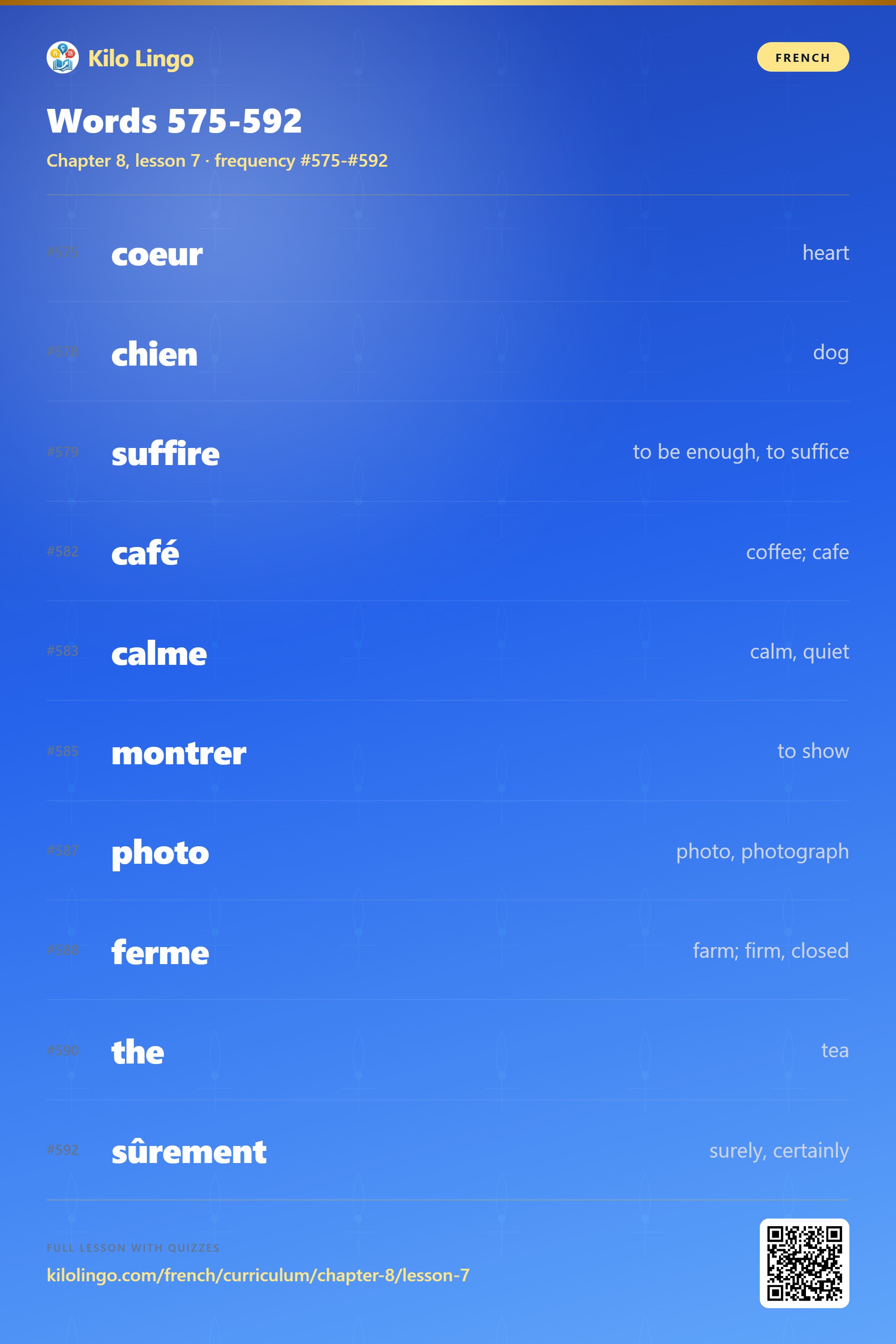
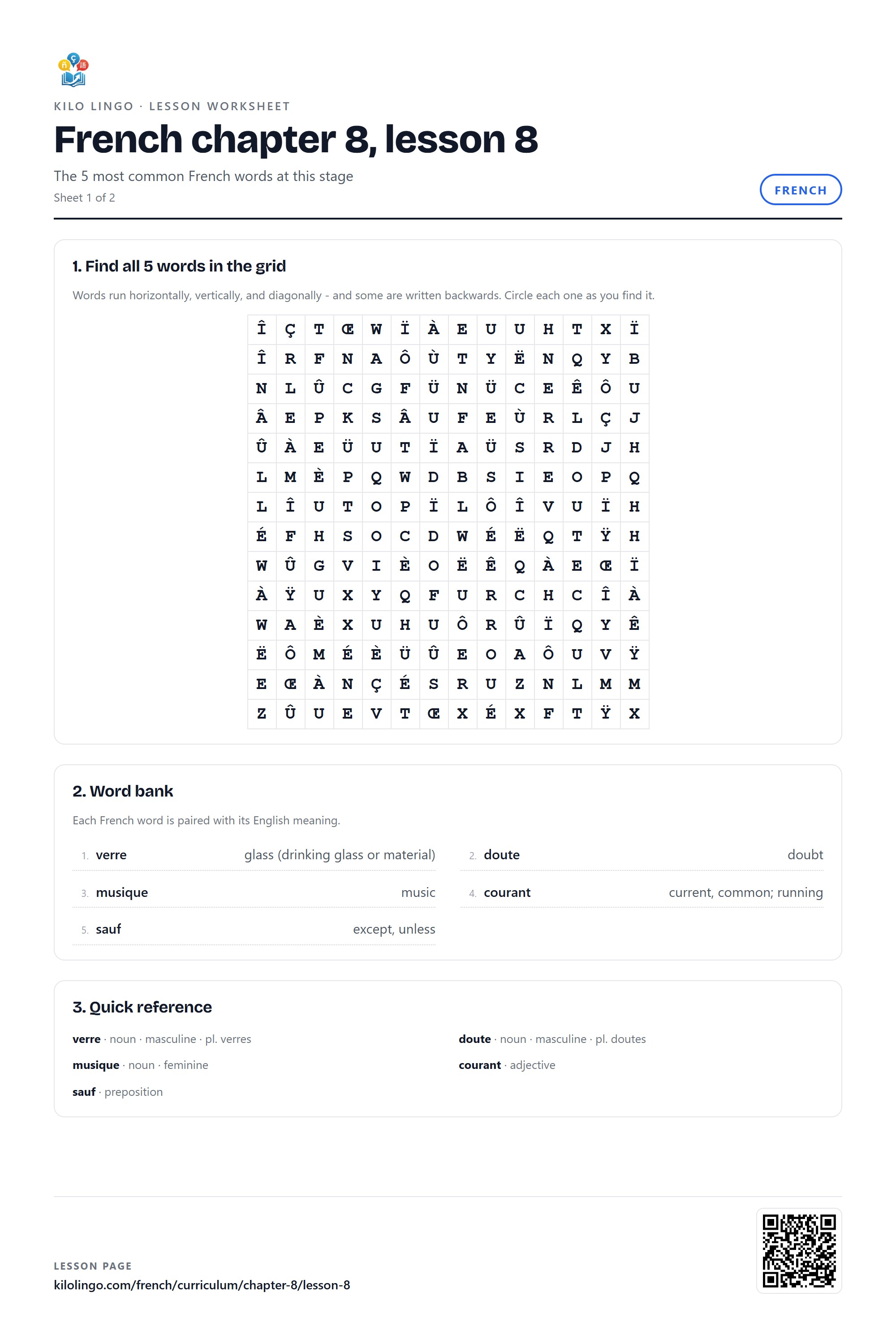
Per-word sheets99 words · a worksheet, infographic and listicle each



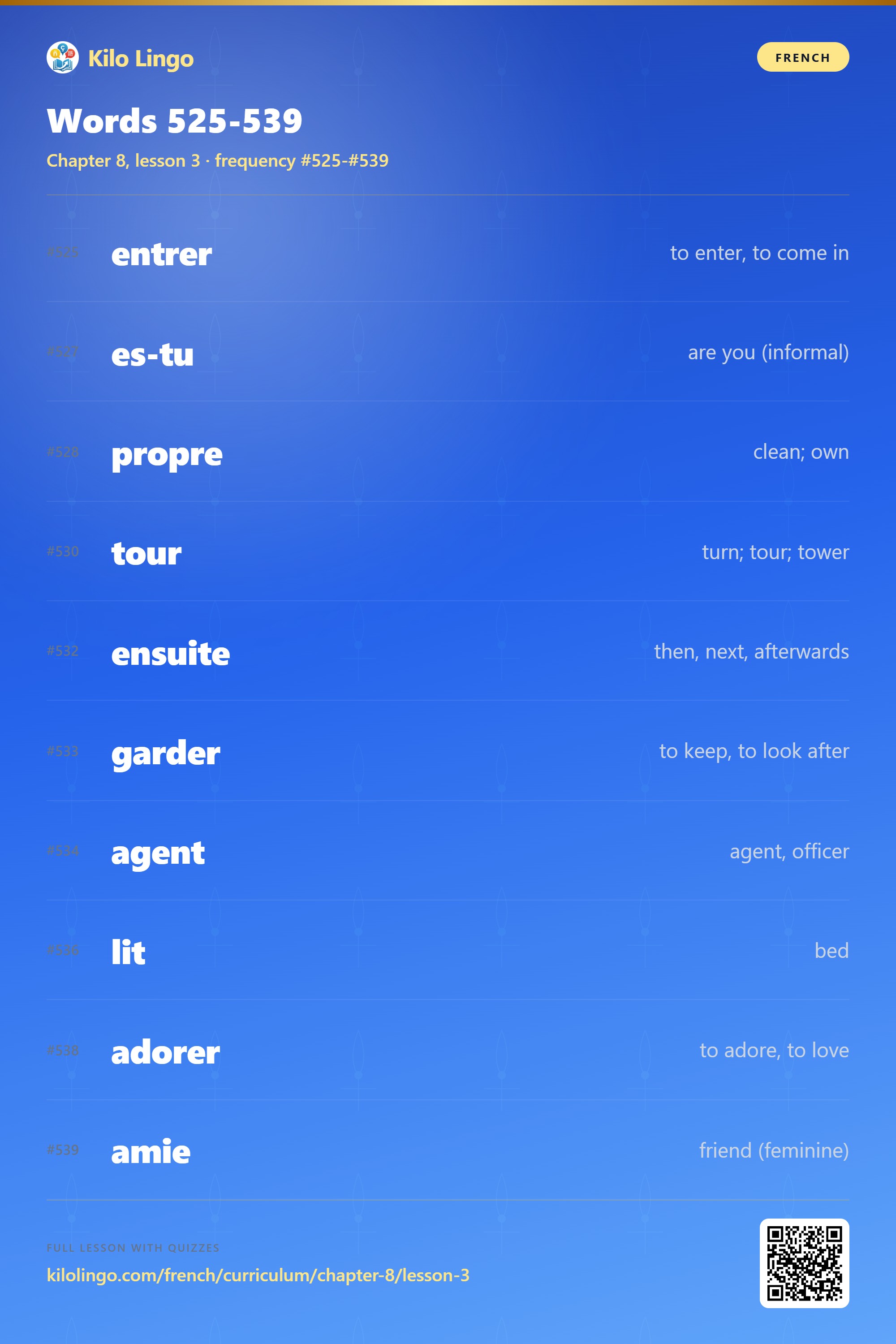
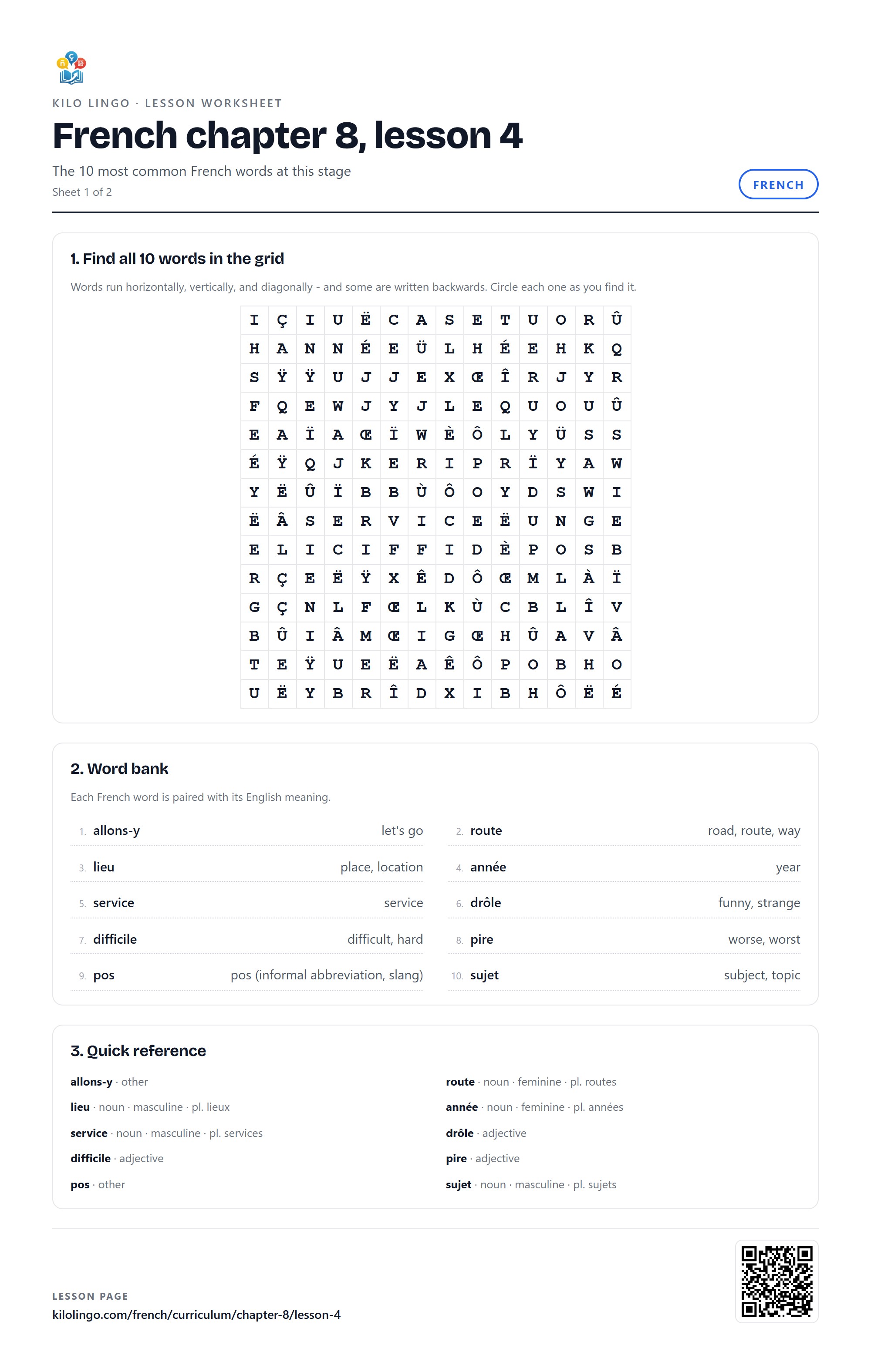
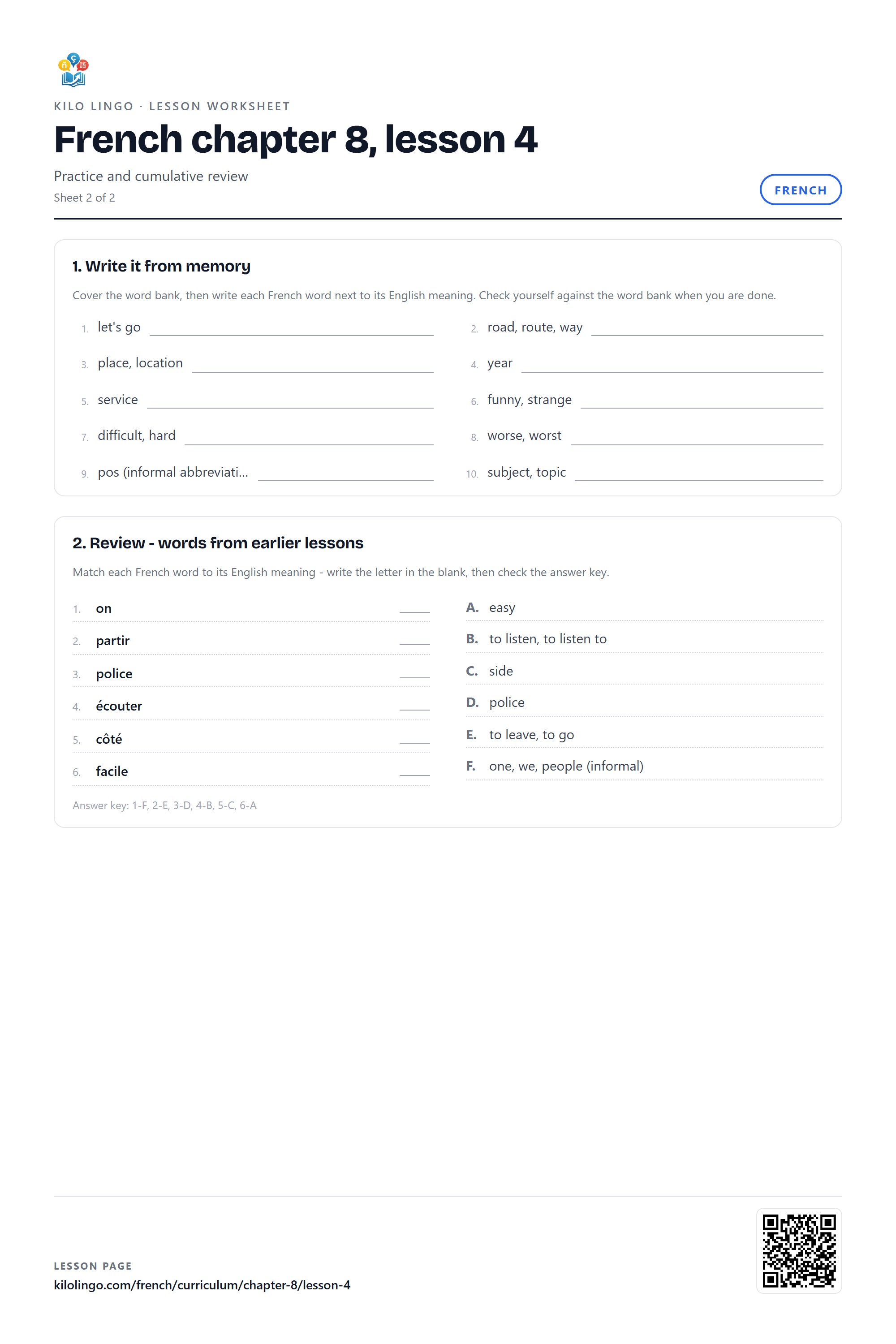

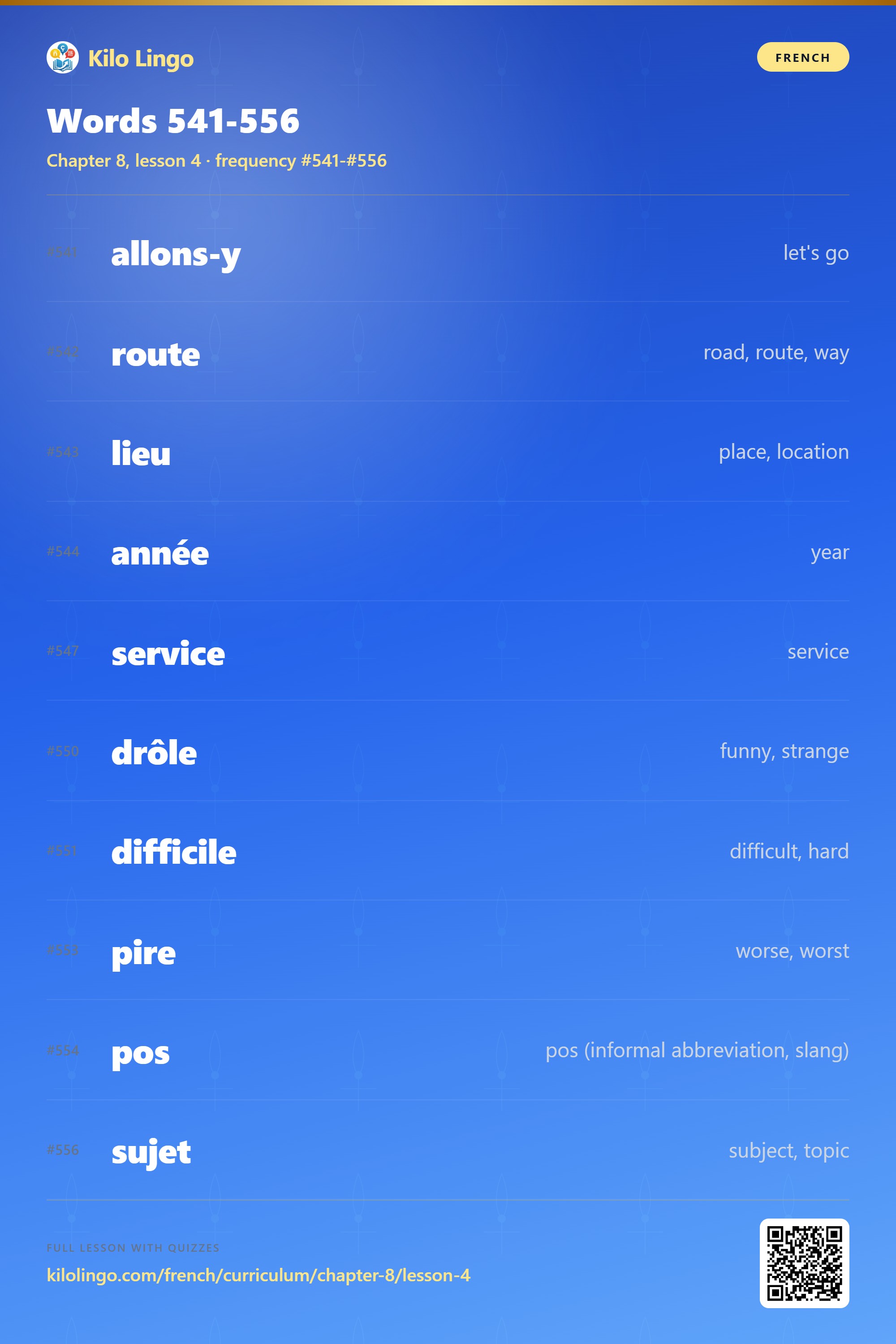



Chapter 9 · The imparfait
Chapter page →- Words 601-610Vocabulary
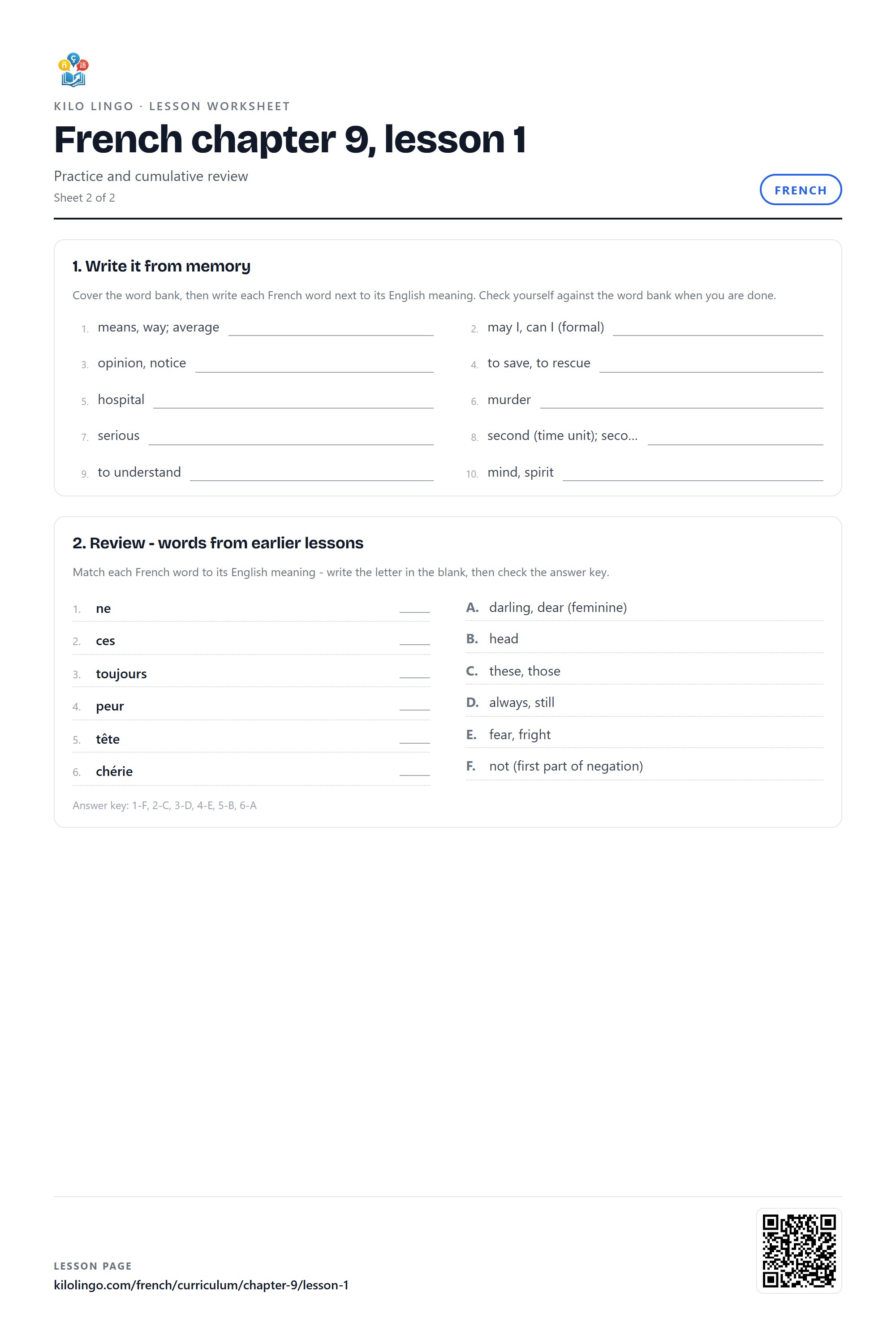
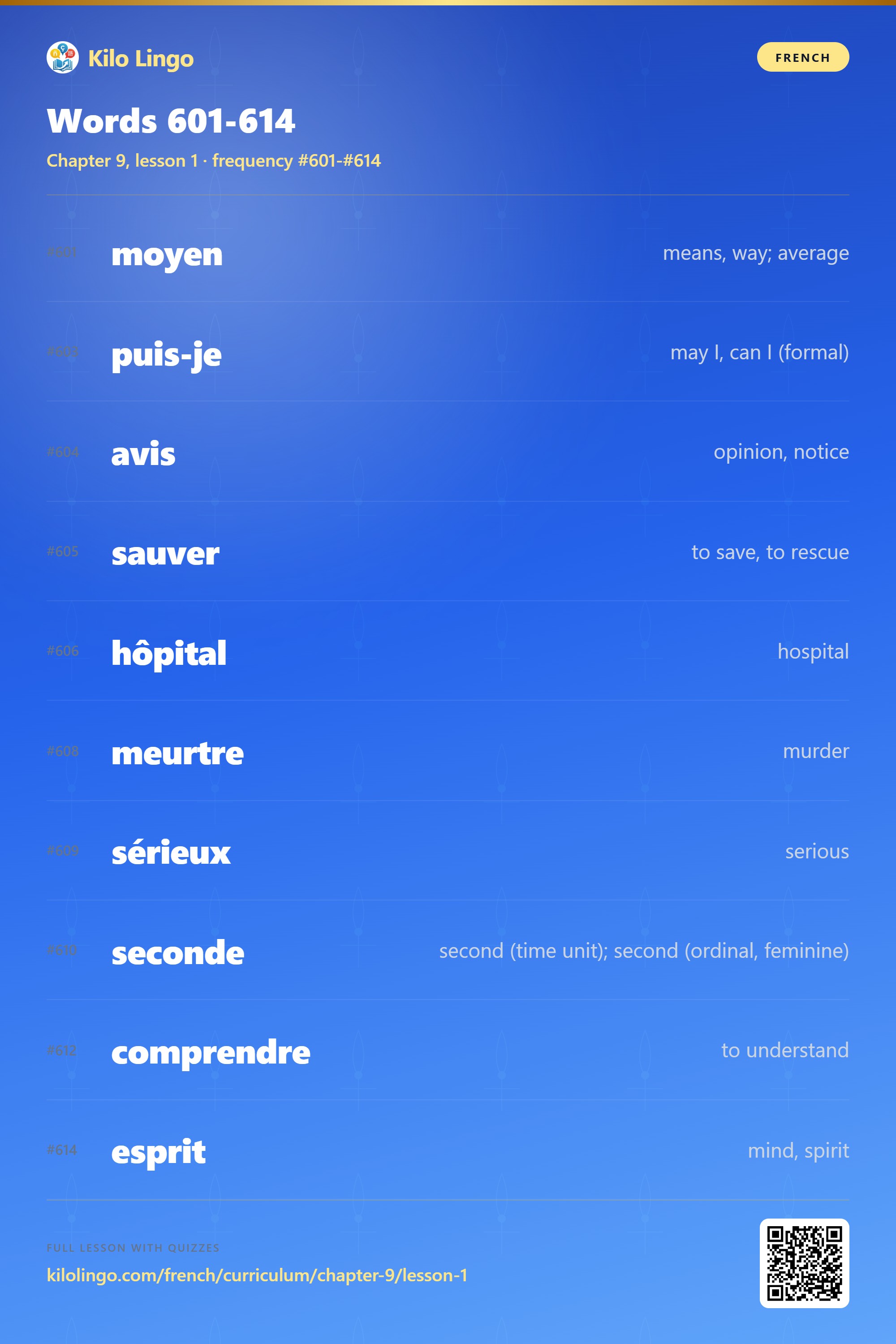
10 words · ranks 601-610
- Word Bubbles review sessionReview games
Pop the words you just met by matching each one to its meaning. A couple of rounds and the batch is yours.
- Words 611-620Vocabulary
10 words · ranks 611-620
- Crossword review sessionReview games
Cross the words you just met, clued in English. Slower than a drill, and it sticks harder.
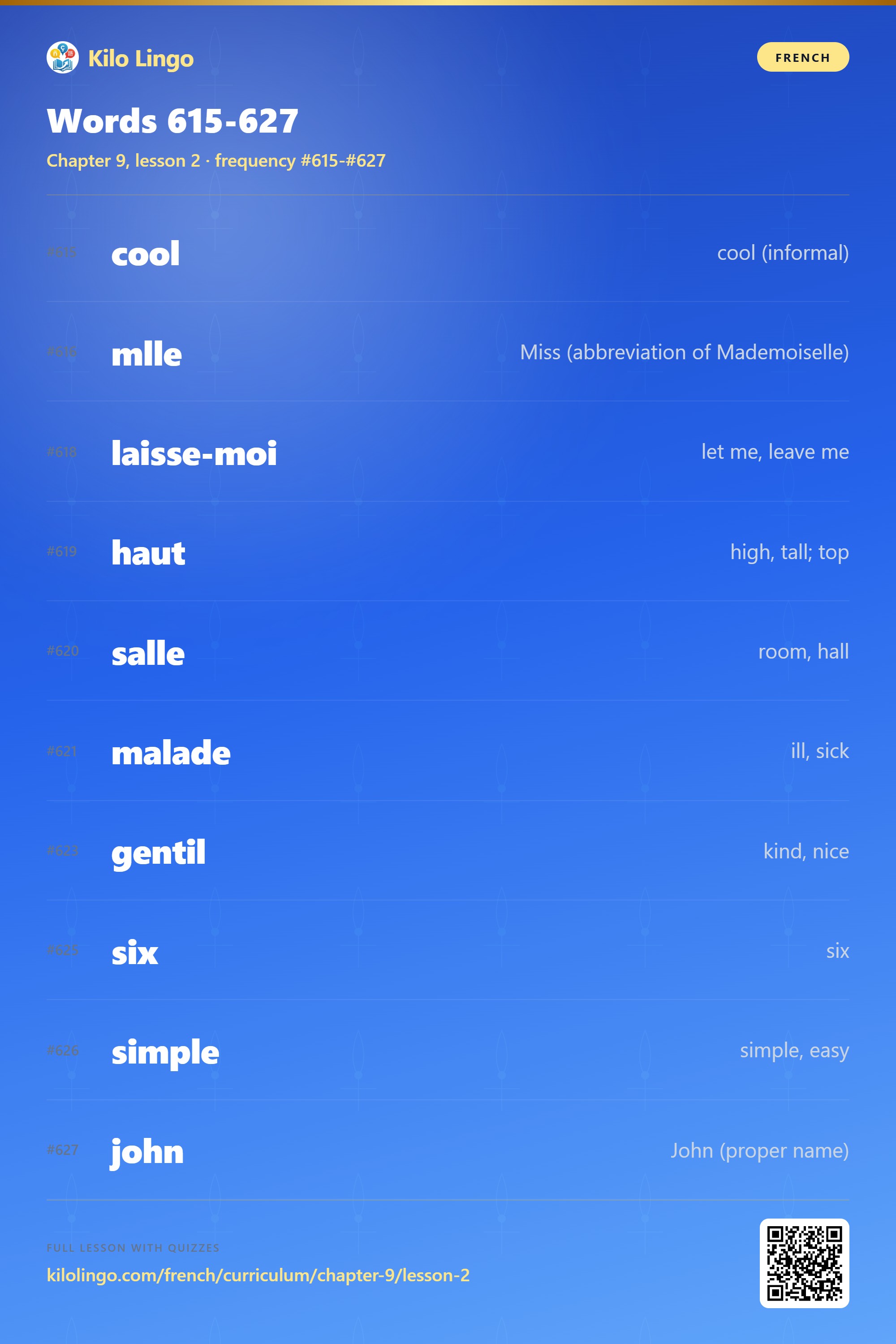
- Words 621-630Vocabulary
10 words · ranks 621-630
- Conjugation Sprint review sessionReview games
Sixty seconds on the endings of the verbs this chapter has drilled so far.
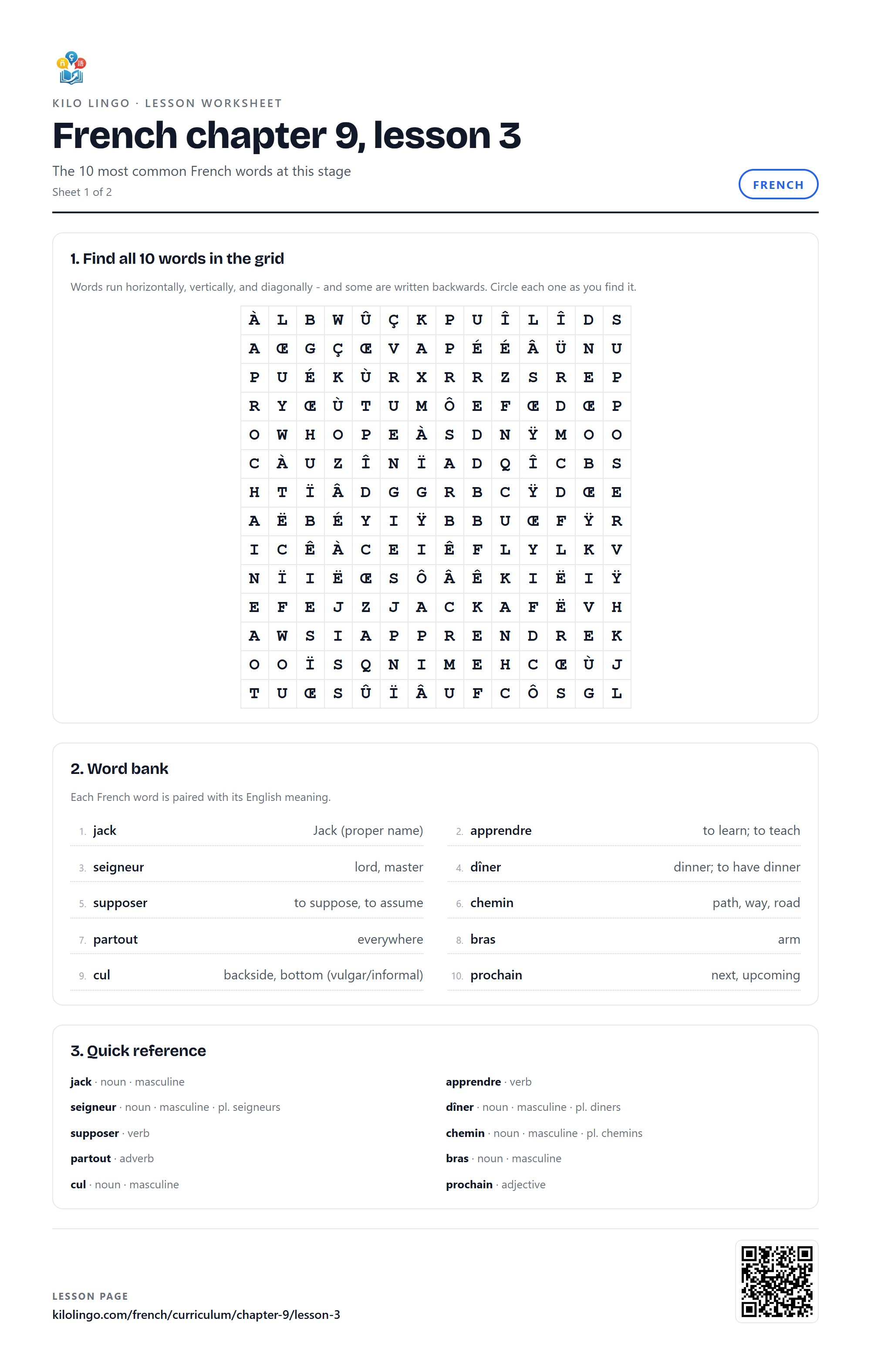
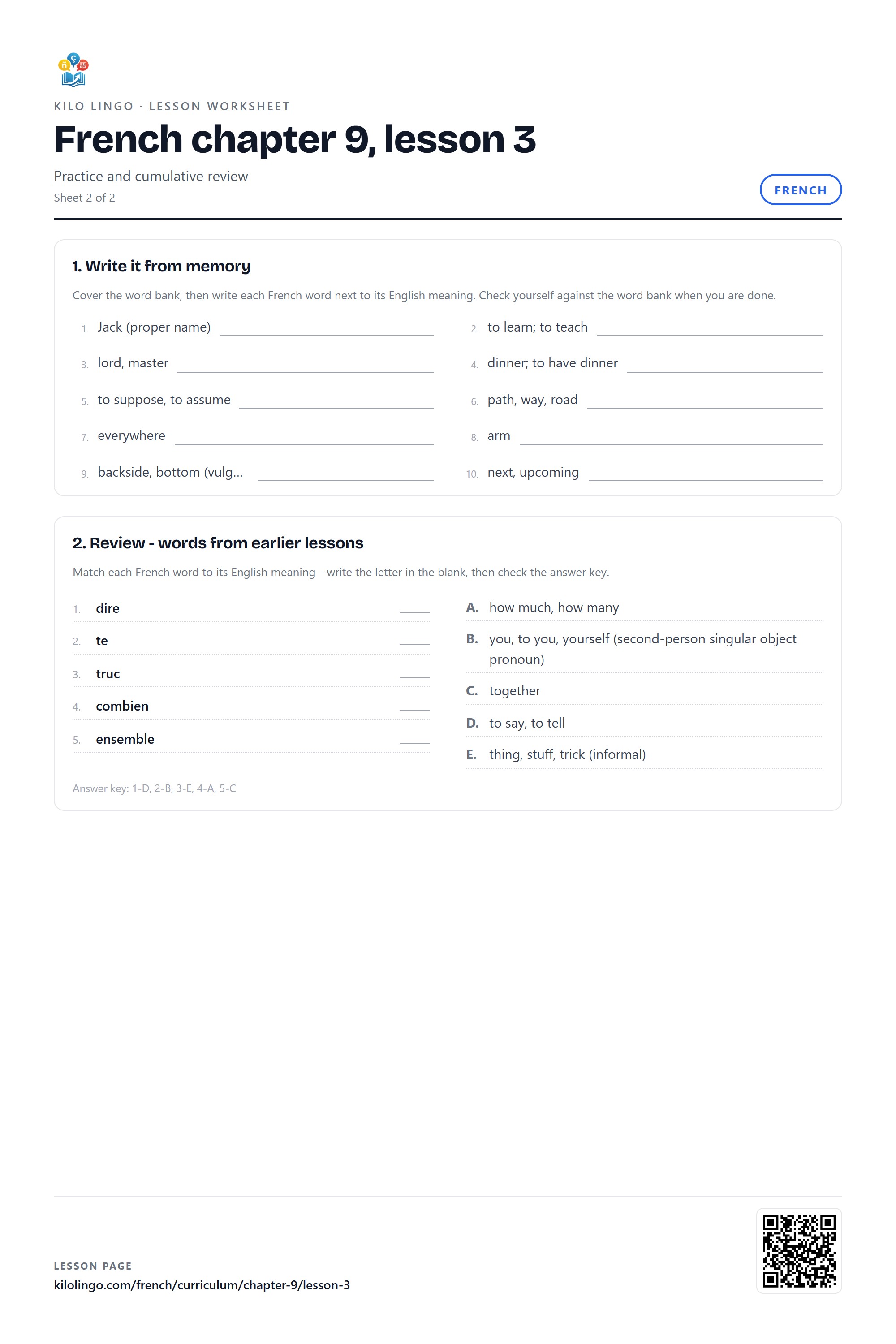
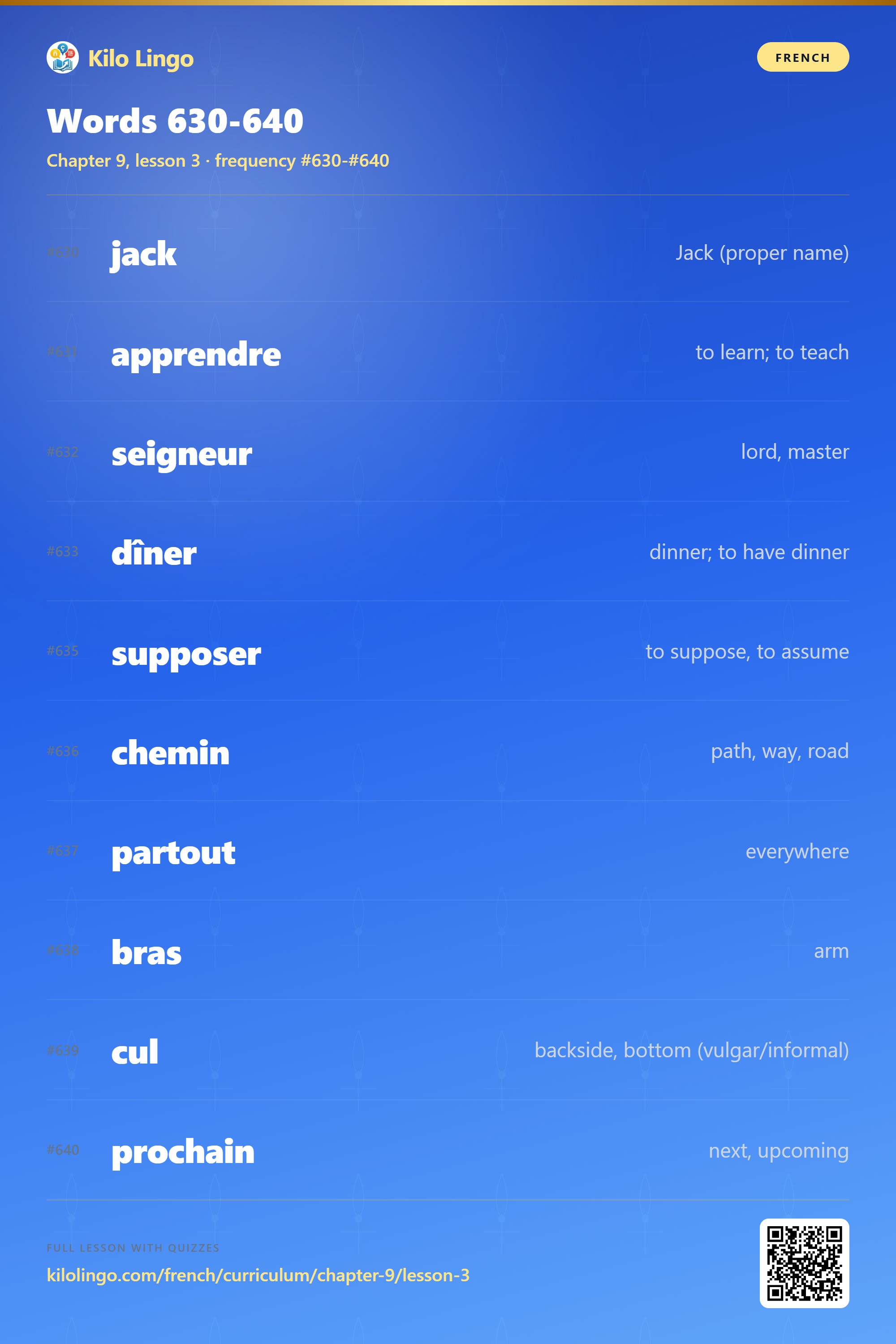
- Words 631-640Vocabulary
10 words · ranks 631-640
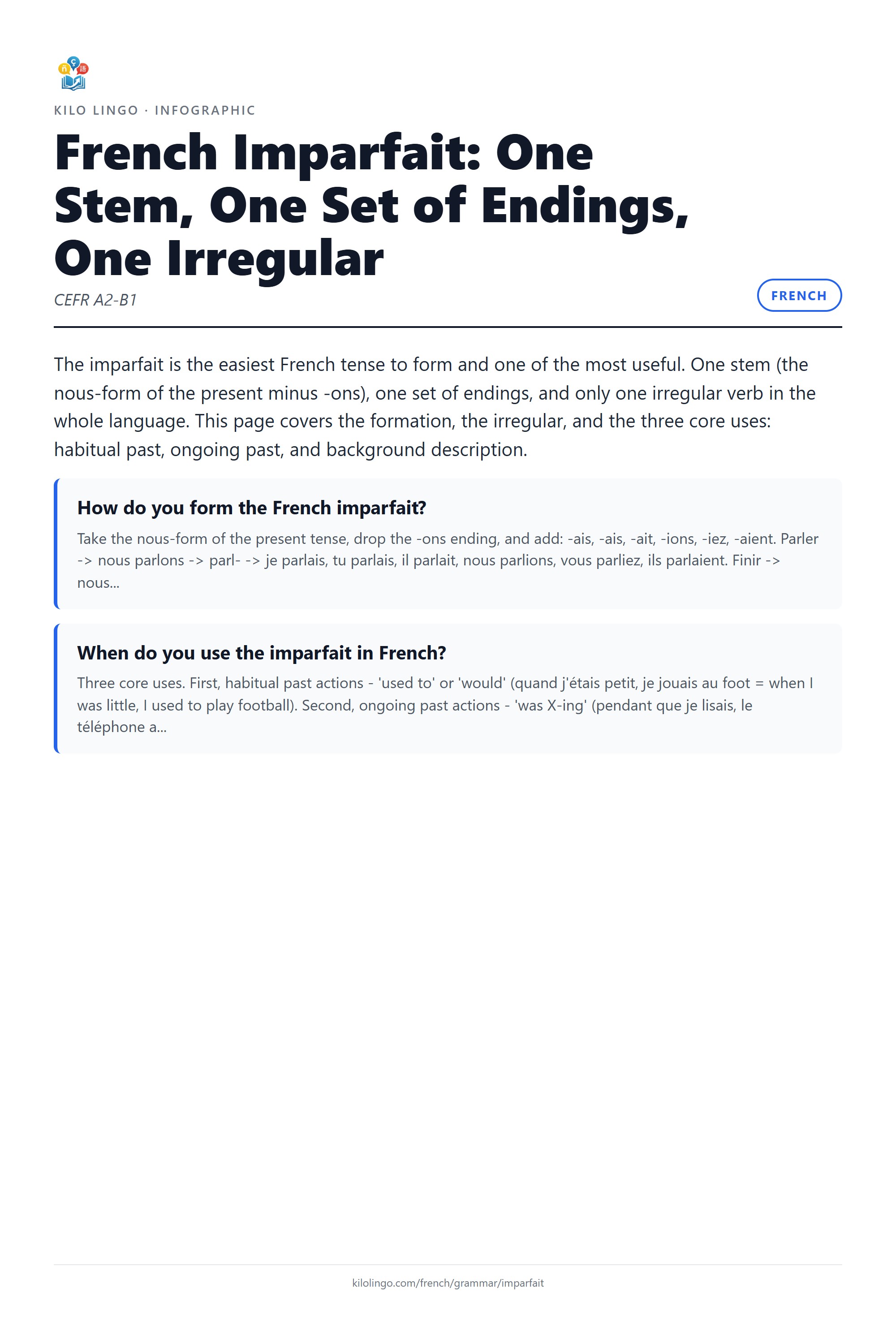
- The imparfaitGrammar
Stem from the nous form, endings -ais / -ais / -ait / -ions / -iez / -aient. Only one irregular stem (etre -> et-). For habitual, ongoing, and background past.
- apporter or amener?Mistake clinic
One is for things. The other is for people.
- Words 641-650Vocabulary
10 words · ranks 641-650
- Word Bubbles review sessionReview games
Pop the words you just met by matching each one to its meaning. A couple of rounds and the batch is yours.
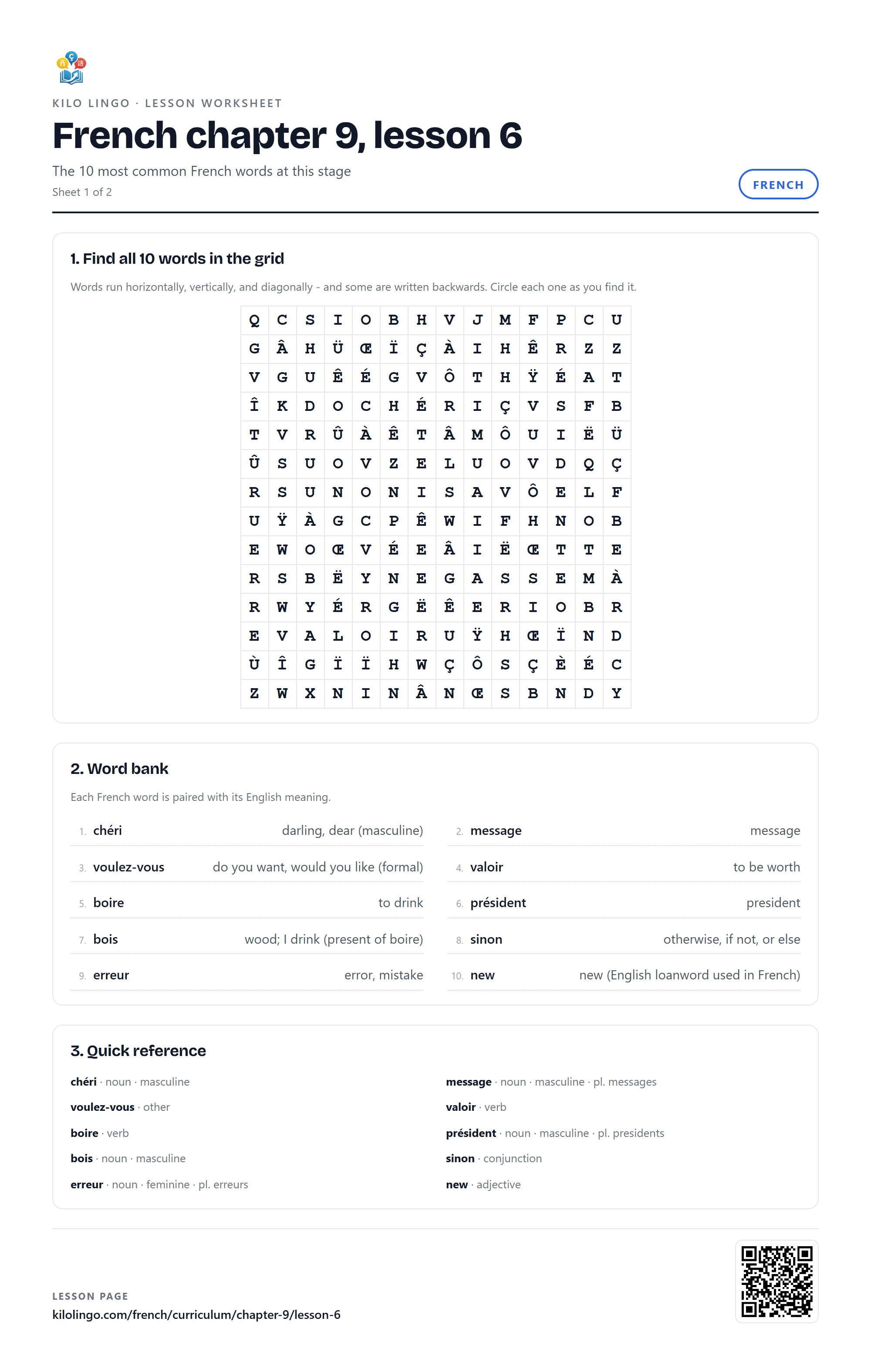
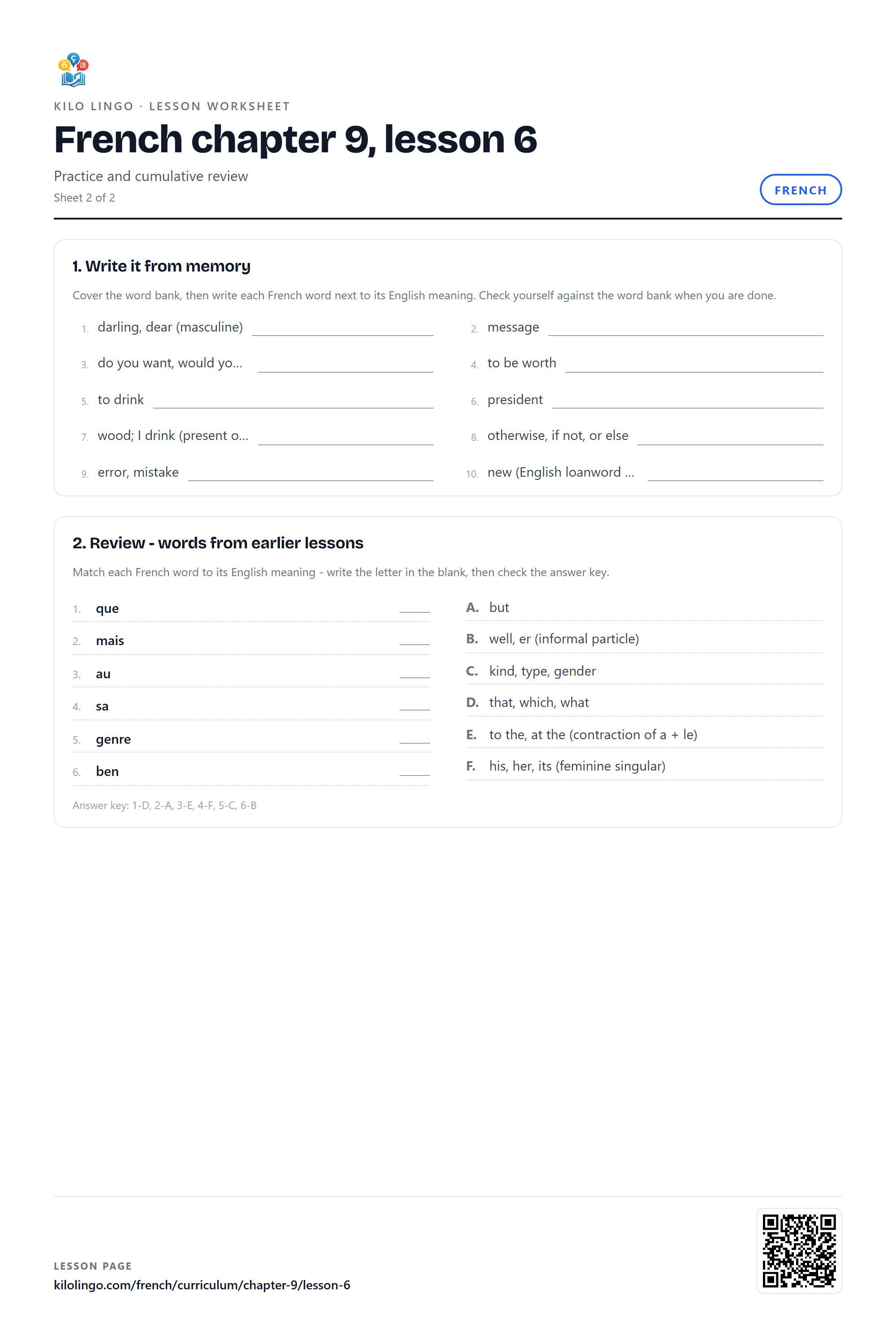
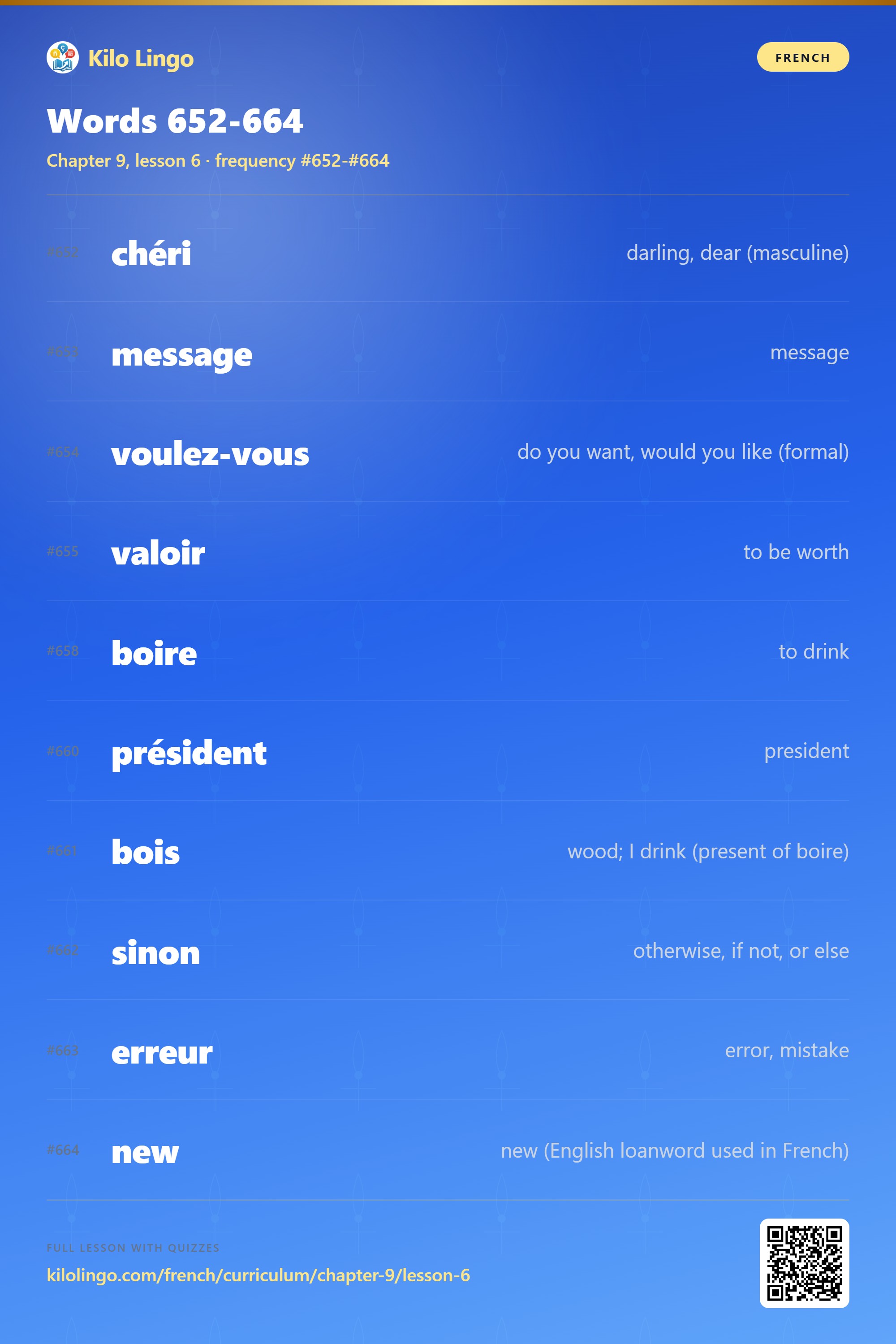
- Words 651-660Vocabulary
10 words · ranks 651-660
- Conjugation Sprint review sessionReview games
Sixty seconds on the endings of the verbs this chapter has drilled so far.
- Words 661-670Vocabulary
10 words · ranks 661-670
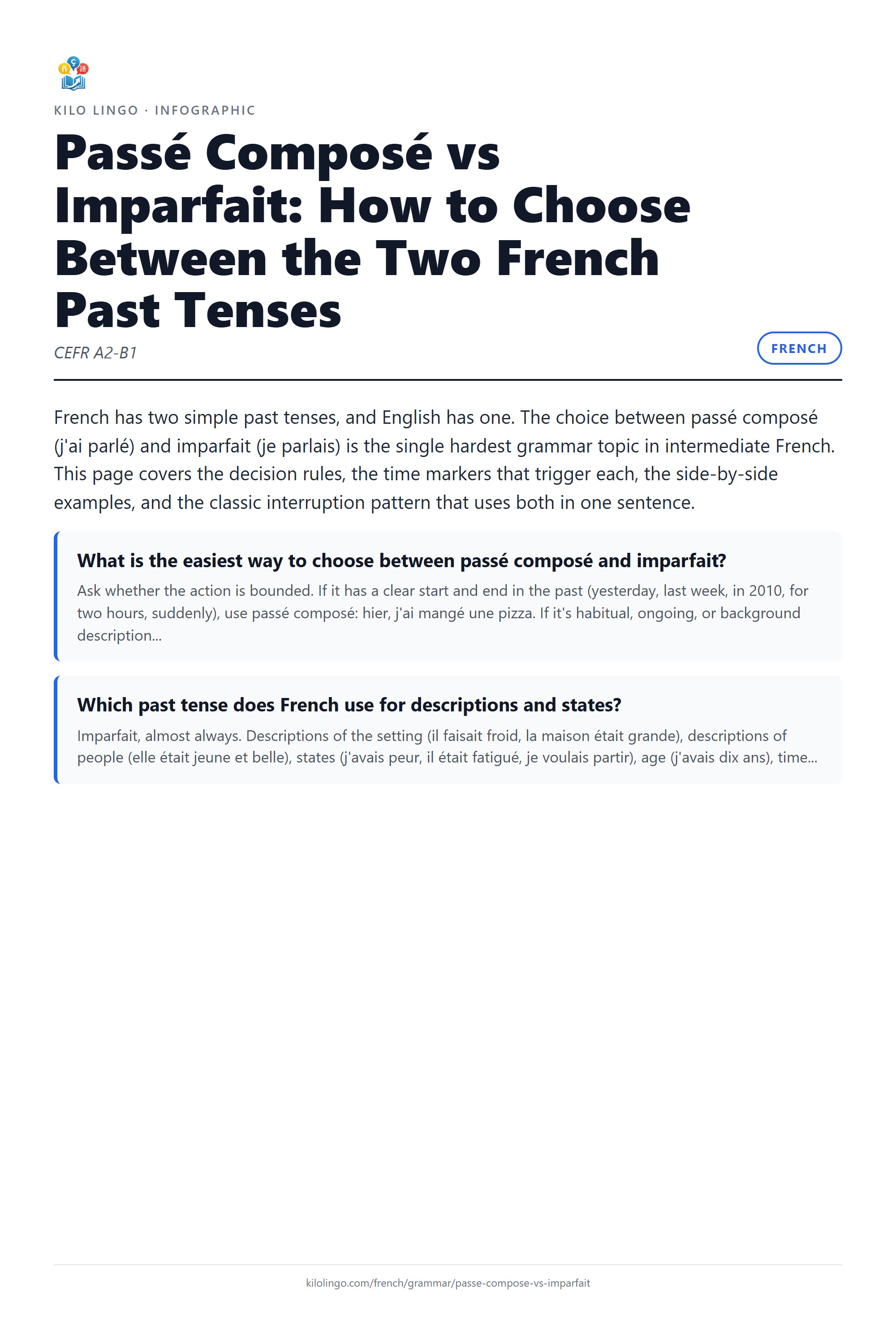
Bounded specific event = passe compose. Habitual / ongoing / background = imparfait. The interruption pattern, the decision rules, and the verbs that shift meaning between the two.
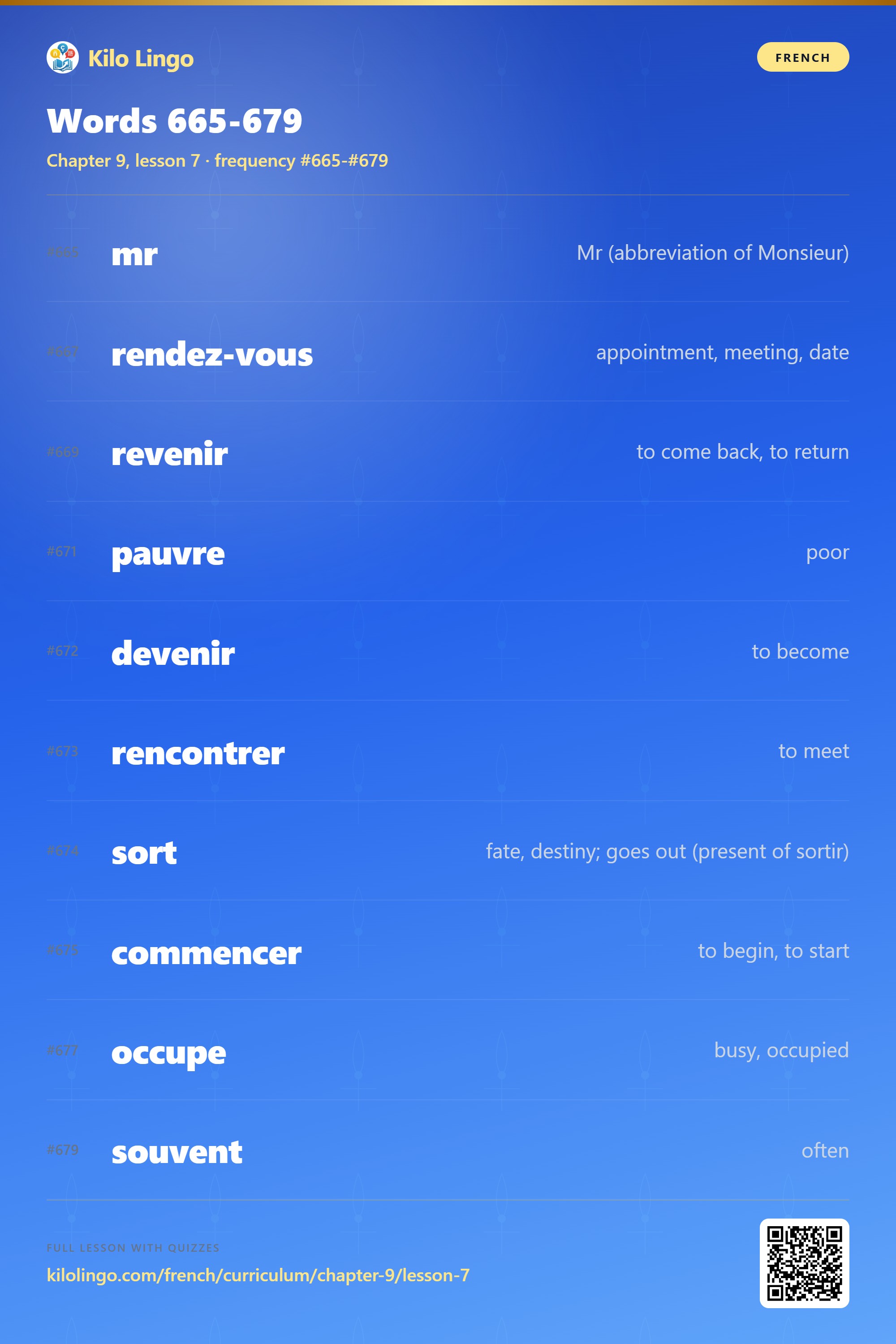
- Words 671-680Vocabulary
10 words · ranks 671-680
- Word Bubbles review sessionReview games
Pop the words you just met by matching each one to its meaning. A couple of rounds and the batch is yours.
- Words 682-691Vocabulary
10 words · ranks 682-691
- Conjugation Sprint review sessionReview games
Sixty seconds on the endings of the verbs this chapter has drilled so far.
- Words 692-700Vocabulary
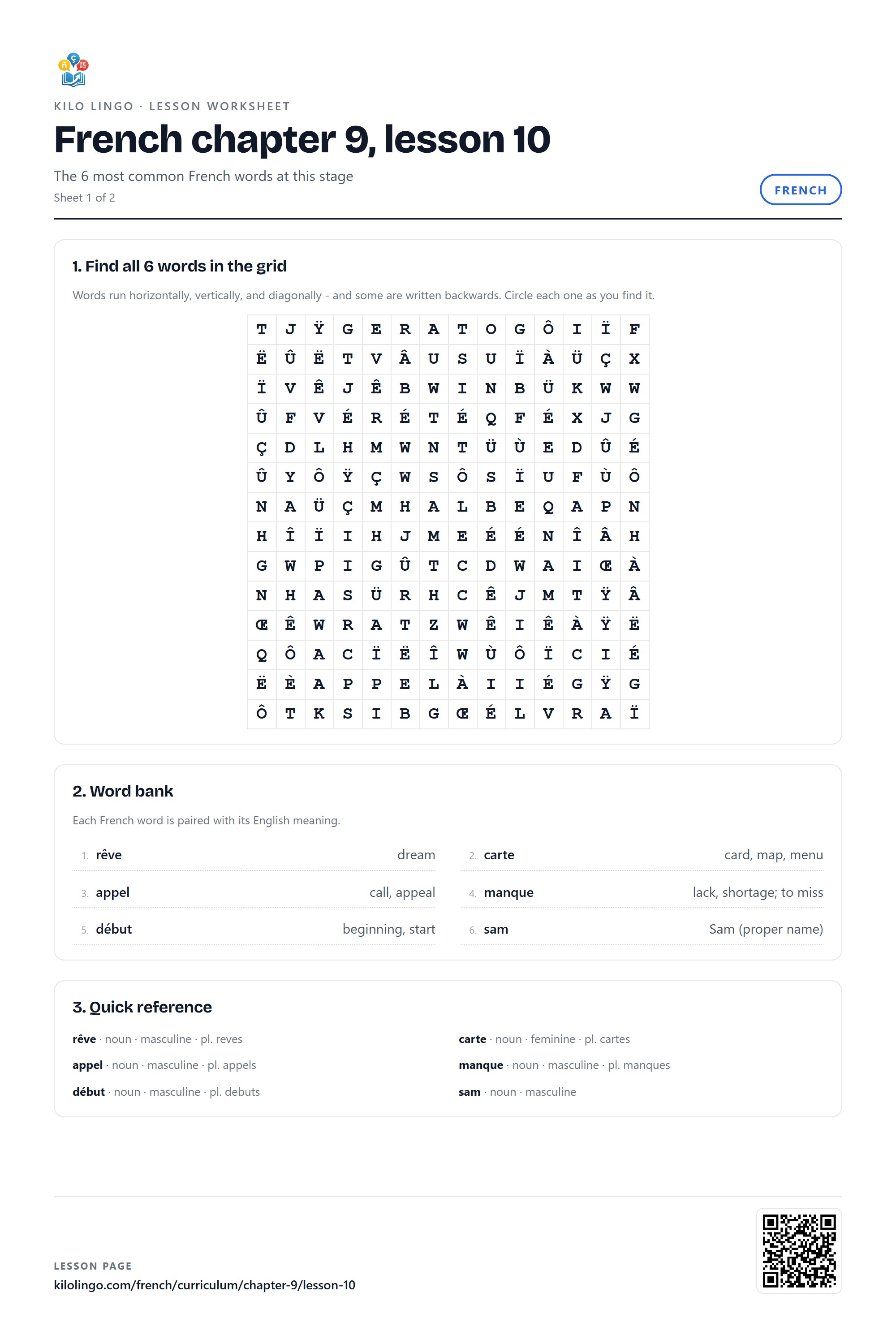
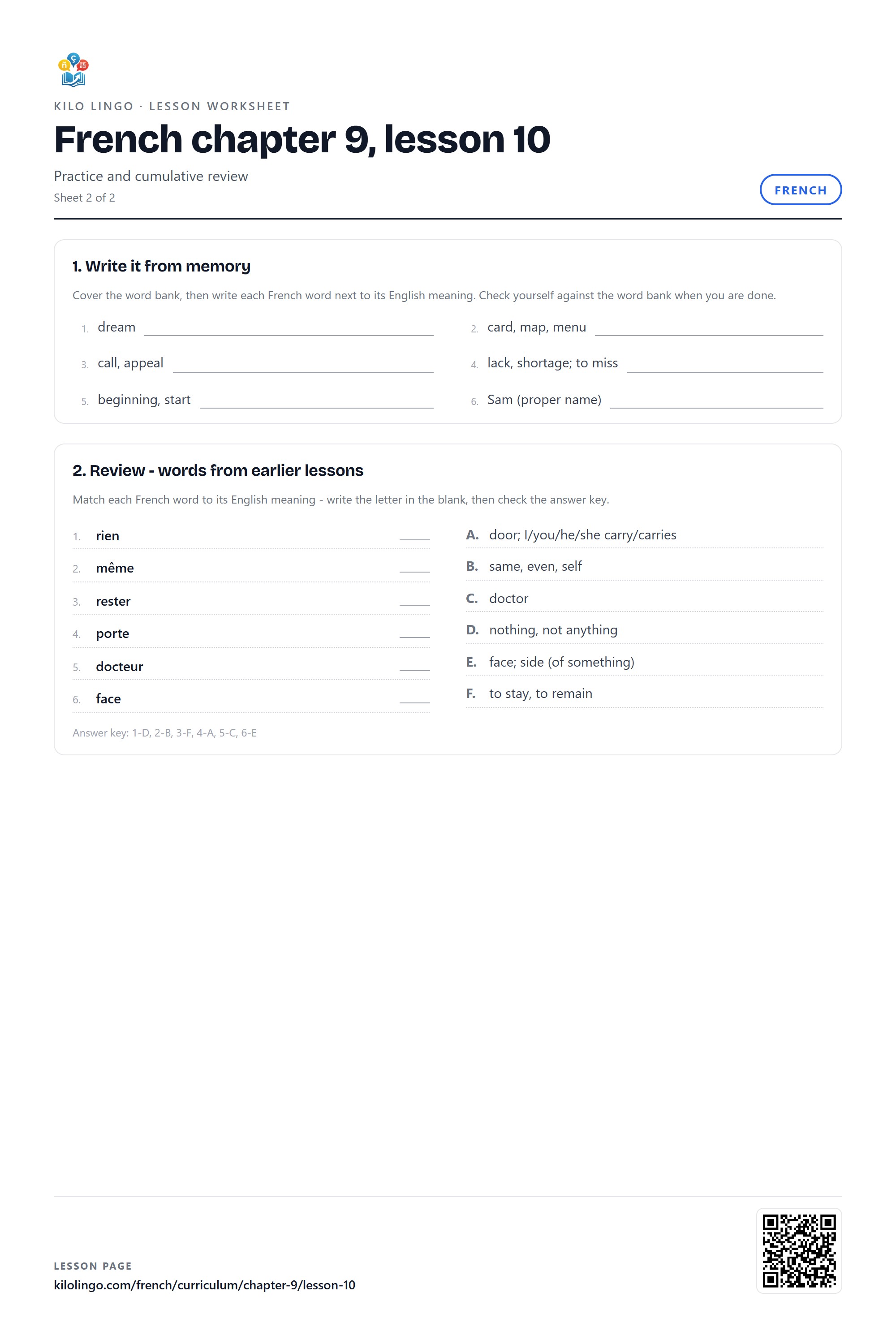
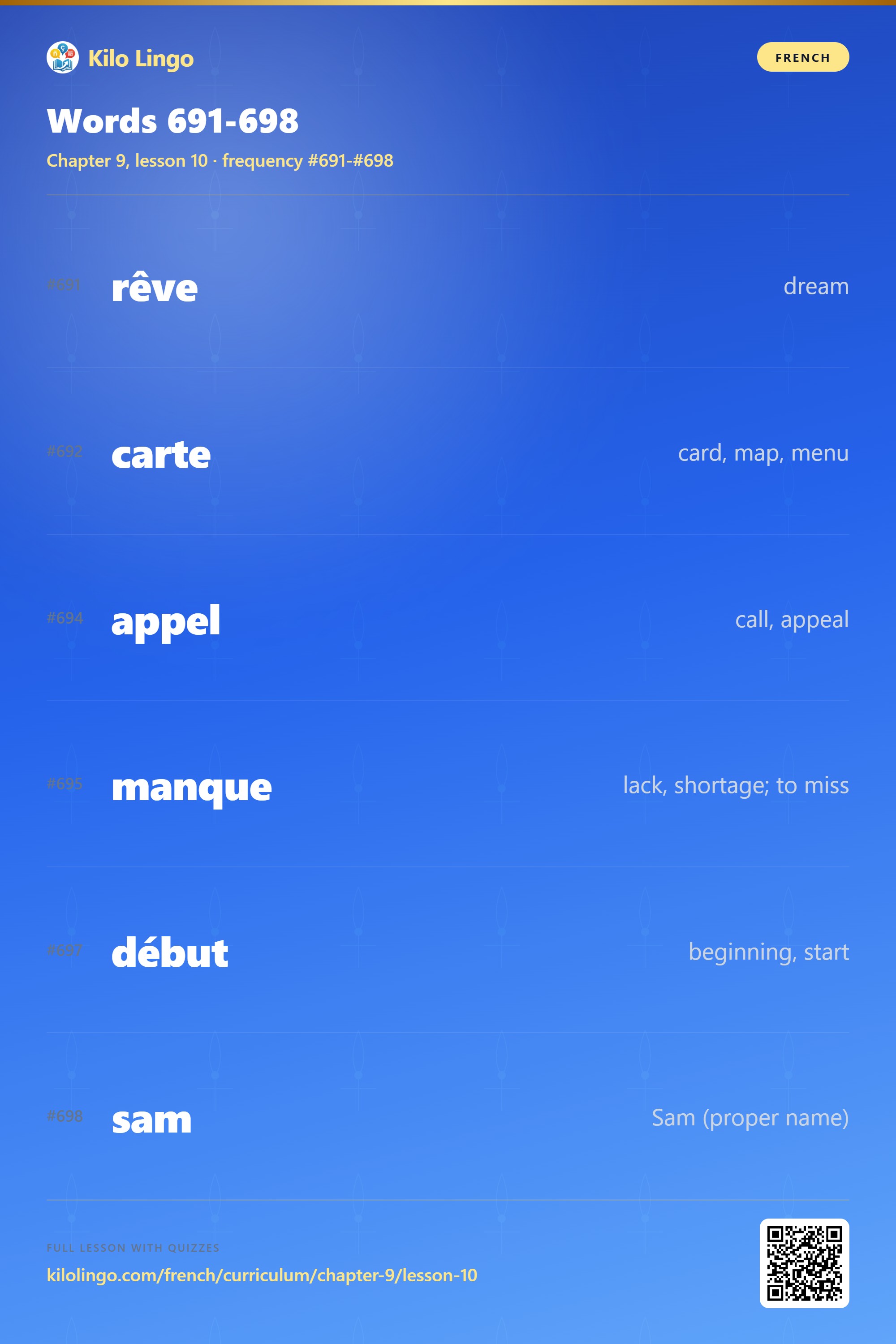
9 words · ranks 692-700
- Song: AlouetteSong
Play it, read along word by word, then answer the questions. Every word is at your level - the song page teaches the few that are new.
- Story milestone: top 700 wordsGraded-reader story
You can read this story using only the words you've learned so far. Every content word sits at or above the rank-700 ceiling.
- Le corps et la santéThemed review
Head, hand and heart, and enough to tell a doctor what hurts. The rest of the body arrives later - this is what you have now.
- Arcade reviewReview games
Replay this chapter's words as games - a different kind of repetition, and it counts.
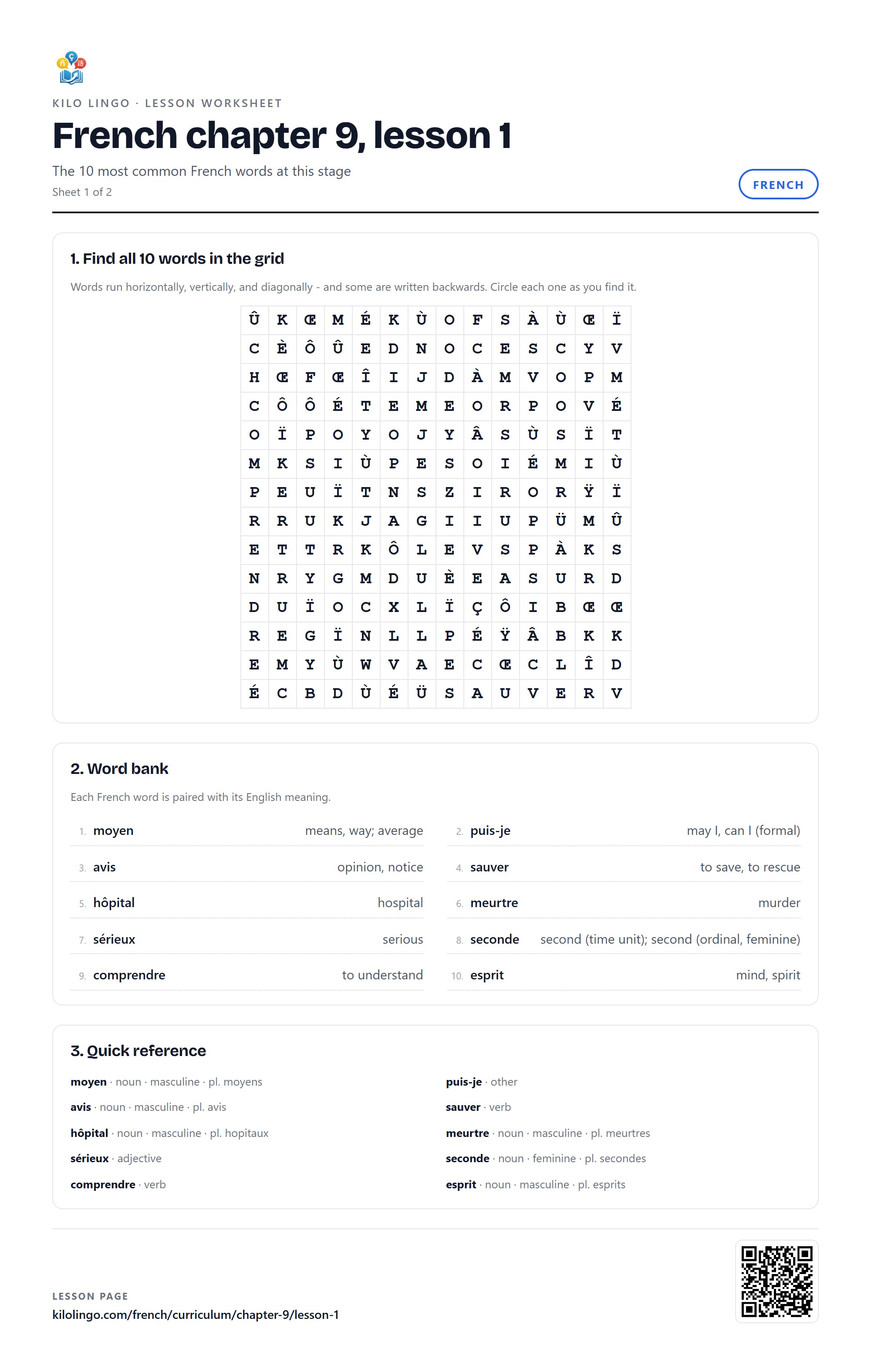
Word printables
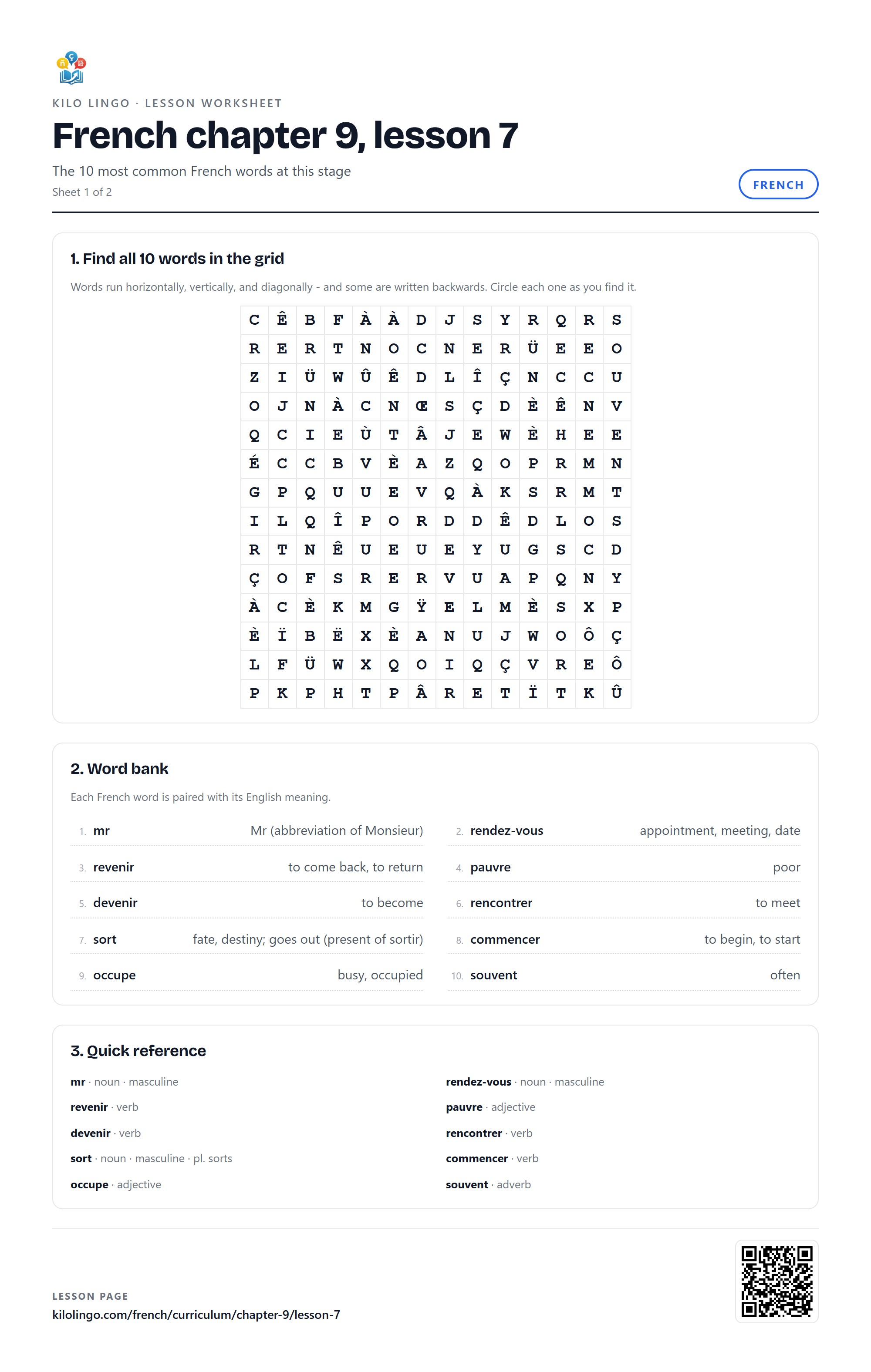
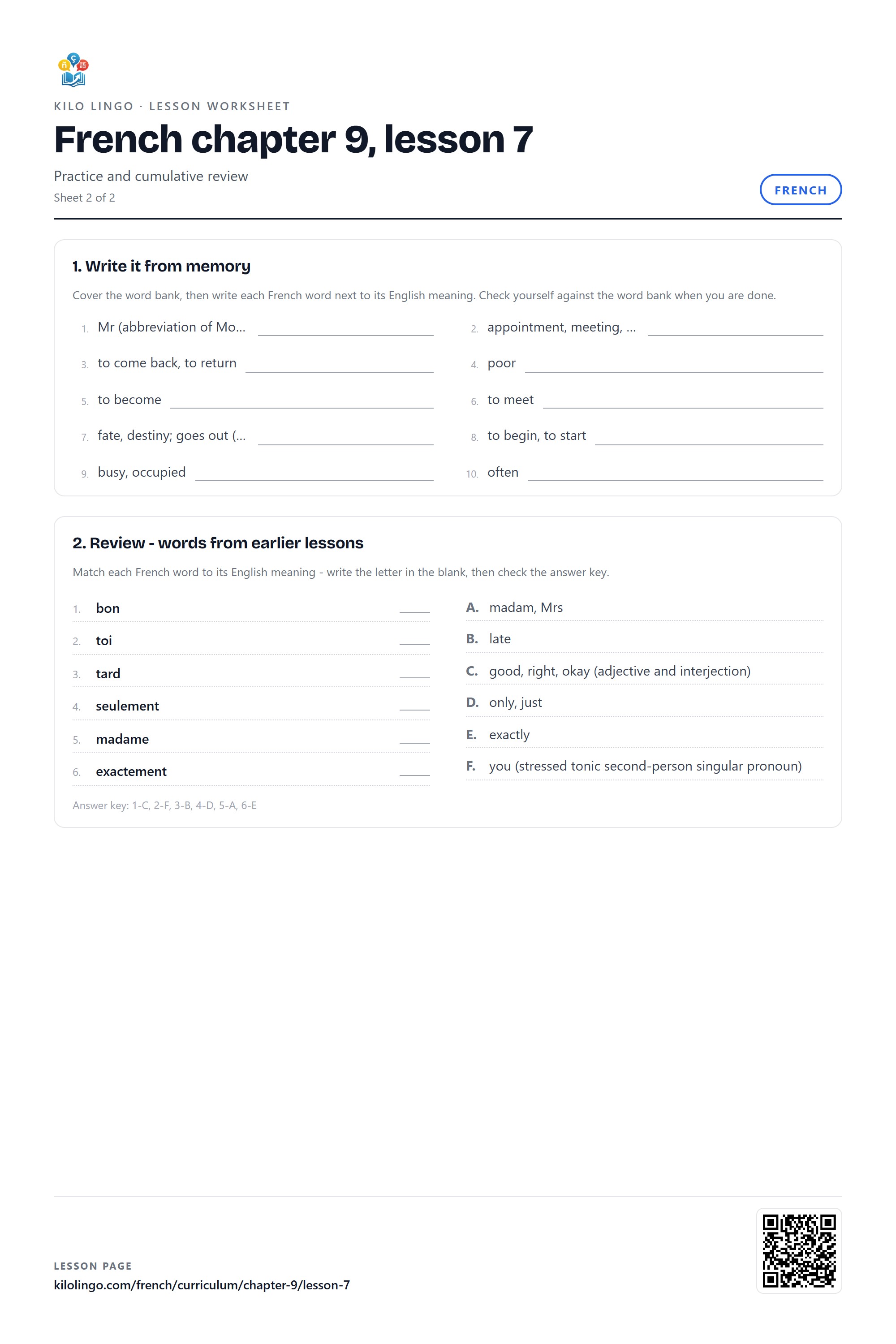
Per-word sheets99 words · a worksheet, infographic and listicle each






Chapter 10 · depuis or pendant?
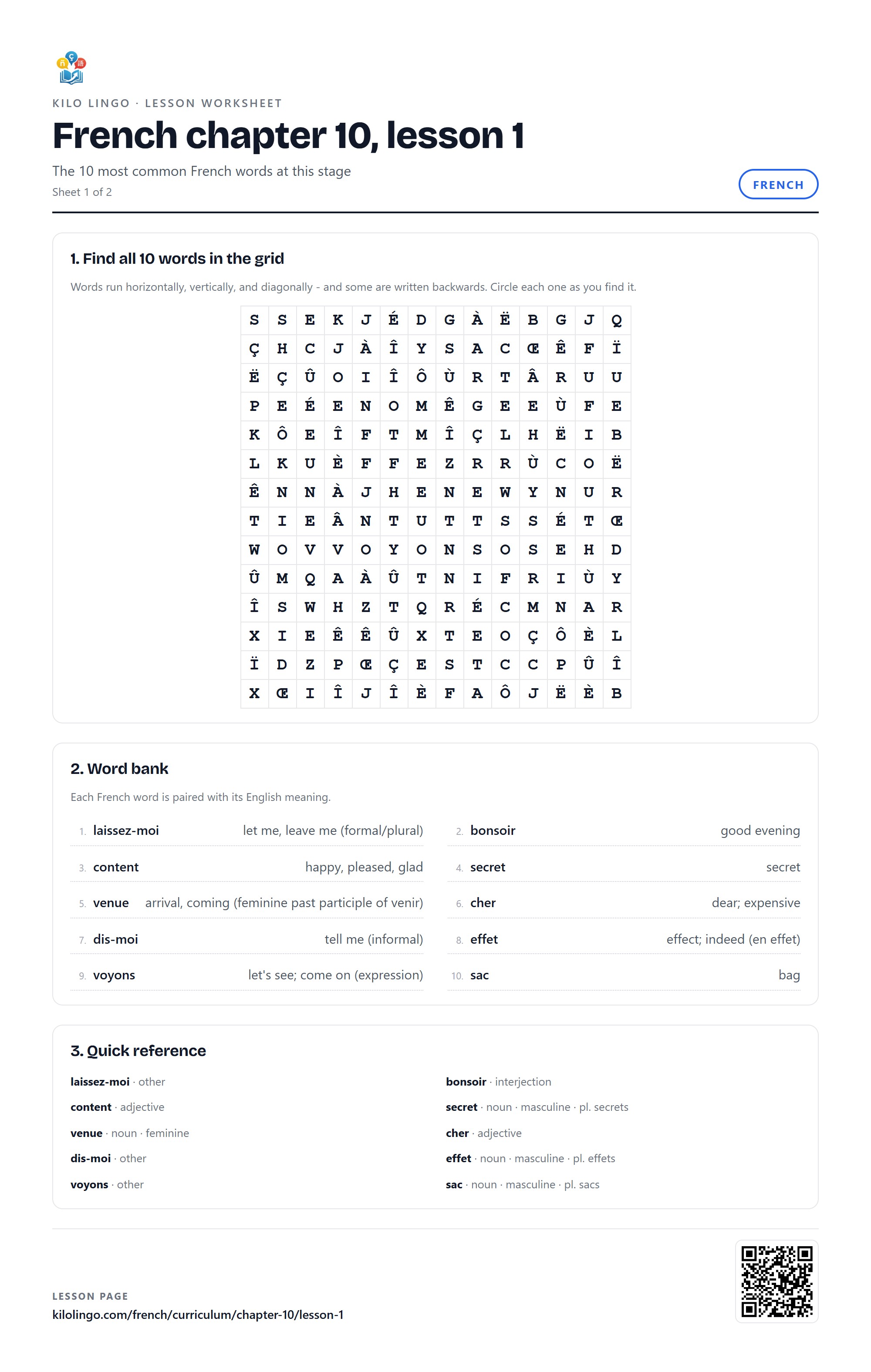
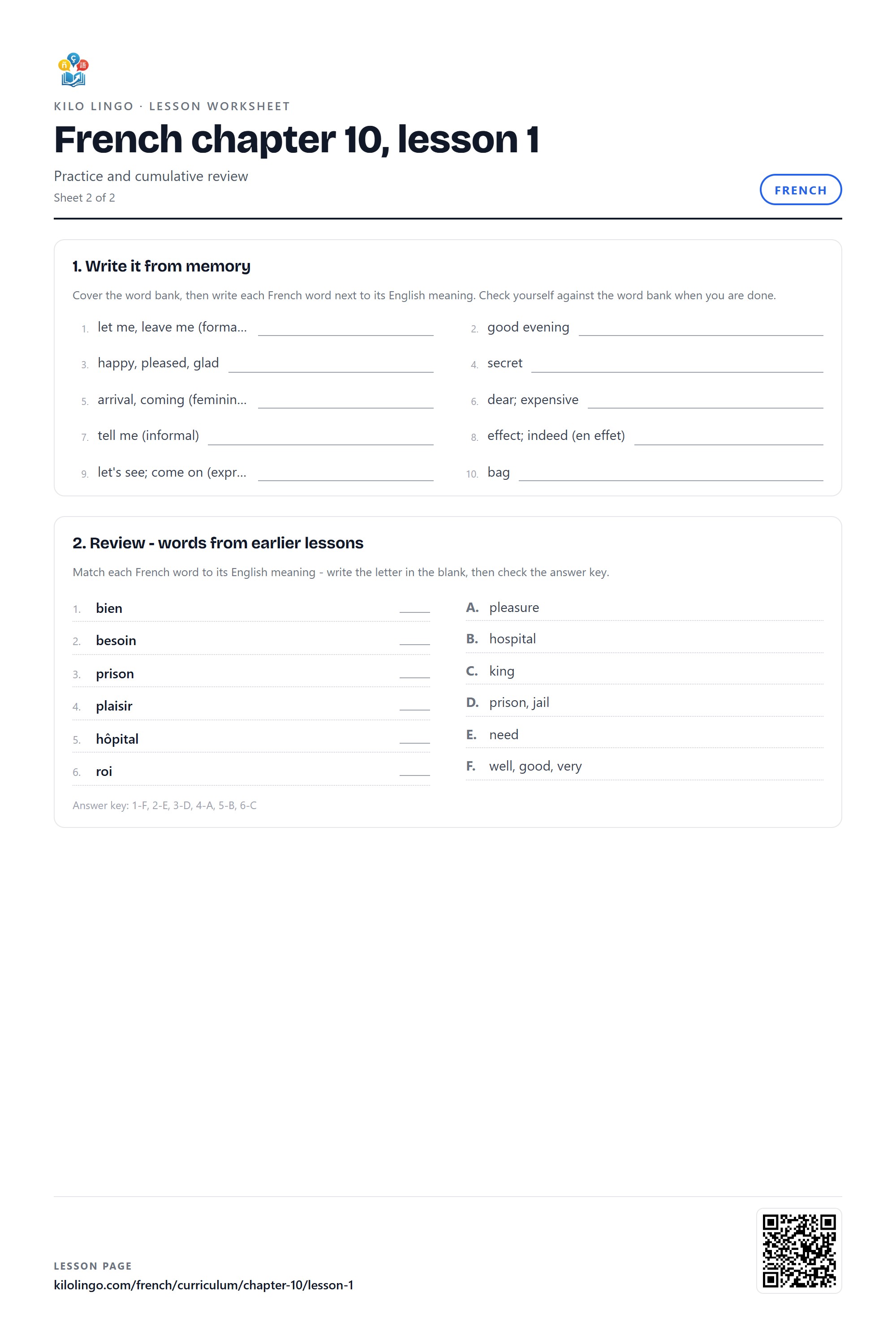
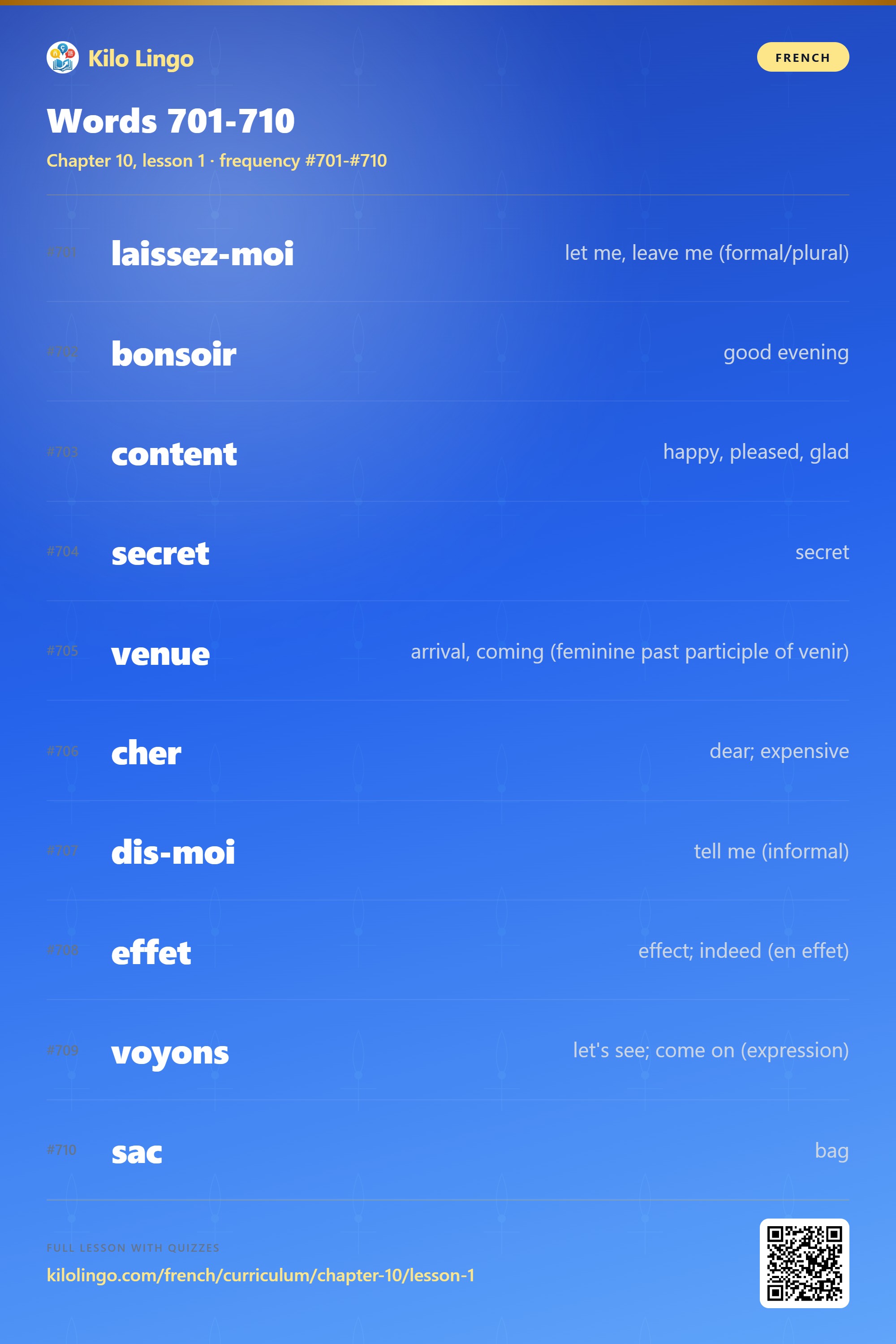
Chapter page →- Words 701-710Vocabulary
10 words · ranks 701-710
- Crossword review sessionReview games
Cross the words you just met, clued in English. Slower than a drill, and it sticks harder.
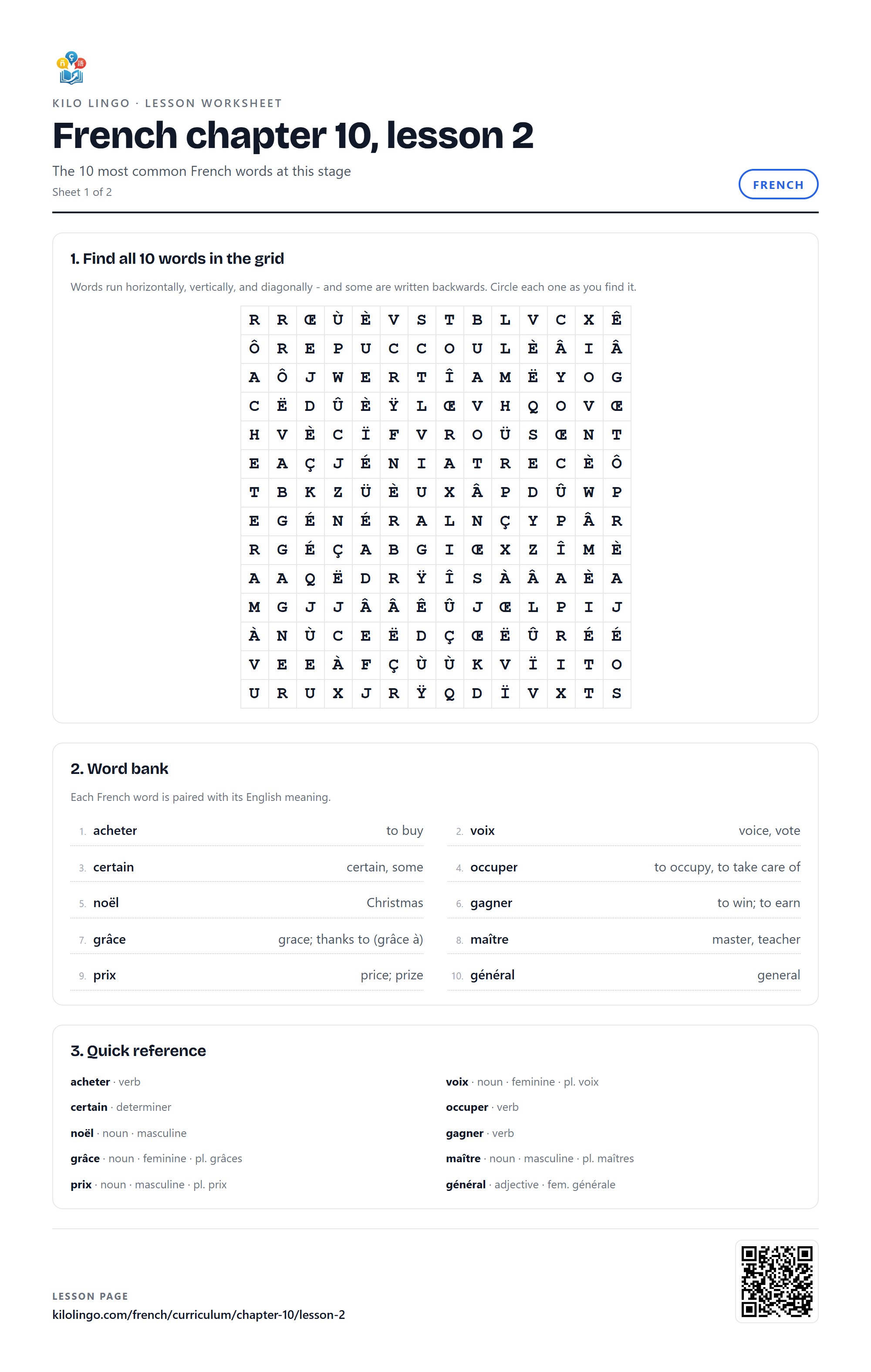
- Words 711-721Vocabulary
10 words · ranks 711-721
- Conjugation Sprint review sessionReview games
Sixty seconds on the endings of the verbs this chapter has drilled so far.
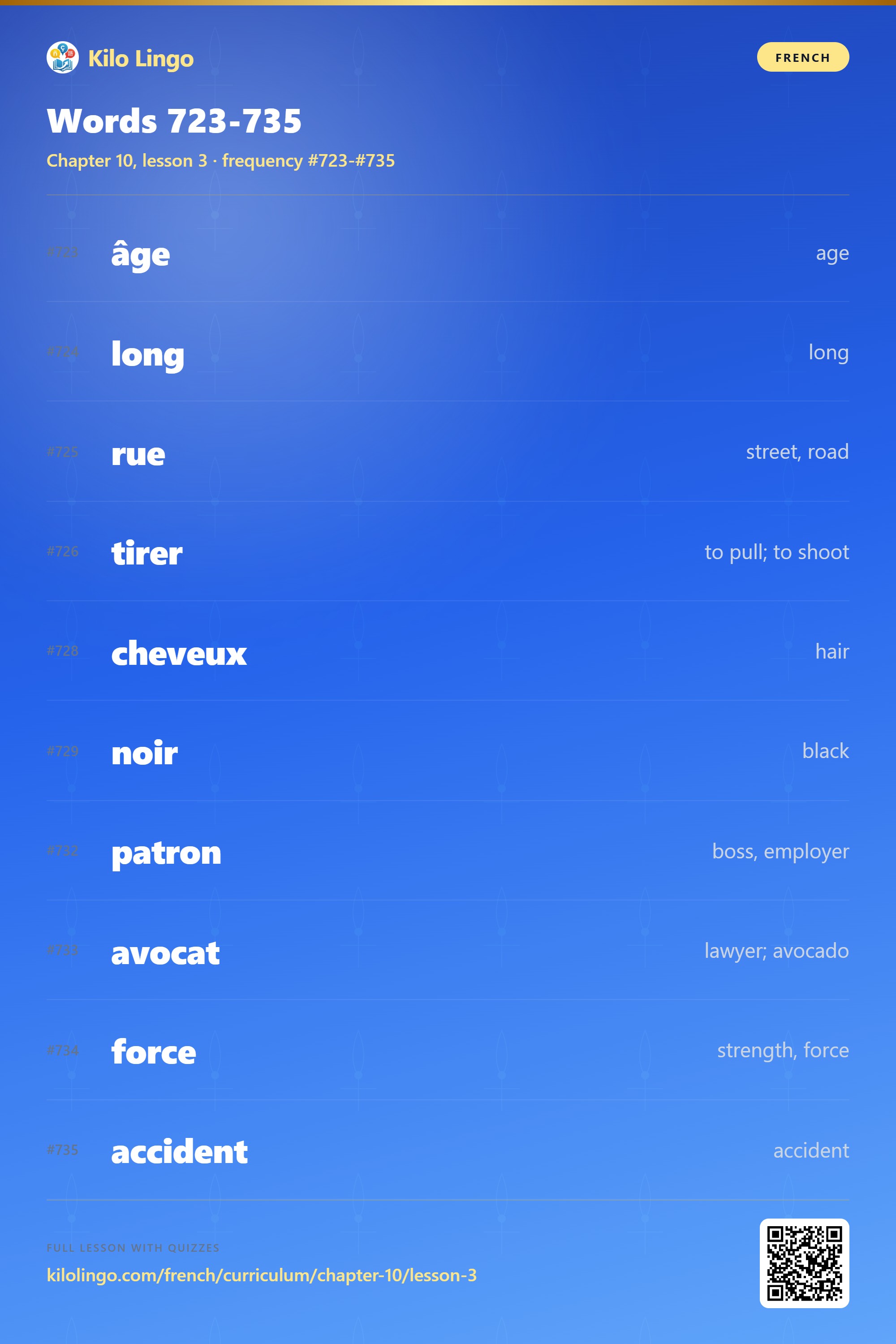
- Words 722-731Vocabulary
10 words · ranks 722-731
- Word Bubbles review sessionReview games
Pop the words you just met by matching each one to its meaning. A couple of rounds and the batch is yours.
- Words 732-741Vocabulary
10 words · ranks 732-741
- Conjugation Sprint review sessionReview games
Sixty seconds on the endings of the verbs this chapter has drilled so far.
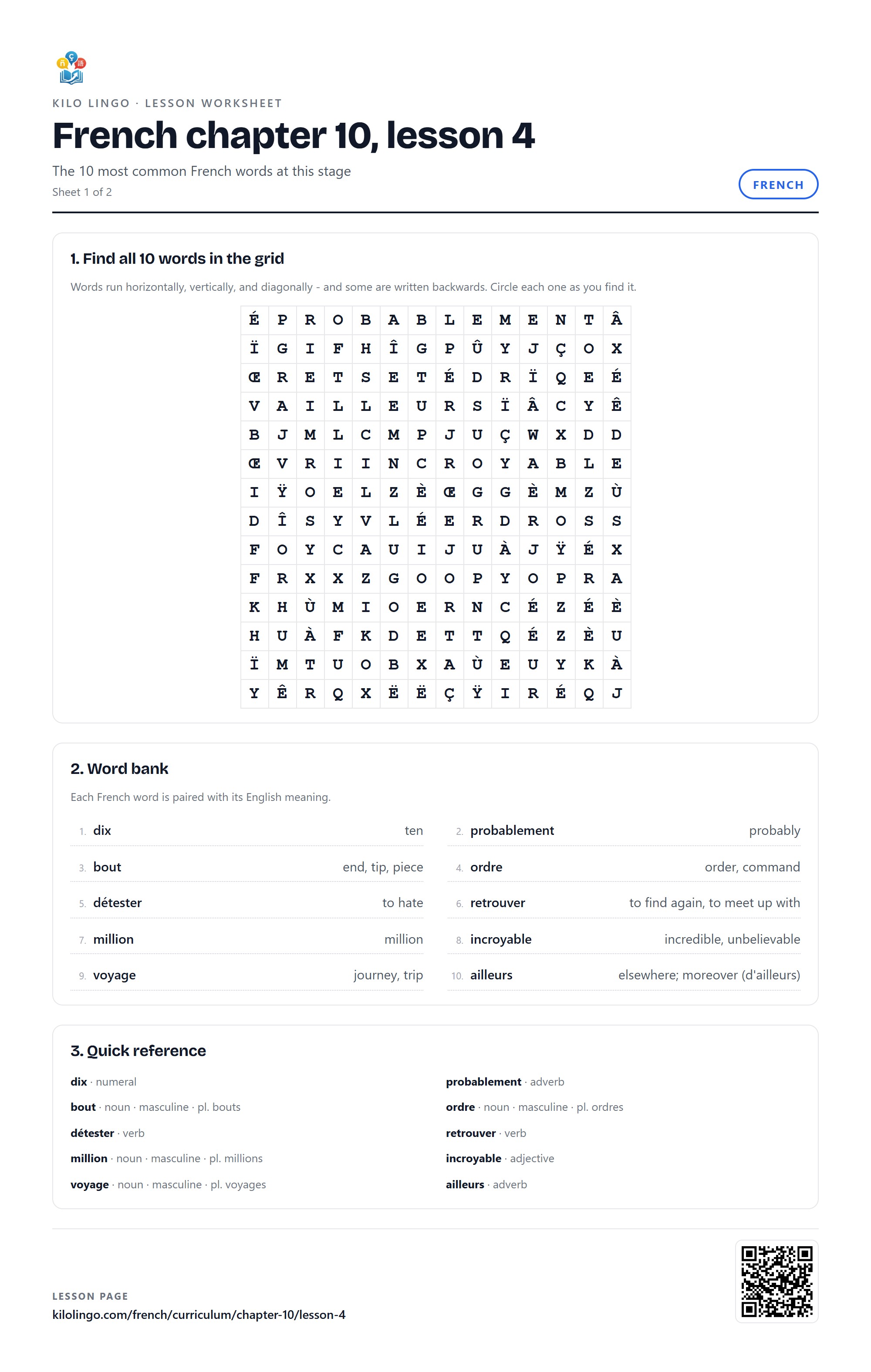
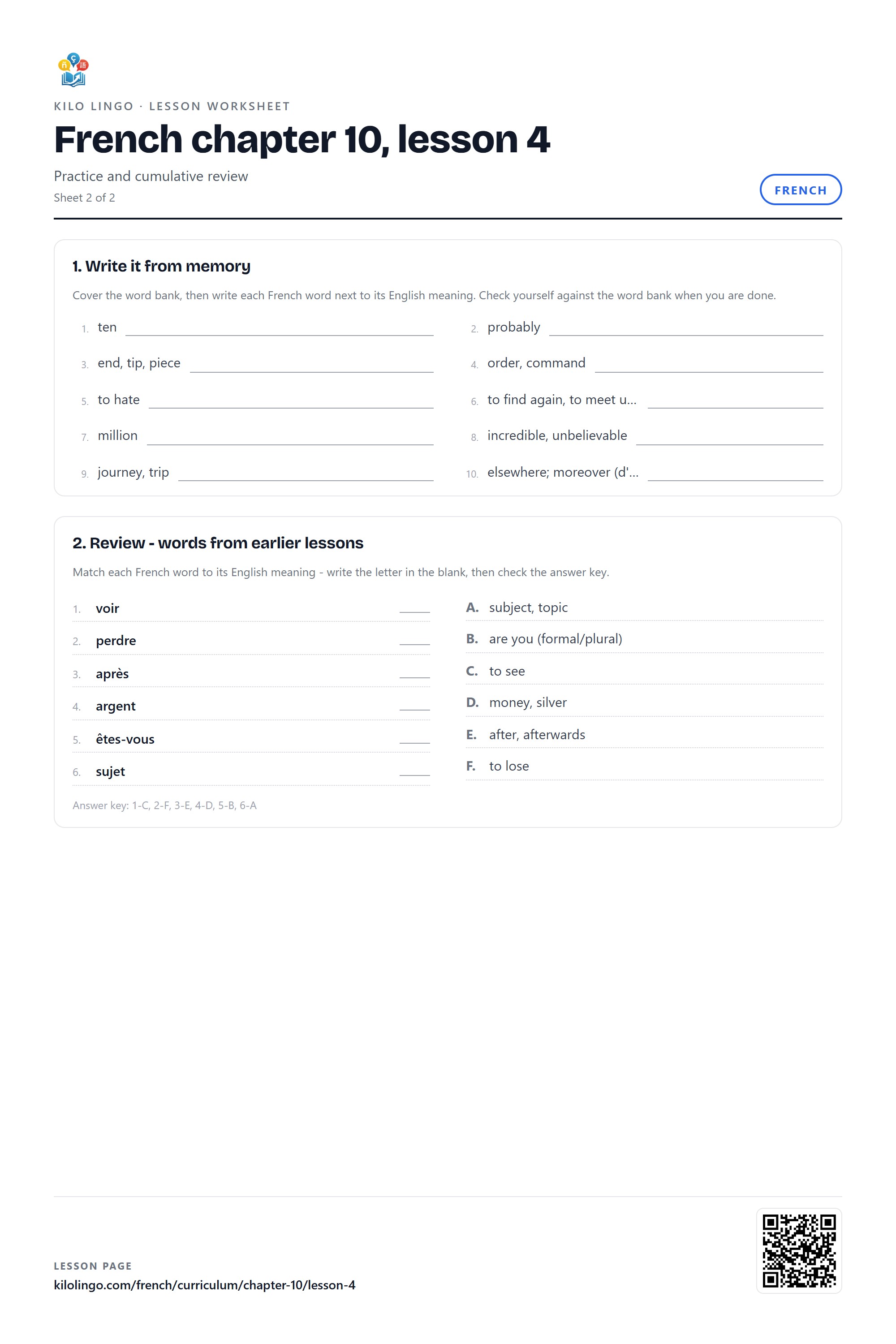
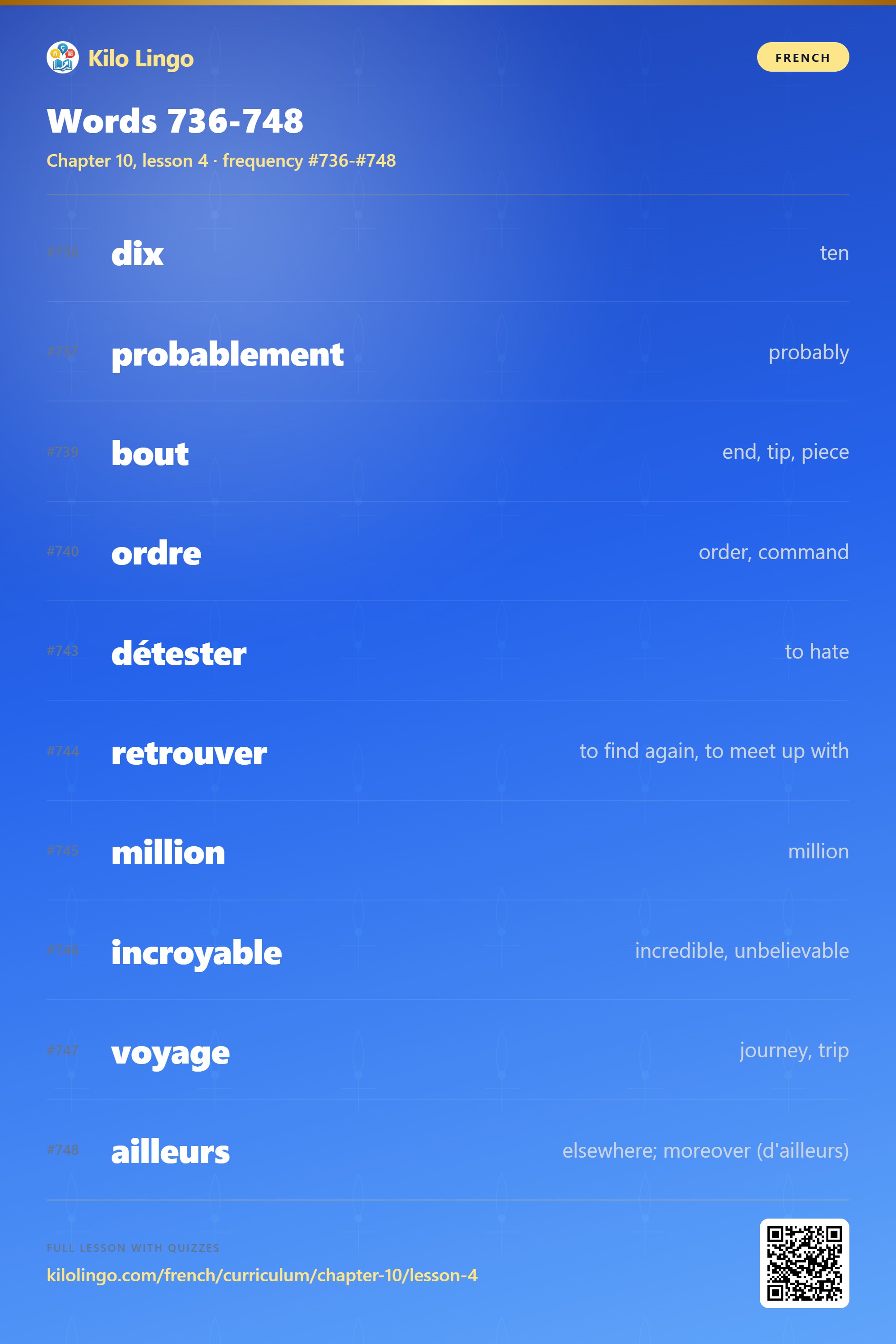
- Words 742-751Vocabulary
10 words · ranks 742-751
- depuis or pendant?Mistake clinic
The tense changes with the word, which is what makes this one hard.
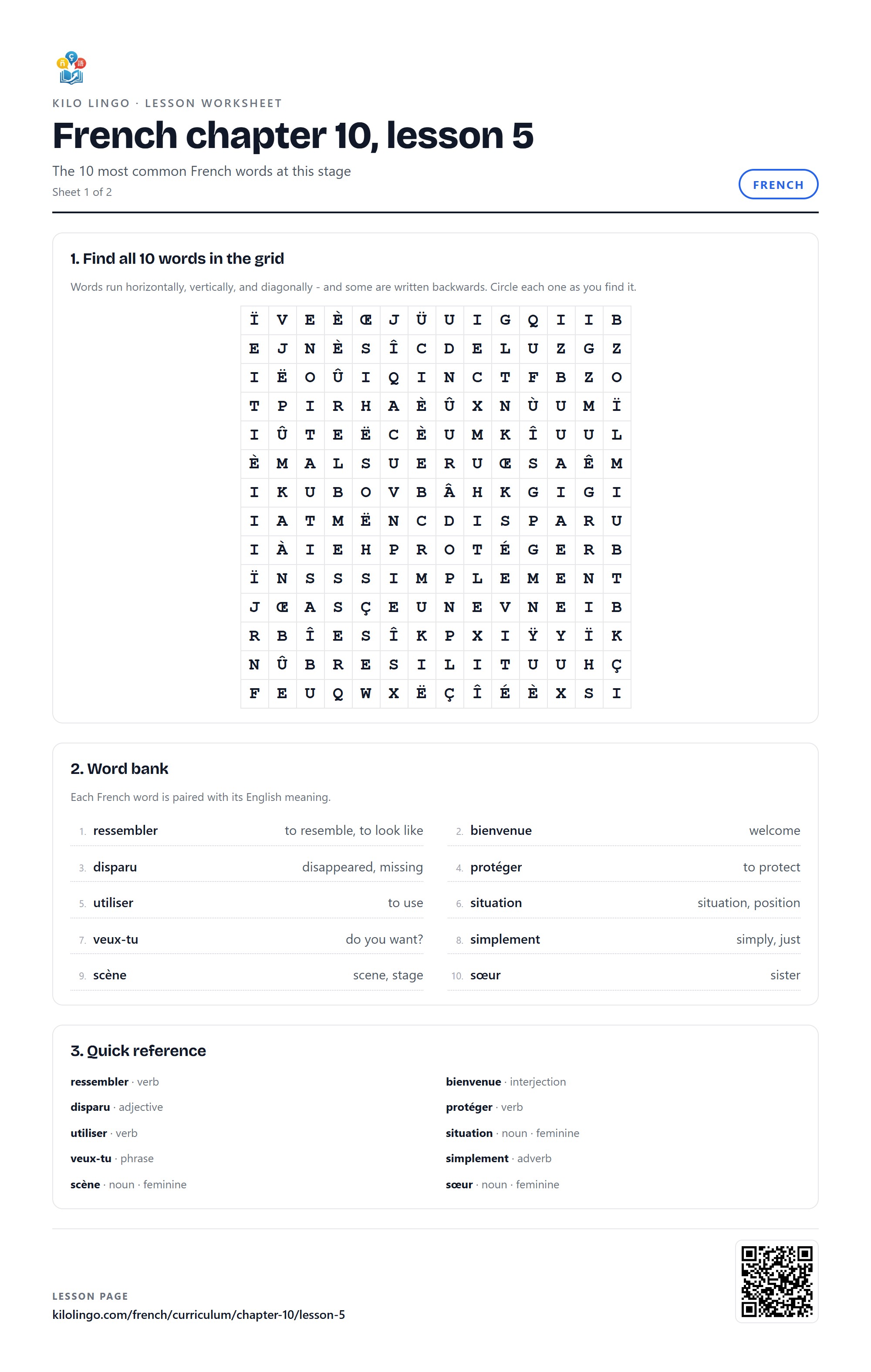
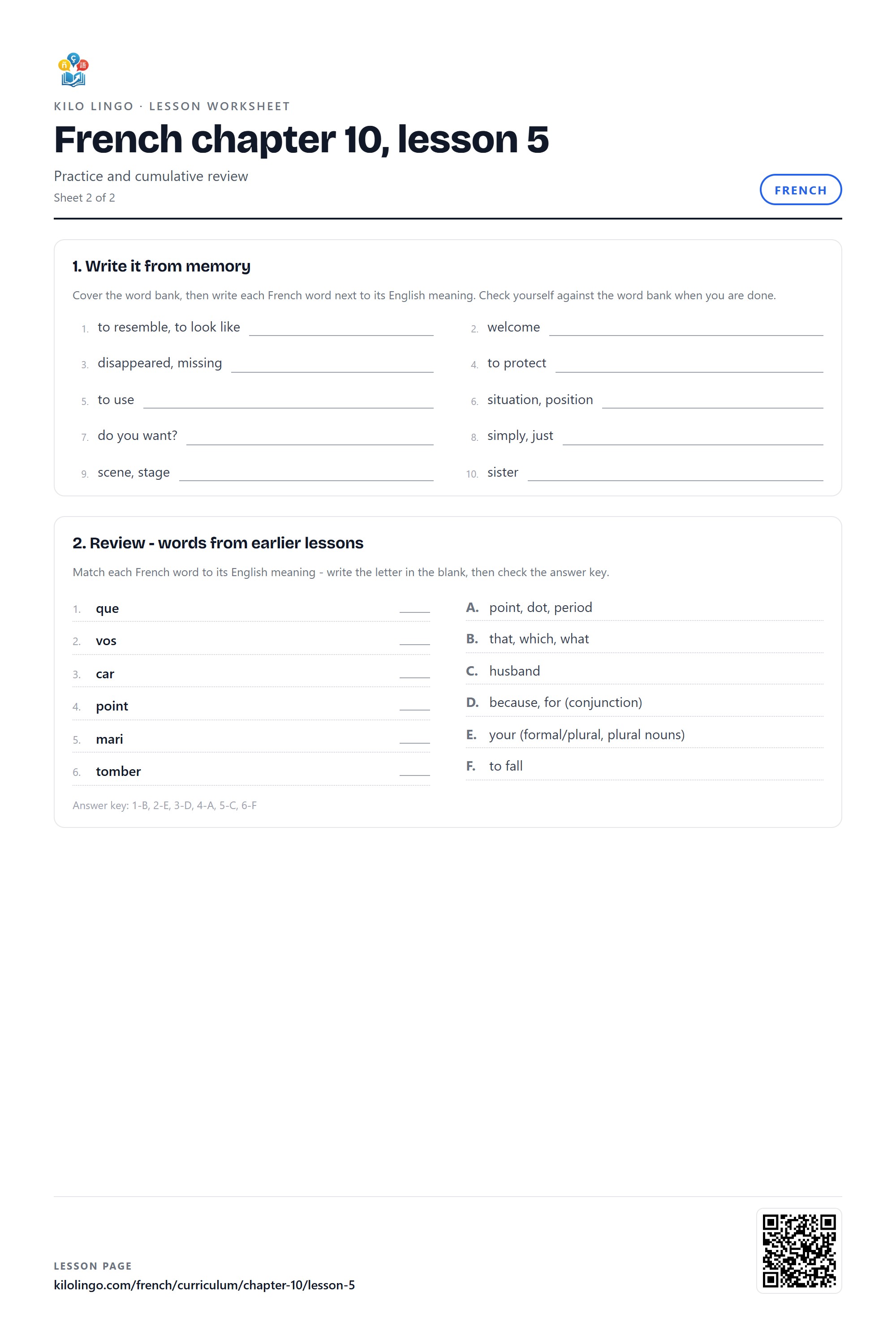
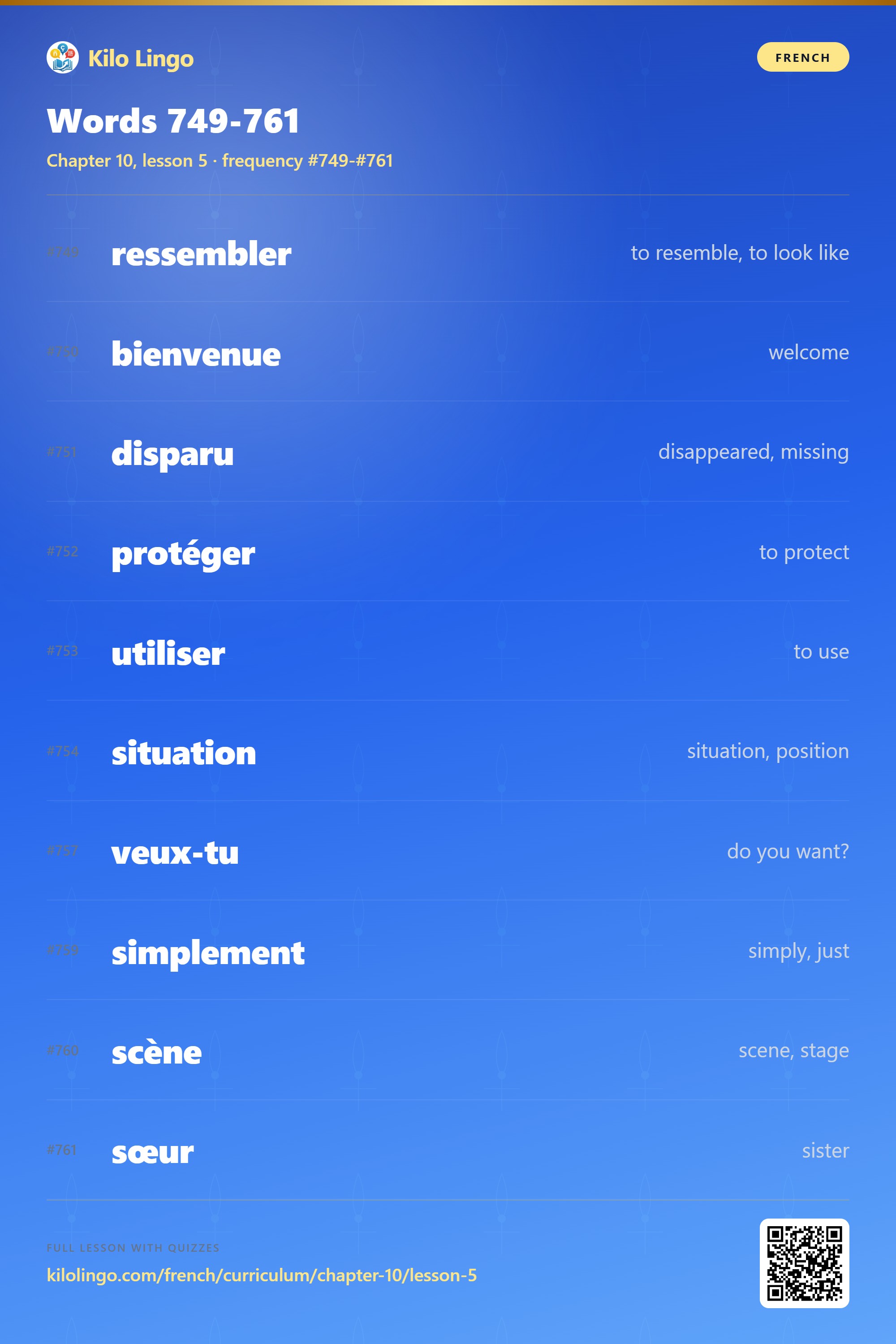
- Words 752-761Vocabulary
10 words · ranks 752-761
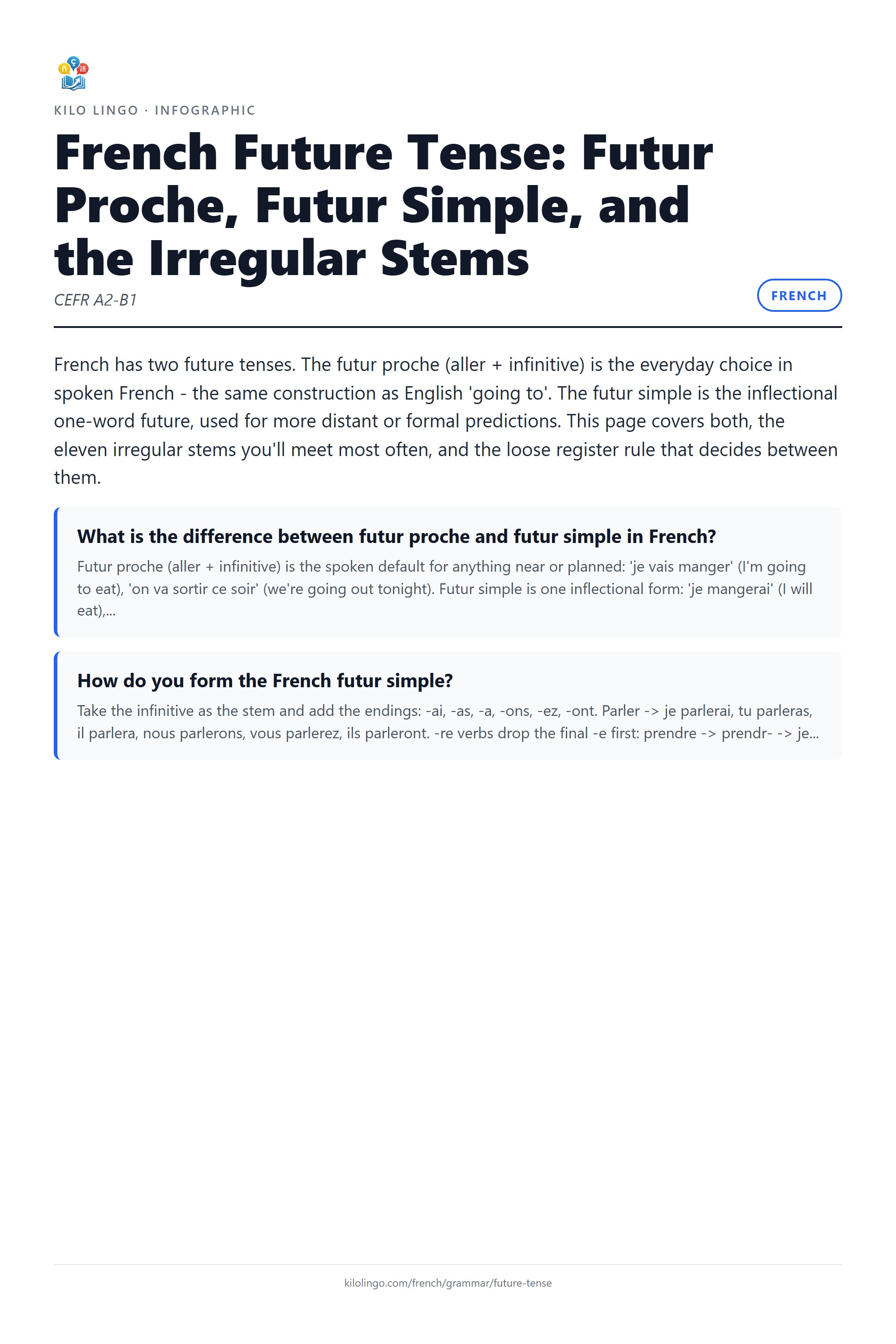
- Talking about the futureGrammar
Two ways: aller + infinitive (futur proche) and the inflectional futur simple. Regular endings -ai / -as / -a / -ons / -ez / -ont, the irregular stems, and when each tense is the right call.
- Words 762-771Vocabulary
10 words · ranks 762-771
- Word Bubbles review sessionReview games
Pop the words you just met by matching each one to its meaning. A couple of rounds and the batch is yours.
- Words 772-781Vocabulary
10 words · ranks 772-781
- Conjugation Sprint review sessionReview games
Sixty seconds on the endings of the verbs this chapter has drilled so far.
- Words 782-791Vocabulary
10 words · ranks 782-791
- Word Bubbles review sessionReview games
Pop the words you just met by matching each one to its meaning. A couple of rounds and the batch is yours.
- Words 792-800Vocabulary
9 words · ranks 792-800
- Story milestone: top 800 wordsGraded-reader story
You can read this story using only the words you've learned so far. Every content word sits at or above the rank-800 ceiling.
- En voyageThemed review
Getting there and back. Chapter 10 finally supplies
gauche, so this is the earliest the course can point you anywhere. Leave a comment in French on a video from a French creator.
- Arcade reviewReview games
Replay this chapter's words as games - a different kind of repetition, and it counts.
Word printables
Per-word sheets99 words · a worksheet, infographic and listicle each

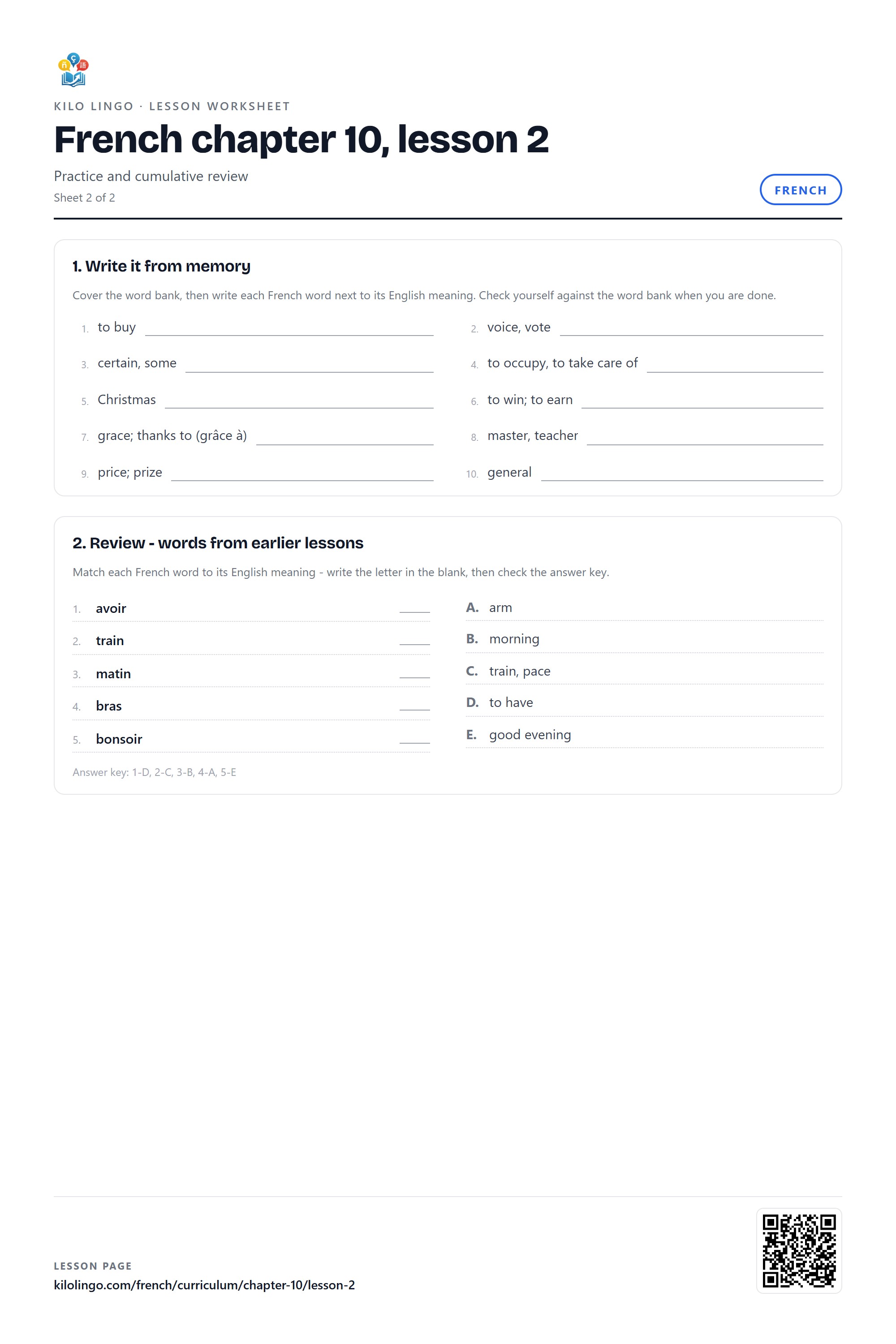

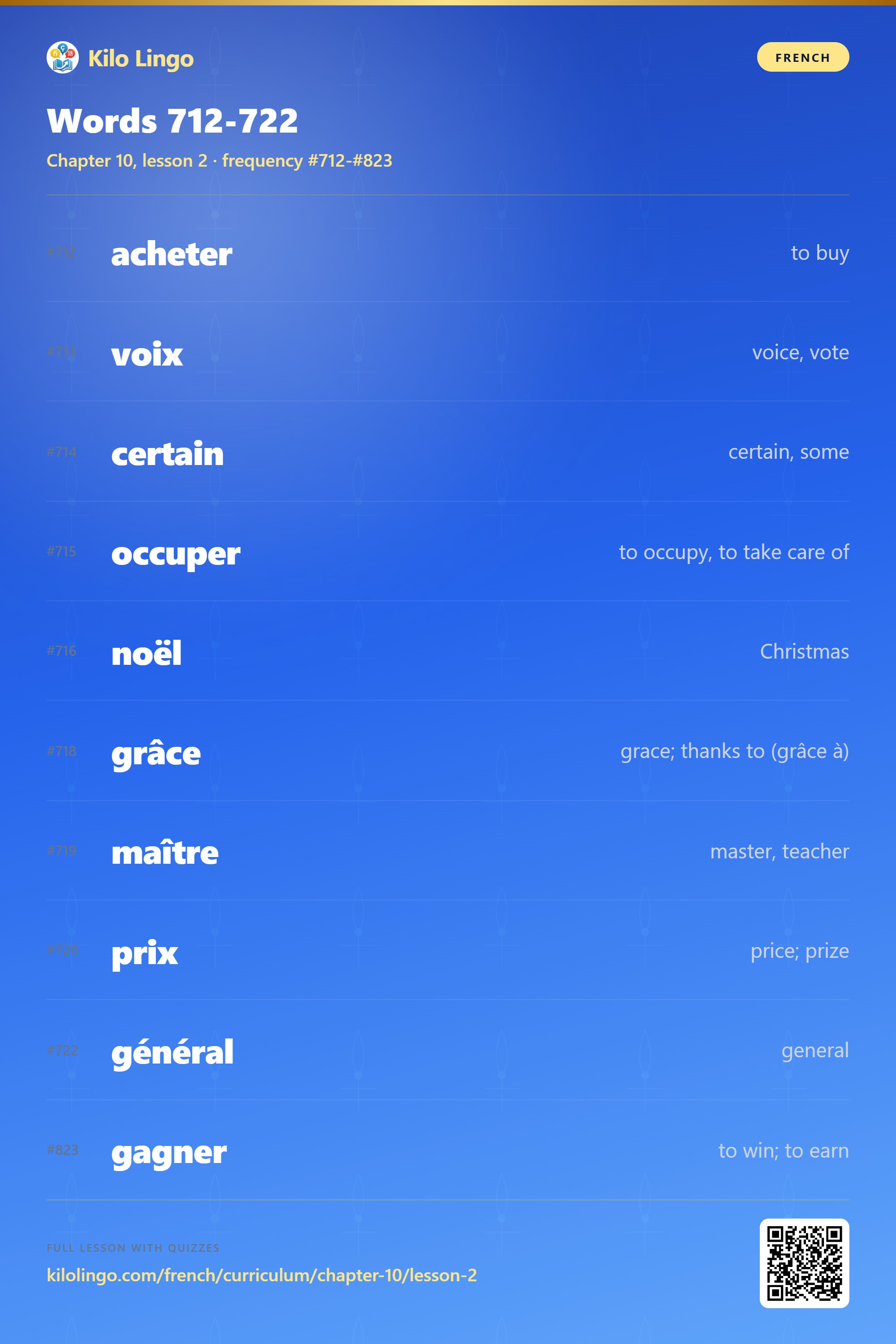
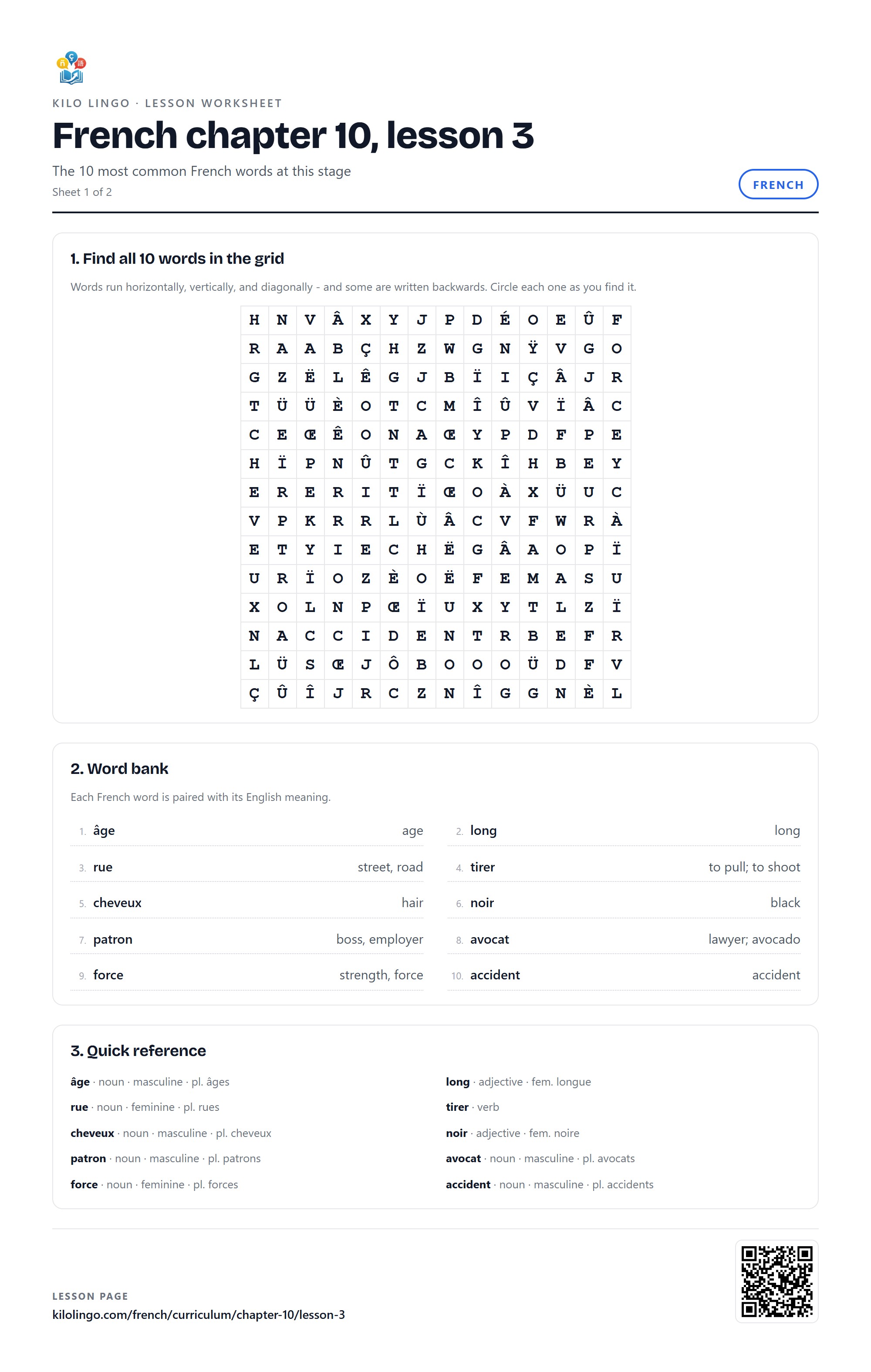
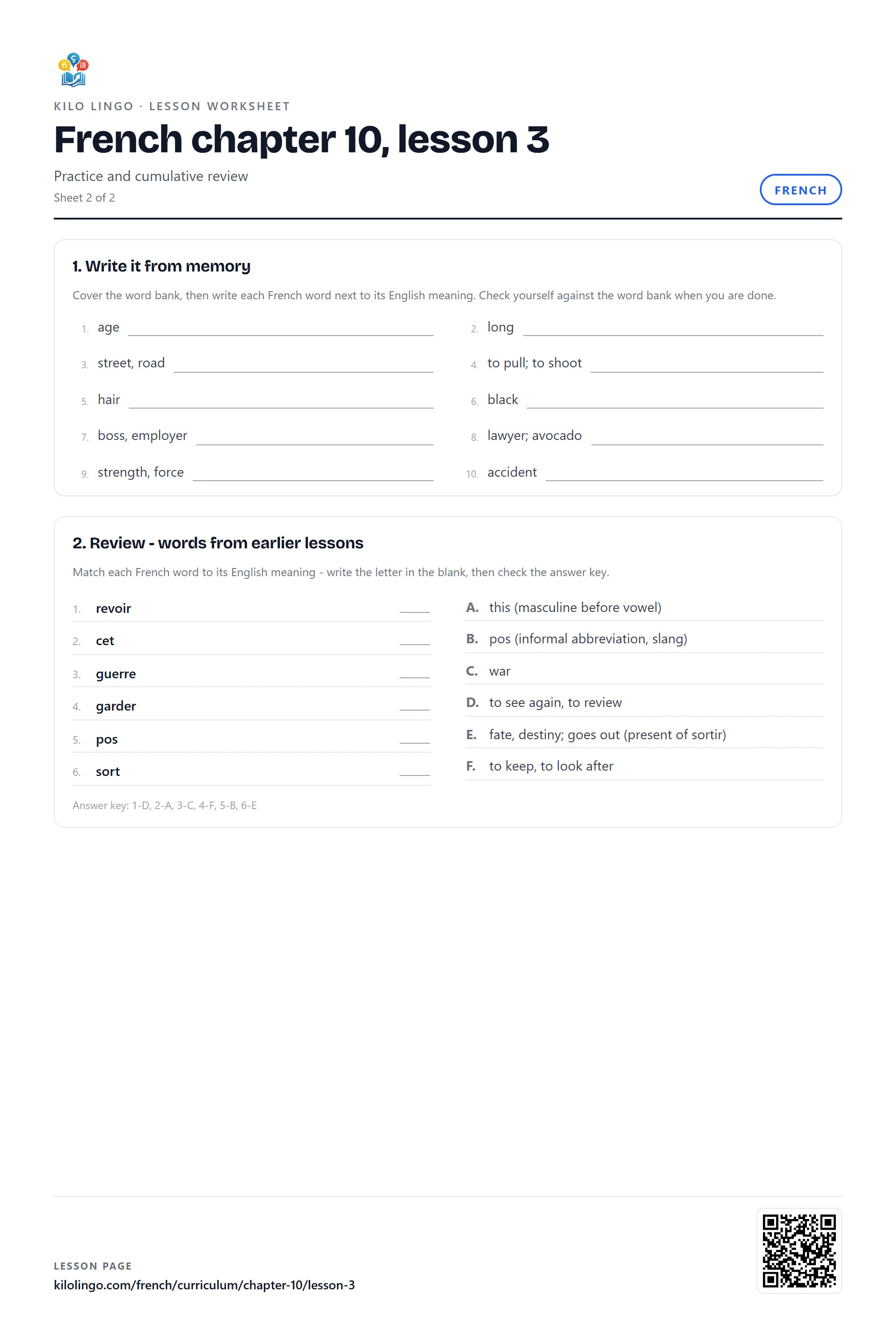



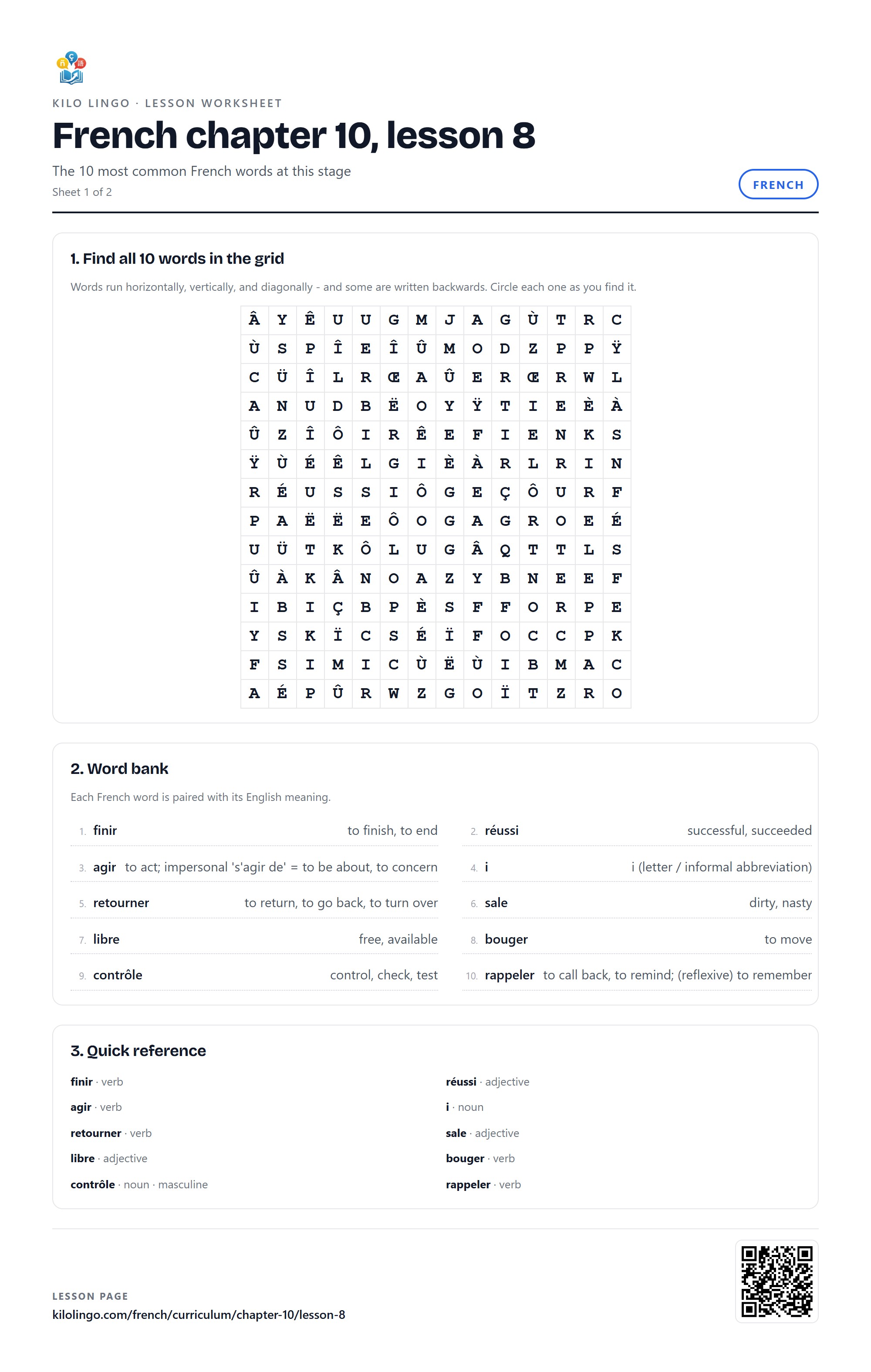
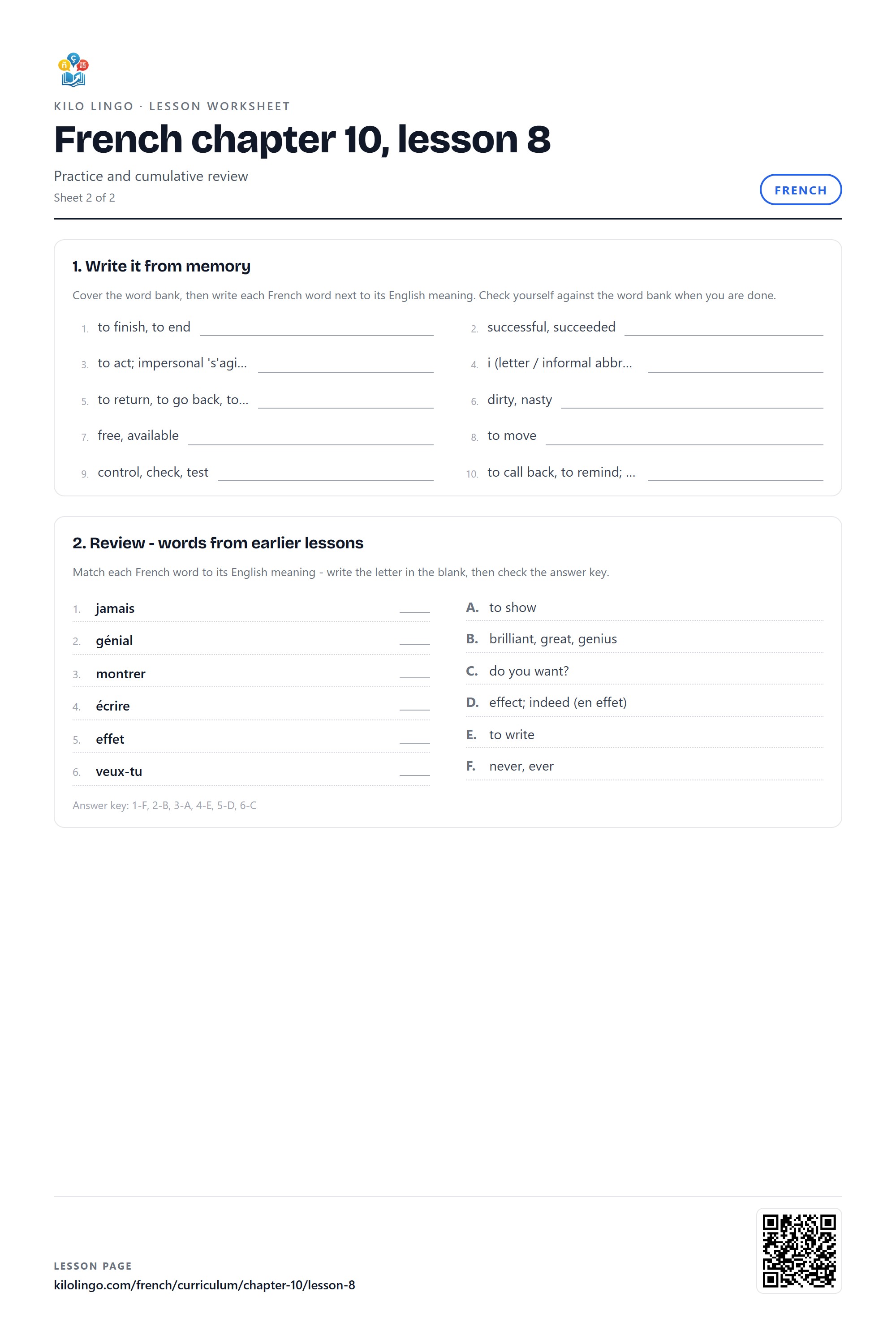

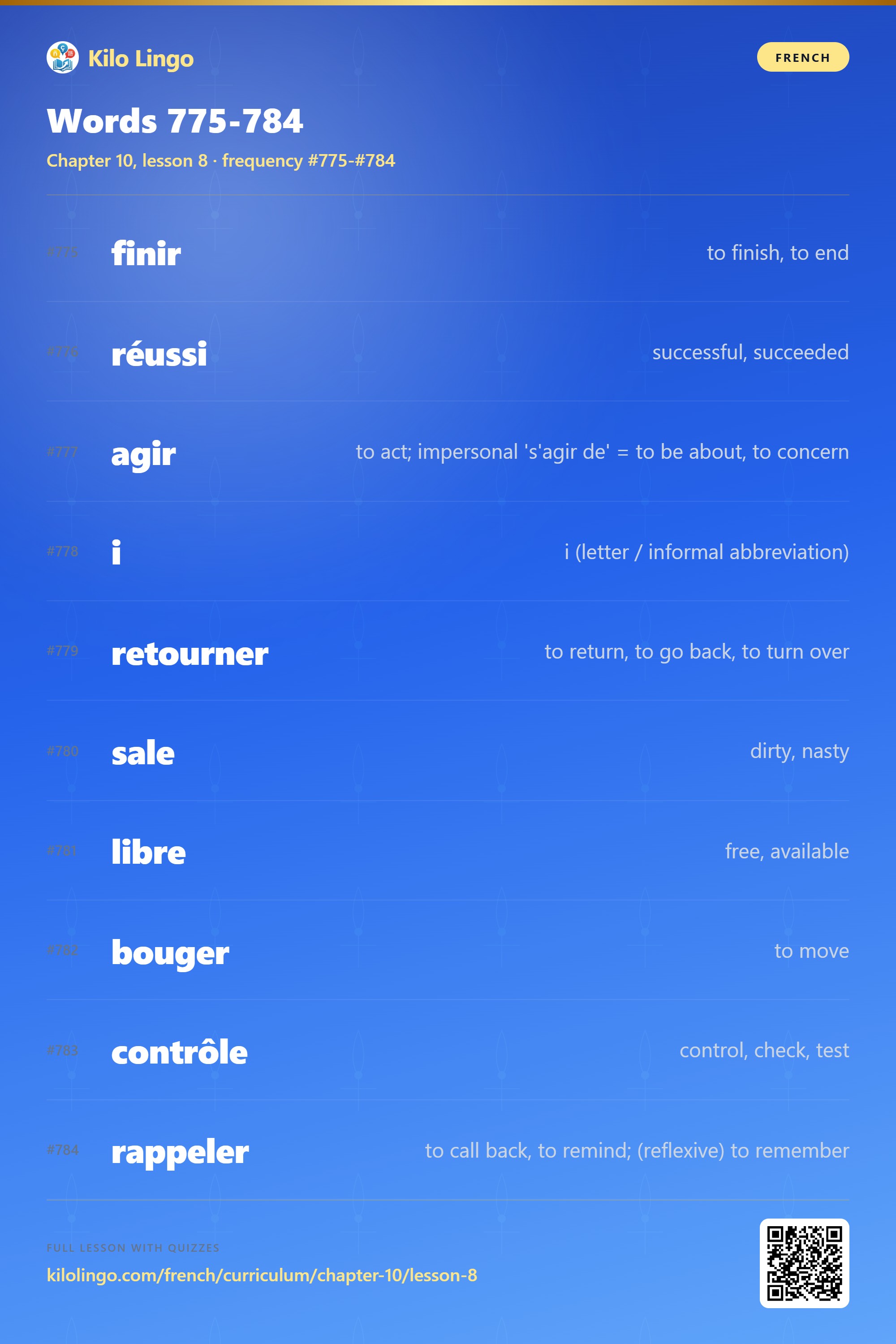
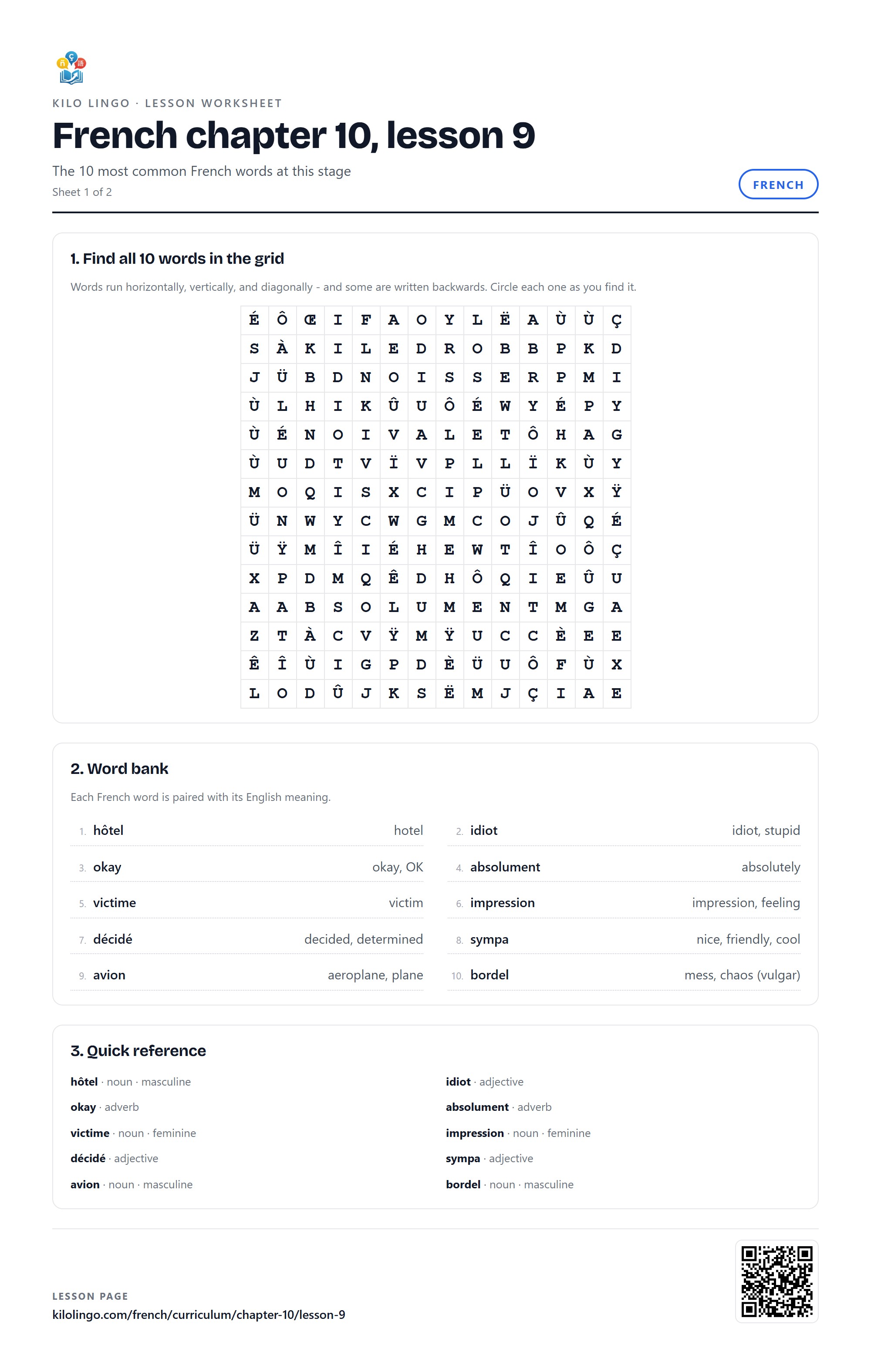


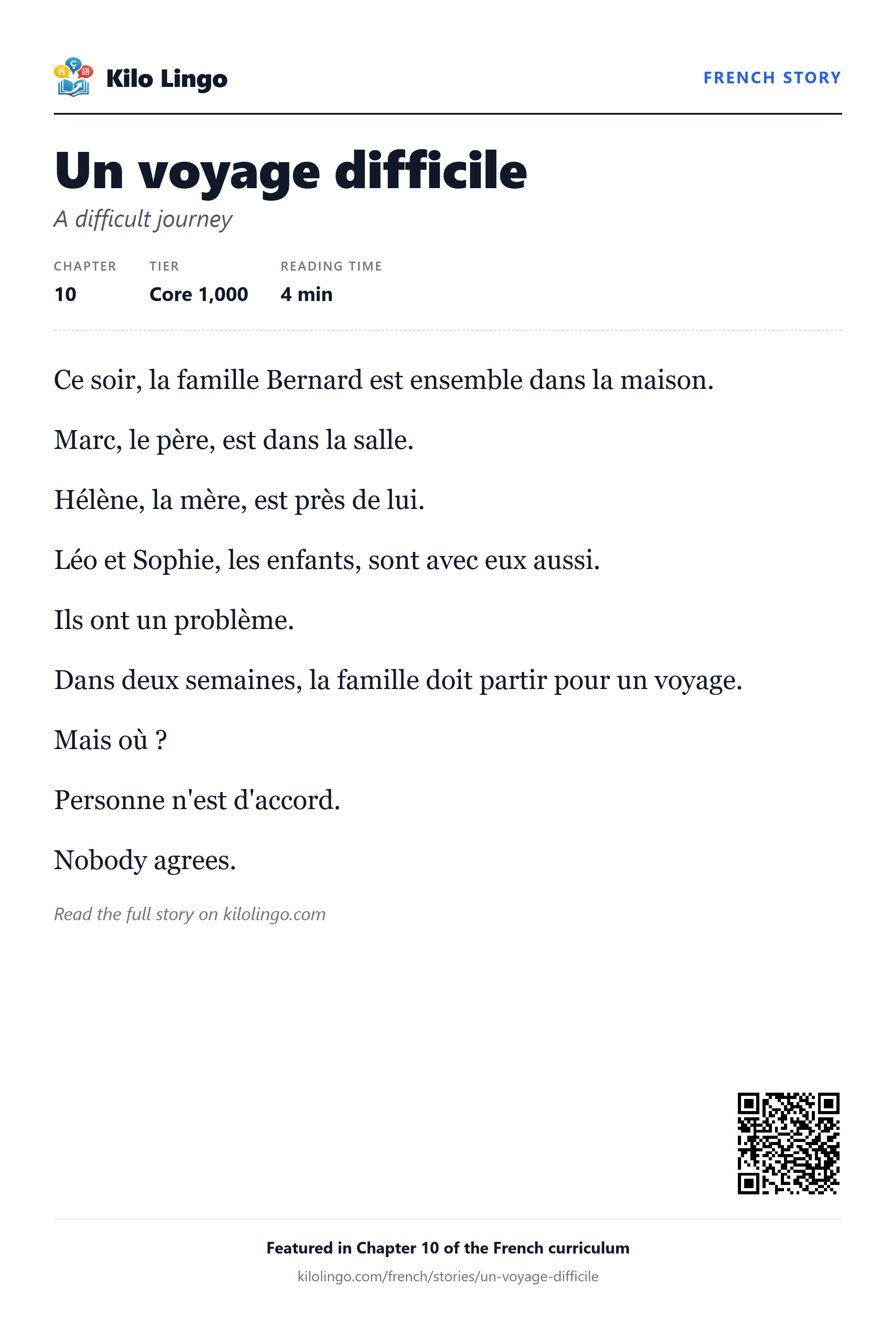
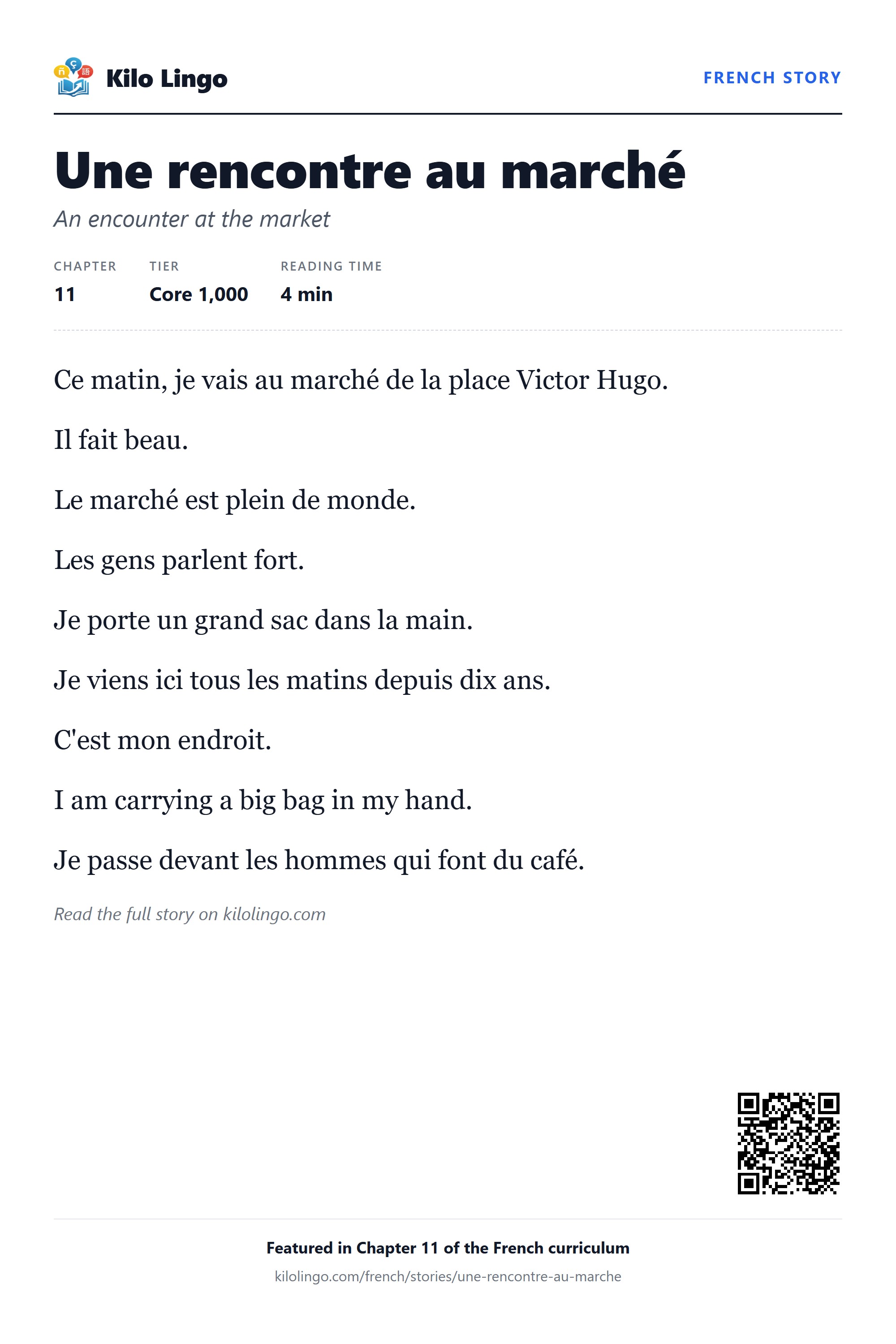
Chapter 11 · rentrer, retourner or revenir?
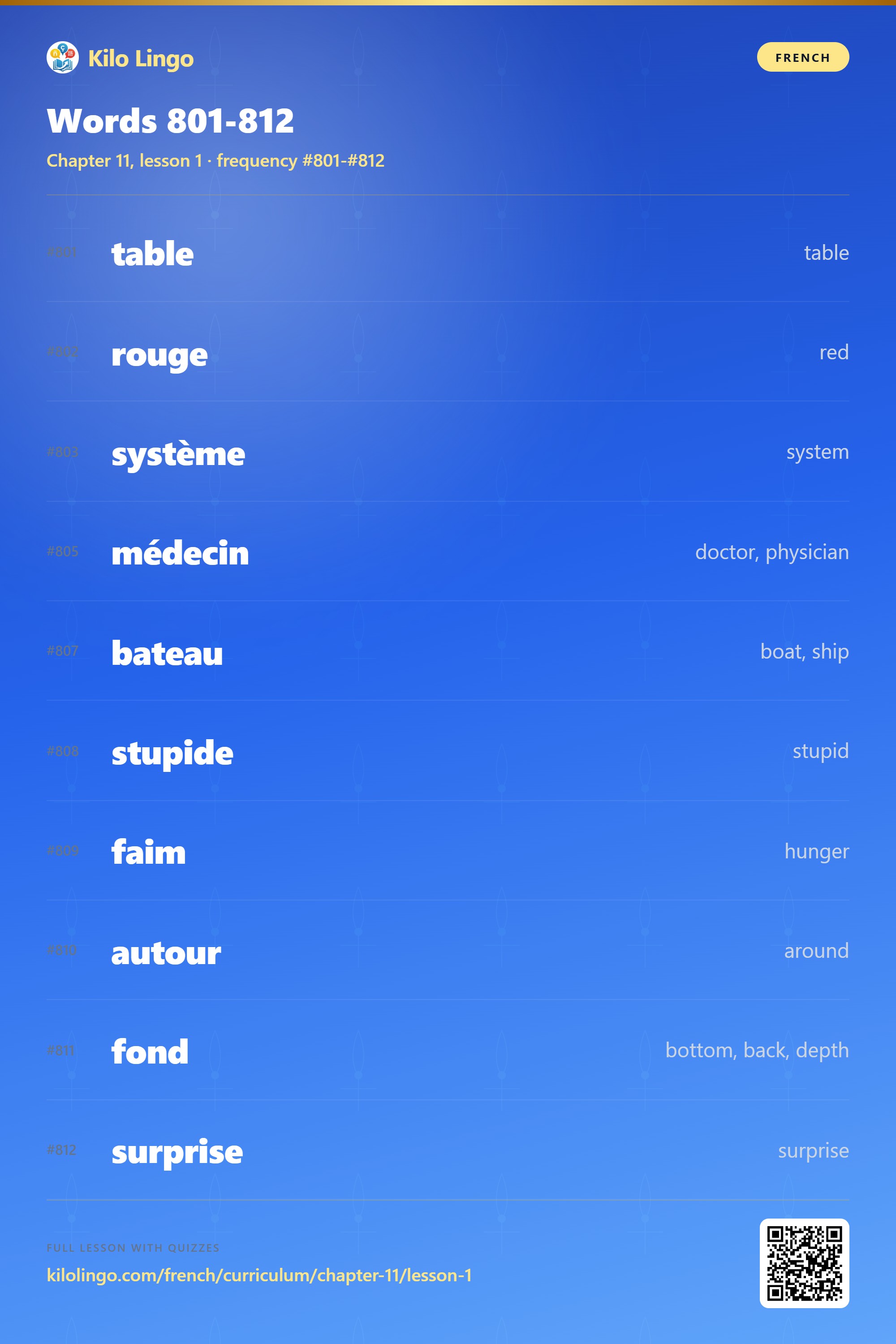
Chapter page →- Words 801-810Vocabulary
10 words · ranks 801-810
- Conjugation Sprint review sessionReview games
Sixty seconds on the endings of the verbs this chapter has drilled so far.
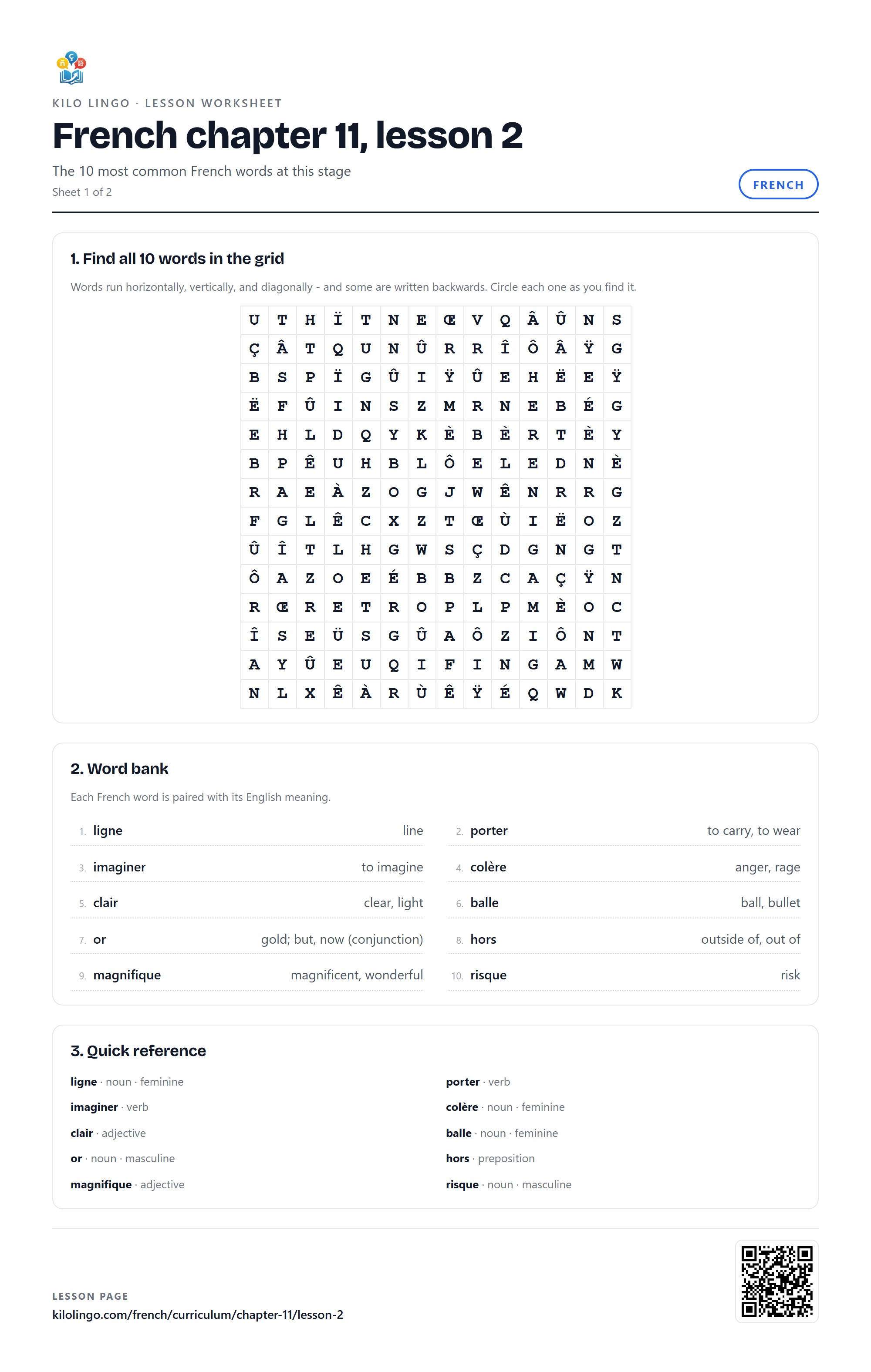
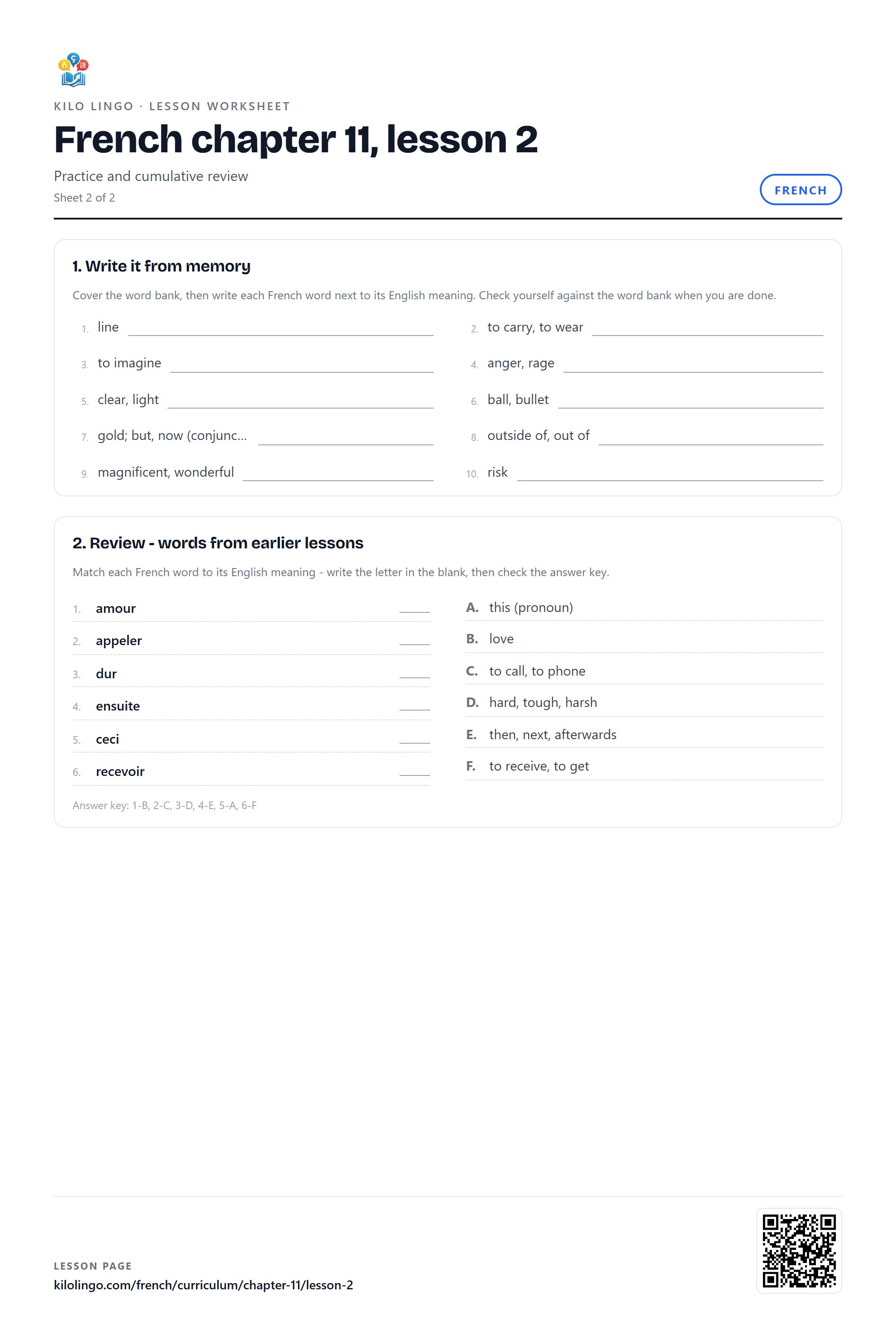
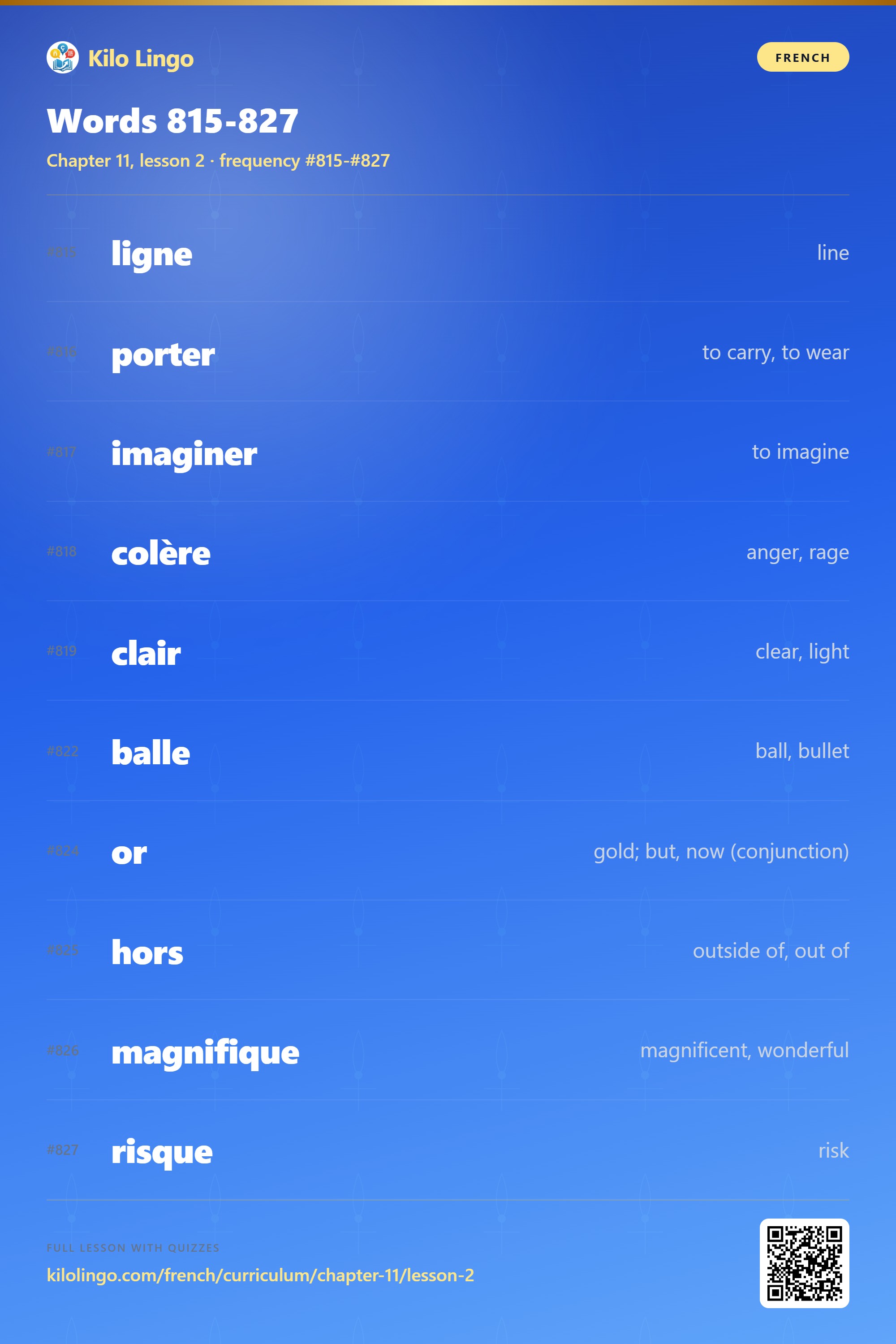
- Words 811-820Vocabulary
10 words · ranks 811-820
- Word Bubbles review sessionReview games
Pop the words you just met by matching each one to its meaning. A couple of rounds and the batch is yours.
- Words 821-830Vocabulary
10 words · ranks 821-830
- Conjugation Sprint review sessionReview games
Sixty seconds on the endings of the verbs this chapter has drilled so far.
- Words 831-840Vocabulary
10 words · ranks 831-840
- Word Bubbles review sessionReview games
Pop the words you just met by matching each one to its meaning. A couple of rounds and the batch is yours.
- Words 841-850Vocabulary
10 words · ranks 841-850
- rentrer, retourner or revenir?Mistake clinic
Three ways to go back, and French picks by where you are going.
- Words 851-860Vocabulary
10 words · ranks 851-860
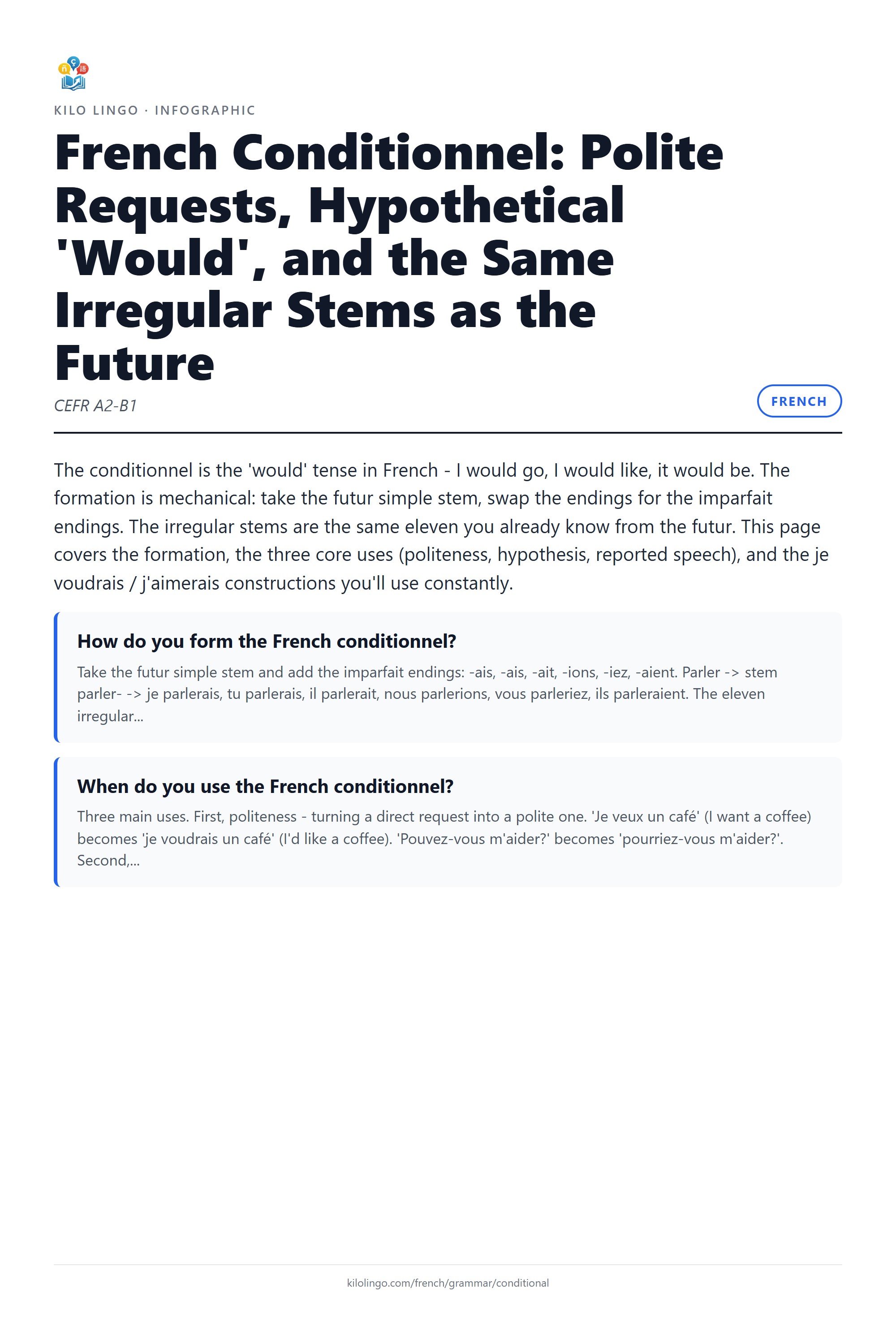
- The conditionnelGrammar
Future stem + imparfait endings. Same irregular stems as the future. Used for politeness (je voudrais, j'aimerais), hypothesis, and reported speech.
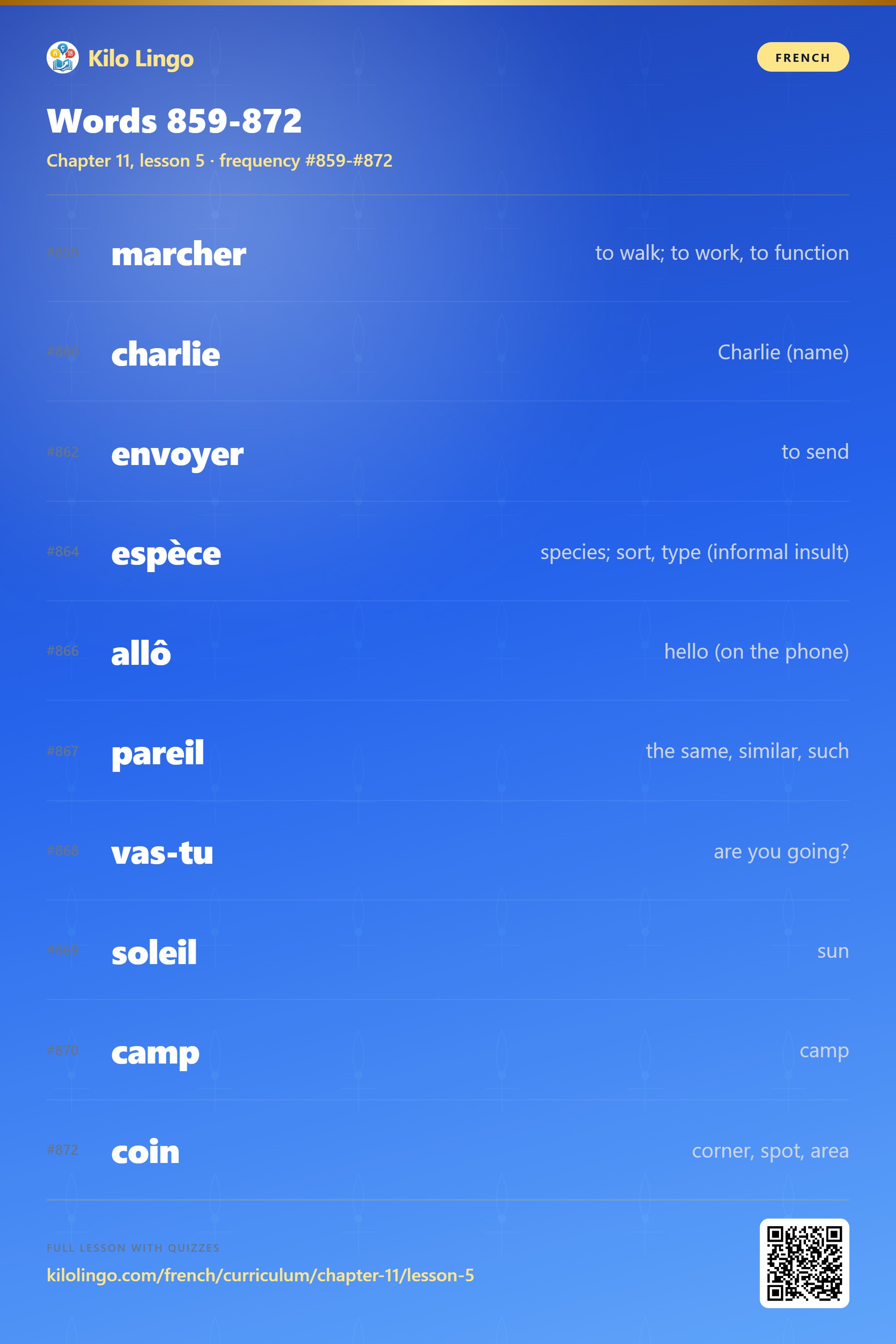
- Words 861-871Vocabulary
10 words · ranks 861-871
- Conjugation Sprint review sessionReview games
Sixty seconds on the endings of the verbs this chapter has drilled so far.
- Words 872-881Vocabulary
10 words · ranks 872-881
- Word Bubbles review sessionReview games
Pop the words you just met by matching each one to its meaning. A couple of rounds and the batch is yours.
- Words 882-891Vocabulary
10 words · ranks 882-891
- Asking the wayPhrase session
Asking is the easy half. These are chosen so you can also follow the answer.
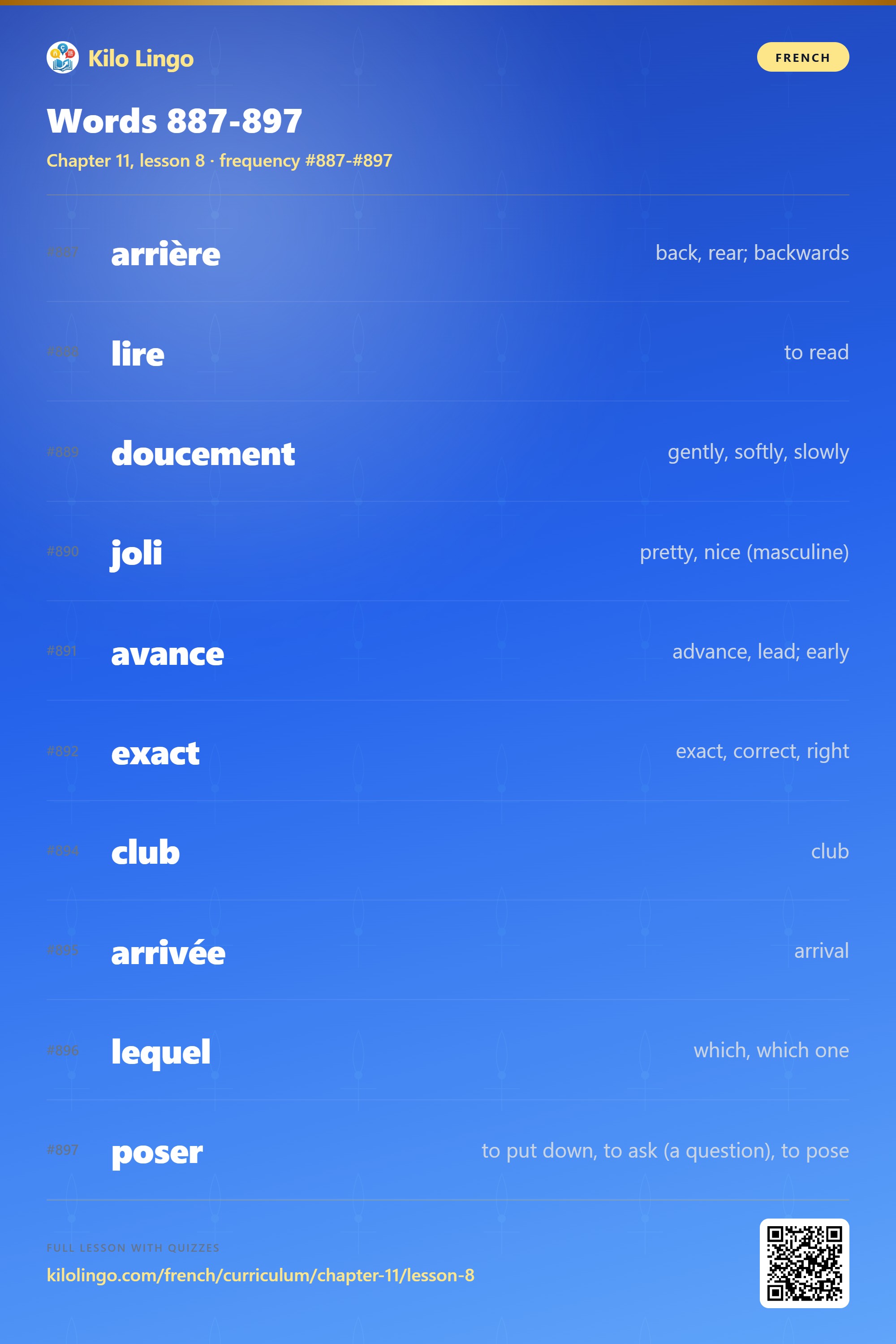
- Words 892-900Vocabulary
9 words · ranks 892-900
- Story milestone: top 900 wordsGraded-reader story
You can read this story using only the words you've learned so far. Every content word sits at or above the rank-900 ceiling.
- Les sentimentsThemed review
Happy, in love, afraid and calm. You could say all of these long before you could say sad -
tristeonly arrives in chapter 11. - Arcade reviewReview games
Replay this chapter's words as games - a different kind of repetition, and it counts.
Word printables
Per-word sheets99 words · a worksheet, infographic and listicle each
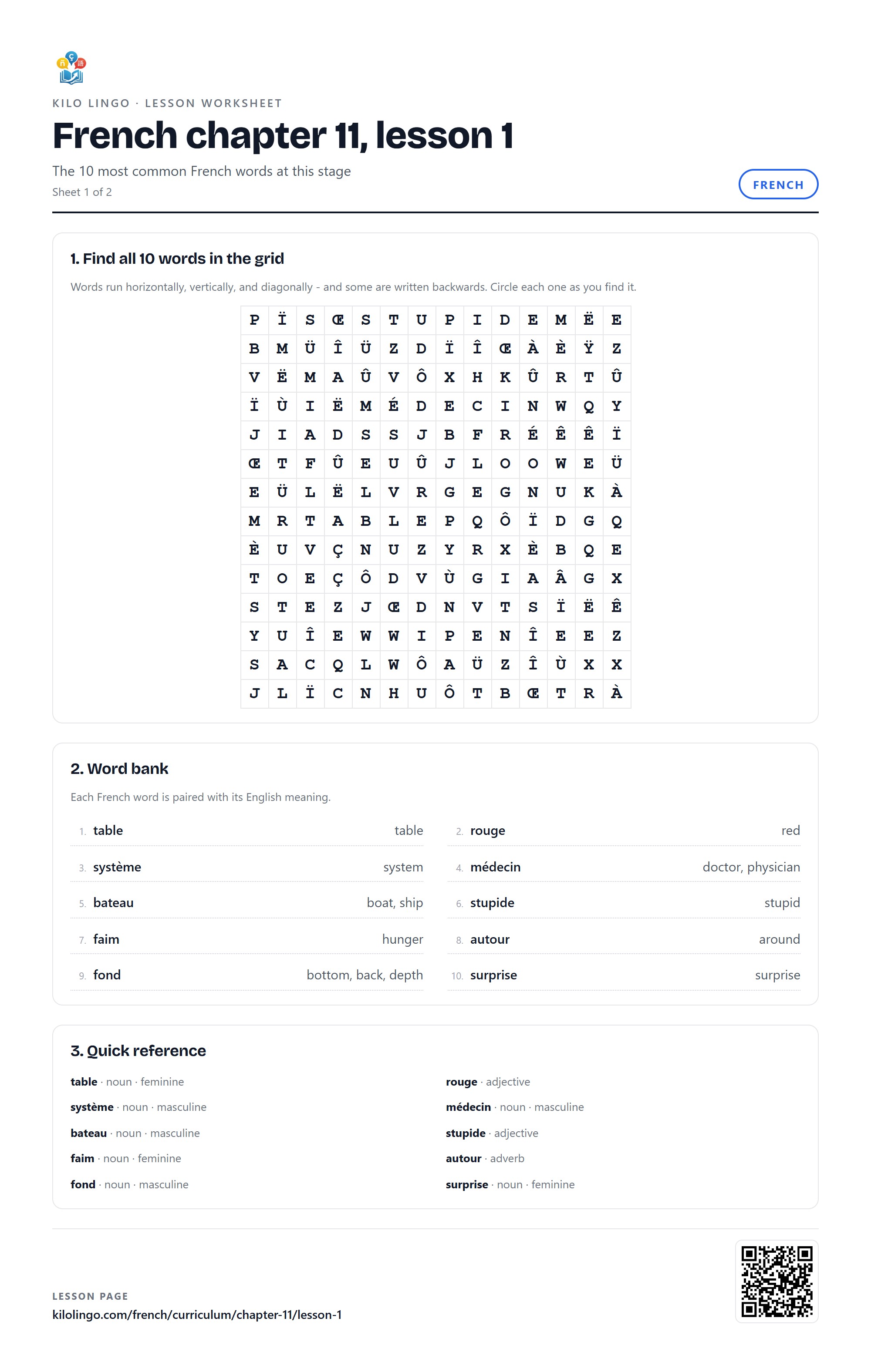
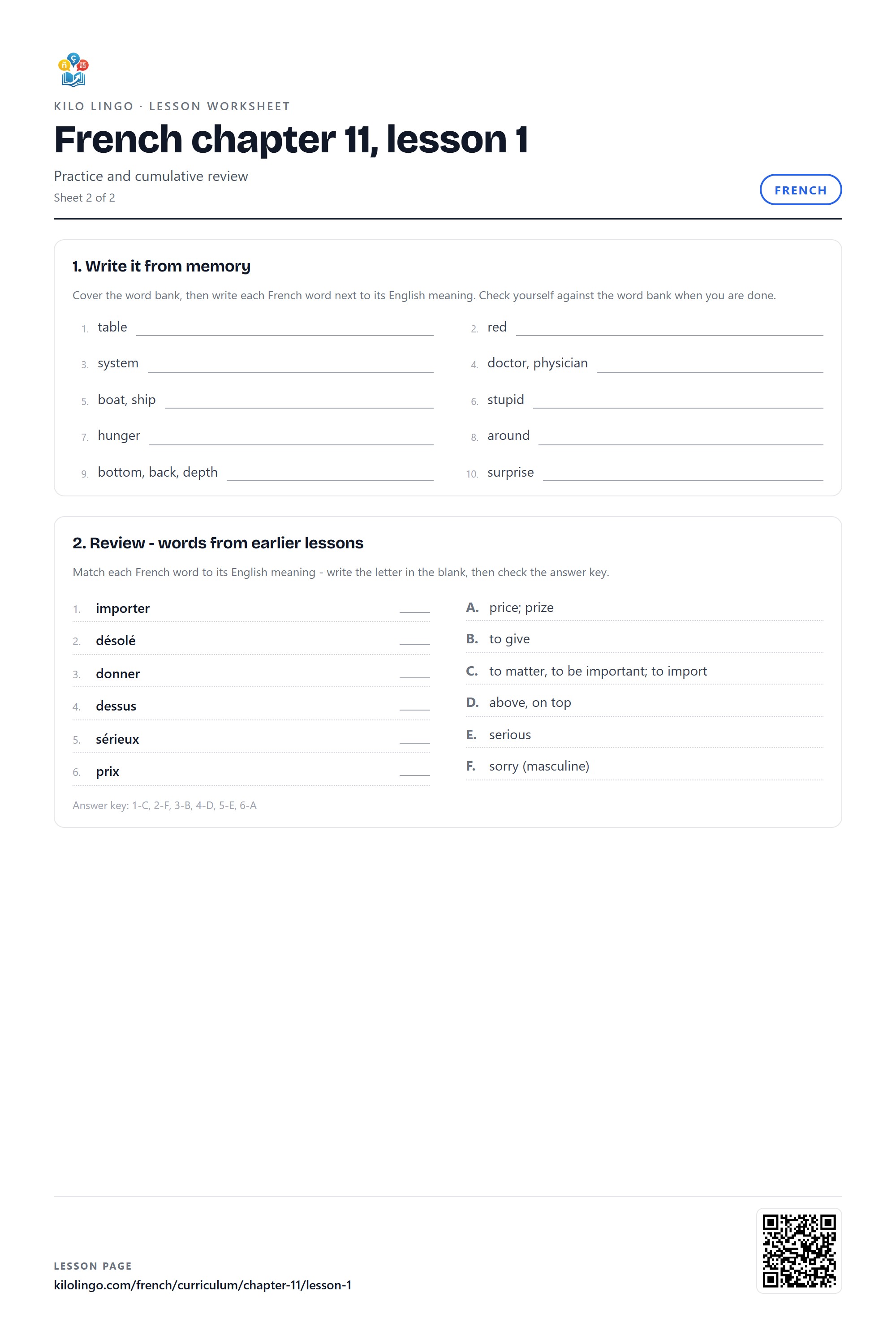


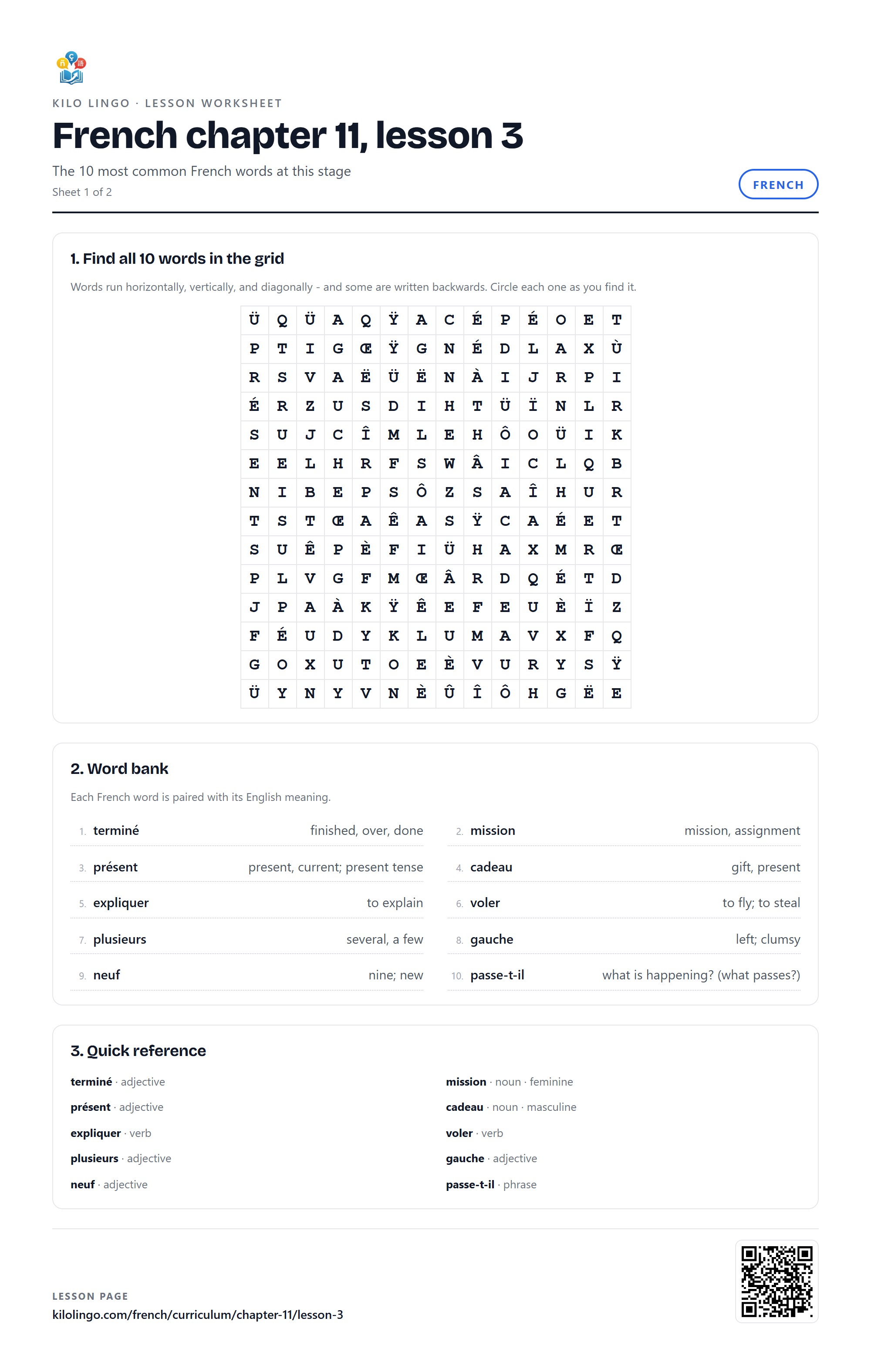
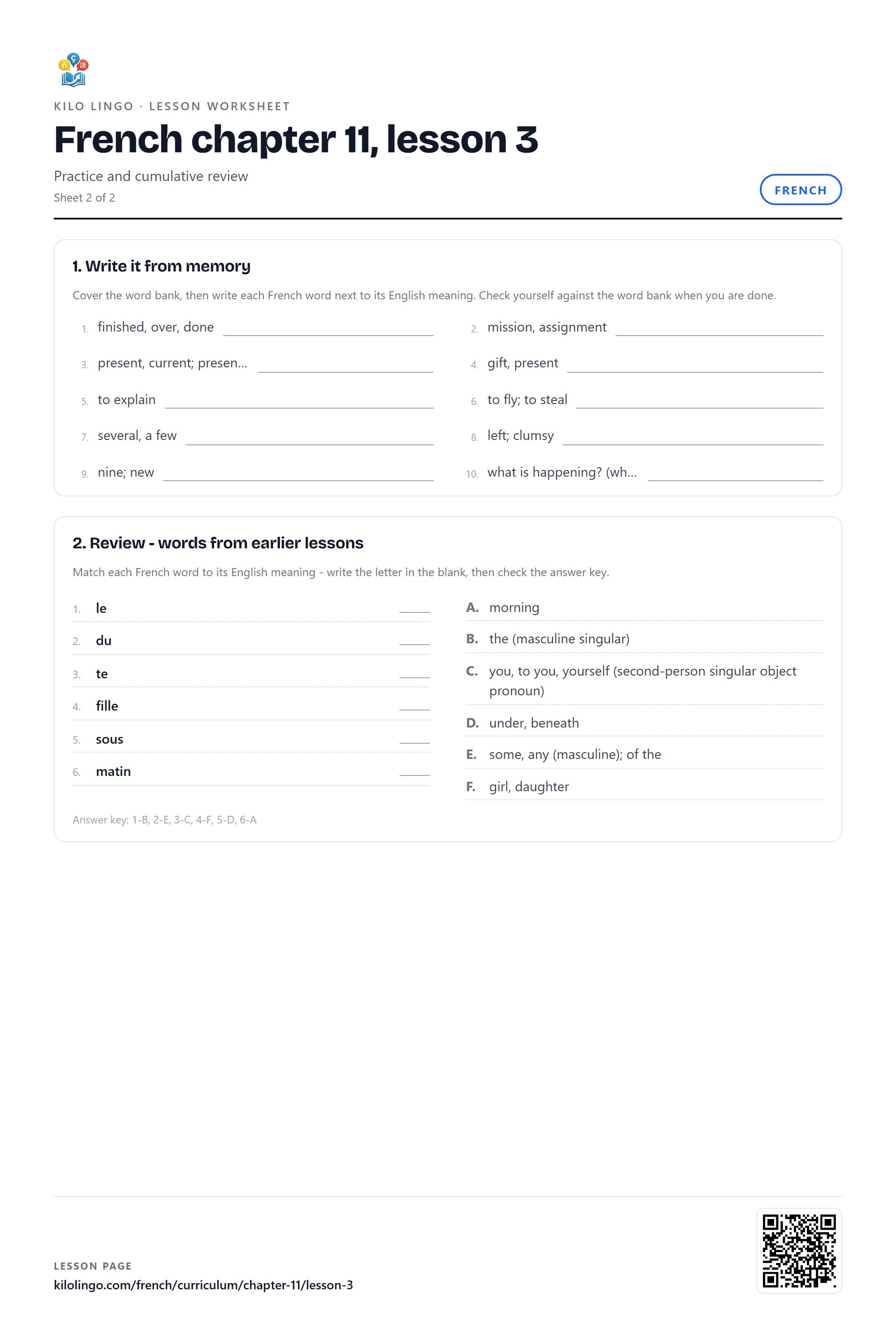

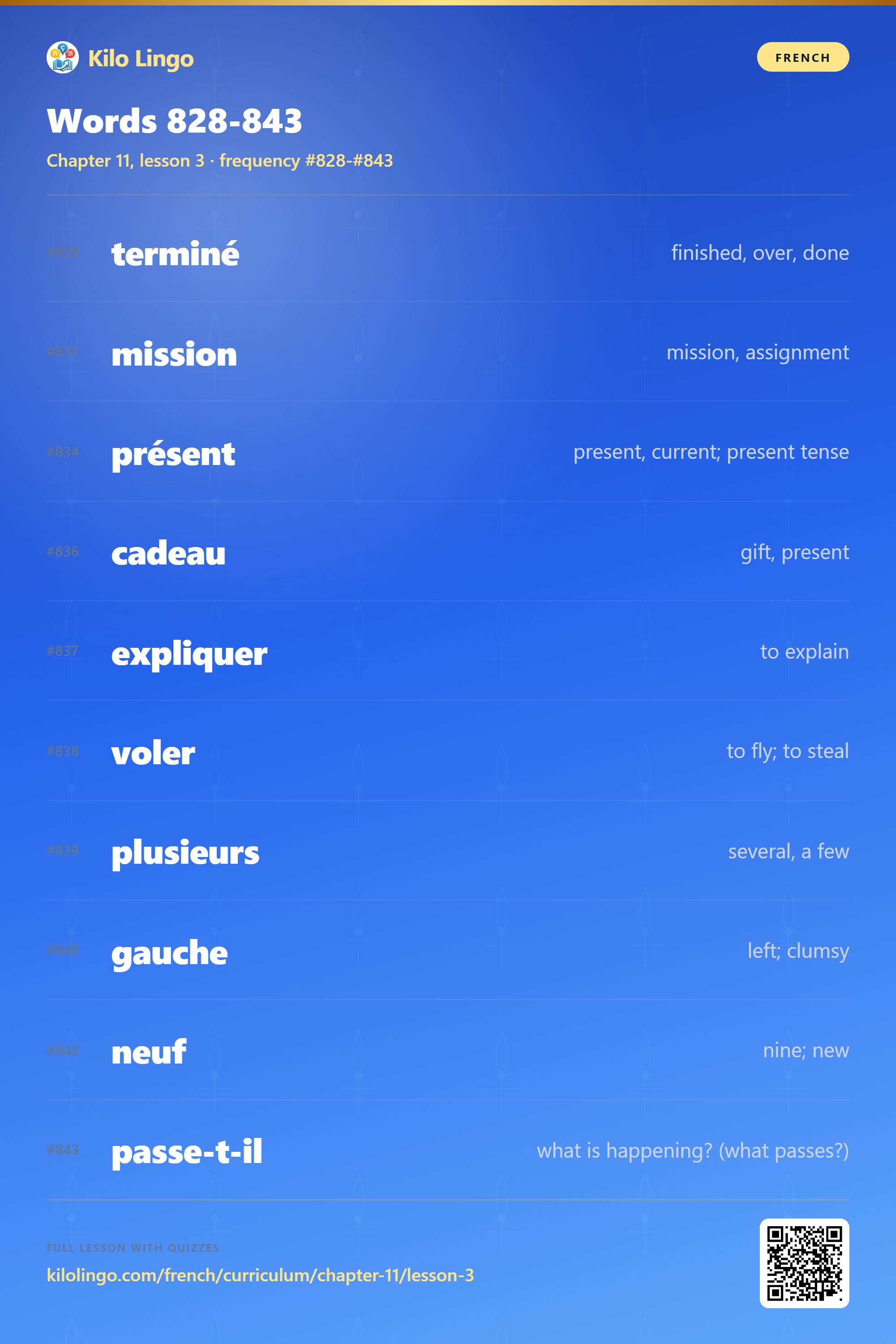
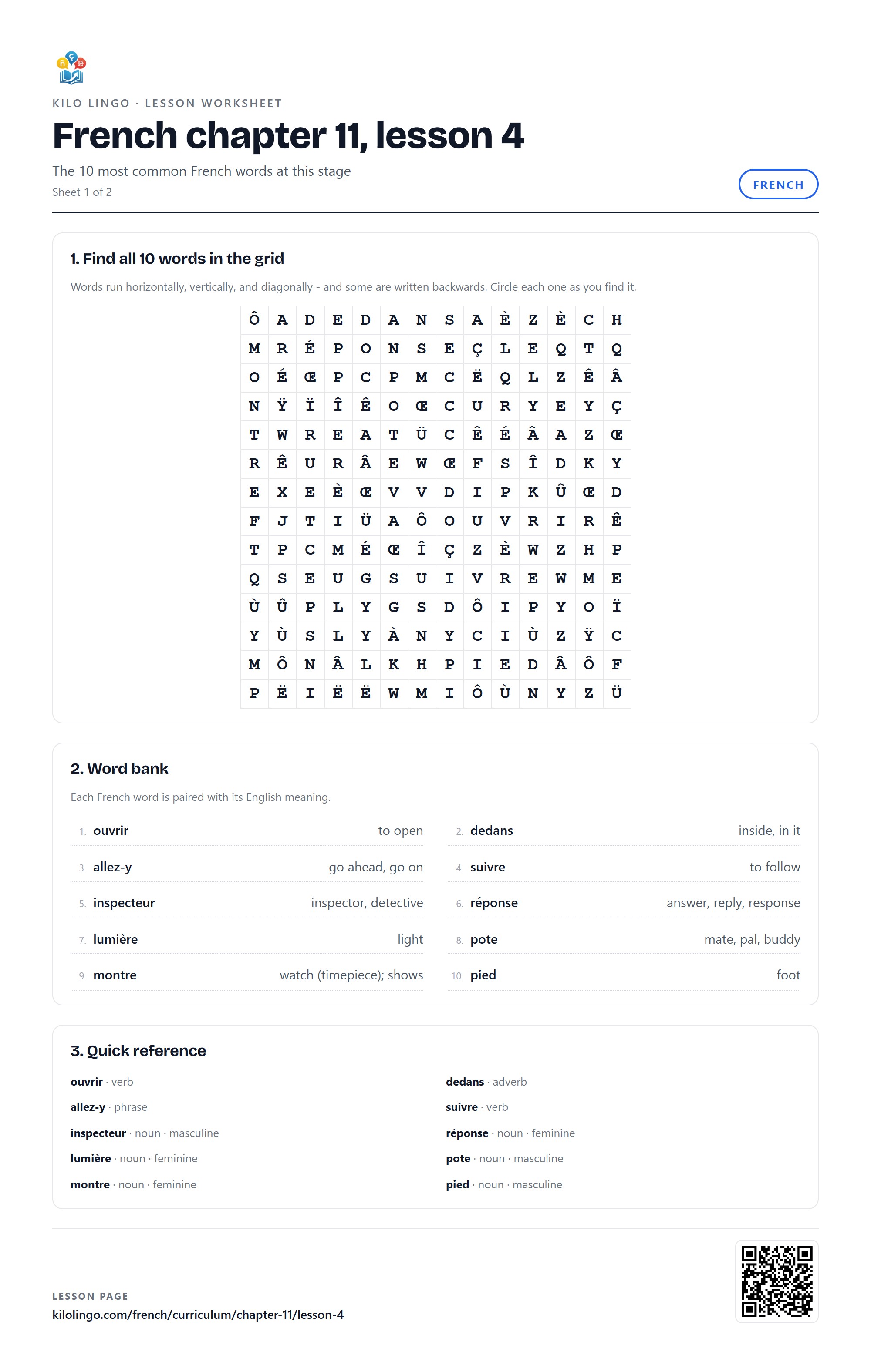
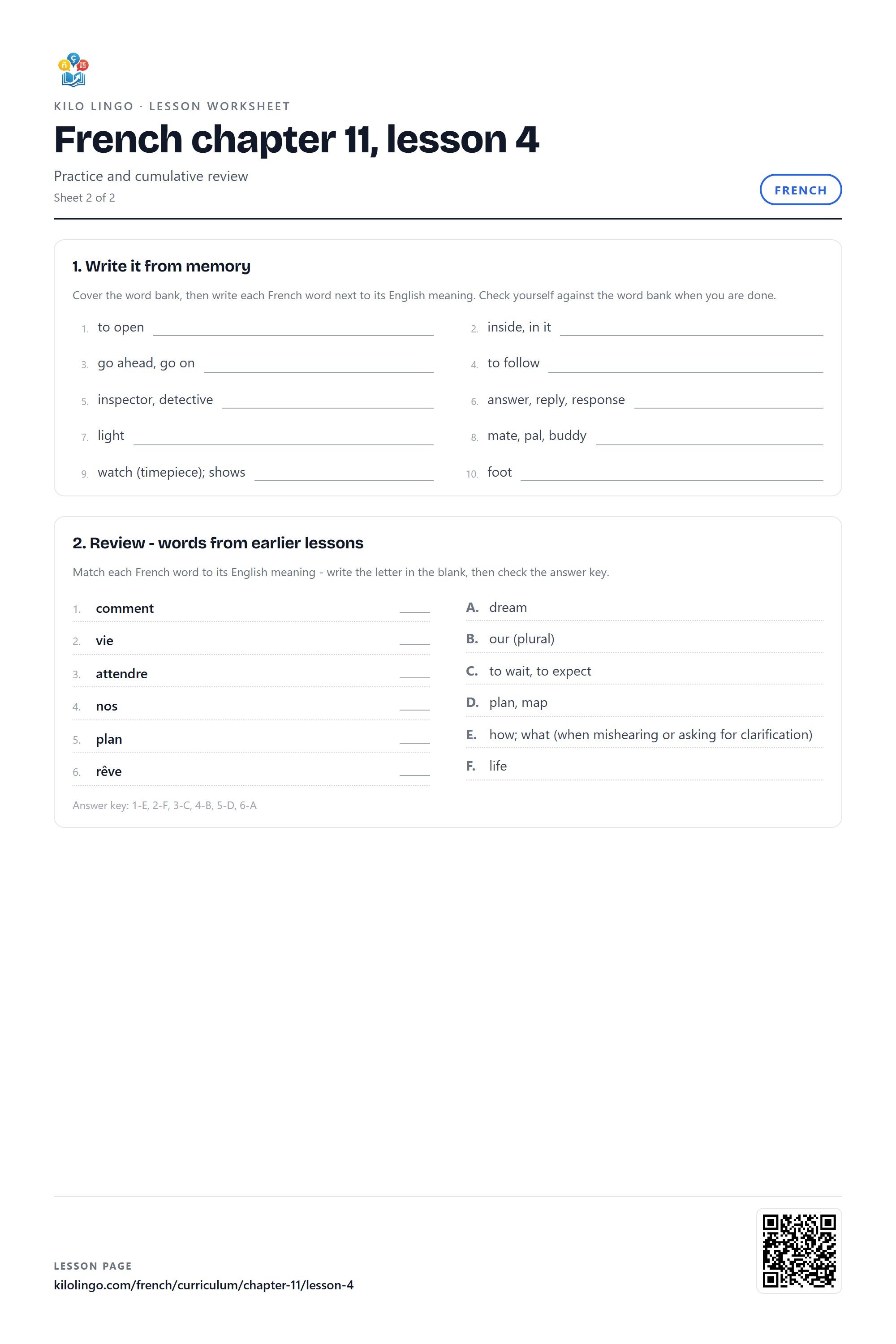

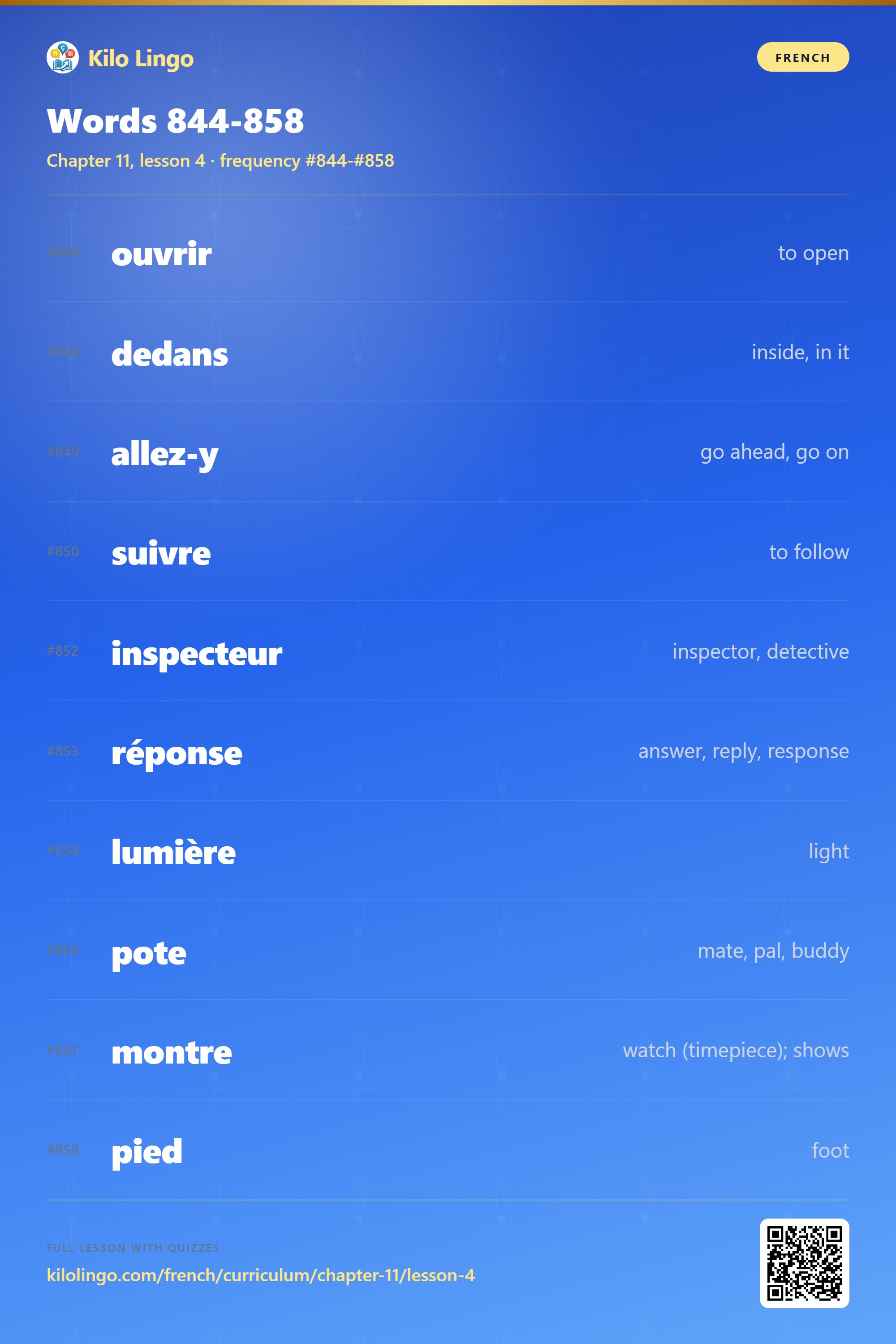
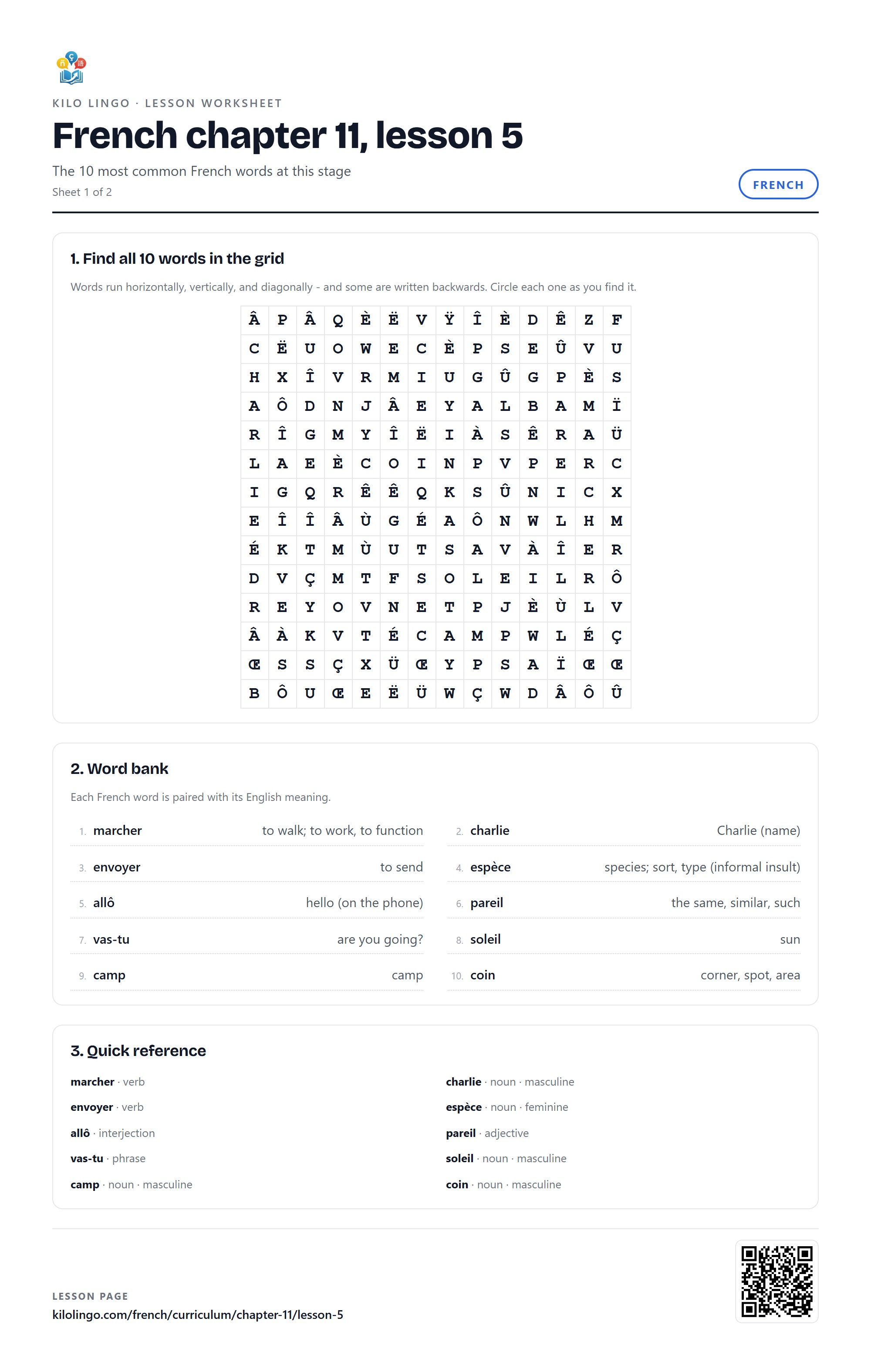
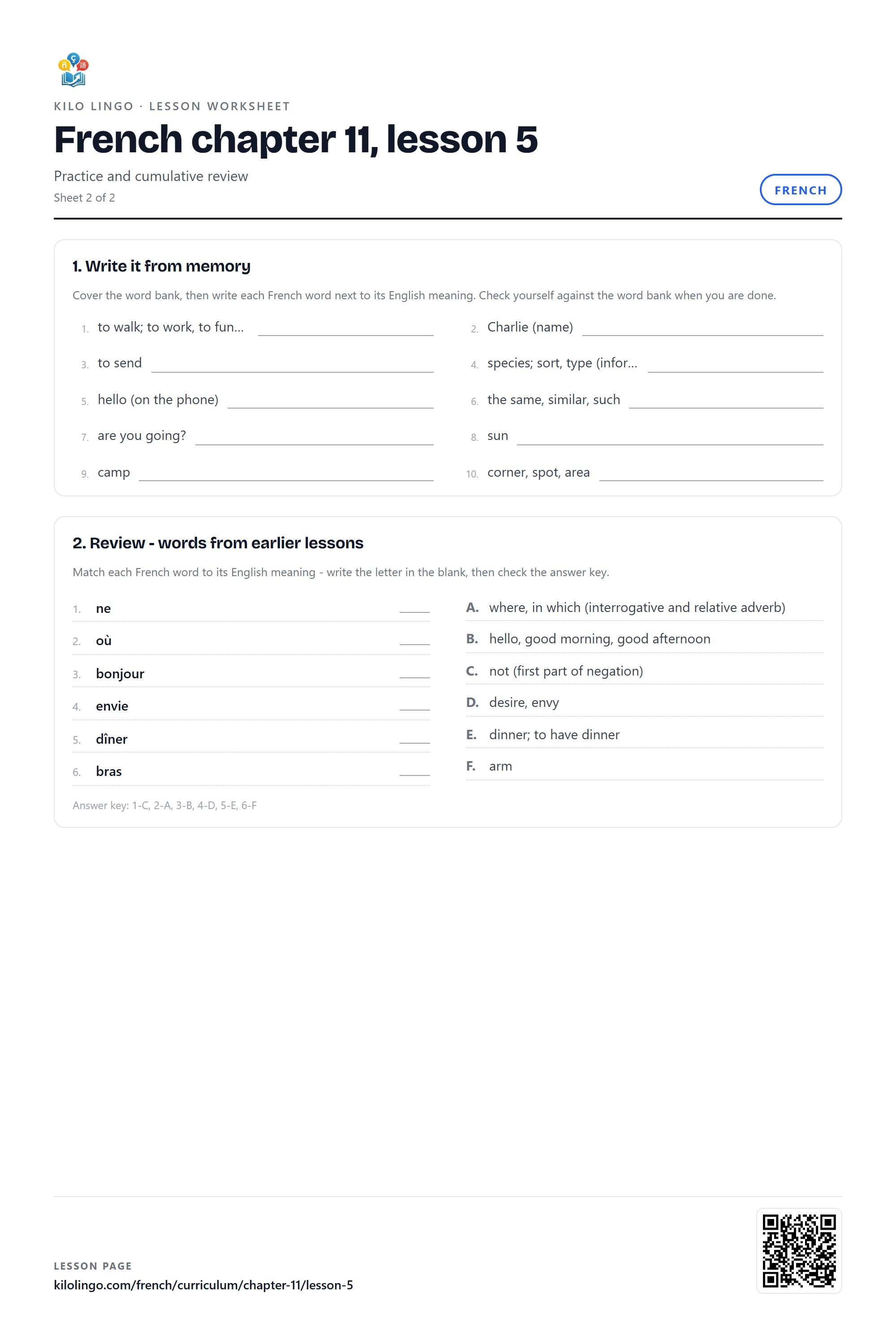



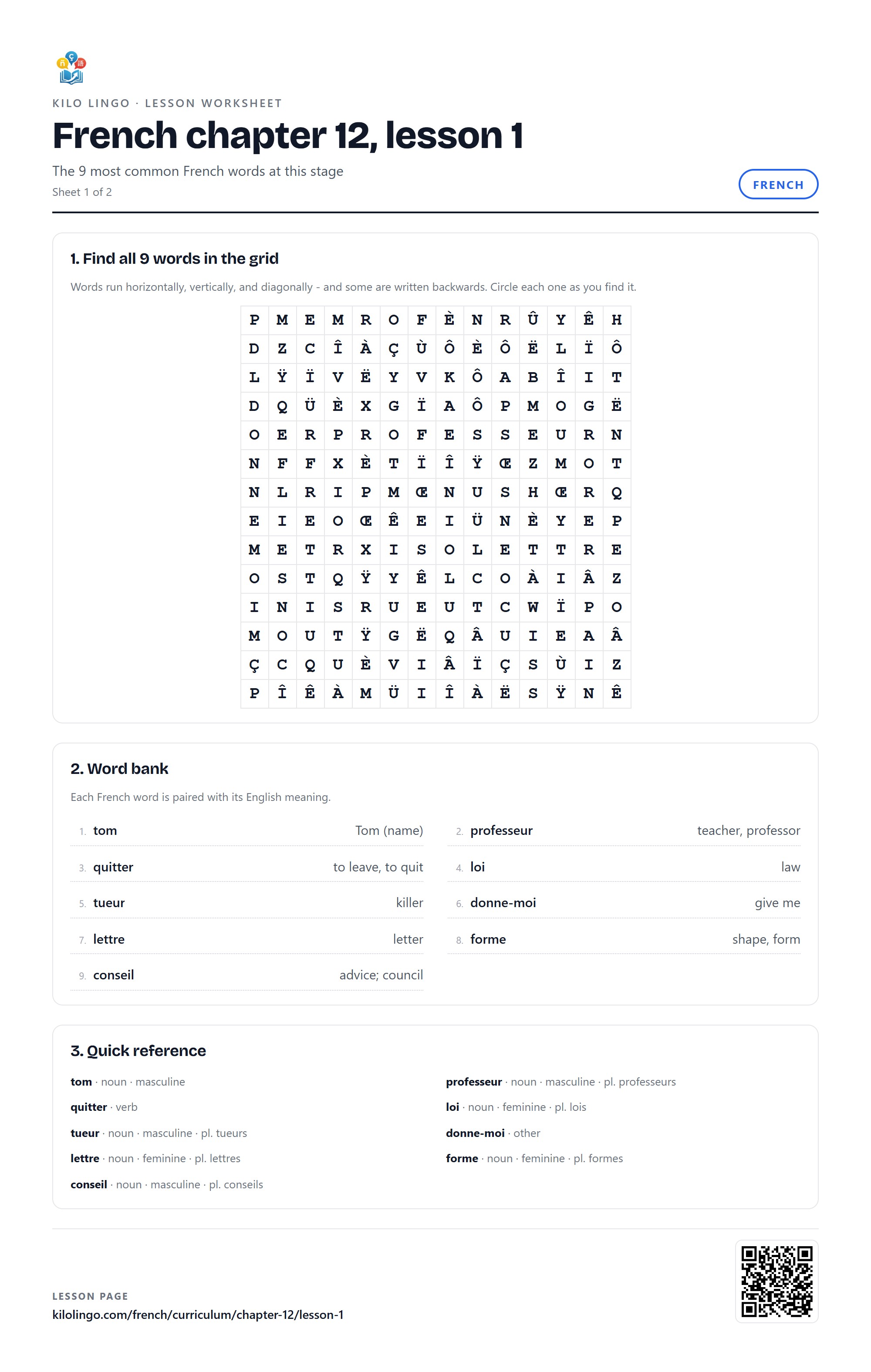
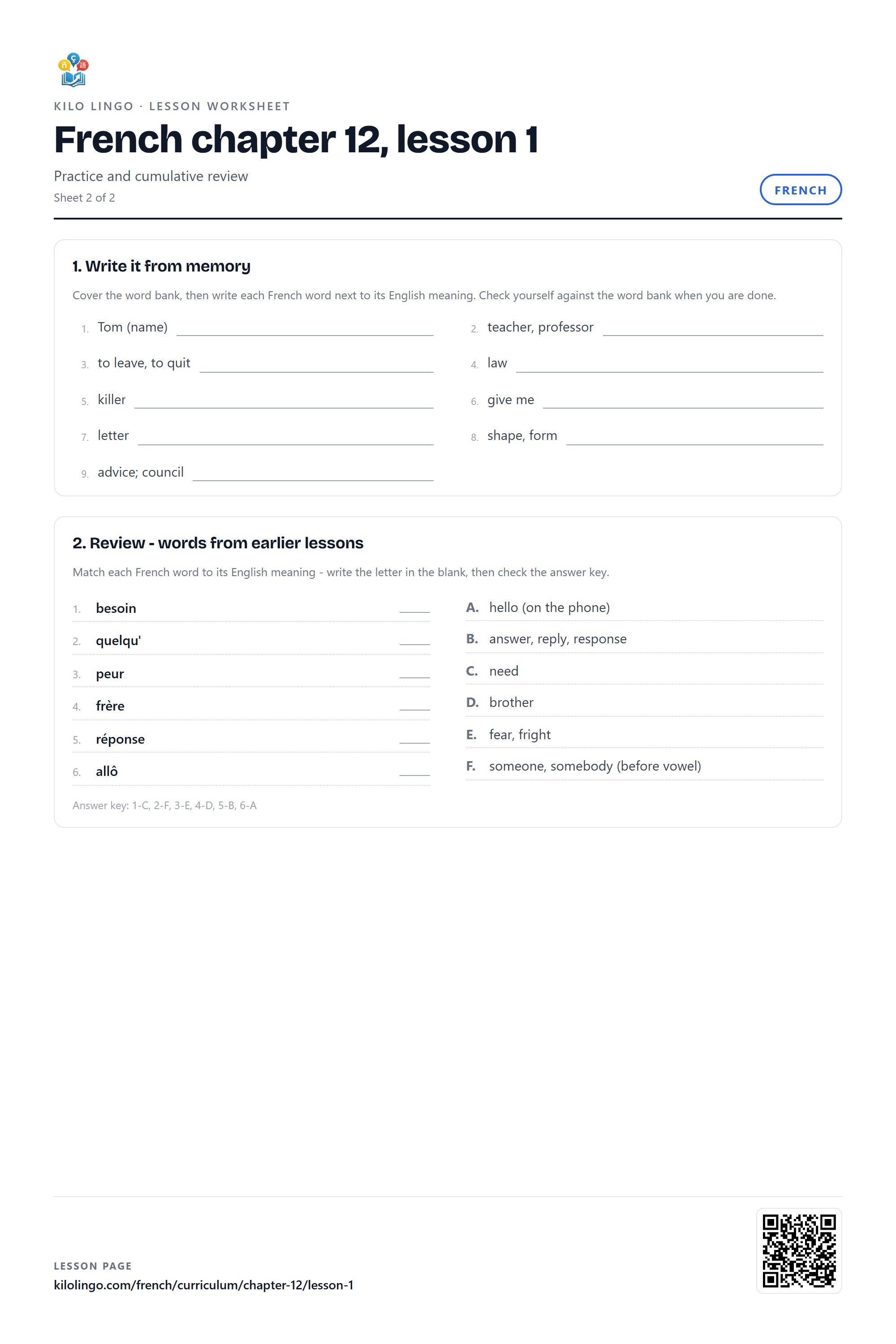
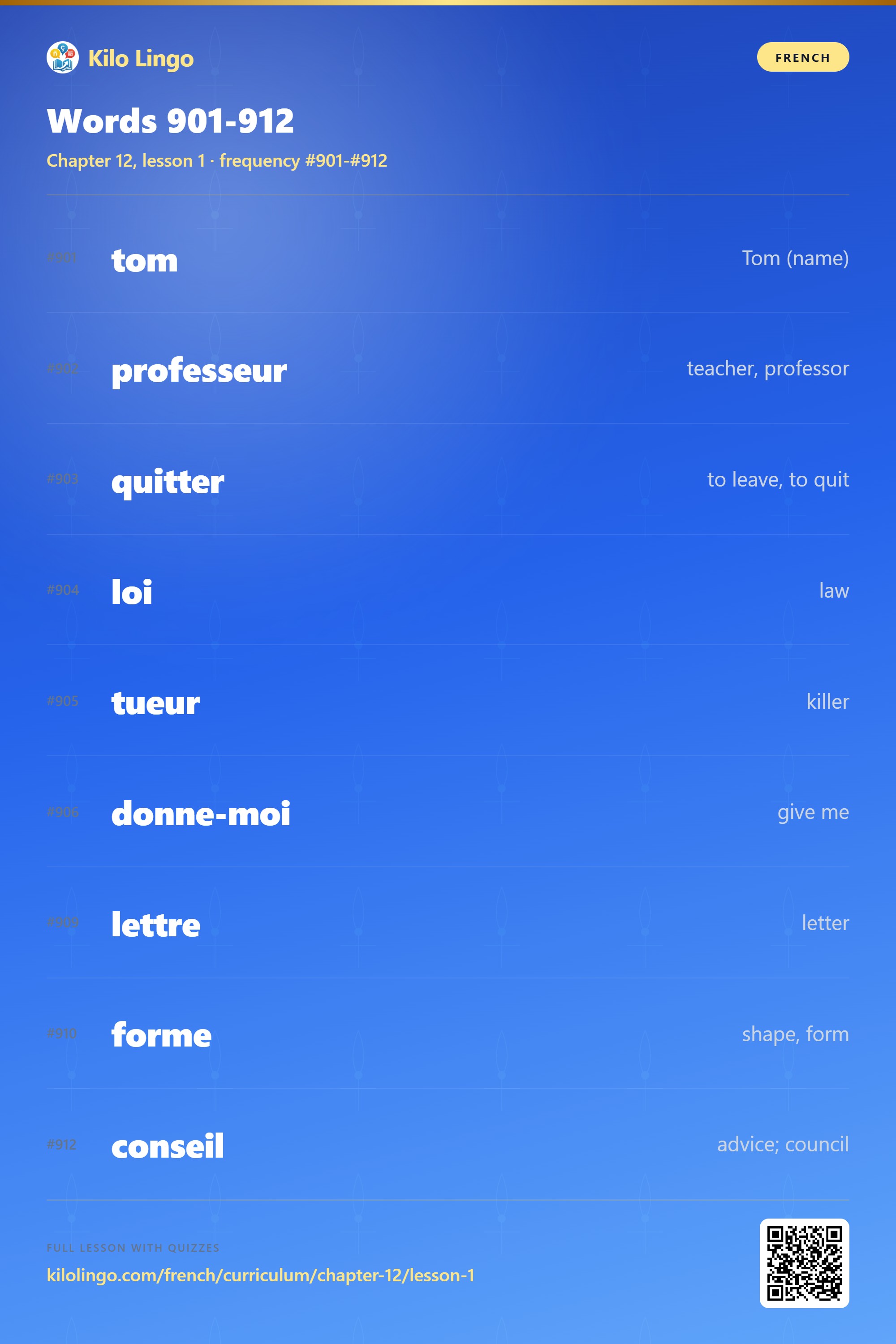
Chapter 12 · Commands: the imperative
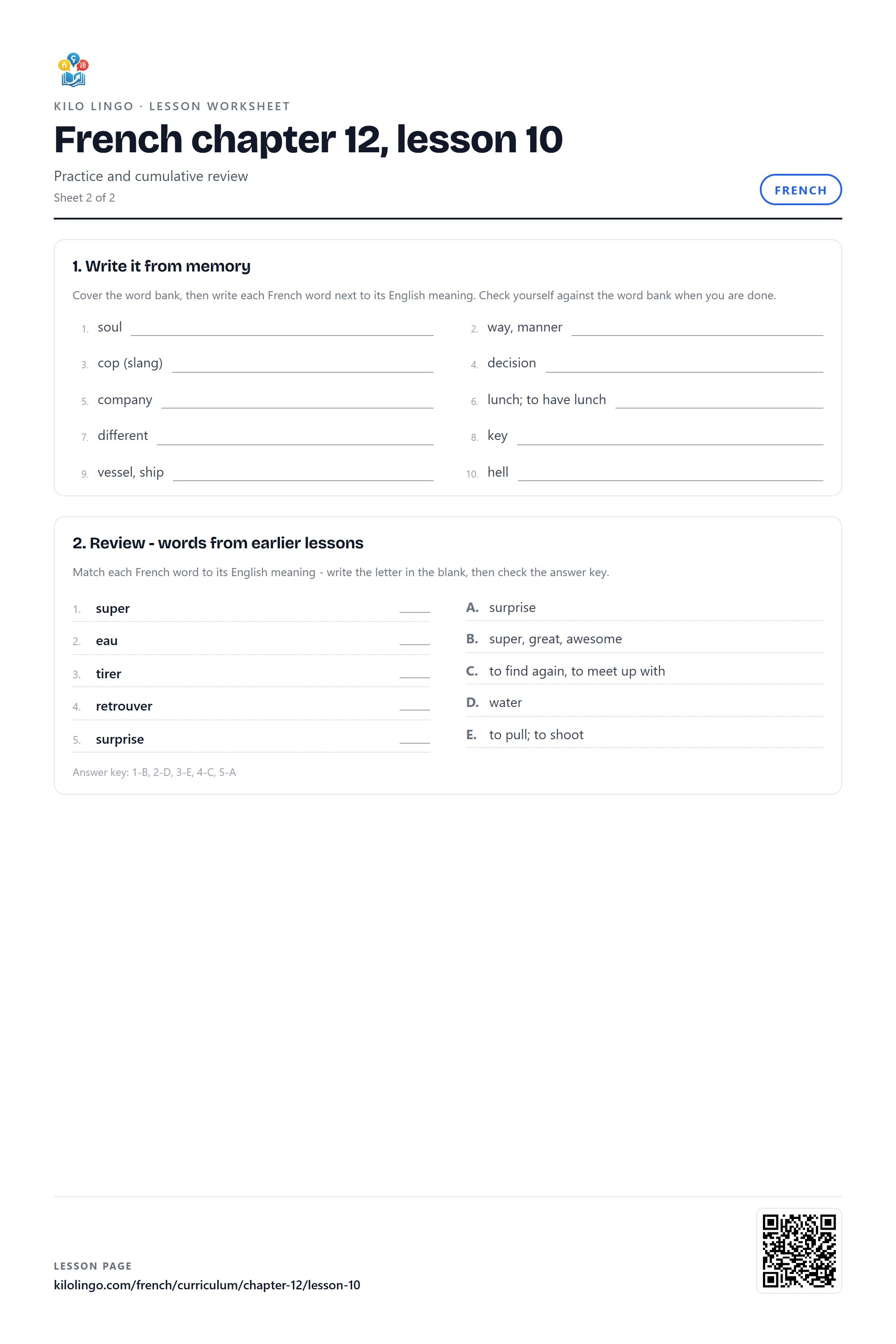
Chapter page →- Words 901-910Vocabulary
10 words · ranks 901-910
- Word Bubbles review sessionReview games
Pop the words you just met by matching each one to its meaning. A couple of rounds and the batch is yours.
- Words 911-920Vocabulary
10 words · ranks 911-920
- Crossword review sessionReview games
Cross the words you just met, clued in English. Slower than a drill, and it sticks harder.
- Words 921-930Vocabulary
10 words · ranks 921-930
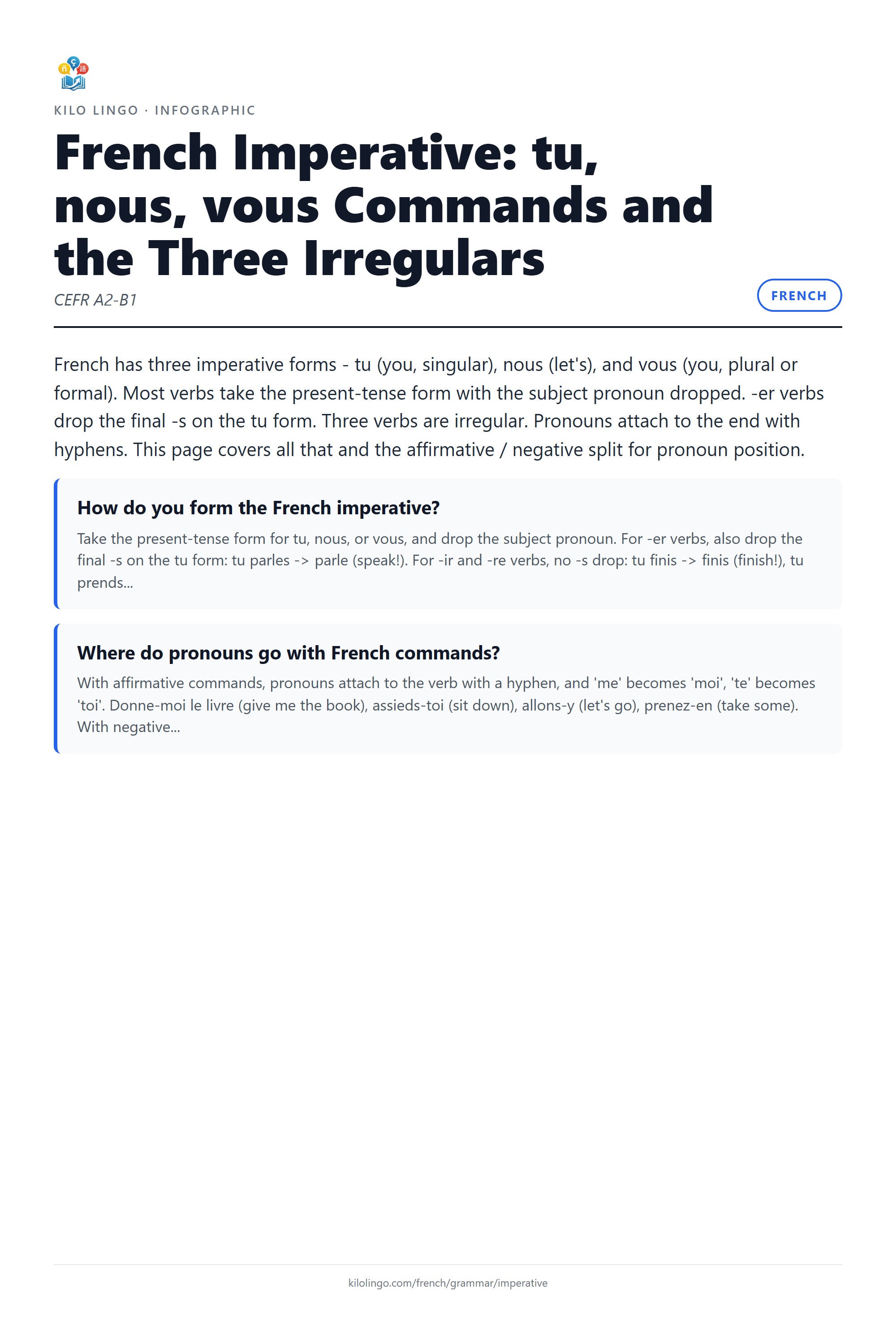
- Commands: the imperativeGrammar
Three forms (tu, nous, vous), the -er drop-the-s on tu, three irregulars (avoir, etre, savoir), and the hyphen-attachment of pronouns: donne-moi, allons-y, prenez-en.
- Words 931-941Vocabulary
10 words · ranks 931-941
- attendre or espérer?Mistake clinic
Attendre is not
to attend, and it is notto hopeeither. - Words 942-951Vocabulary
10 words · ranks 942-951
- Word Bubbles review sessionReview games
Pop the words you just met by matching each one to its meaning. A couple of rounds and the batch is yours.
- Words 952-961Vocabulary
10 words · ranks 952-961
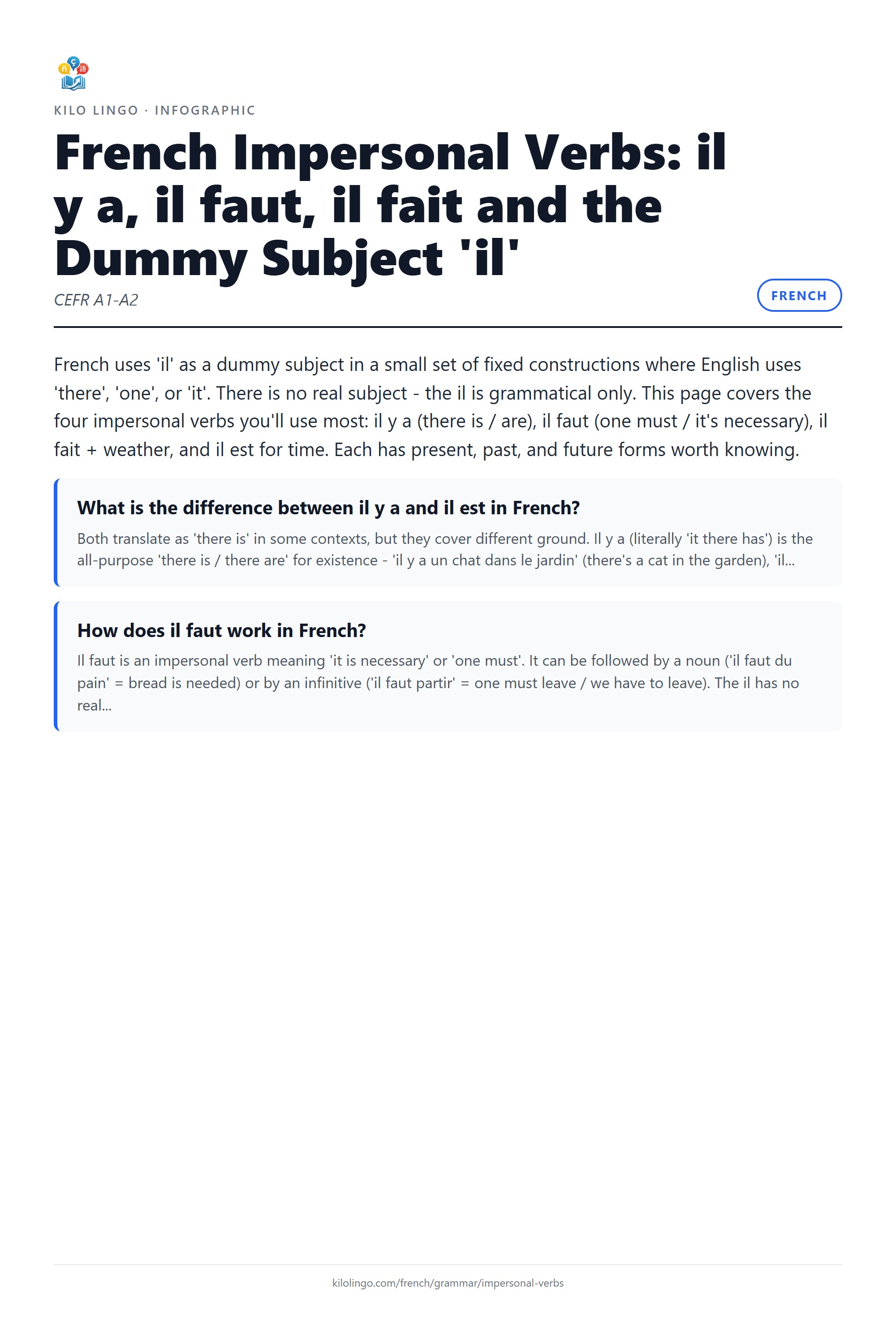
How French says 'there is', 'one must', 'it's cold'. The constructions that take il as a dummy subject with no real referent.
- Words 962-971Vocabulary
10 words · ranks 962-971
- Conjugation Sprint review sessionReview games
Sixty seconds on the endings of the verbs this chapter has drilled so far.
- Words 972-982Vocabulary
10 words · ranks 972-982
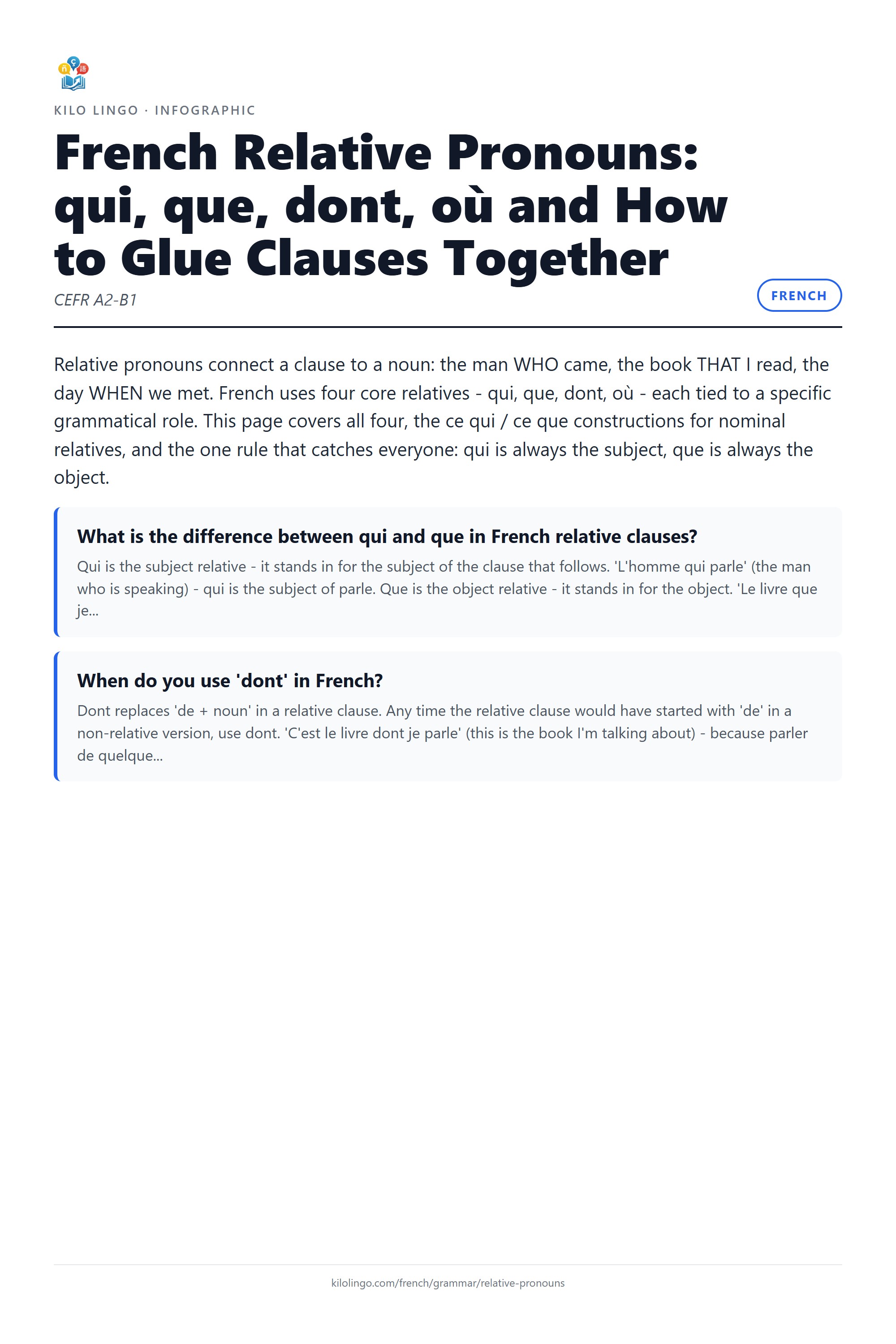
qui = subject relative, que = object relative, dont covers de-relations, ou covers place and time. Plus ce qui / ce que for nominal relatives.
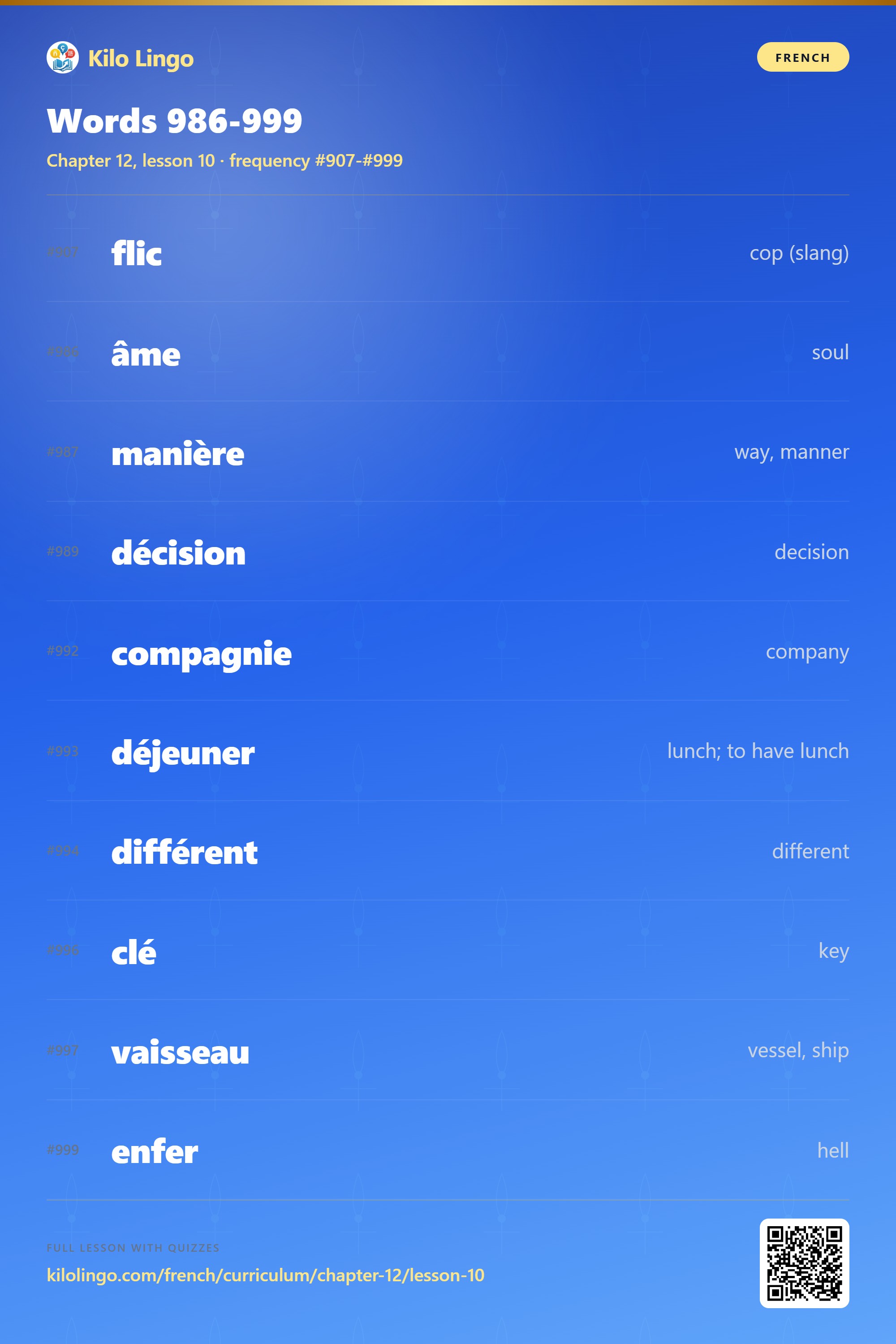
- Words 983-992Vocabulary
10 words · ranks 983-992
- Word Bubbles review sessionReview games
Pop the words you just met by matching each one to its meaning. A couple of rounds and the batch is yours.
- Words 993-1000Vocabulary
8 words · ranks 993-1000
- Story milestone: top 1000 wordsGraded-reader story
You can read this story using only the words you've learned so far. Every content word sits at or above the rank-1000 ceiling.
- Le travail et les étudesThemed review
The office and the classroom.
boulotis what people actually say for work;travailis what they write. - Arcade reviewReview games
Replay this chapter's words as games - a different kind of repetition, and it counts.
Word printables
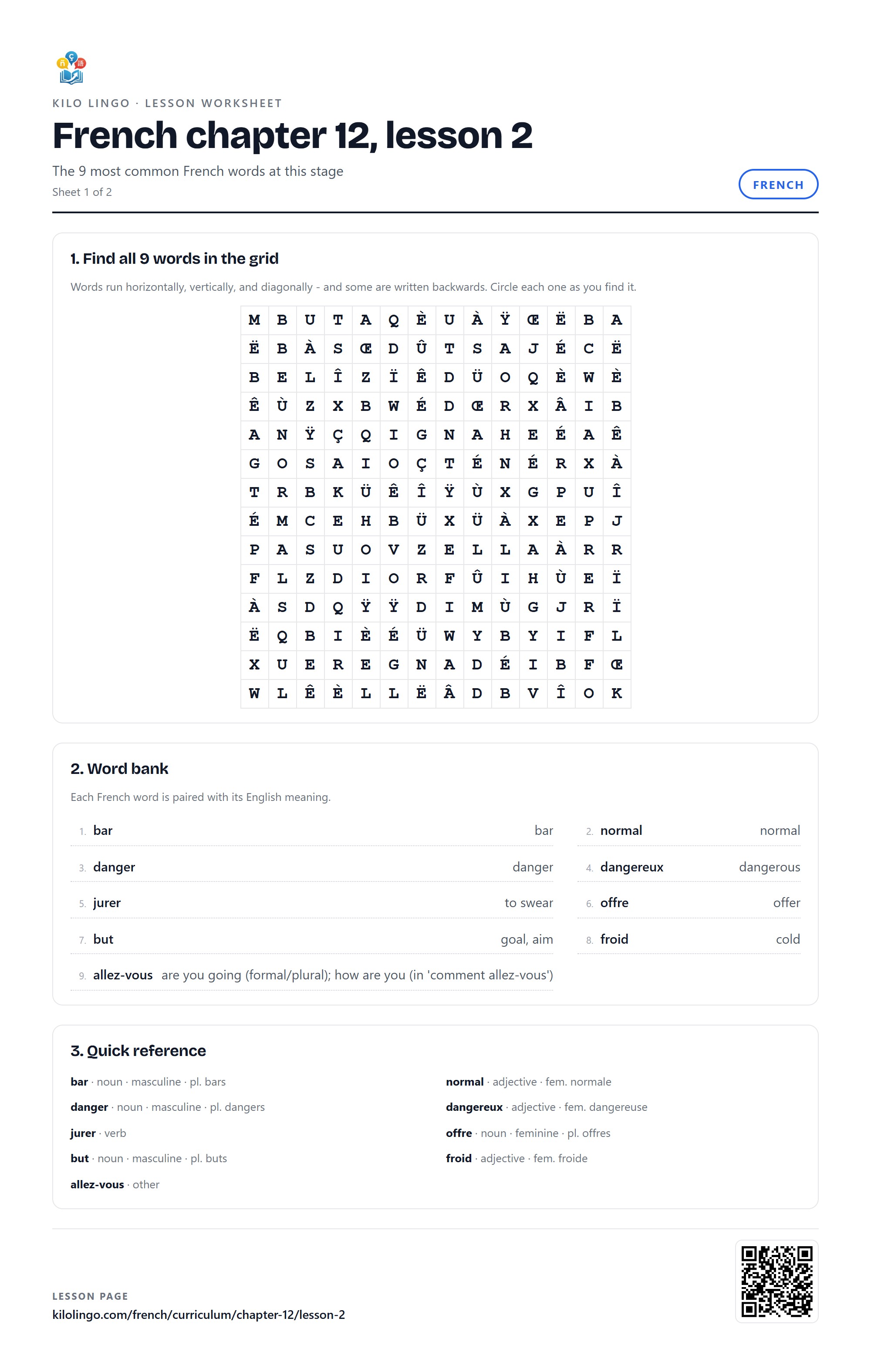
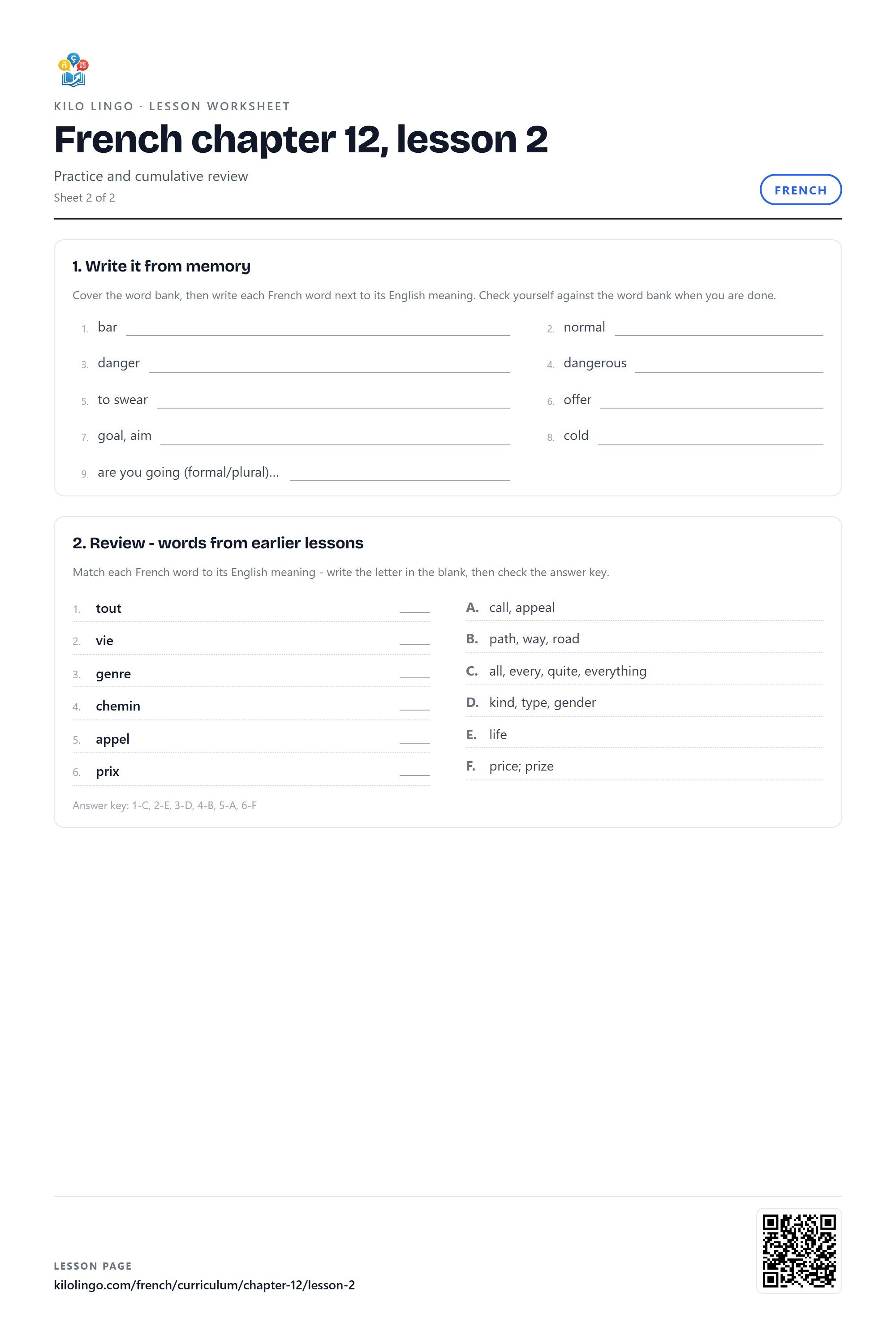
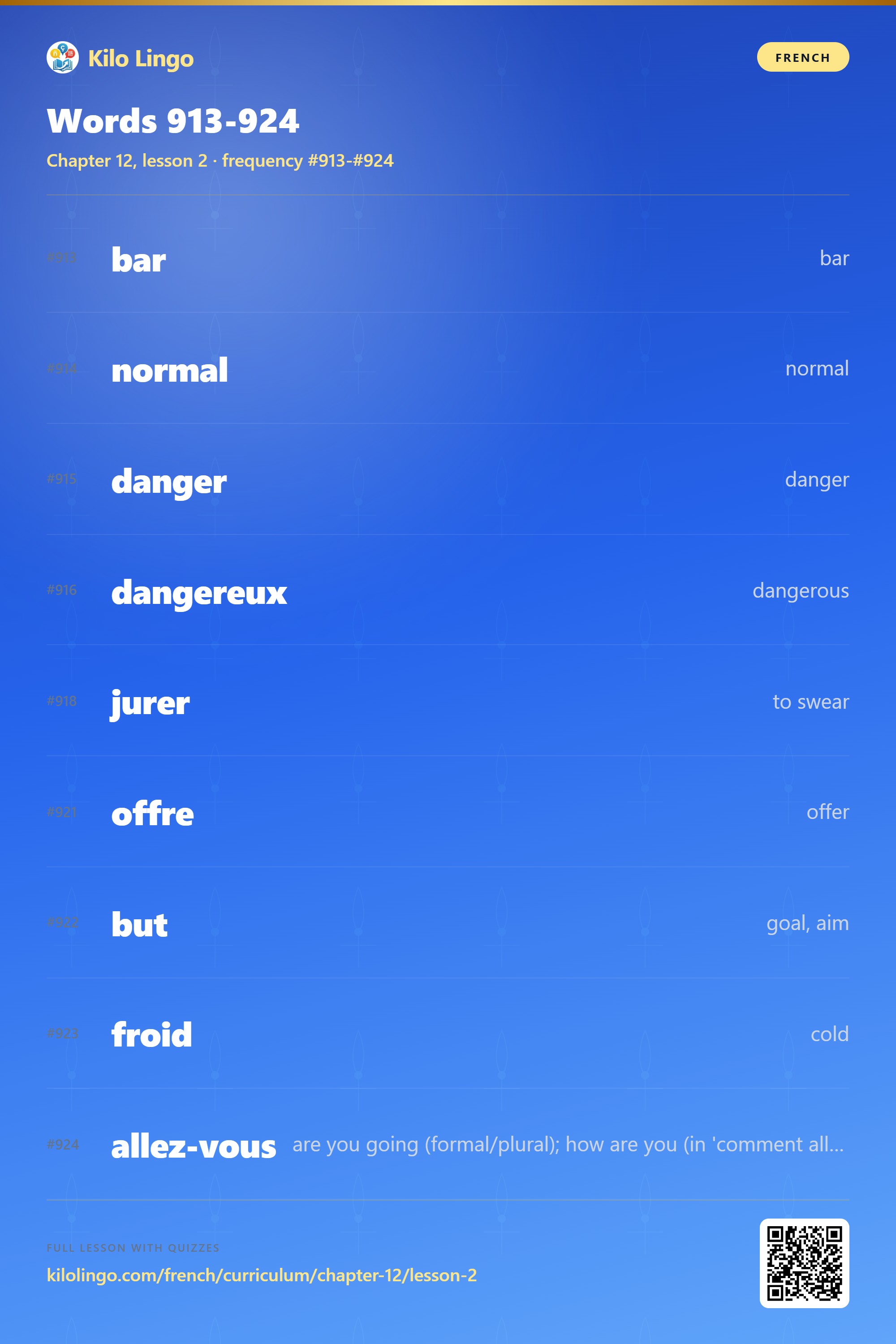
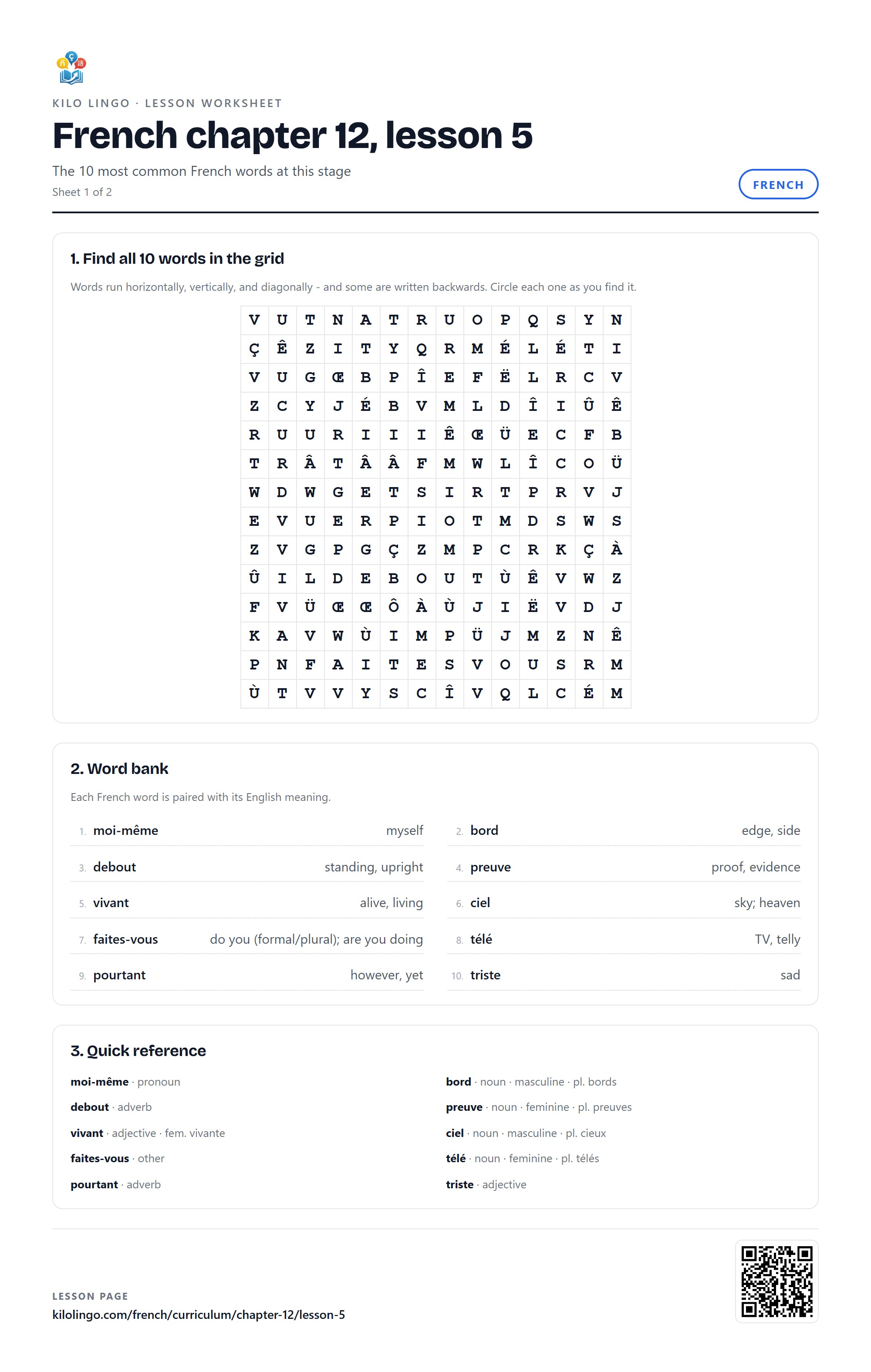
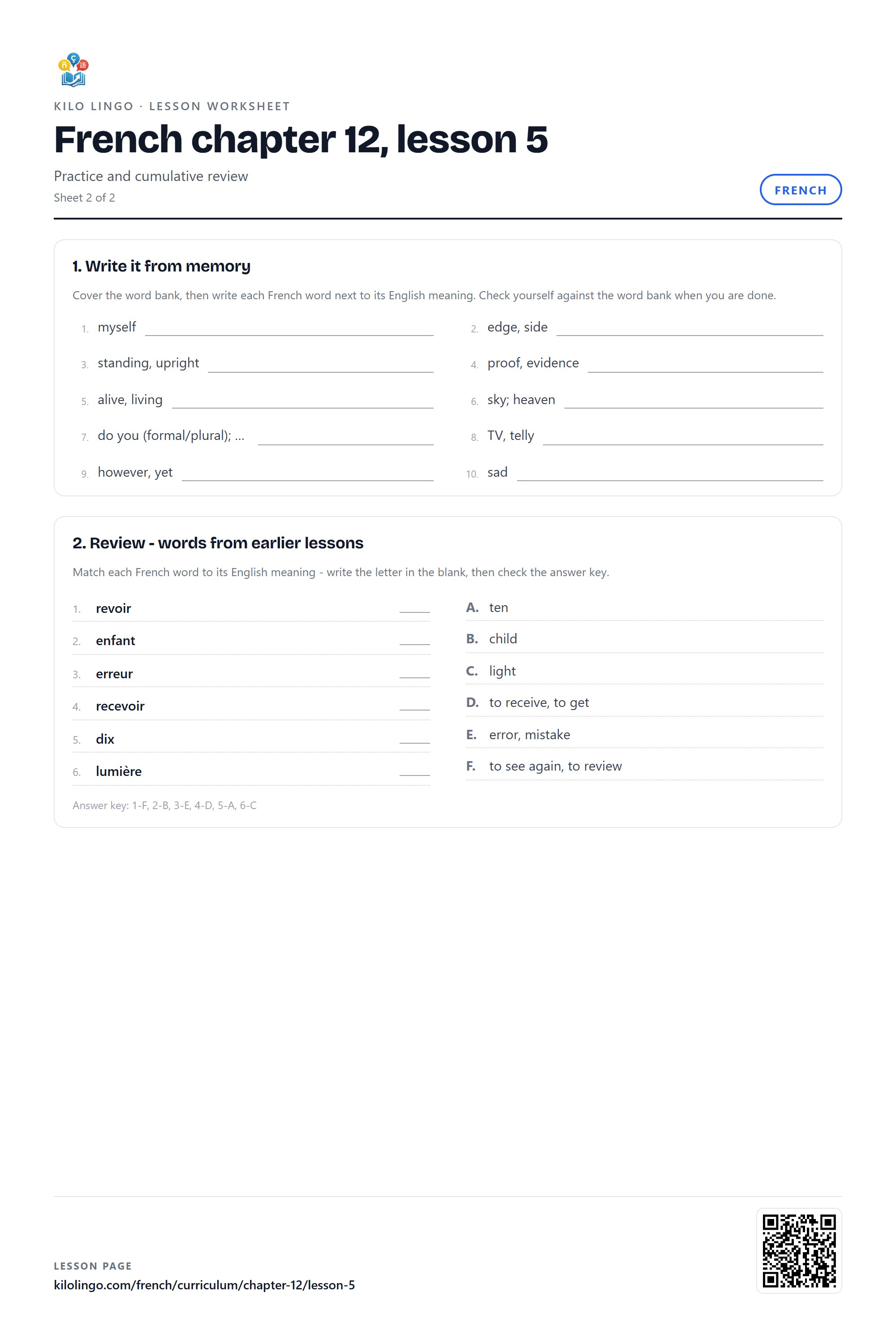
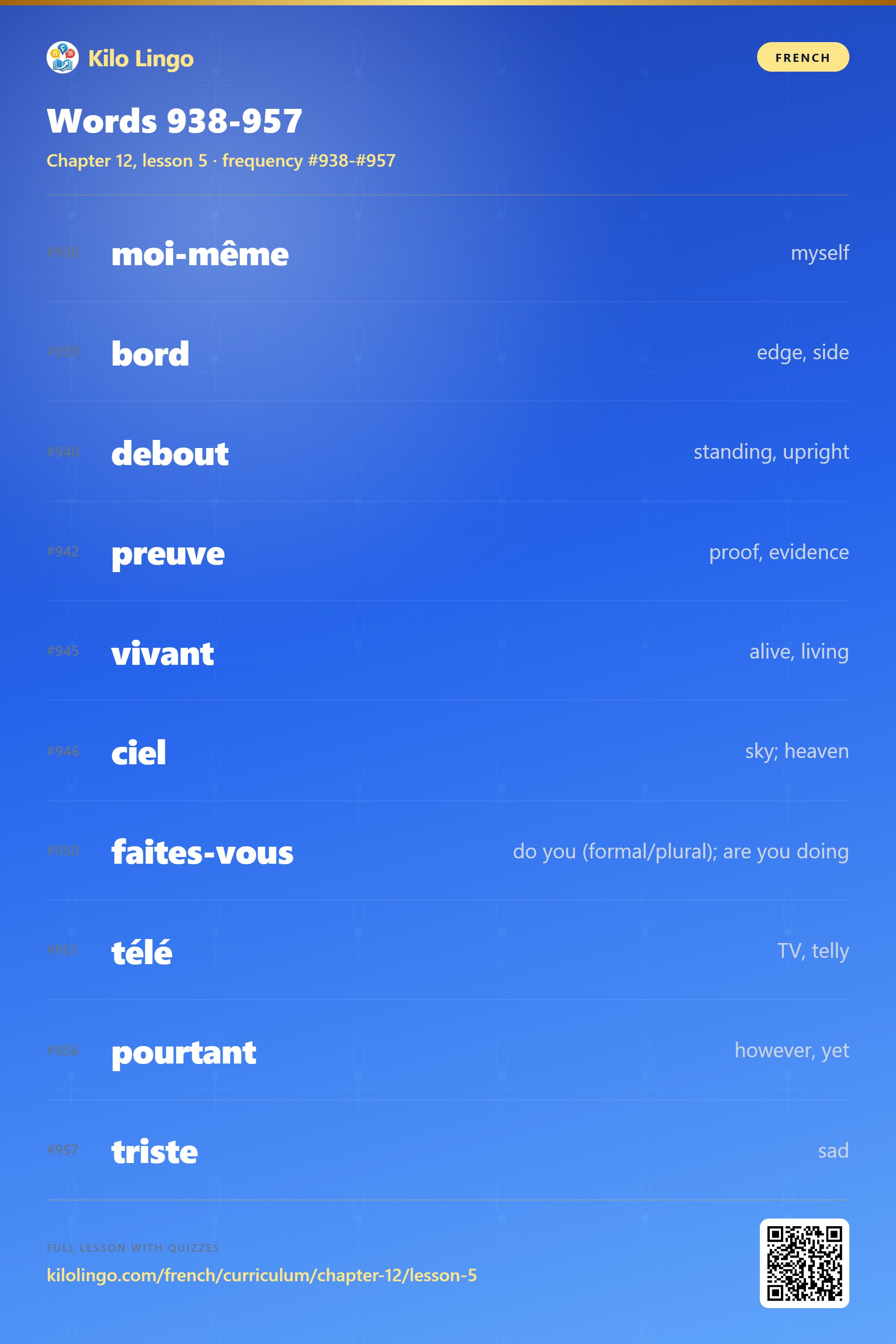
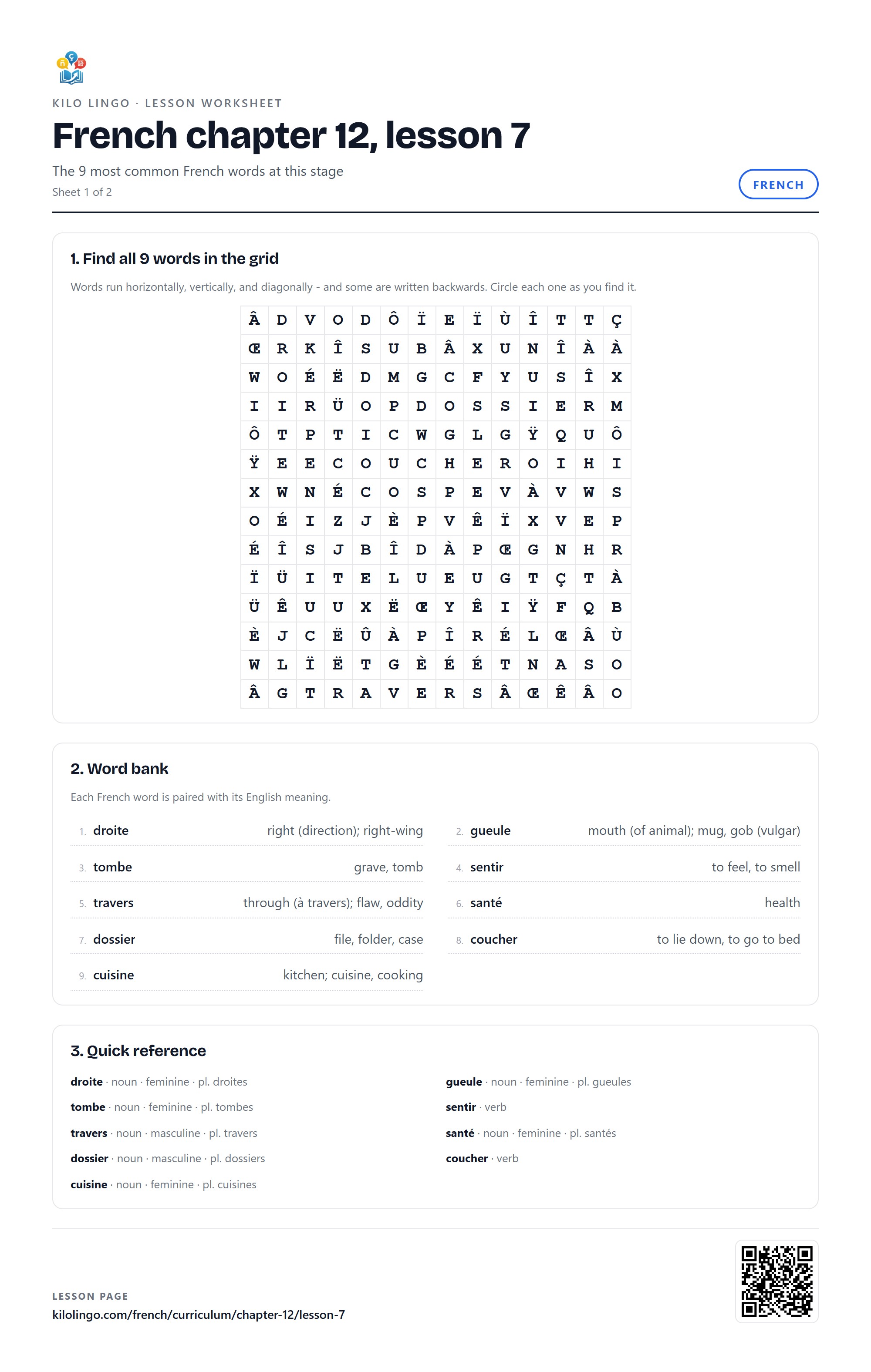
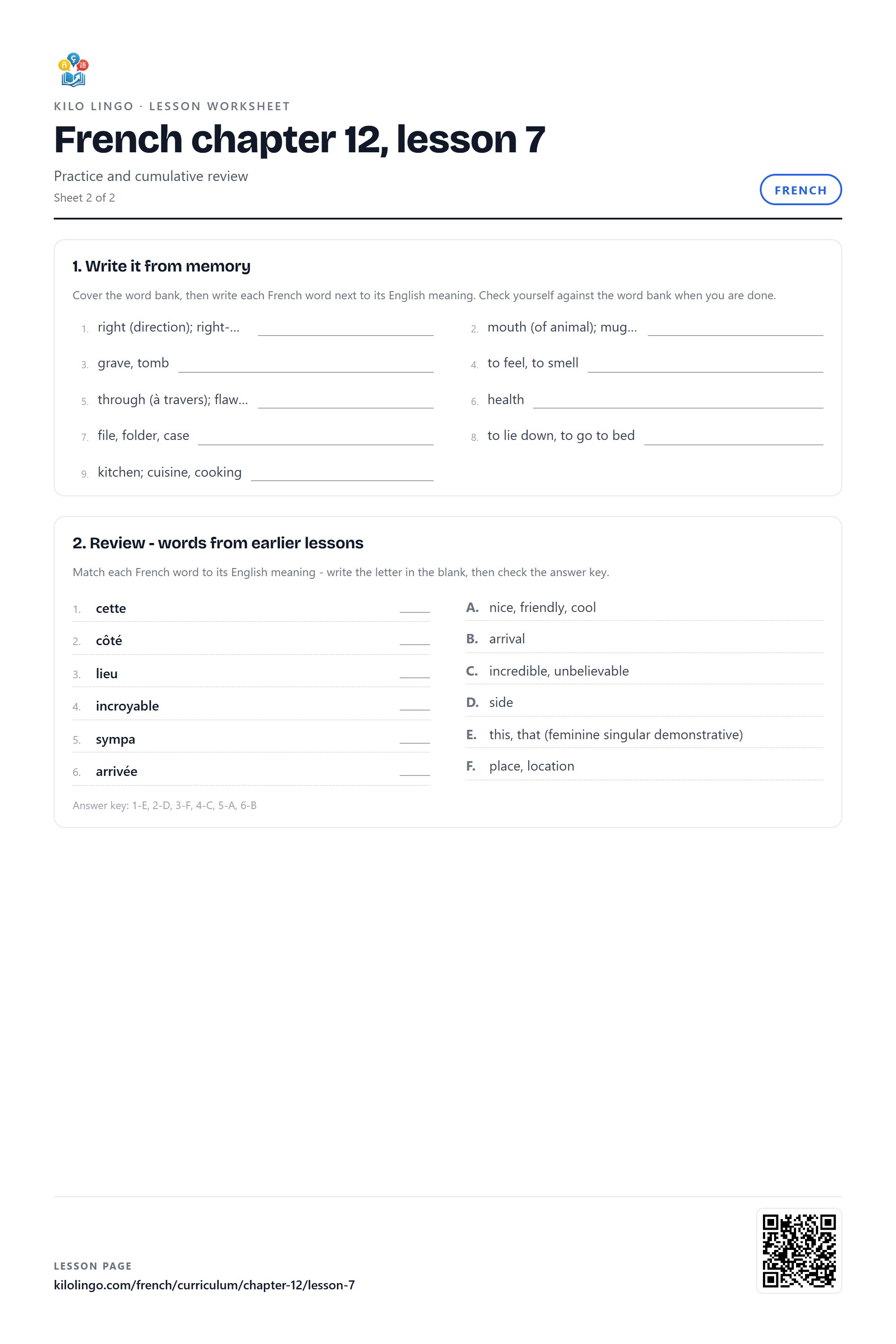
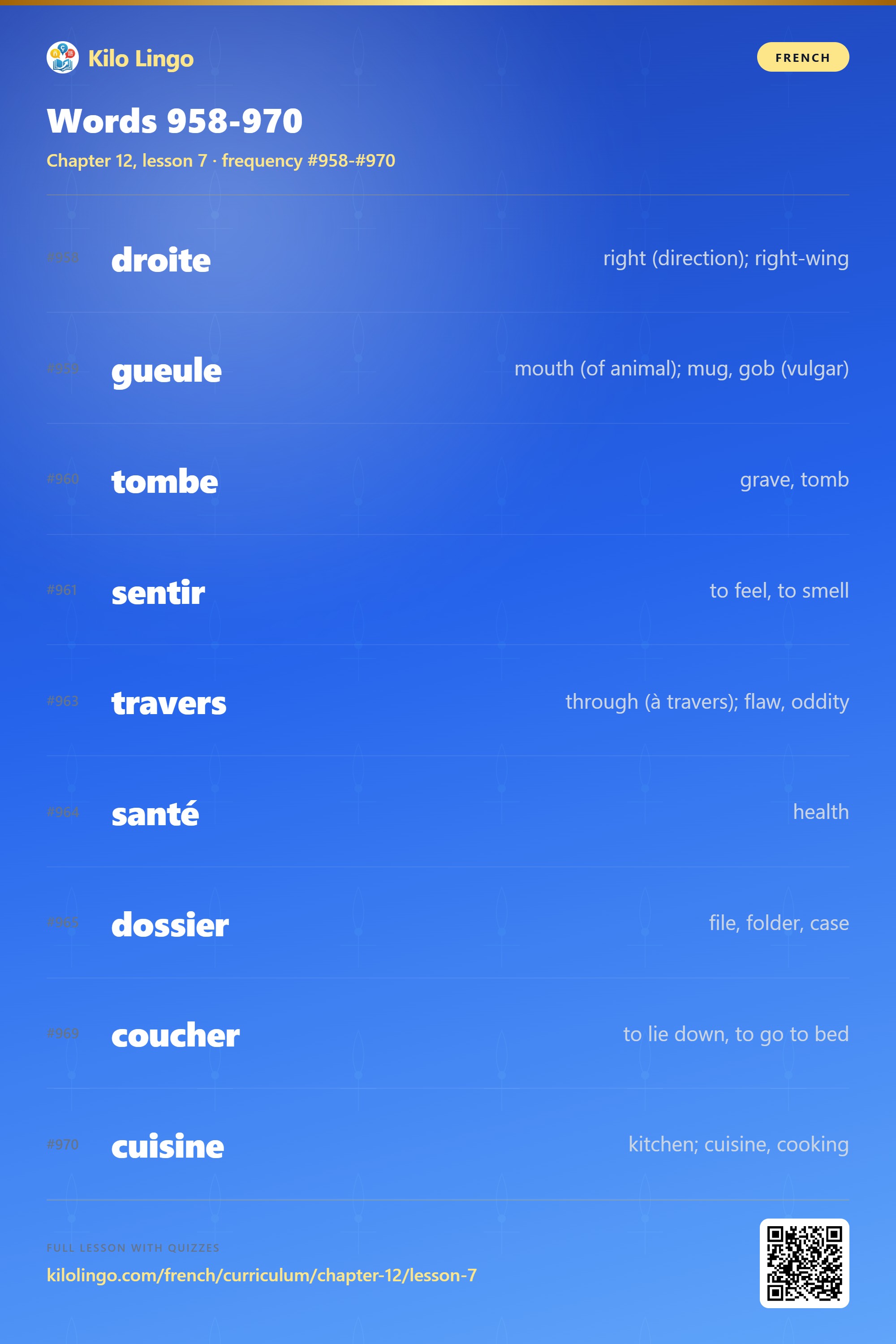
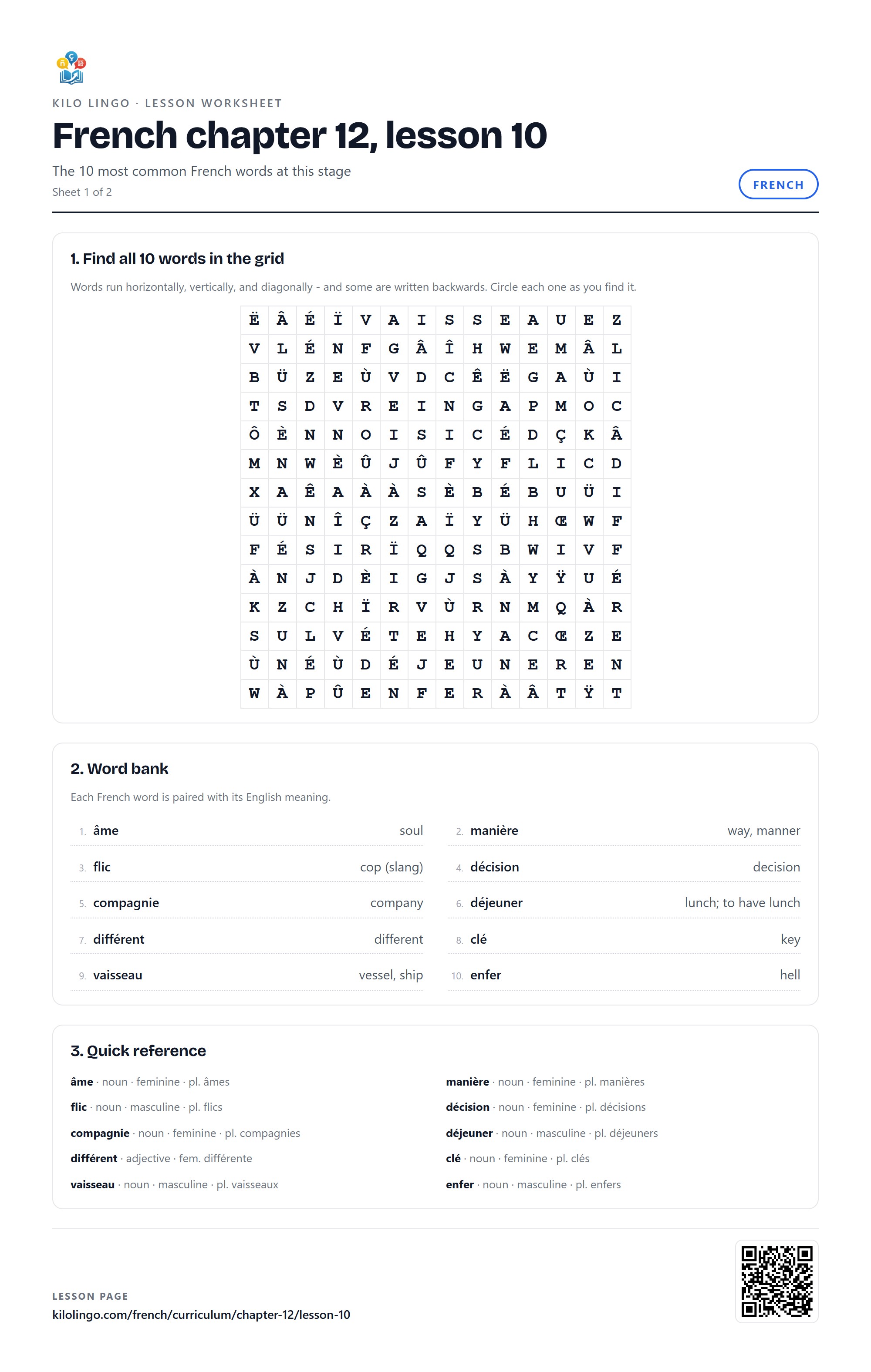
Per-word sheets98 words · a worksheet, infographic and listicle each





Chapter 13 · Superlatives: le plus, le moins
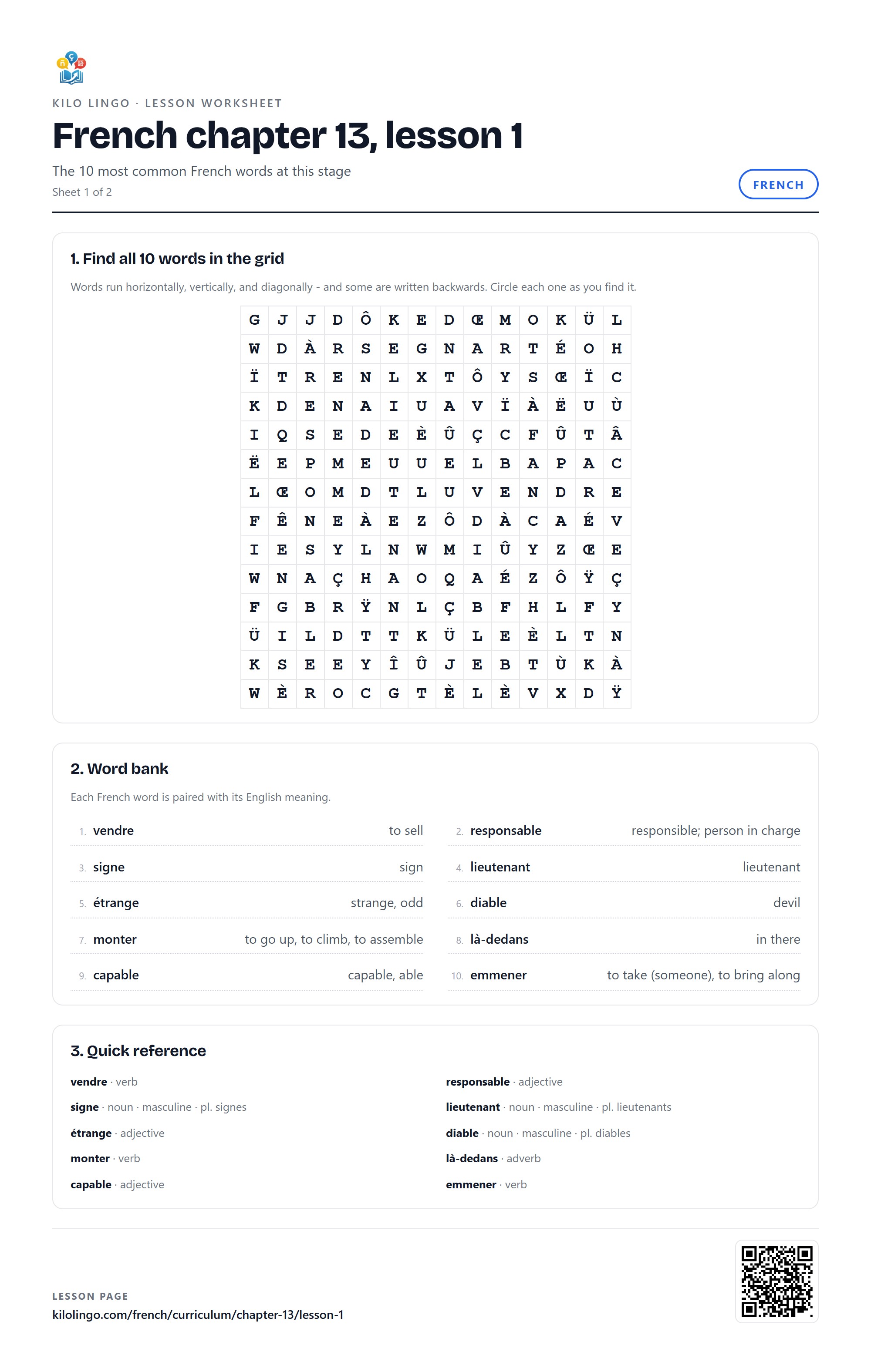
Chapter page →- Words 1001-1010Vocabulary
10 words · ranks 1001-1010
- Crossword review sessionReview games
Cross the words you just met, clued in English. Slower than a drill, and it sticks harder.
- Words 1011-1020Vocabulary
10 words · ranks 1011-1020
- Word Bubbles review sessionReview games
Pop the words you just met by matching each one to its meaning. A couple of rounds and the batch is yours.
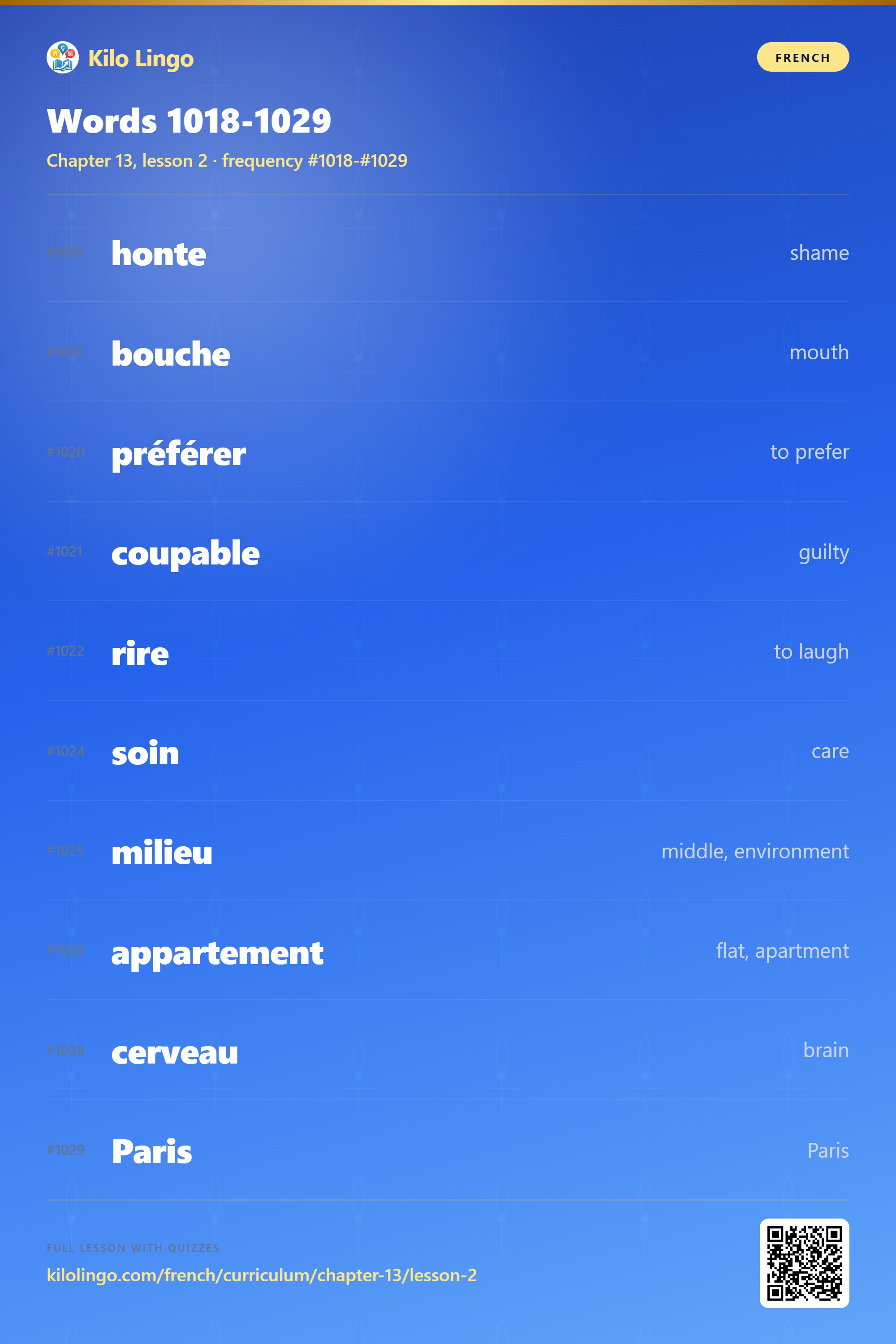
- Words 1021-1030Vocabulary
10 words · ranks 1021-1030
- Conjugation Sprint review sessionReview games
Sixty seconds on the endings of the verbs this chapter has drilled so far.
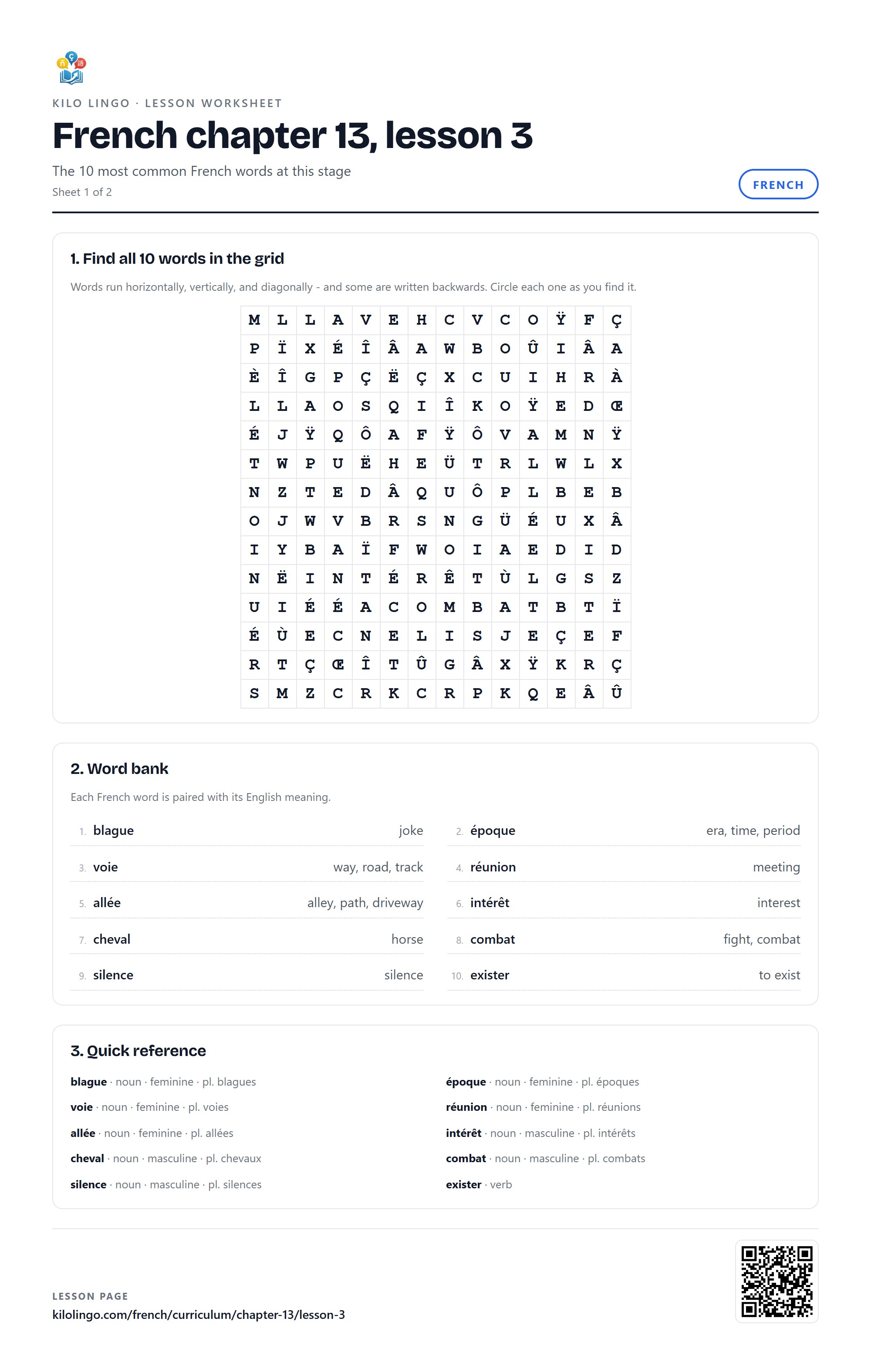
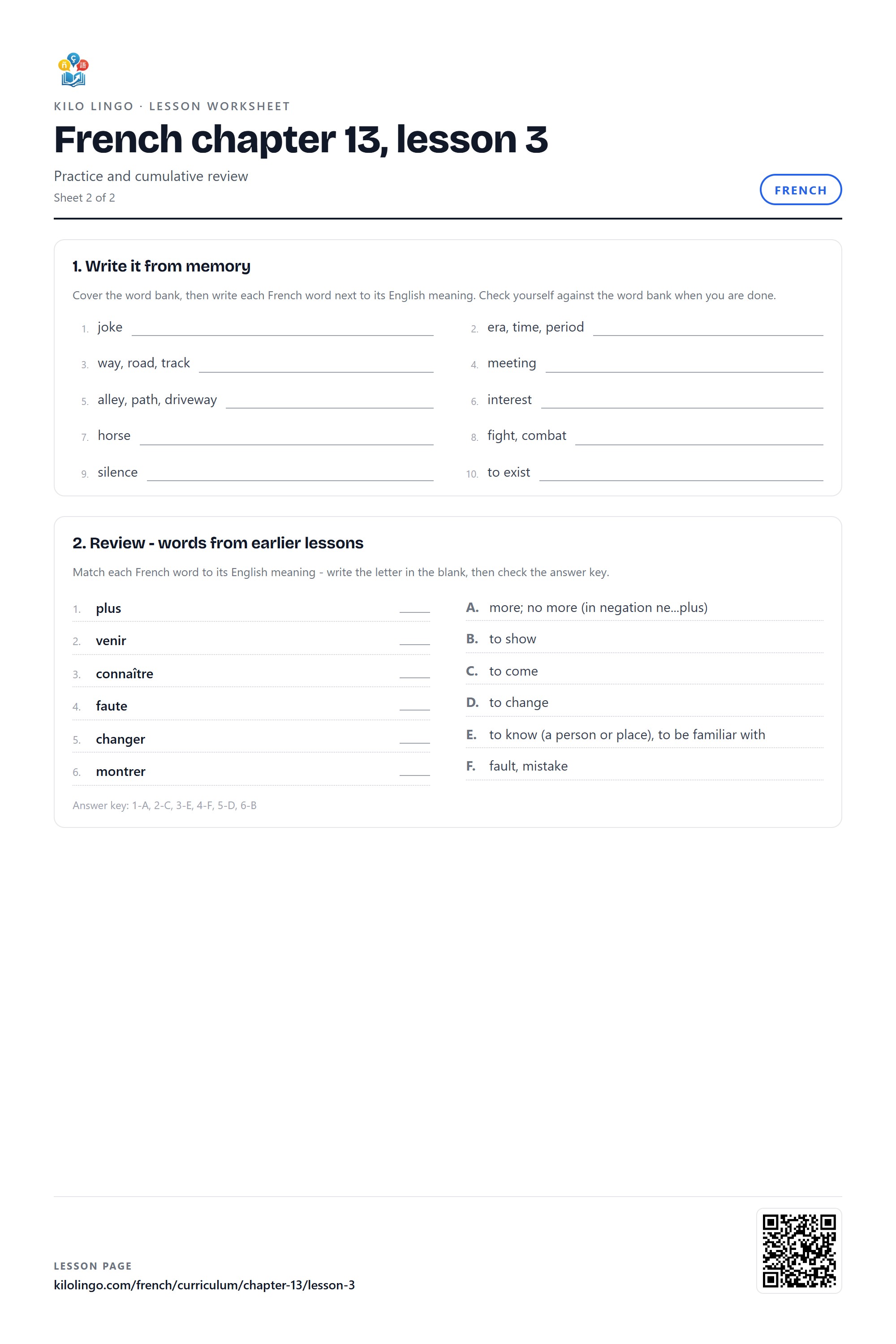
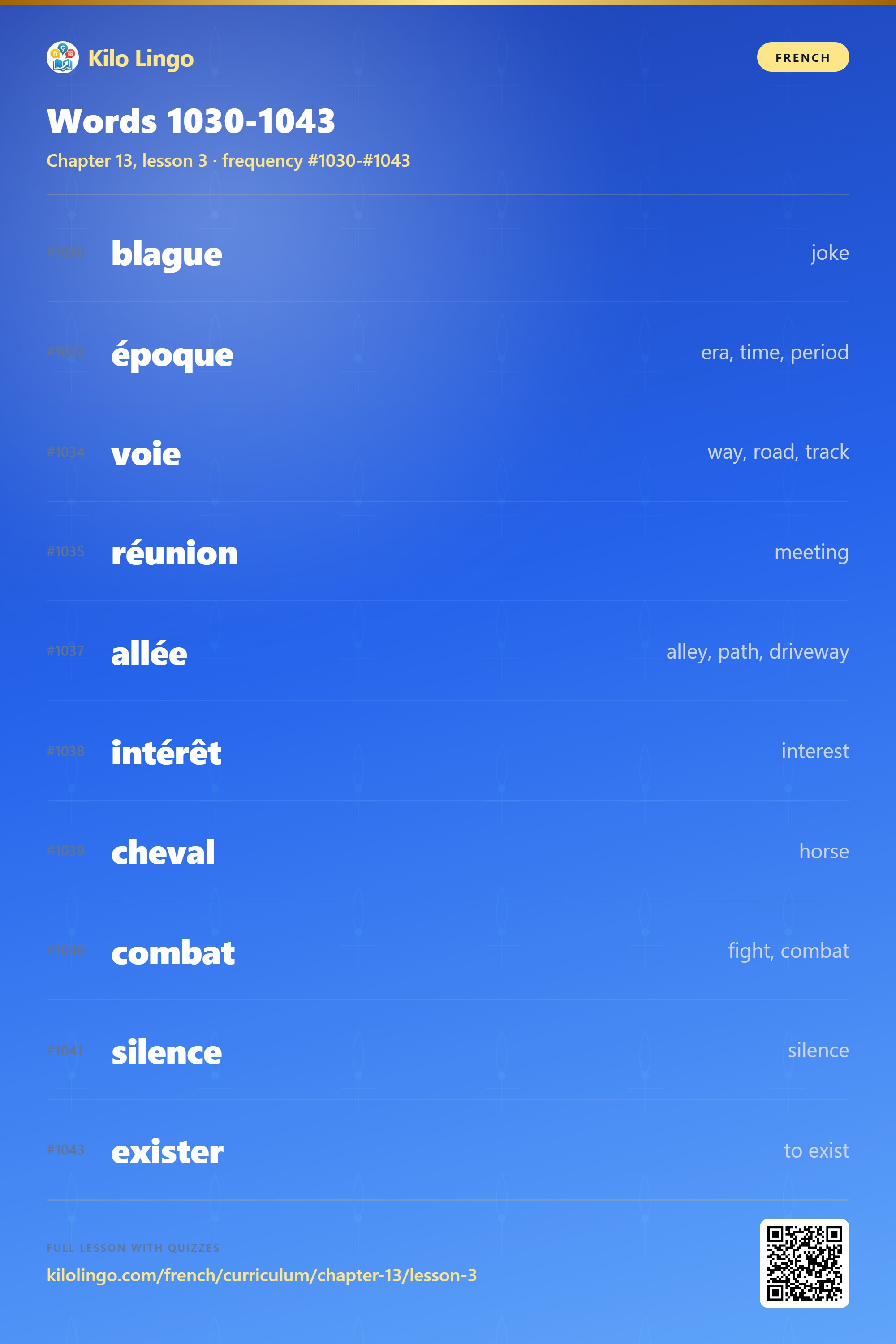
- Words 1031-1040Vocabulary
10 words · ranks 1031-1040
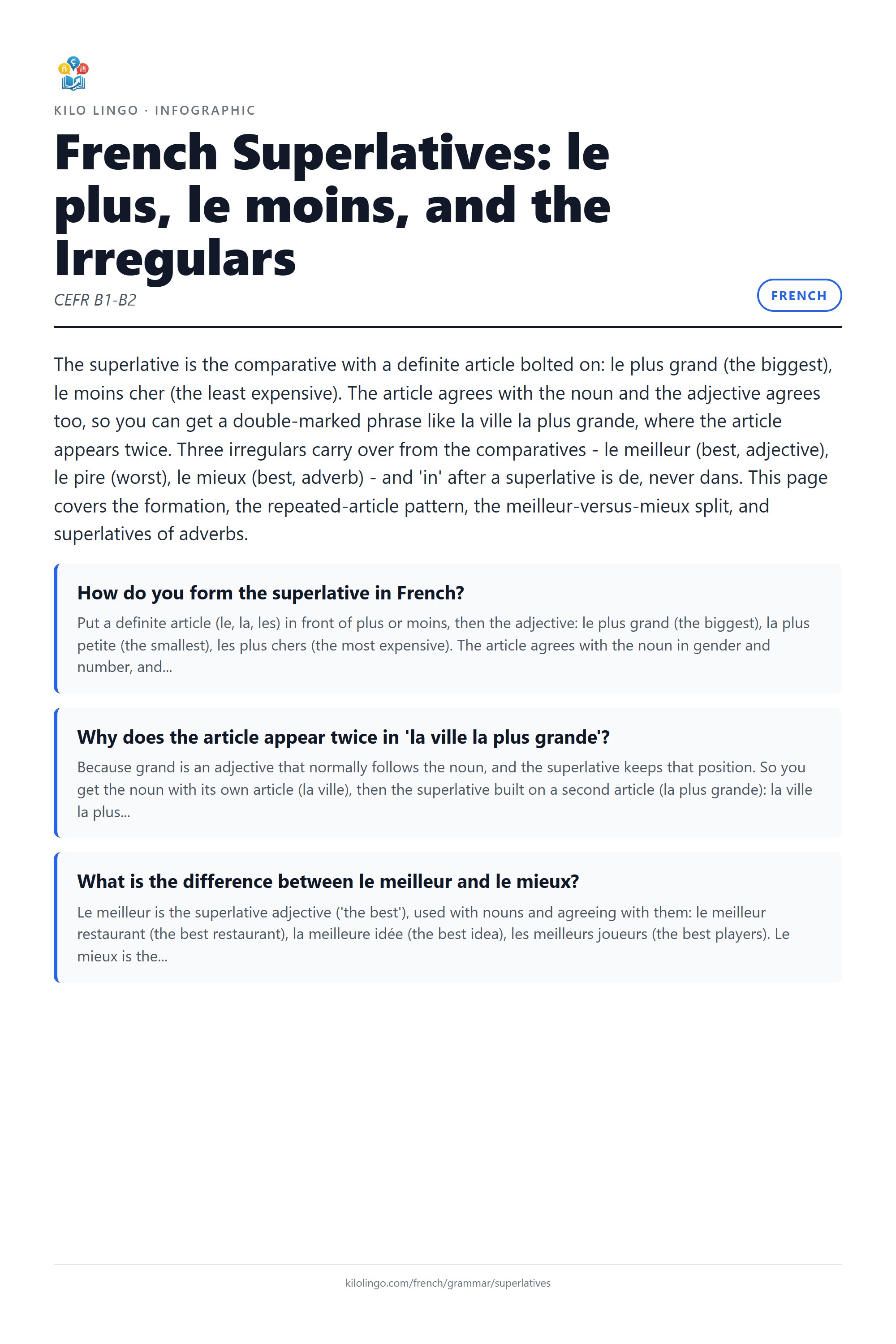
The most and the least: le/la/les plus + adjective with the repeated article, de for 'in/of', and the irregulars le meilleur, le pire, le mieux.
- c'est or il est?Mistake clinic
Both are
he isorit is. What follows decides which. - Words 1041-1050Vocabulary
10 words · ranks 1041-1050
- Word Bubbles review sessionReview games
Pop the words you just met by matching each one to its meaning. A couple of rounds and the batch is yours.
- Words 1051-1060Vocabulary
10 words · ranks 1051-1060
- Conjugation Sprint review sessionReview games
Sixty seconds on the endings of the verbs this chapter has drilled so far.
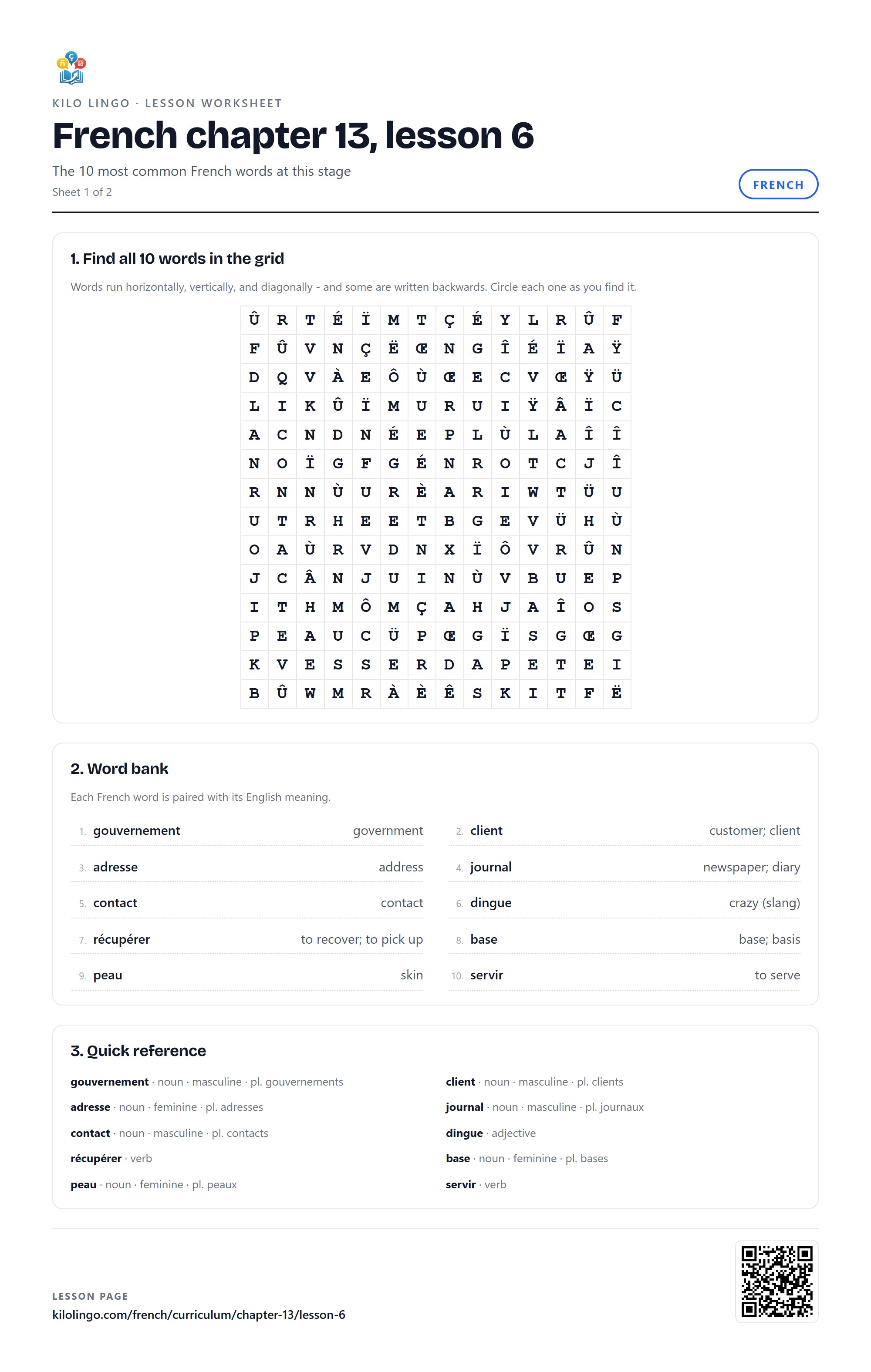
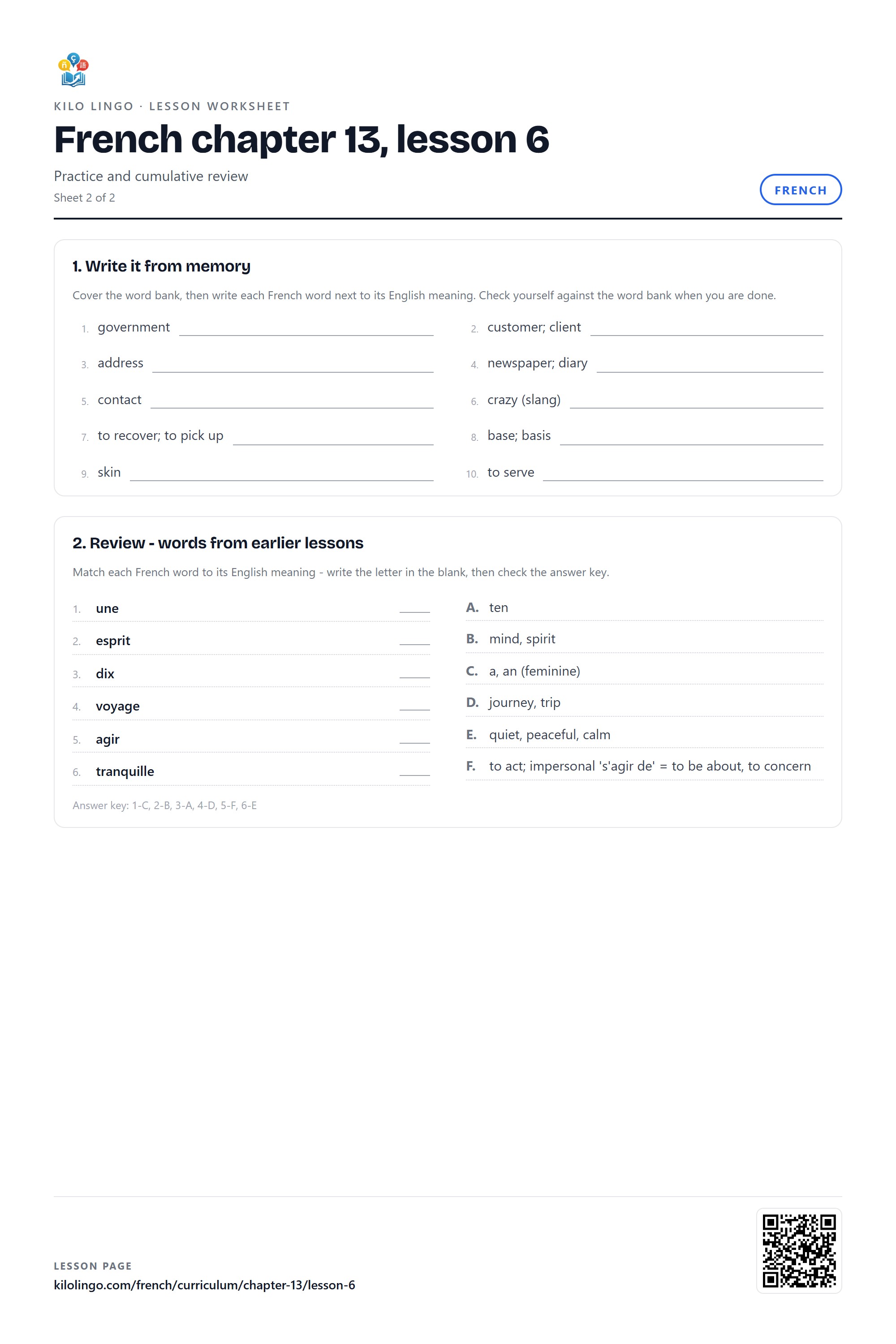
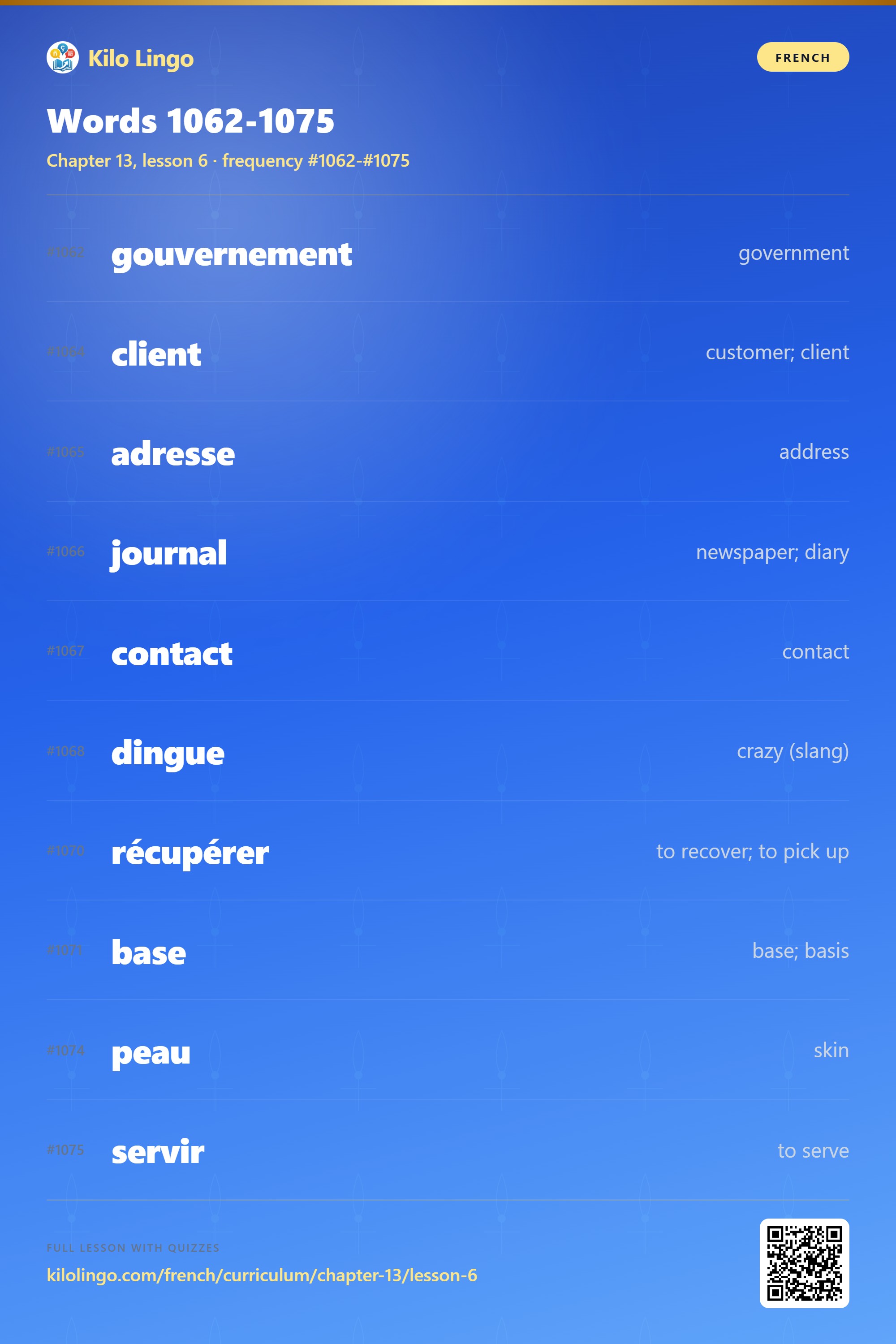
- Words 1061-1070Vocabulary
10 words · ranks 1061-1070
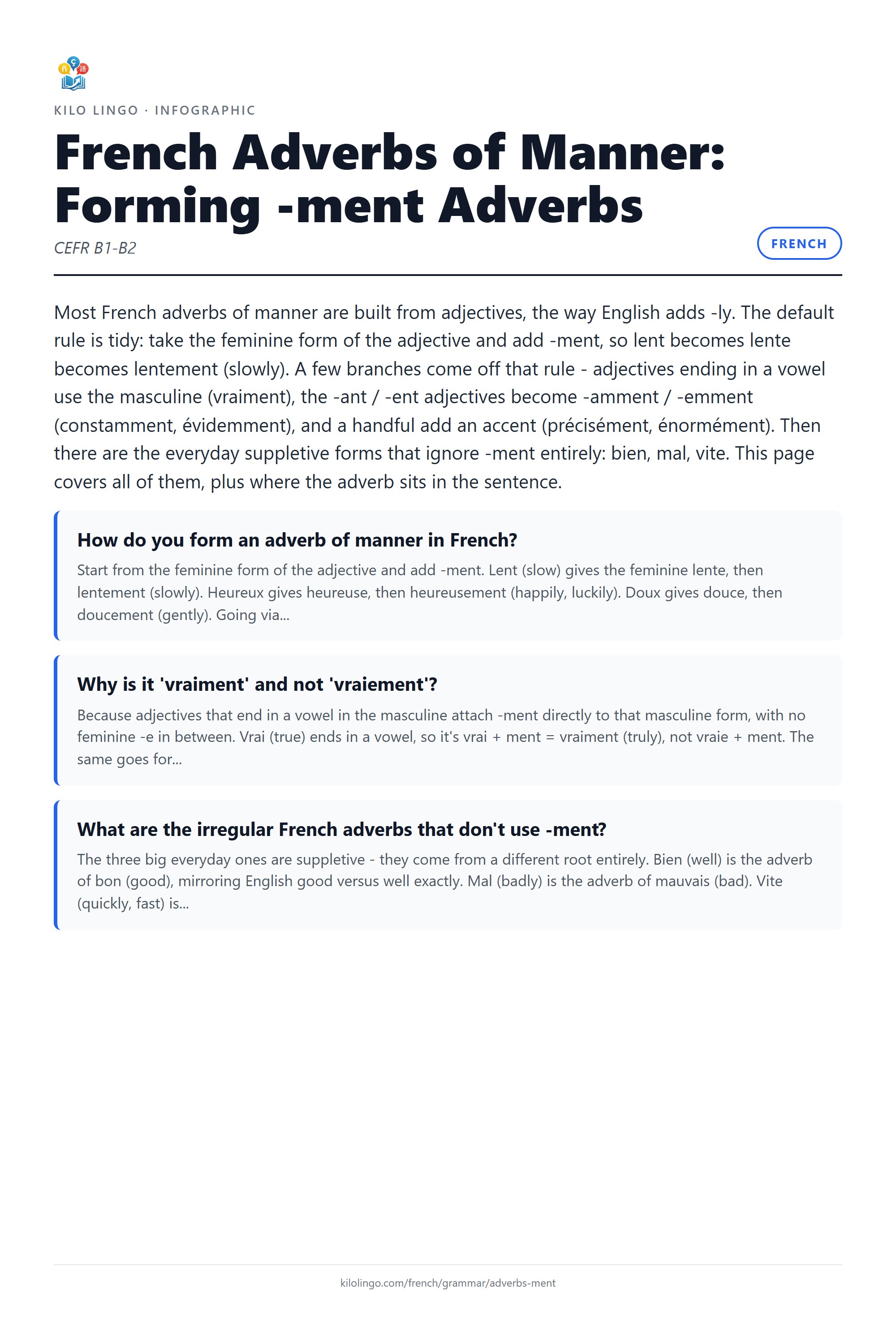
- Adverbs of manner in -mentGrammar
Building adverbs from the feminine adjective (lente -> lentement), the -amment / -emment pairs, and the suppletive irregulars bien, mal and vite.
- Words 1071-1080Vocabulary
10 words · ranks 1071-1080
- Word Bubbles review sessionReview games
Pop the words you just met by matching each one to its meaning. A couple of rounds and the batch is yours.
- Words 1081-1091Vocabulary
10 words · ranks 1081-1091
- Conjugation Sprint review sessionReview games
Sixty seconds on the endings of the verbs this chapter has drilled so far.
- Words 1092-1100Vocabulary
9 words · ranks 1092-1100
- Story milestone: top 1100 wordsGraded-reader story
You can read this story using only the words you've learned so far. Every content word sits at or above the rank-1100 ceiling.
- L'argent et les coursesThemed review
Buying, selling and what it costs. Small set, but it covers a market stall end to end.
- Arcade reviewReview games
Replay this chapter's words as games - a different kind of repetition, and it counts.
Word printables
Per-word sheets99 words · a worksheet, infographic and listicle each
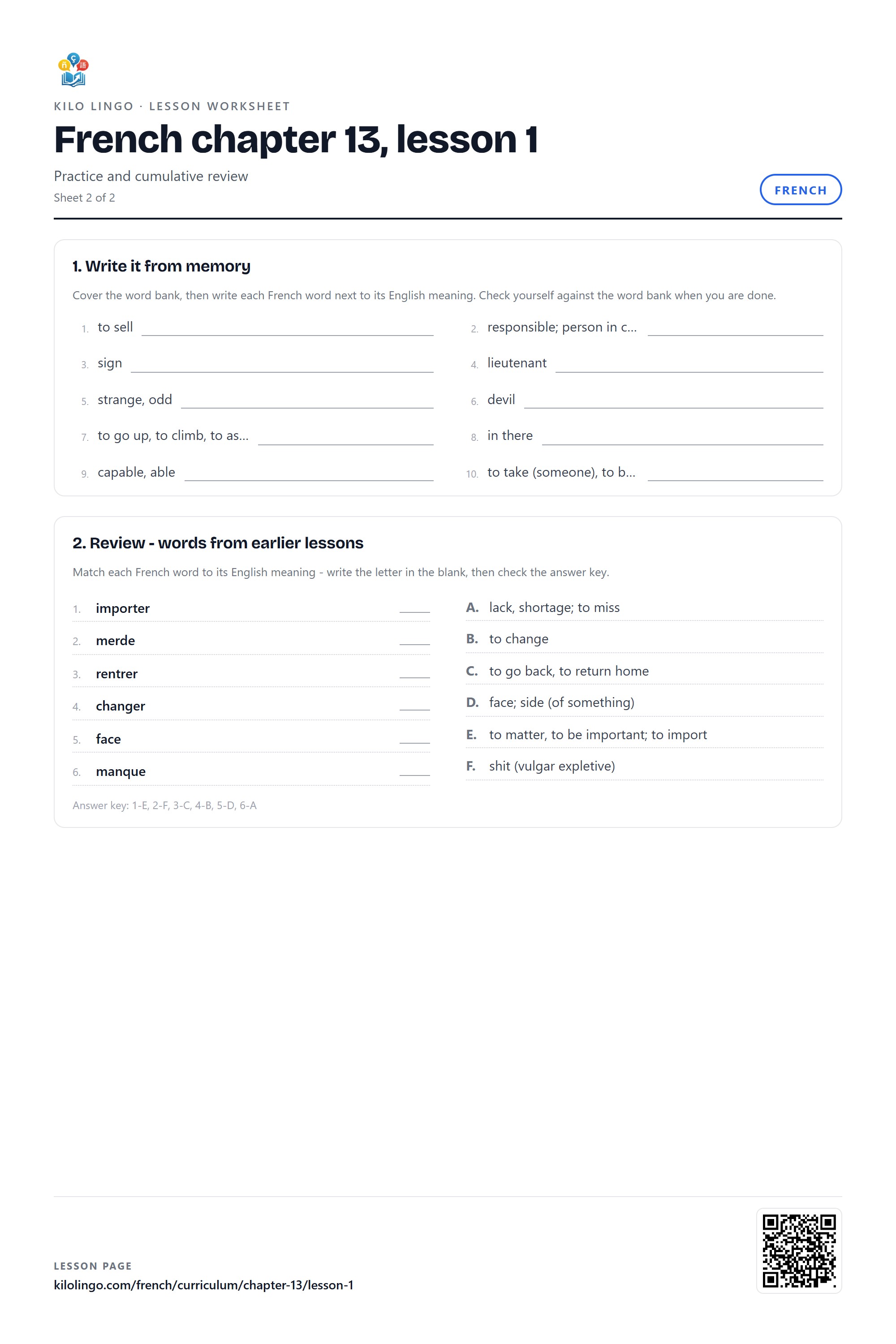

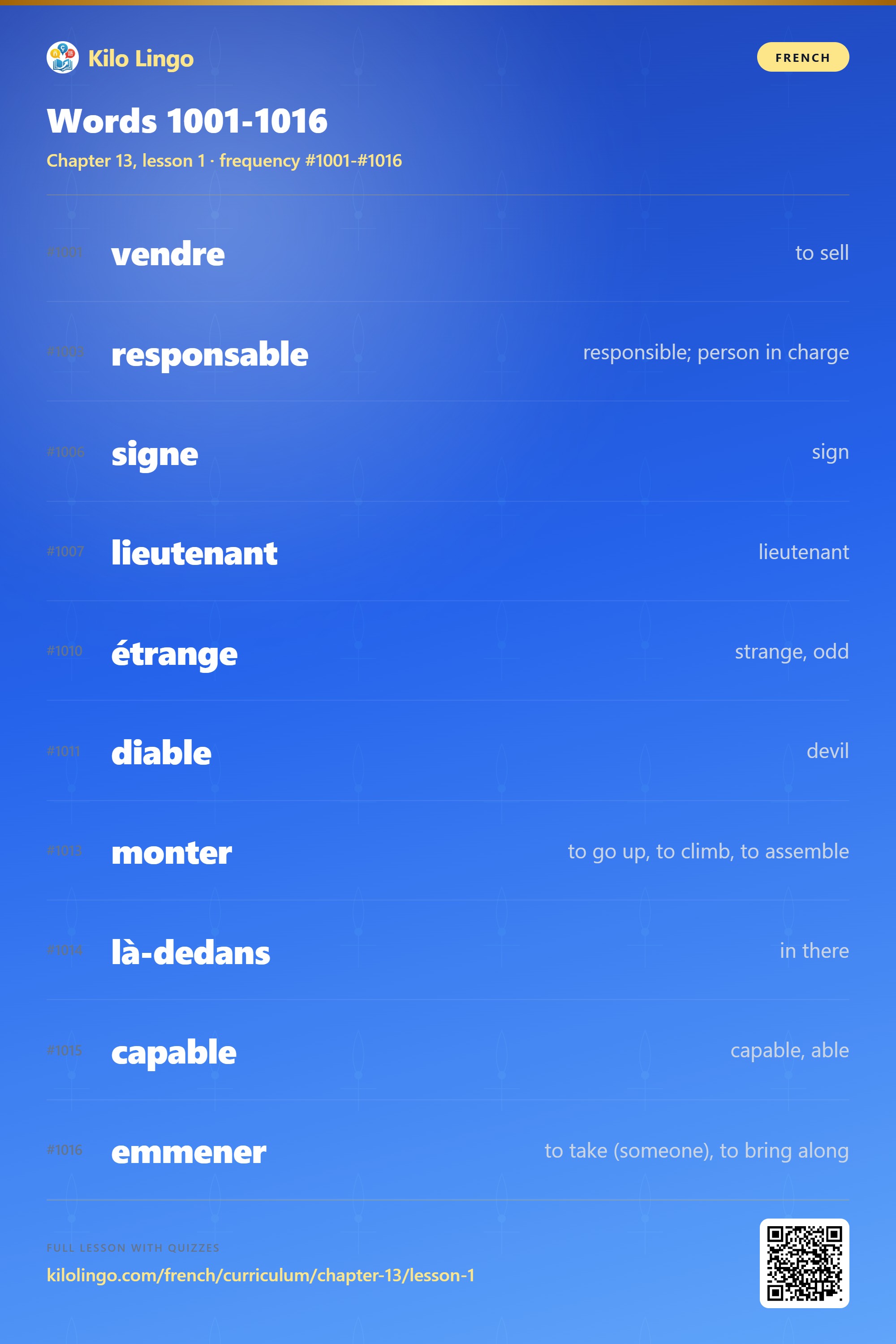
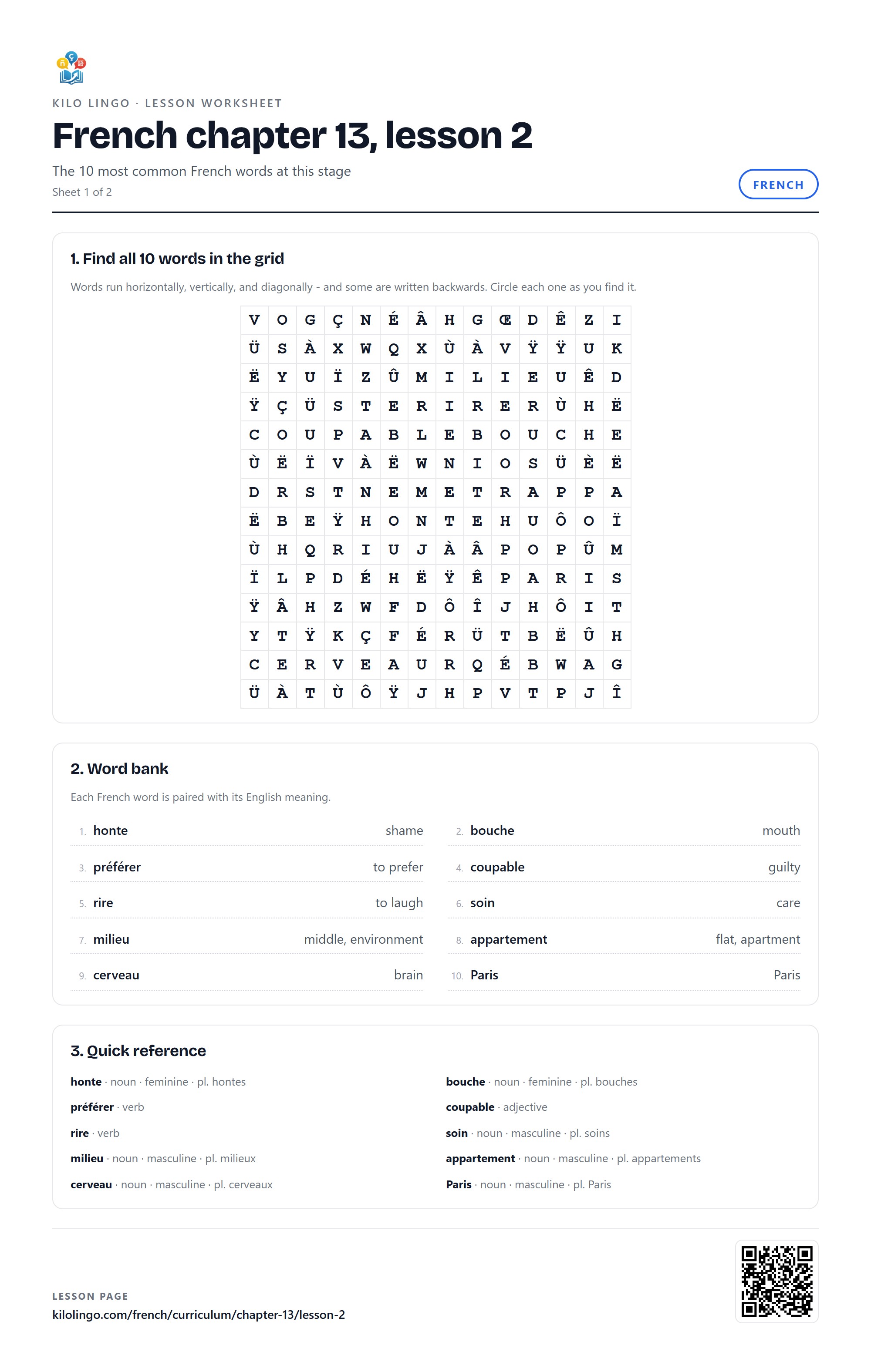
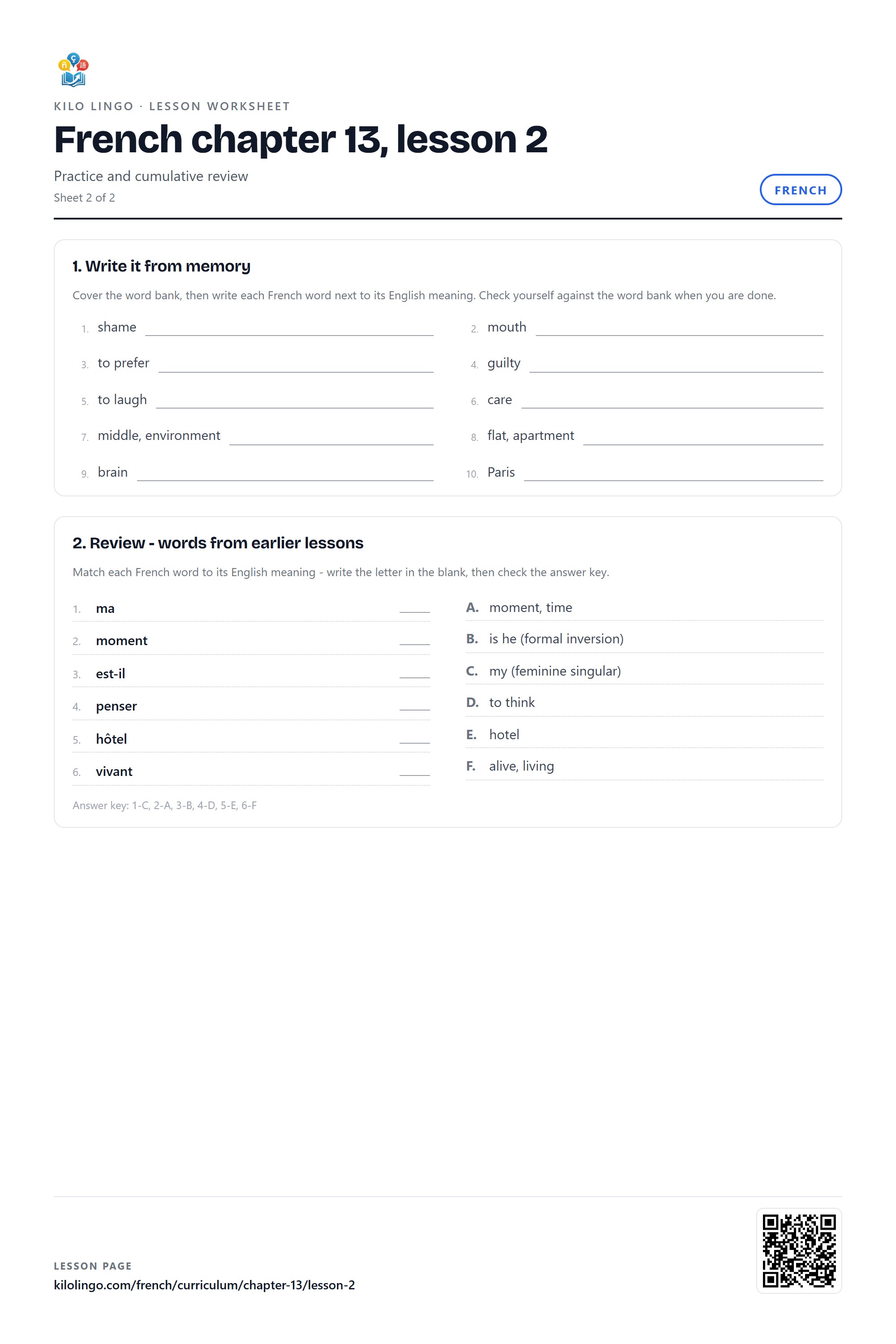



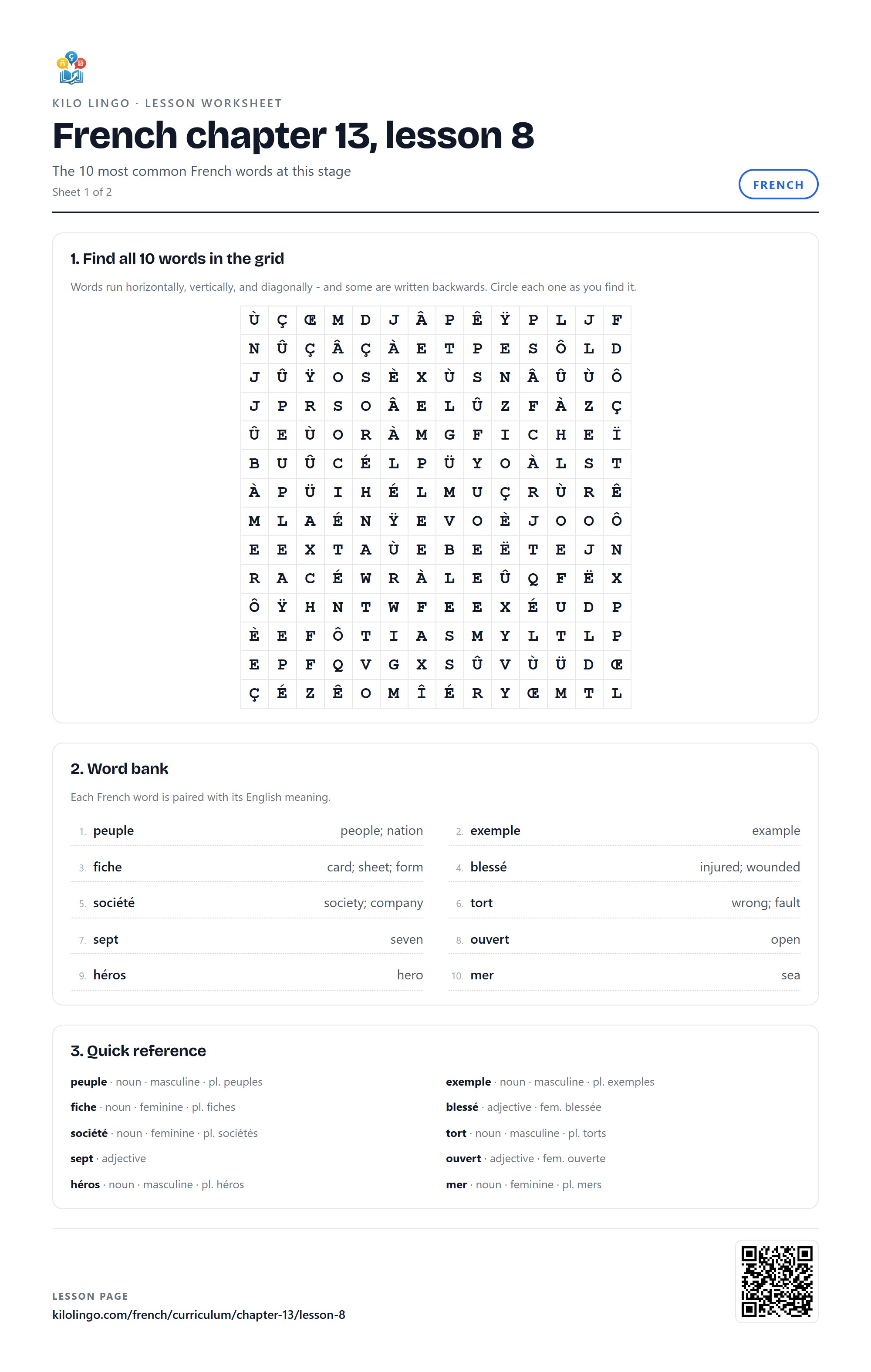
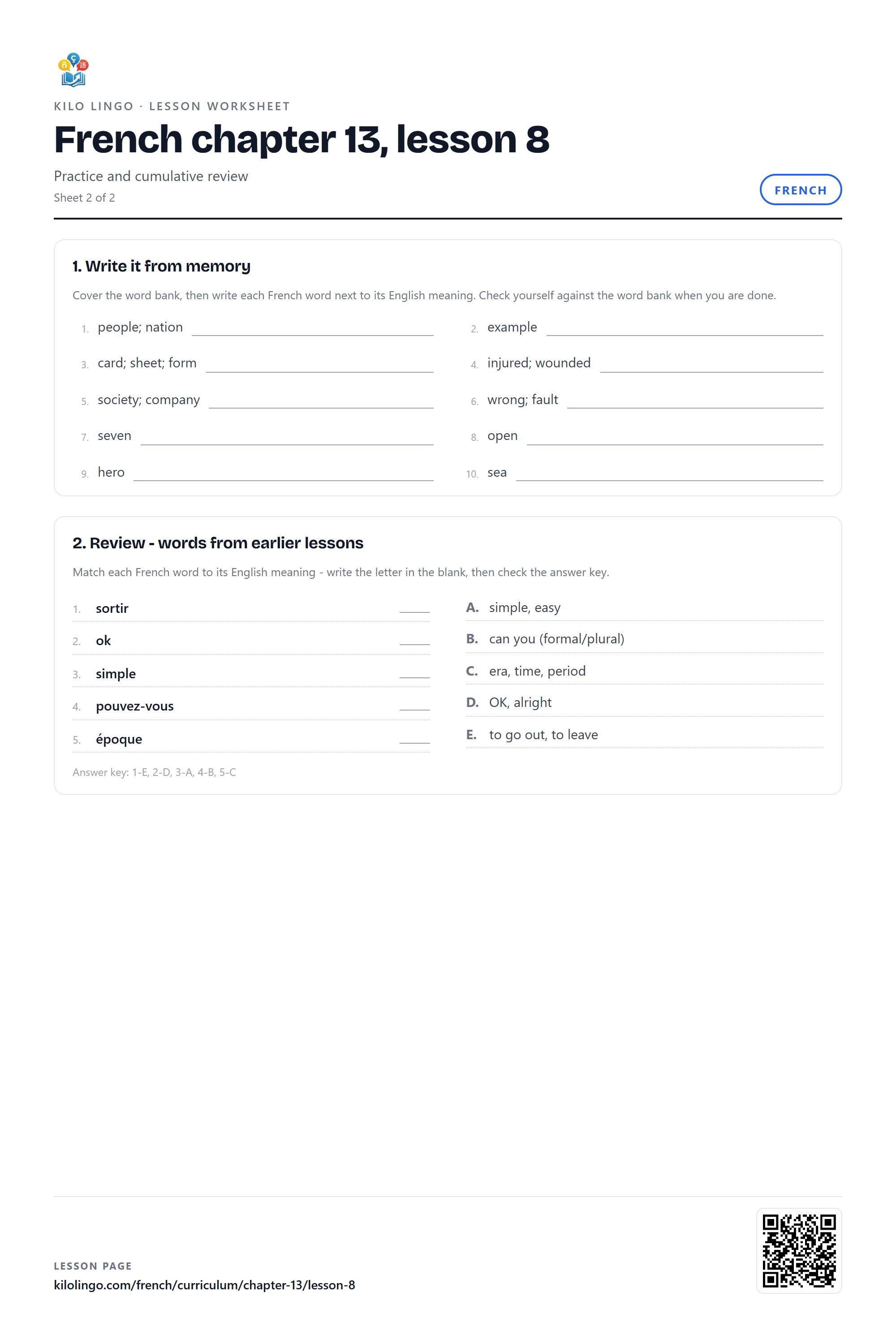

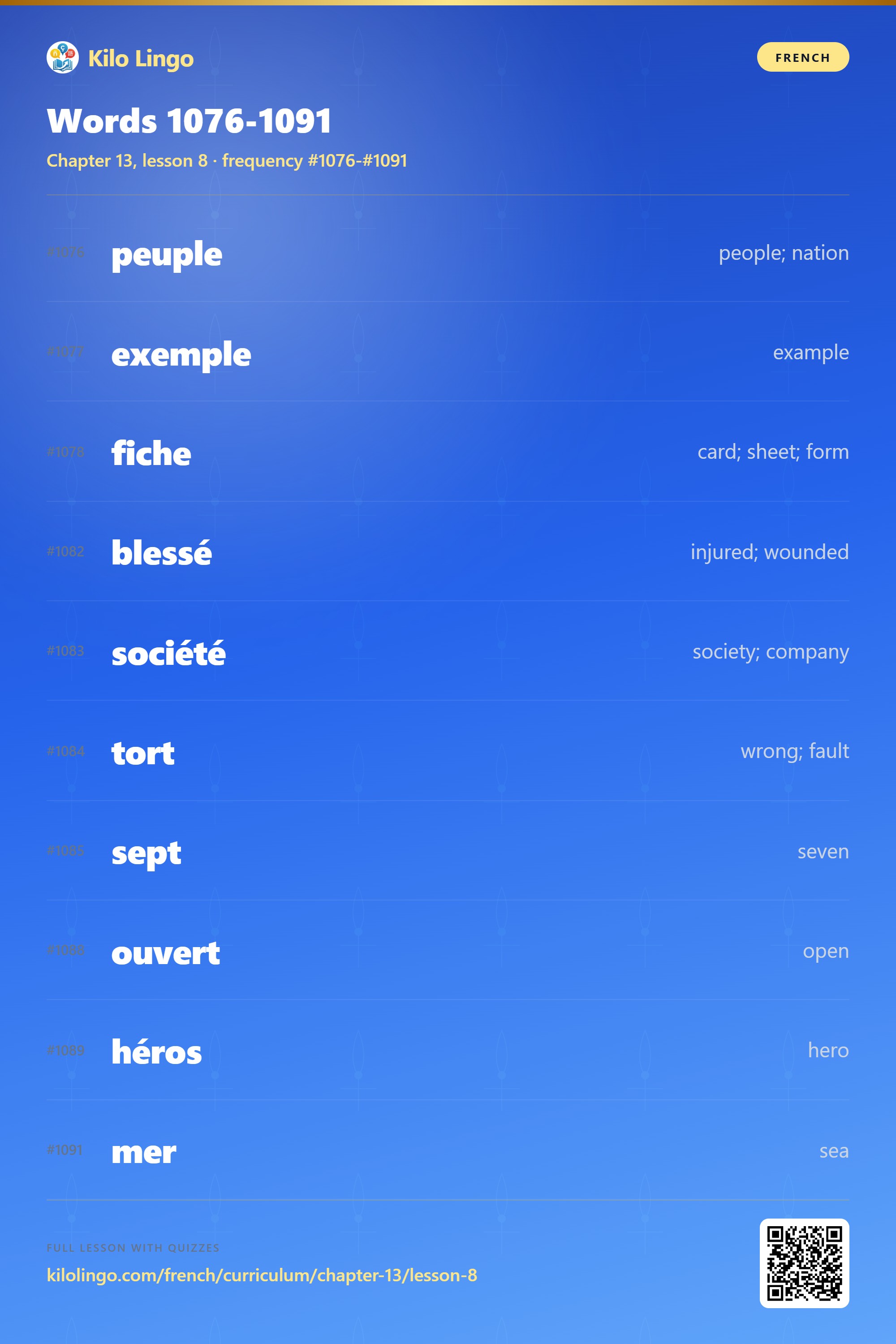
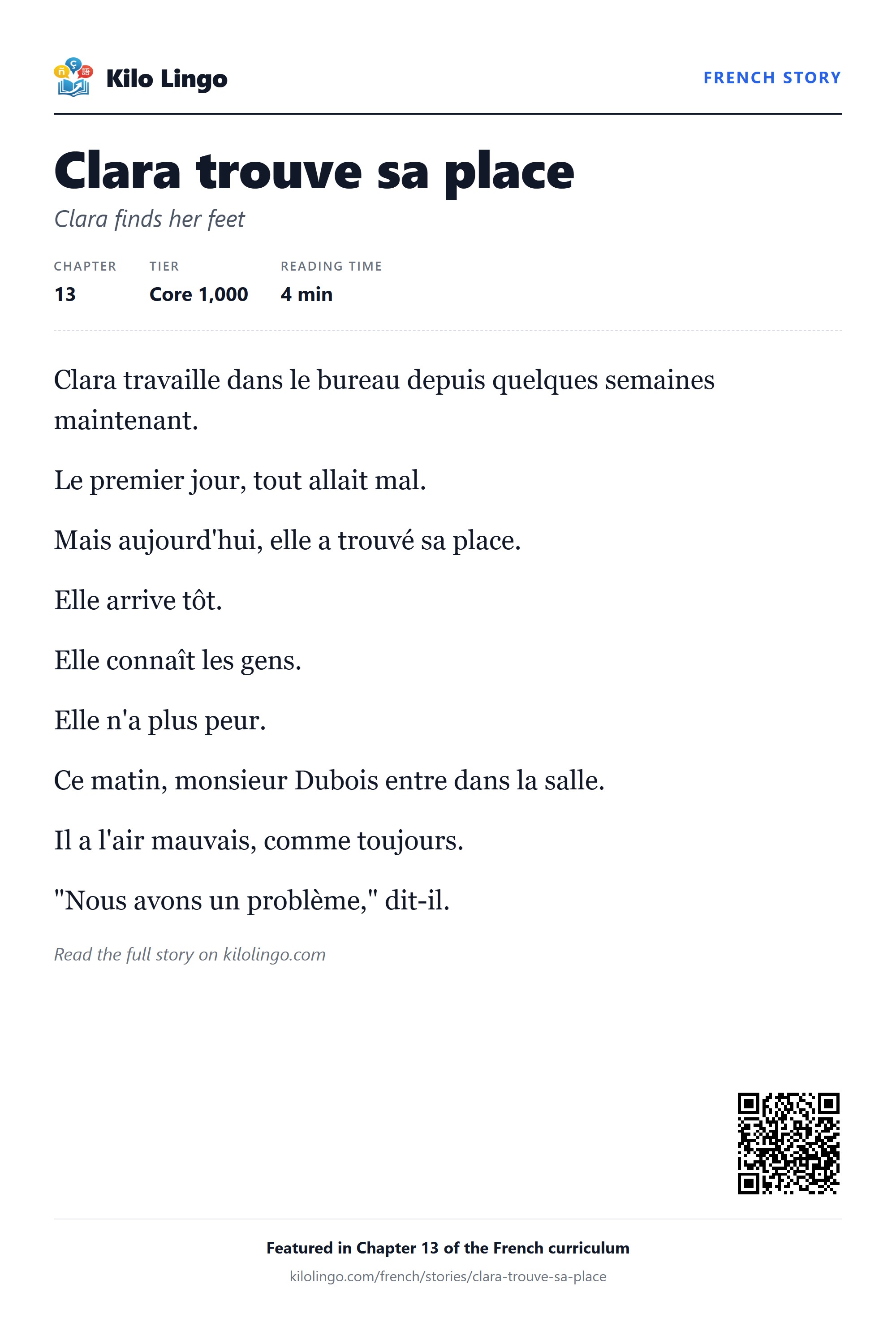
Chapter 14 · The pronouns y and en
Chapter page →- Words 1101-1110Vocabulary
10 words · ranks 1101-1110
- Conjugation Sprint review sessionReview games
Sixty seconds on the endings of the verbs this chapter has drilled so far.
- Words 1111-1120Vocabulary
10 words · ranks 1111-1120
- Crossword review sessionReview games
Cross the words you just met, clued in English. Slower than a drill, and it sticks harder.
- Words 1121-1132Vocabulary
10 words · ranks 1121-1132
- Word Bubbles review sessionReview games
Pop the words you just met by matching each one to its meaning. A couple of rounds and the batch is yours.
- Words 1133-1142Vocabulary
10 words · ranks 1133-1142
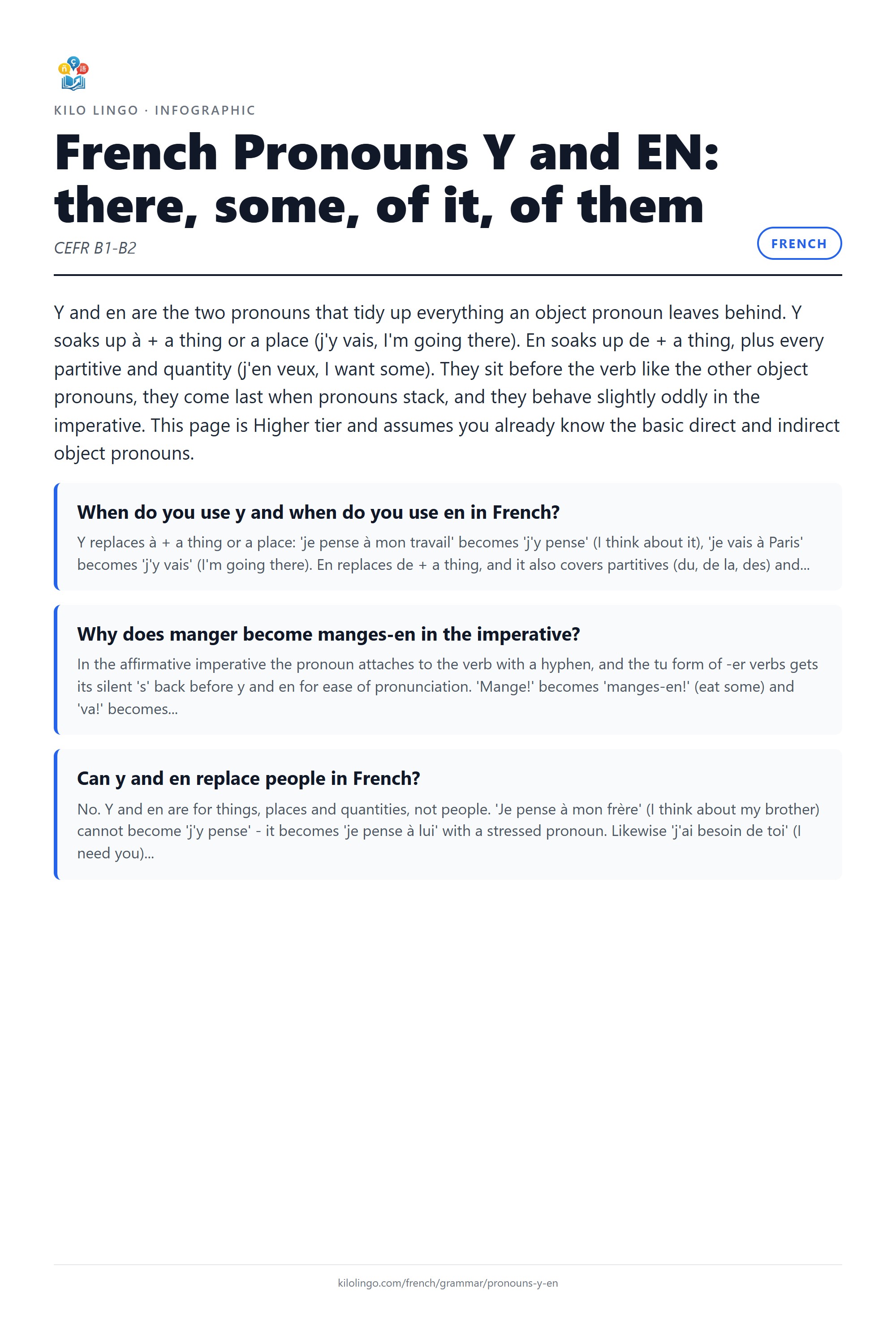
- The pronouns y and enGrammar
y replaces a + a thing or place (j'y vais, j'y pense); en replaces de + a thing, partitives and quantities (j'en veux, j'en ai trois). Position and the imperative attachment (vas-y, prends-en).
- penser à or penser de?Mistake clinic
One is thinking about. The other is thinking of, as in what do you reckon.
- Words 1143-1153Vocabulary
10 words · ranks 1143-1153
- Conjugation Sprint review sessionReview games
Sixty seconds on the endings of the verbs this chapter has drilled so far.
- Words 1154-1163Vocabulary
10 words · ranks 1154-1163
- Word Bubbles review sessionReview games
Pop the words you just met by matching each one to its meaning. A couple of rounds and the batch is yours.
- Words 1164-1173Vocabulary
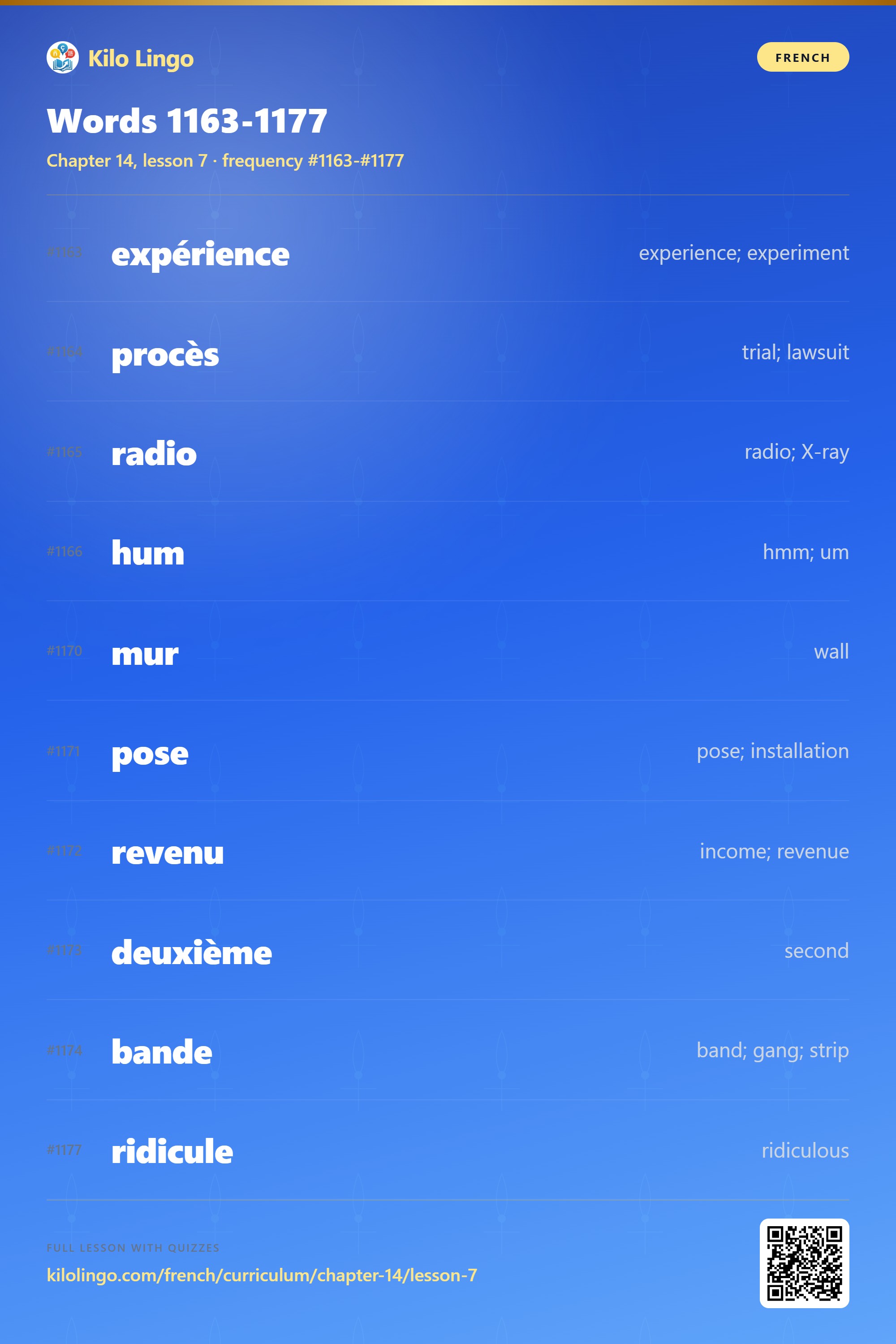
10 words · ranks 1164-1173
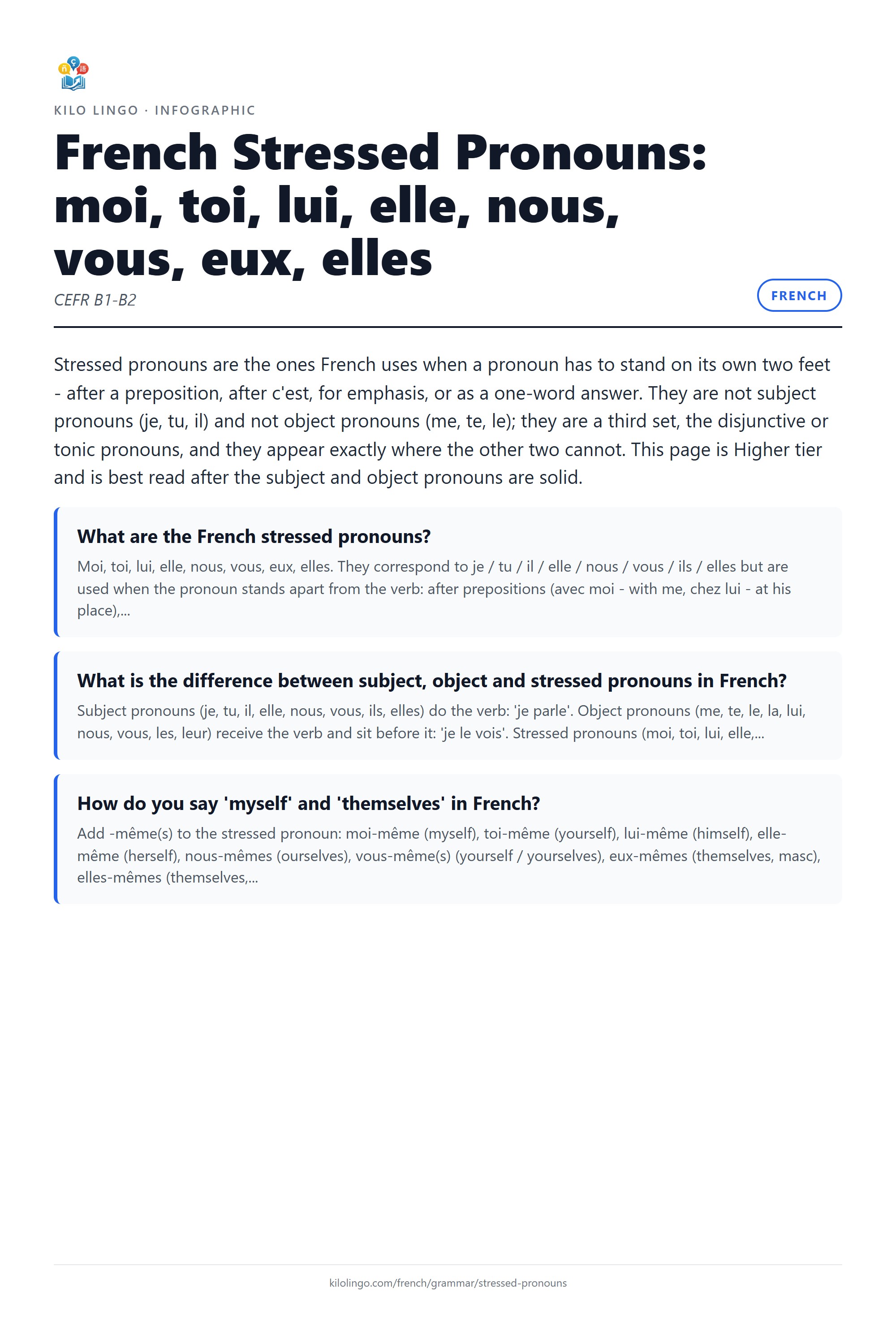
The disjunctive pronouns after prepositions (avec moi), for emphasis (moi, je pense), after c'est, in comparisons, and with -meme.
- Words 1174-1183Vocabulary
10 words · ranks 1174-1183
- At the cafePhrase session
Enough to order, to say it was good, and to mean it.
- Words 1184-1193Vocabulary
10 words · ranks 1184-1193
- Conjugation Sprint review sessionReview games
Sixty seconds on the endings of the verbs this chapter has drilled so far.
- Words 1194-1200Vocabulary
7 words · ranks 1194-1200
Play it, read along word by word, then answer the questions. Every word is at your level - the song page teaches the few that are new.
- Story milestone: top 1200 wordsGraded-reader story
You can read this story using only the words you've learned so far. Every content word sits at or above the rank-1200 ceiling.
- Le corps, en détailThemed review
The second pass, now that the face has a mouth, a nose and ears - and now that you can say where it hurts.
- Arcade reviewReview games
Replay this chapter's words as games - a different kind of repetition, and it counts.
Word printables
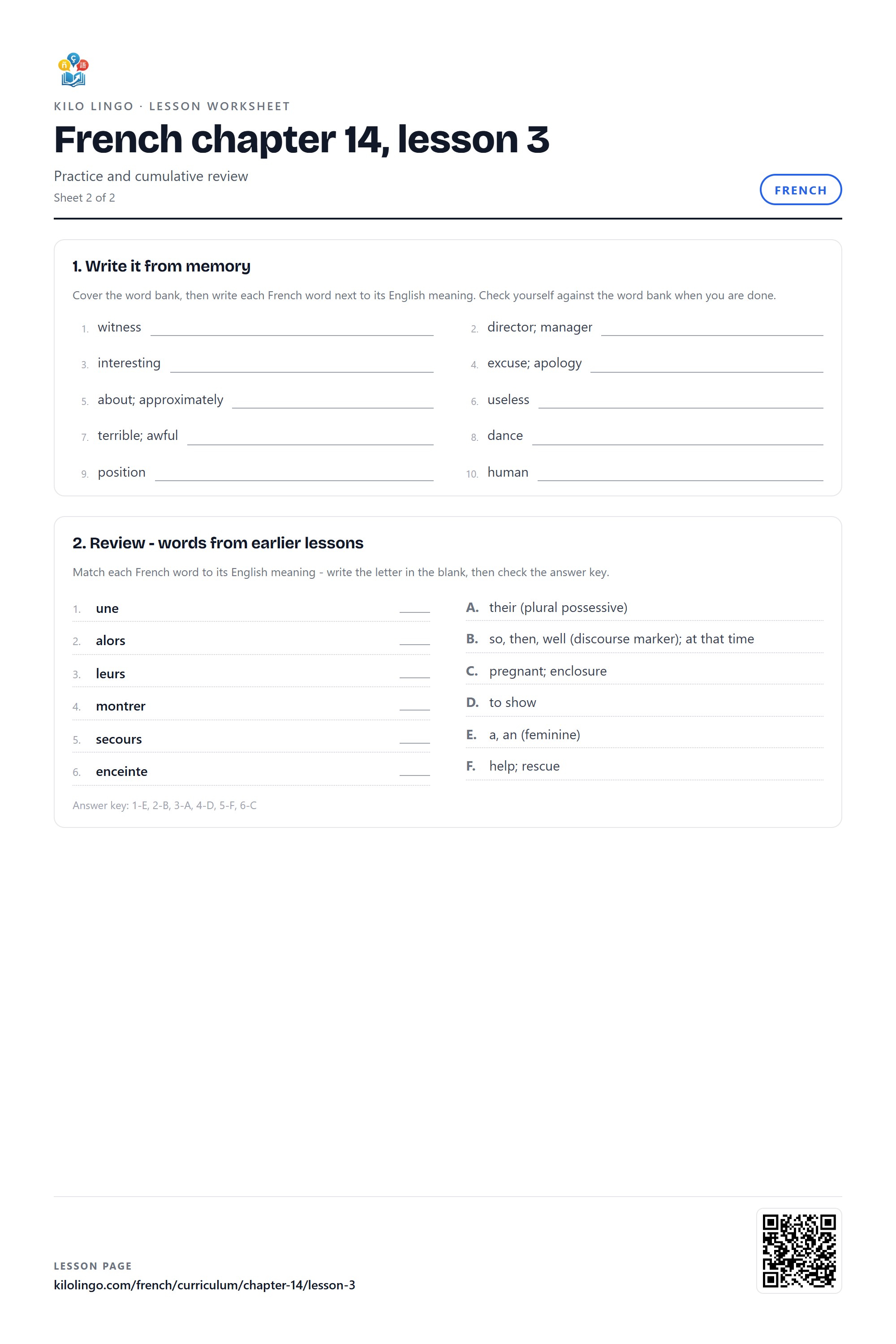
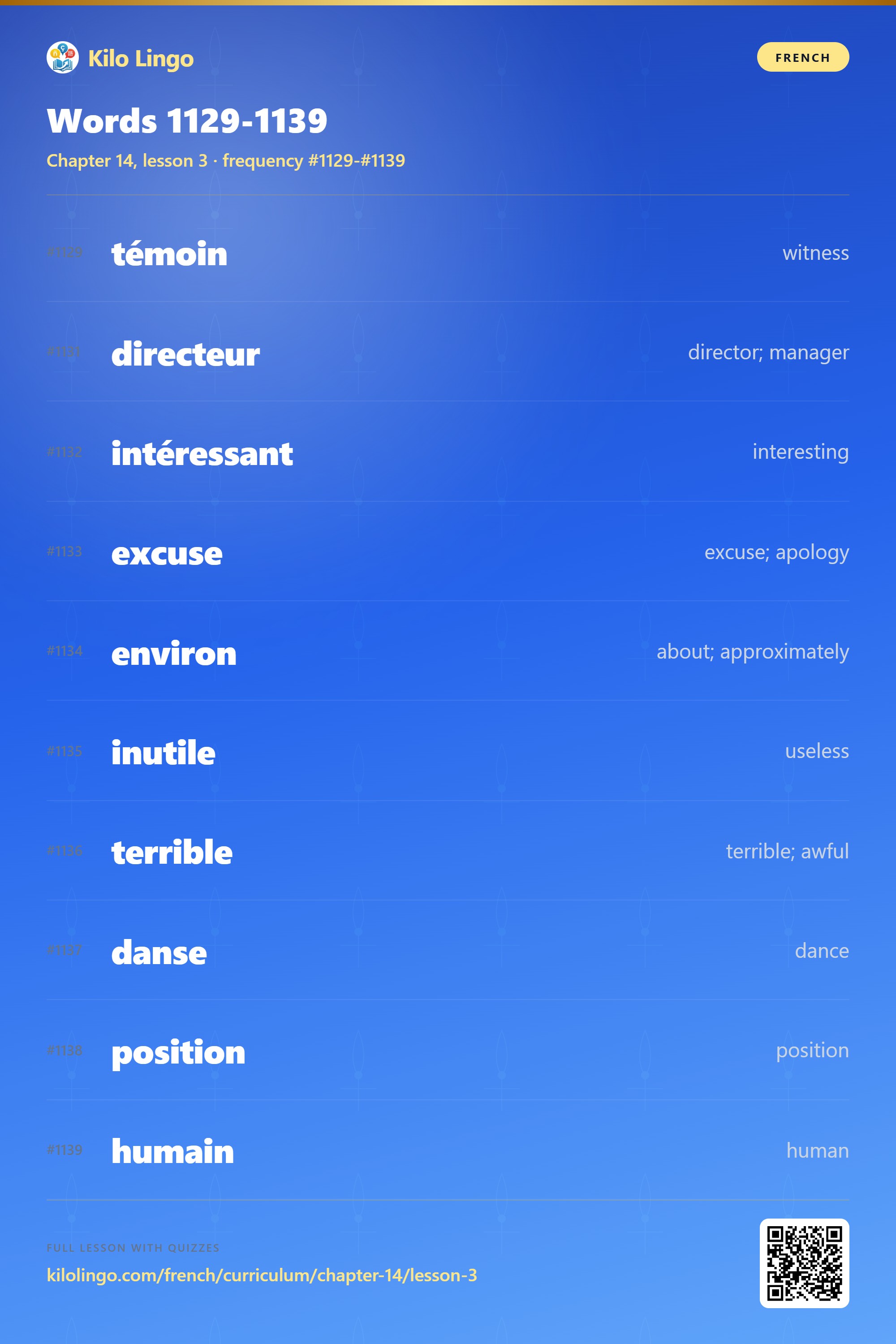
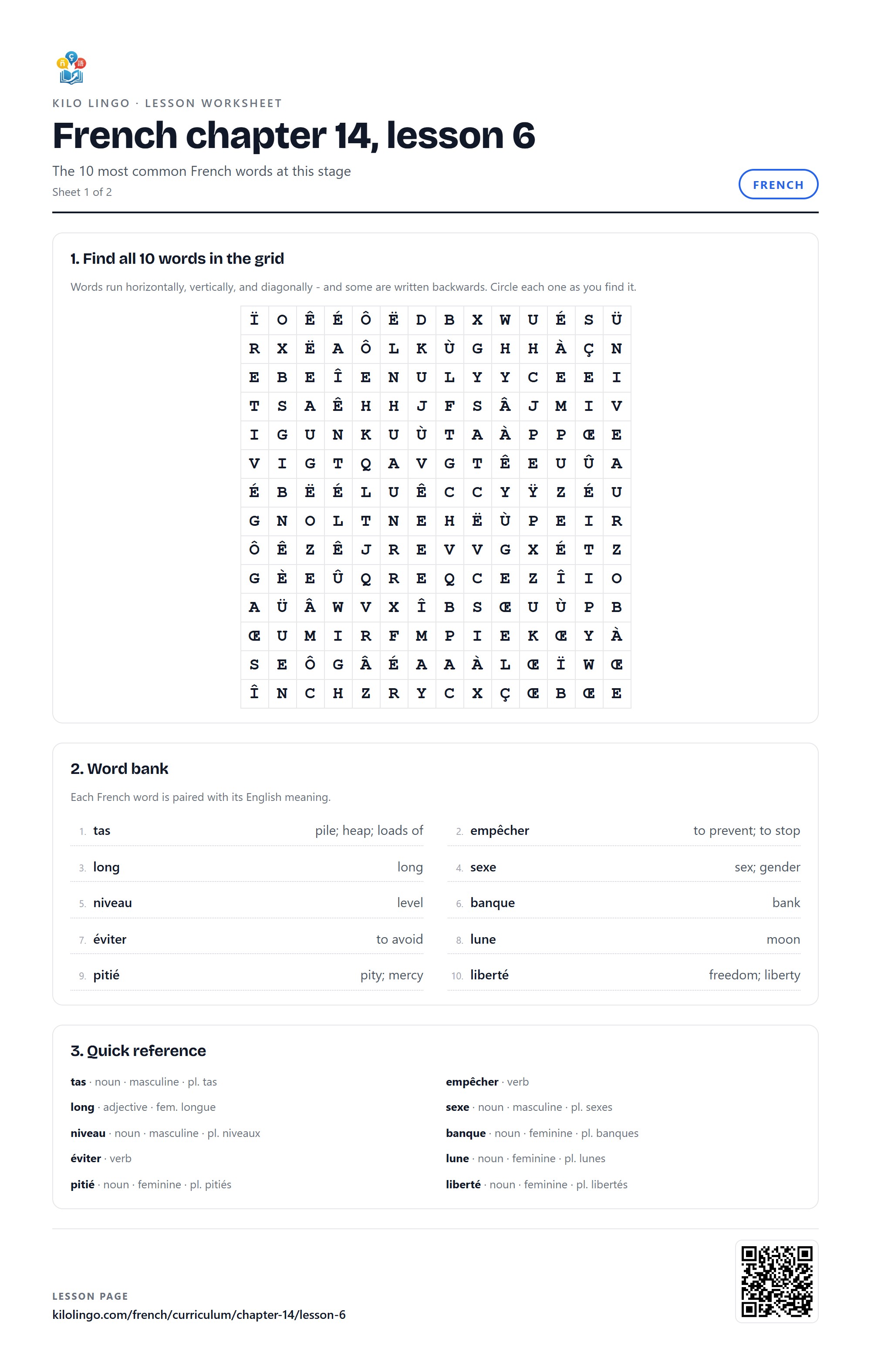
Per-word sheets97 words · a worksheet, infographic and listicle each
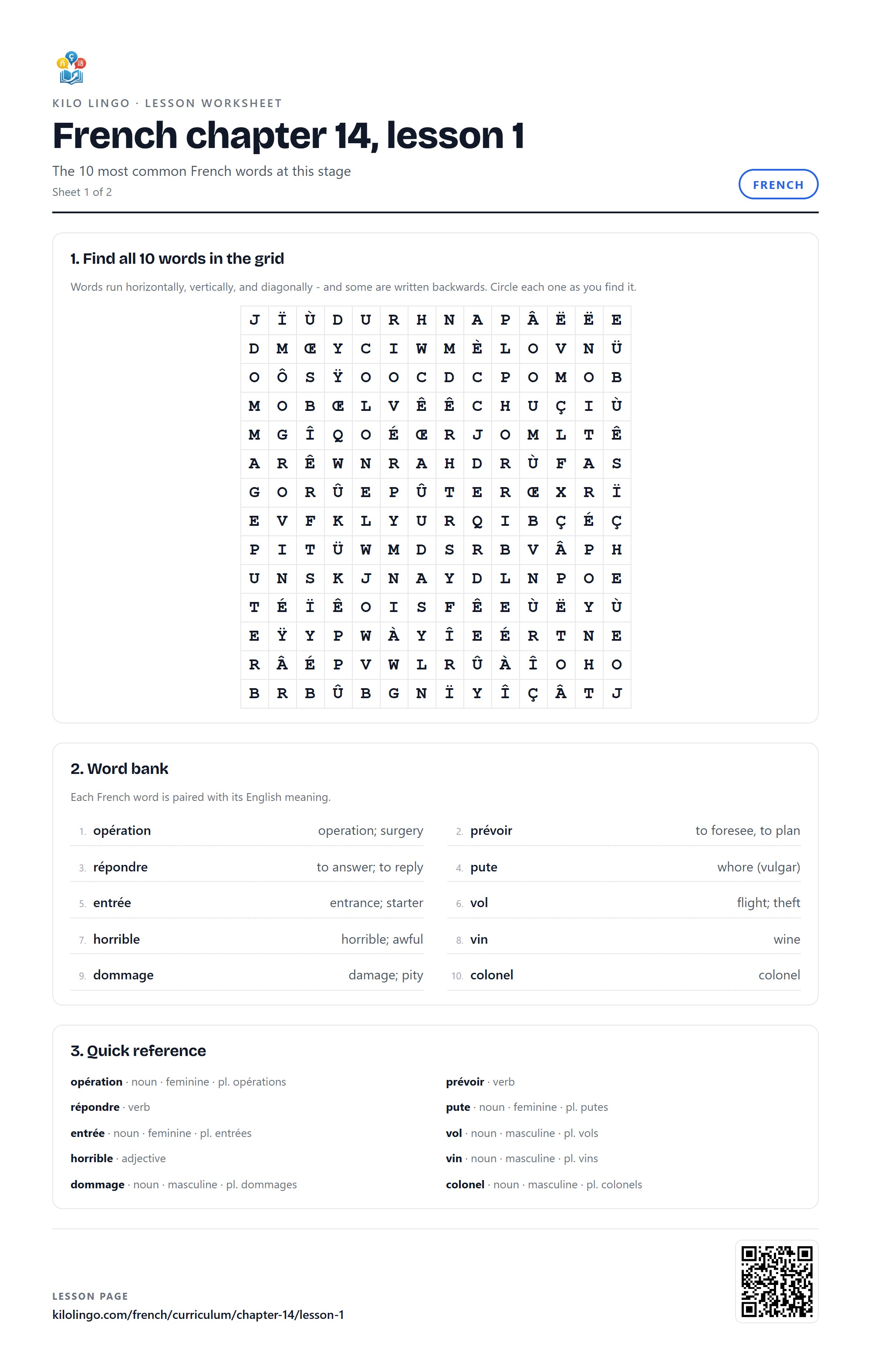
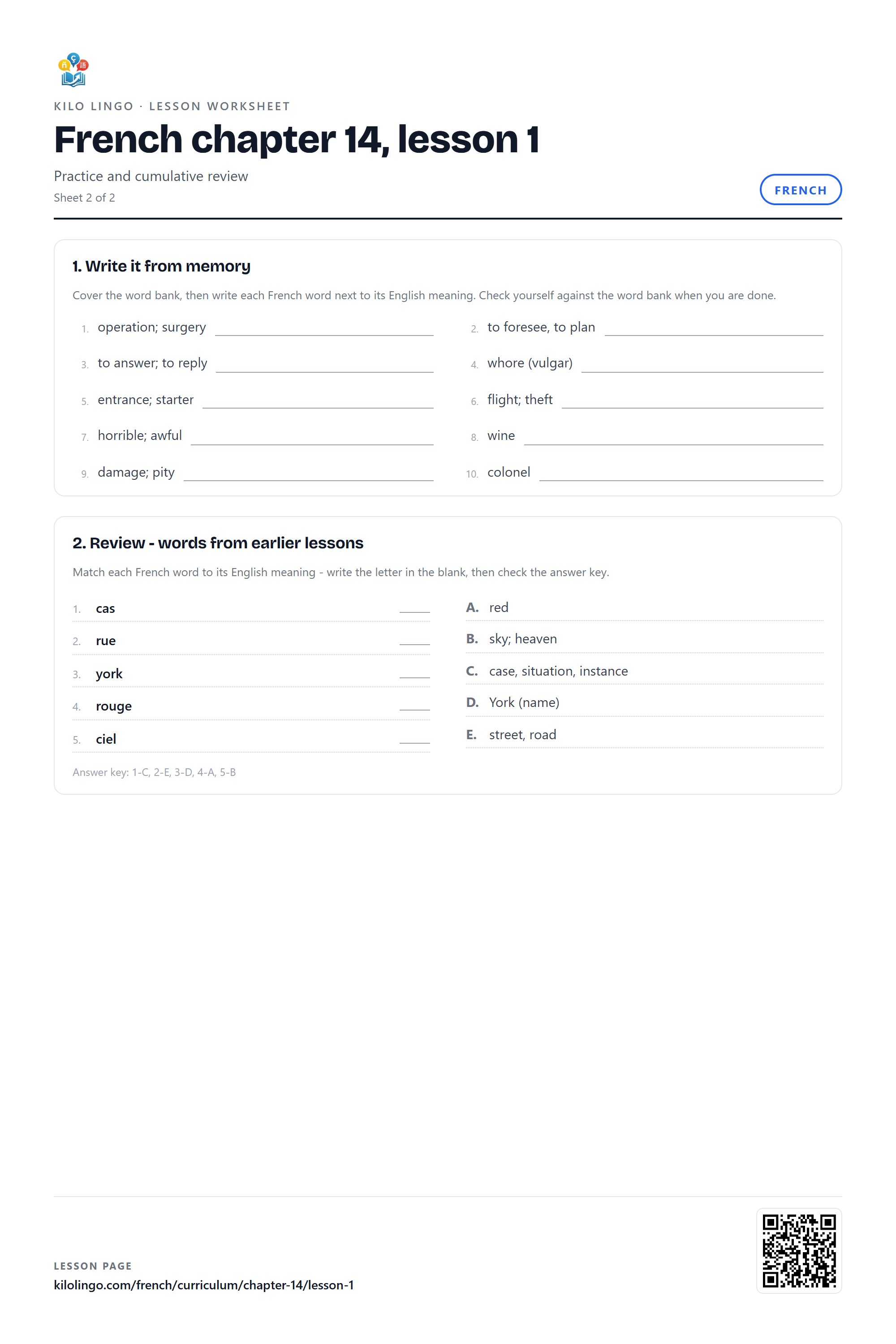

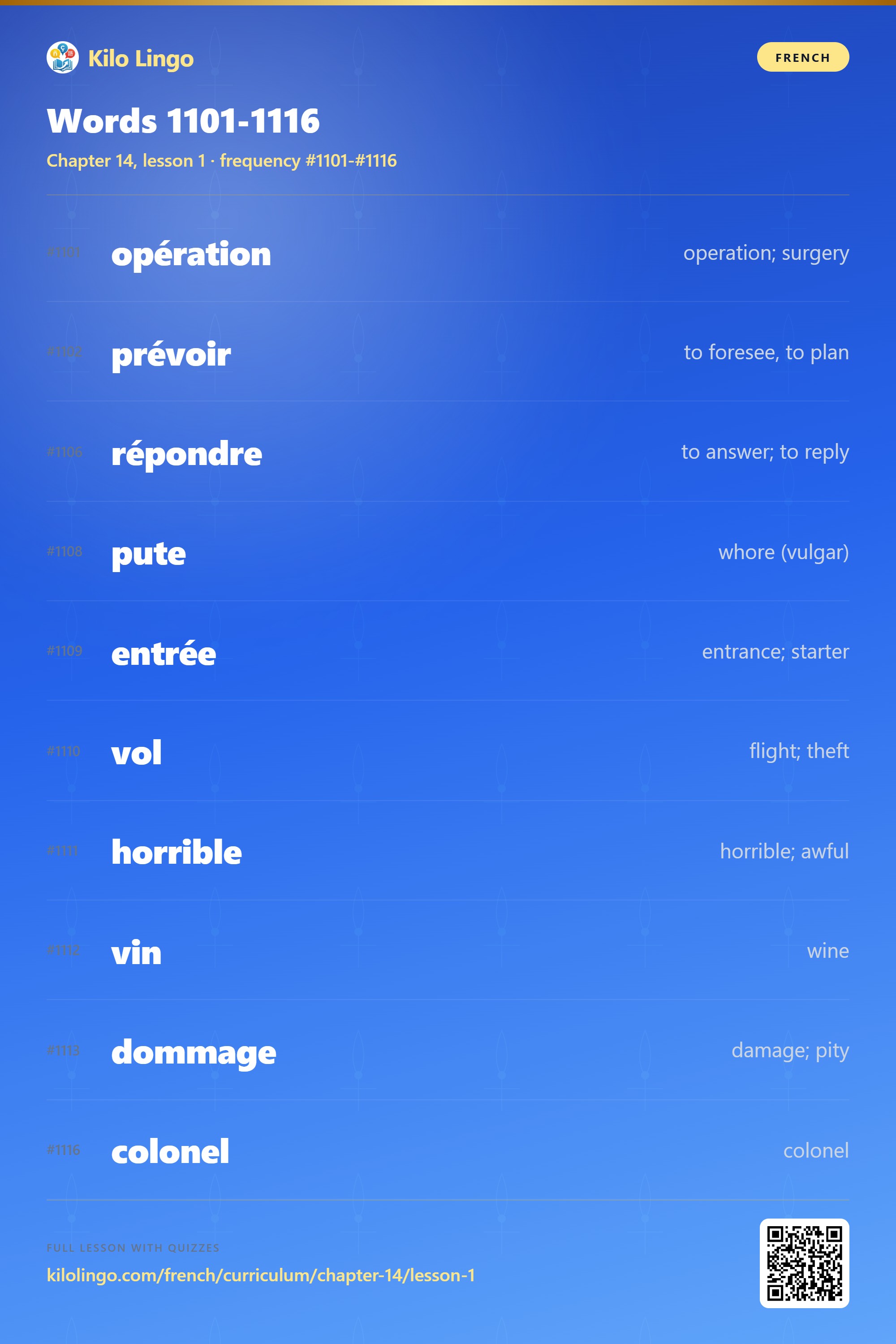
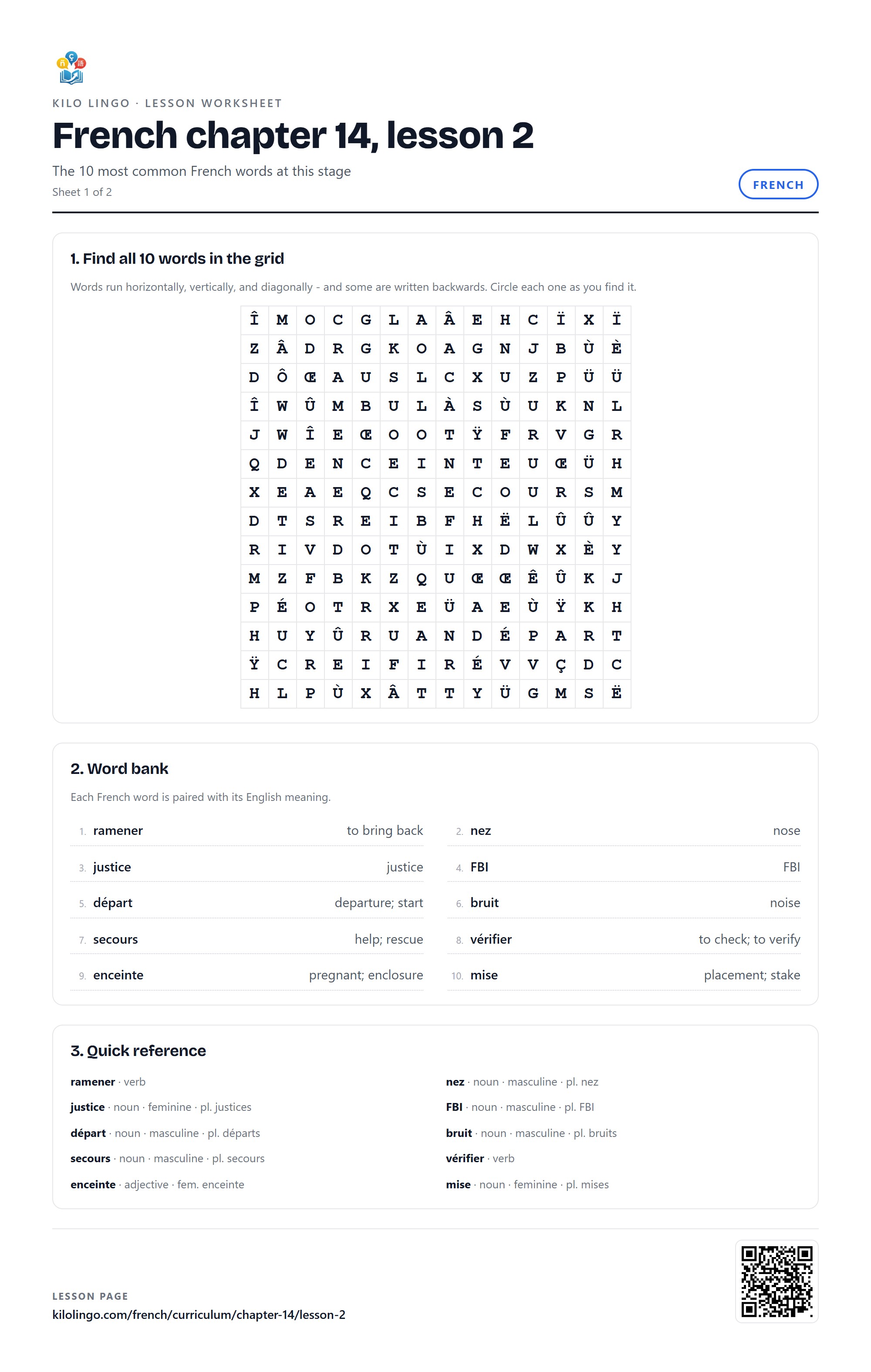
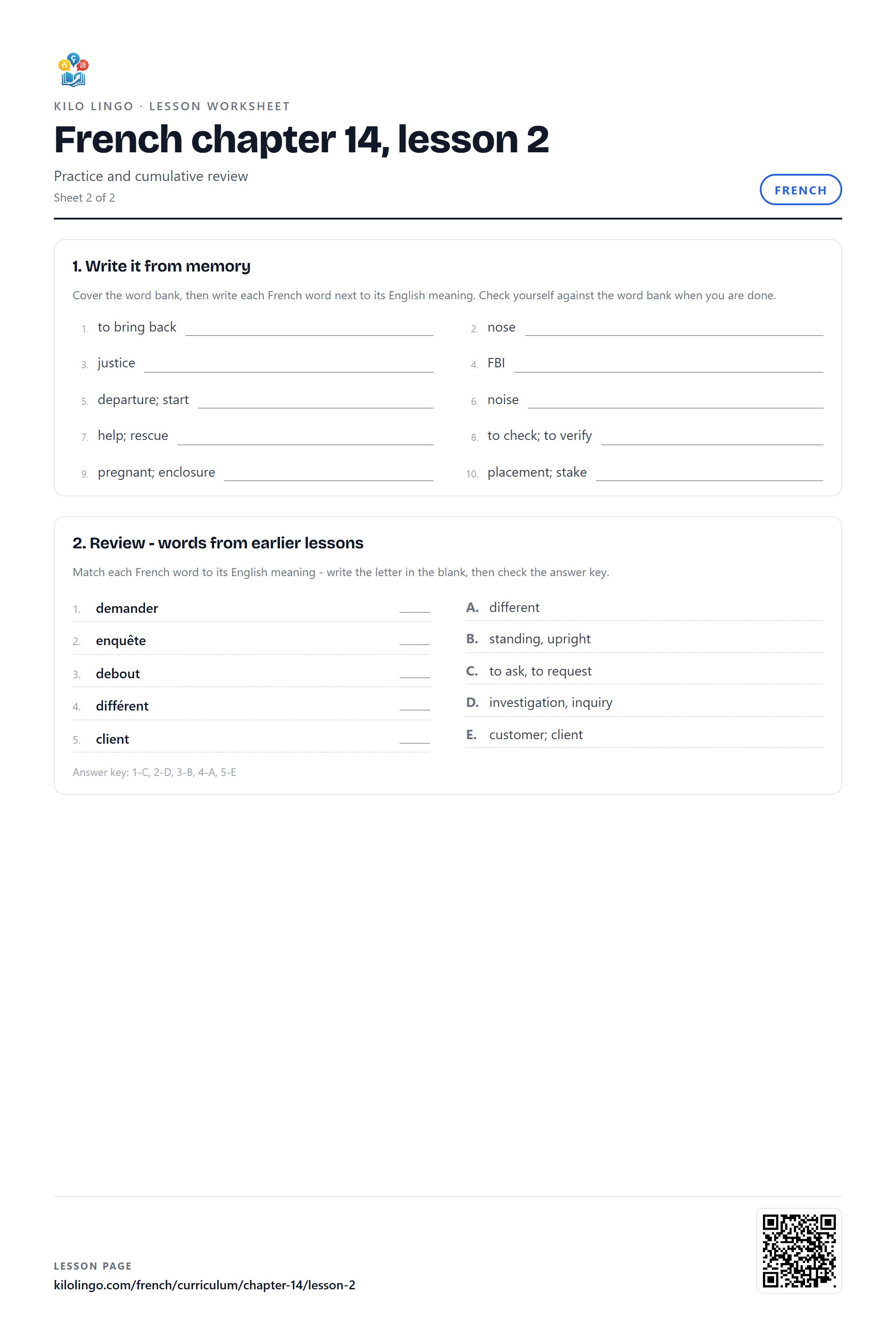

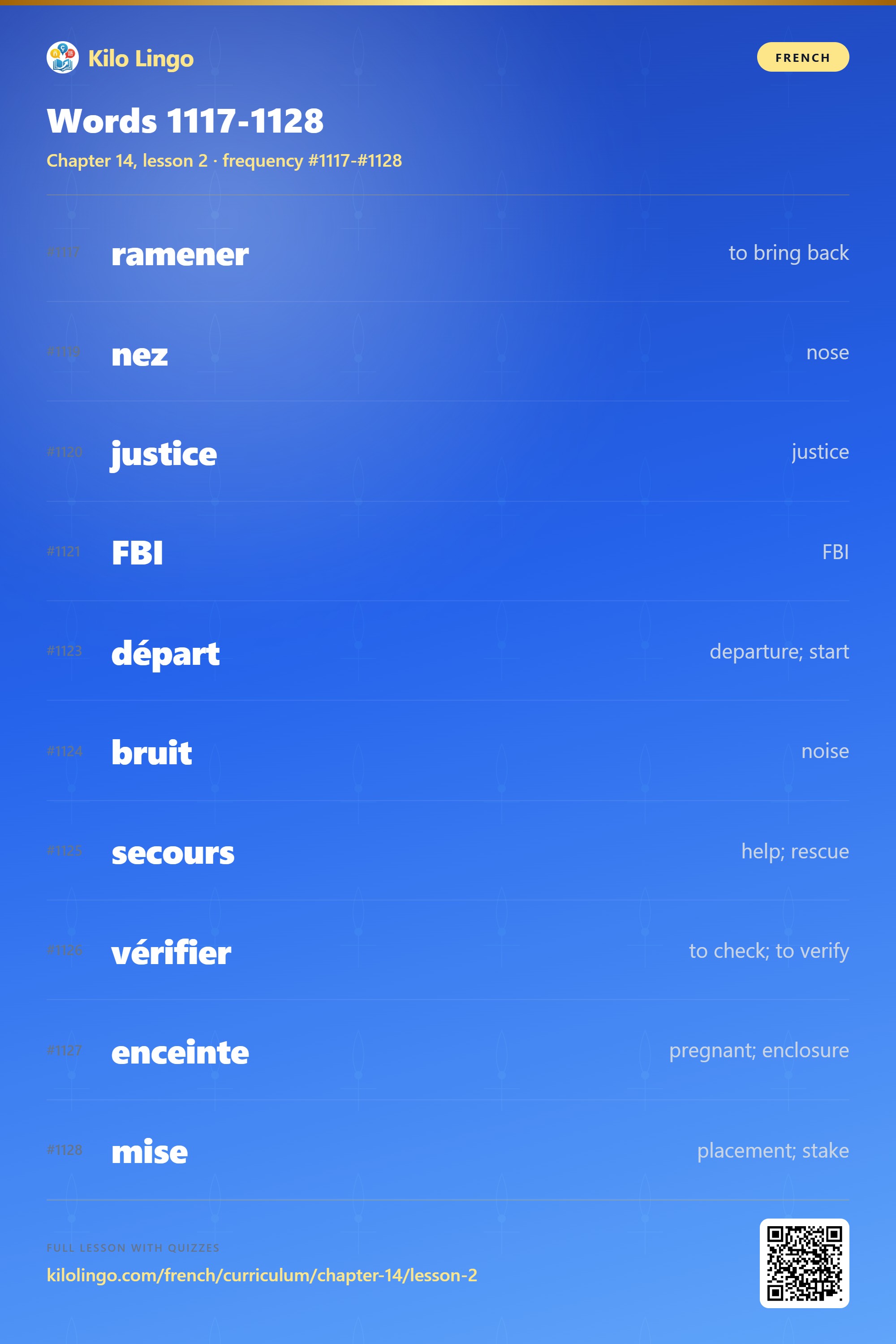
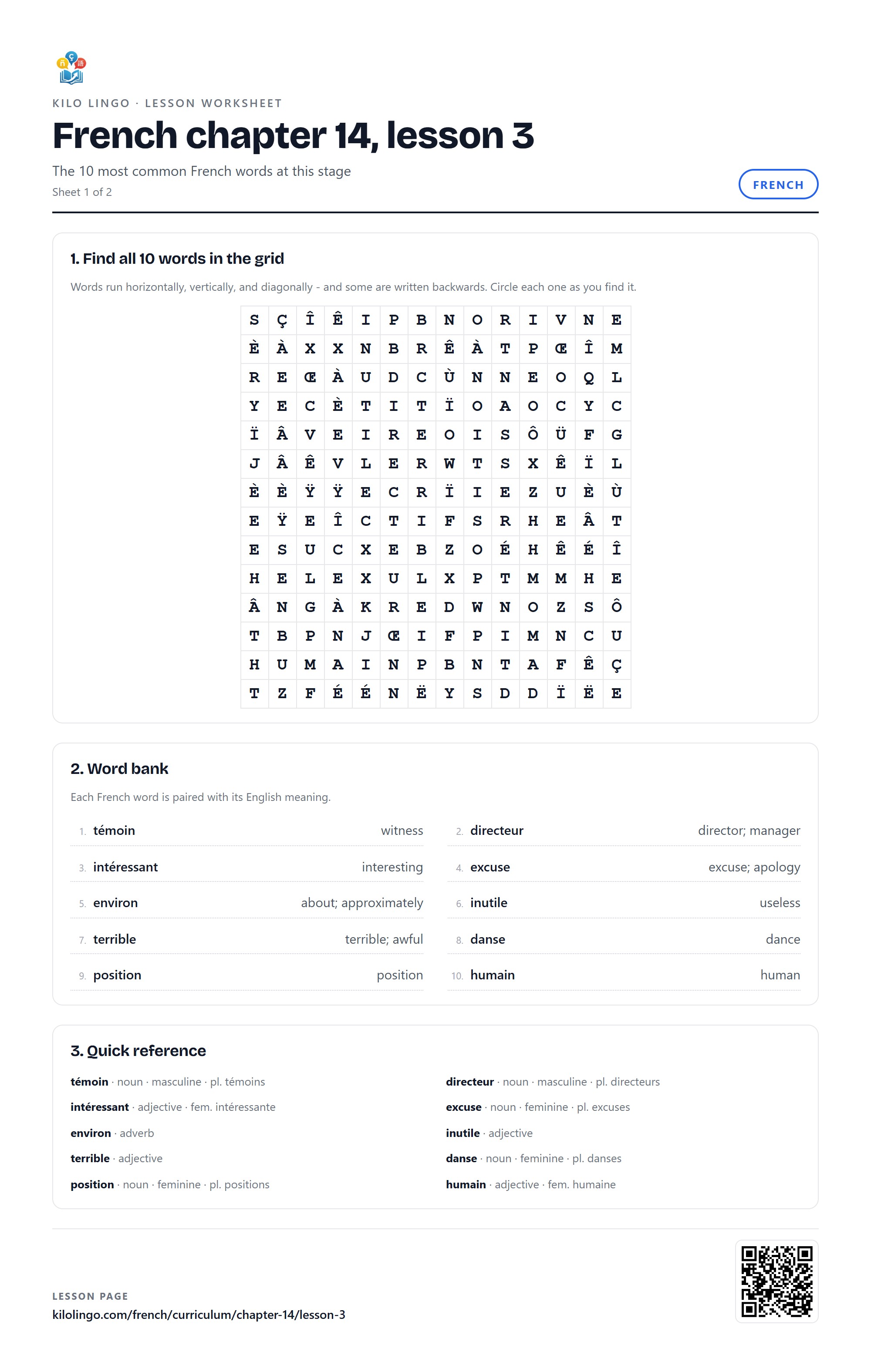

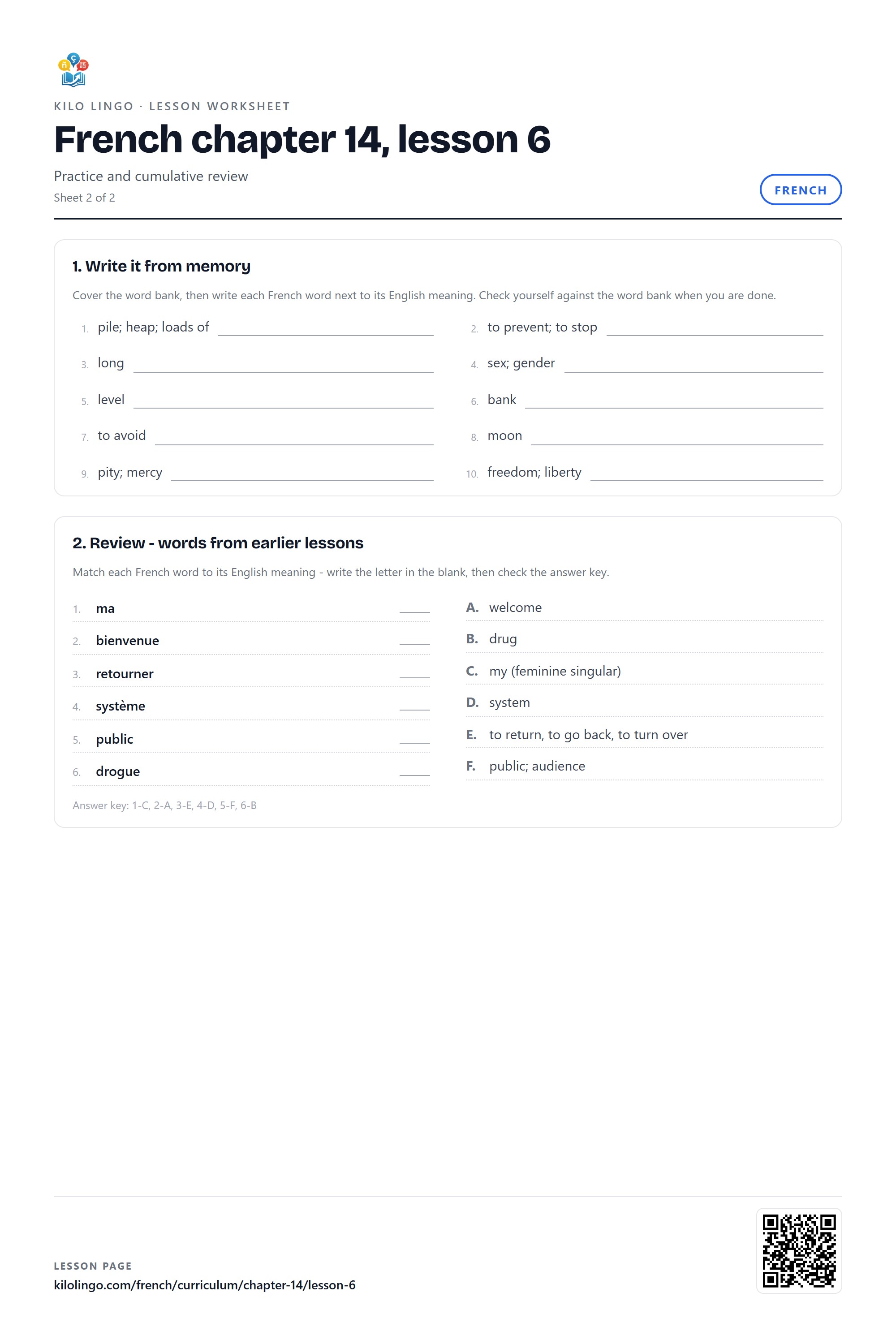

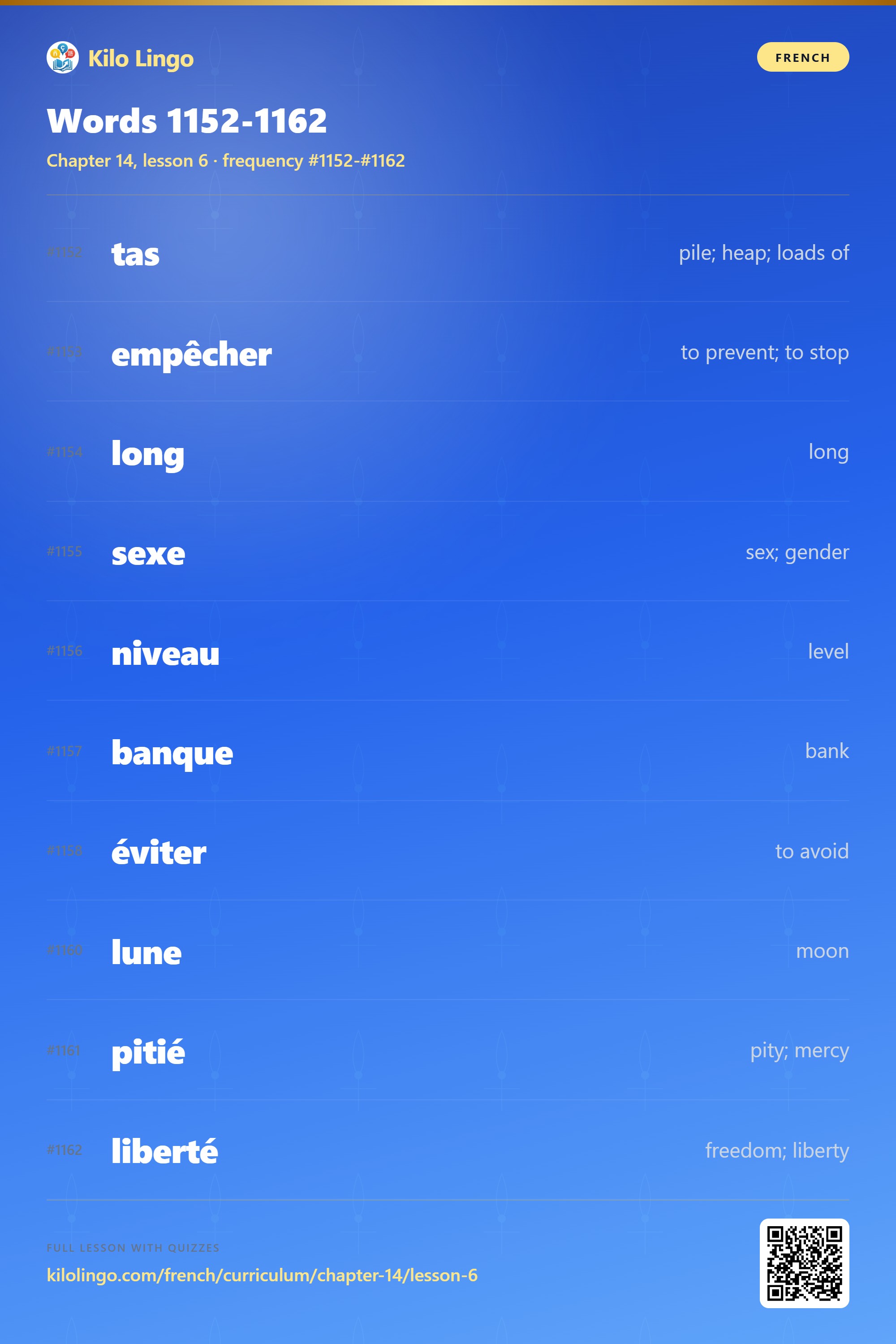
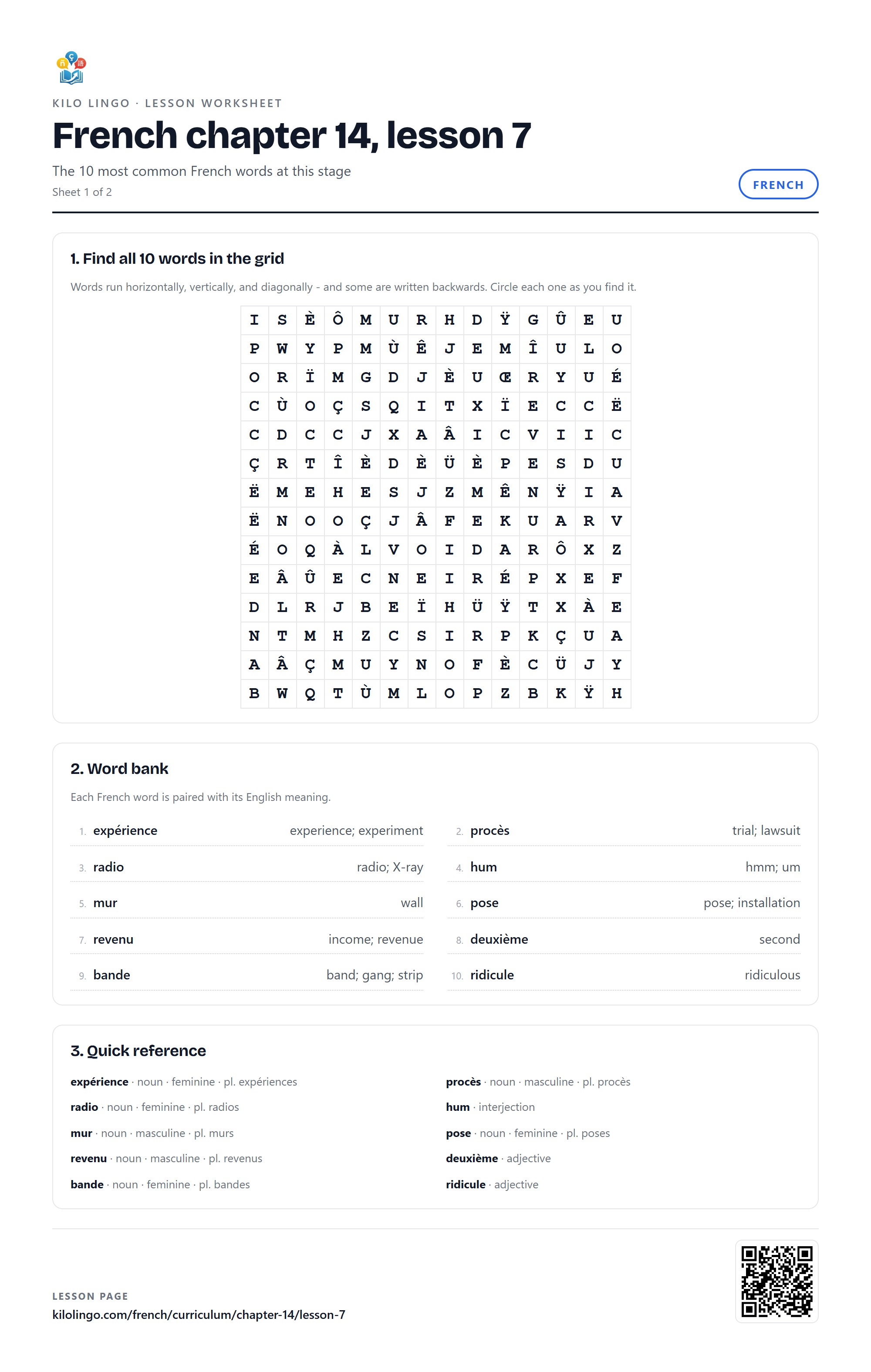
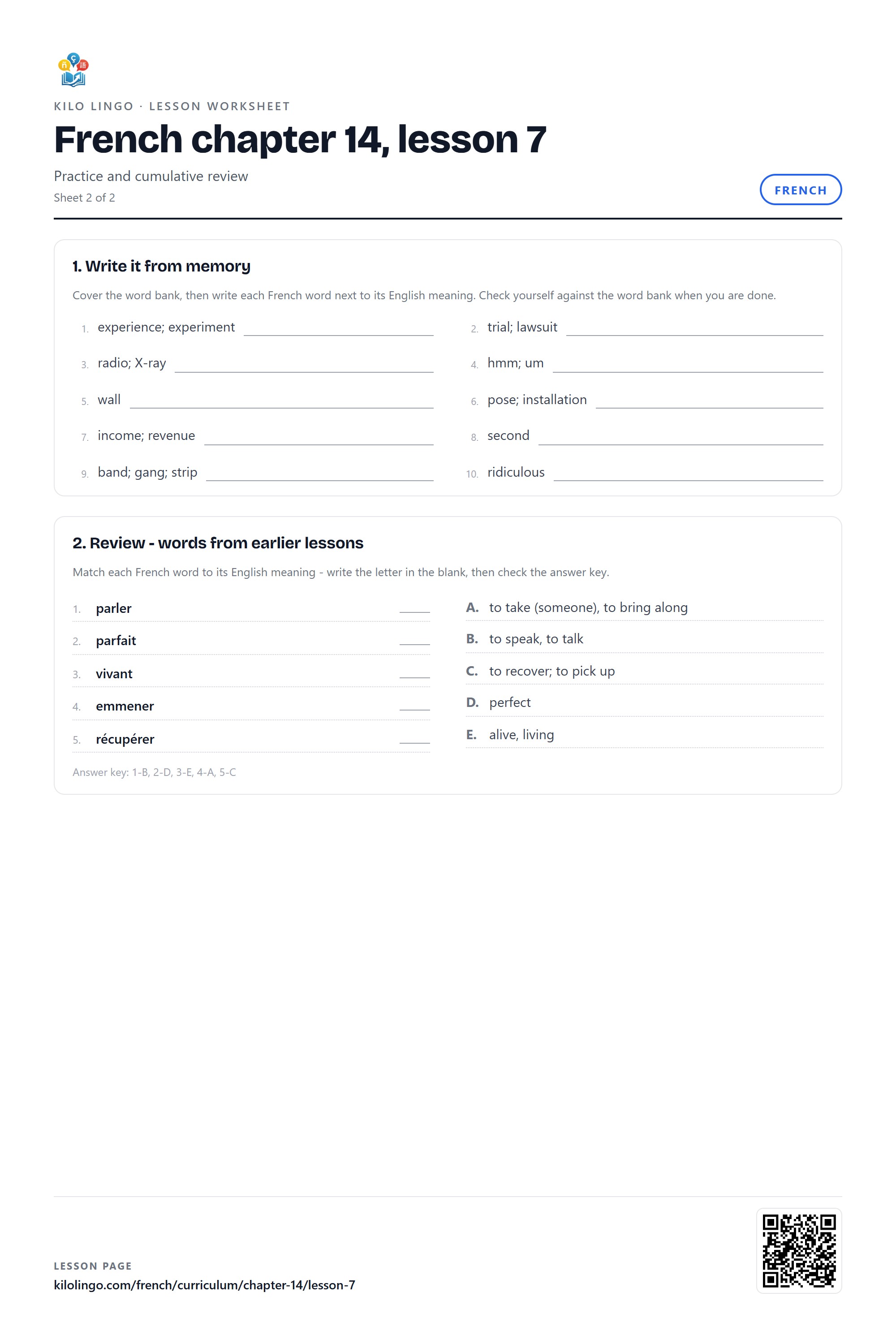


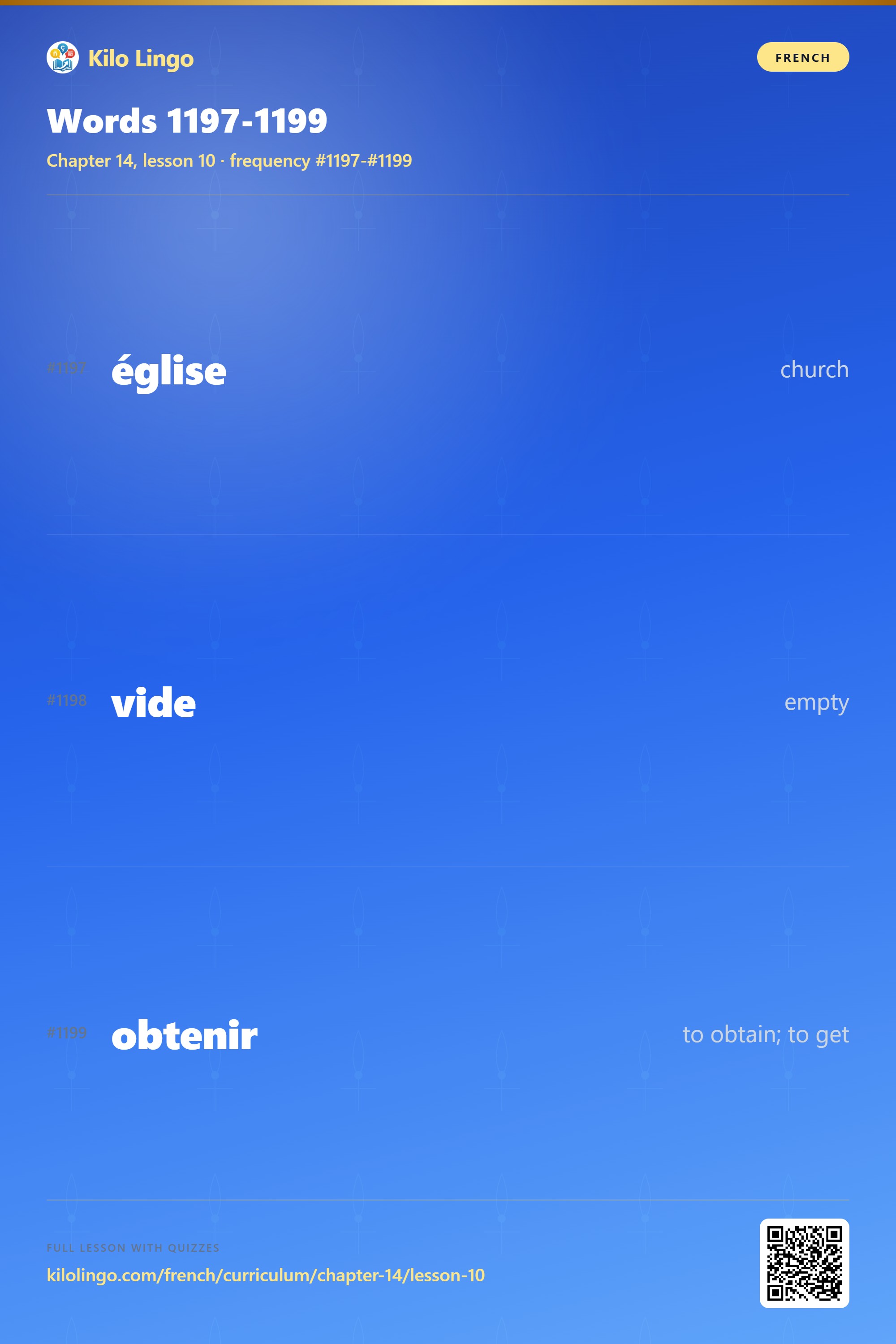
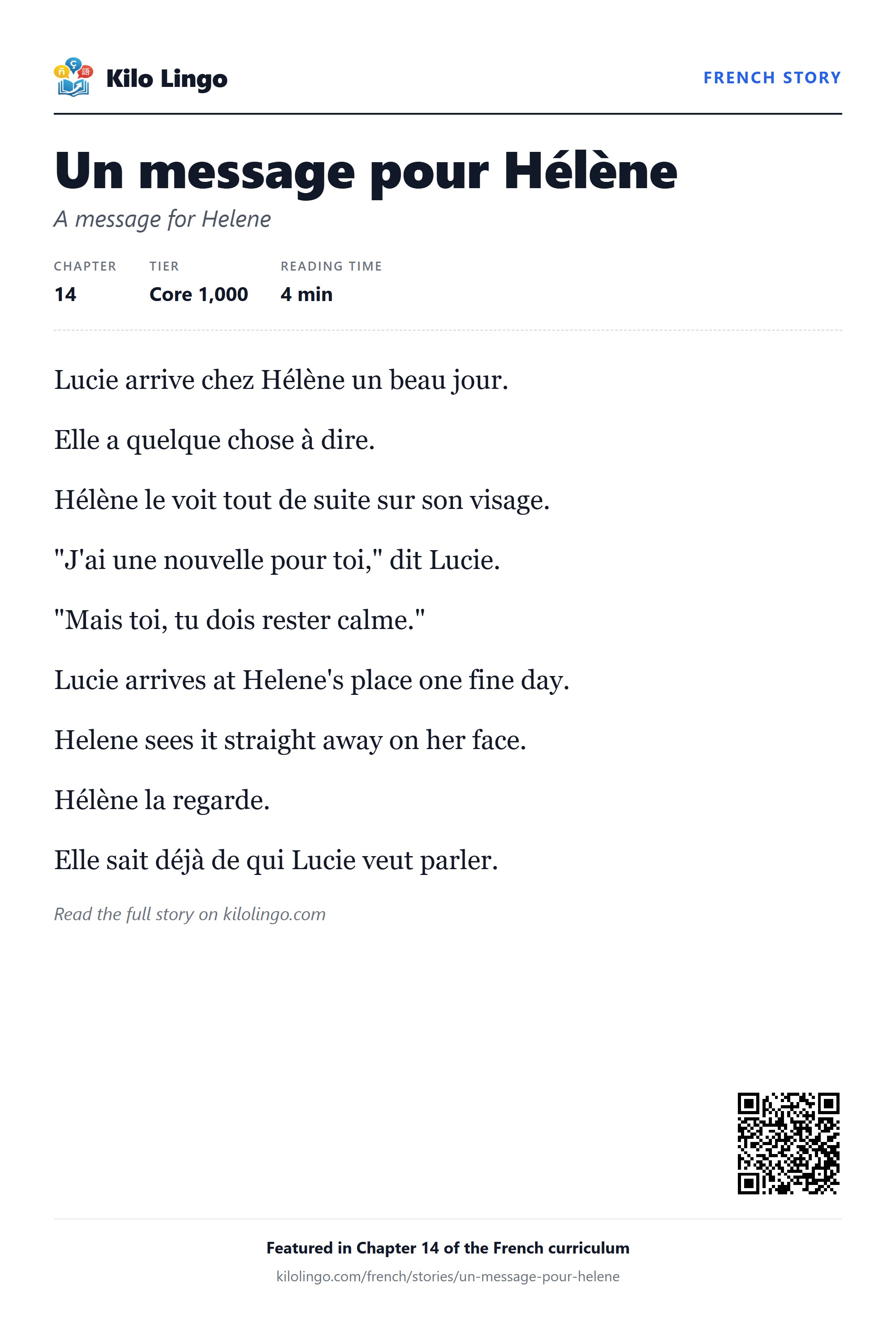
Chapter 15 · Venir de + infinitive: the recent past
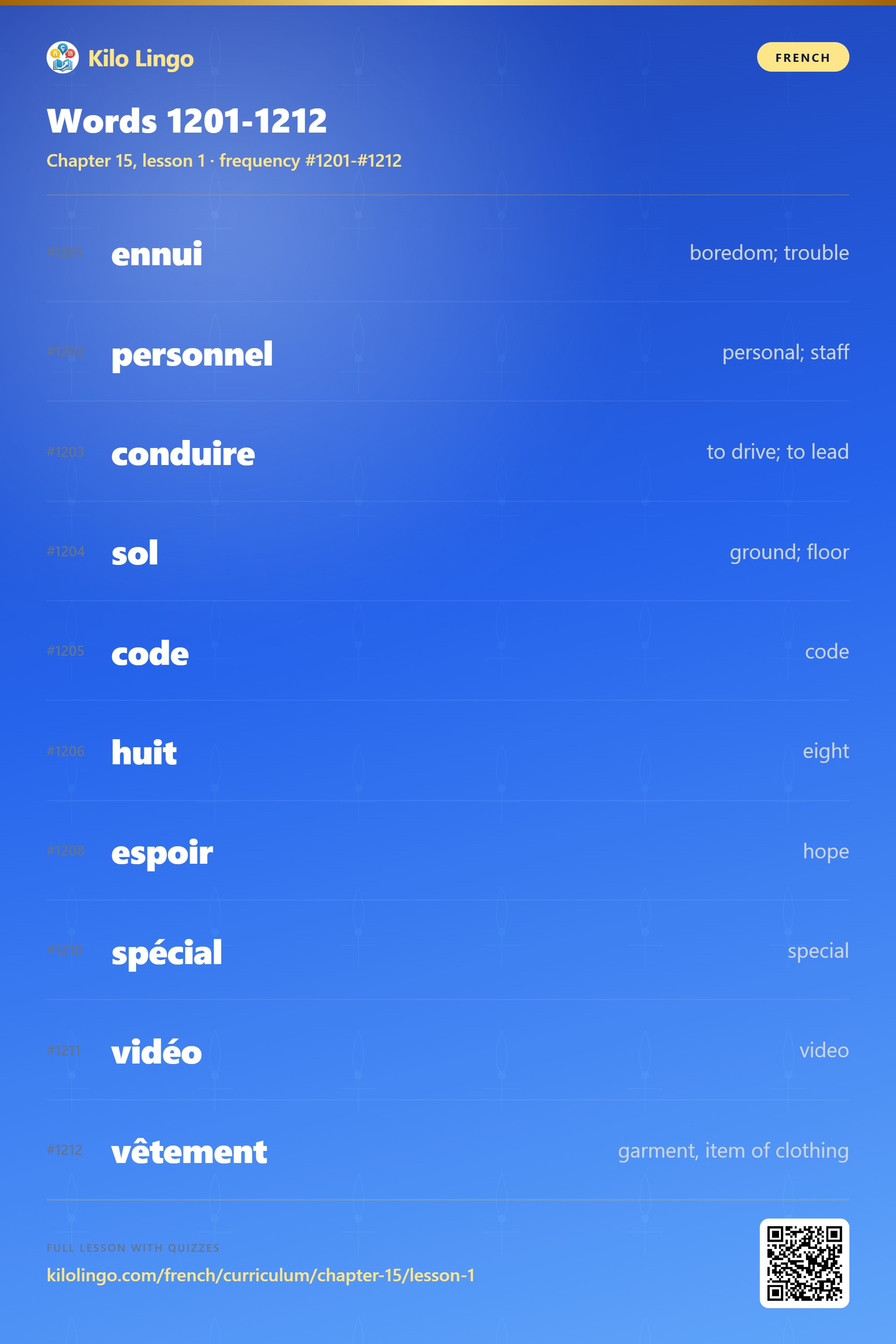
Chapter page →- Words 1201-1210Vocabulary
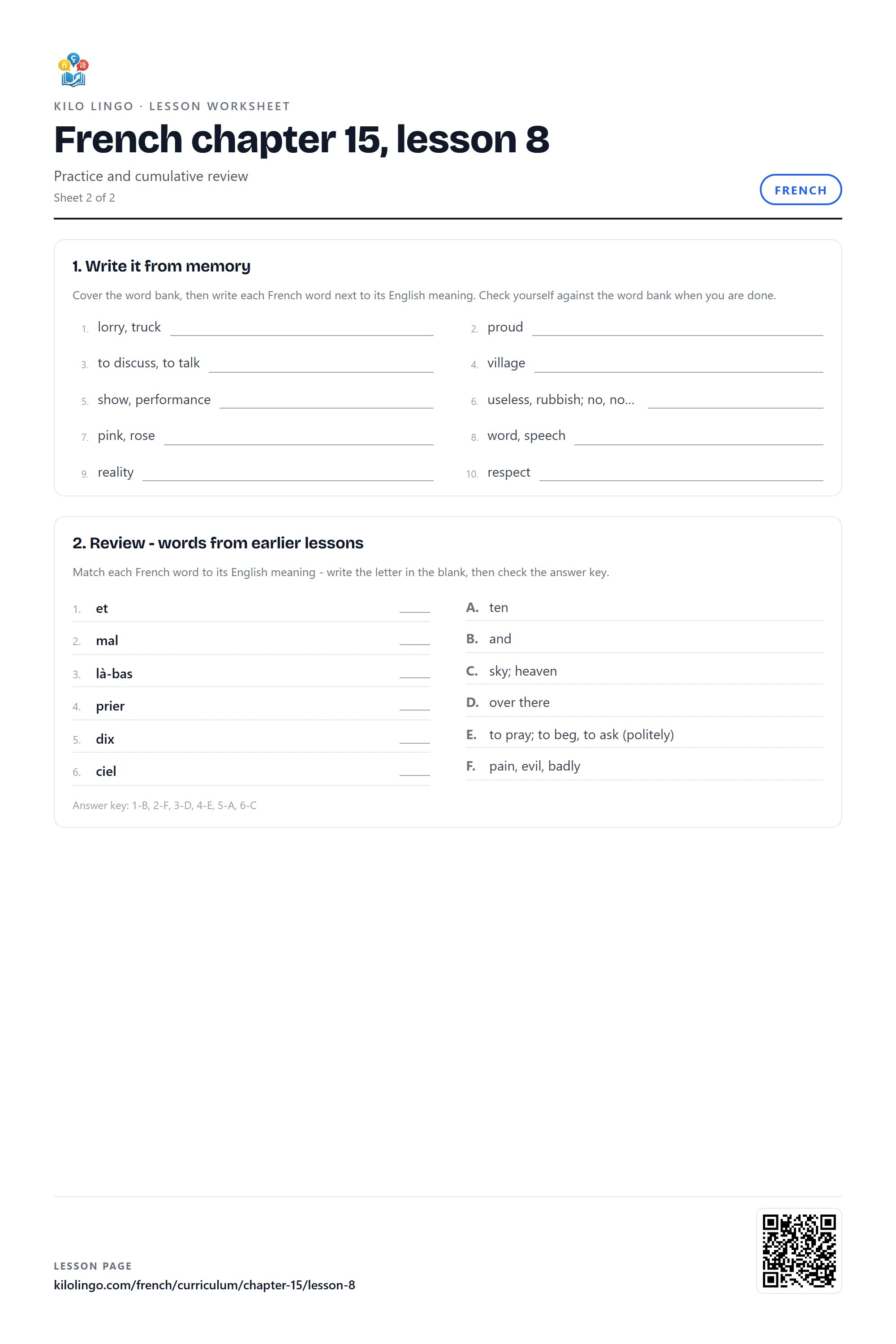
10 words · ranks 1201-1210
- Crossword review sessionReview games
Cross the words you just met, clued in English. Slower than a drill, and it sticks harder.
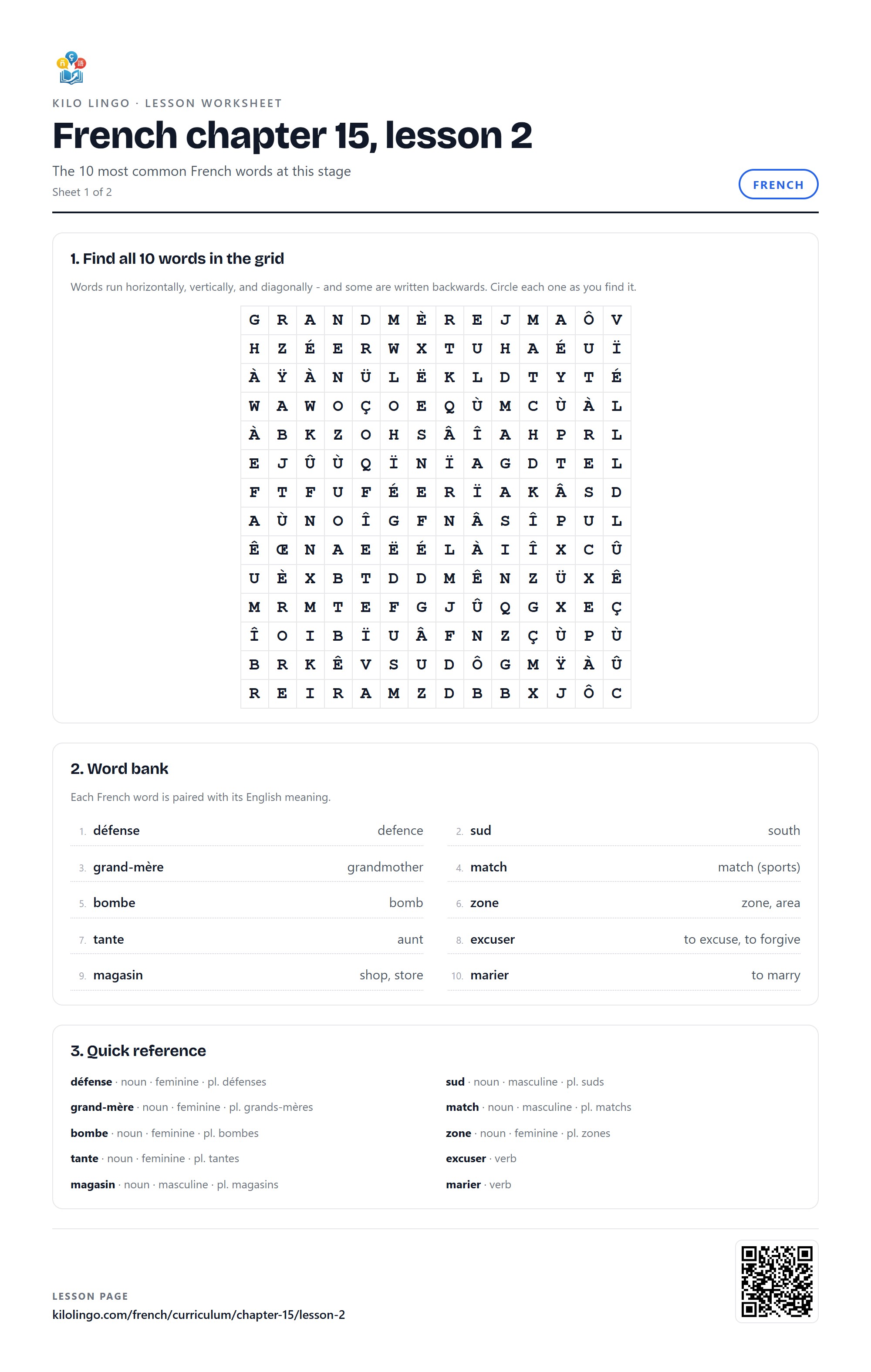
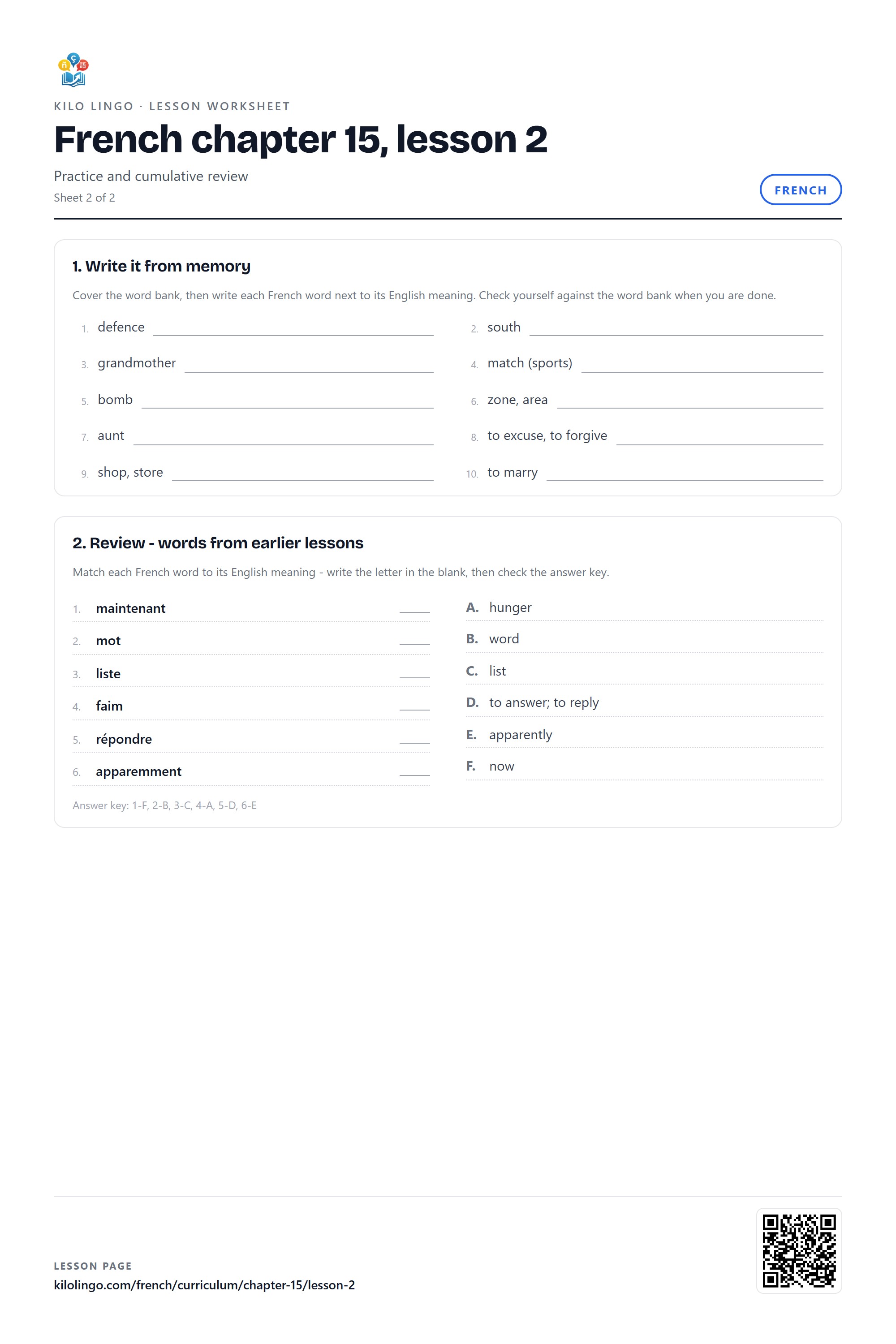
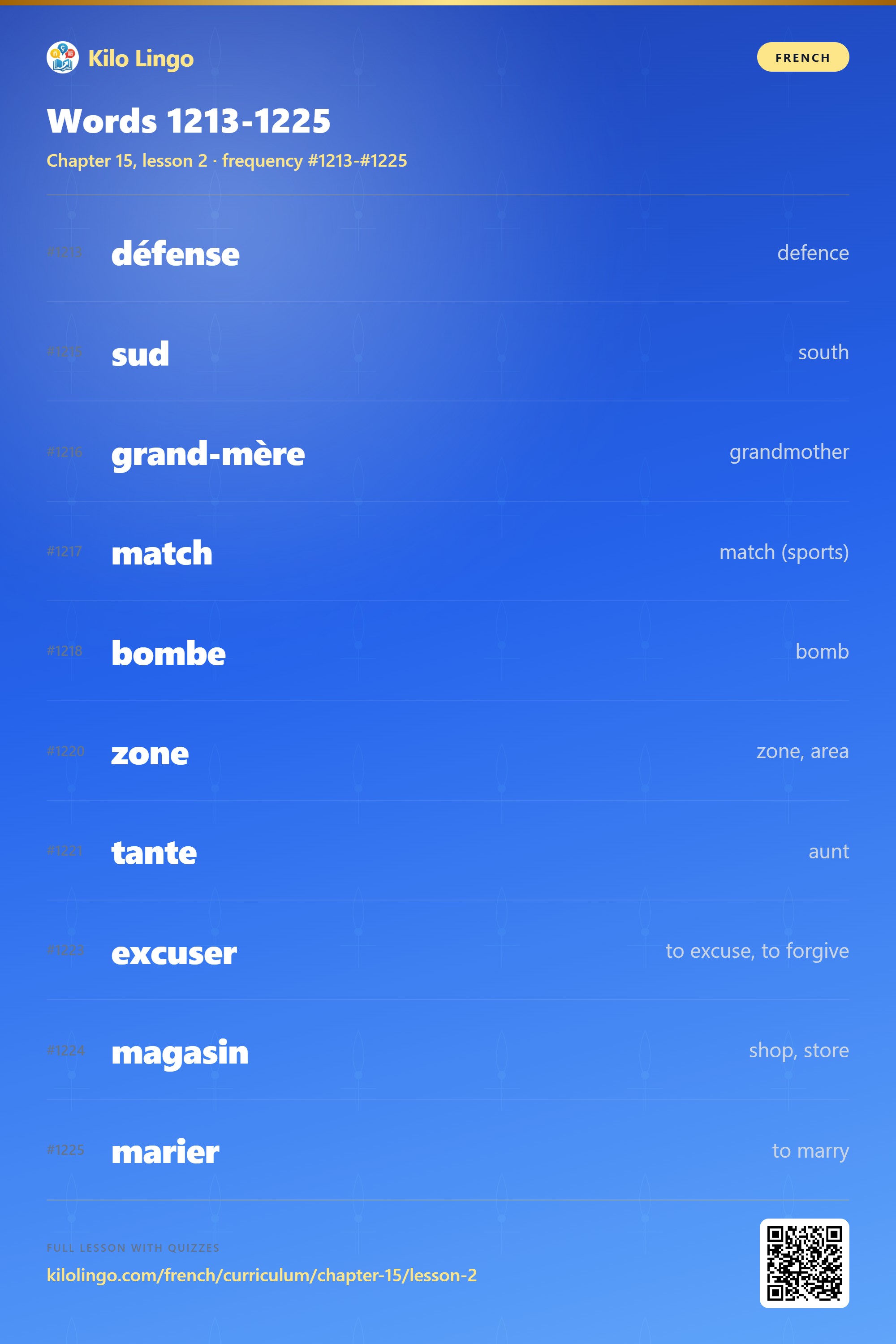
- Words 1211-1220Vocabulary
10 words · ranks 1211-1220
- Word Bubbles review sessionReview games
Pop the words you just met by matching each one to its meaning. A couple of rounds and the batch is yours.
- Words 1221-1231Vocabulary
10 words · ranks 1221-1231
- Conjugation Sprint review sessionReview games
Sixty seconds on the endings of the verbs this chapter has drilled so far.
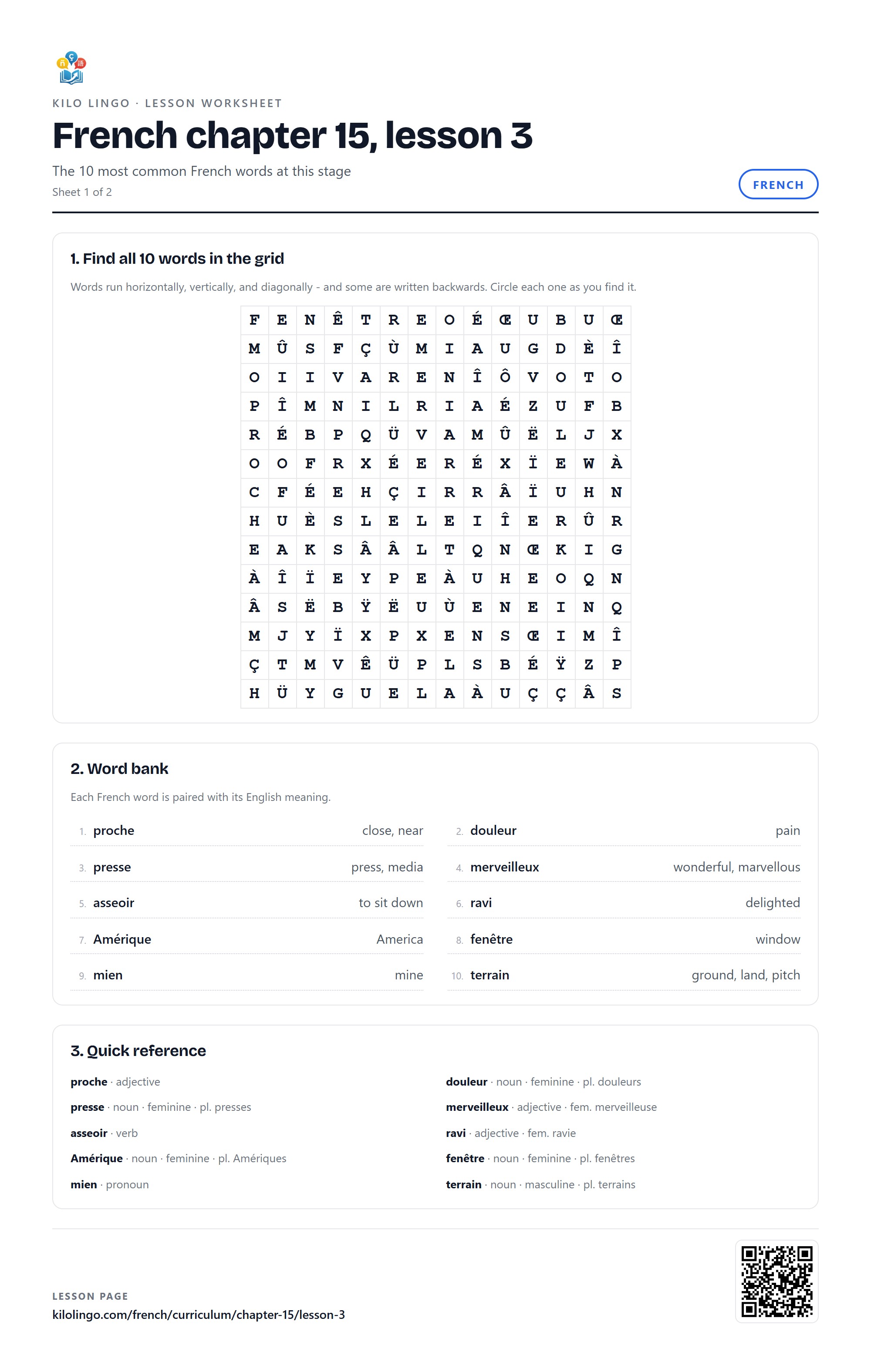
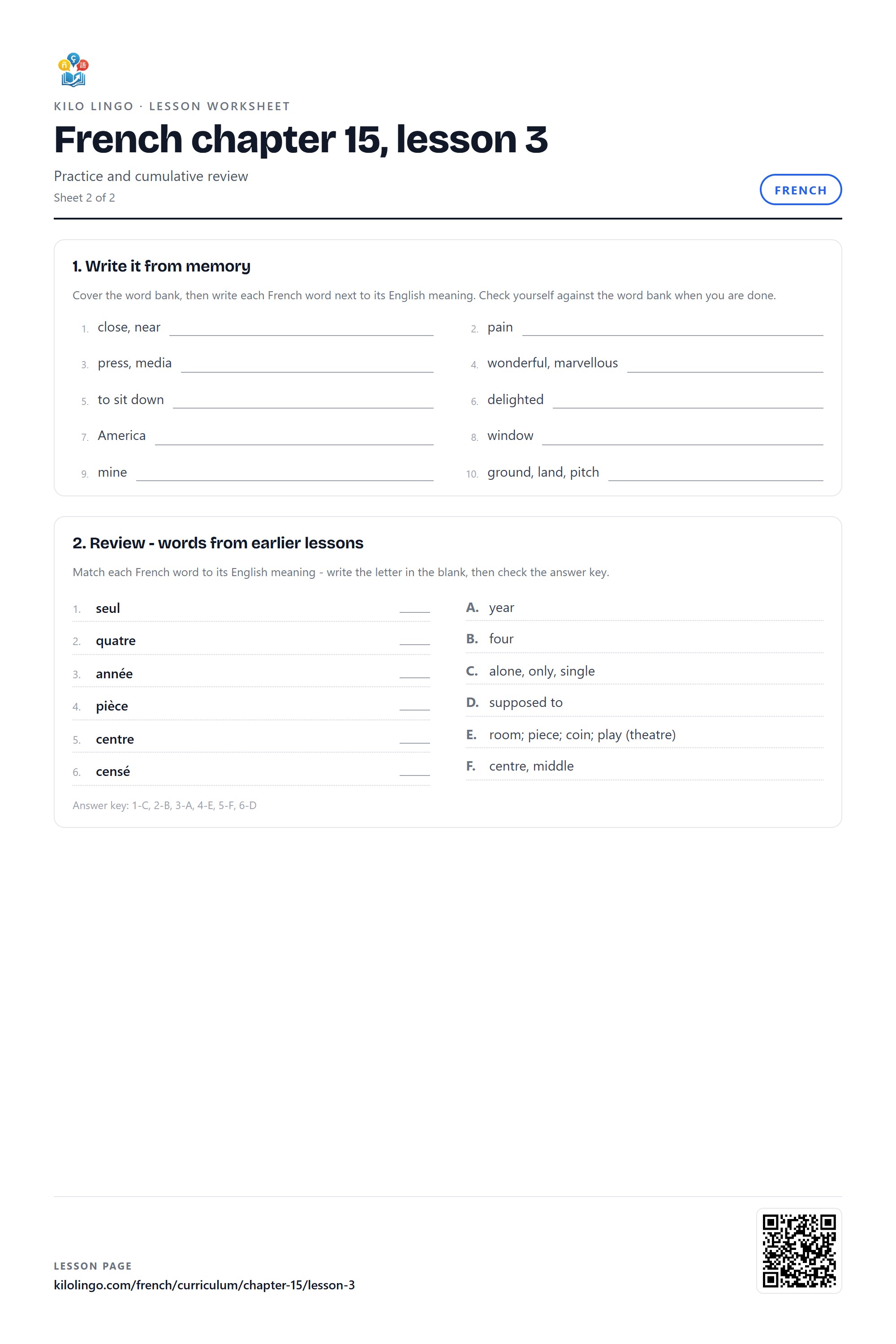
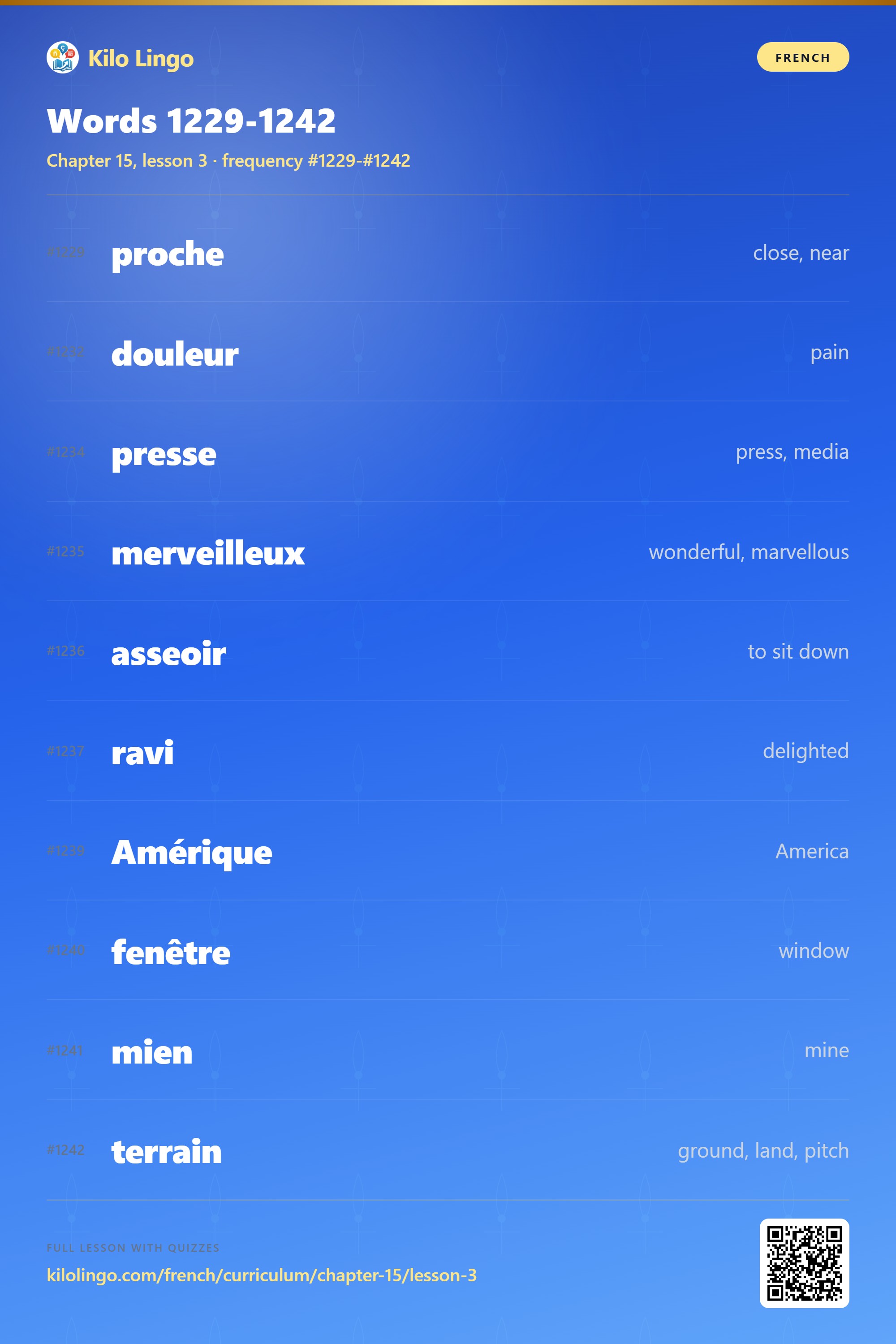
- Words 1232-1241Vocabulary
10 words · ranks 1232-1241
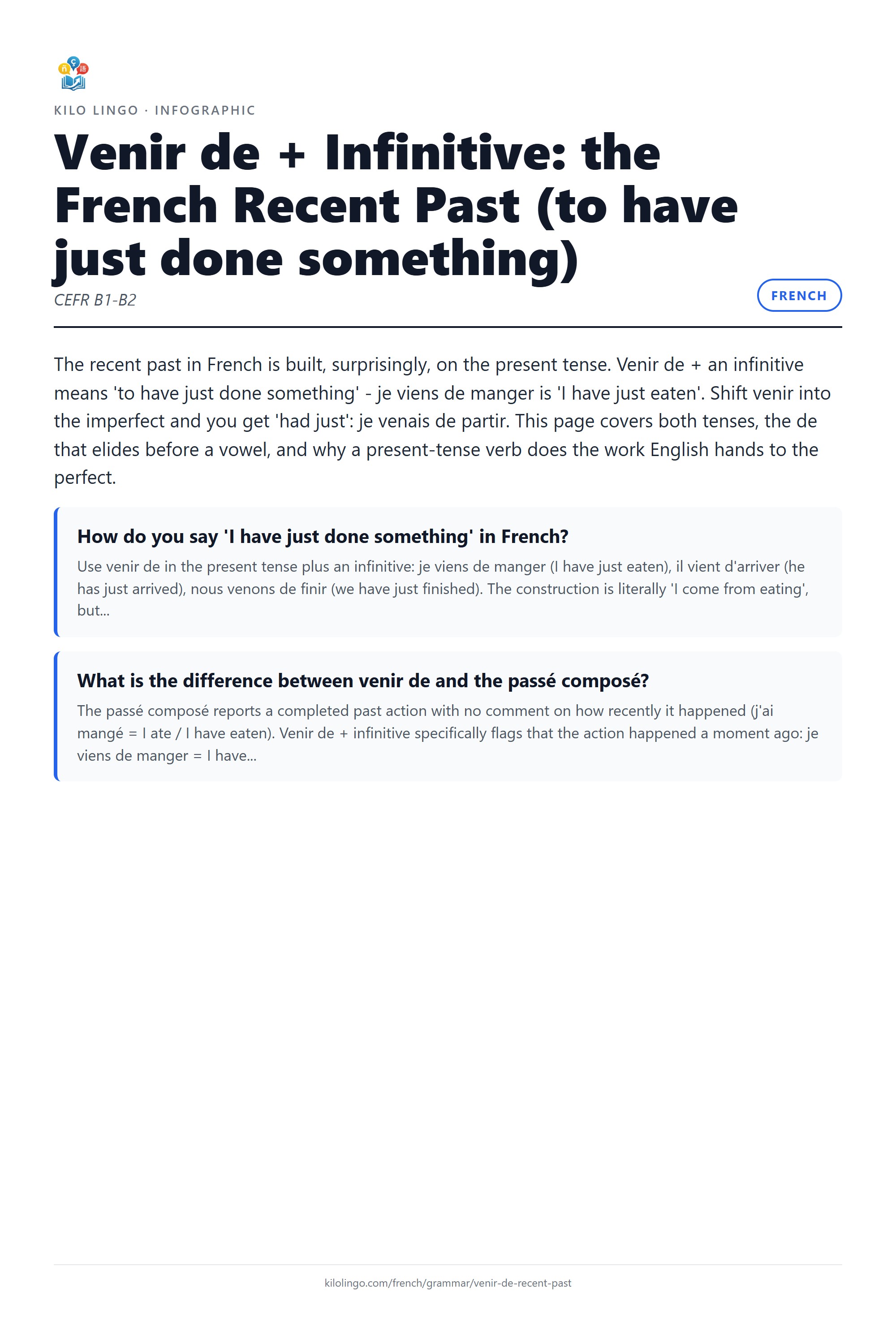
venir de + infinitive means 'to have just done' (je viens de manger). The present-tense form, the imperfect venais de for 'had just', and how it differs from the passe compose.
- se souvenir or se rappeler?Mistake clinic
Same meaning, different plumbing. The preposition is the whole difference.
- Words 1242-1251Vocabulary
10 words · ranks 1242-1251
- Word Bubbles review sessionReview games
Pop the words you just met by matching each one to its meaning. A couple of rounds and the batch is yours.
- Words 1252-1261Vocabulary
10 words · ranks 1252-1261
- Conjugation Sprint review sessionReview games
Sixty seconds on the endings of the verbs this chapter has drilled so far.
- Words 1262-1271Vocabulary
10 words · ranks 1262-1271
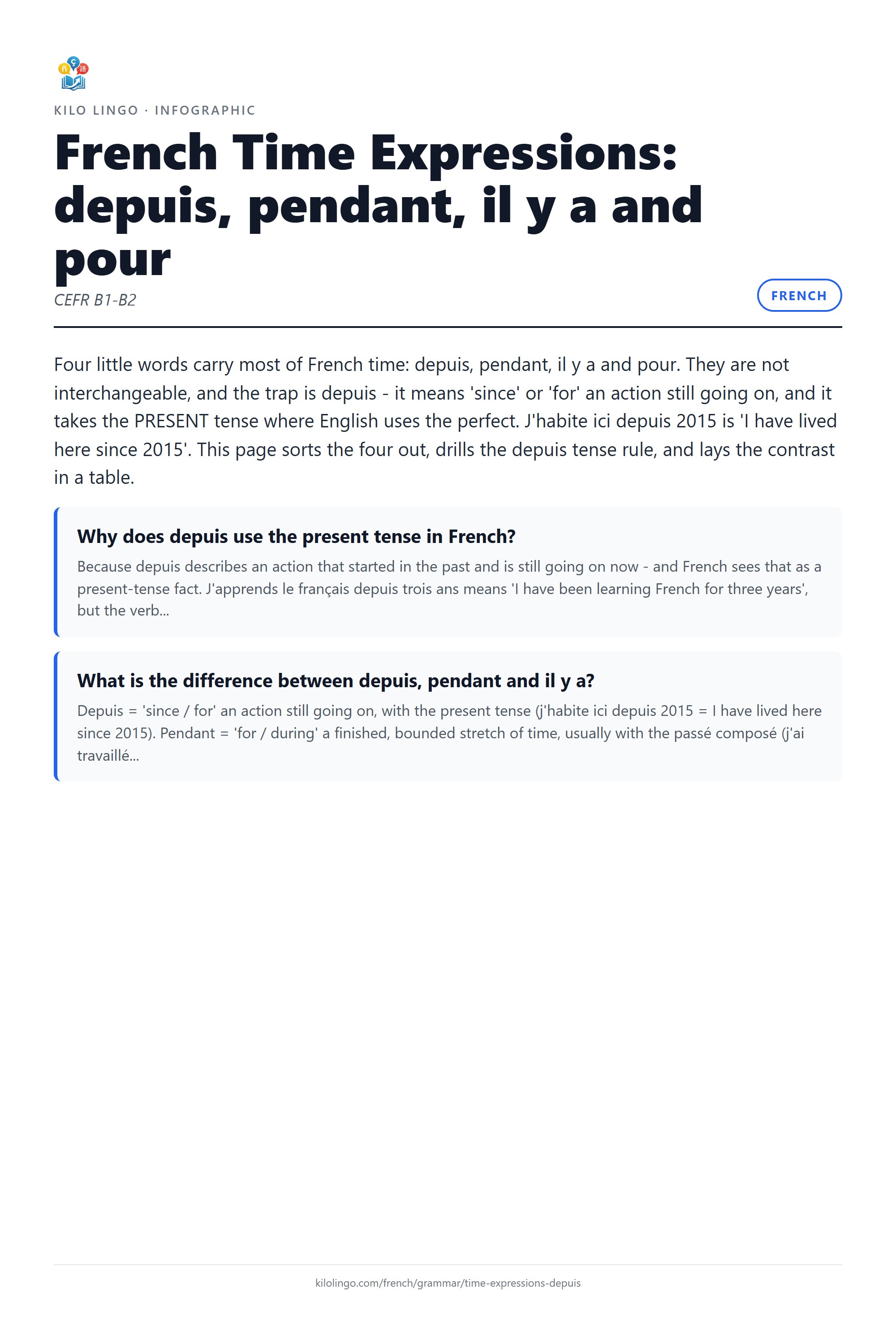
depuis + the present for an action still going on, pendant for a bounded duration, il y a for 'ago', pour for a planned future stretch - and the depuis present-tense trap.
- Words 1272-1281Vocabulary
10 words · ranks 1272-1281
- Word Bubbles review sessionReview games
Pop the words you just met by matching each one to its meaning. A couple of rounds and the batch is yours.
- Words 1282-1291Vocabulary
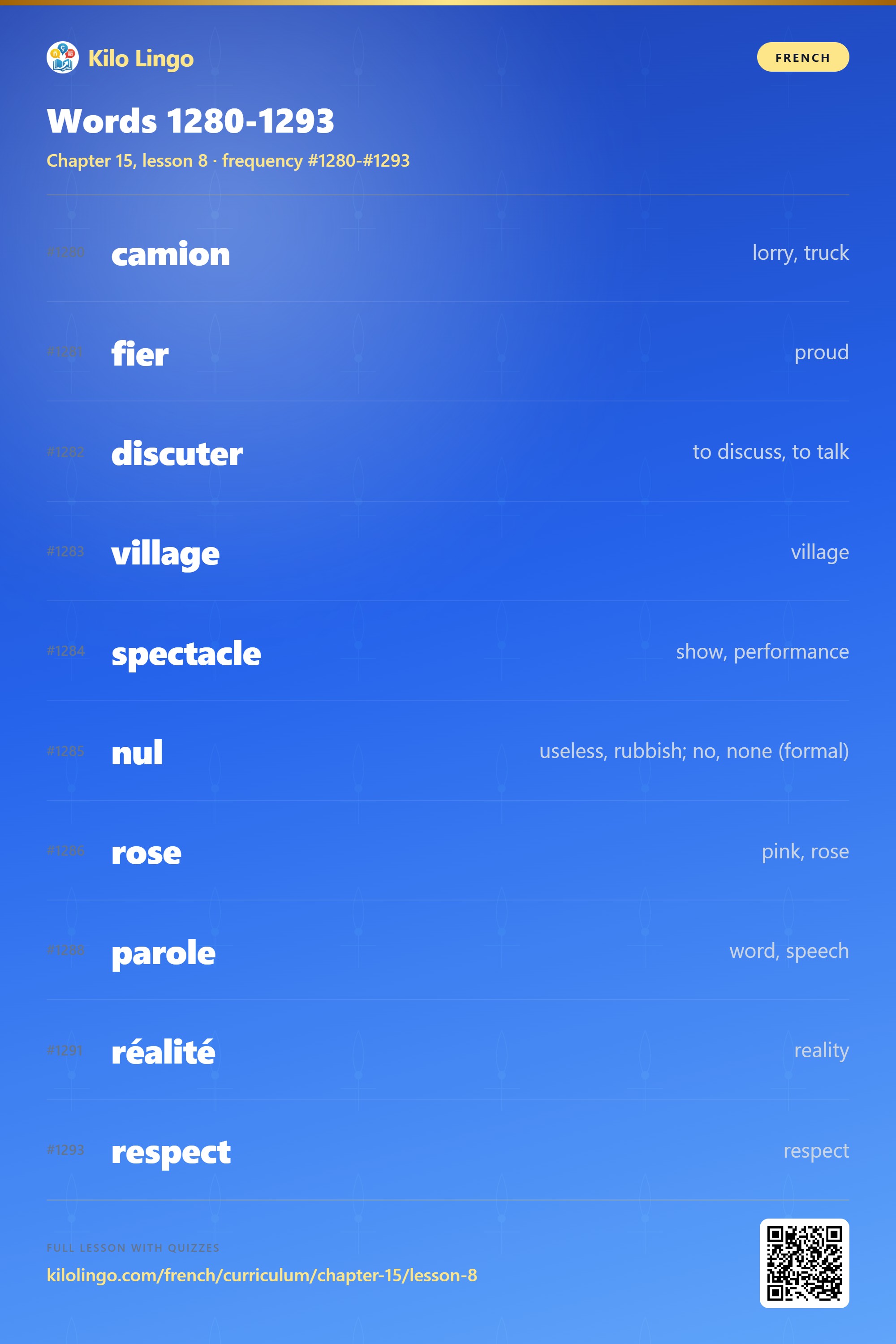
10 words · ranks 1282-1291
- Conjugation Sprint review sessionReview games
Sixty seconds on the endings of the verbs this chapter has drilled so far.
- Words 1292-1300Vocabulary
9 words · ranks 1292-1300
Play it, read along word by word, then answer the questions. Every word is at your level - the song page teaches the few that are new.
- Story milestone: top 1300 wordsGraded-reader story
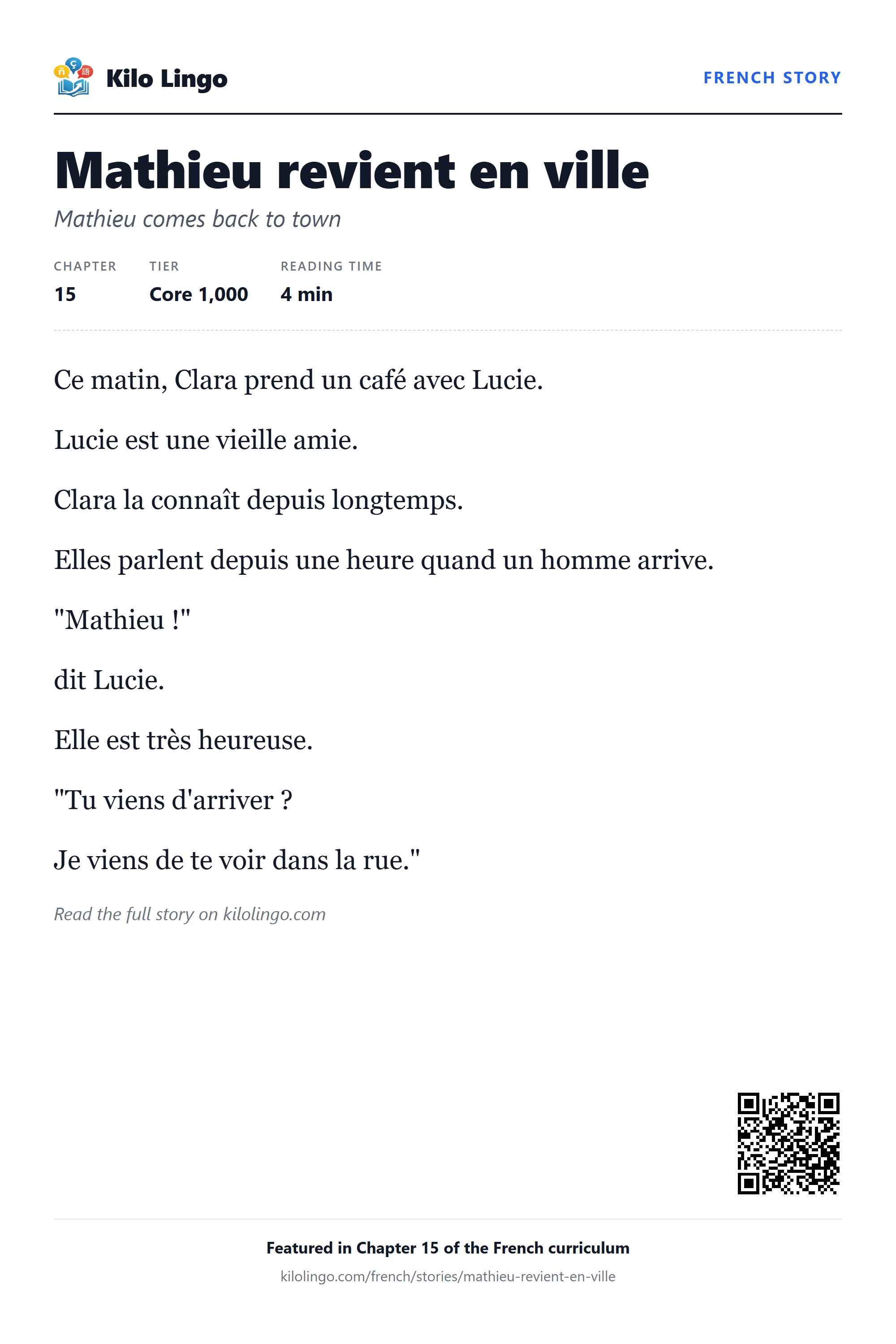
You can read this story using only the words you've learned so far. Every content word sits at or above the rank-1300 ceiling.
- La nature et le temps qu'il faitThemed review
Sun, wind and sea.
tempsdoes double duty here - the weather and the time are the same word. - Arcade reviewReview games
Replay this chapter's words as games - a different kind of repetition, and it counts.
Word printables
Per-word sheets99 words · a worksheet, infographic and listicle each
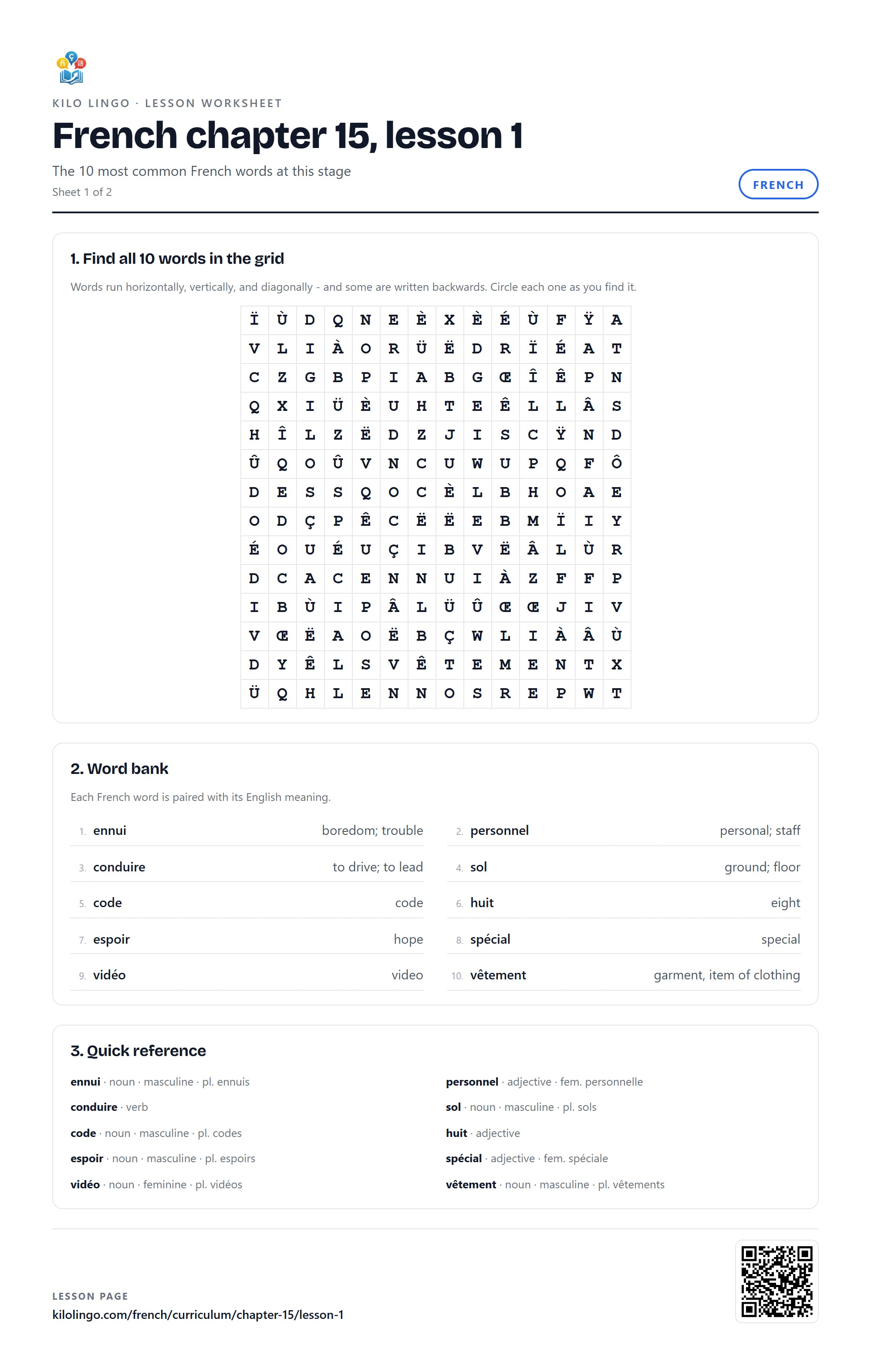
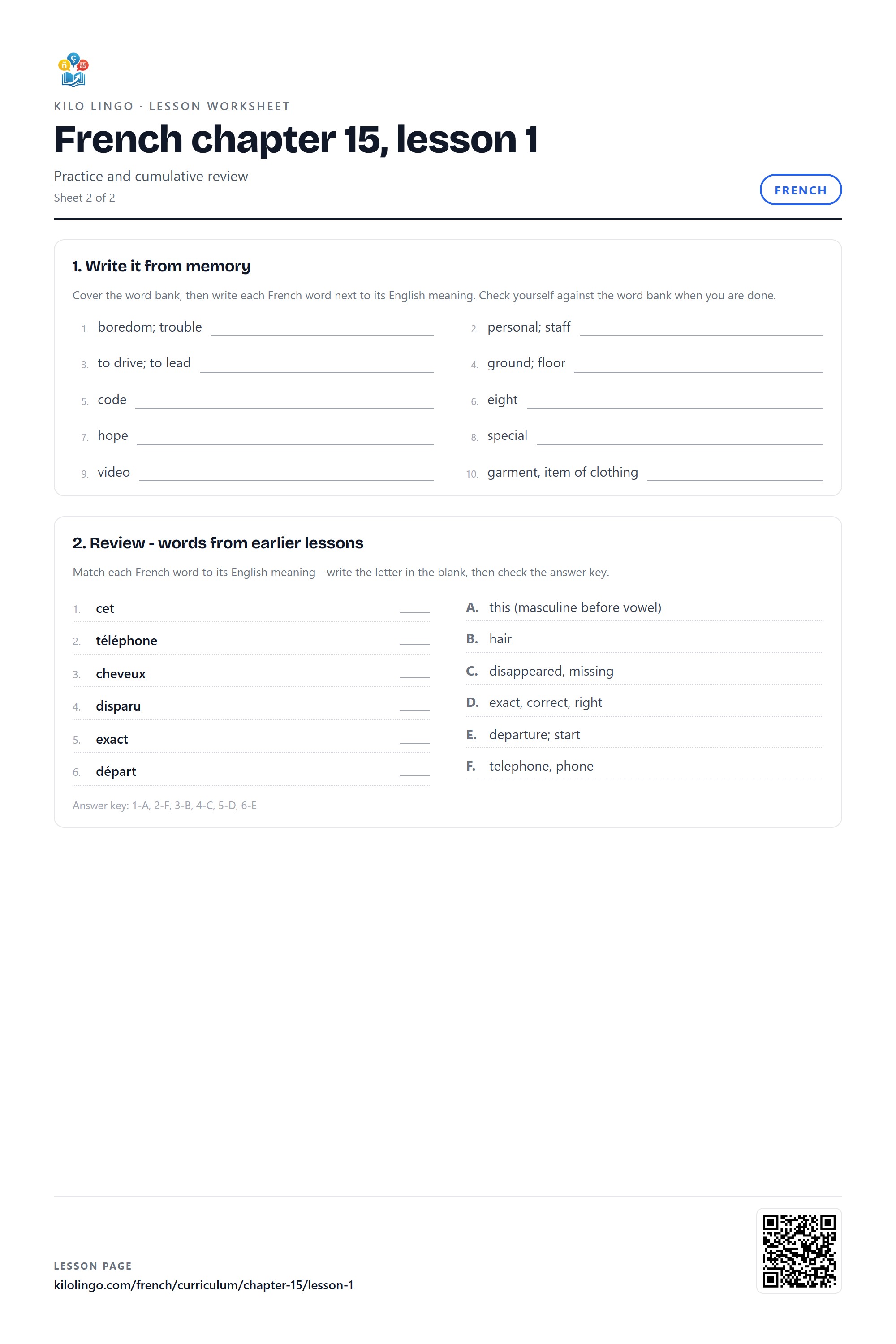



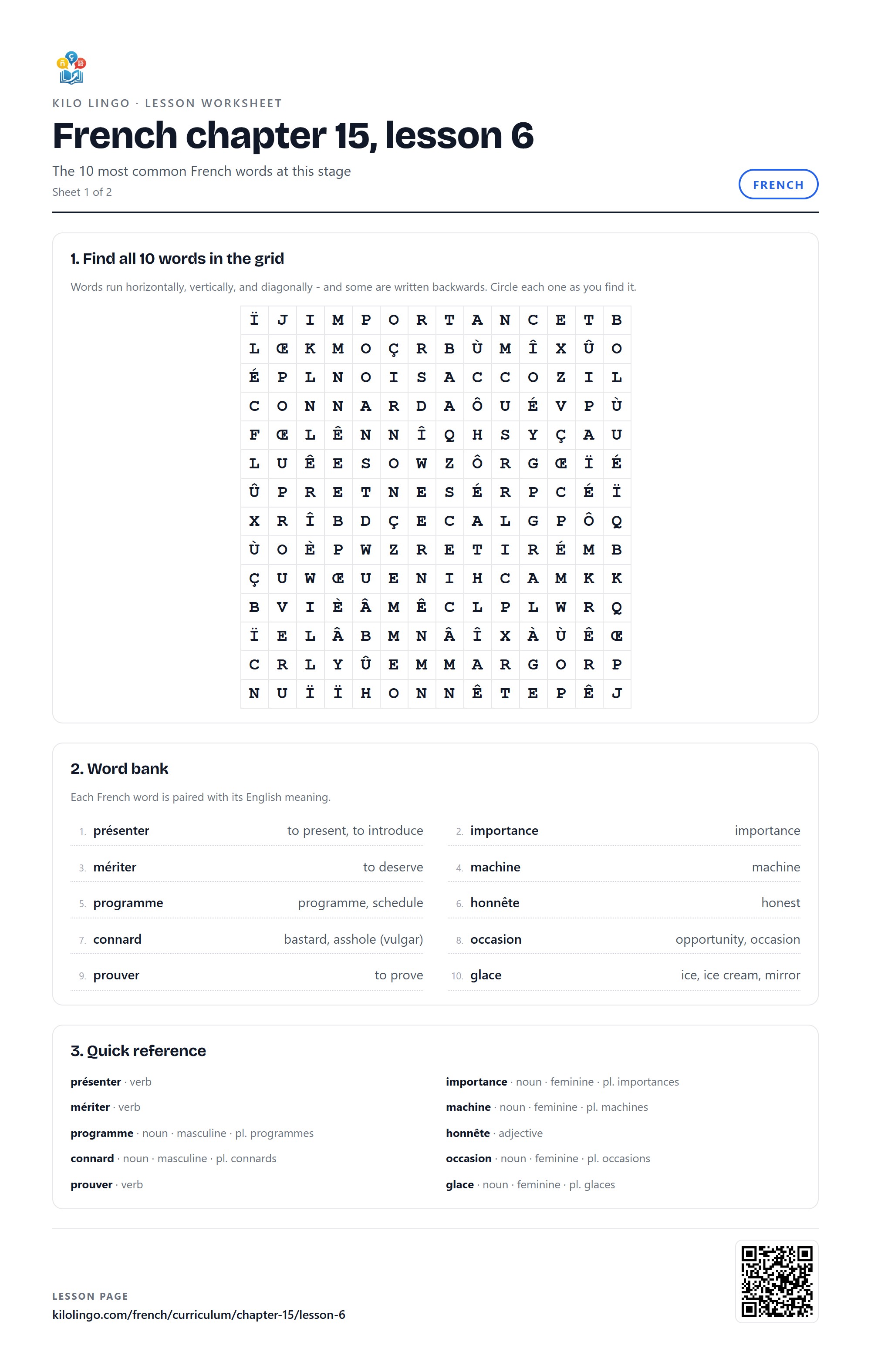
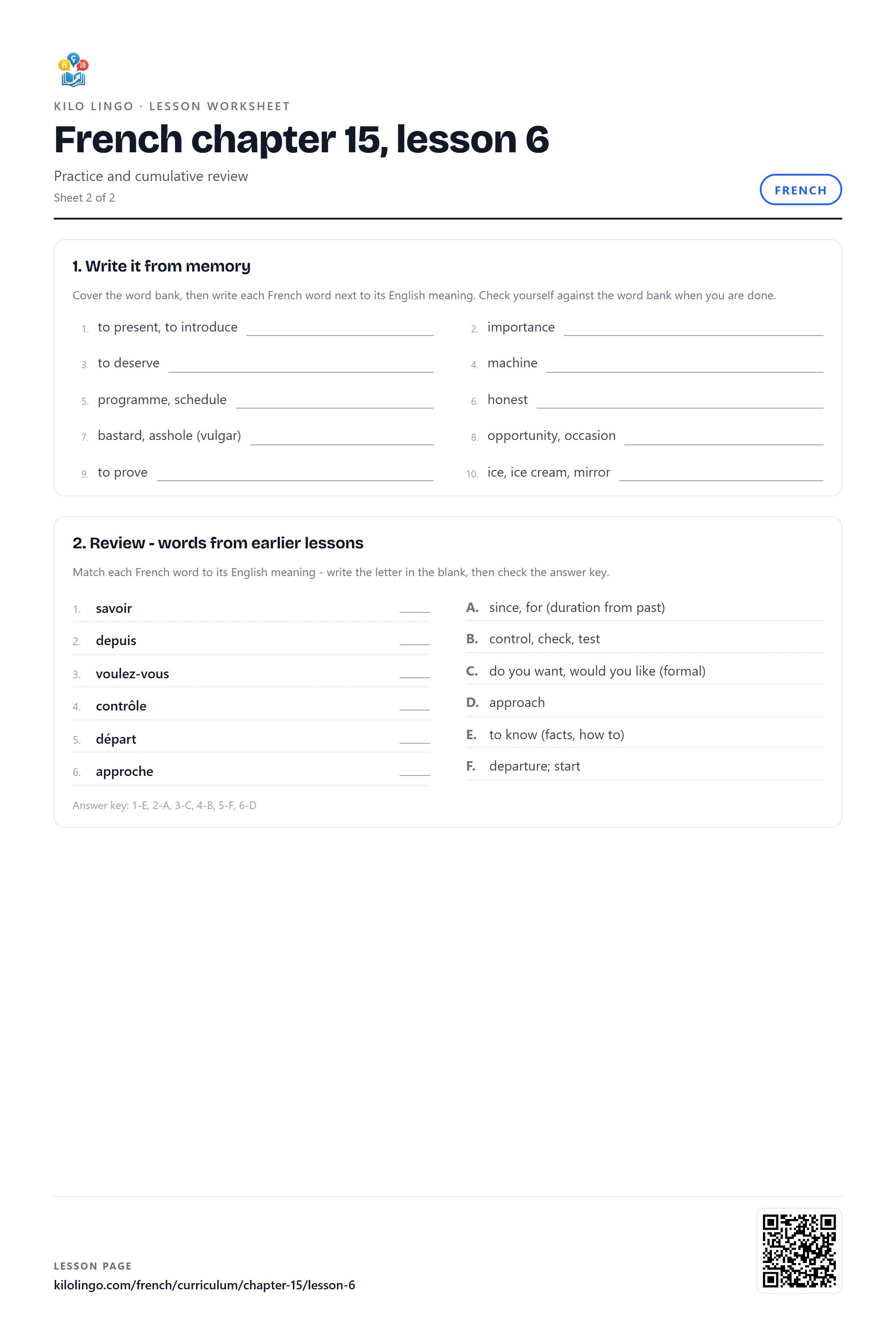

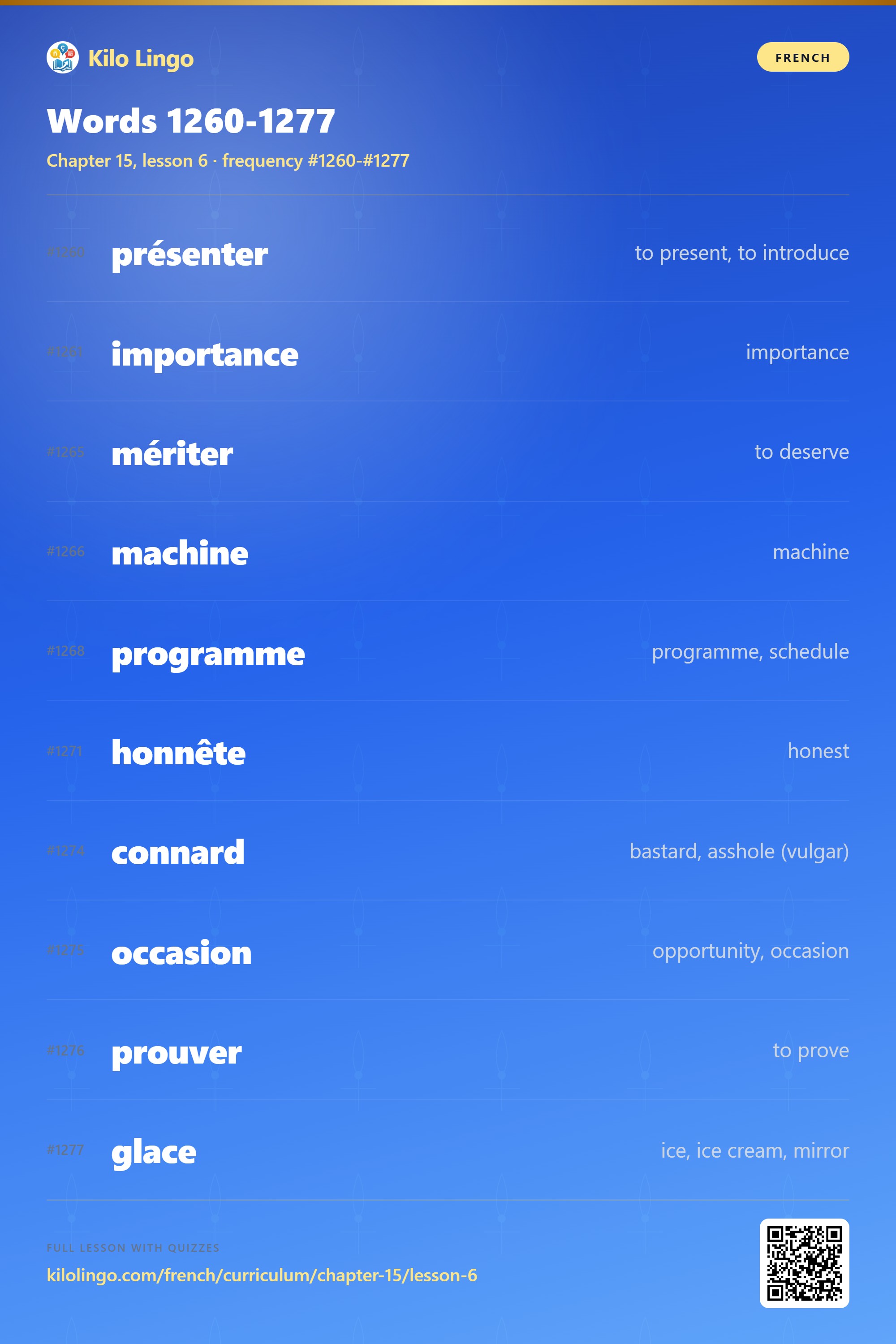
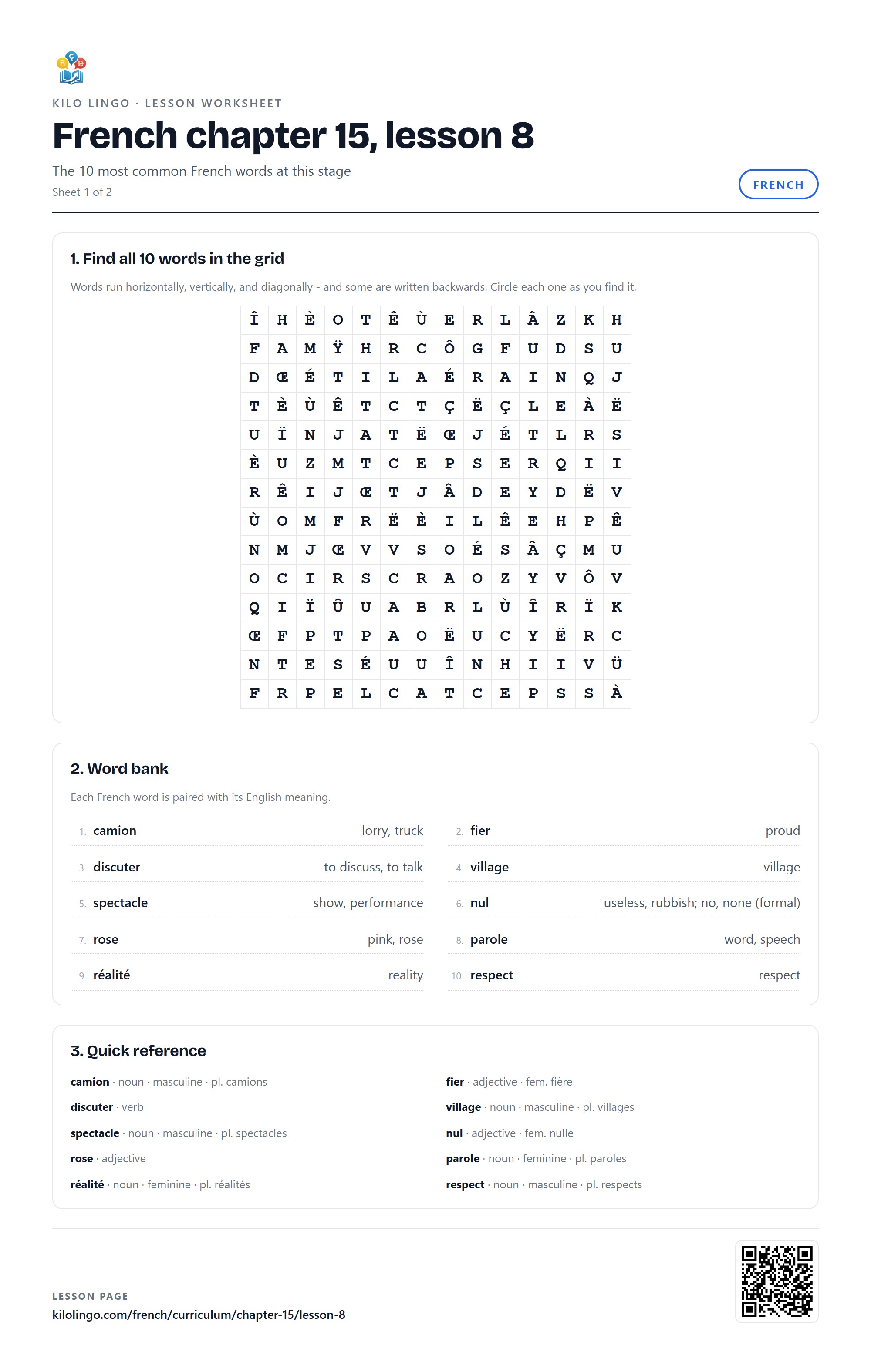

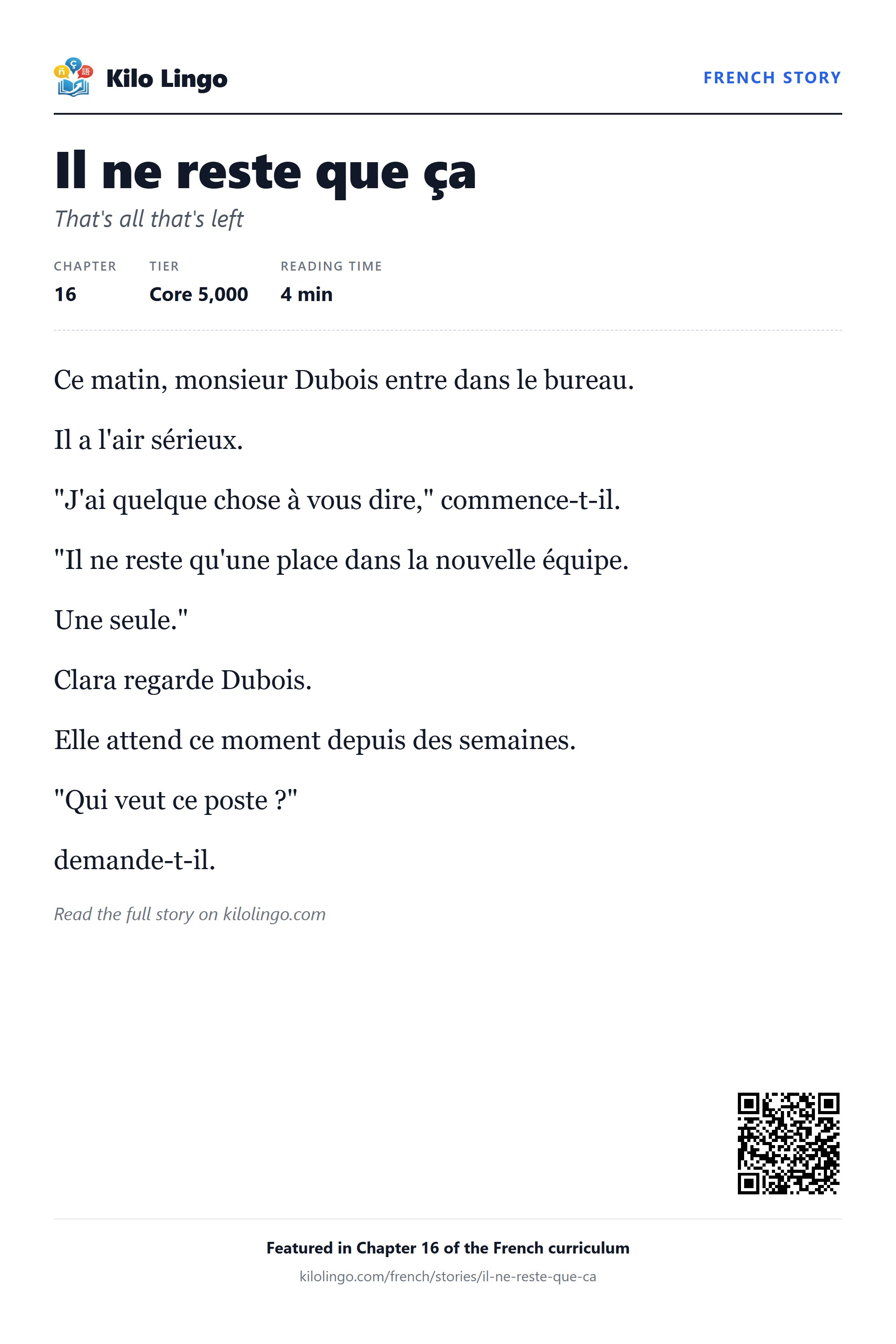
Chapter 16 · Negation beyond pas: ne... que, ni... ni, aucun
Chapter page →- Words 1301-1310Vocabulary
10 words · ranks 1301-1310
- Crossword review sessionReview games
Cross the words you just met, clued in English. Slower than a drill, and it sticks harder.
- Words 1311-1320Vocabulary
10 words · ranks 1311-1320
- Conjugation Sprint review sessionReview games
Sixty seconds on the endings of the verbs this chapter has drilled so far.
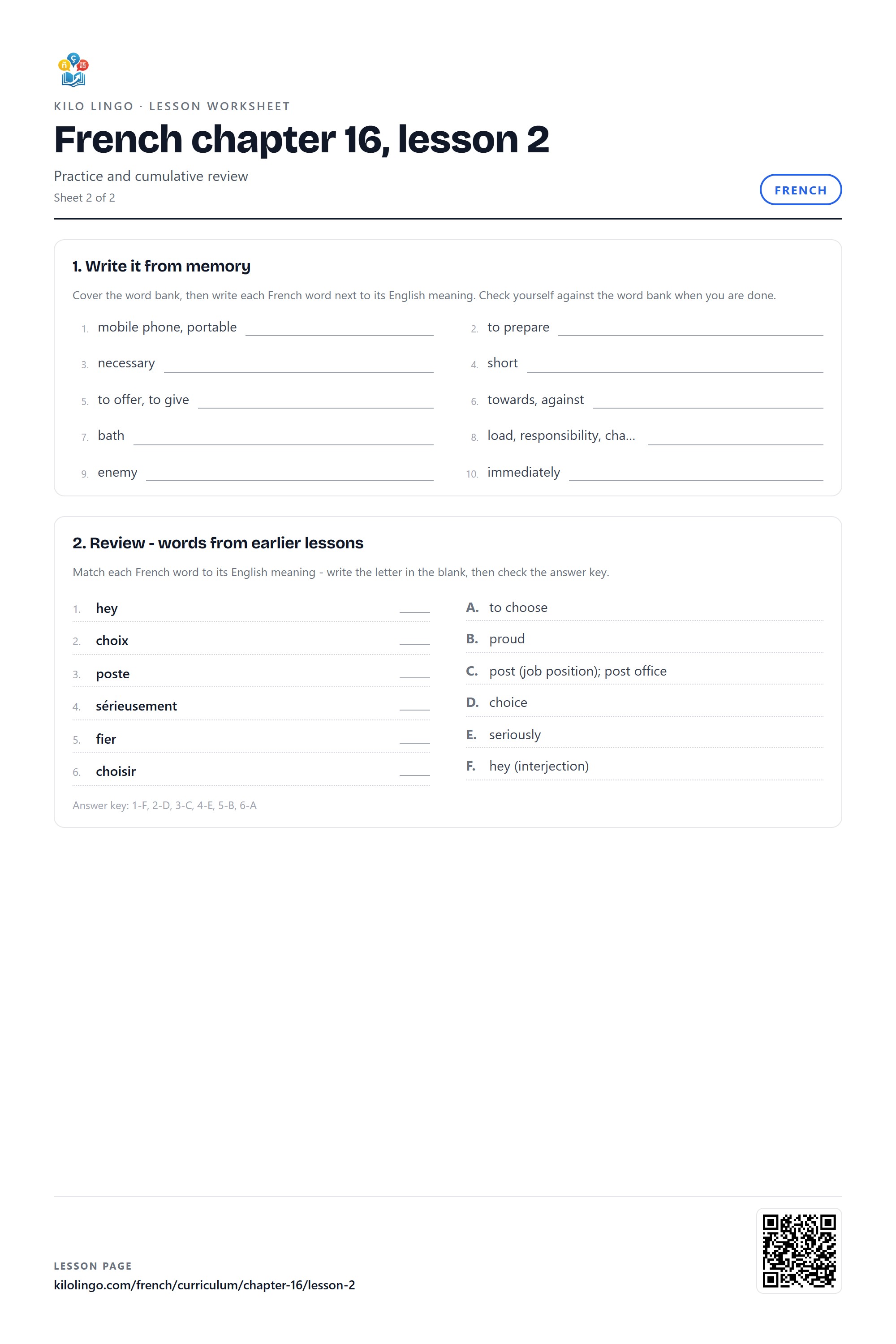
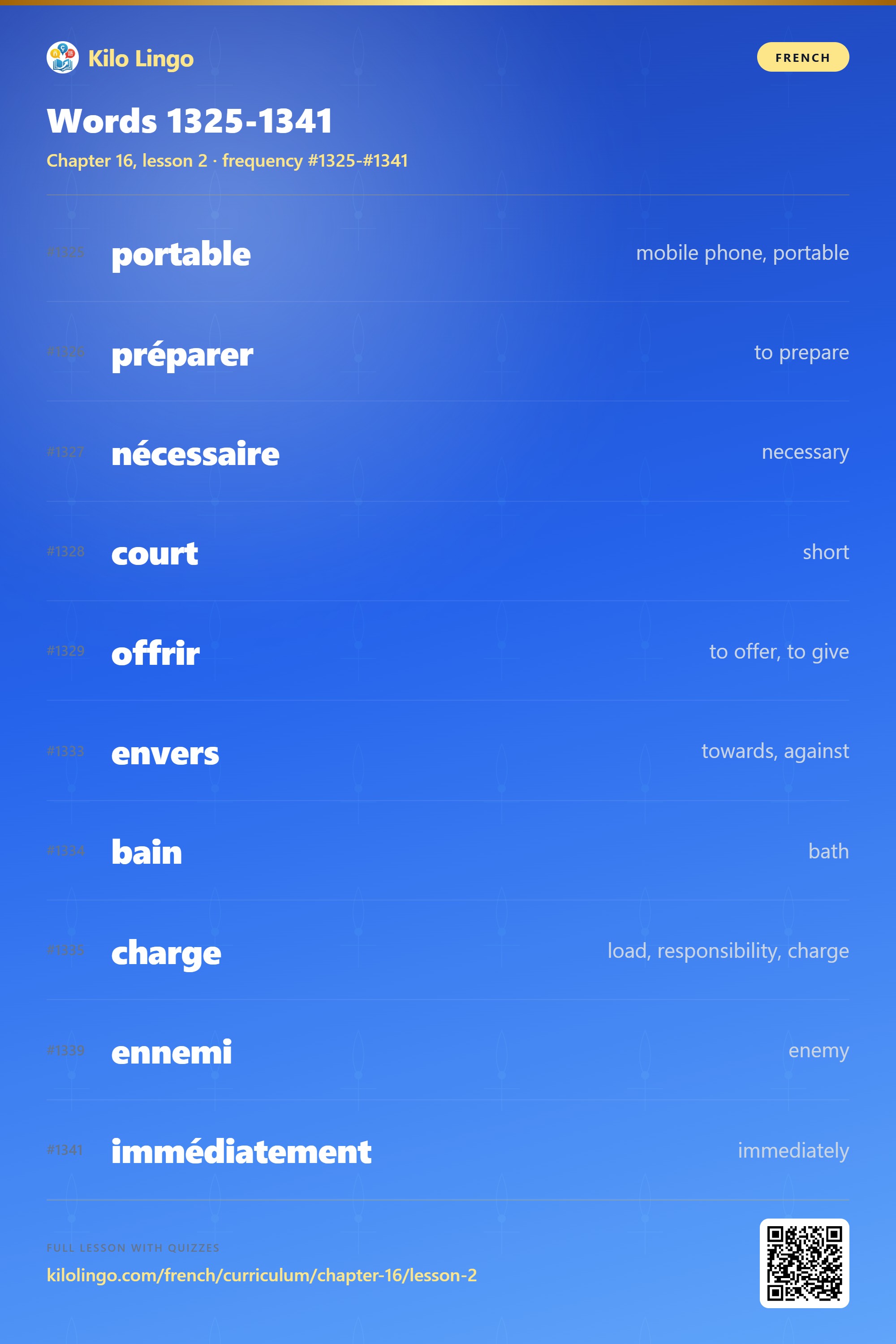
- Words 1321-1330Vocabulary
10 words · ranks 1321-1330
- Word Bubbles review sessionReview games
Pop the words you just met by matching each one to its meaning. A couple of rounds and the batch is yours.
- Words 1331-1340Vocabulary
10 words · ranks 1331-1340
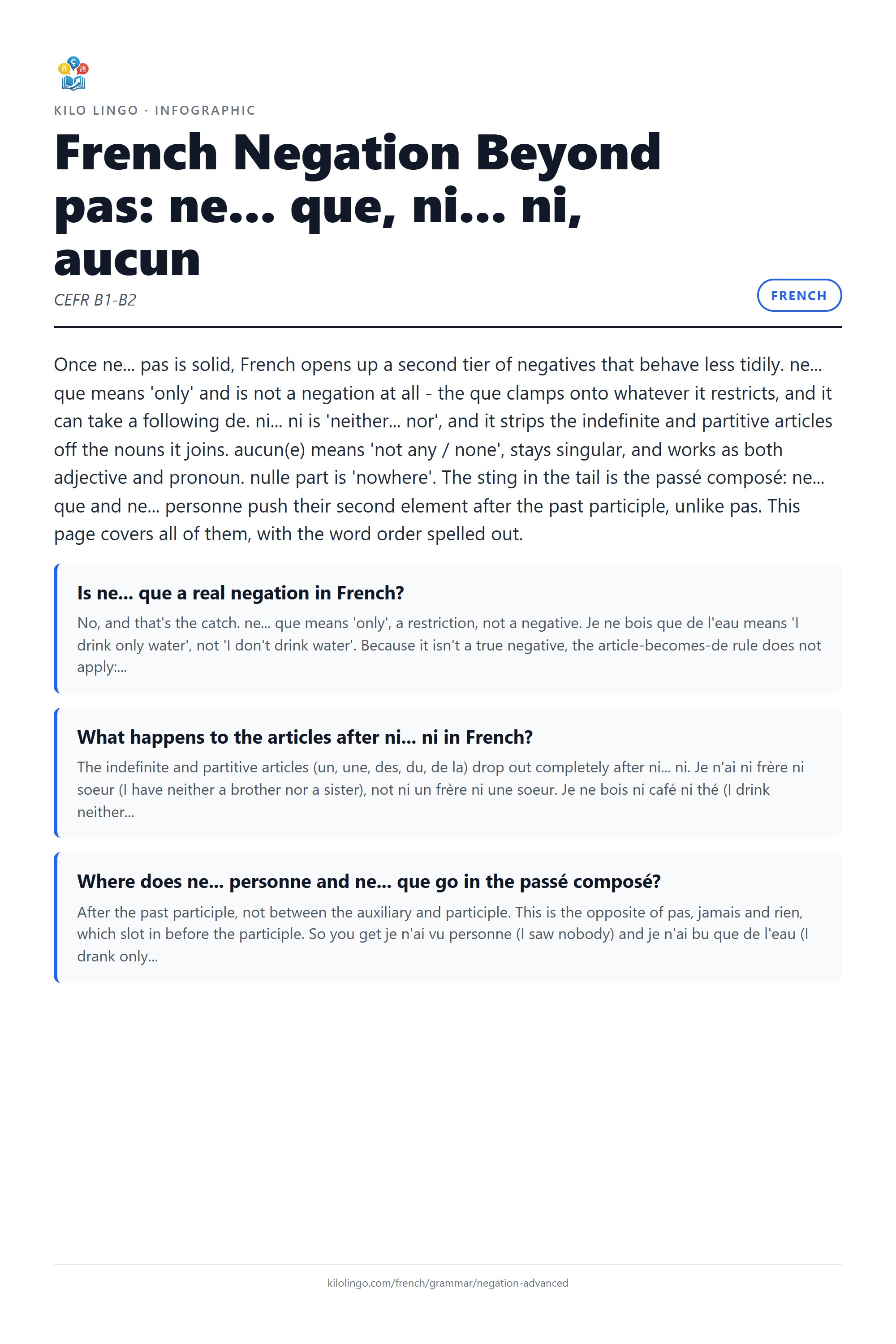
ne... que for 'only' (and why it isn't a true negative), ni... ni for 'neither... nor' with its dropped articles, aucun(e) always singular, nulle part, and where each piece lands in the passe compose.
- neuf or nouveau?Mistake clinic
One means unused. The other means new to you, which is not the same claim.
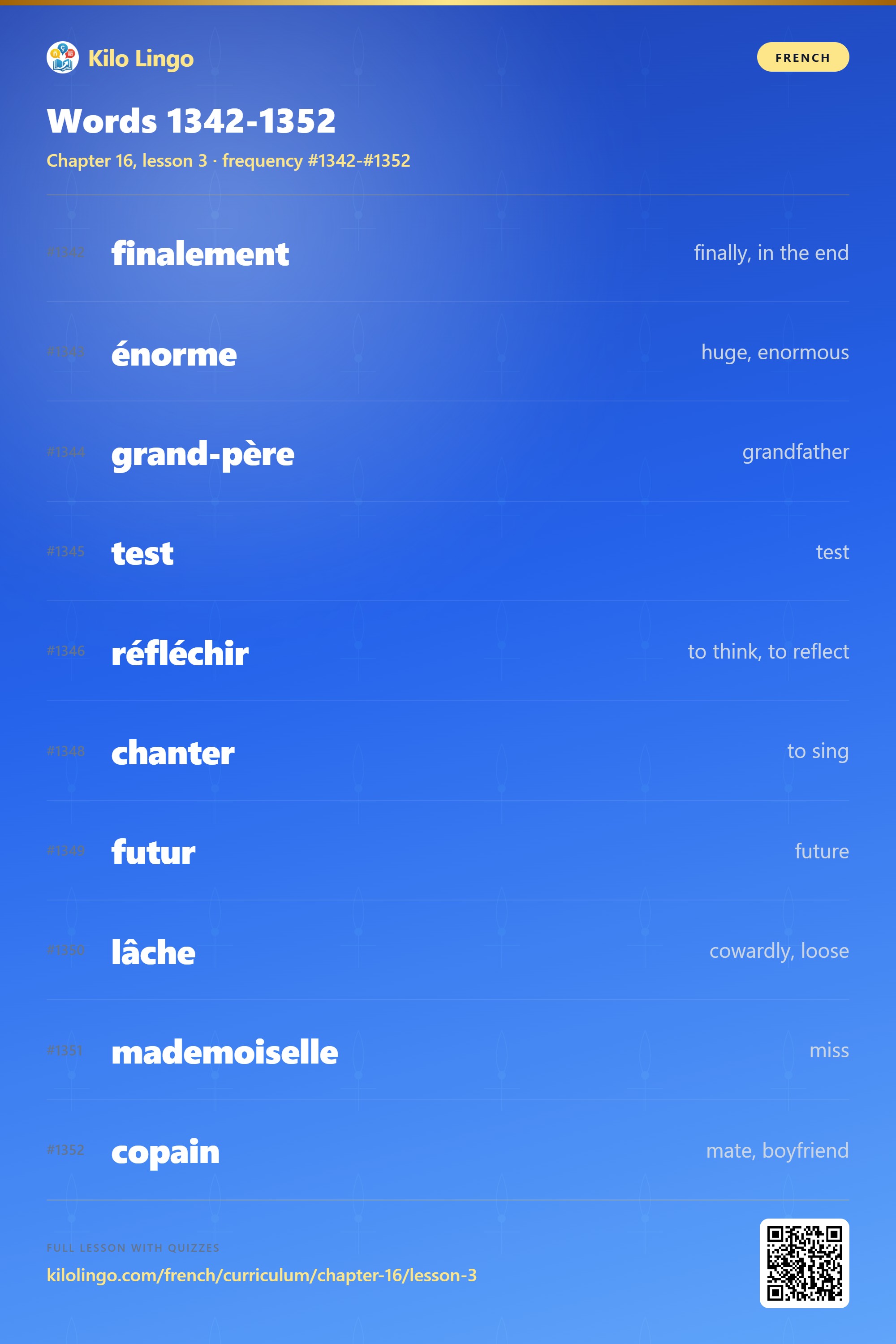
- Words 1341-1350Vocabulary
10 words · ranks 1341-1350
- Conjugation Sprint review sessionReview games
Sixty seconds on the endings of the verbs this chapter has drilled so far.
- Words 1351-1360Vocabulary
10 words · ranks 1351-1360
- Word Bubbles review sessionReview games
Pop the words you just met by matching each one to its meaning. A couple of rounds and the batch is yours.
- Words 1361-1370Vocabulary
10 words · ranks 1361-1370
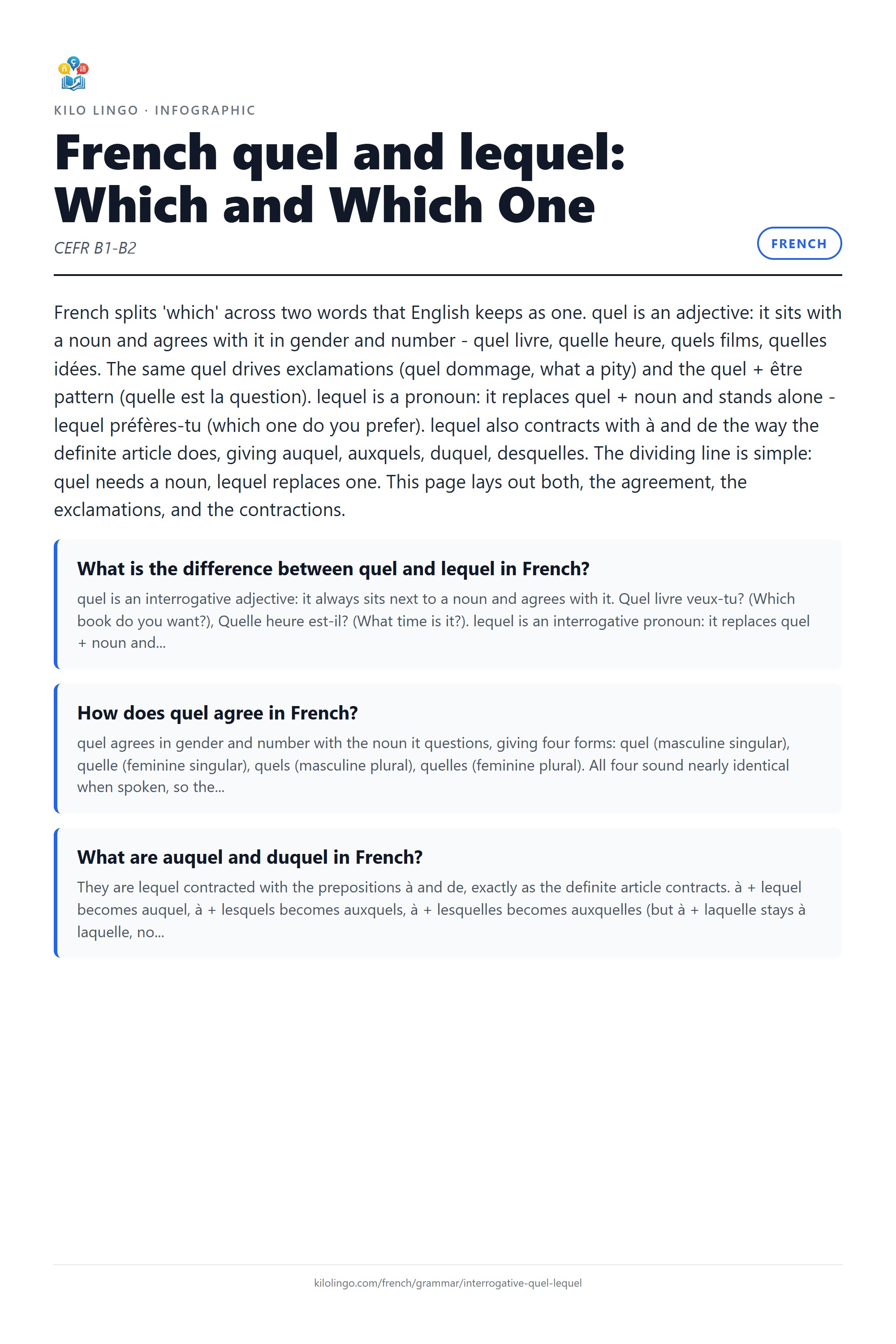
- Quel and lequelGrammar
quel as the interrogative adjective that agrees with its noun (Quelle heure ?), lequel as the pronoun that replaces quel + noun (Lequel ?), and the auquel / duquel contractions.
- Words 1371-1380Vocabulary
10 words · ranks 1371-1380
- Conjugation Sprint review sessionReview games
Sixty seconds on the endings of the verbs this chapter has drilled so far.
- Words 1381-1390Vocabulary
10 words · ranks 1381-1390
- Word Bubbles review sessionReview games
Pop the words you just met by matching each one to its meaning. A couple of rounds and the batch is yours.
- Words 1391-1400Vocabulary
10 words · ranks 1391-1400
- Story milestone: top 1400 wordsGraded-reader story
You can read this story using only the words you've learned so far. Every content word sits at or above the rank-1400 ceiling.
- À table, deuxième serviceThemed review
The meal fills out: fish, a knife to eat it with, and at last the word
restaurantitself. - Arcade reviewReview games
Replay this chapter's words as games - a different kind of repetition, and it counts.
Word printables
Per-word sheets100 words · a worksheet, infographic and listicle each
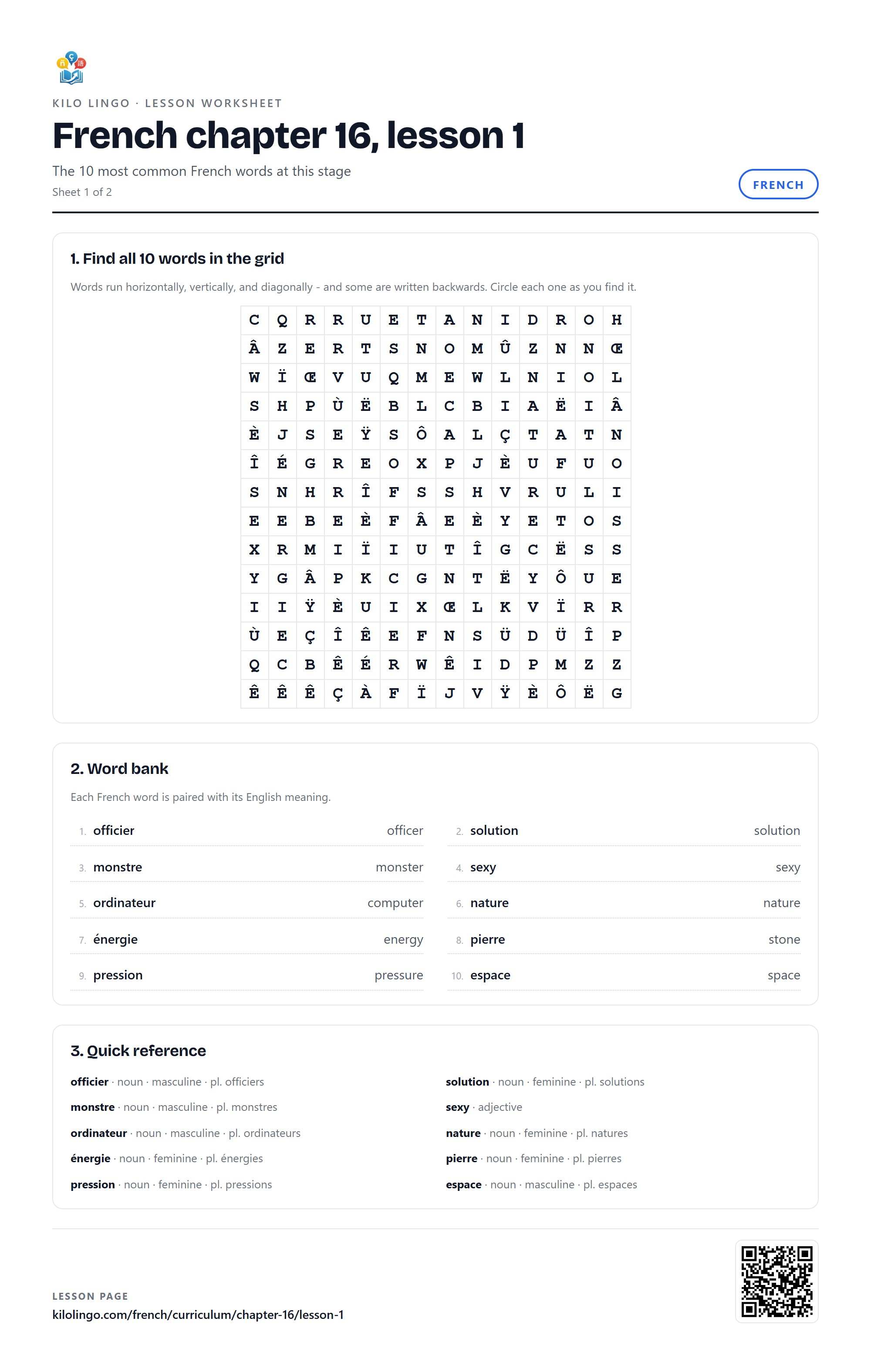
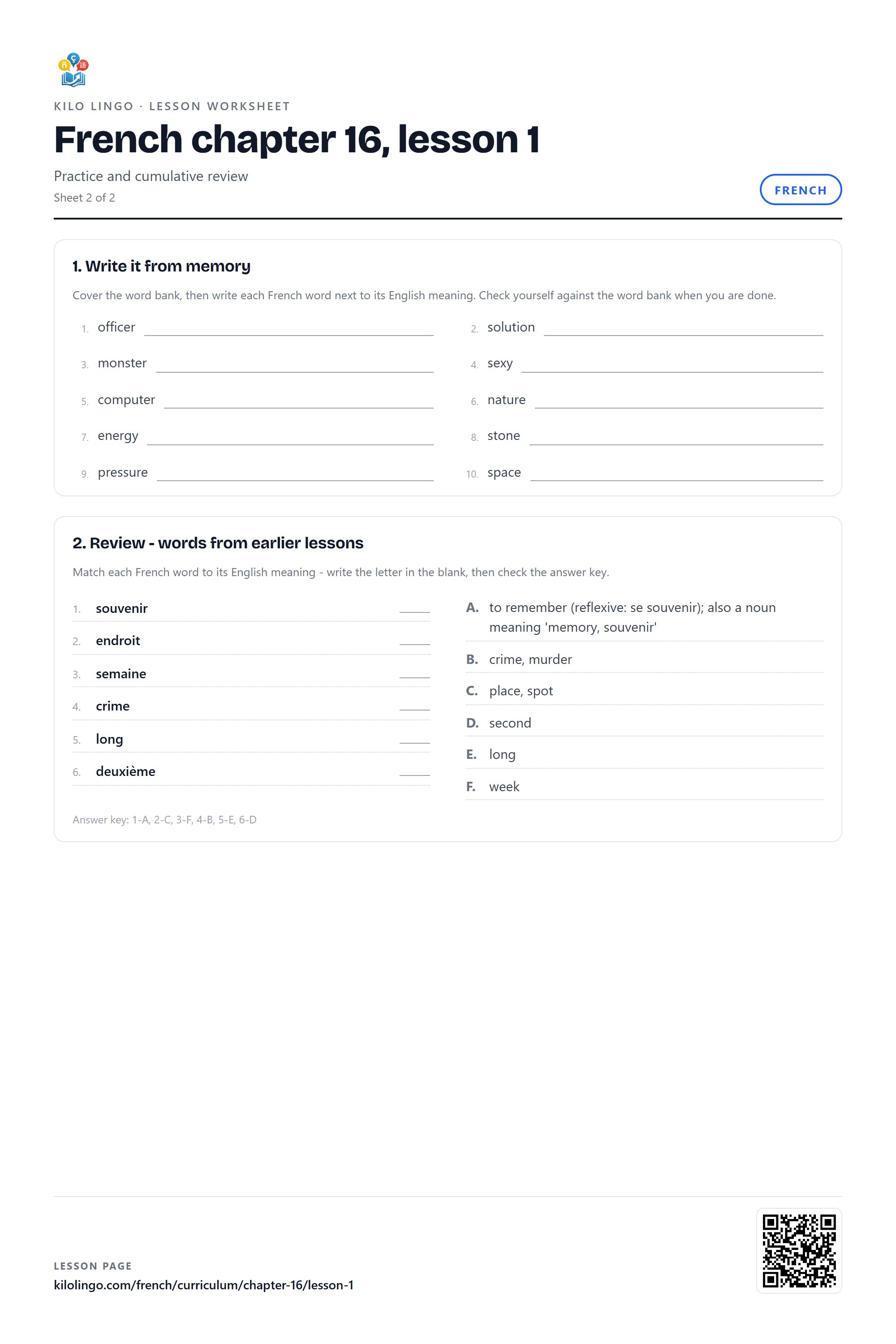

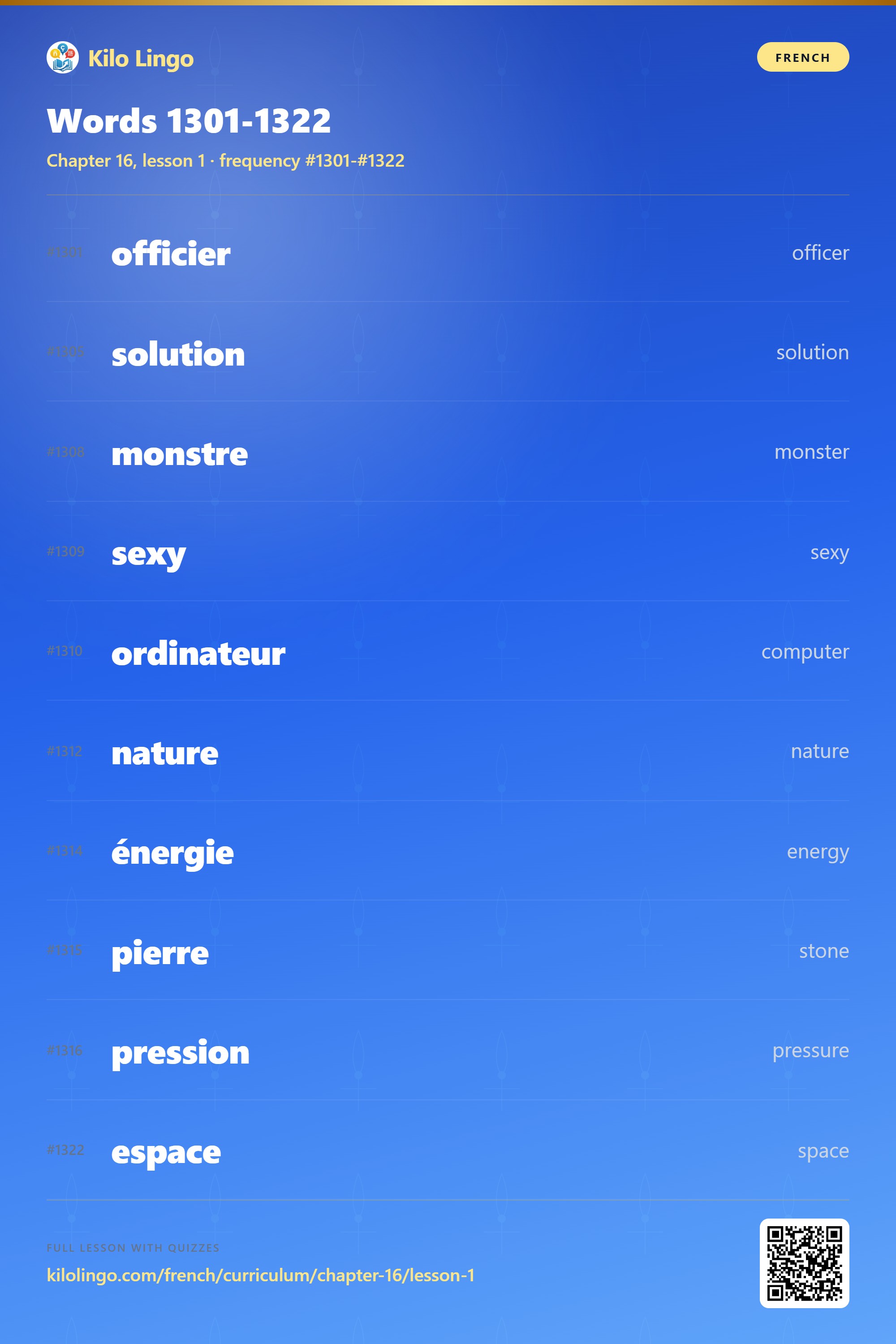
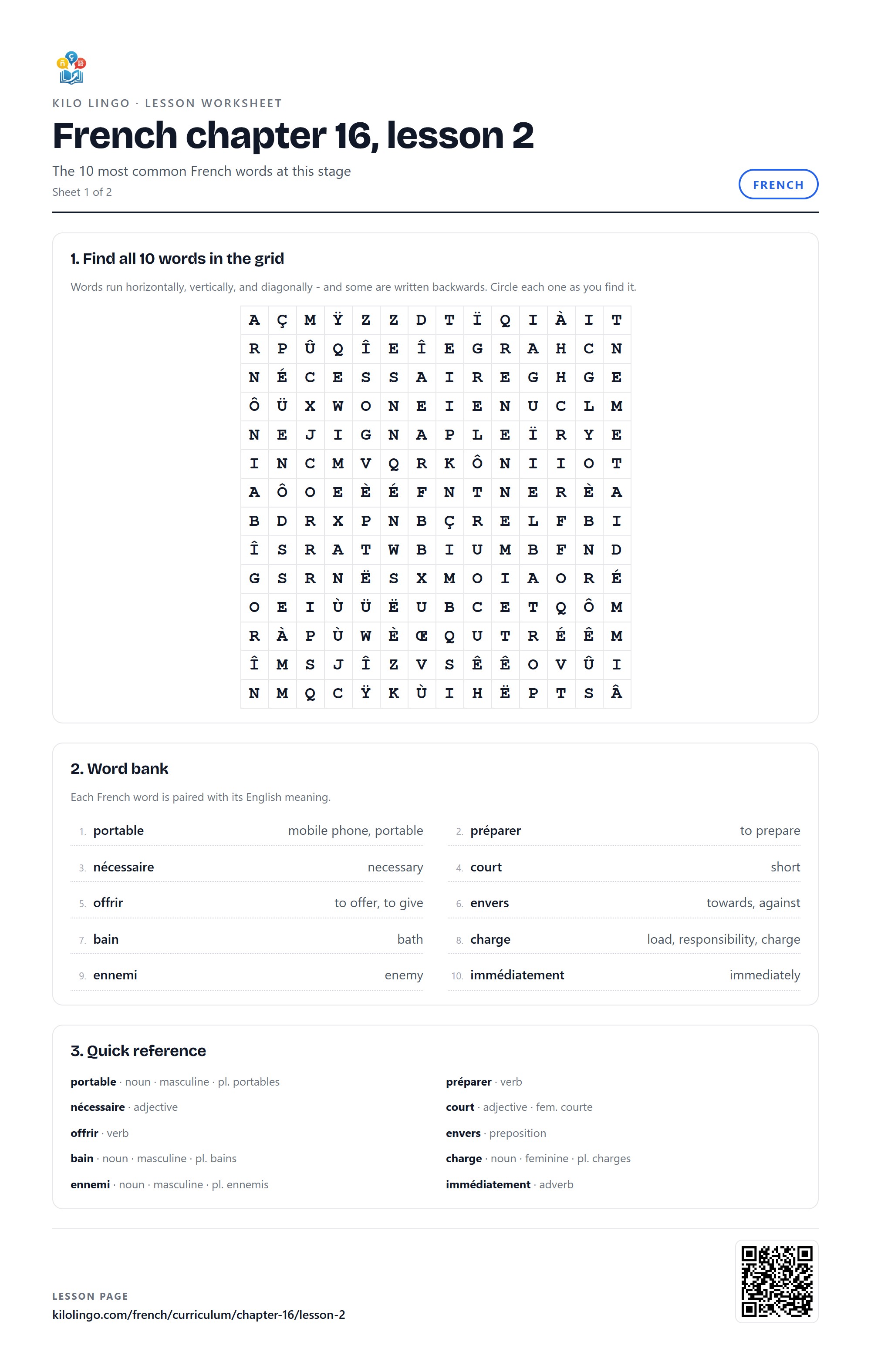



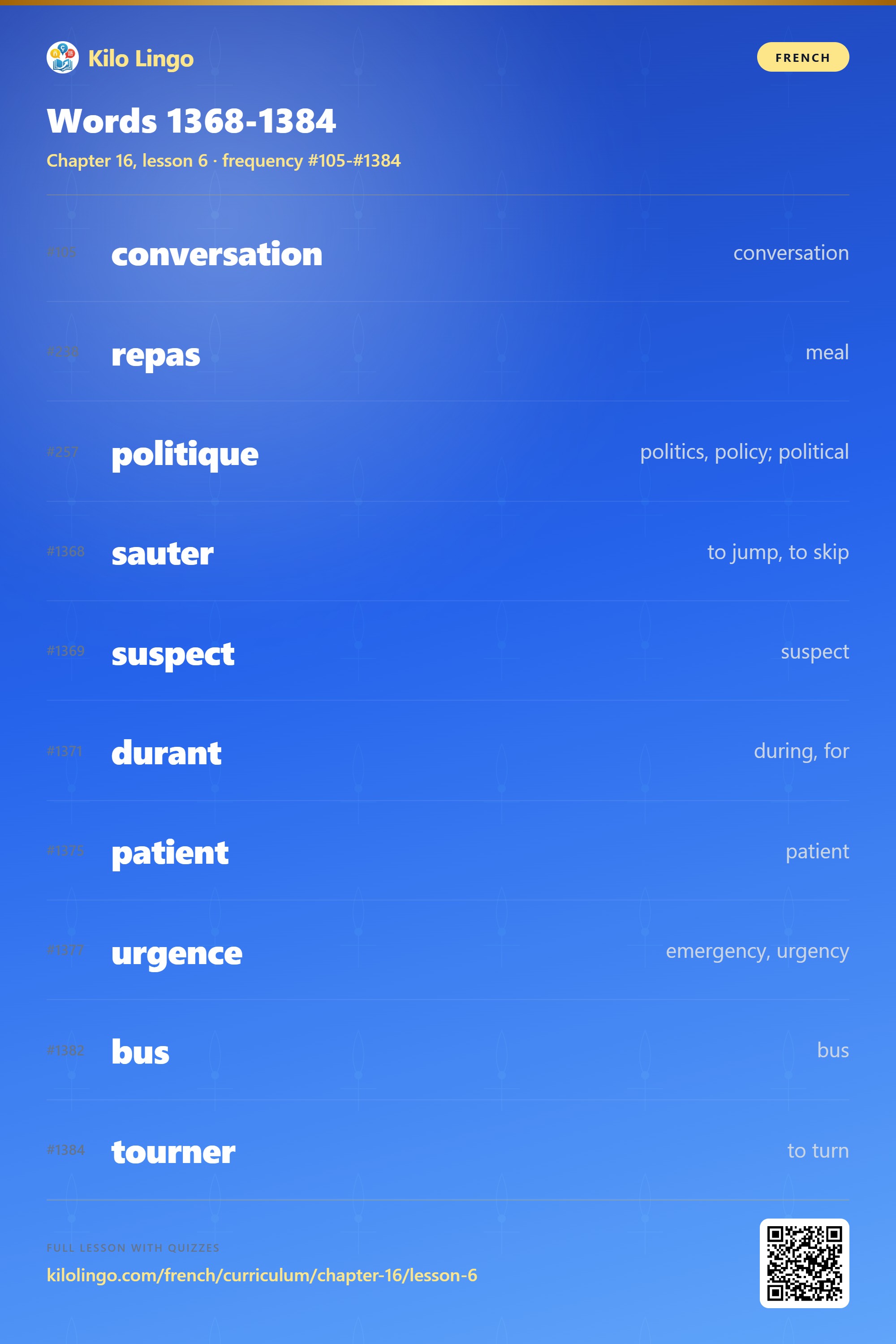
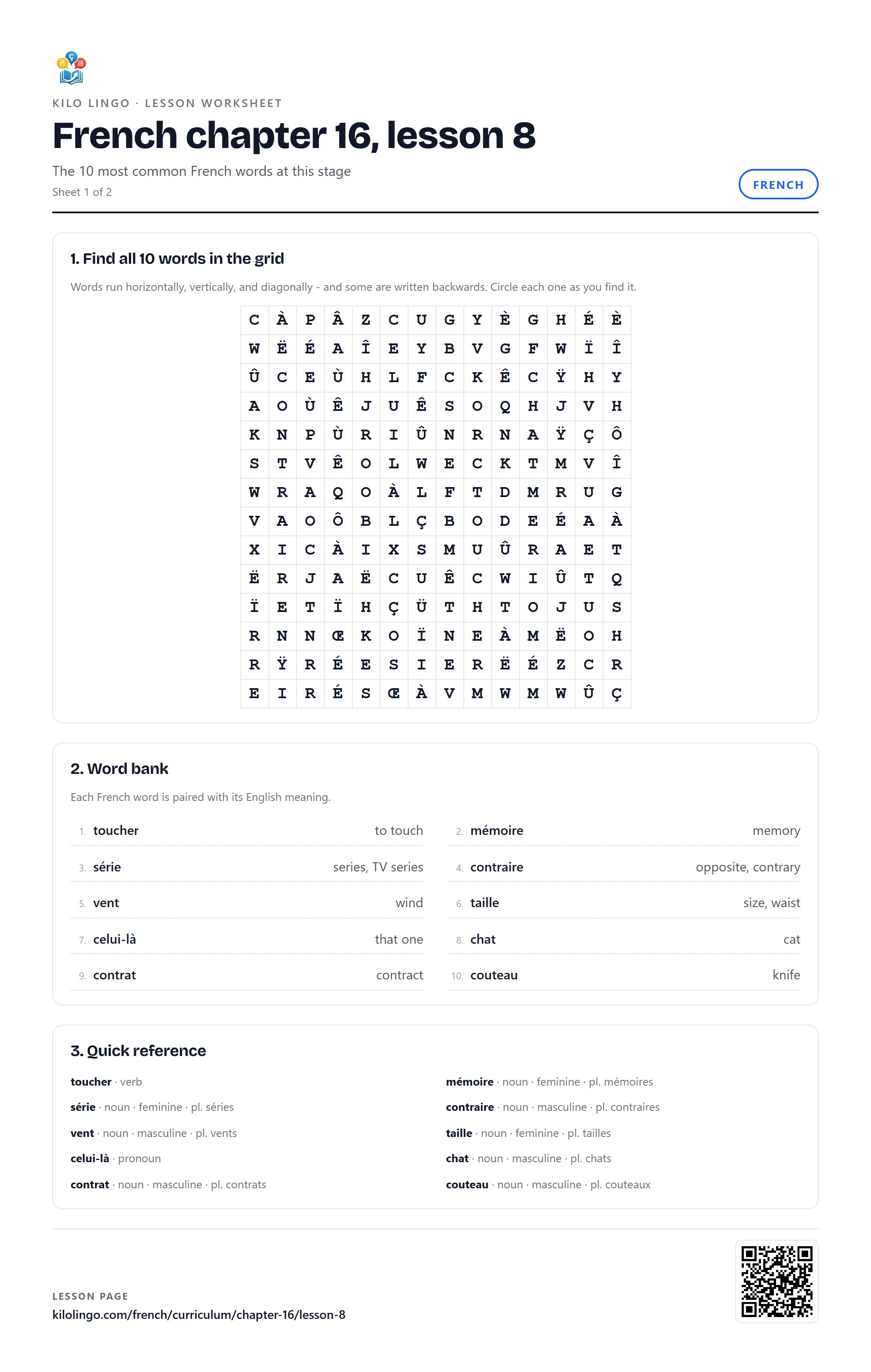
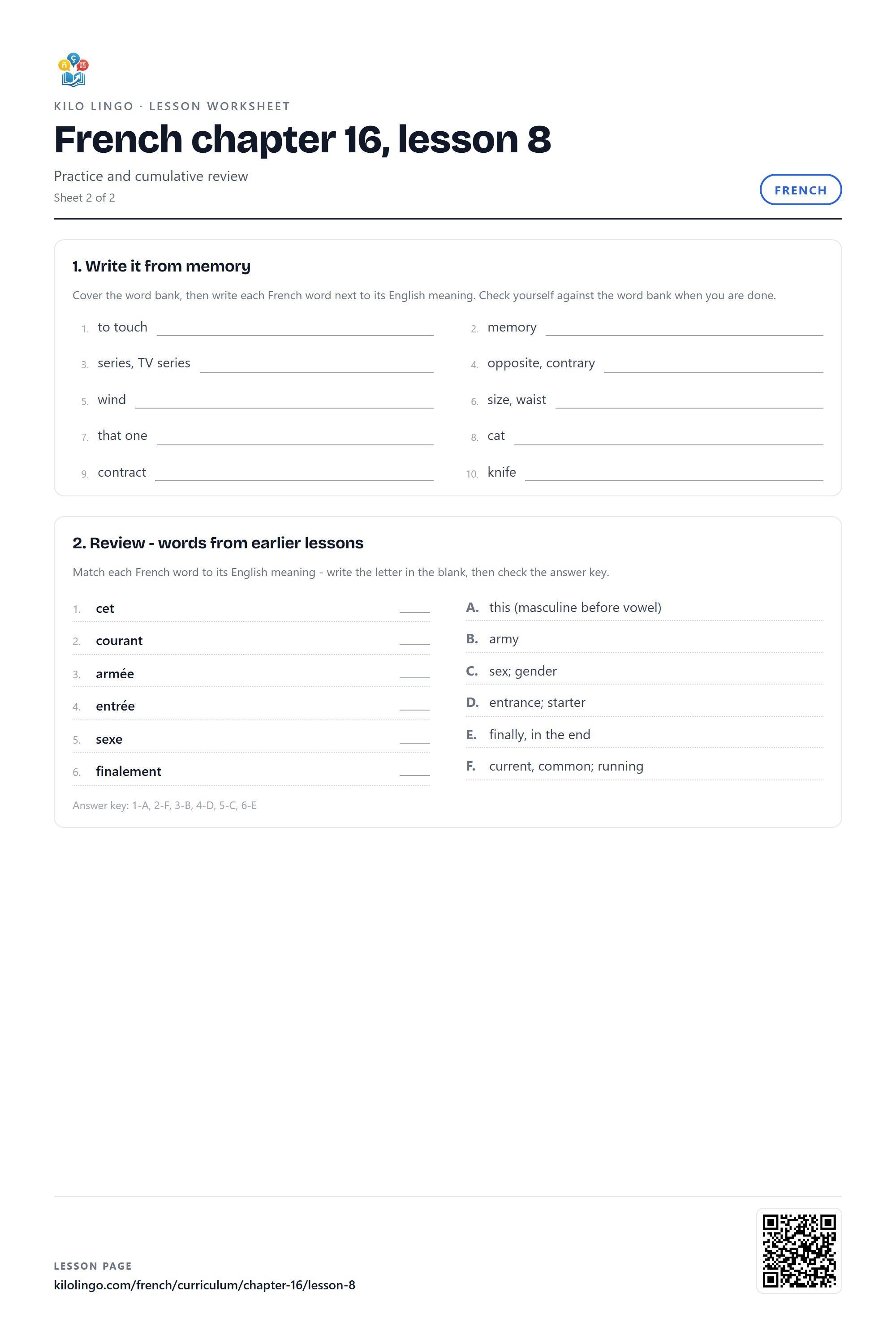

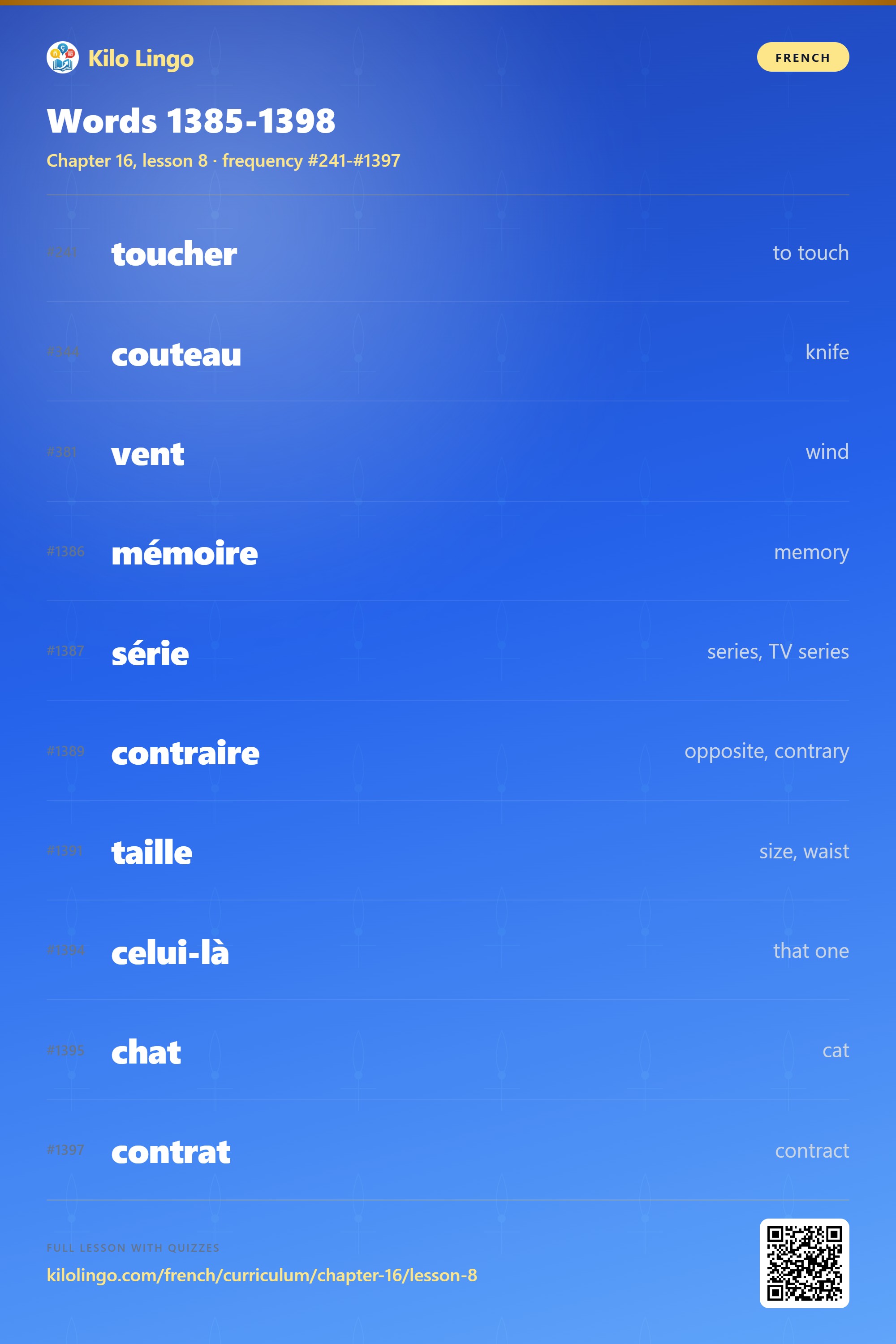
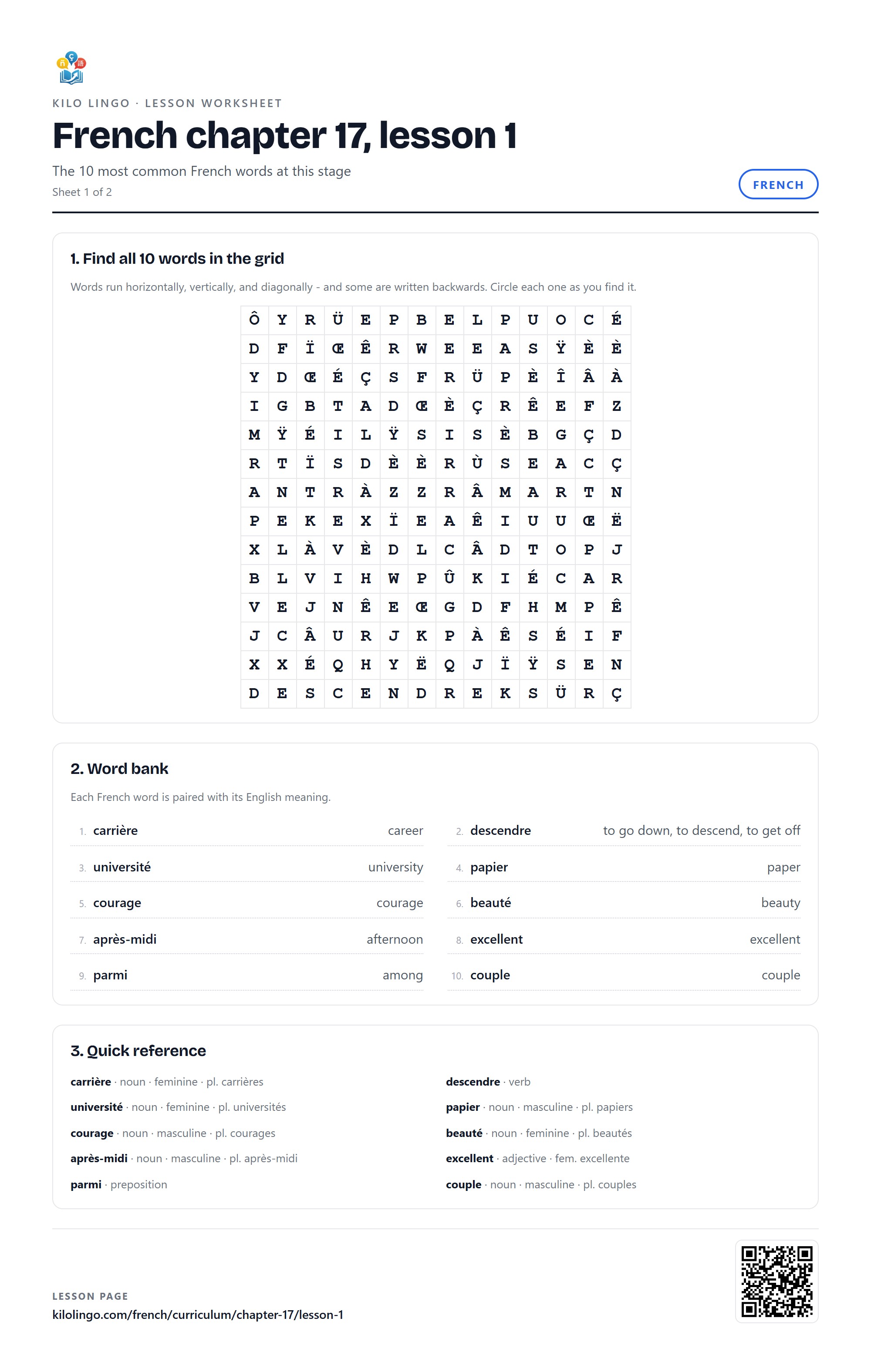
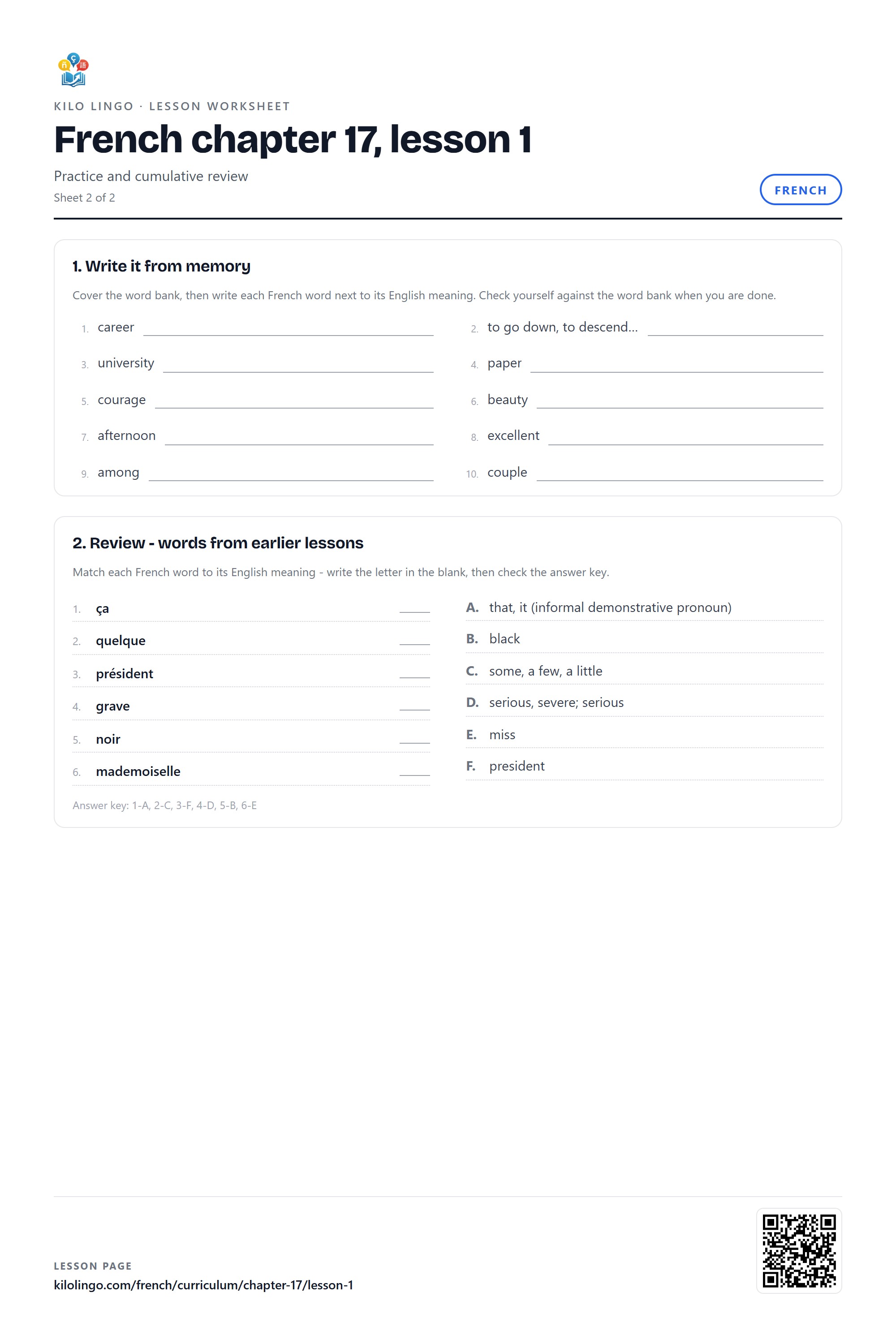
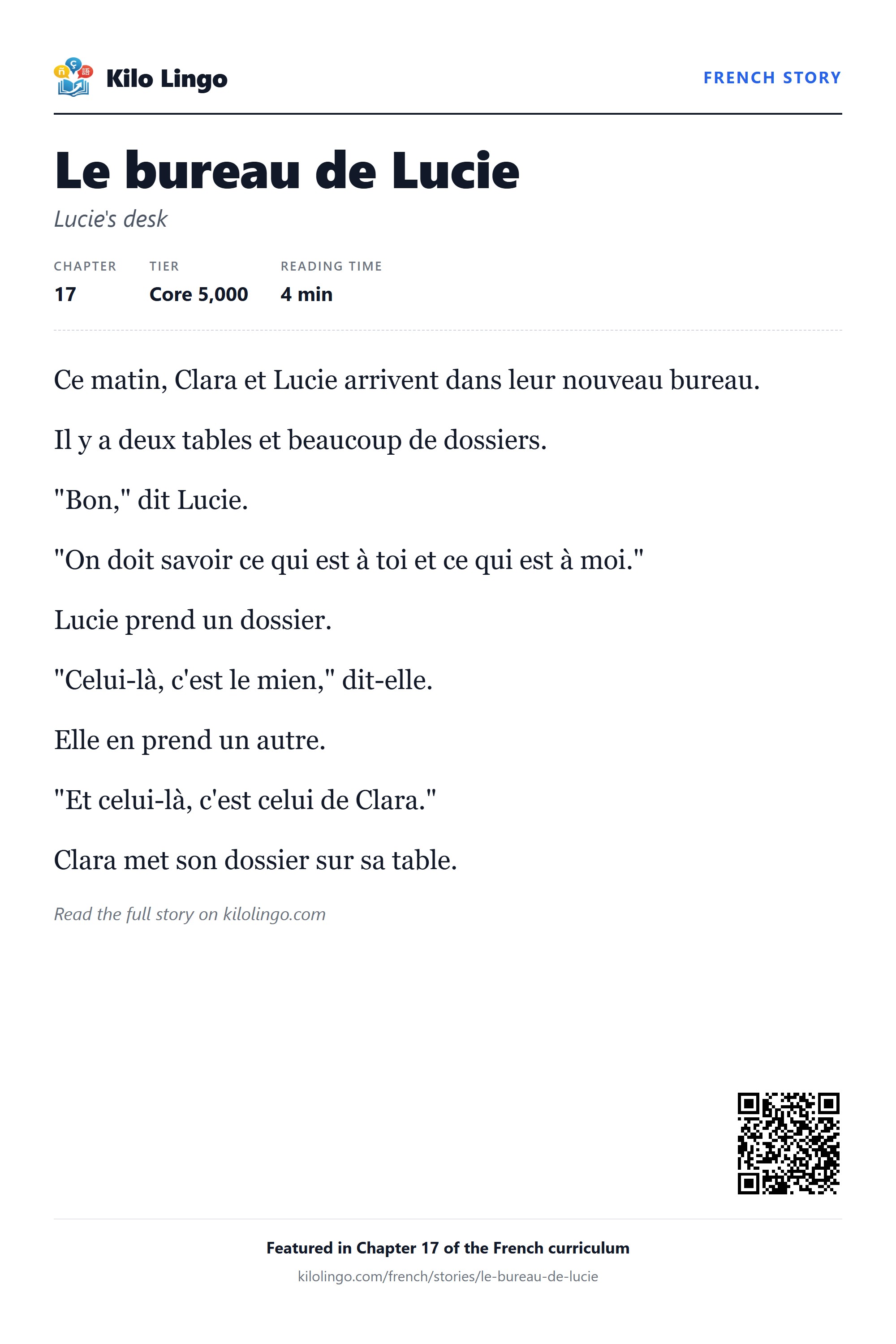
Chapter 17 · Demonstrative pronouns: celui, celle, ceux
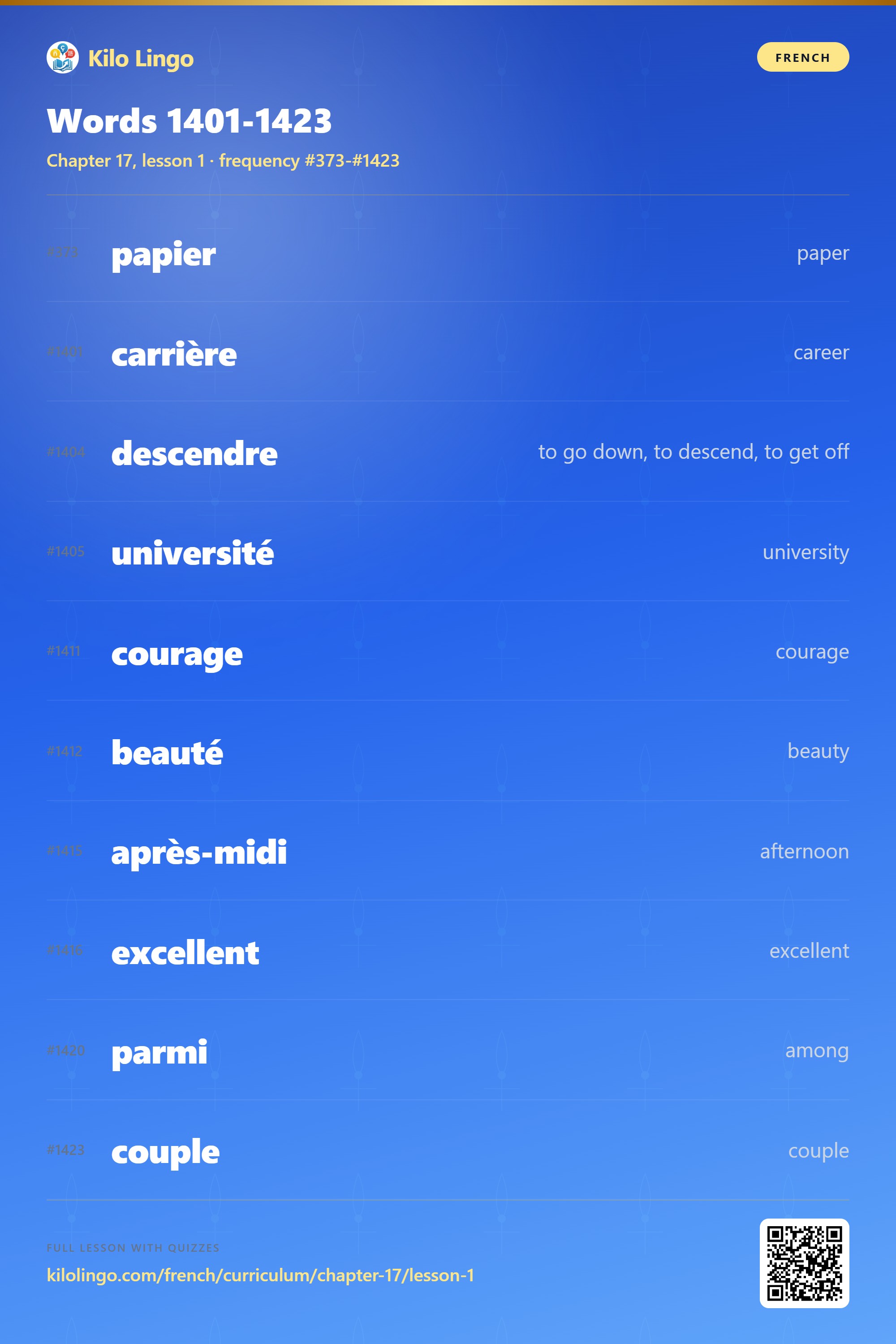
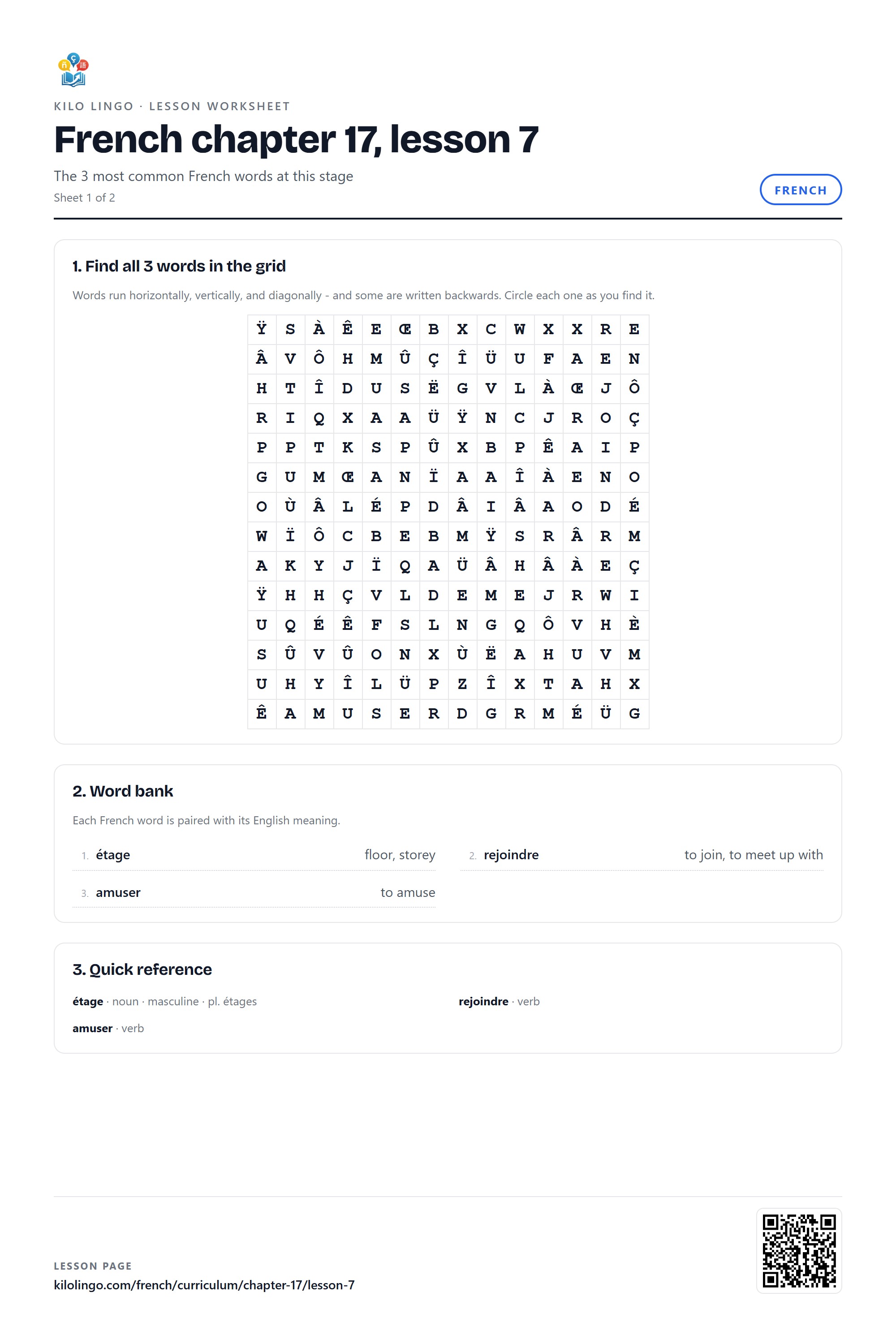
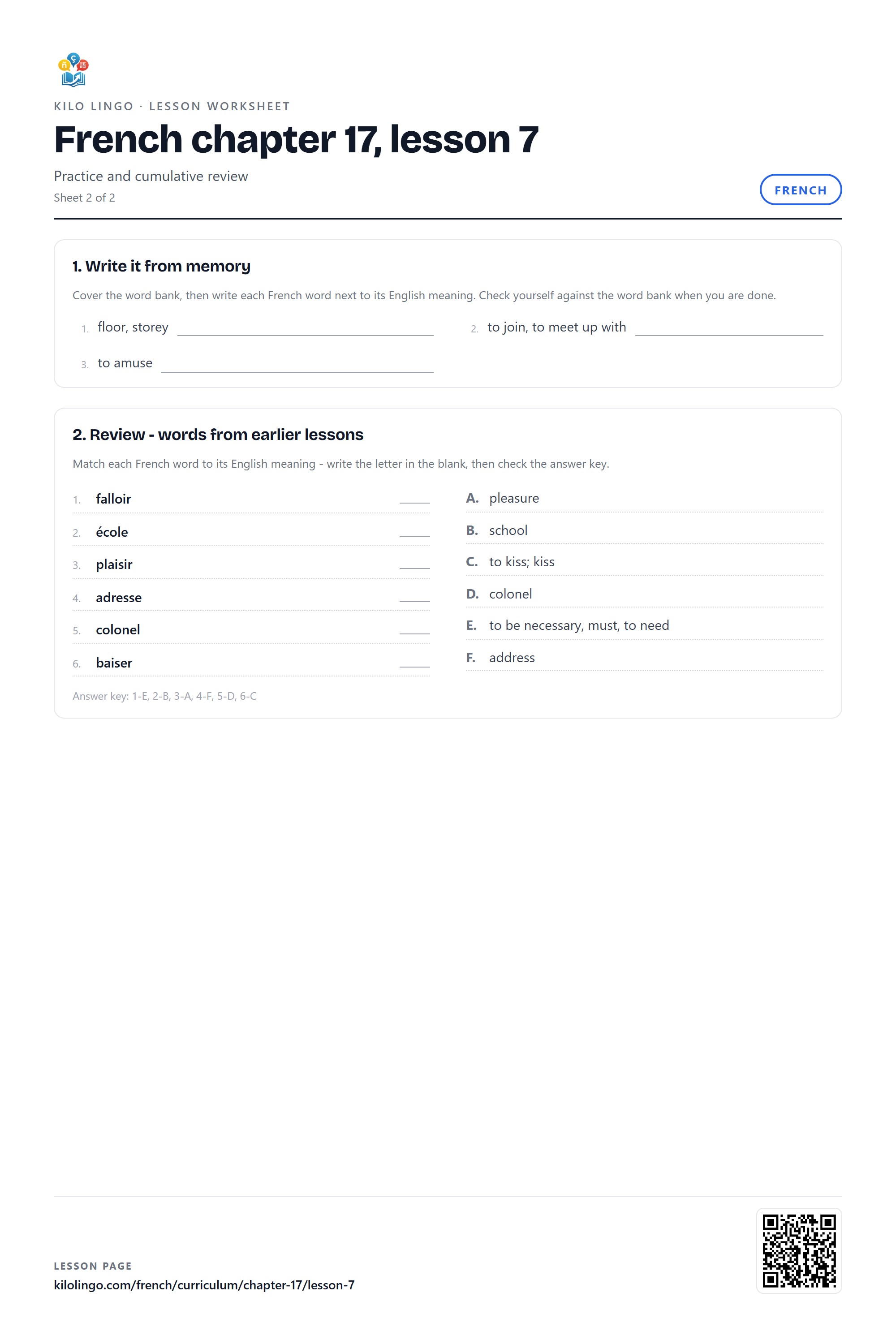
Chapter page →- Words 1401-1410Vocabulary
10 words · ranks 1401-1410
- Crossword review sessionReview games
Cross the words you just met, clued in English. Slower than a drill, and it sticks harder.
- Words 1411-1420Vocabulary
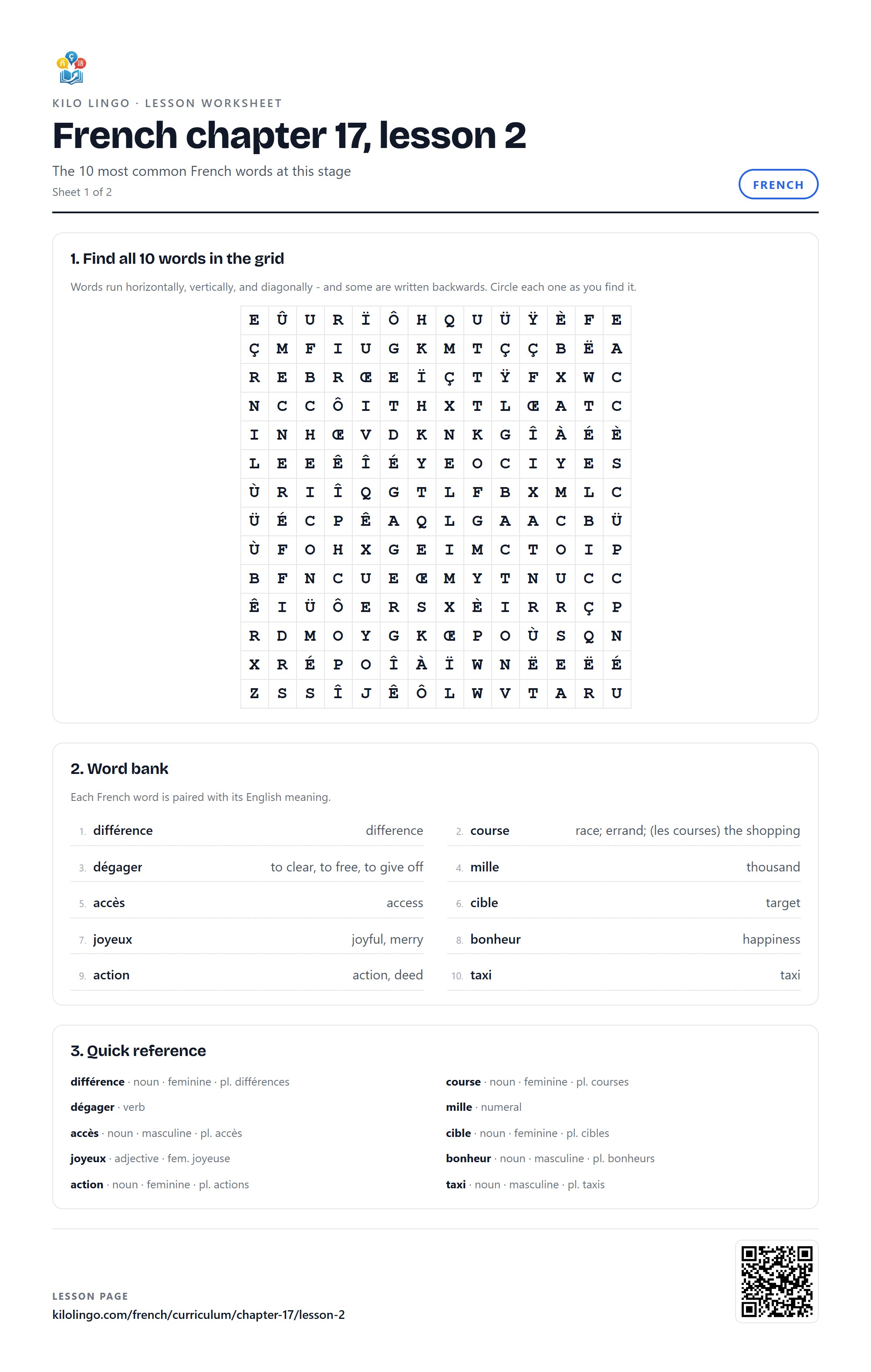
10 words · ranks 1411-1420
- Word Bubbles review sessionReview games
Pop the words you just met by matching each one to its meaning. A couple of rounds and the batch is yours.
- Words 1421-1430Vocabulary
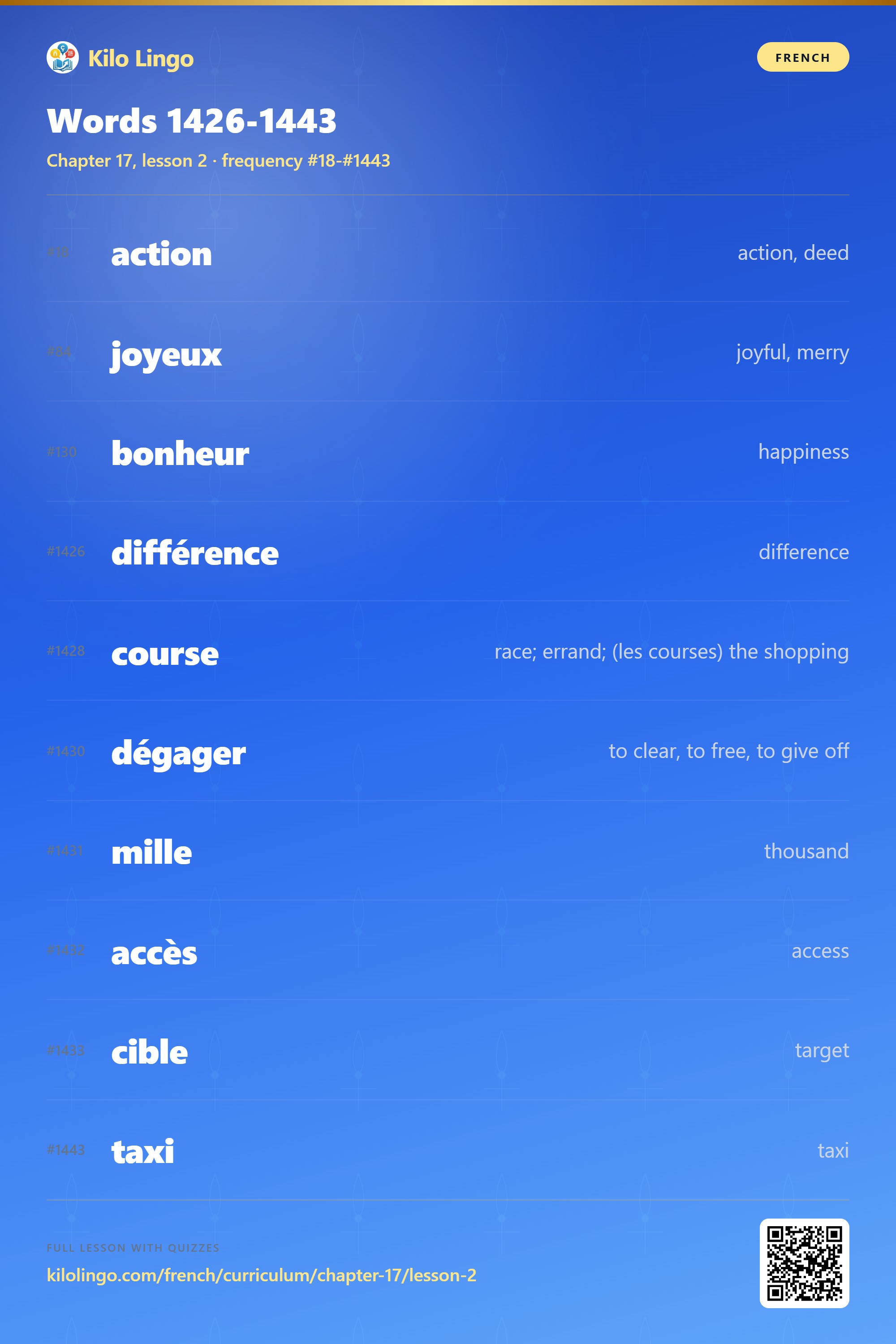
10 words · ranks 1421-1430
- Conjugation Sprint review sessionReview games
Sixty seconds on the endings of the verbs this chapter has drilled so far.
- Words 1431-1440Vocabulary
10 words · ranks 1431-1440
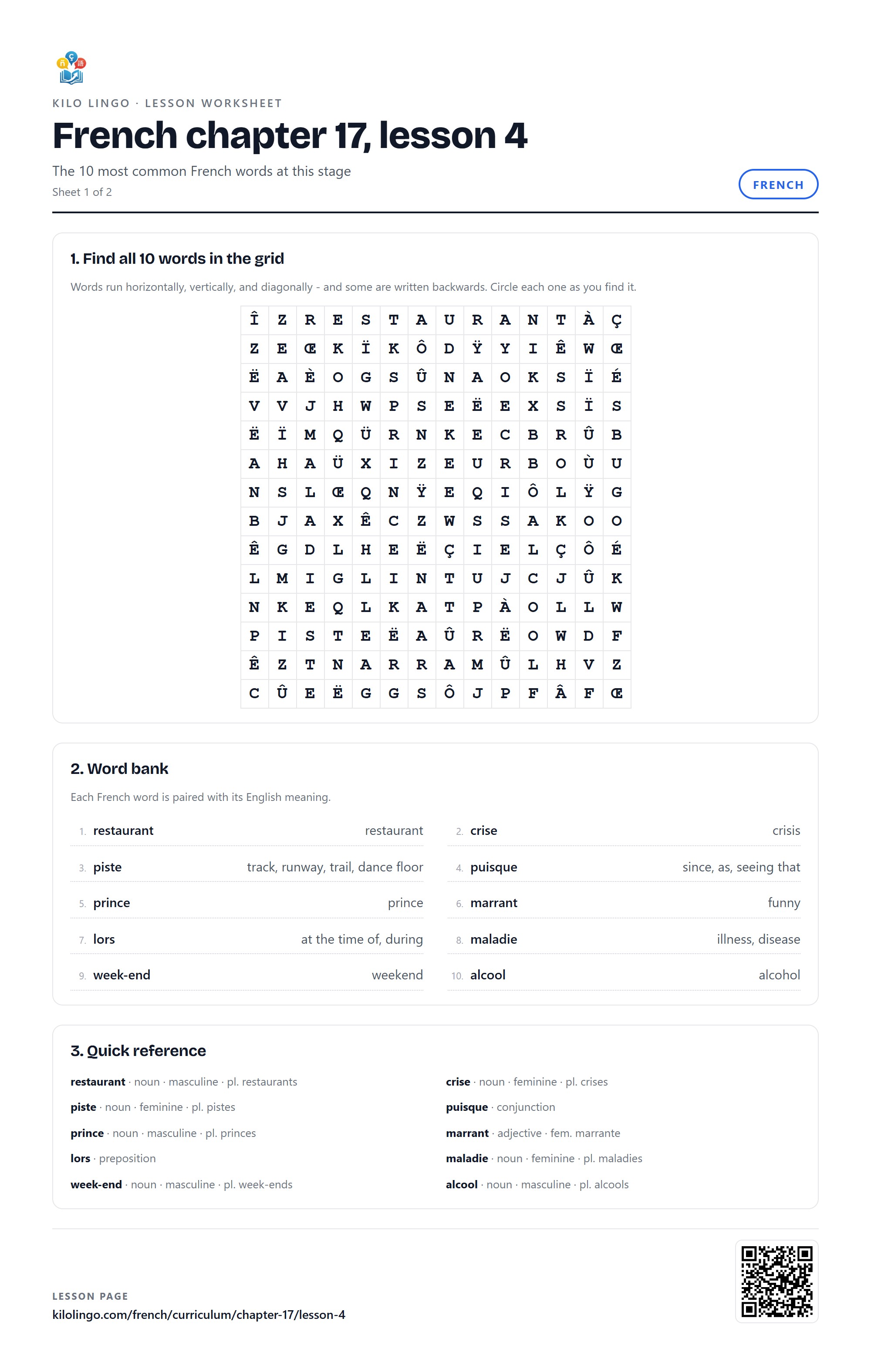
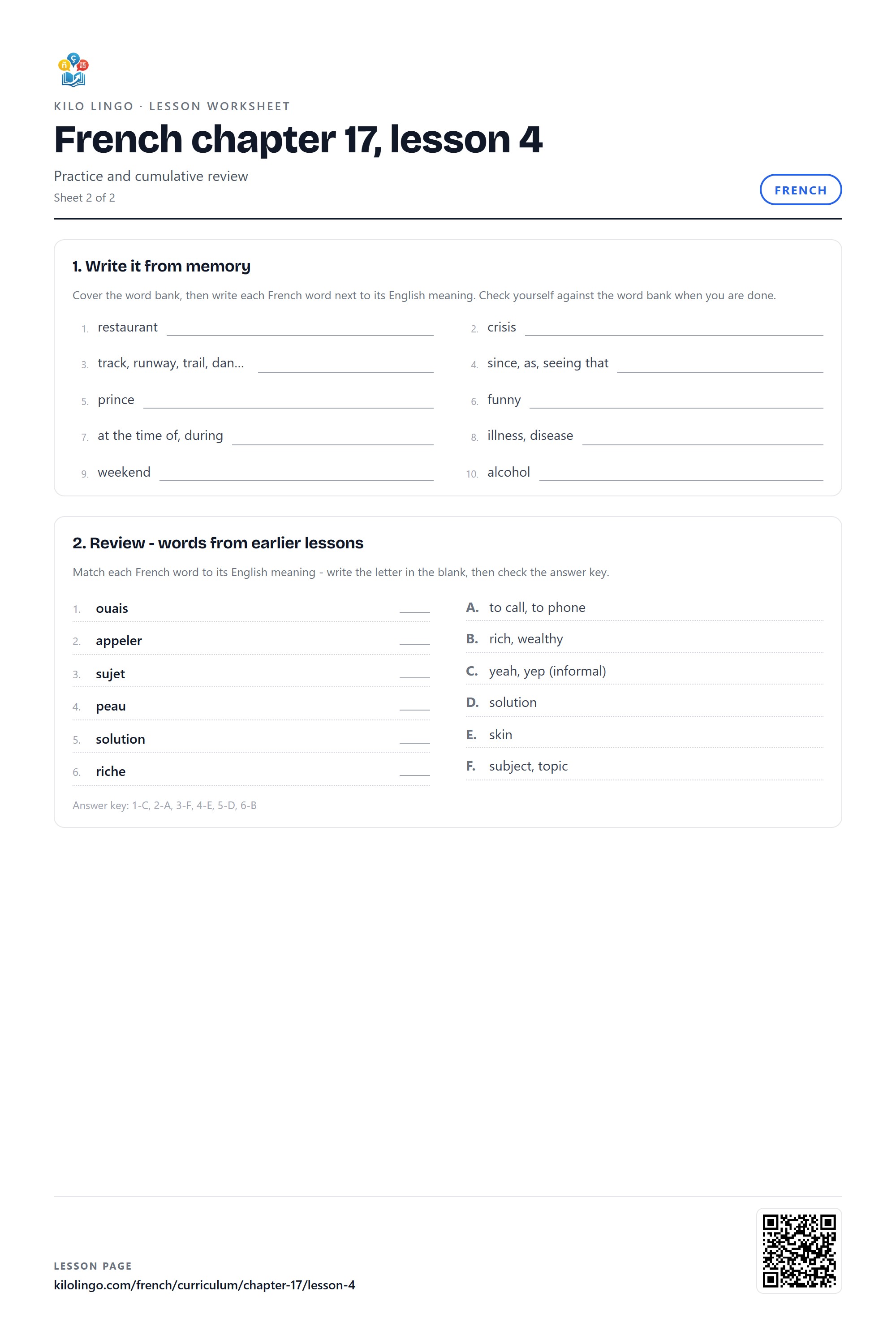
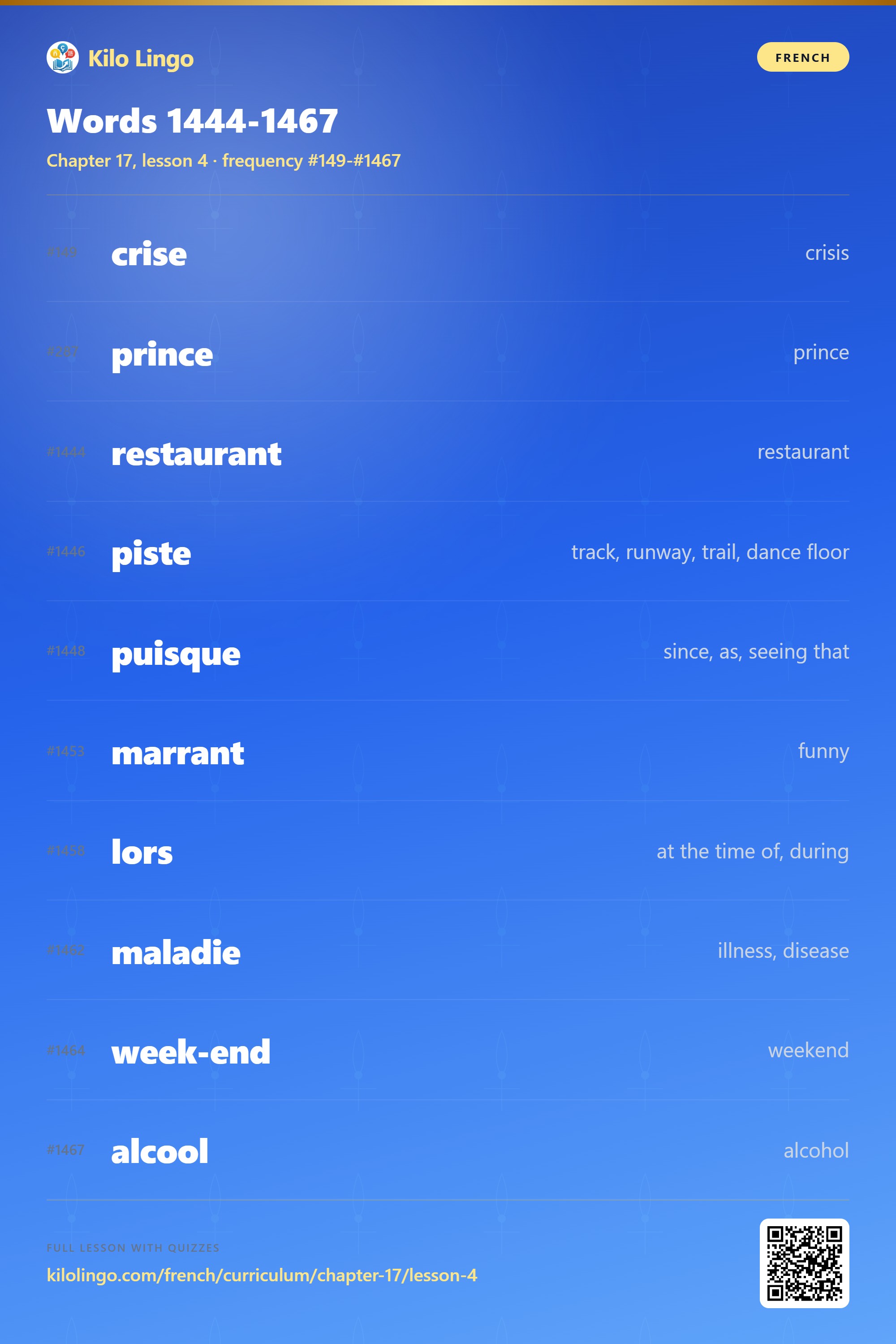
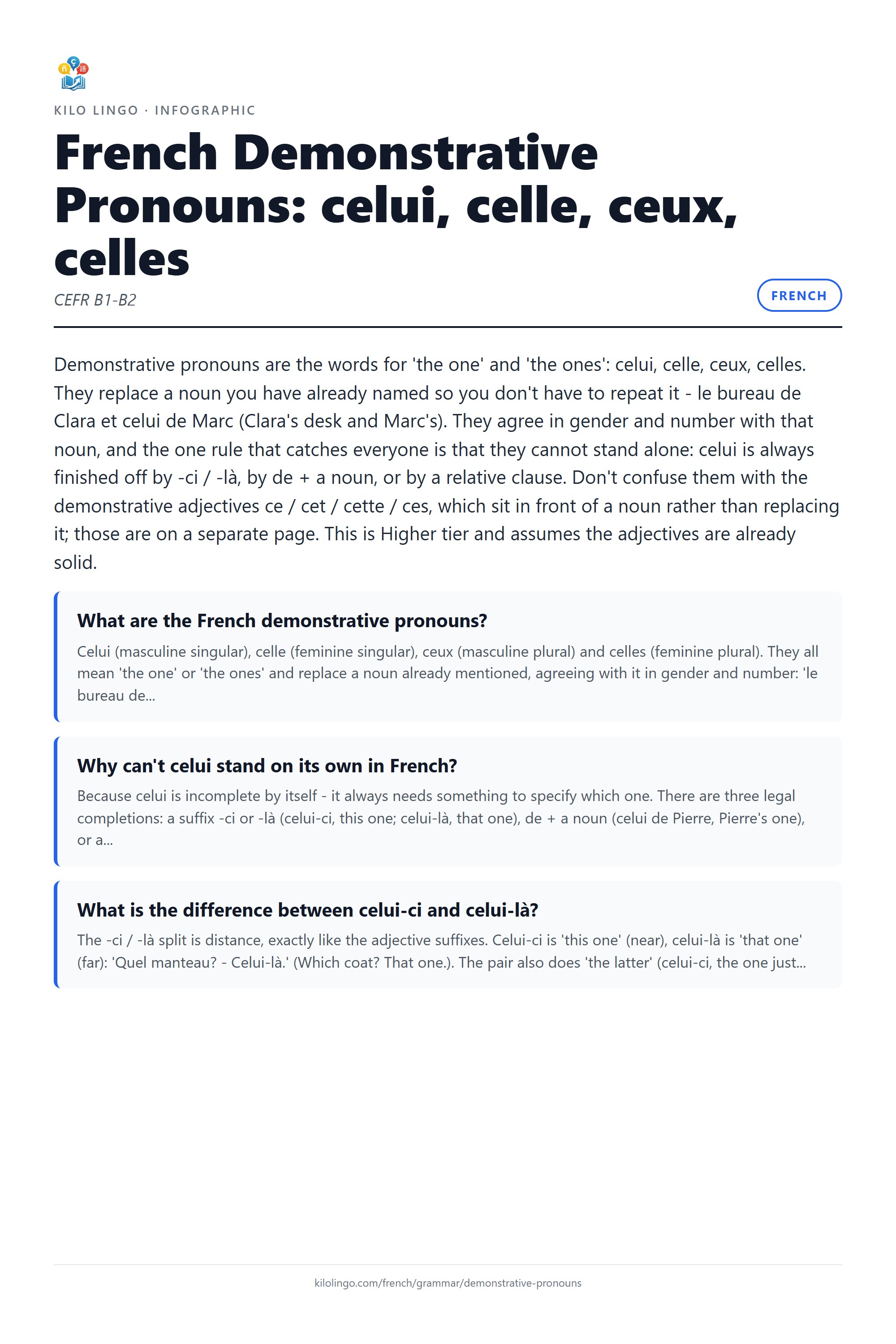
celui / celle / ceux / celles for 'the one(s)', completed by -ci / -la, by de + noun (celui de Marc), or by a relative clause (celui qui parle), plus the neuter ceci / cela / ca.
- aussi or non plus?Mistake clinic
One agrees with a yes. The other agrees with a no.
- Words 1441-1450Vocabulary
10 words · ranks 1441-1450
- Word Bubbles review sessionReview games
Pop the words you just met by matching each one to its meaning. A couple of rounds and the batch is yours.
- Words 1451-1460Vocabulary
10 words · ranks 1451-1460
- Conjugation Sprint review sessionReview games
Sixty seconds on the endings of the verbs this chapter has drilled so far.
- Words 1461-1470Vocabulary
10 words · ranks 1461-1470
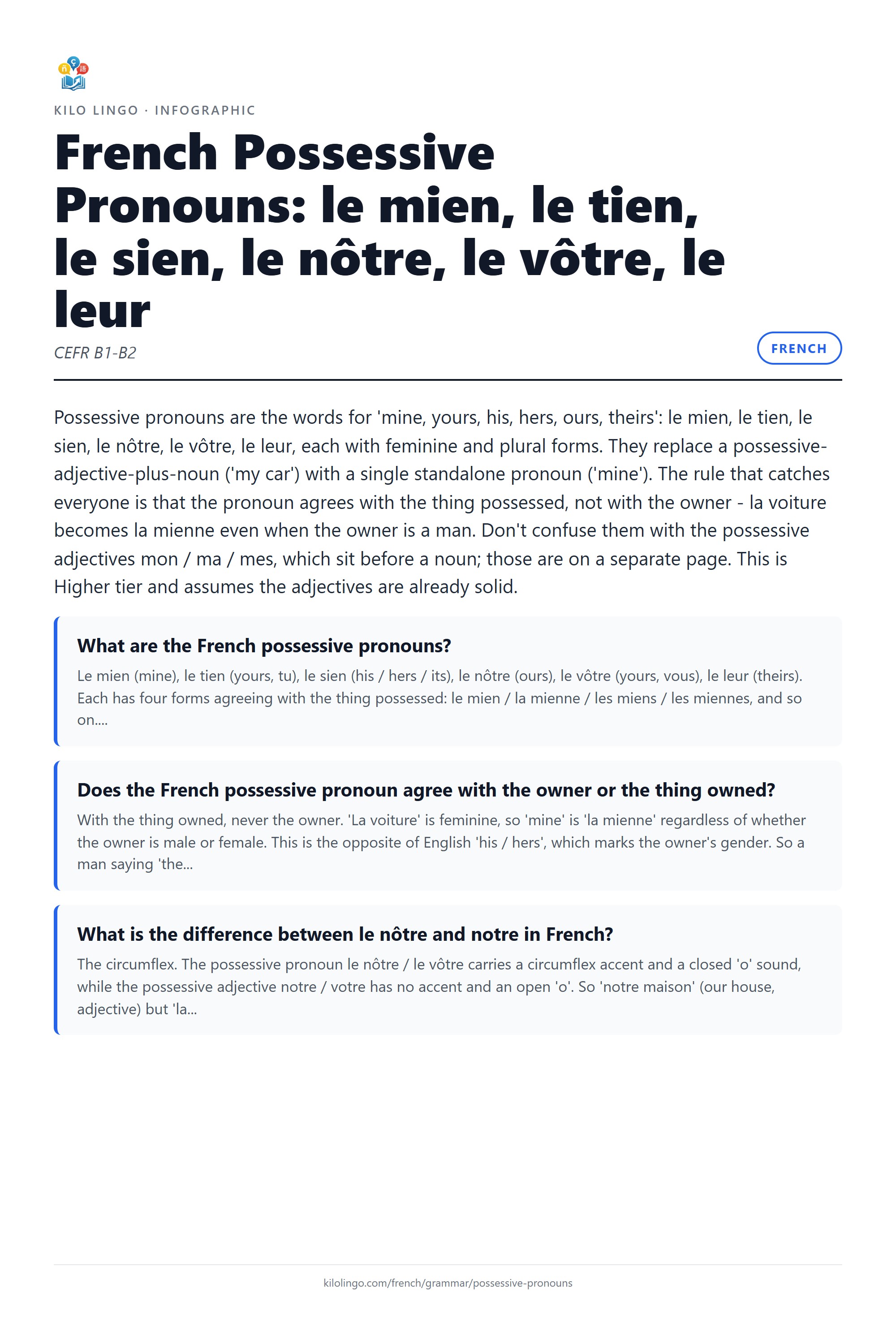
le mien / la mienne / les miens through le leur for 'mine, yours, theirs'. The pronoun agrees with the thing owned, the circumflex on le notre / le votre, and c'est a moi vs c'est le mien.
- Words 1471-1480Vocabulary
10 words · ranks 1471-1480
- In a shopPhrase session
Buying something, and leaving without buying something.
- Words 1481-1490Vocabulary
10 words · ranks 1481-1490
- Word Bubbles review sessionReview games
Pop the words you just met by matching each one to its meaning. A couple of rounds and the batch is yours.
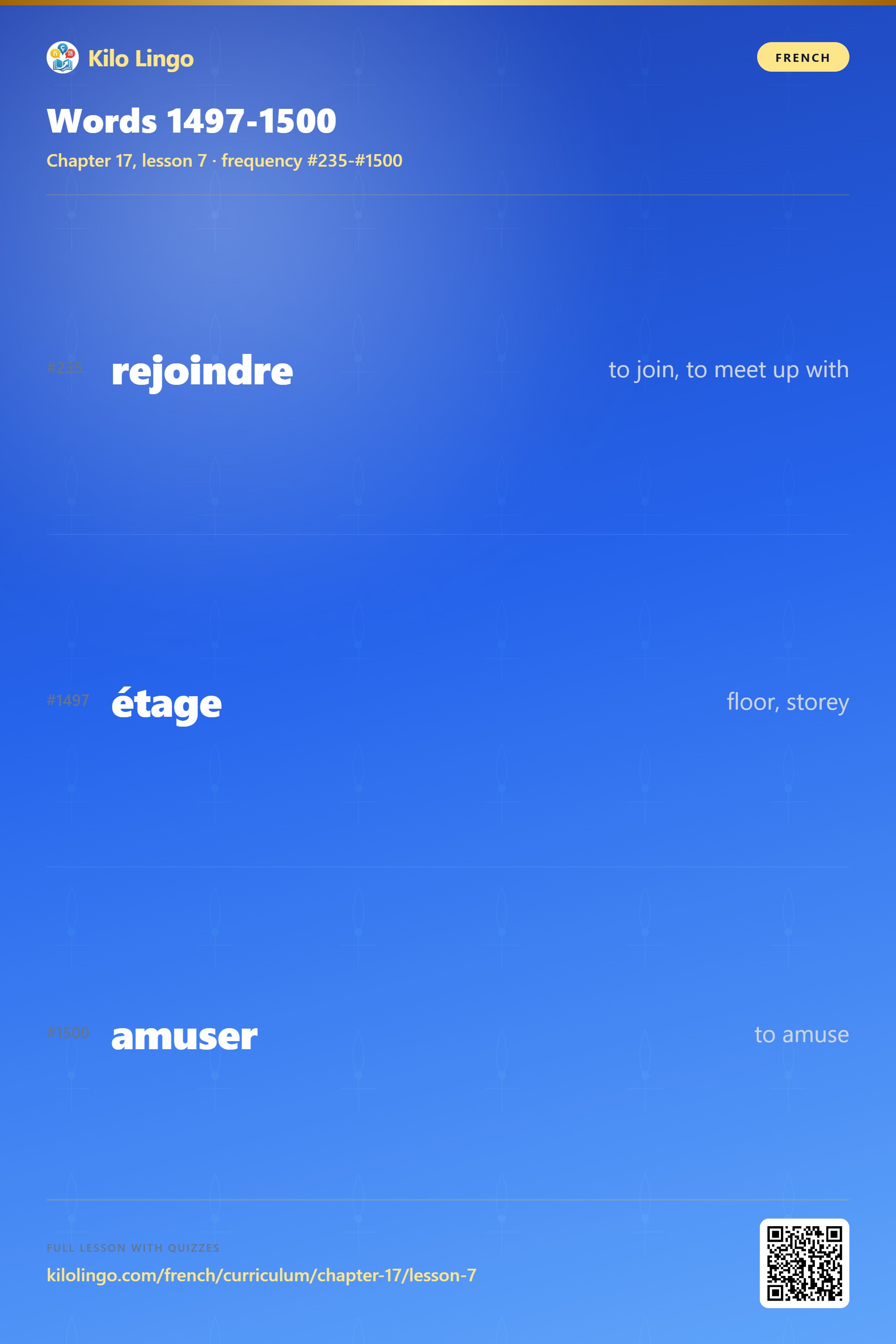
- Words 1491-1500Vocabulary
10 words · ranks 1491-1500
- Story milestone: top 1500 wordsGraded-reader story
You can read this story using only the words you've learned so far. Every content word sits at or above the rank-1500 ceiling.
- La maisonThemed review
Room by room.
pieceis the room; it is also the coin and the piece you already know. - Arcade reviewReview games
Replay this chapter's words as games - a different kind of repetition, and it counts.
Word printables
Per-word sheets100 words · a worksheet, infographic and listicle each




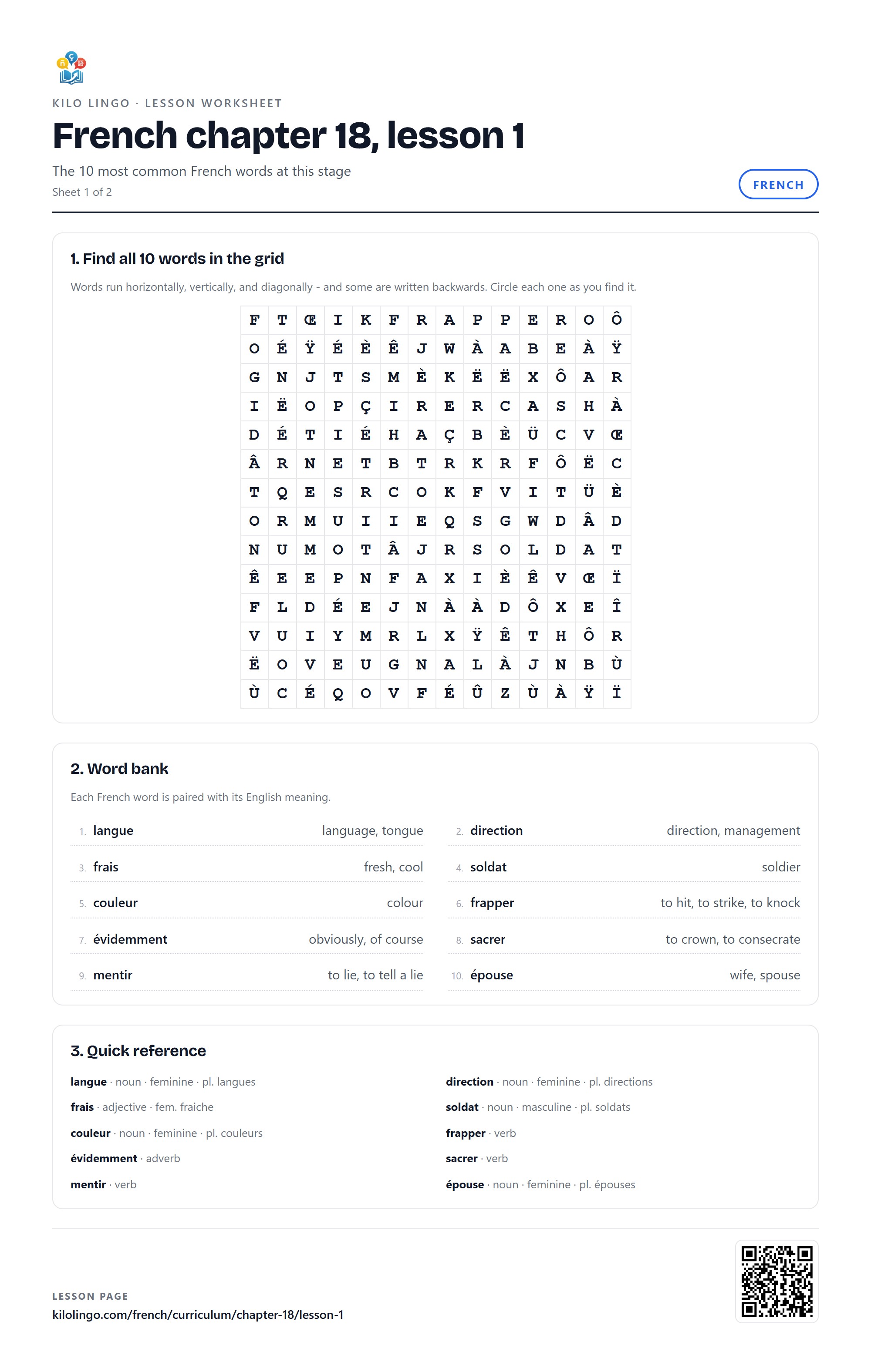
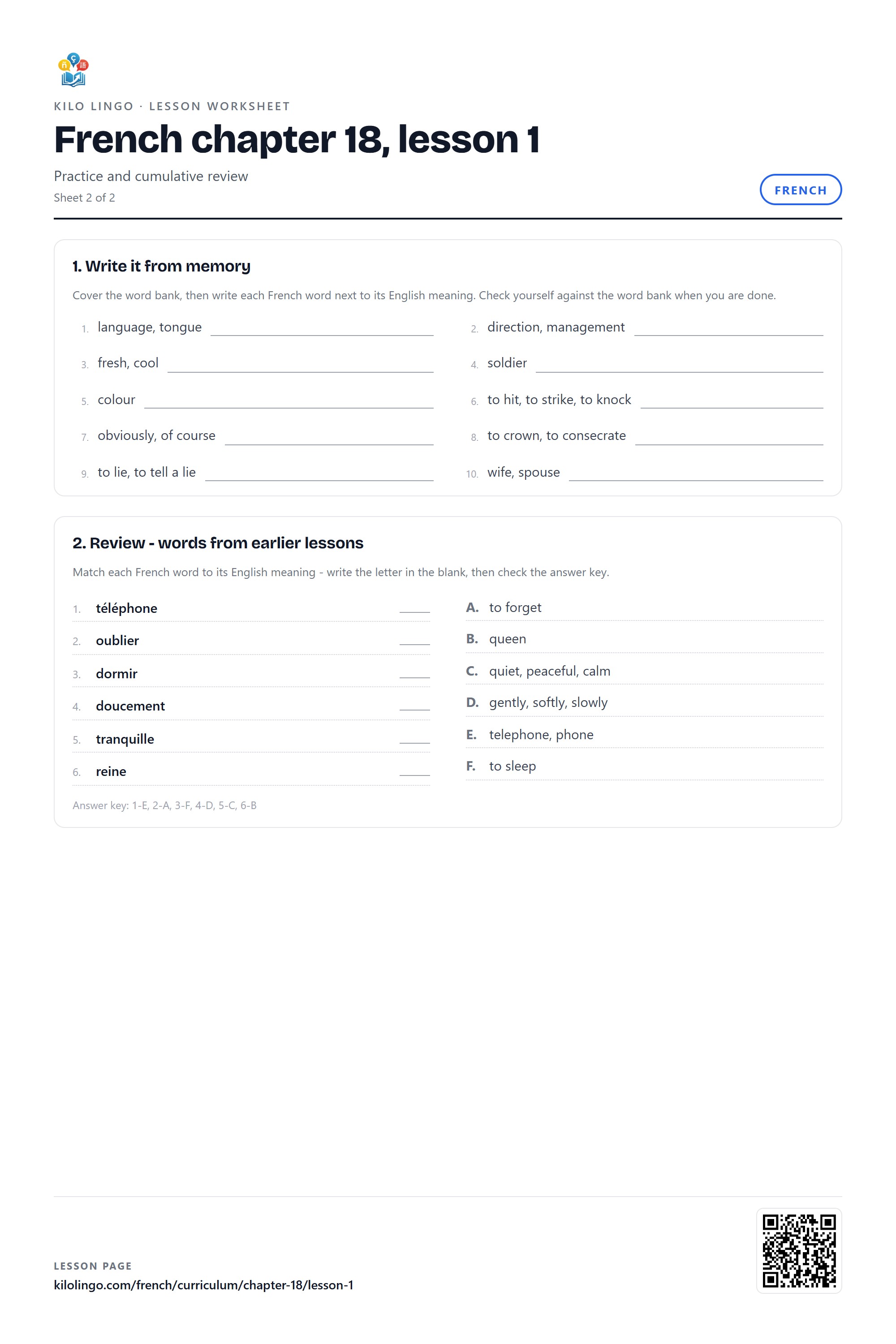
Chapter 18 · Adjective position and meaning shift
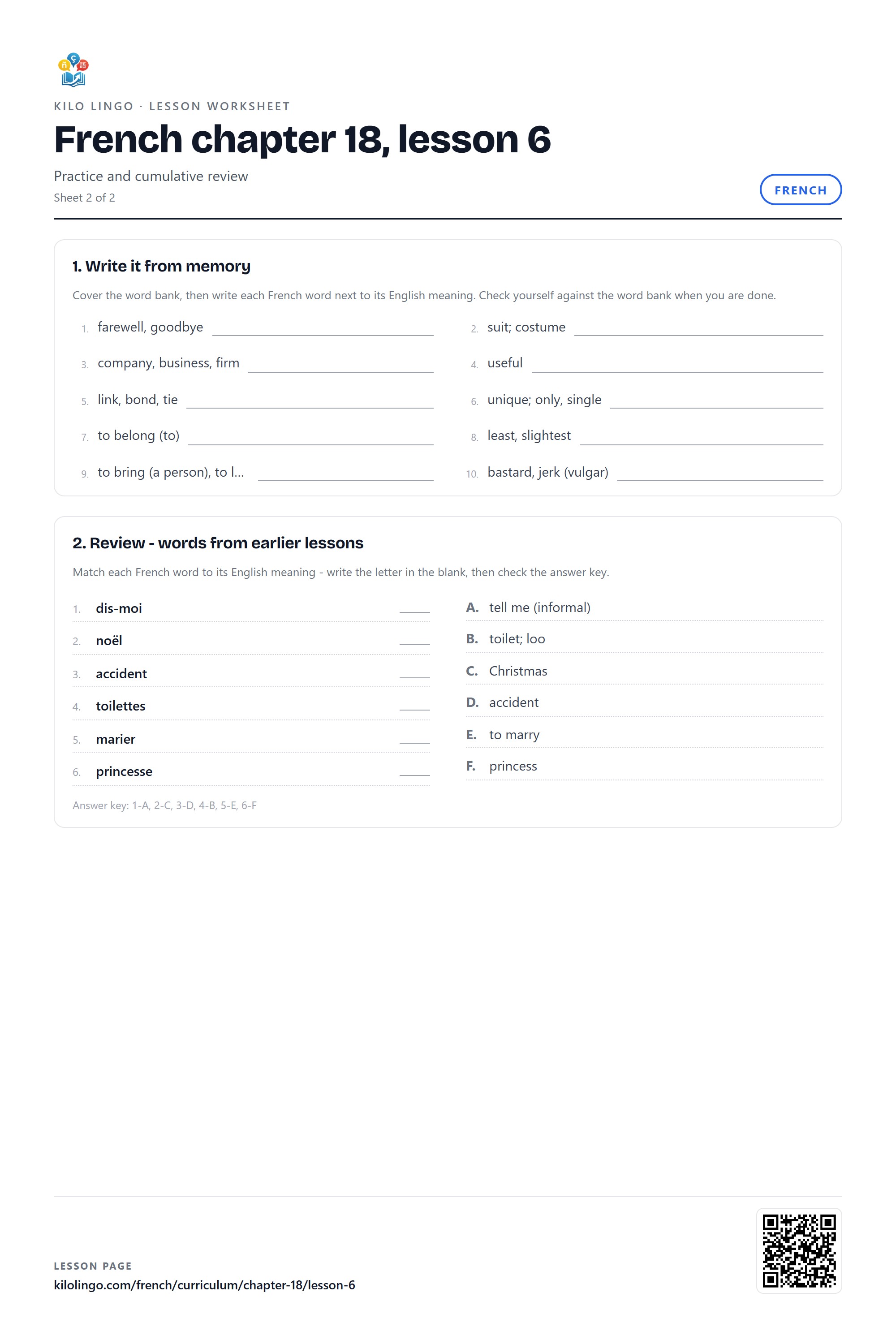
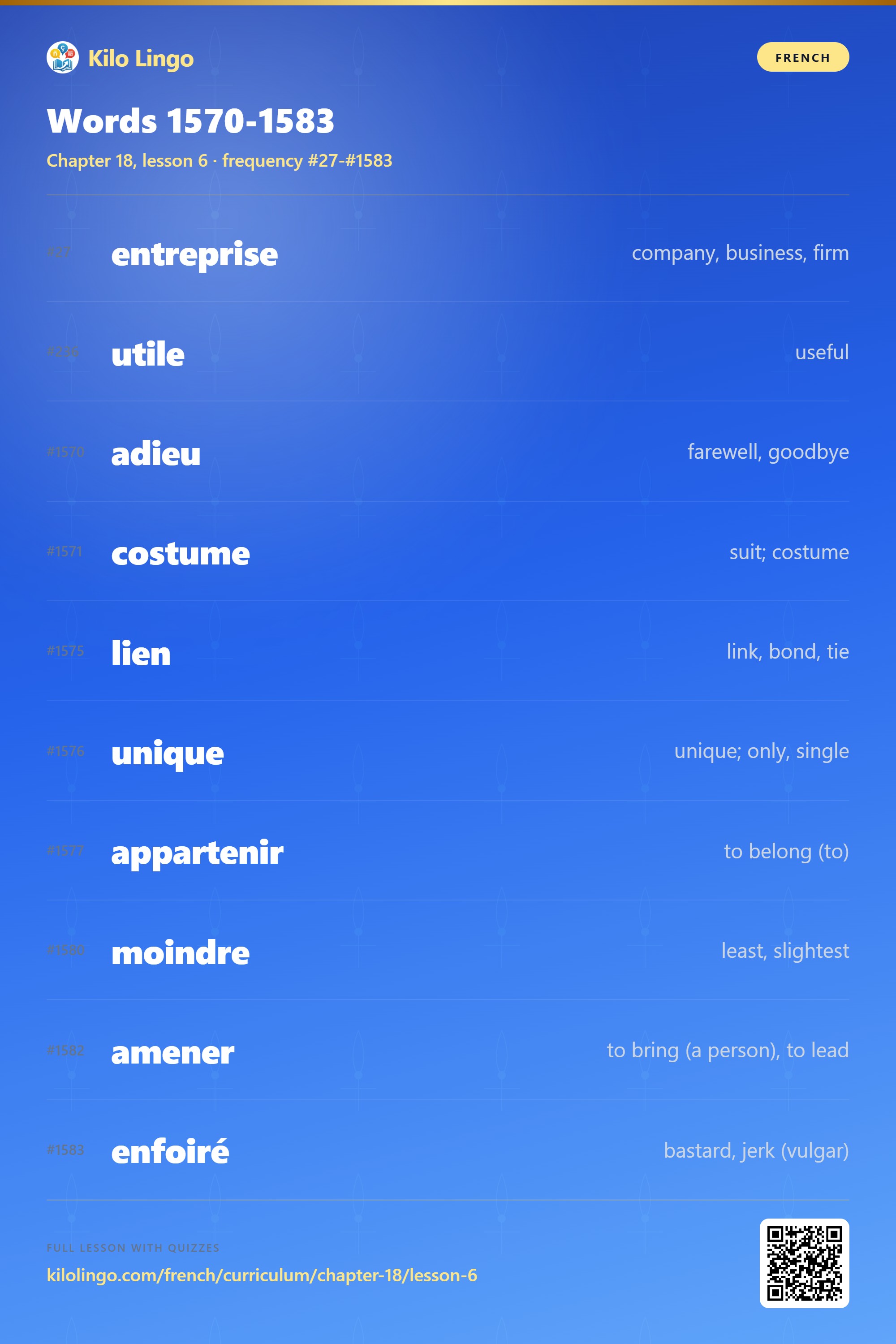
Chapter page →- Words 1501-1510Vocabulary
10 words · ranks 1501-1510
- Word Bubbles review sessionReview games
Pop the words you just met by matching each one to its meaning. A couple of rounds and the batch is yours.
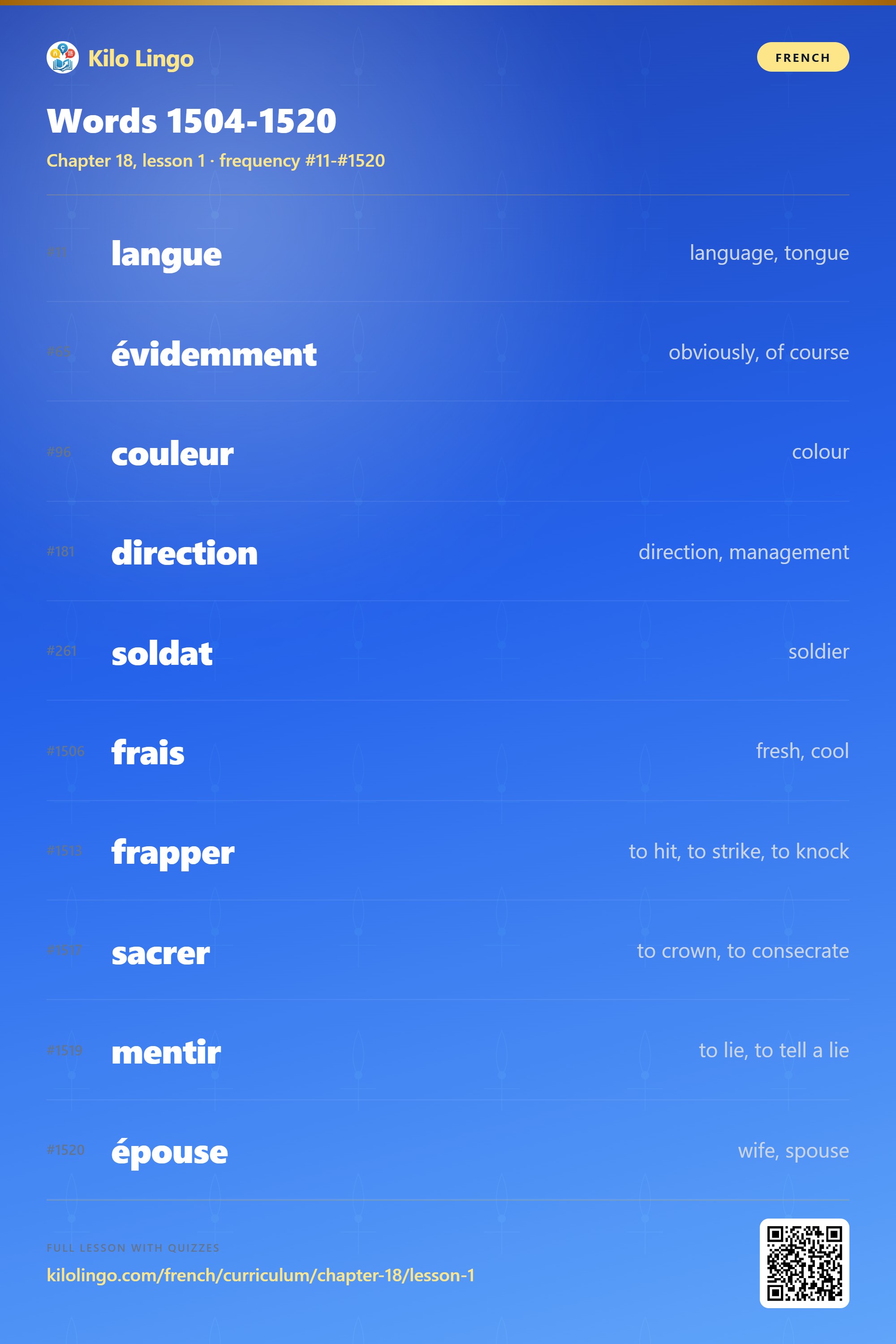
- Words 1511-1520Vocabulary
10 words · ranks 1511-1520
- Conjugation Sprint review sessionReview games
Sixty seconds on the endings of the verbs this chapter has drilled so far.
- Words 1521-1530Vocabulary
10 words · ranks 1521-1530
- Word Bubbles review sessionReview games
Pop the words you just met by matching each one to its meaning. A couple of rounds and the batch is yours.
- Words 1531-1540Vocabulary
10 words · ranks 1531-1540
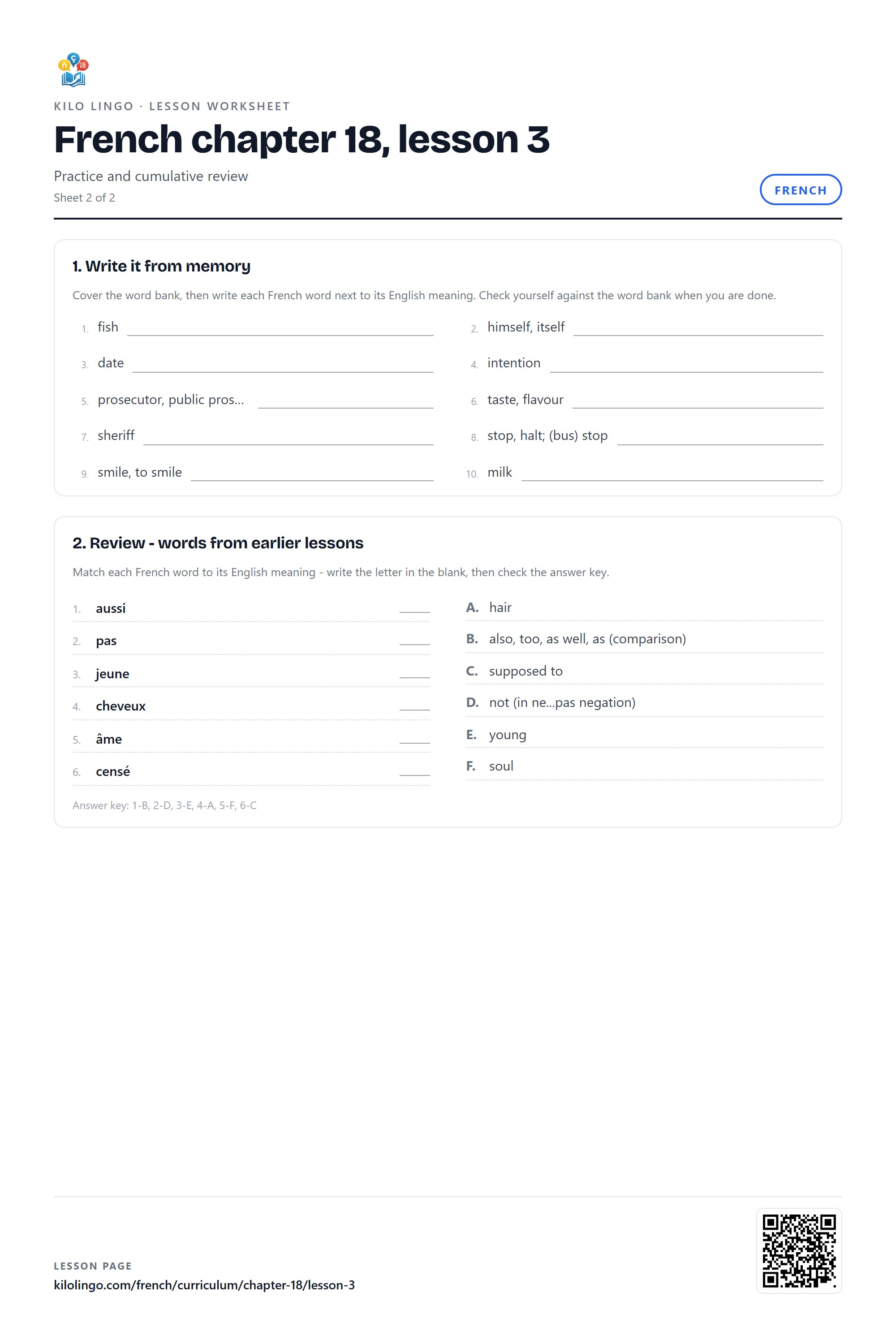
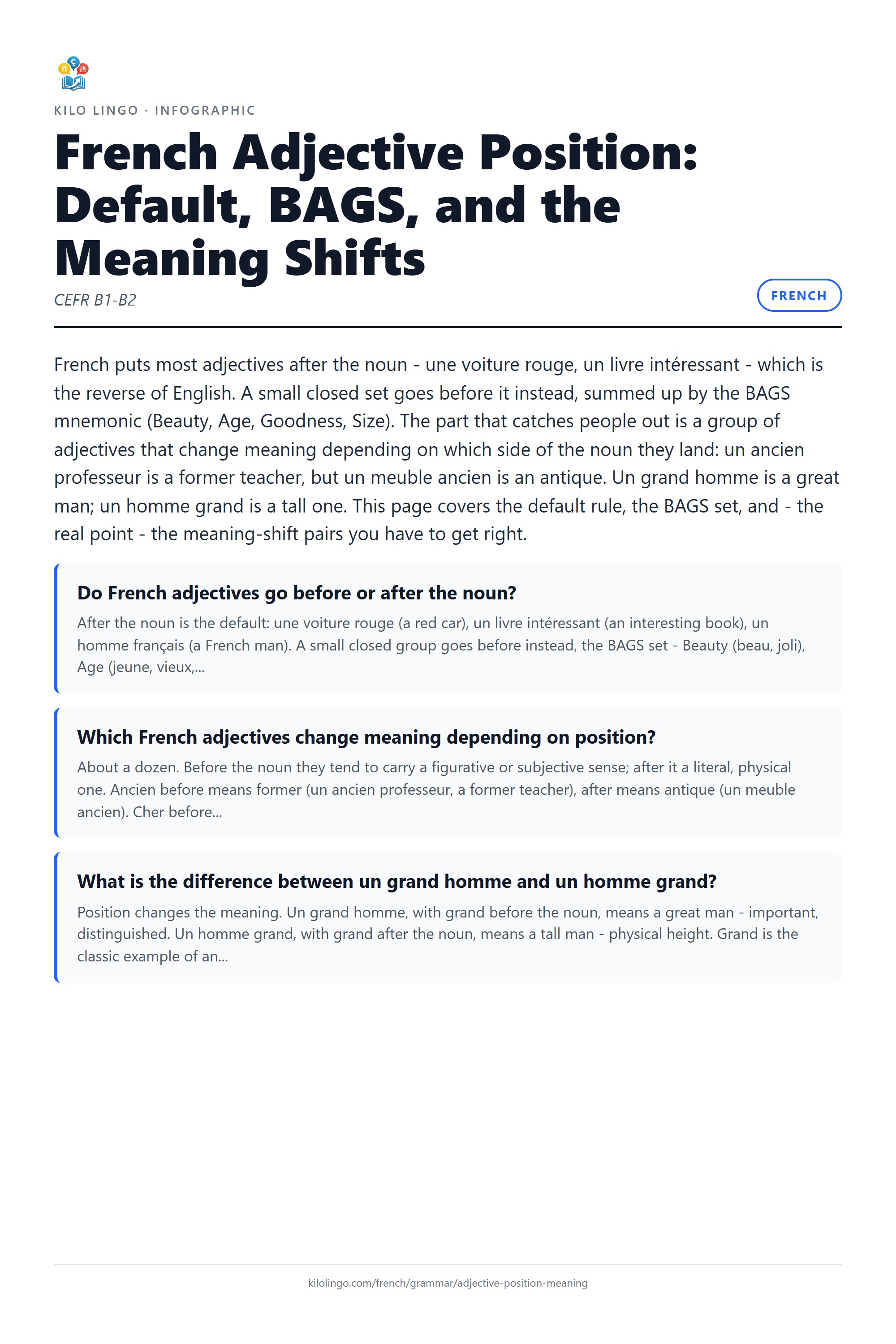
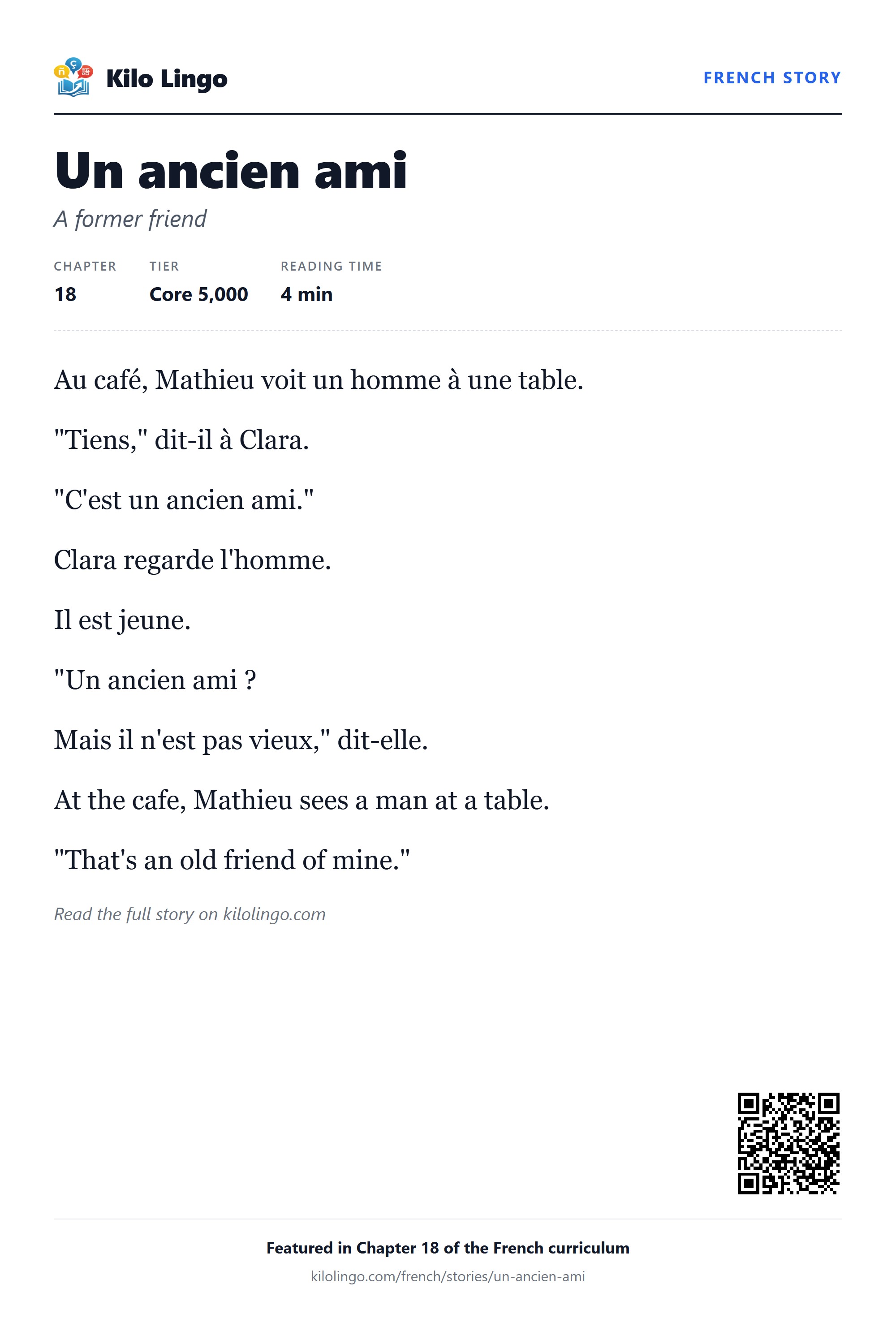
Where an adjective sits changes its meaning: un ancien ami (a former friend) vs un meuble ancien (an antique), un grand homme (a great man) vs un homme grand (a tall man), ma propre voiture vs une voiture propre.
- encore or toujours?Mistake clinic
Both can mean
still, and only one of them meansalways. - Words 1541-1550Vocabulary
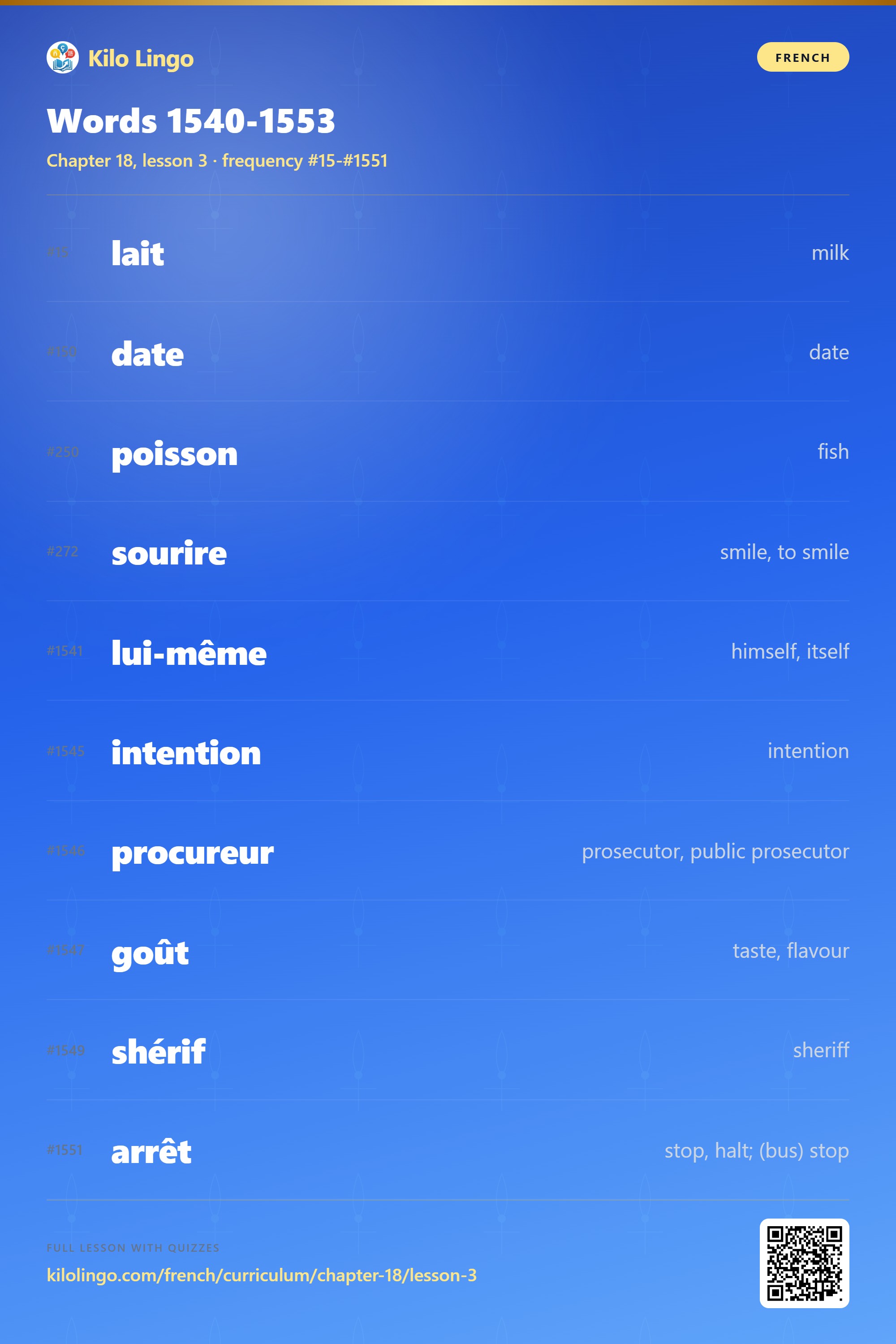
10 words · ranks 1541-1550
- Conjugation Sprint review sessionReview games
Sixty seconds on the endings of the verbs this chapter has drilled so far.
- Words 1551-1560Vocabulary
10 words · ranks 1551-1560
- Word Bubbles review sessionReview games
Pop the words you just met by matching each one to its meaning. A couple of rounds and the batch is yours.
- Words 1561-1570Vocabulary
10 words · ranks 1561-1570
- Comparison of adverbsGrammar
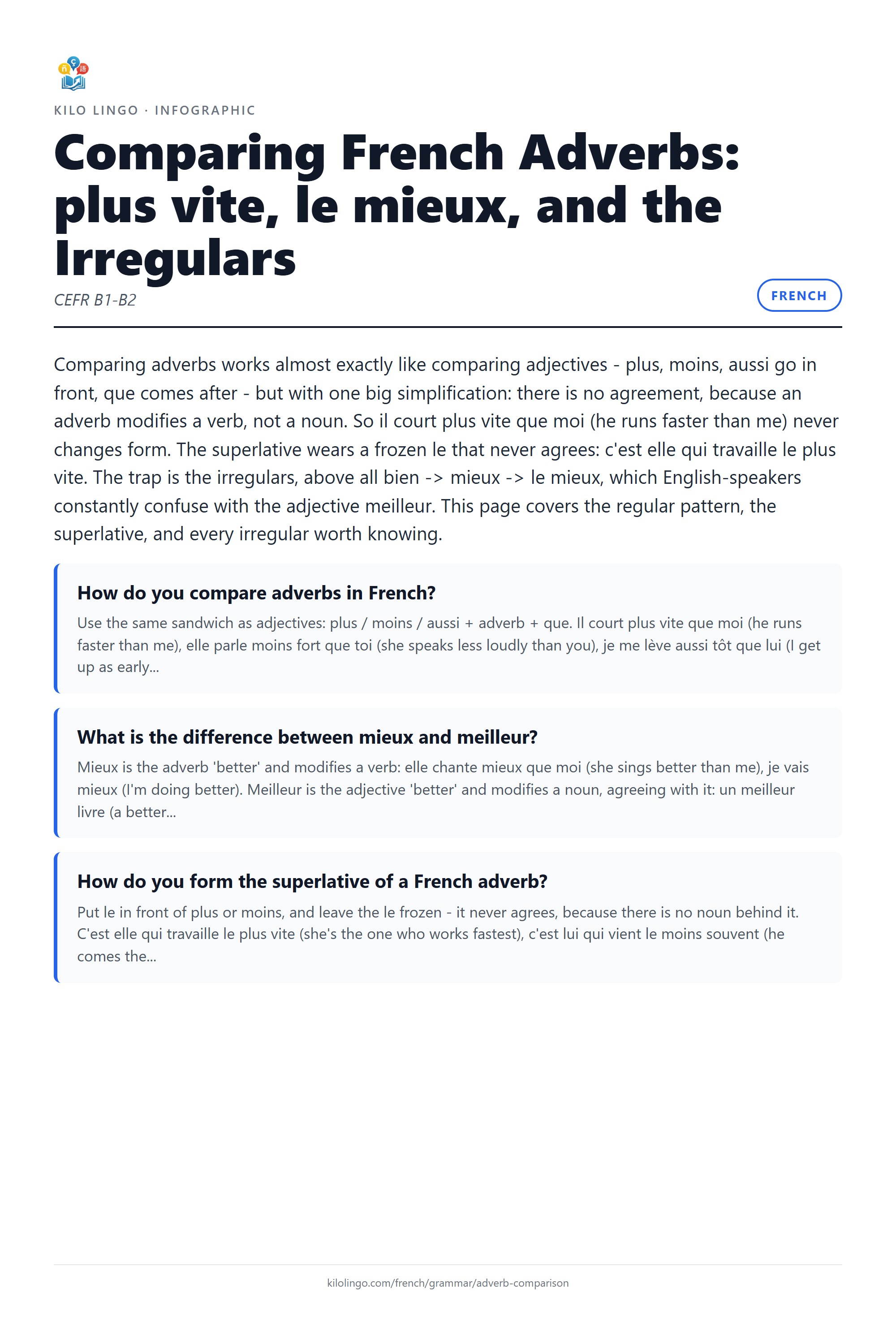
plus / moins / aussi + adverb + que with no agreement, the frozen-le superlative (le plus vite), and the irregulars bien -> mieux, mal -> plus mal / pis, beaucoup -> plus, peu -> moins.
- Words 1571-1580Vocabulary
10 words · ranks 1571-1580
- Conjugation Sprint review sessionReview games
Sixty seconds on the endings of the verbs this chapter has drilled so far.
- Words 1581-1590Vocabulary
10 words · ranks 1581-1590
- Word Bubbles review sessionReview games
Pop the words you just met by matching each one to its meaning. A couple of rounds and the batch is yours.
- Words 1591-1600Vocabulary
10 words · ranks 1591-1600
- Story milestone: top 1600 wordsGraded-reader story
You can read this story using only the words you've learned so far. Every content word sits at or above the rank-1600 ceiling.
- En villeThemed review
Finding your way around town, from the square to the bridge to the corner shop.
- Arcade reviewReview games
Replay this chapter's words as games - a different kind of repetition, and it counts.
Word printables
Per-word sheets100 words · a worksheet, infographic and listicle each

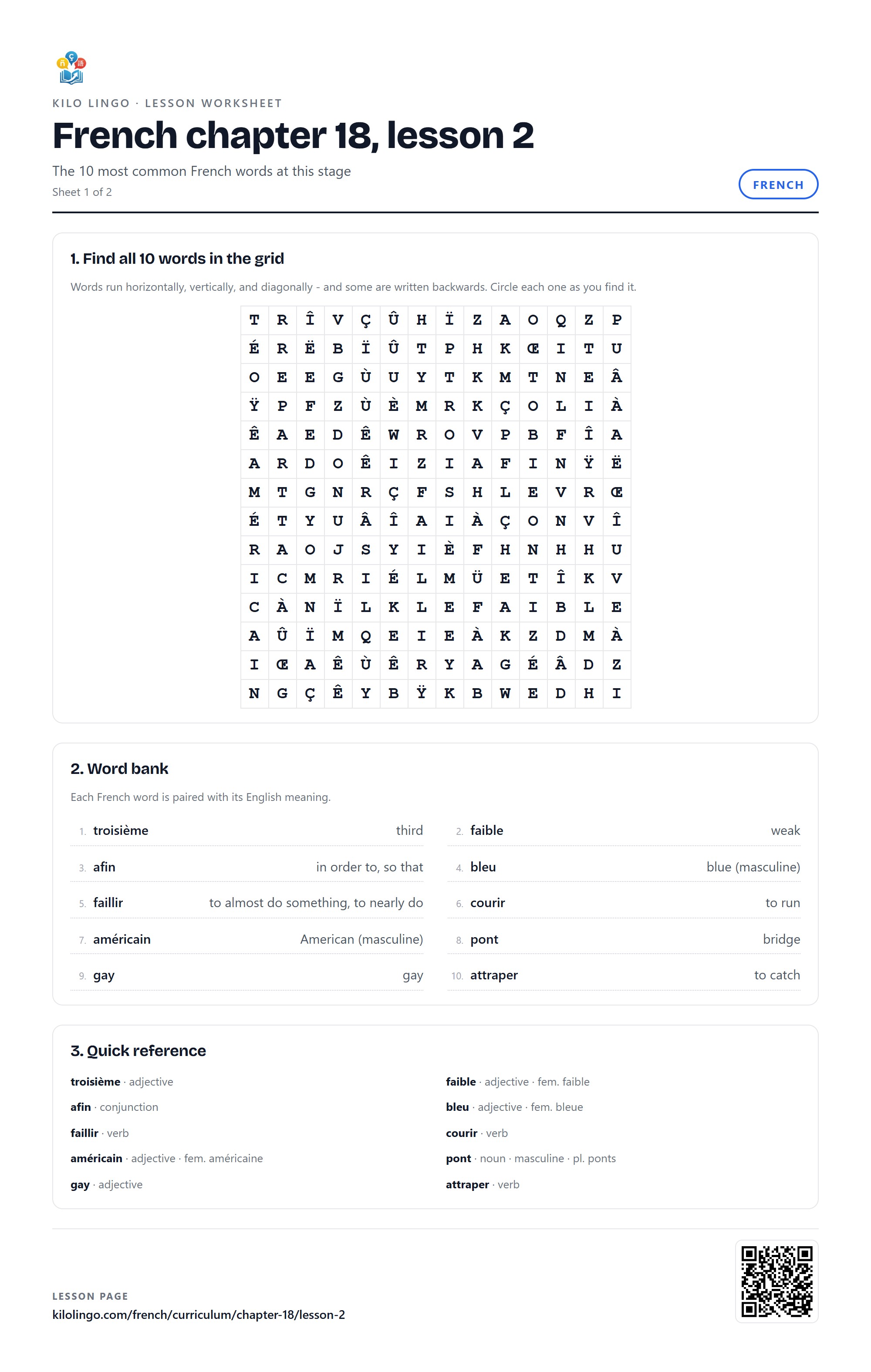
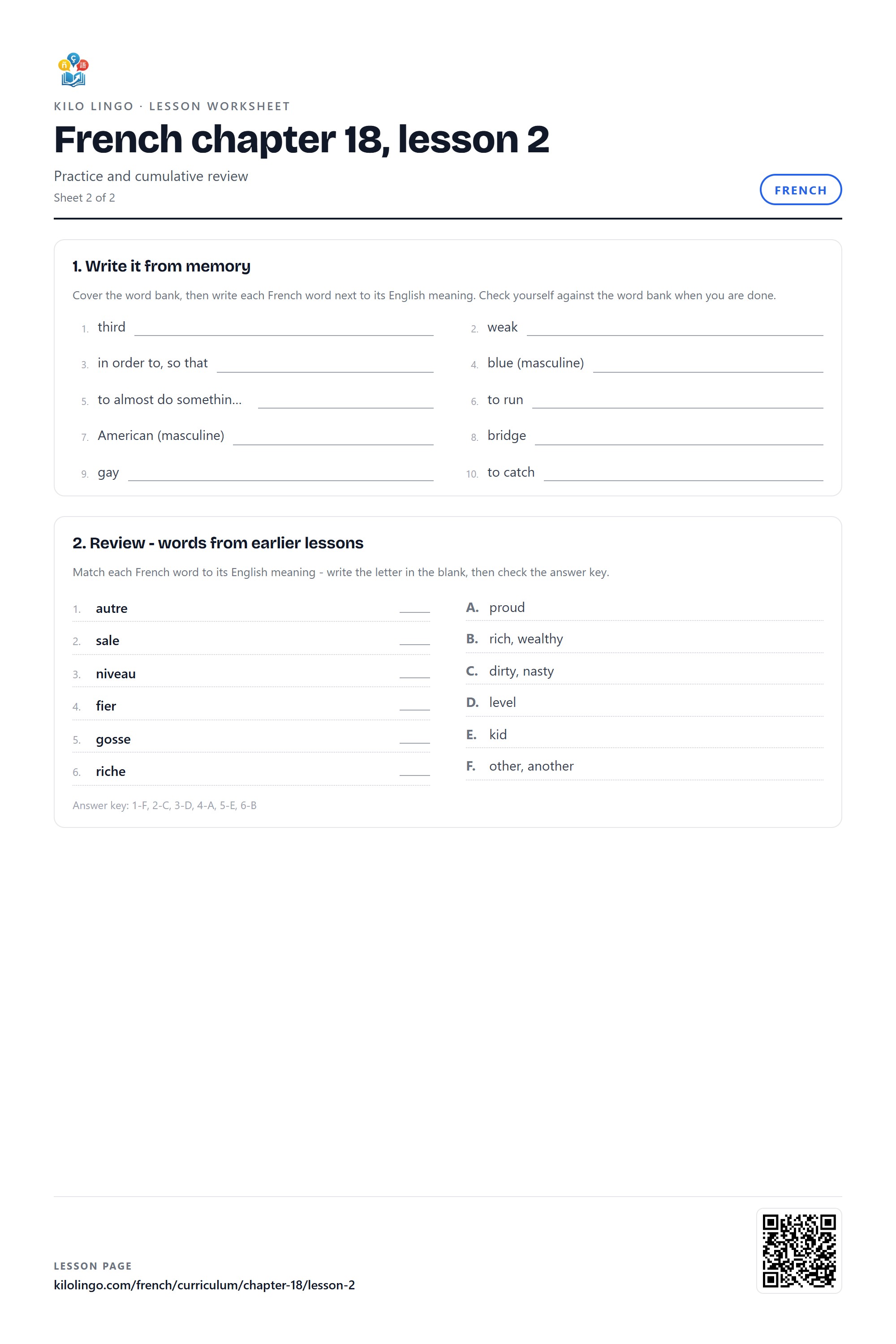

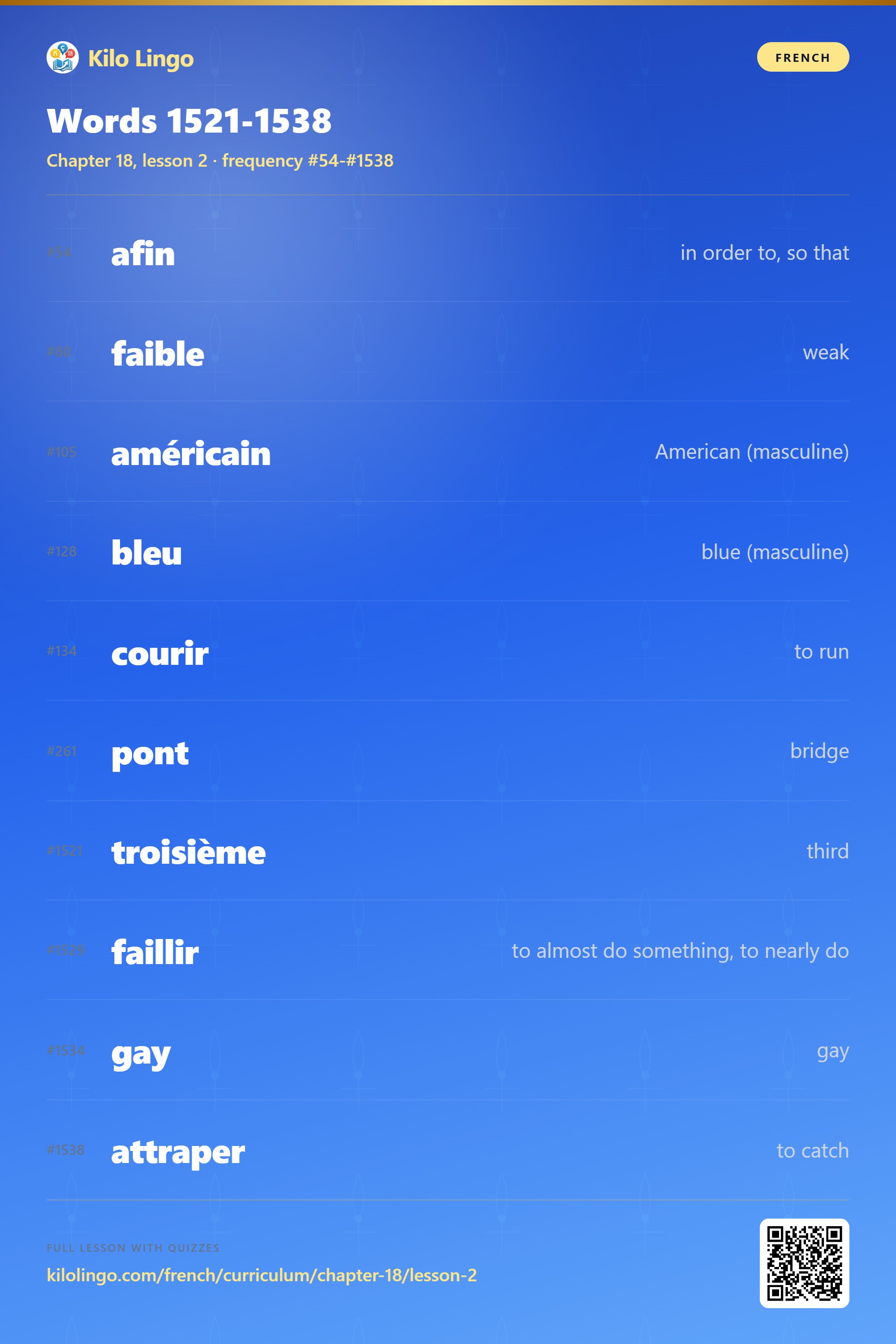
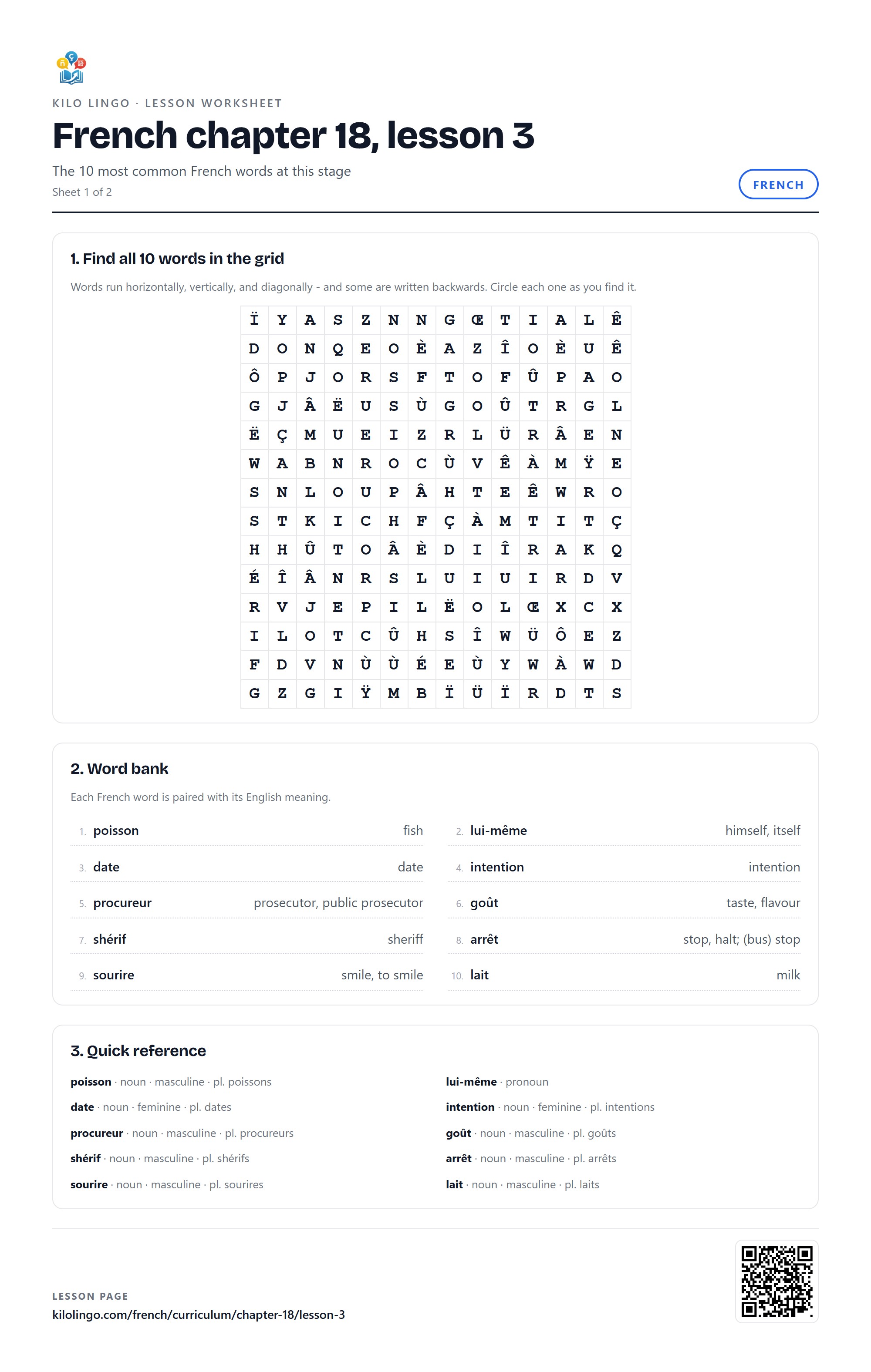



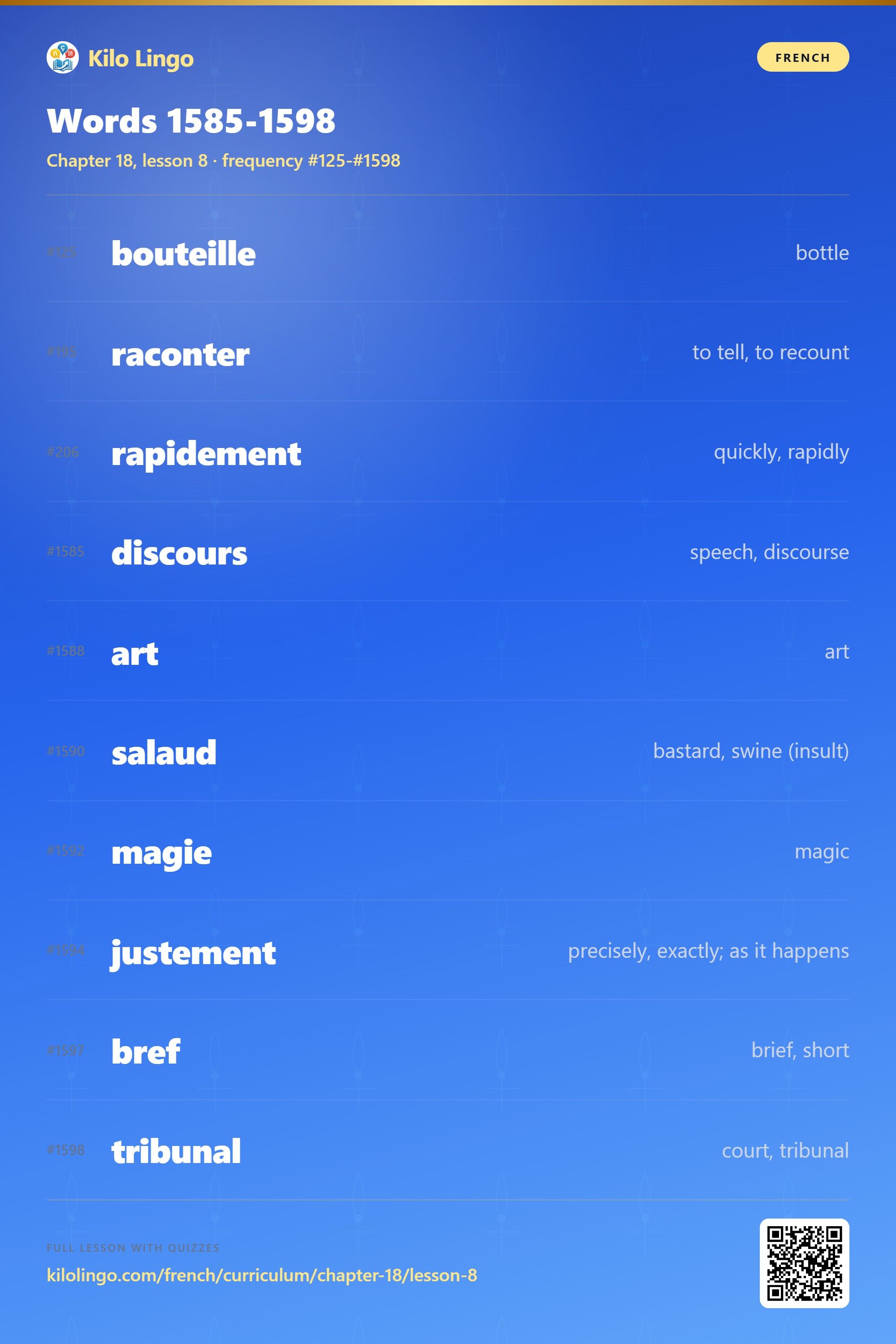
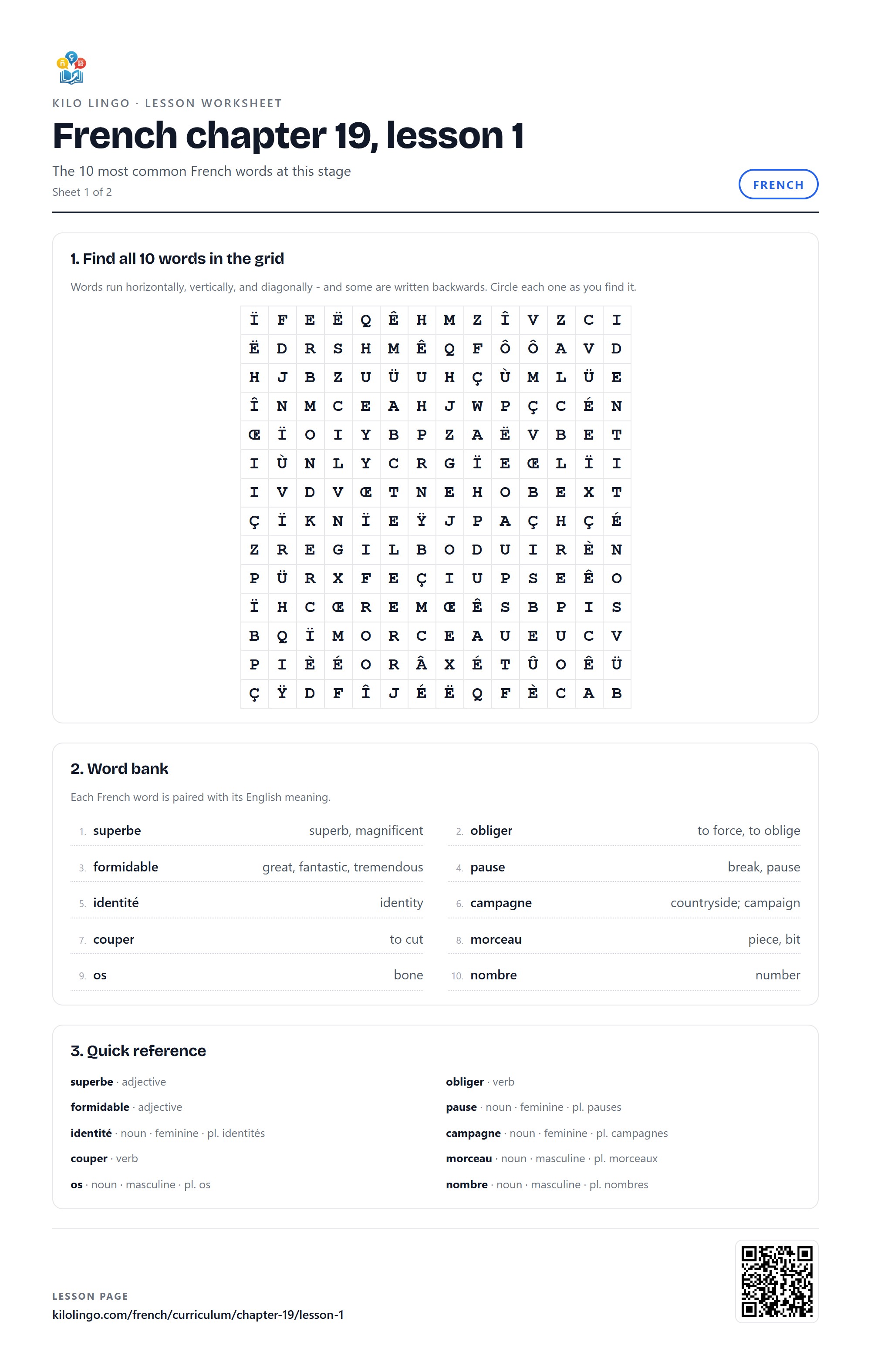
Chapter 19 · The present subjunctive: how to form it
Chapter page →- Words 1601-1610Vocabulary
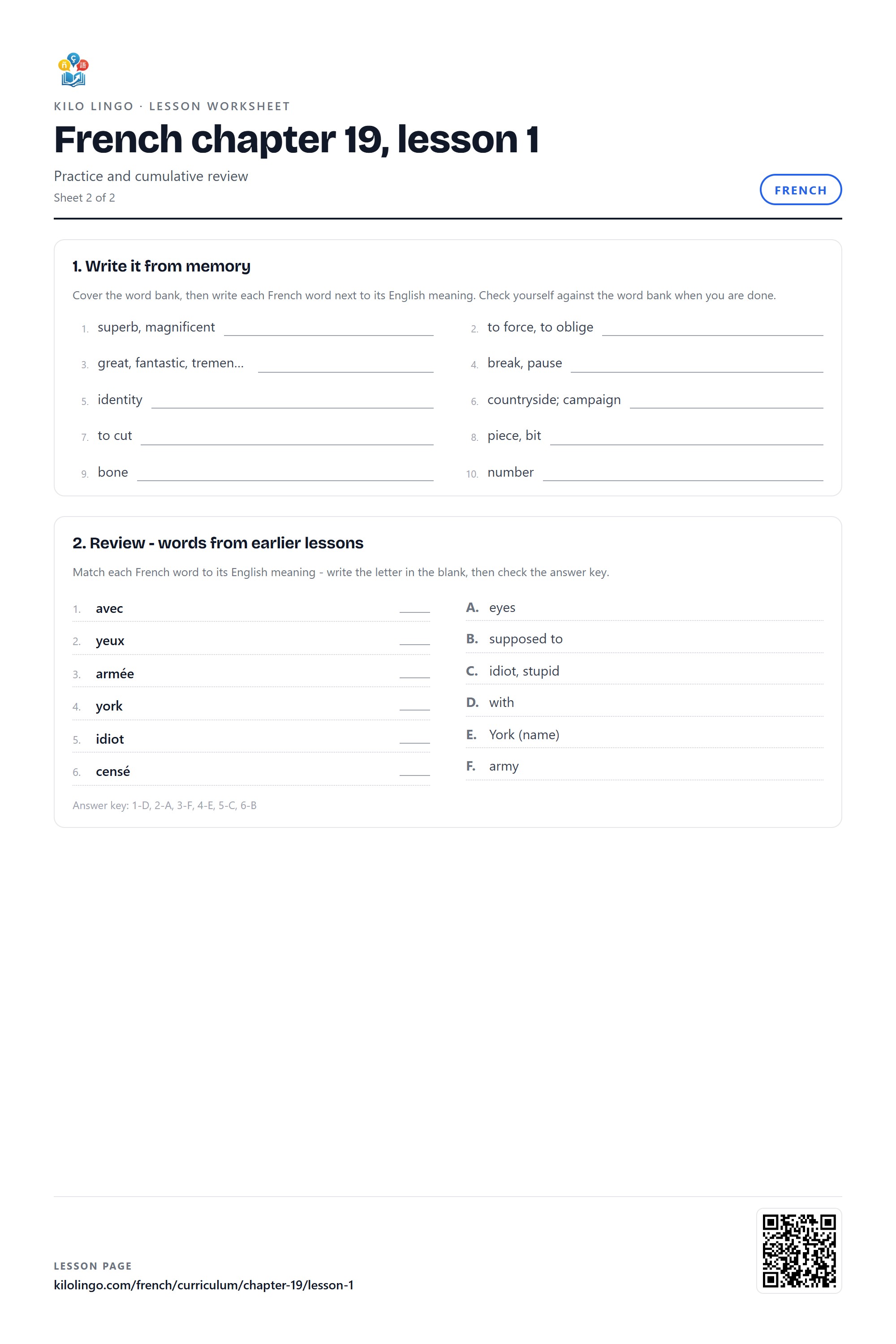
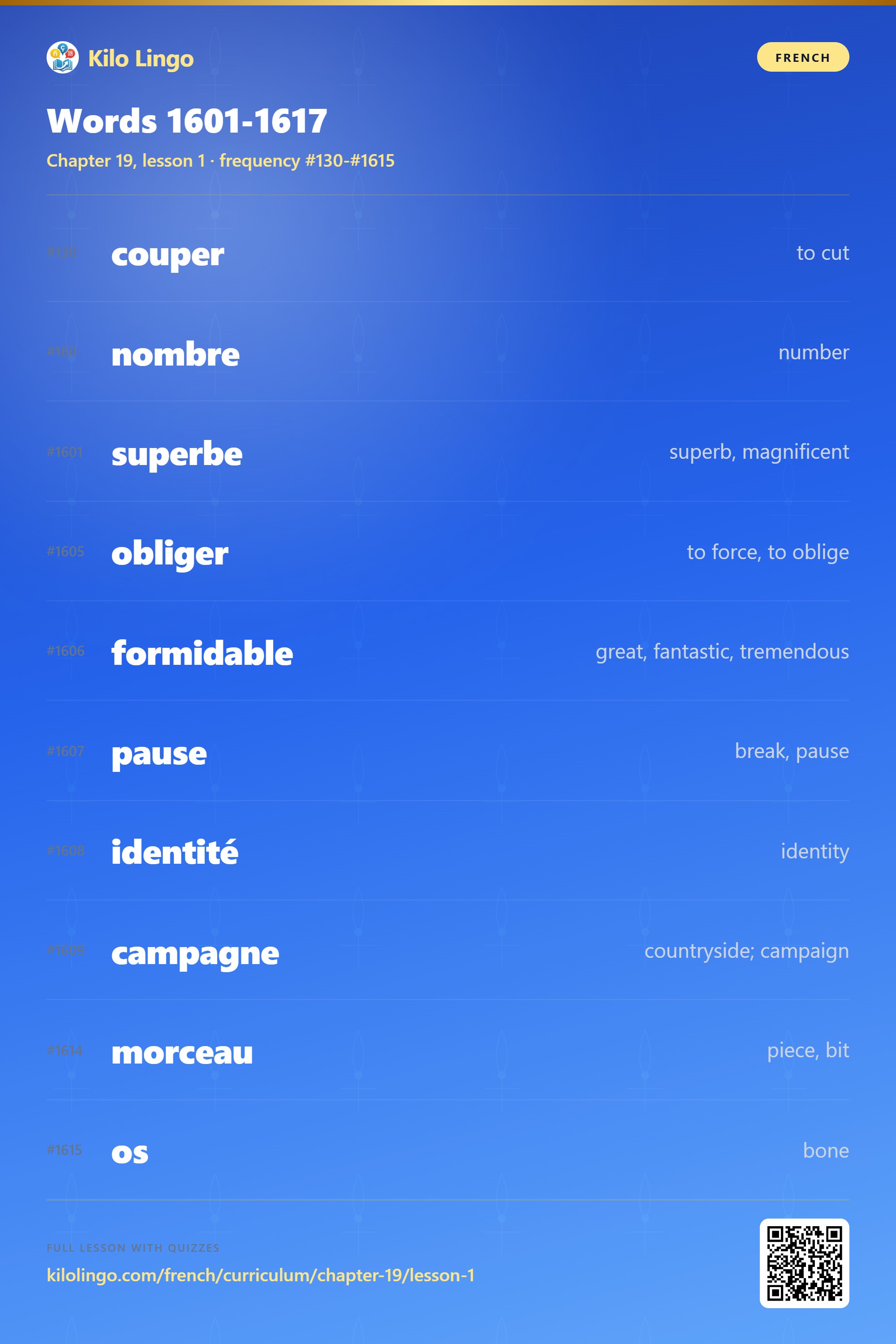
10 words · ranks 1601-1610
- Crossword review sessionReview games
Cross the words you just met, clued in English. Slower than a drill, and it sticks harder.
- Words 1611-1620Vocabulary
10 words · ranks 1611-1620
- Word Bubbles review sessionReview games
Pop the words you just met by matching each one to its meaning. A couple of rounds and the batch is yours.
- Words 1621-1630Vocabulary
10 words · ranks 1621-1630
- Conjugation Sprint review sessionReview games
Sixty seconds on the endings of the verbs this chapter has drilled so far.
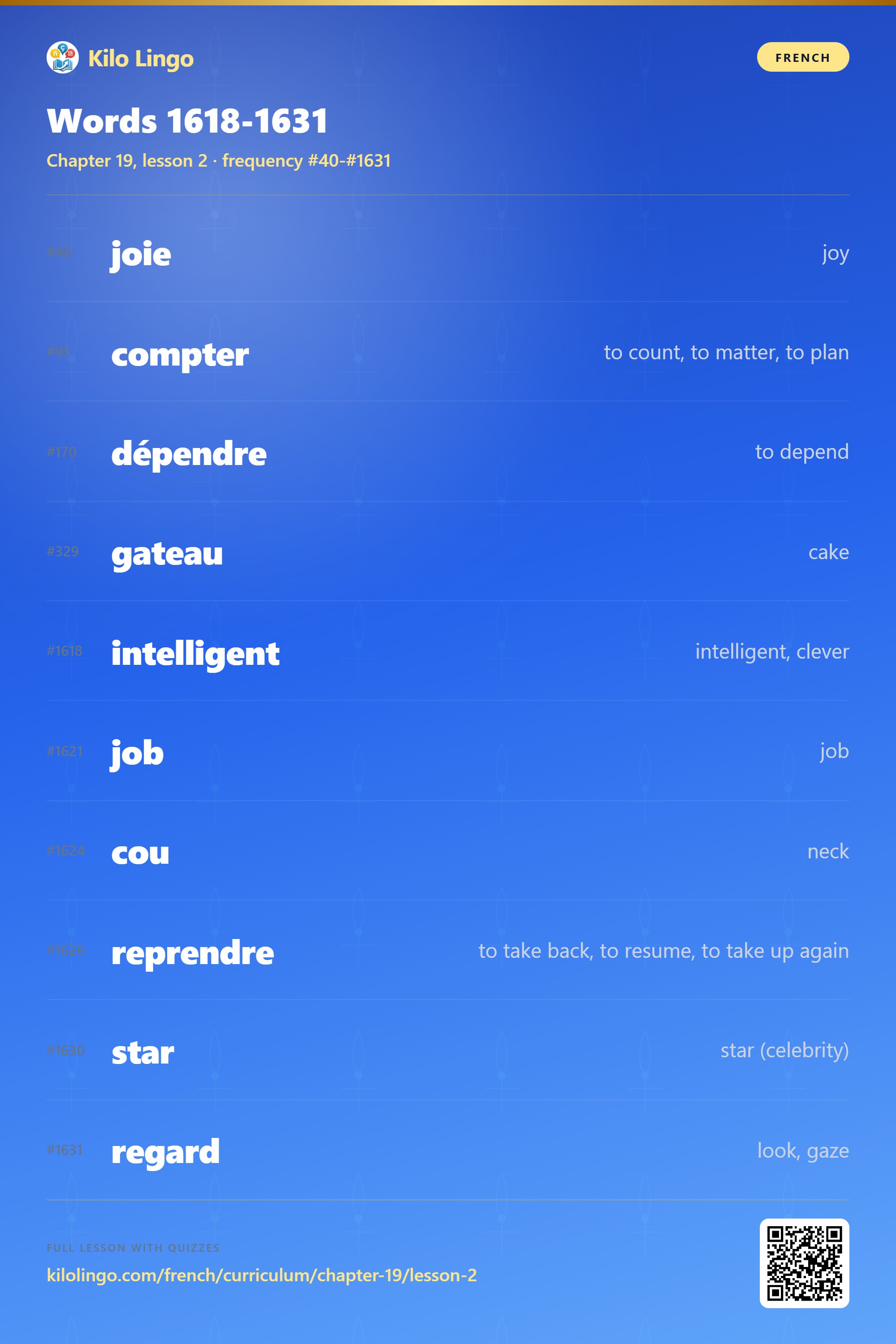
- Words 1631-1640Vocabulary
10 words · ranks 1631-1640
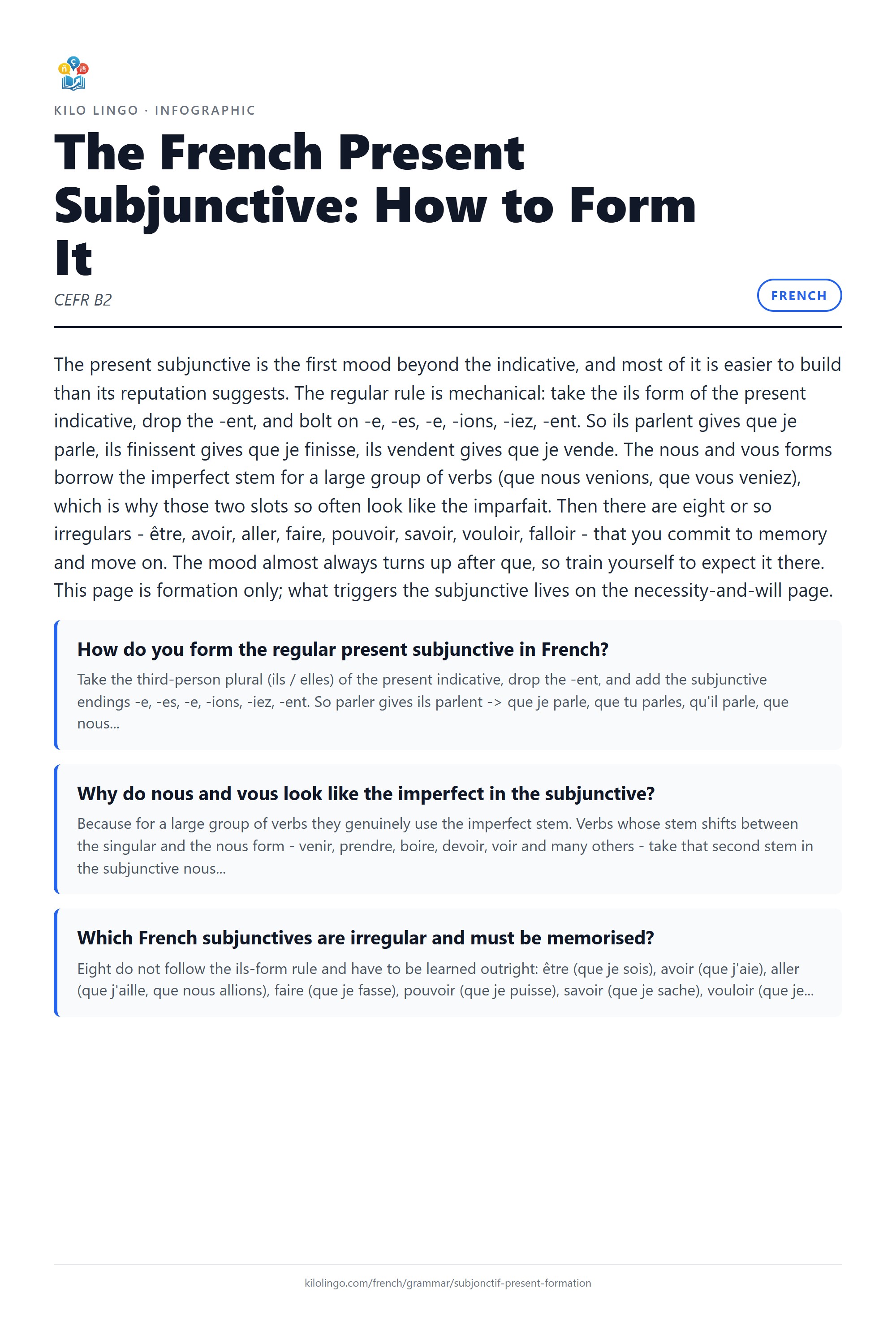
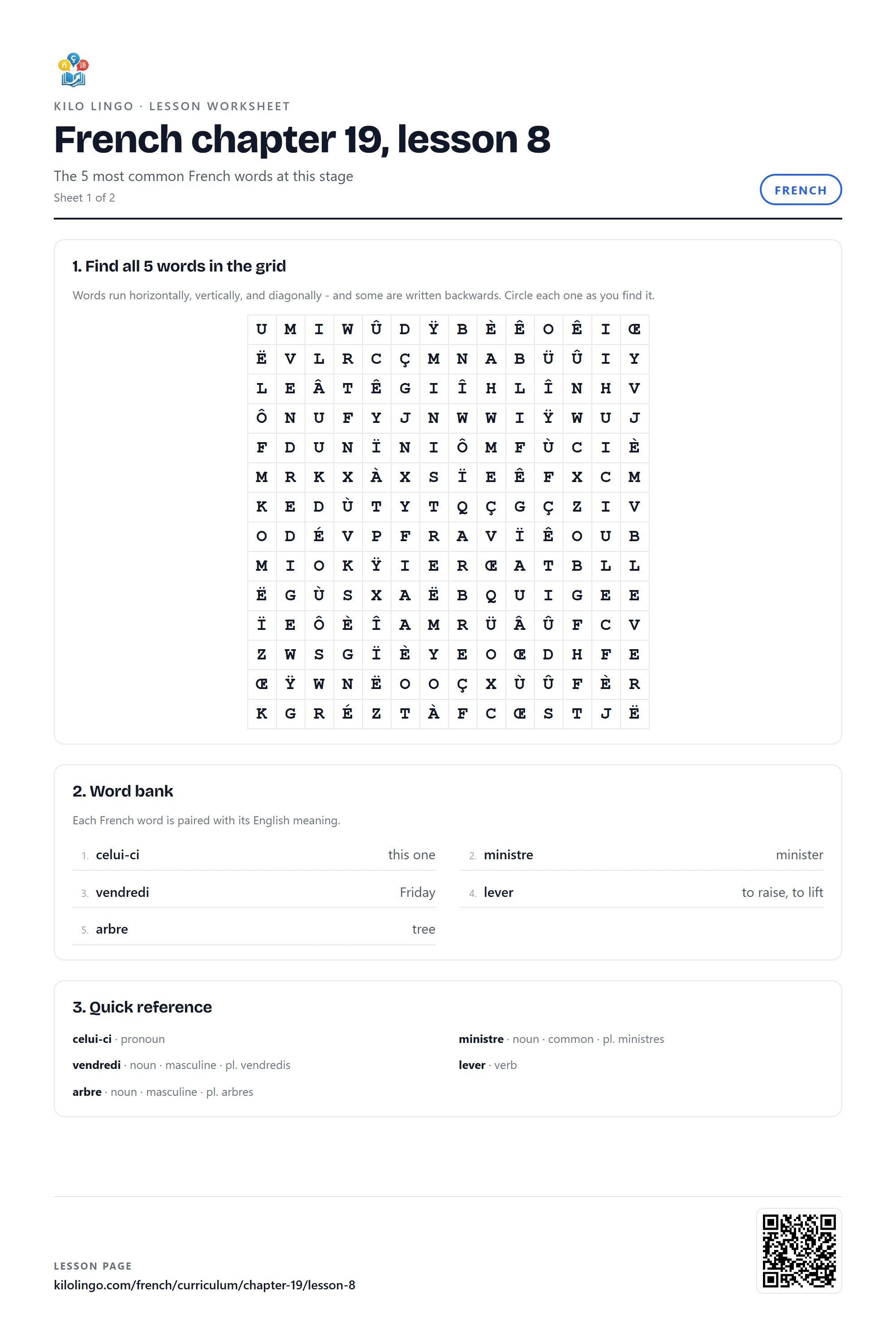
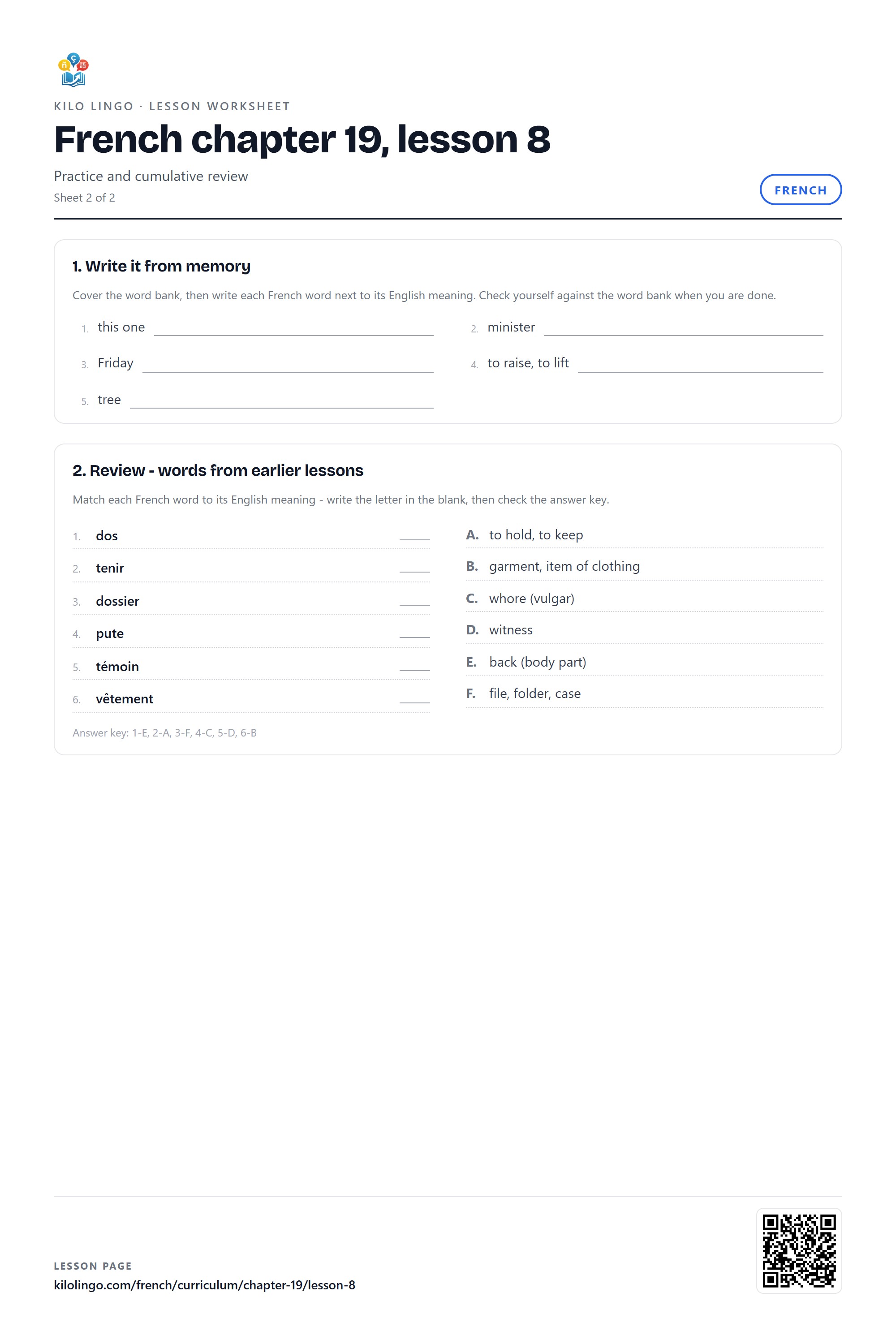
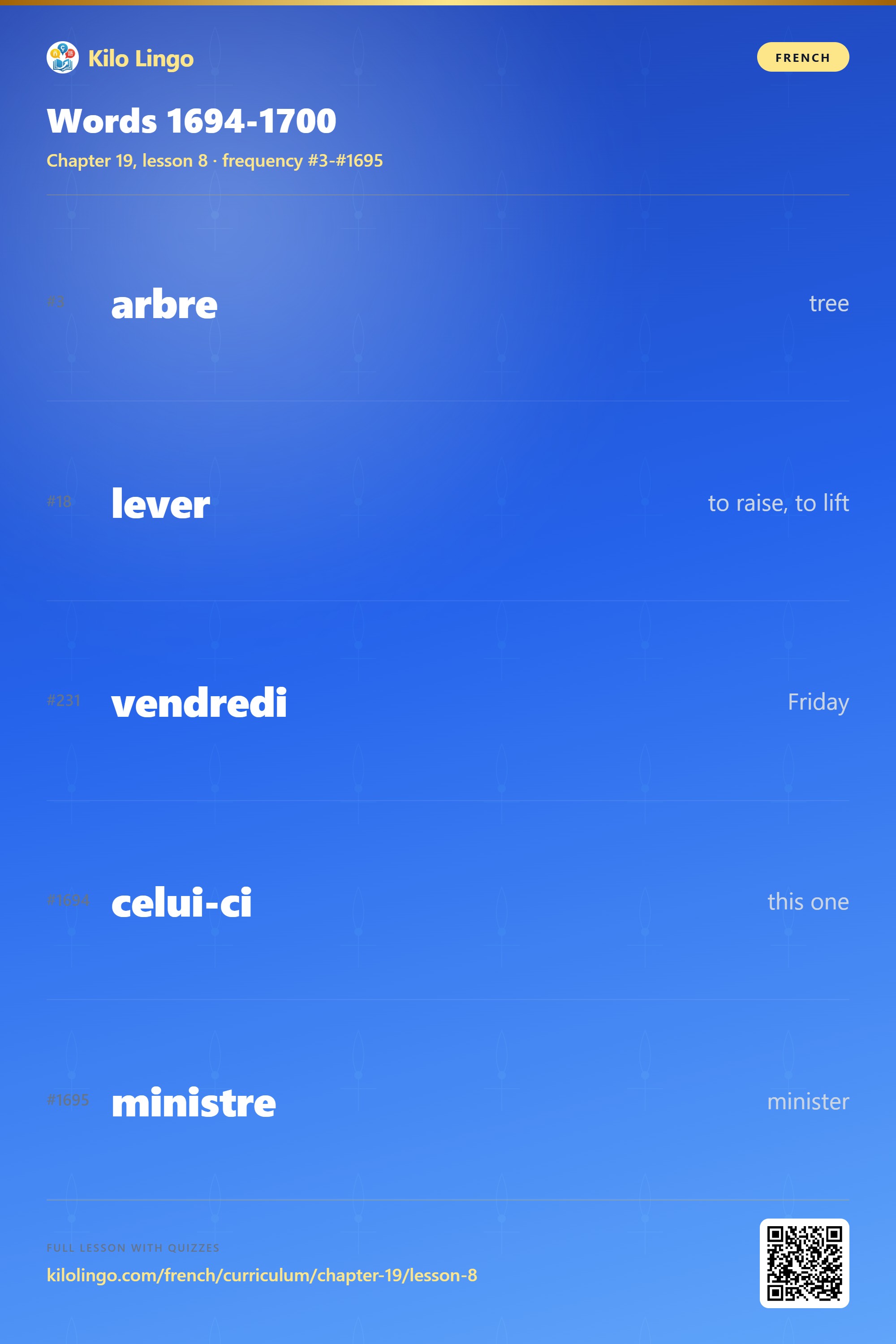
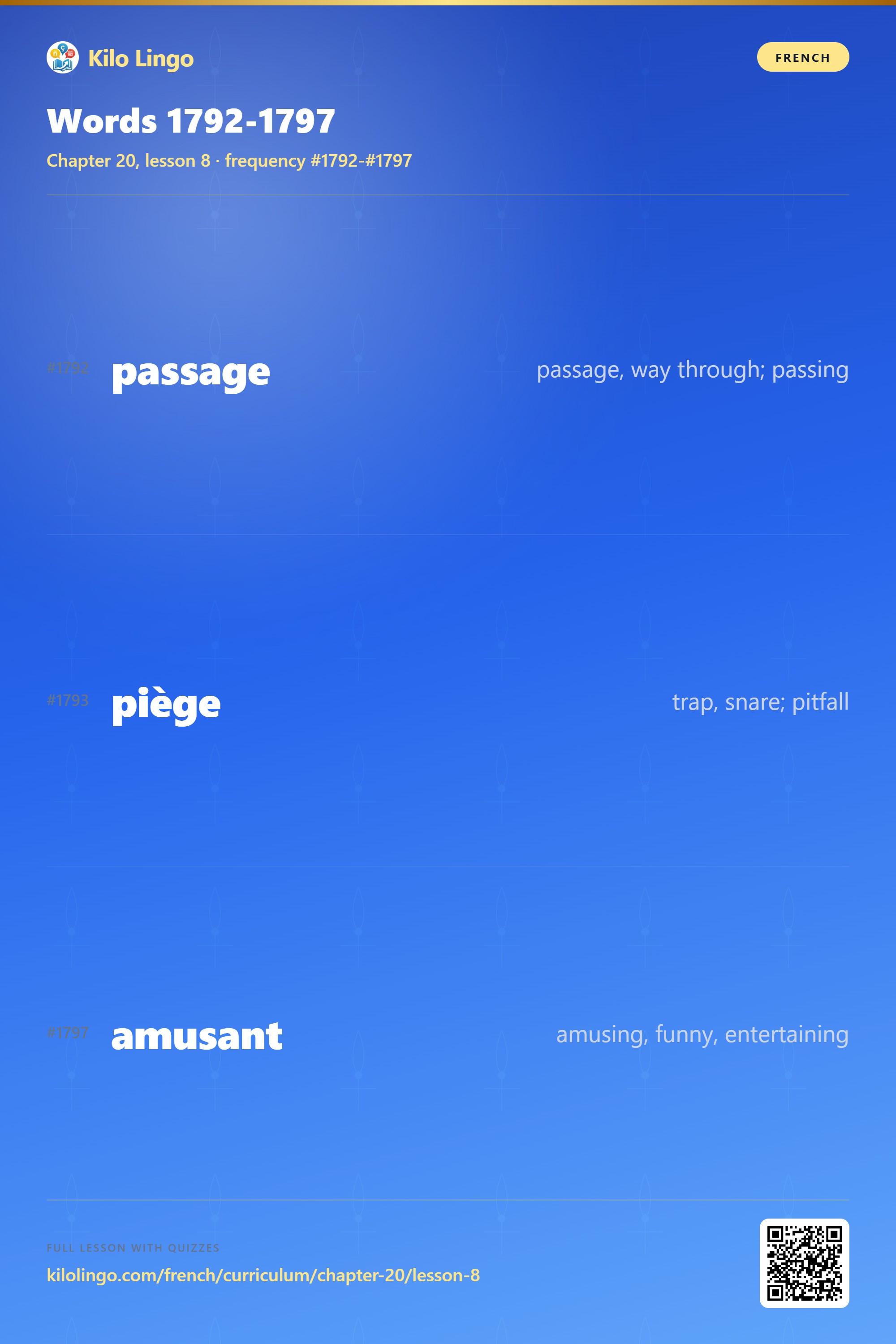
The mechanical rule: take the ils form of the present (ils parlent), drop the -ent, add -e, -es, -e, -ions, -iez, -ent. The nous / vous forms borrow the imperfect stem, plus the handful of irregulars you memorise - etre, avoir, aller, faire, pouvoir, savoir, vouloir, falloir.
- vivre or habiter?Mistake clinic
One is where your things are. The other is whether you are alive.
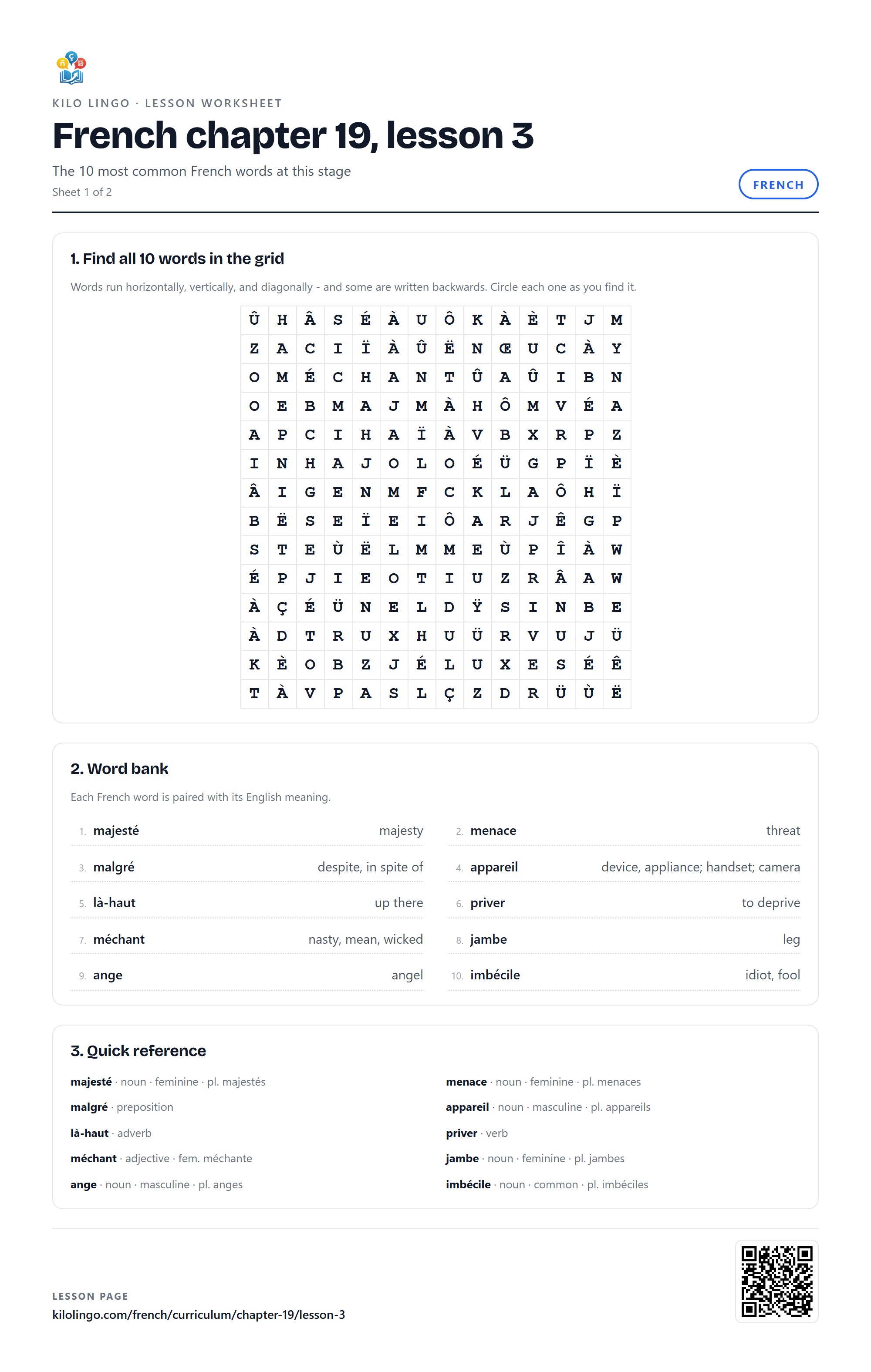
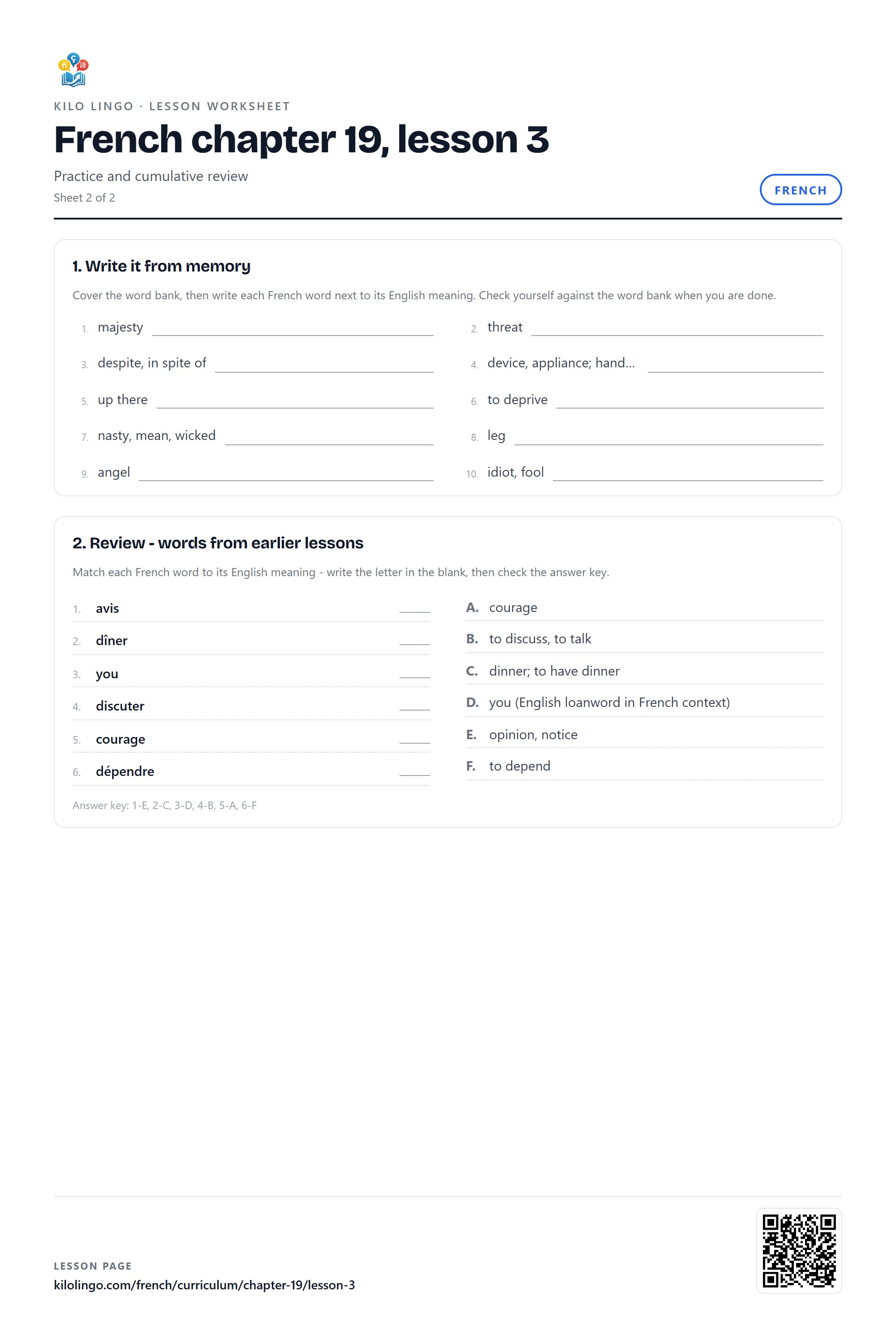
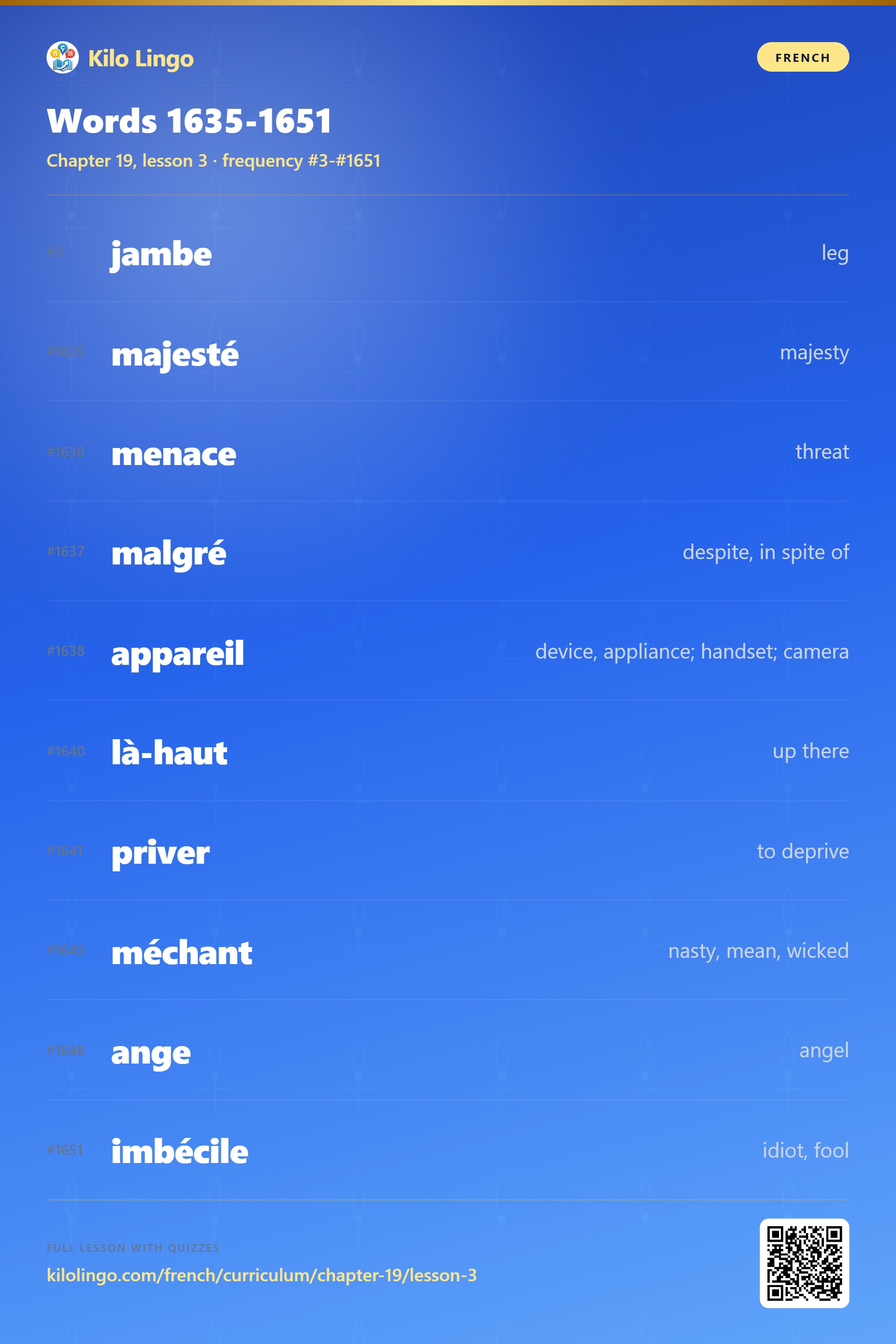
- Words 1641-1650Vocabulary
10 words · ranks 1641-1650
- Word Bubbles review sessionReview games
Pop the words you just met by matching each one to its meaning. A couple of rounds and the batch is yours.
- Words 1651-1660Vocabulary
10 words · ranks 1651-1660
- Conjugation Sprint review sessionReview games
Sixty seconds on the endings of the verbs this chapter has drilled so far.
- Words 1661-1670Vocabulary
10 words · ranks 1661-1670
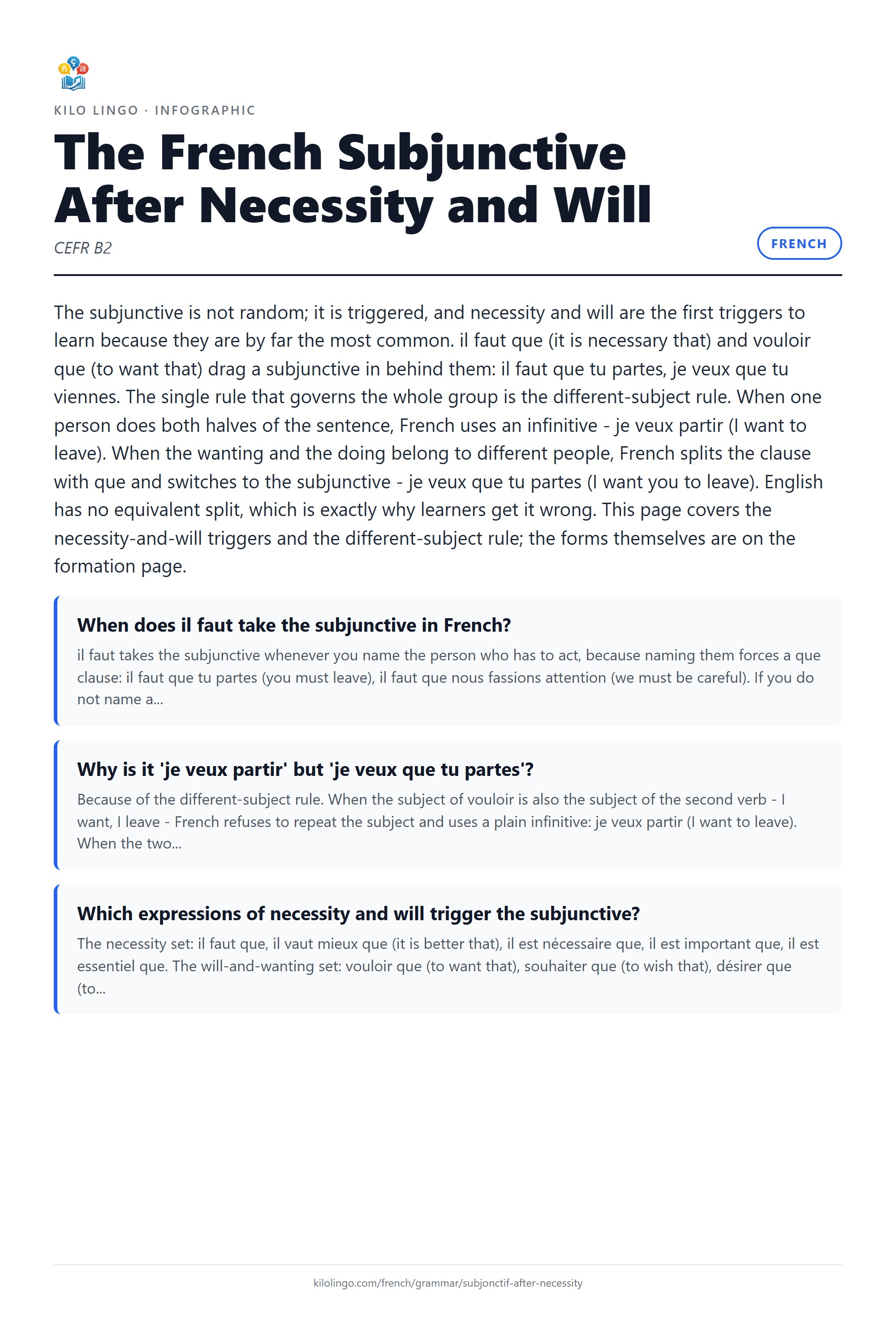
il faut que, vouloir que, il vaut mieux que and the rest of the necessity-and-will triggers, governed by the different-subject rule: je veux partir (same subject, infinitive) vs je veux que tu partes (different subjects, subjunctive).
- Words 1671-1680Vocabulary
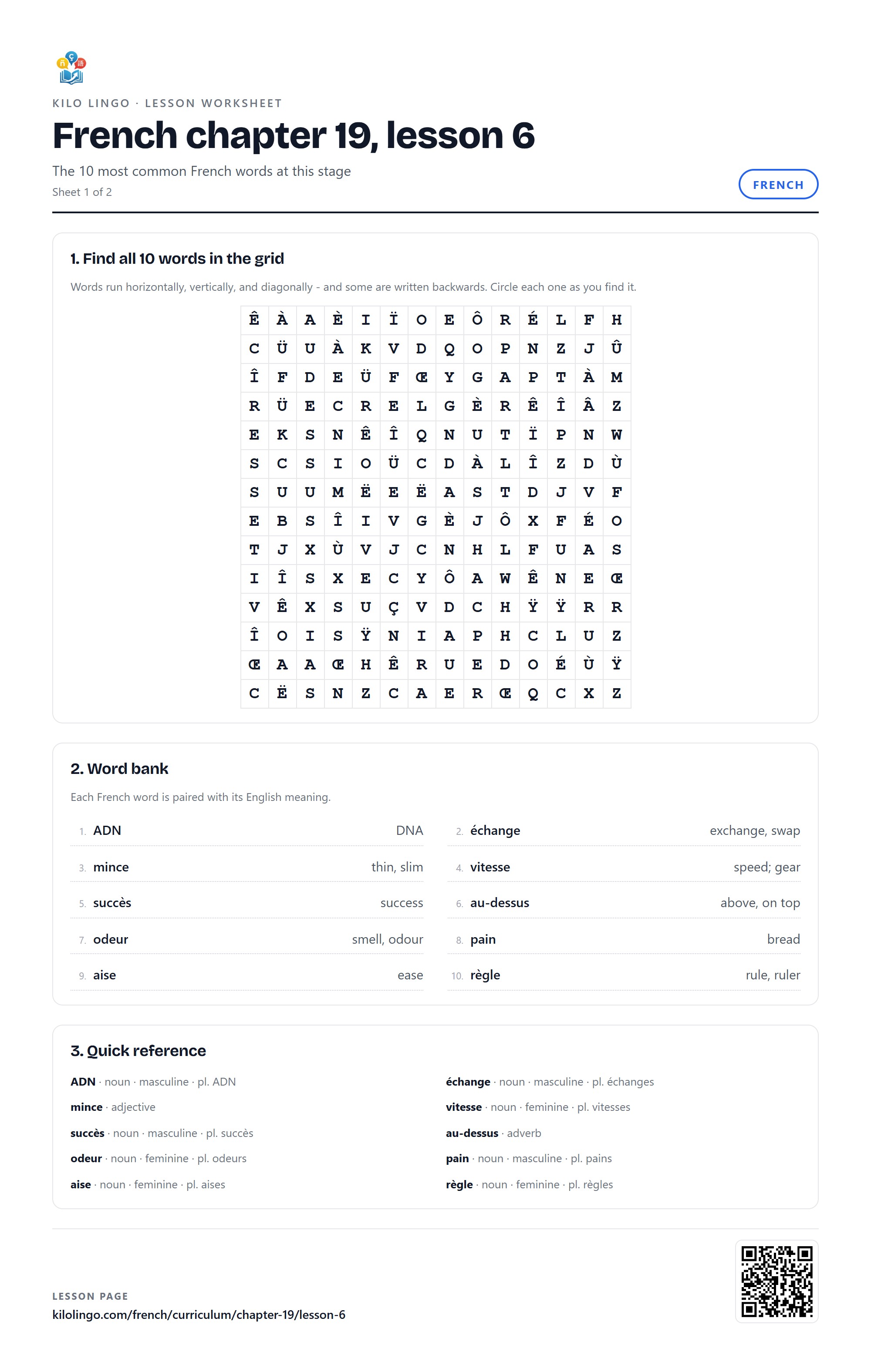
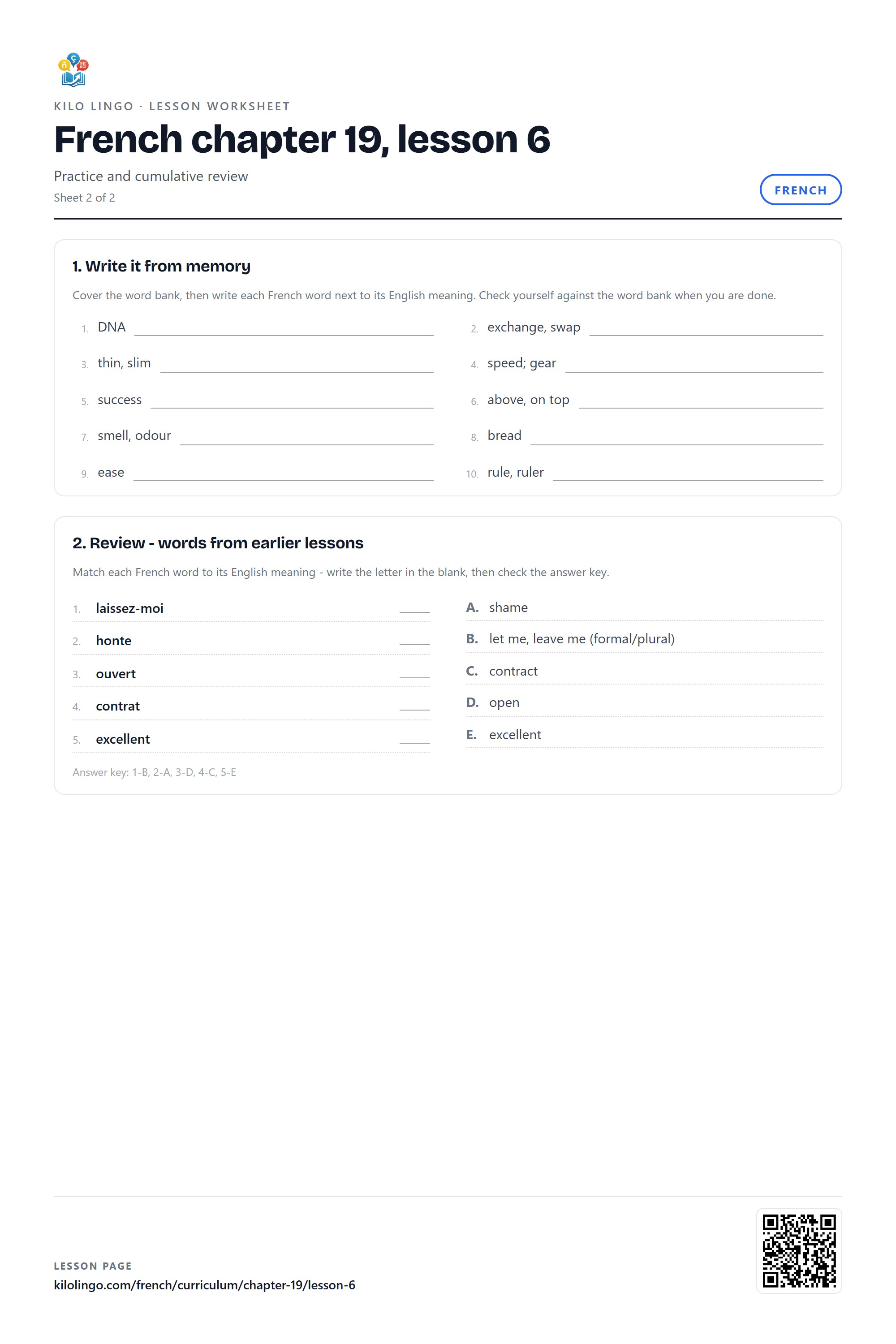
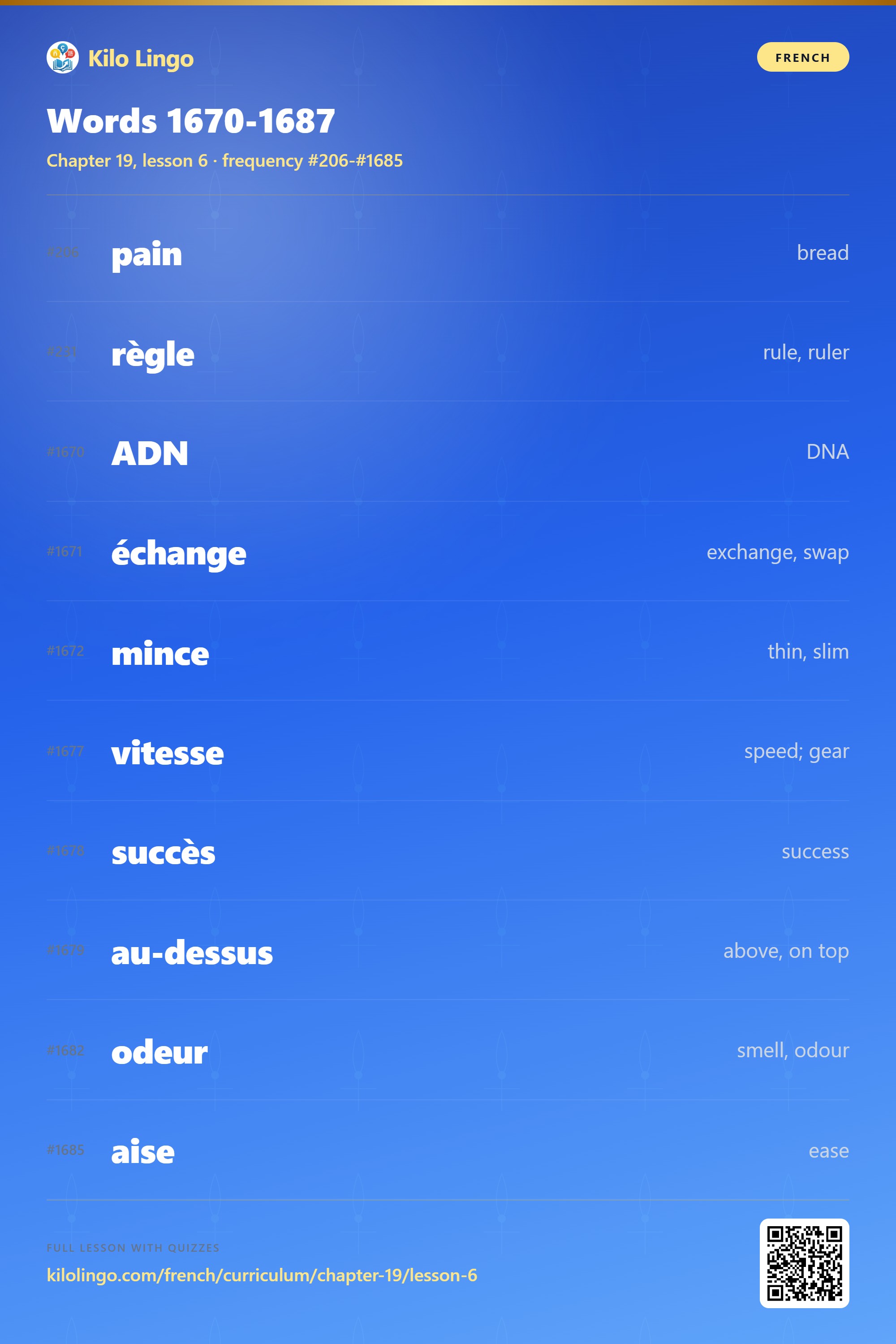
10 words · ranks 1671-1680
- Word Bubbles review sessionReview games
Pop the words you just met by matching each one to its meaning. A couple of rounds and the batch is yours.
- Words 1681-1690Vocabulary
10 words · ranks 1681-1690
- Conjugation Sprint review sessionReview games
Sixty seconds on the endings of the verbs this chapter has drilled so far.
- Words 1691-1700Vocabulary
10 words · ranks 1691-1700
- Story milestone: top 1700 wordsGraded-reader story
You can read this story using only the words you've learned so far. Every content word sits at or above the rank-1700 ceiling.
- Le sportThemed review
Playing, winning and losing.
jouer ais to play a sport,jouer deis to play an instrument - the preposition carries the whole meaning. - Arcade reviewReview games
Replay this chapter's words as games - a different kind of repetition, and it counts.
Word printables
Per-word sheets100 words · a worksheet, infographic and listicle each





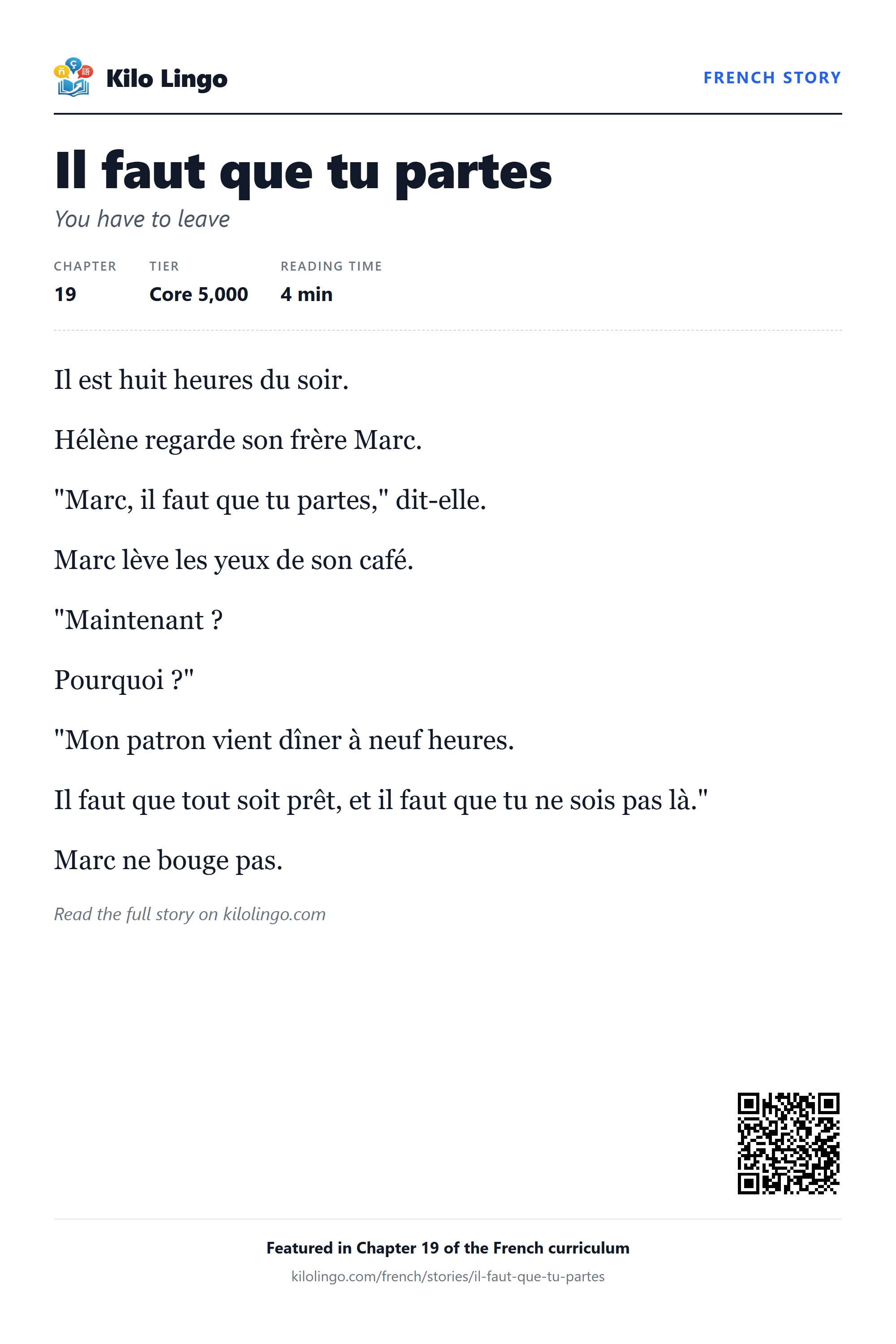
Chapter 20 · The subjunctive after doubt, emotion and opinion
Chapter page →- Words 1701-1710Vocabulary
10 words · ranks 1701-1710
- Word Bubbles review sessionReview games
Pop the words you just met by matching each one to its meaning. A couple of rounds and the batch is yours.
- Words 1711-1720Vocabulary
10 words · ranks 1711-1720
- Conjugation Sprint review sessionReview games
Sixty seconds on the endings of the verbs this chapter has drilled so far.
- Words 1721-1730Vocabulary
10 words · ranks 1721-1730
- Word Bubbles review sessionReview games
Pop the words you just met by matching each one to its meaning. A couple of rounds and the batch is yours.
- Words 1731-1740Vocabulary
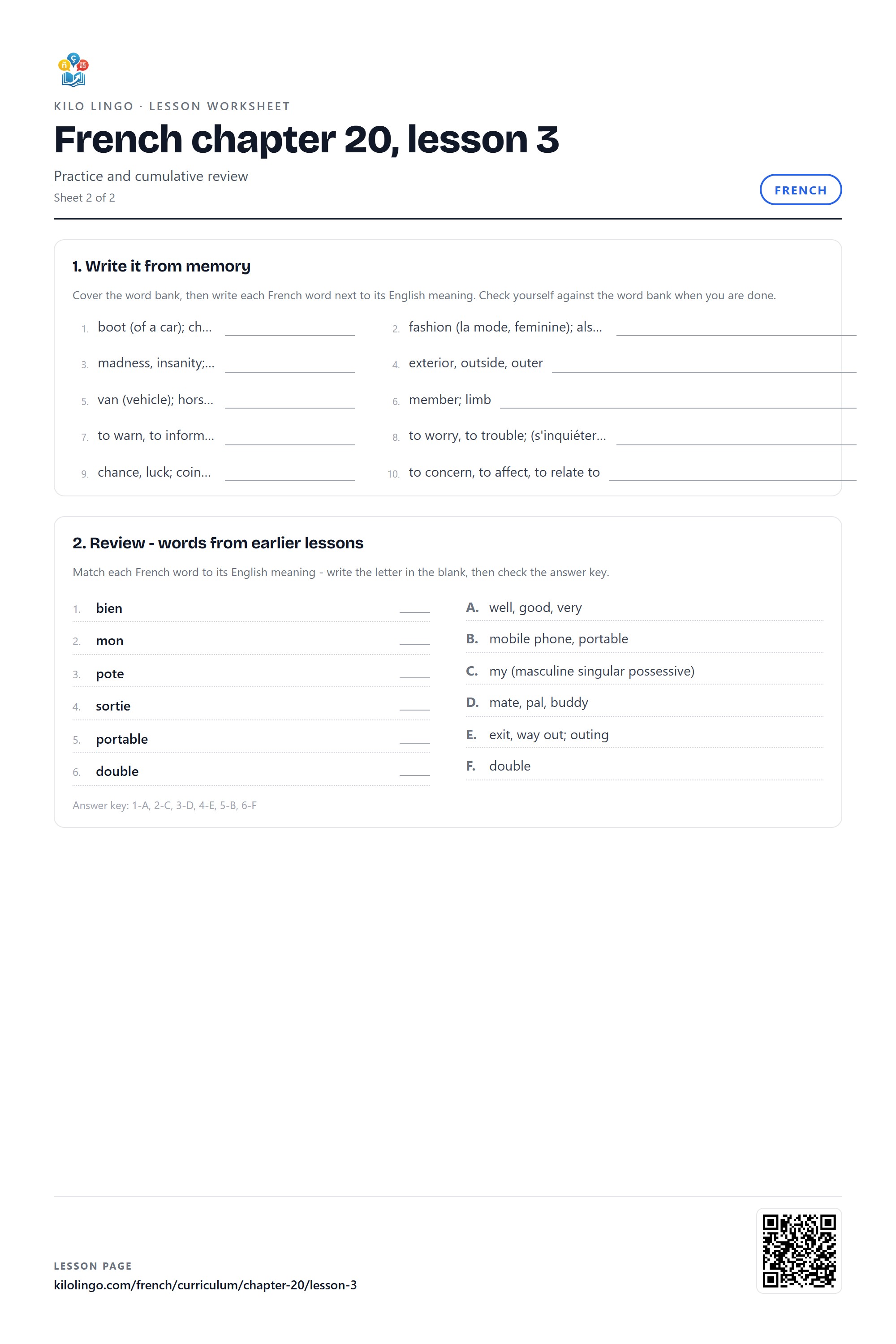
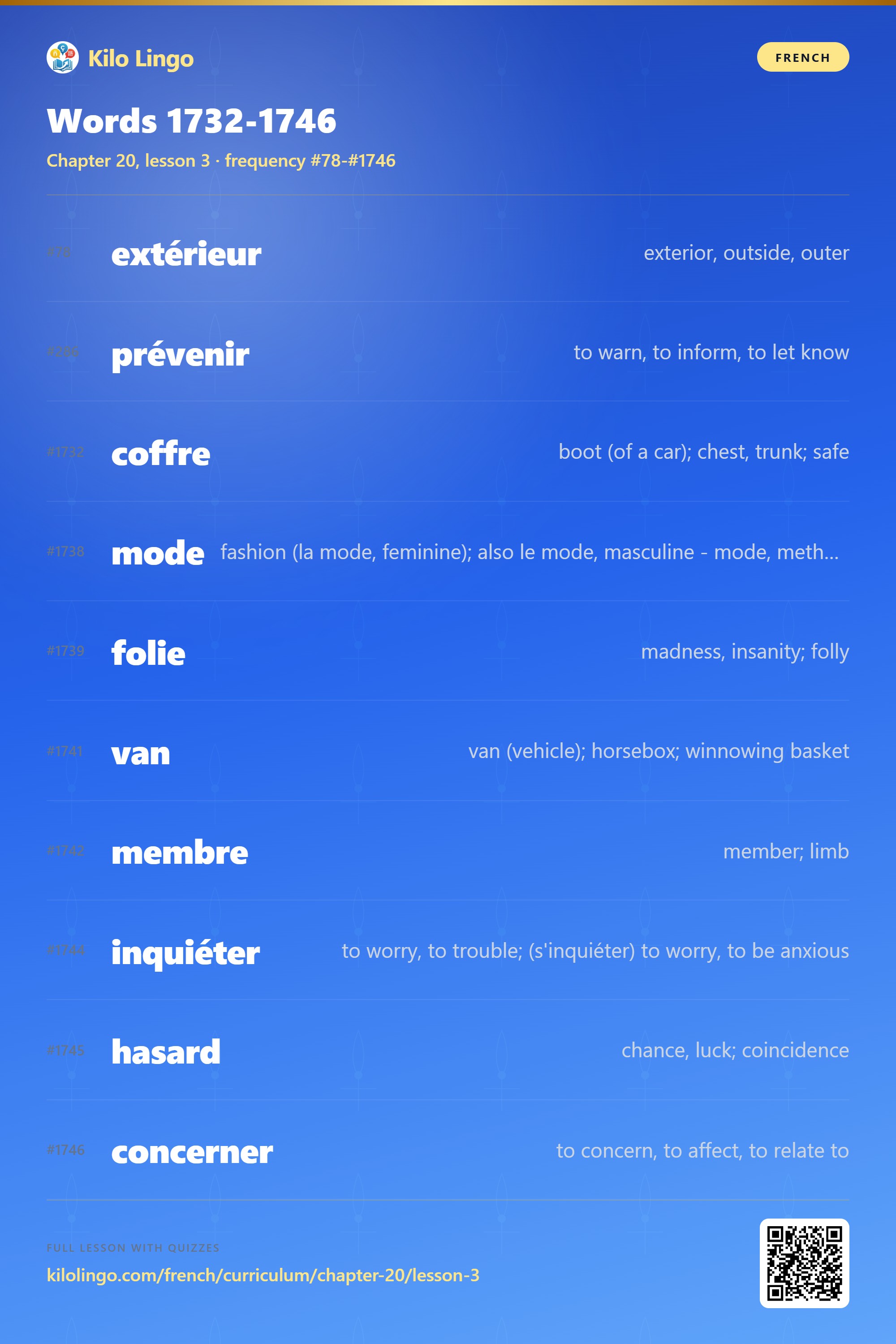
10 words · ranks 1731-1740
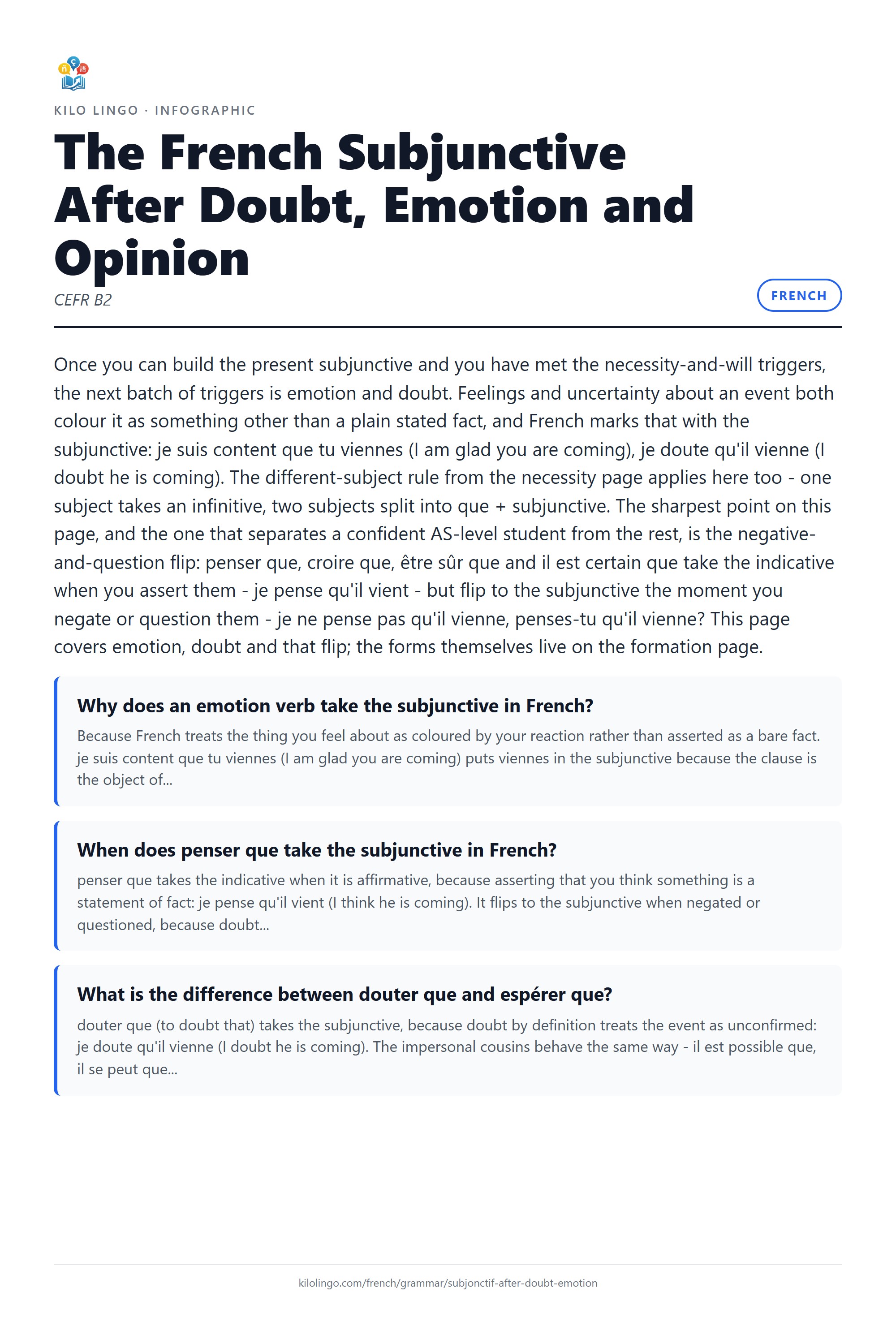
Emotion (etre content que, avoir peur que, regretter que) and doubt (douter que, il est possible que) take the subjunctive, and the negative-and-question flip turns penser que / croire que / etre sur que from indicative (je pense qu'il vient) to subjunctive (je ne pense pas qu'il vienne).
- partir, sortir or quitter?Mistake clinic
Three ways to leave, and one of them cannot stand alone.
- Words 1741-1750Vocabulary
10 words · ranks 1741-1750
- Conjugation Sprint review sessionReview games
Sixty seconds on the endings of the verbs this chapter has drilled so far.
- Words 1751-1760Vocabulary
10 words · ranks 1751-1760
- Word Bubbles review sessionReview games
Pop the words you just met by matching each one to its meaning. A couple of rounds and the batch is yours.
- Words 1761-1770Vocabulary
10 words · ranks 1761-1770
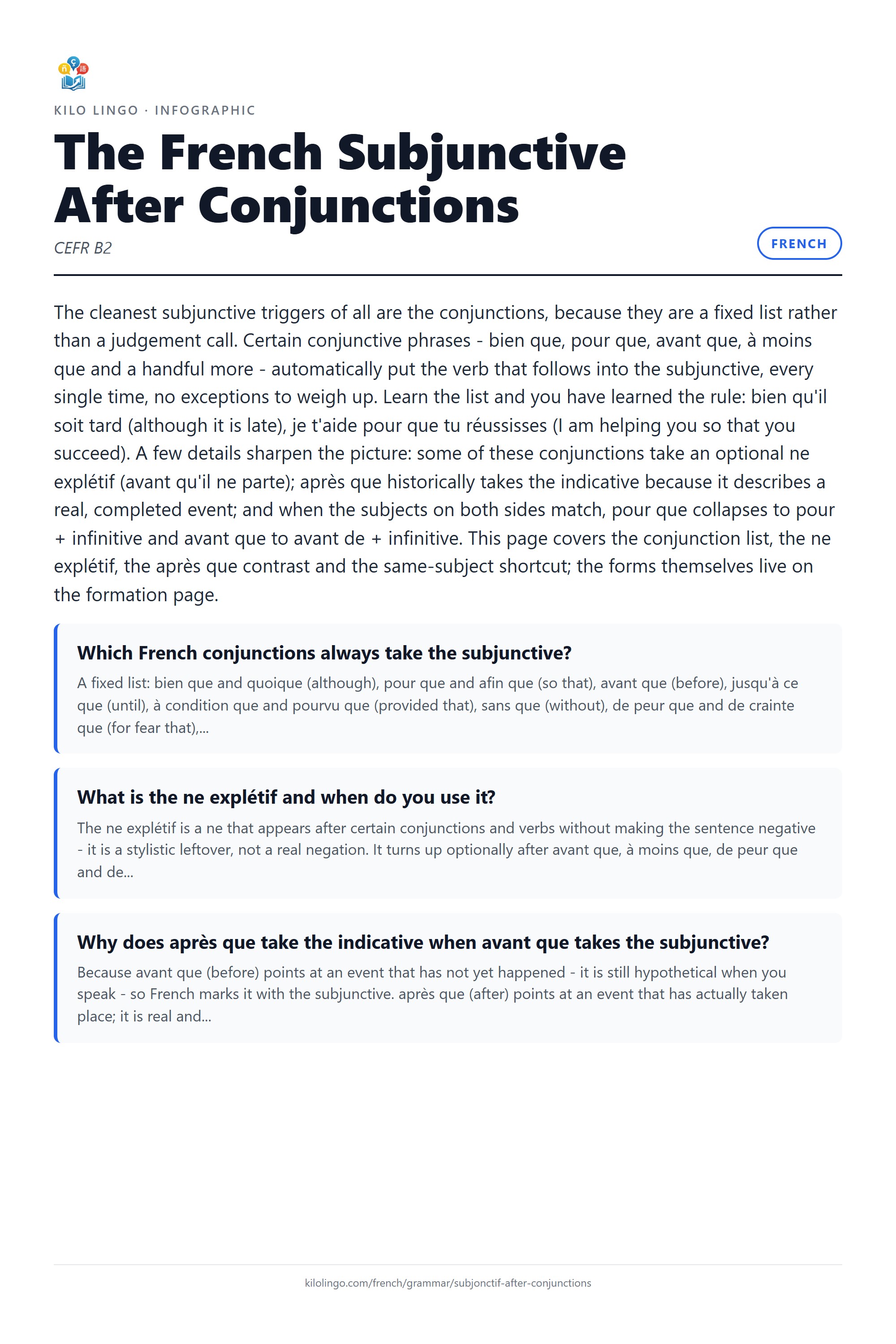
Conjunctive phrases that always trigger the subjunctive: bien que and quoique (although), pour que and afin que (so that), avant que (before), jusqu'a ce que (until), a condition que and pourvu que (provided that), a moins que (unless), sans que (without), plus the same-subject shortcut pour que -> pour + infinitive.
- Words 1771-1780Vocabulary
10 words · ranks 1771-1780
- Making plansPhrase session
Arranging to meet, and getting out of it politely.
- Words 1781-1790Vocabulary
10 words · ranks 1781-1790
- Conjugation Sprint review sessionReview games
Sixty seconds on the endings of the verbs this chapter has drilled so far.
- Words 1791-1800Vocabulary
10 words · ranks 1791-1800
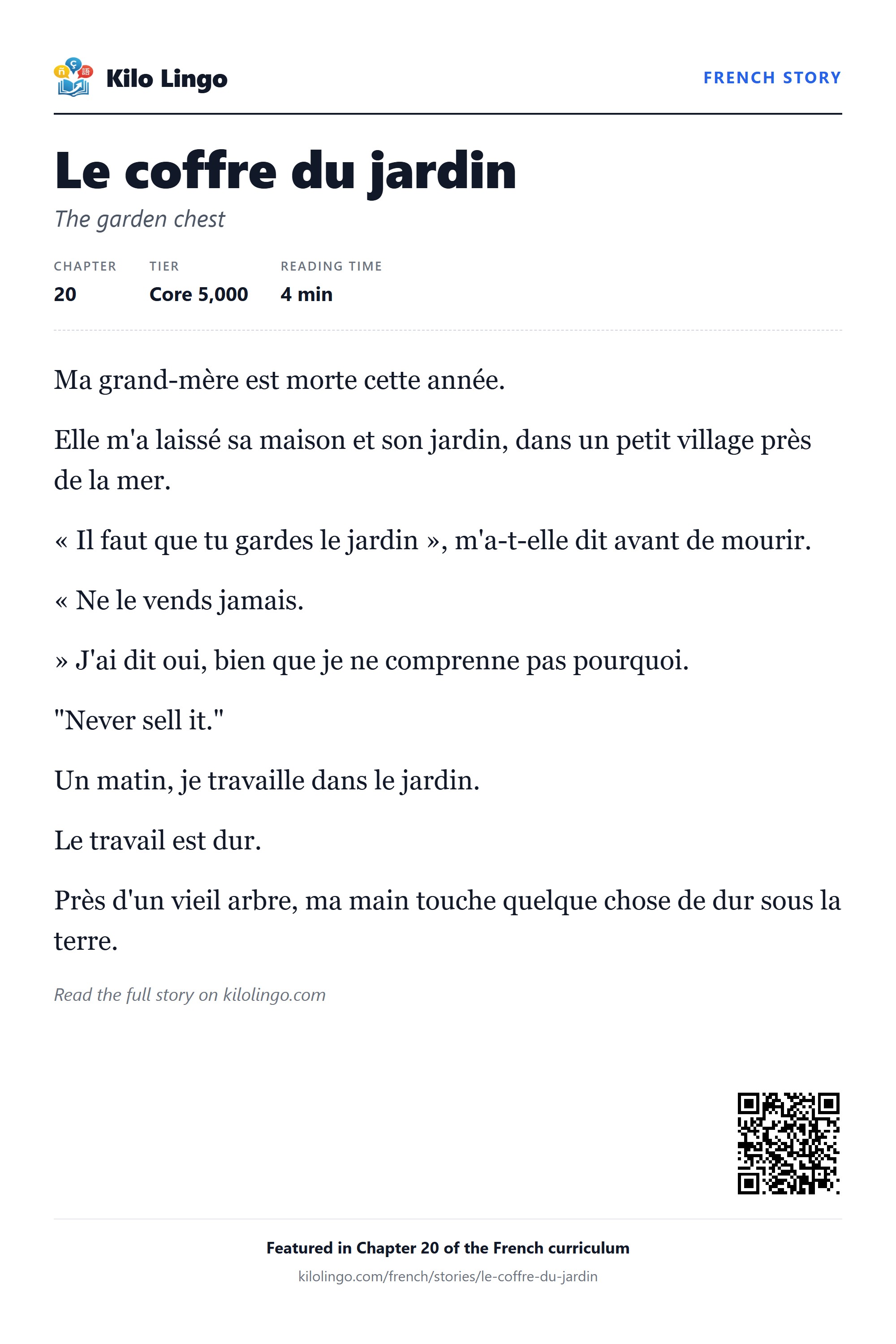
- Story milestone: top 1800 wordsGraded-reader story
You can read this story using only the words you've learned so far. Every content word sits at or above the rank-1800 ceiling.
- Les vêtementsThemed review
Getting dressed.
porteris to wear as well as to carry, andtailleis your size as well as your waist. - Arcade reviewReview games
Replay this chapter's words as games - a different kind of repetition, and it counts.
Word printables
Per-word sheets100 words · a worksheet, infographic and listicle each
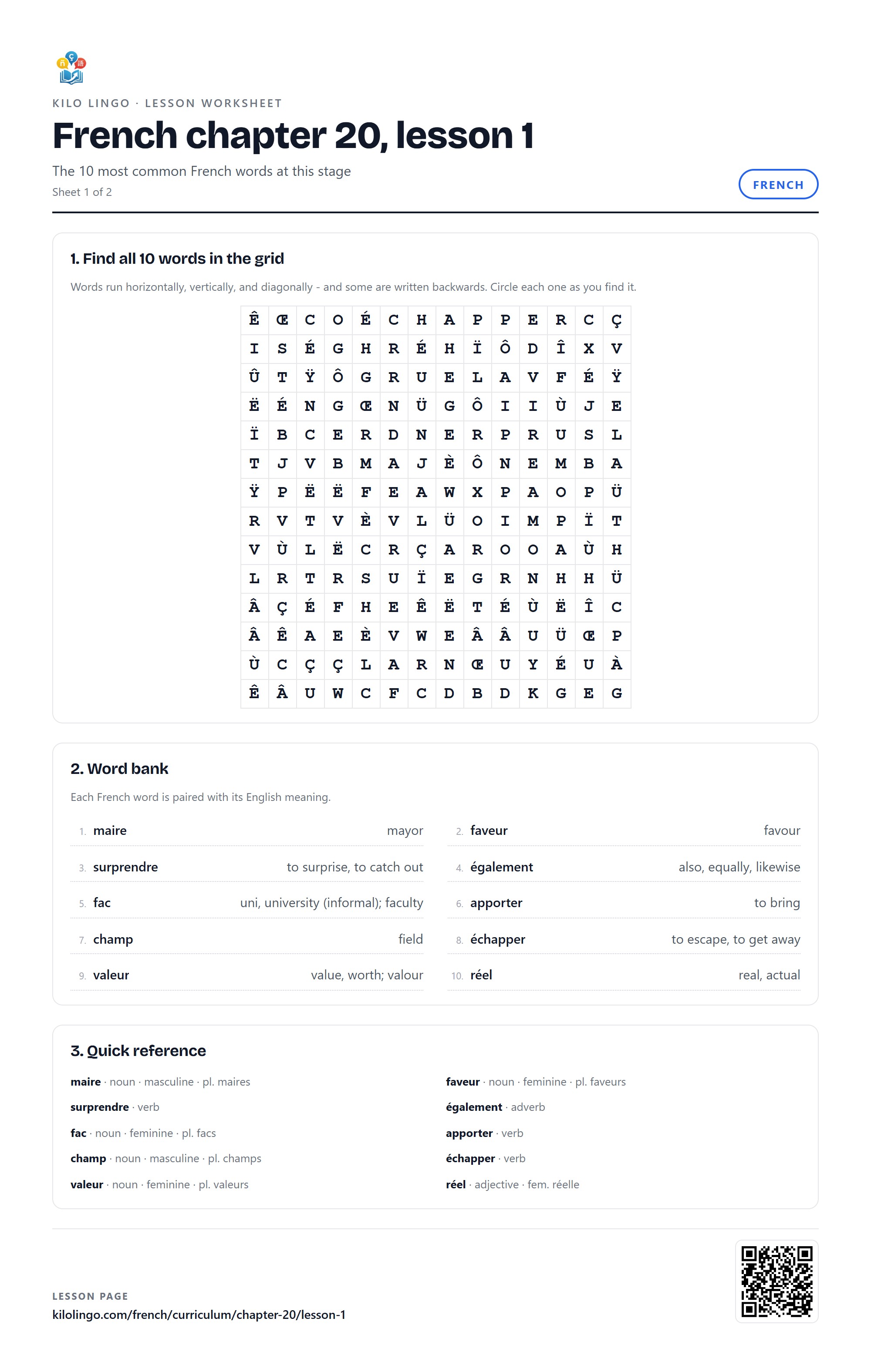
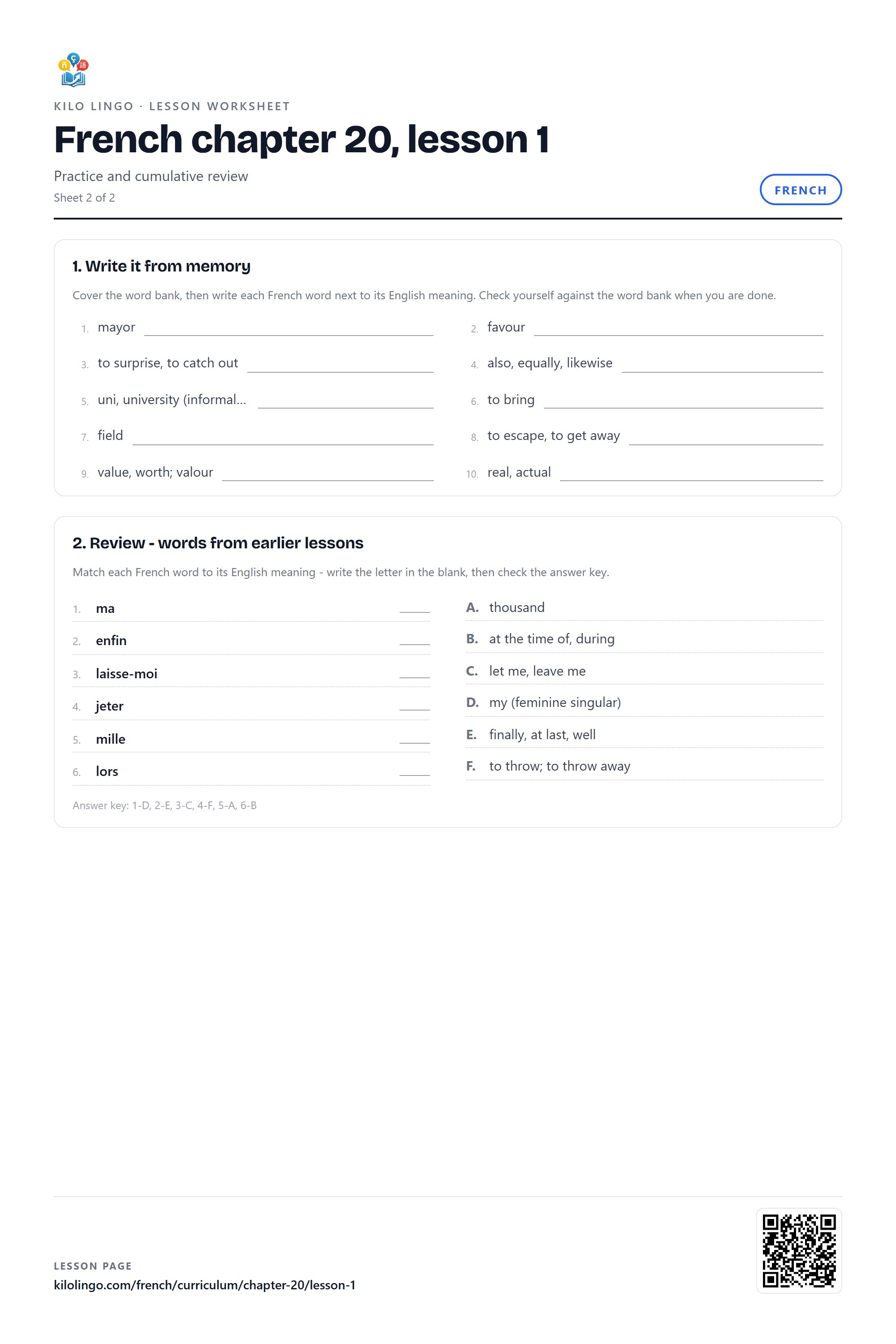

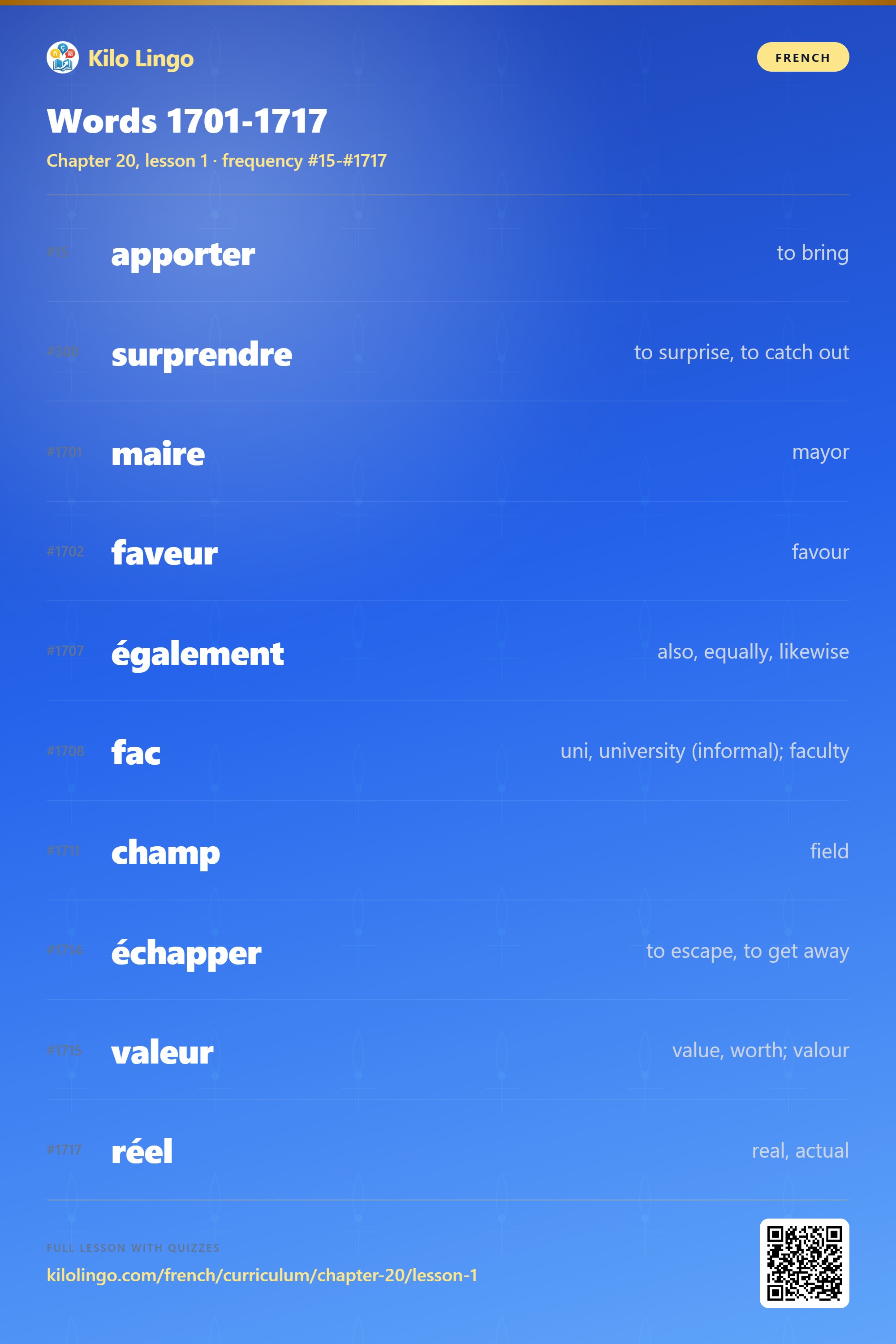
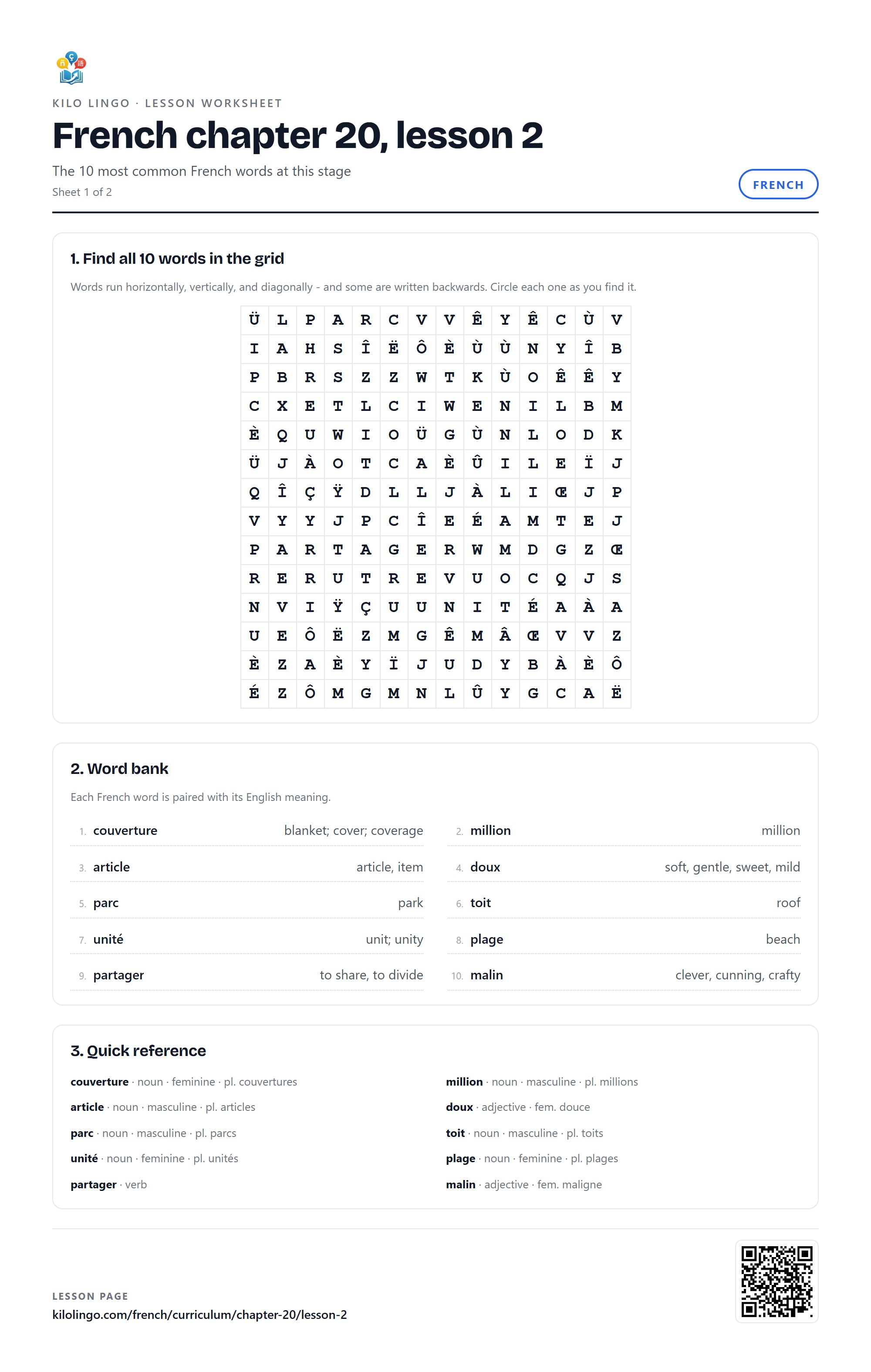
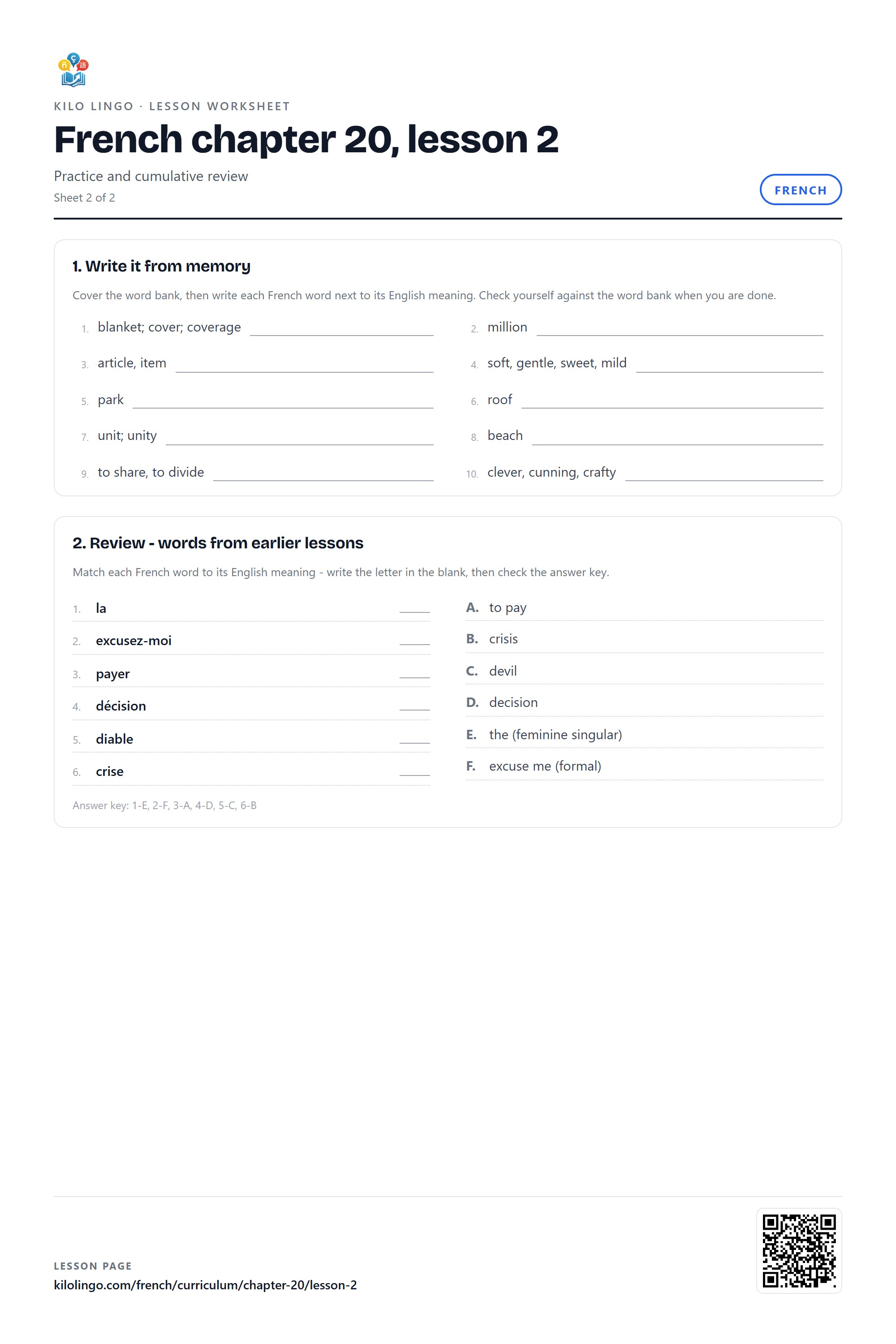

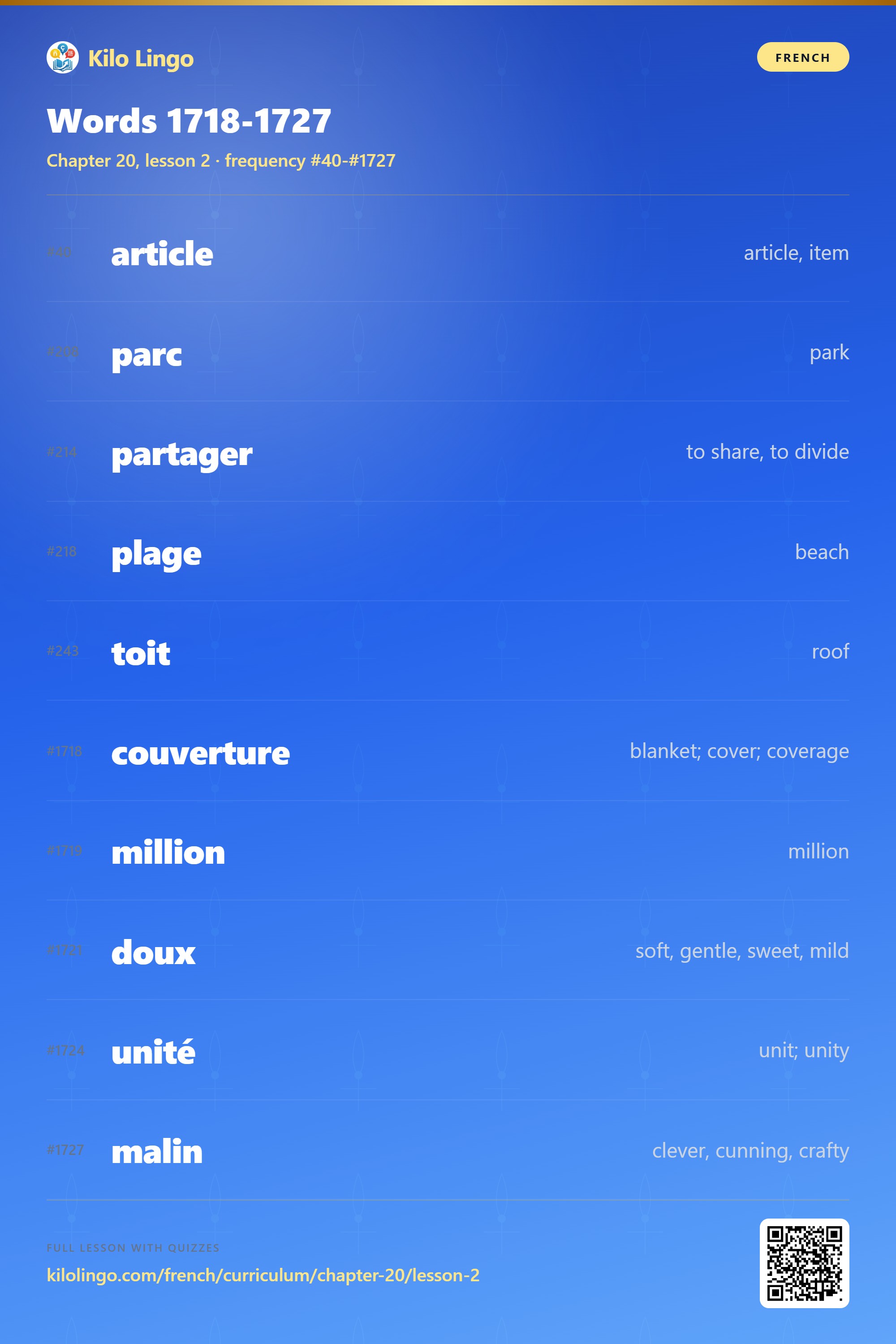
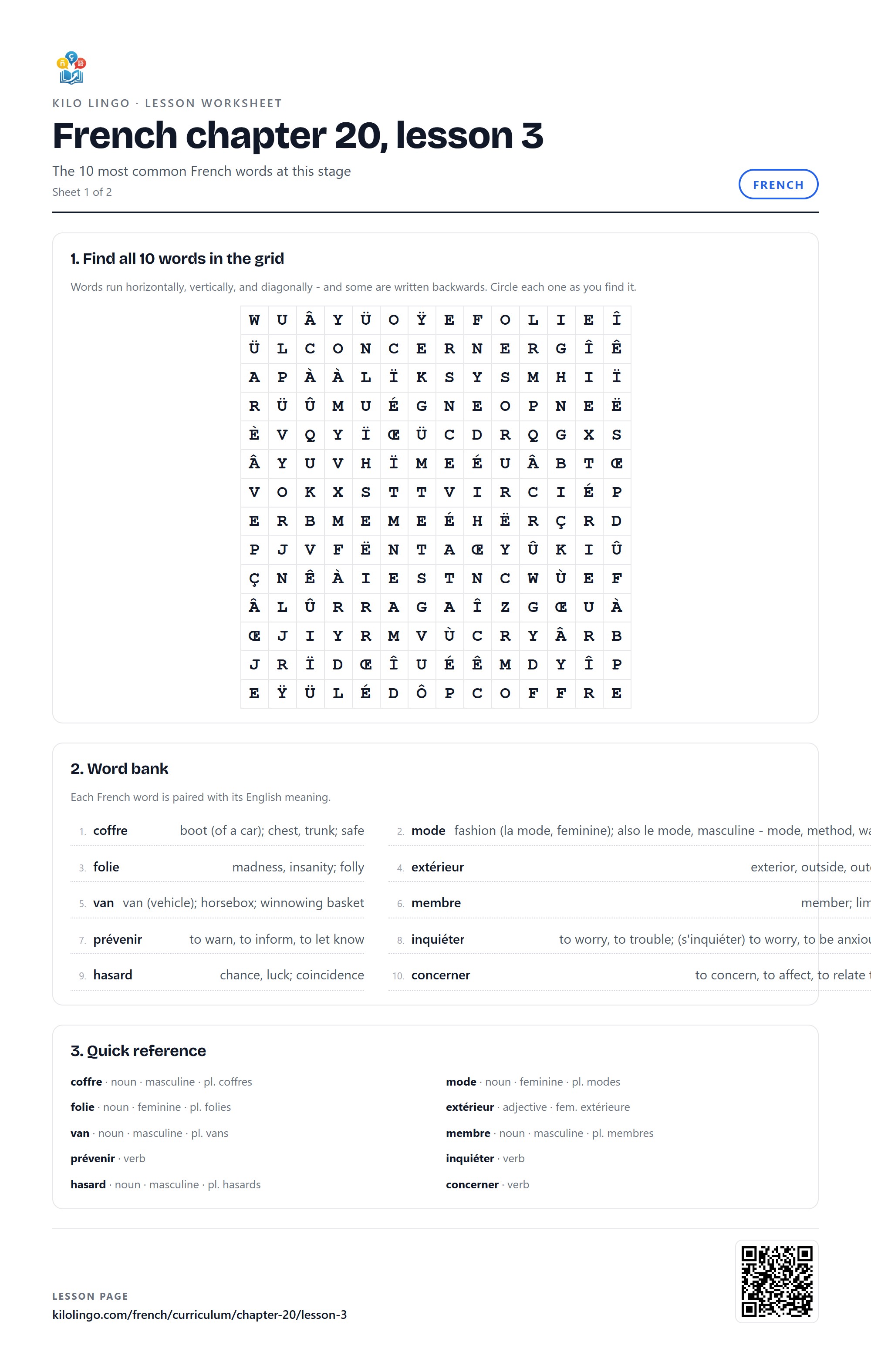

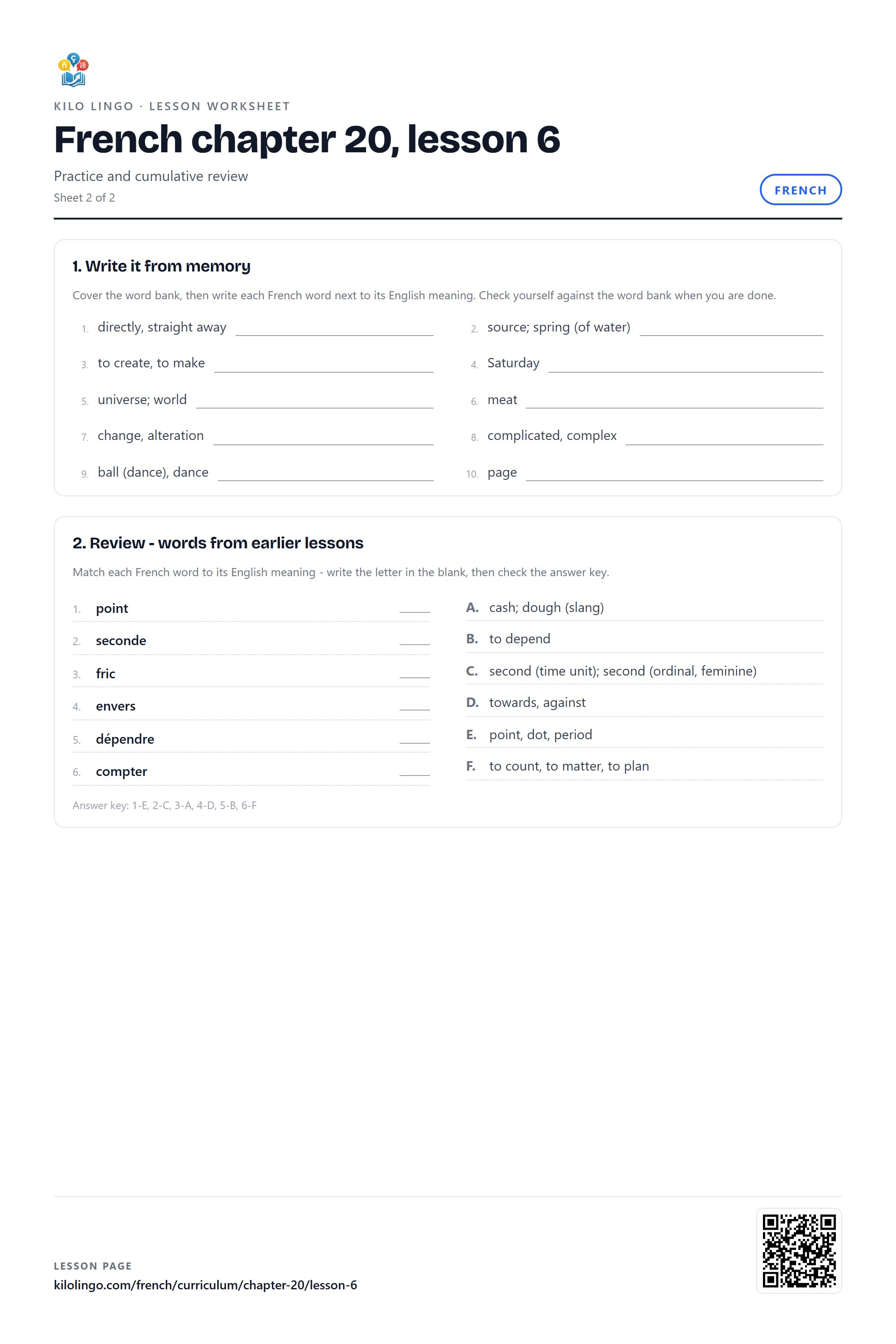

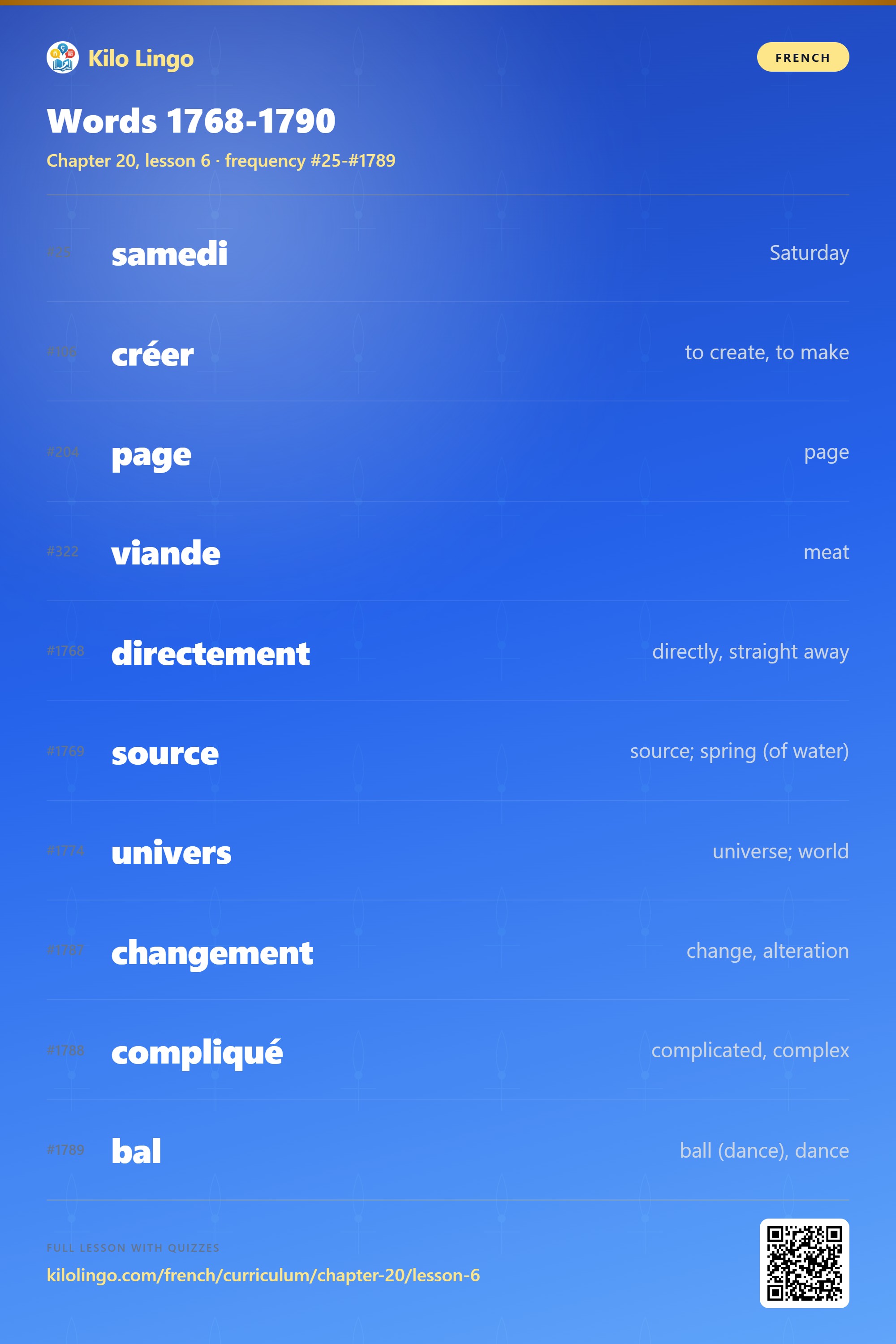
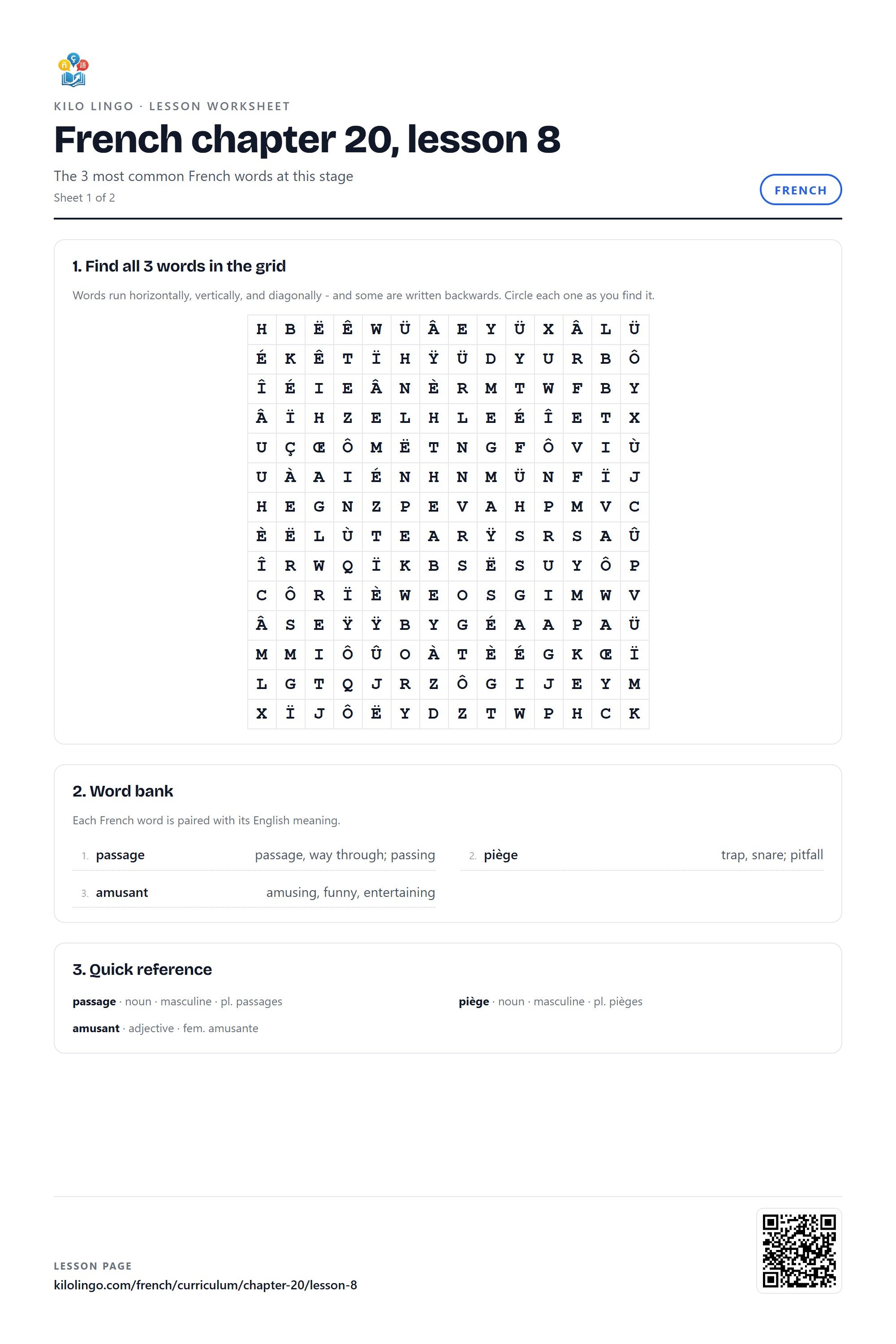
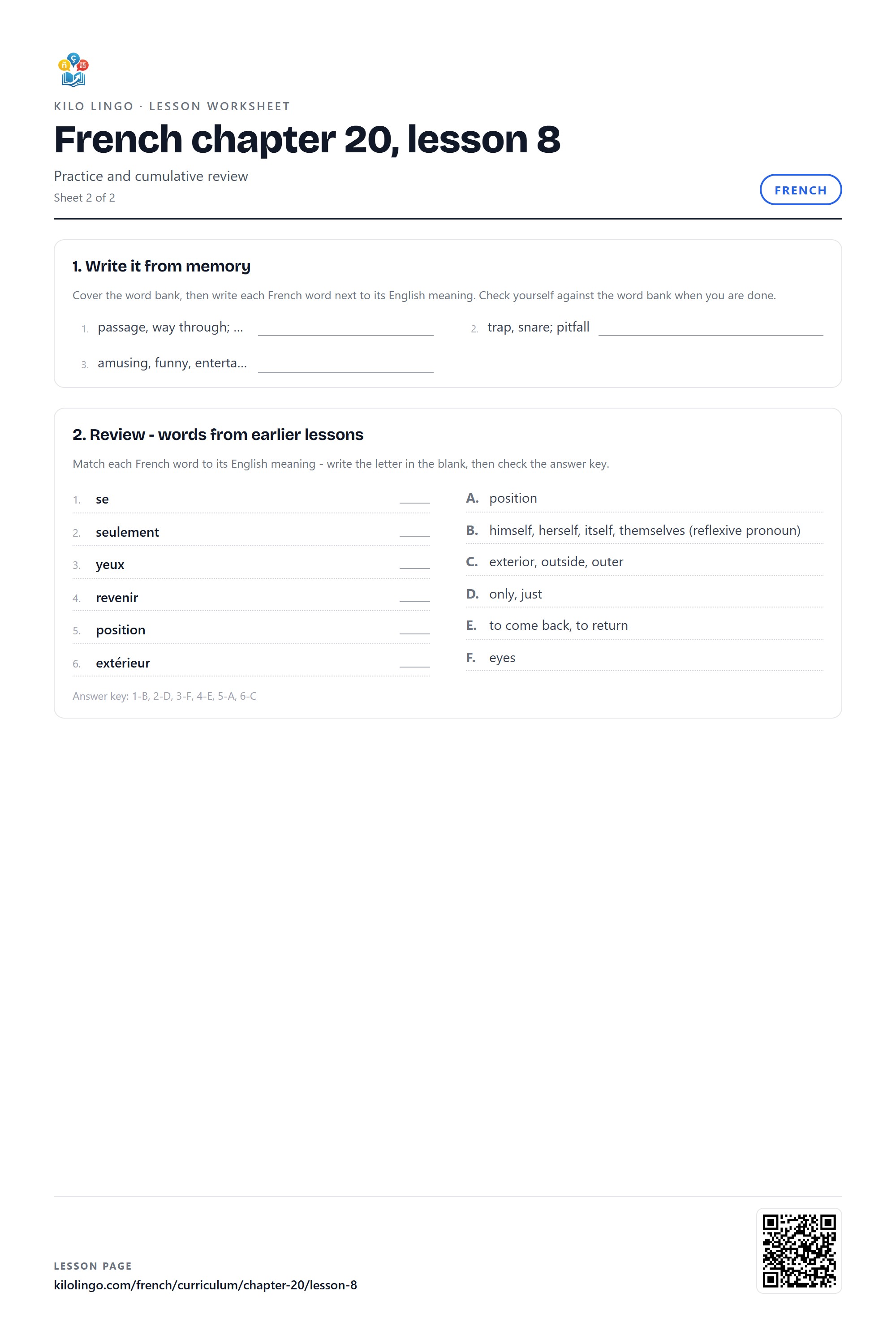

Chapter 21 · The passive voice
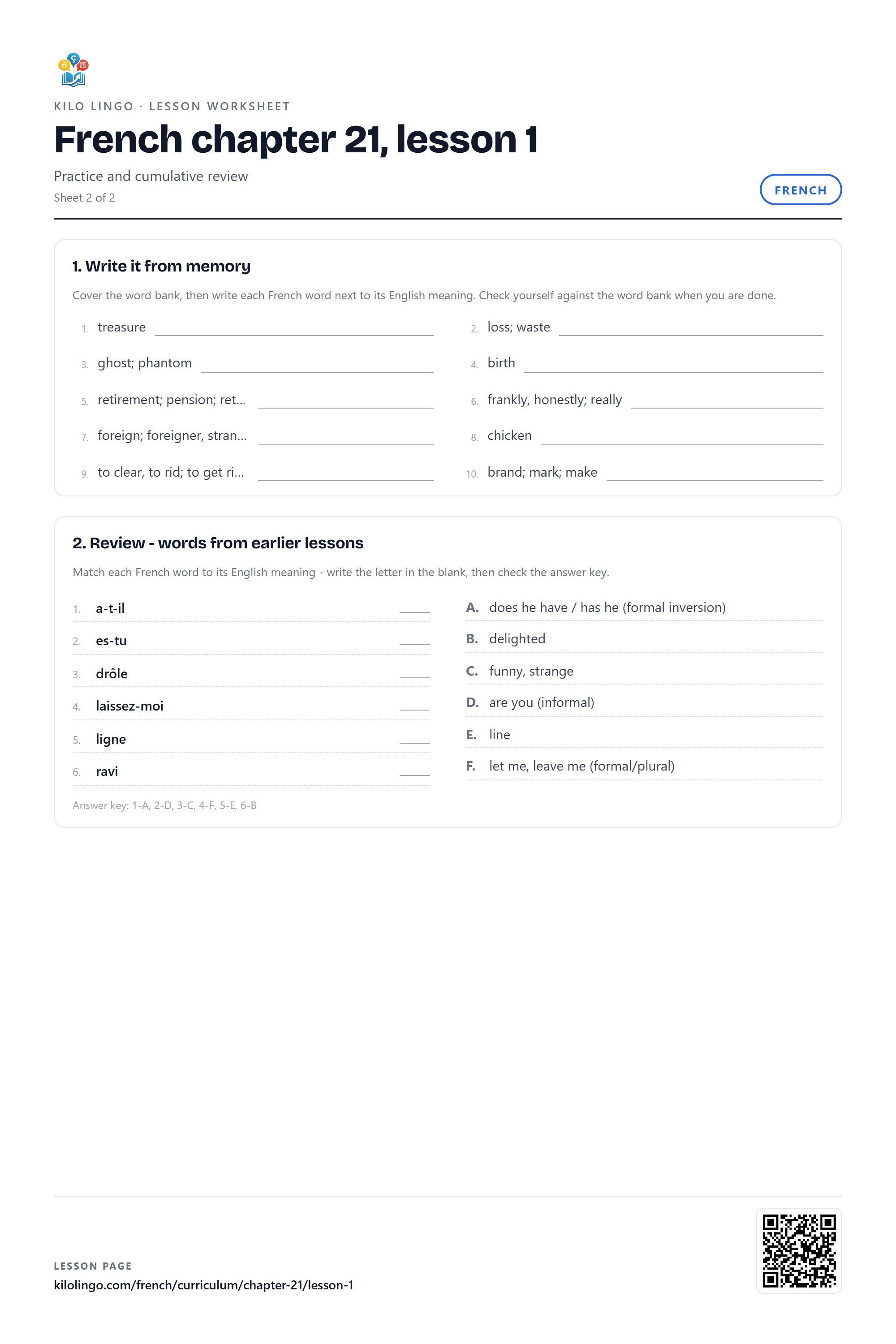
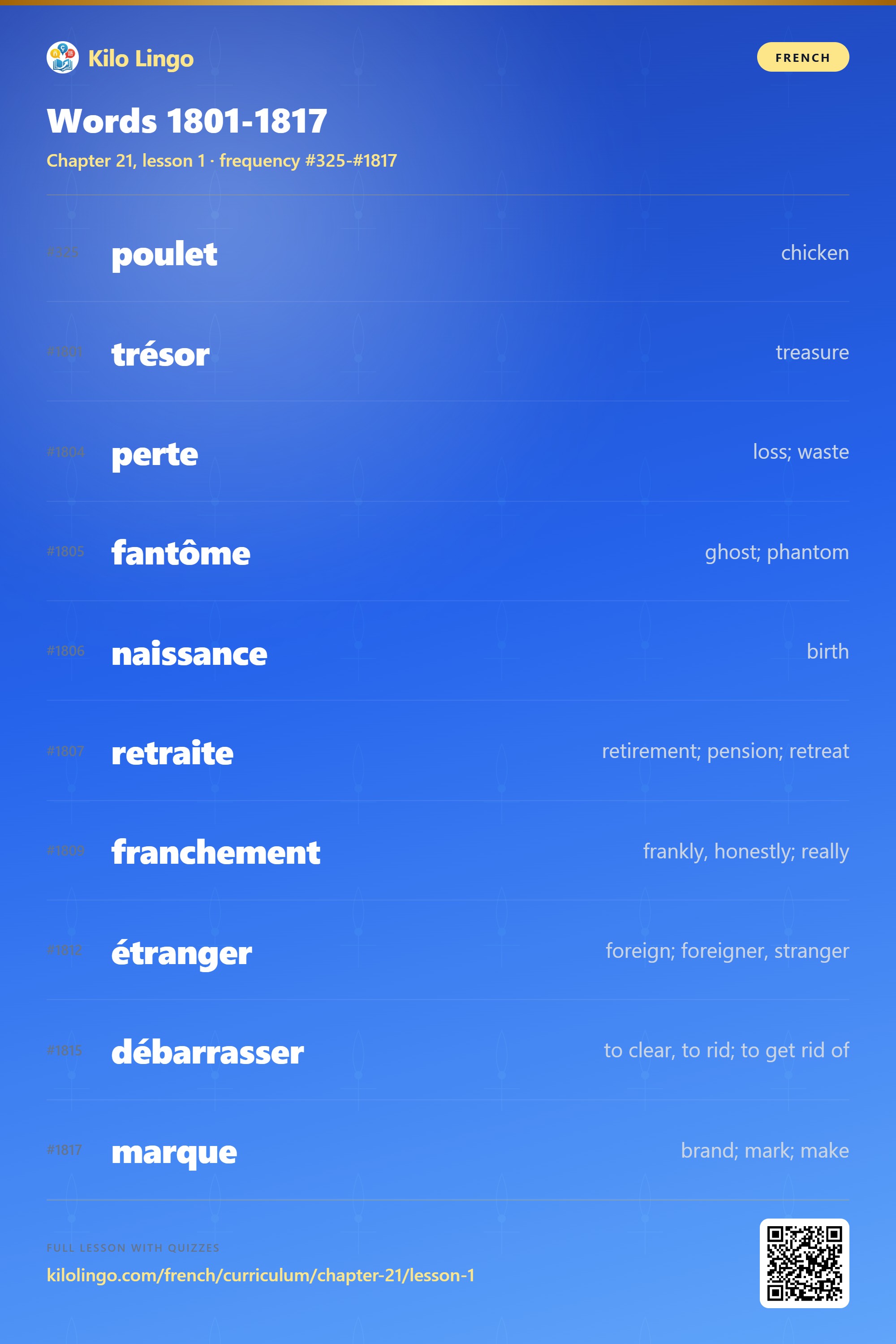
Chapter page →- Words 1801-1810Vocabulary
10 words · ranks 1801-1810
- Word Bubbles review sessionReview games
Pop the words you just met by matching each one to its meaning. A couple of rounds and the batch is yours.
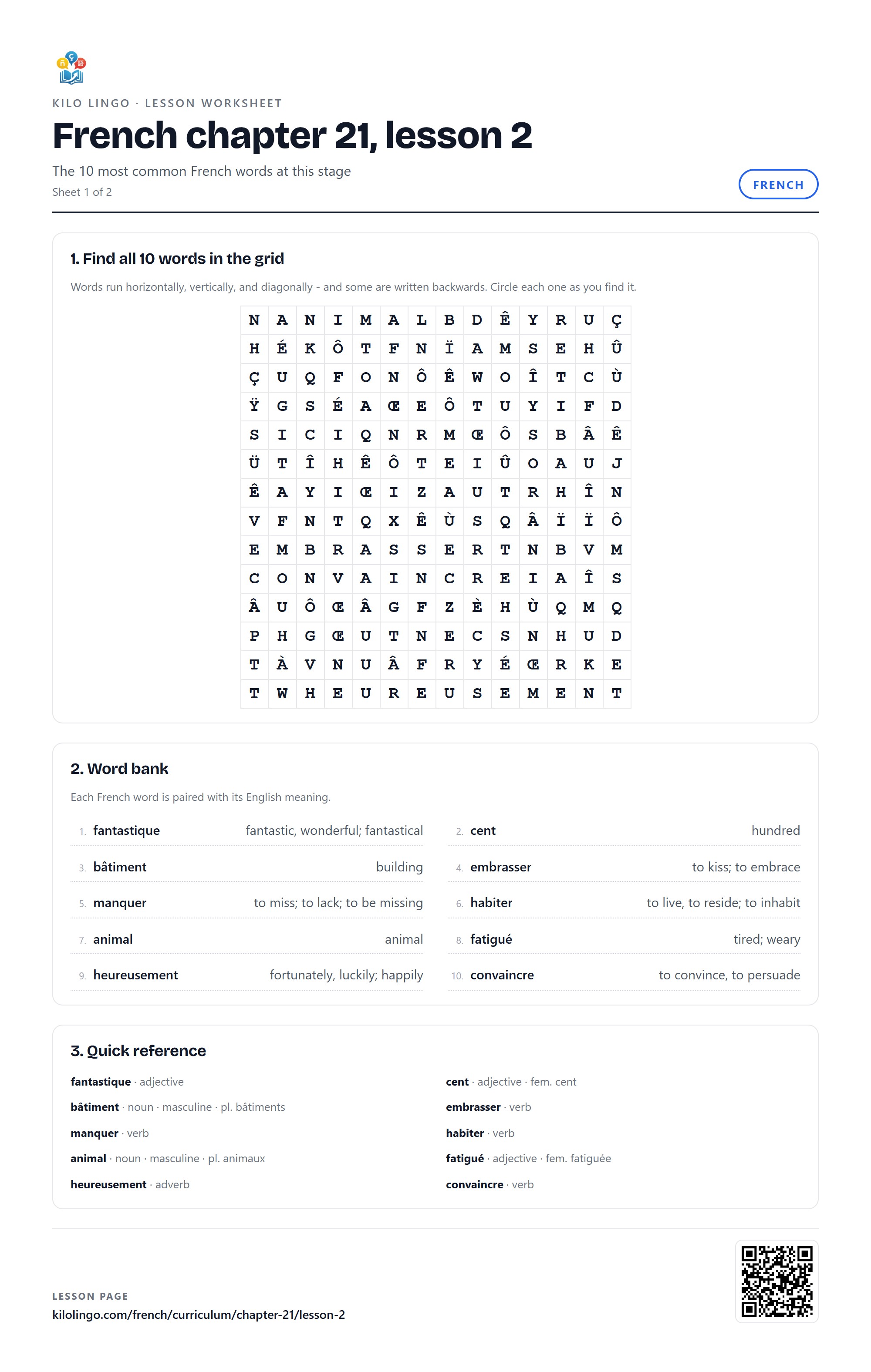
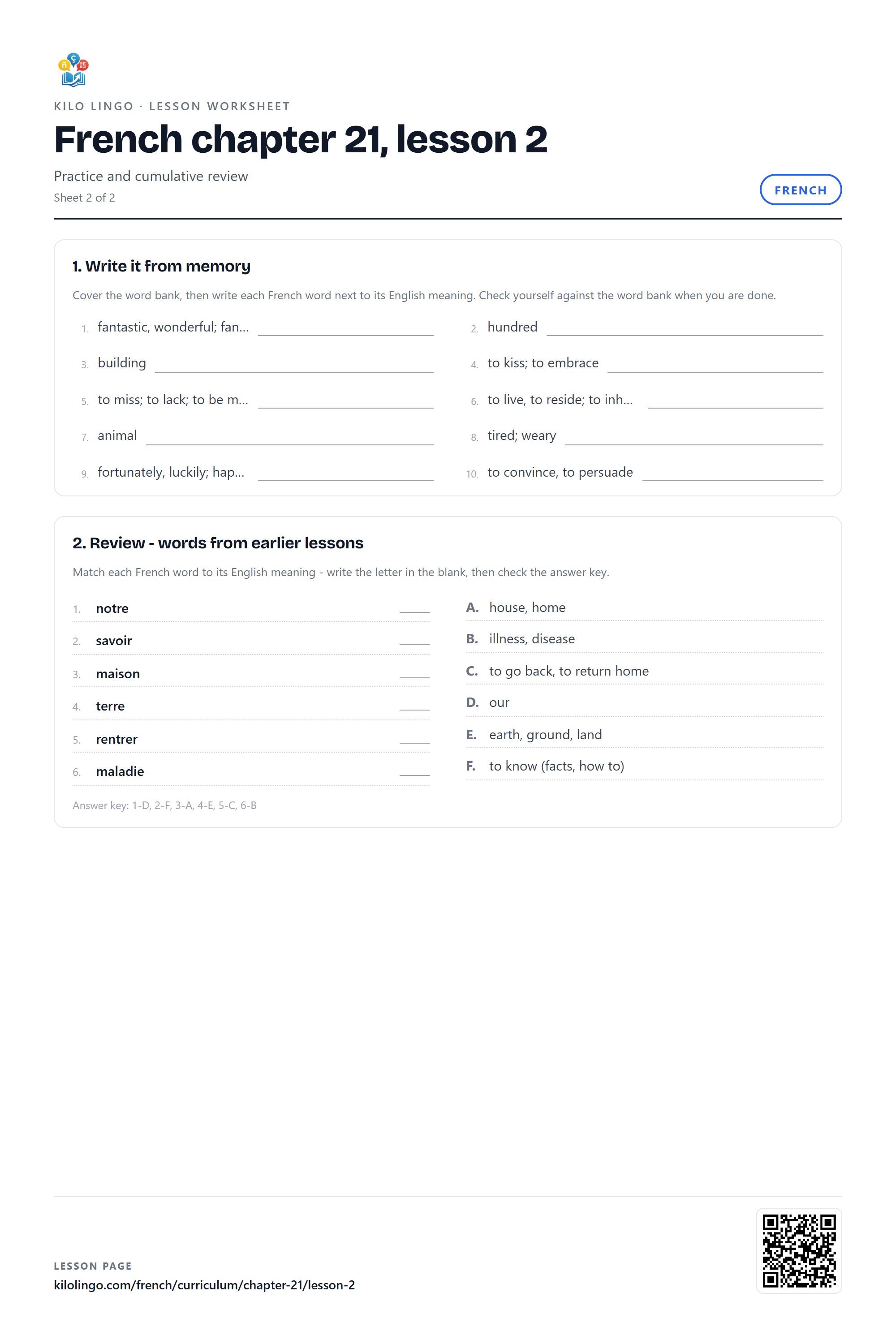
- Words 1811-1820Vocabulary
10 words · ranks 1811-1820
- Crossword review sessionReview games
Cross the words you just met, clued in English. Slower than a drill, and it sticks harder.
- Words 1821-1830Vocabulary
10 words · ranks 1821-1830
- Conjugation Sprint review sessionReview games
Sixty seconds on the endings of the verbs this chapter has drilled so far.
- Words 1831-1840Vocabulary
10 words · ranks 1831-1840
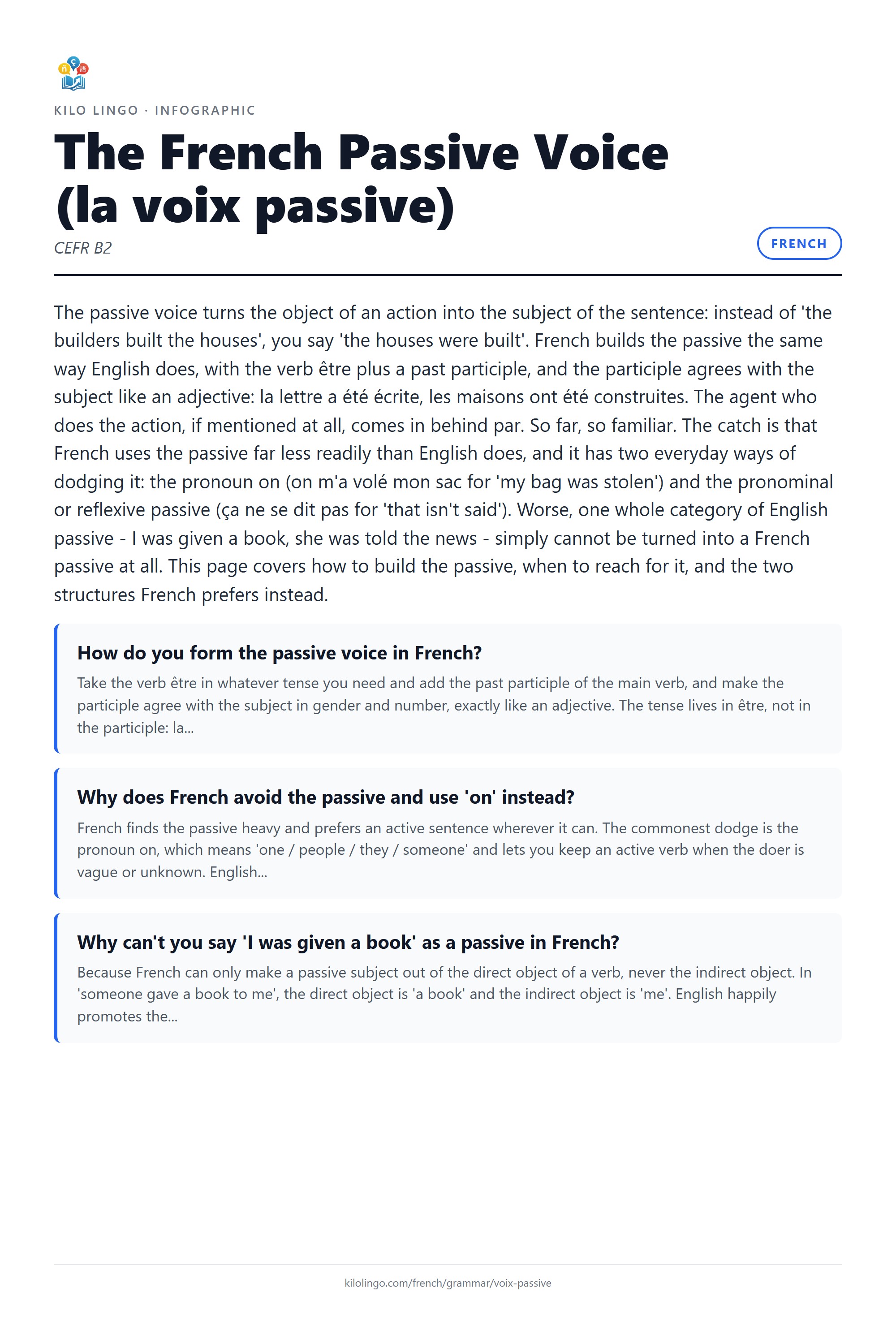
- The passive voiceGrammar
etre (in any tense) + past participle agreeing with the subject (la lettre a ete ecrite), the agent introduced by par, and the ways French prefers to avoid the passive: on (on m'a vole mon sac) and the pronominal passive (ca ne se dit pas).
- emmener or emporter?Mistake clinic
The away-from-here version of amener and apporter.
- Words 1841-1850Vocabulary
10 words · ranks 1841-1850
- Word Bubbles review sessionReview games
Pop the words you just met by matching each one to its meaning. A couple of rounds and the batch is yours.
- Words 1851-1860Vocabulary
10 words · ranks 1851-1860
- Conjugation Sprint review sessionReview games
Sixty seconds on the endings of the verbs this chapter has drilled so far.
- Words 1861-1870Vocabulary
10 words · ranks 1861-1870
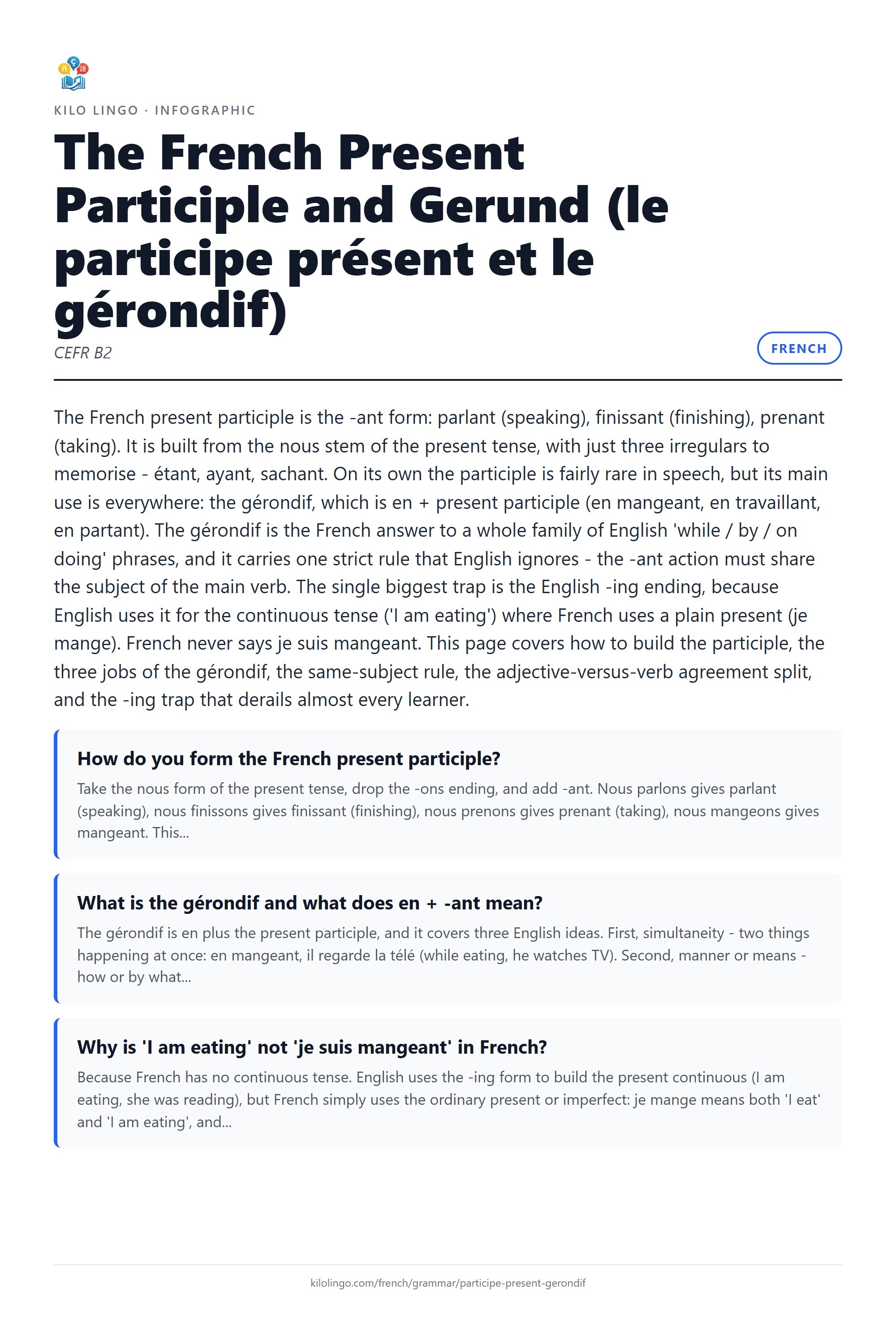
The -ant form (parlant, finissant, with irregulars etant, ayant, sachant) and the gerund en + participle for simultaneity (en mangeant), means (en travaillant) and condition, under the same-subject rule, plus why French has no -ing continuous tense.
- Words 1871-1880Vocabulary
10 words · ranks 1871-1880
- Word Bubbles review sessionReview games
Pop the words you just met by matching each one to its meaning. A couple of rounds and the batch is yours.
- Words 1881-1890Vocabulary
10 words · ranks 1881-1890
- Conjugation Sprint review sessionReview games
Sixty seconds on the endings of the verbs this chapter has drilled so far.
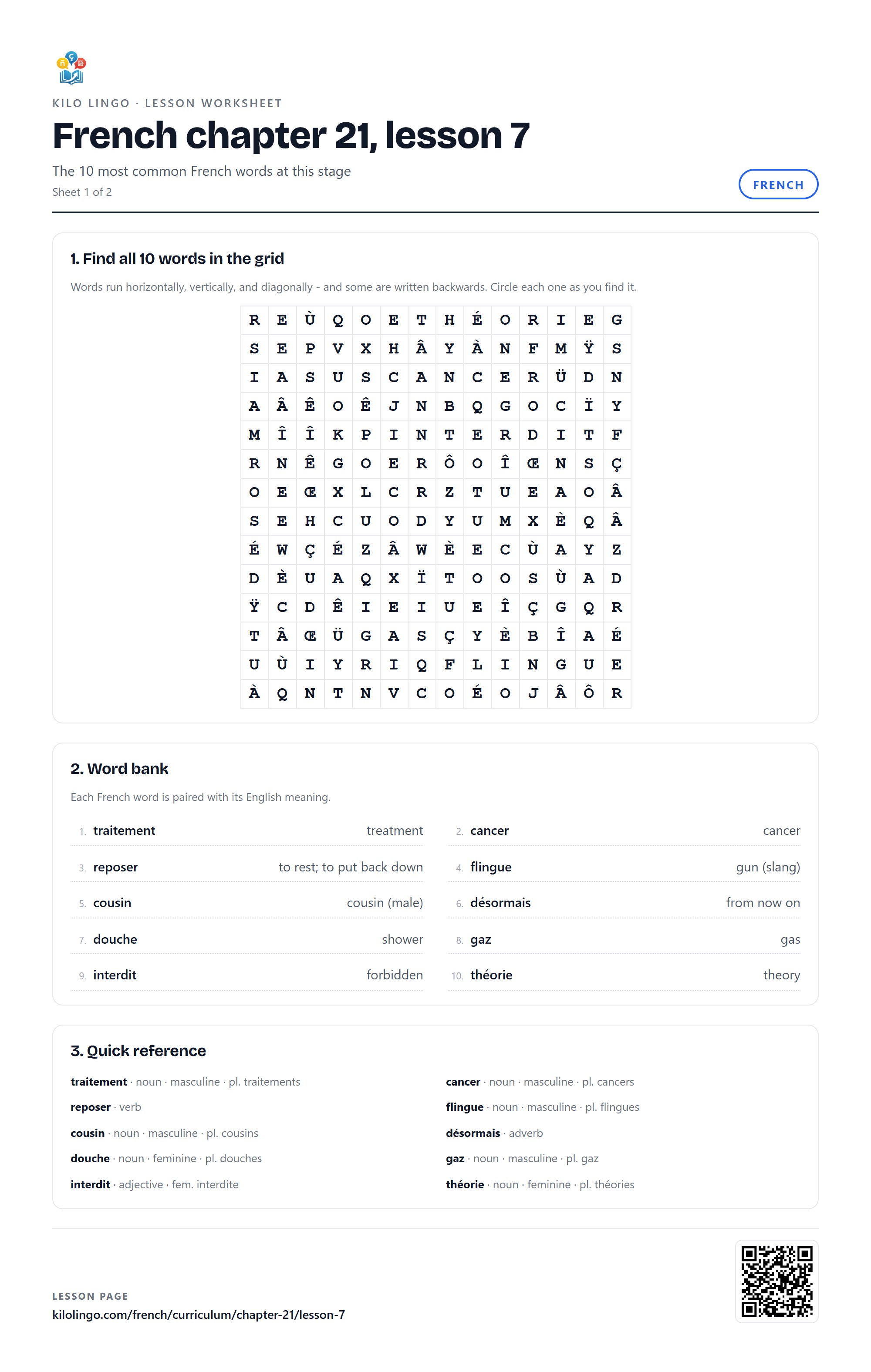
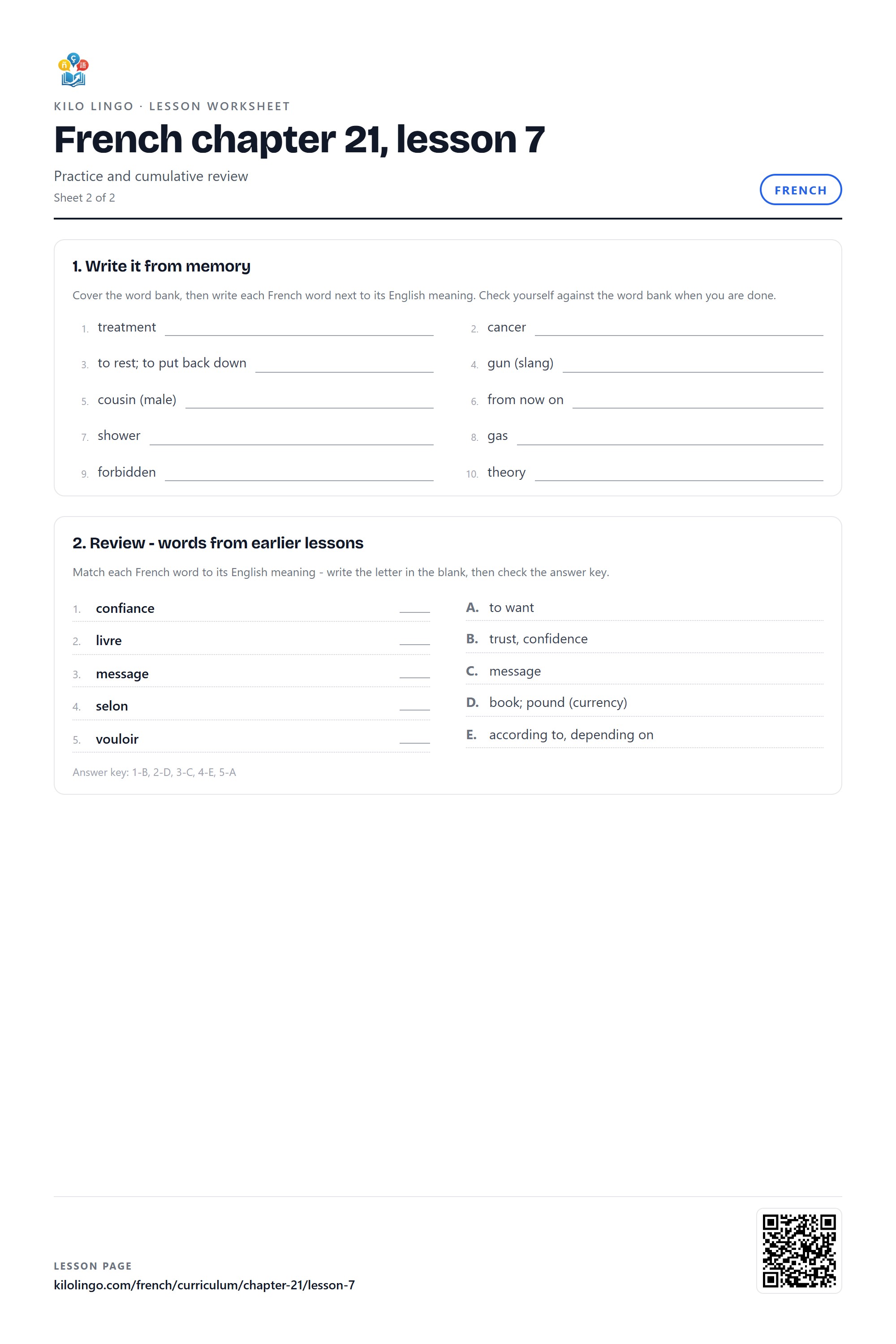
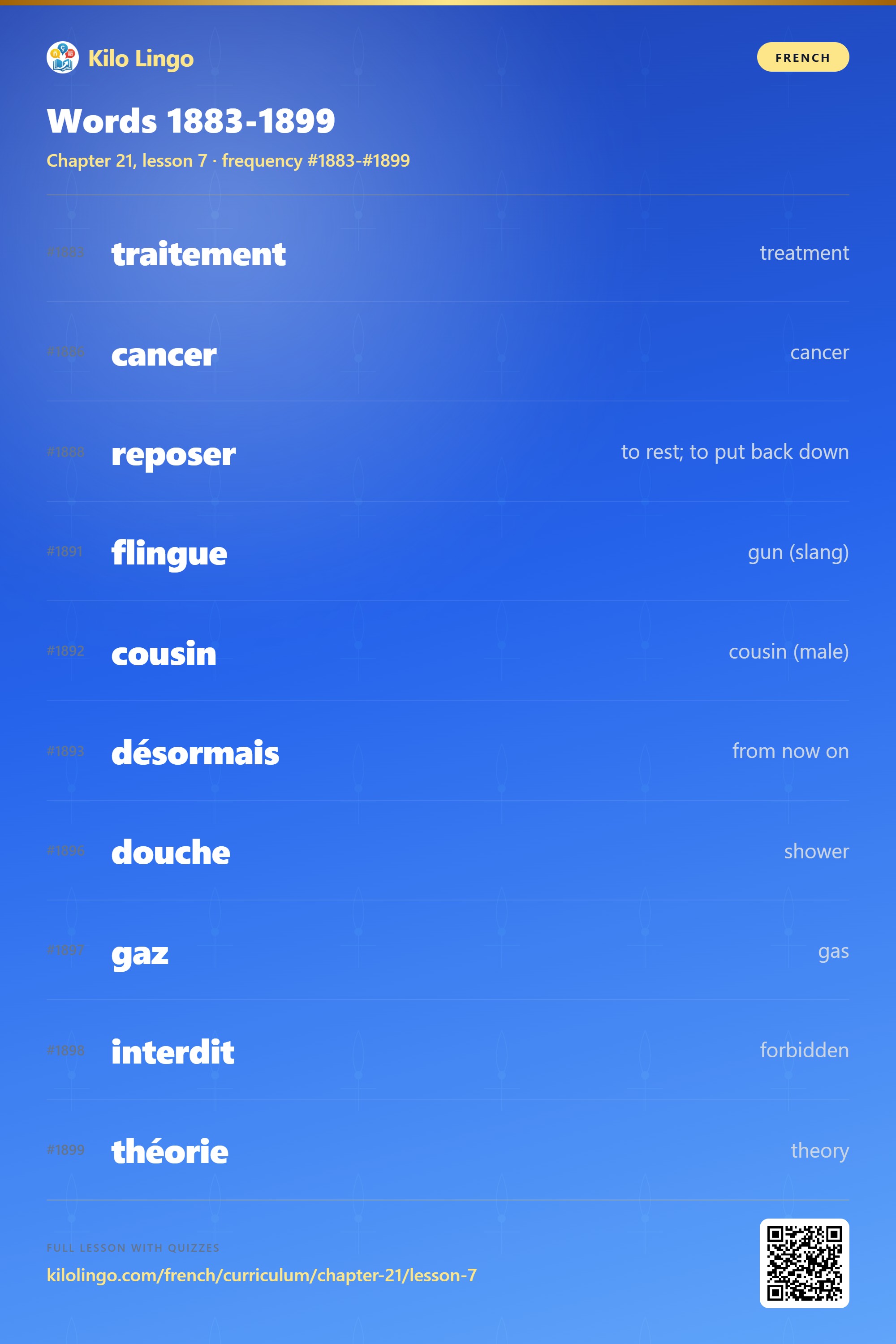
- Words 1891-1900Vocabulary
10 words · ranks 1891-1900
- Story milestone: top 1900 wordsGraded-reader story
You can read this story using only the words you've learned so far. Every content word sits at or above the rank-1900 ceiling.
- Les animauxThemed review
chienarrived in chapter 1 and waited twenty chapters for the rest. Watchbete: the animal, and also stupid. - Arcade reviewReview games
Replay this chapter's words as games - a different kind of repetition, and it counts.
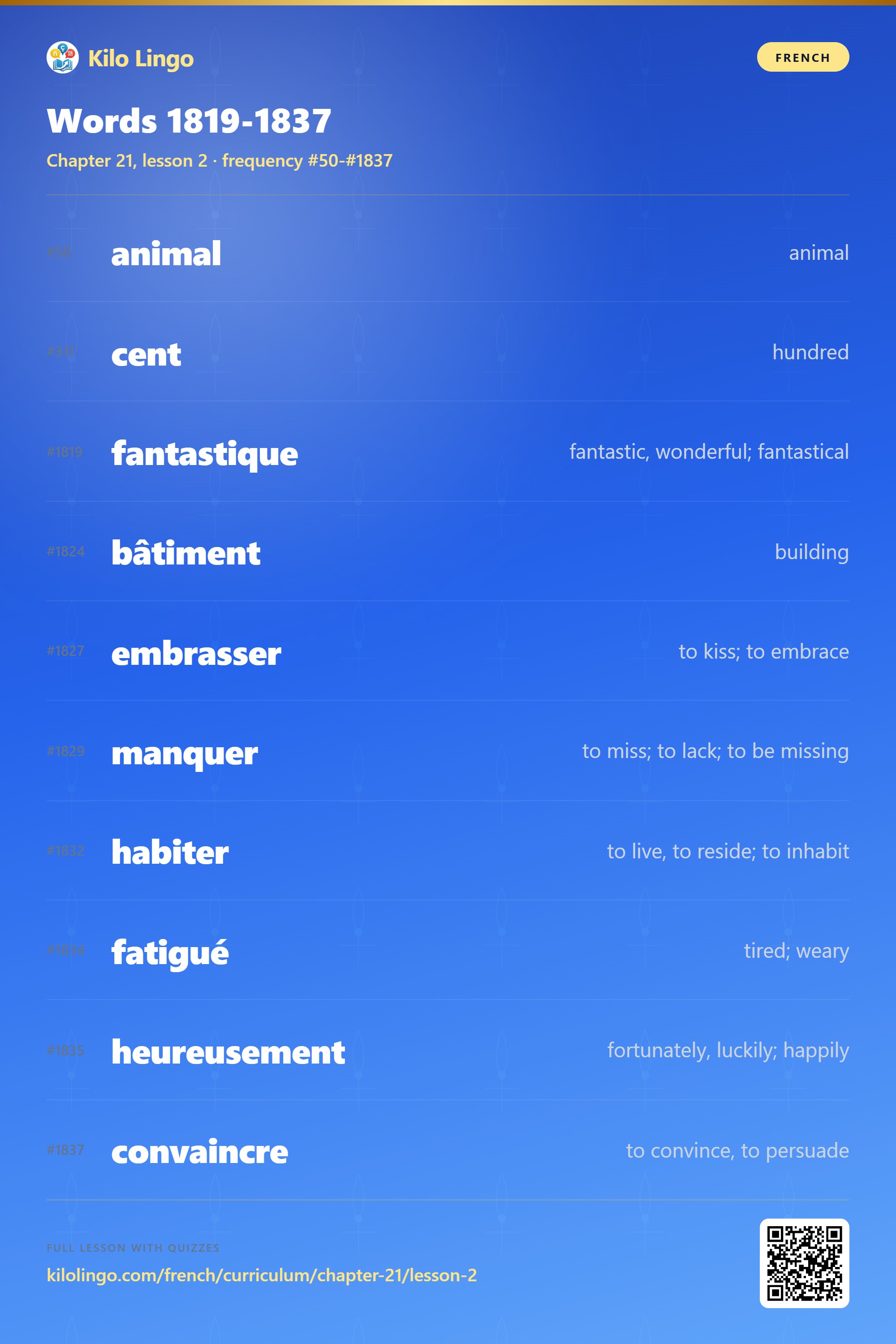
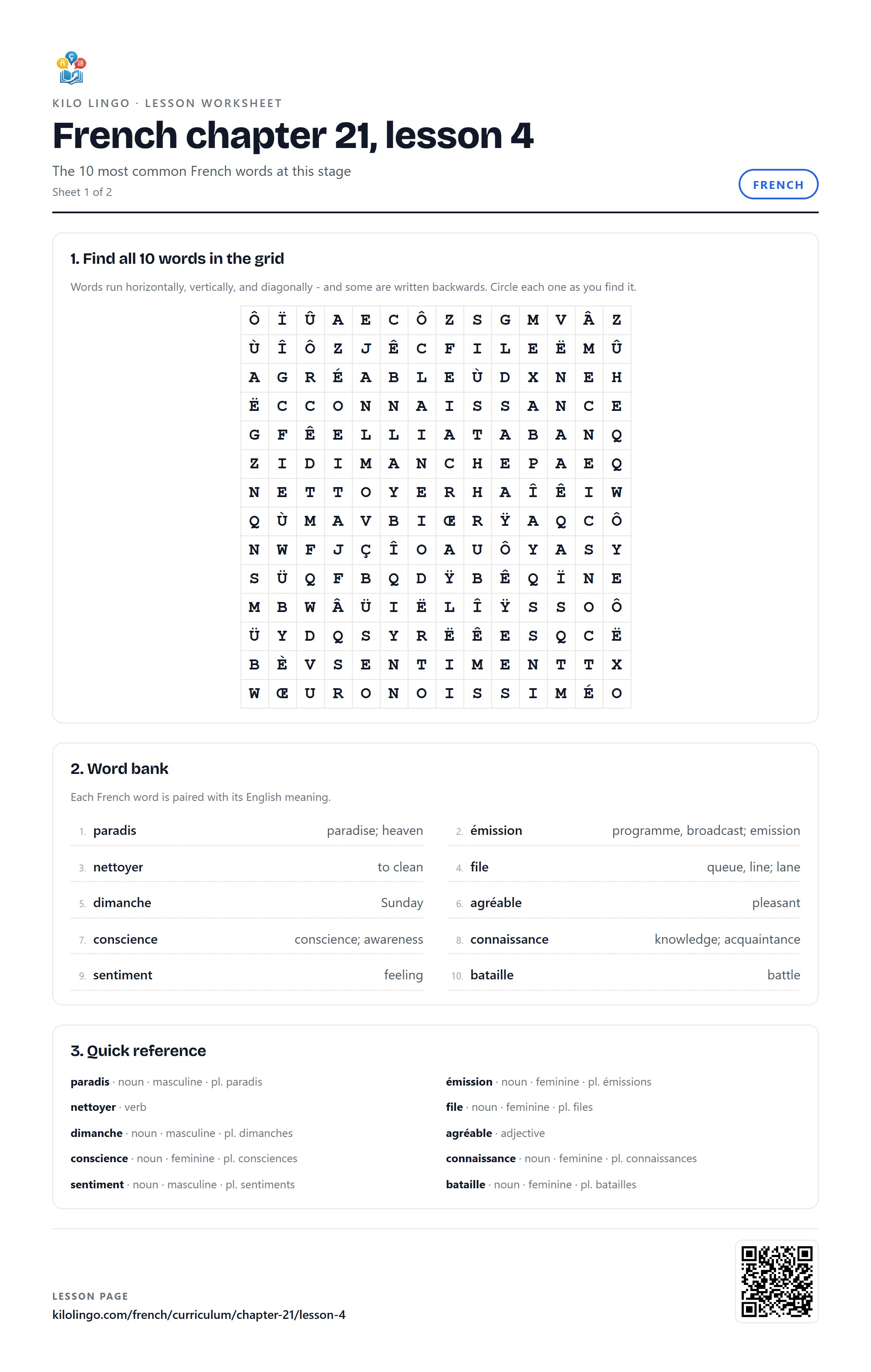
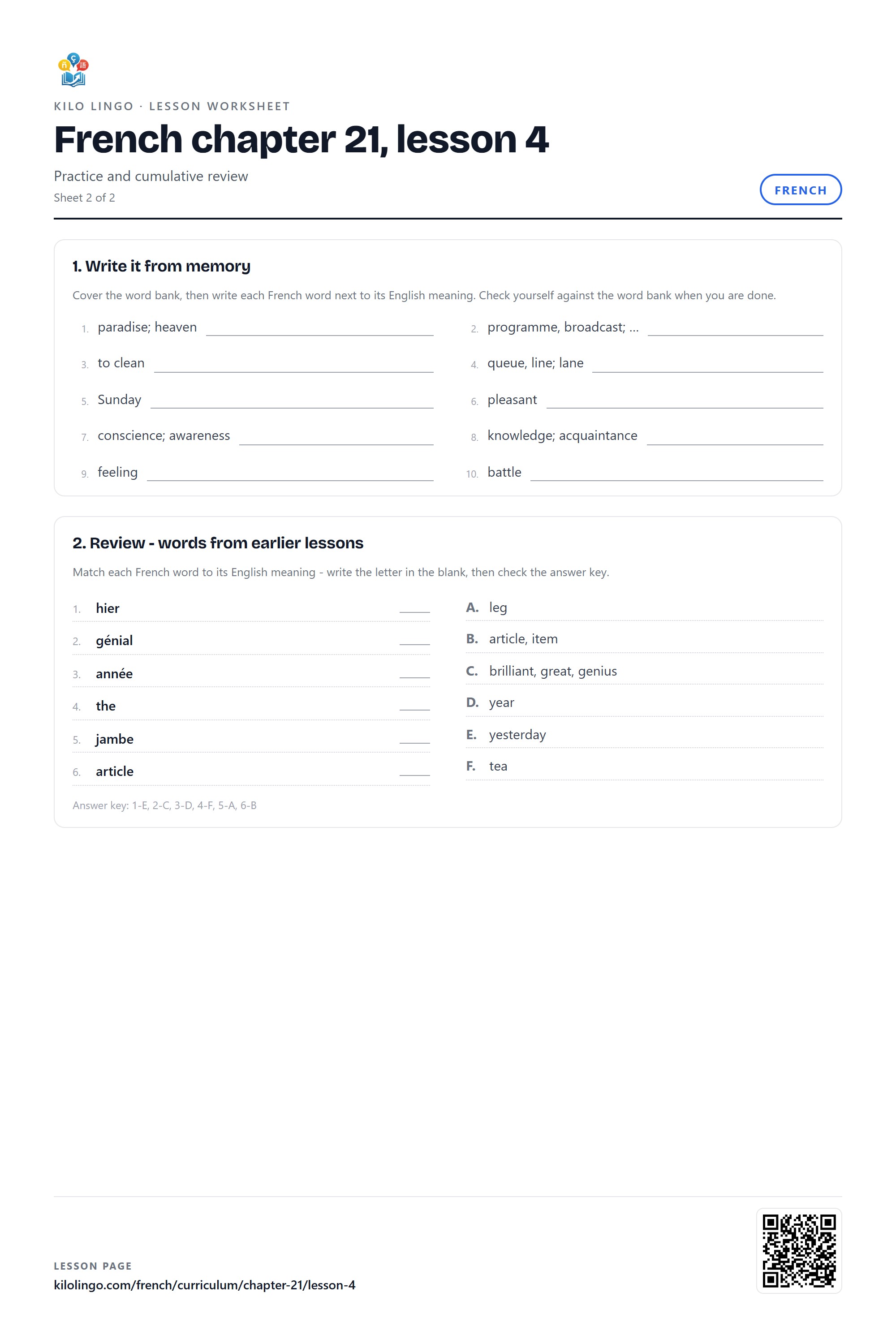
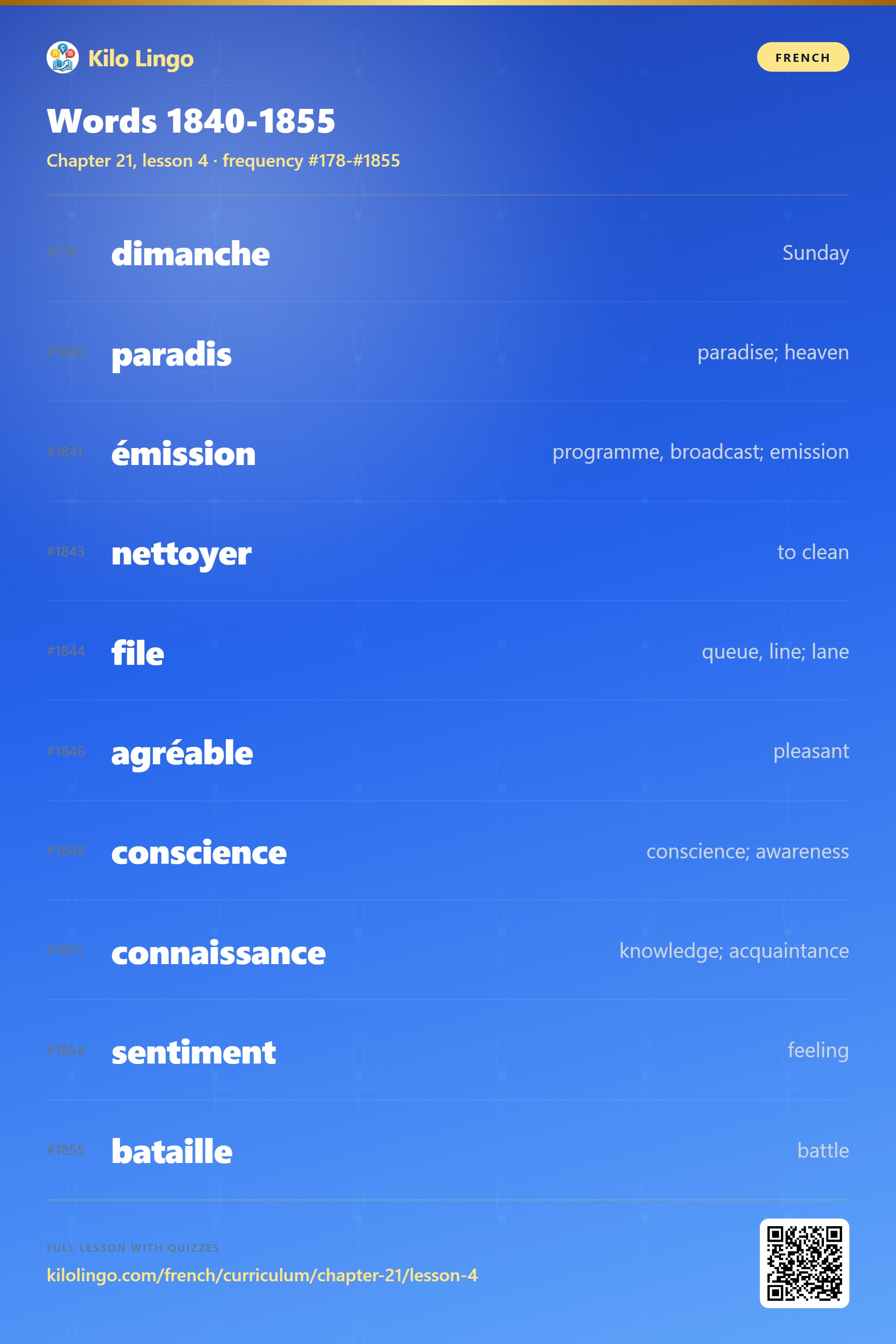
Word printables
Per-word sheets100 words · a worksheet, infographic and listicle each




Chapter 22 · The pluperfect
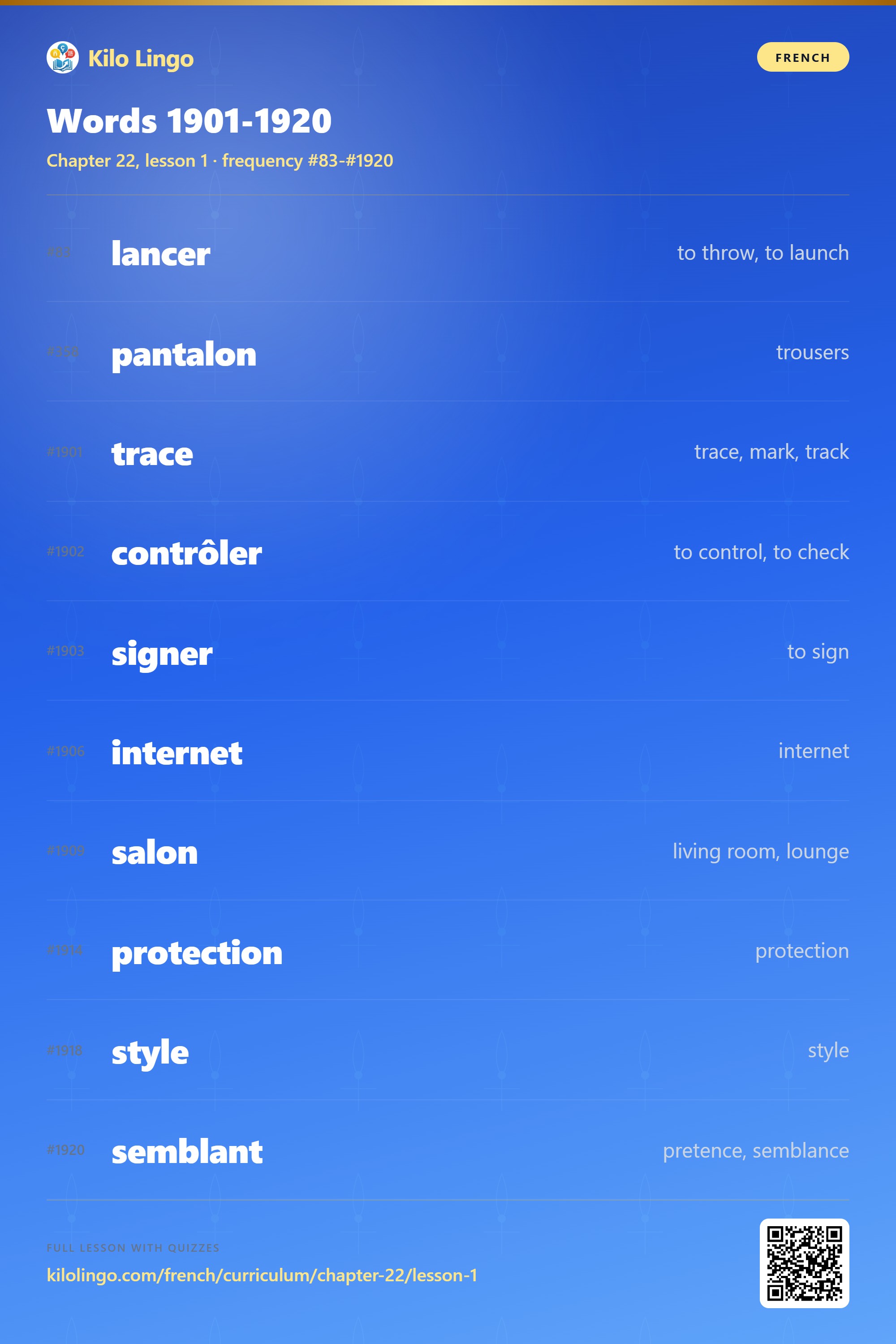
Chapter page →- Words 1901-1910Vocabulary
10 words · ranks 1901-1910
- Word Bubbles review sessionReview games
Pop the words you just met by matching each one to its meaning. A couple of rounds and the batch is yours.
- Words 1911-1920Vocabulary
10 words · ranks 1911-1920
- Conjugation Sprint review sessionReview games
Sixty seconds on the endings of the verbs this chapter has drilled so far.
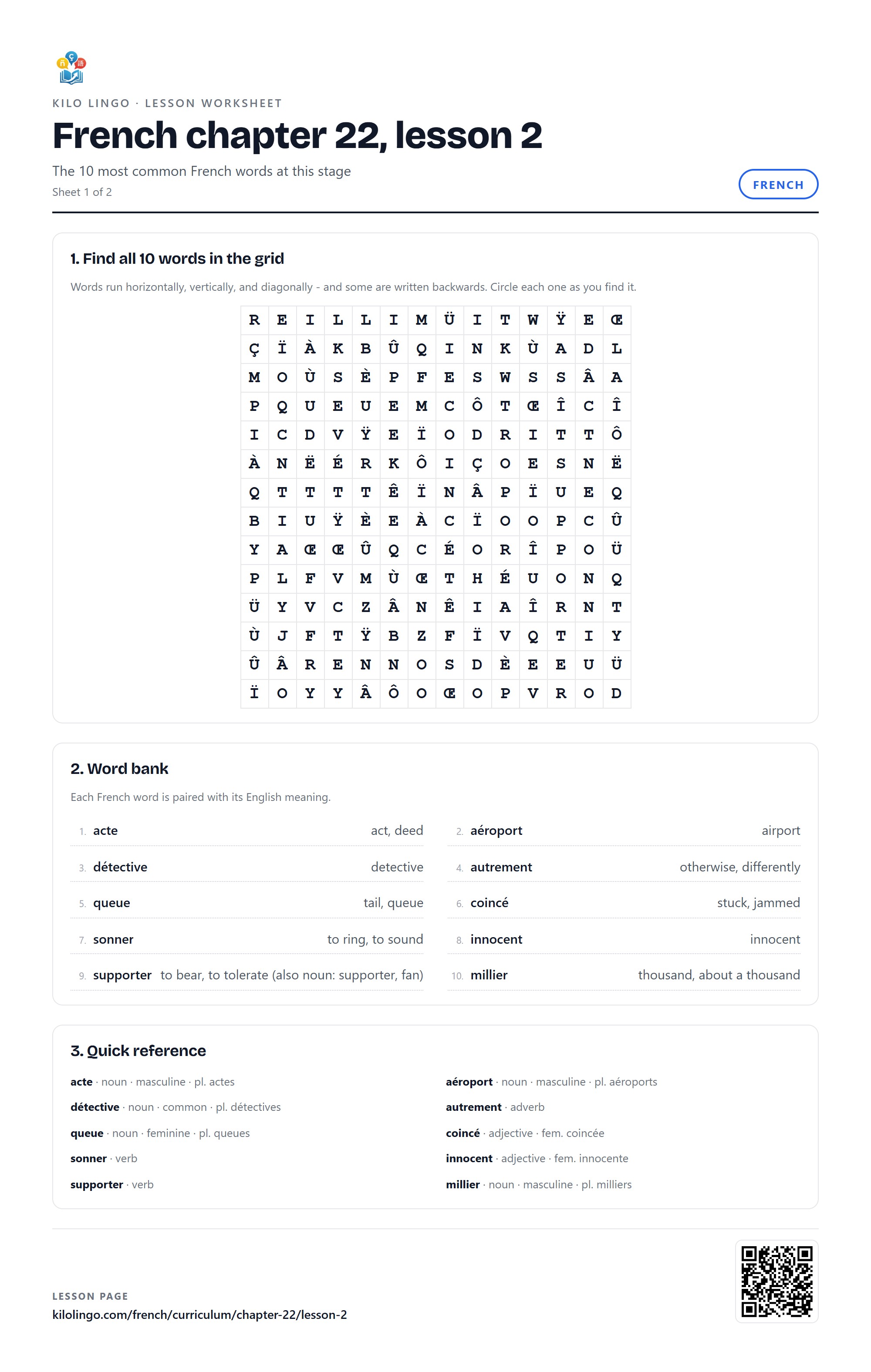
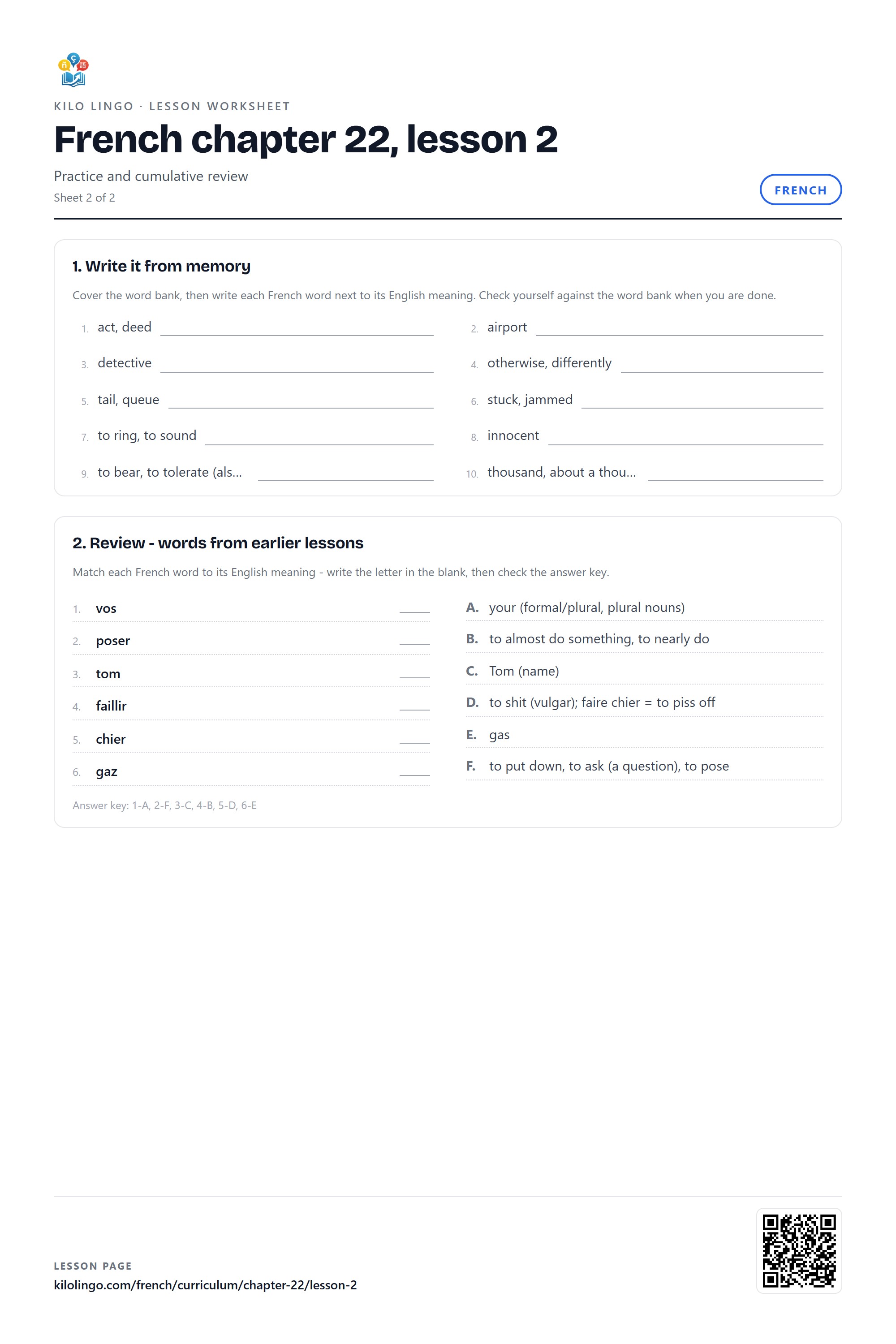
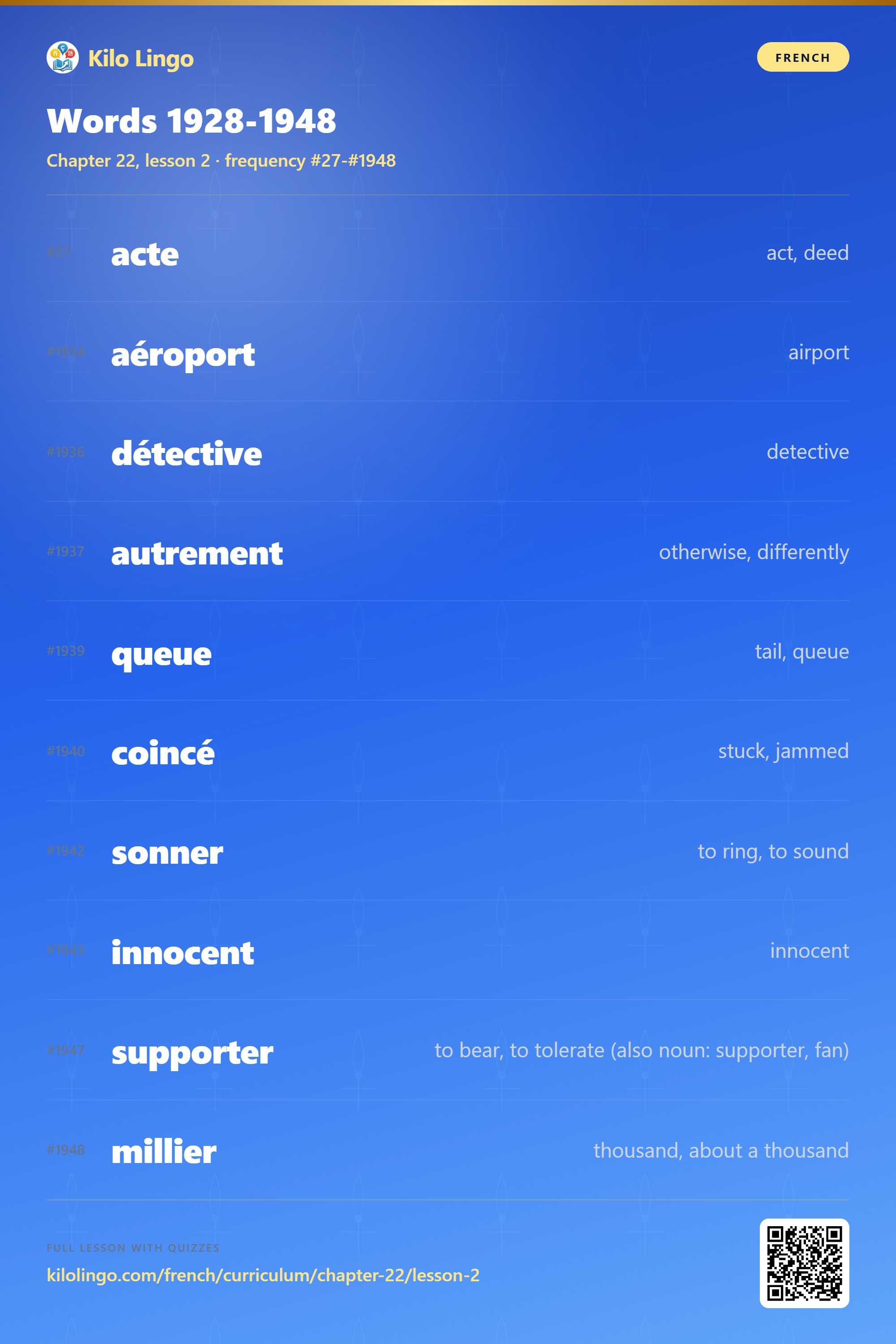
- Words 1921-1930Vocabulary
10 words · ranks 1921-1930
- Word Bubbles review sessionReview games
Pop the words you just met by matching each one to its meaning. A couple of rounds and the batch is yours.
- Words 1931-1940Vocabulary
10 words · ranks 1931-1940
- The pluperfectGrammar
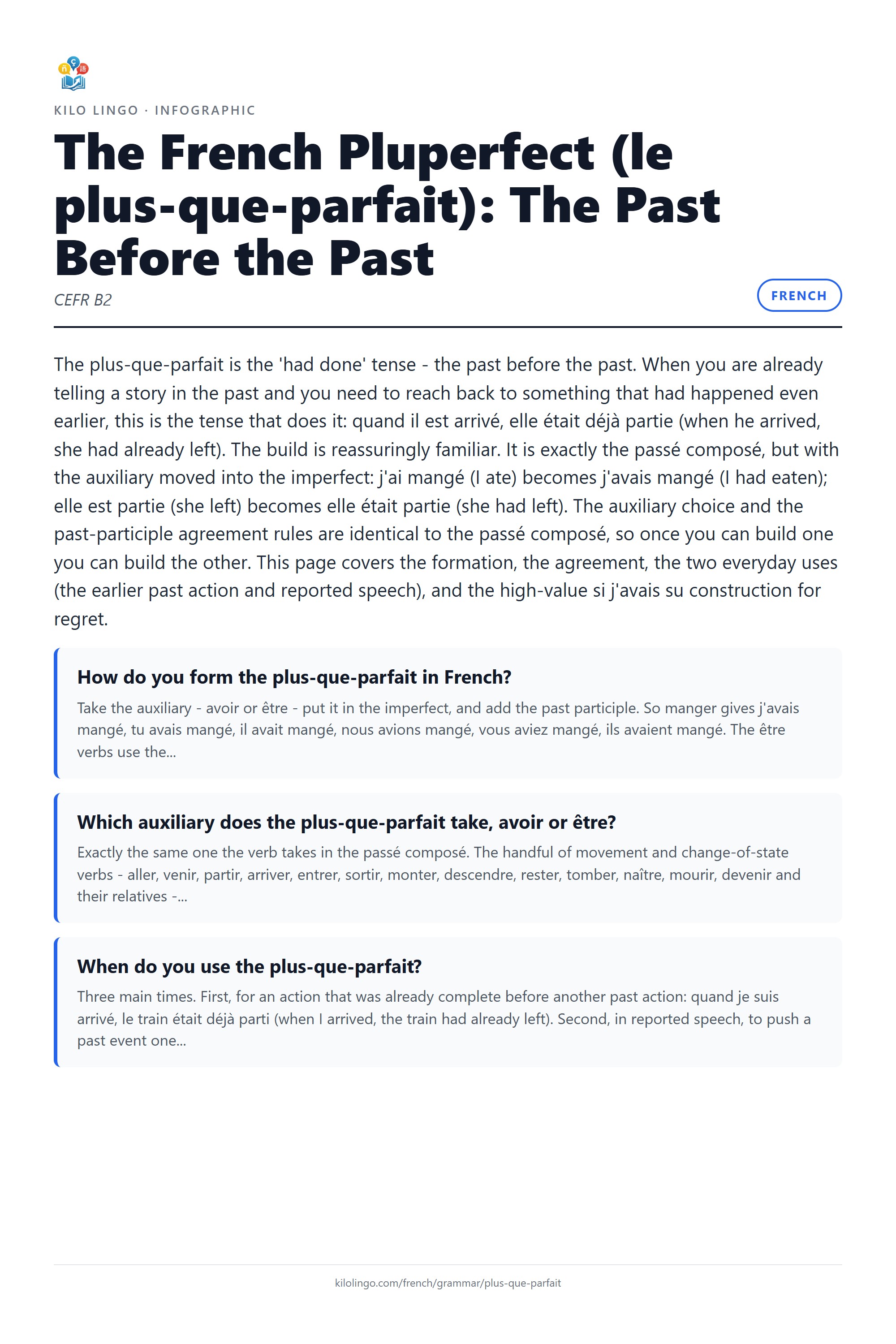
The 'had done' tense: imperfect of avoir / etre + past participle (j'avais mange, elle etait partie), with the same auxiliary and agreement rules as the passe compose, for an action finished before another past action (quand il est arrive, elle etait deja partie).
- devoir or falloir?Mistake clinic
One says who has to. The other just says it has to happen.
- Words 1941-1950Vocabulary
10 words · ranks 1941-1950
- Conjugation Sprint review sessionReview games
Sixty seconds on the endings of the verbs this chapter has drilled so far.
- Words 1951-1960Vocabulary
10 words · ranks 1951-1960
- Word Bubbles review sessionReview games
Pop the words you just met by matching each one to its meaning. A couple of rounds and the batch is yours.
- Words 1961-1970Vocabulary
10 words · ranks 1961-1970
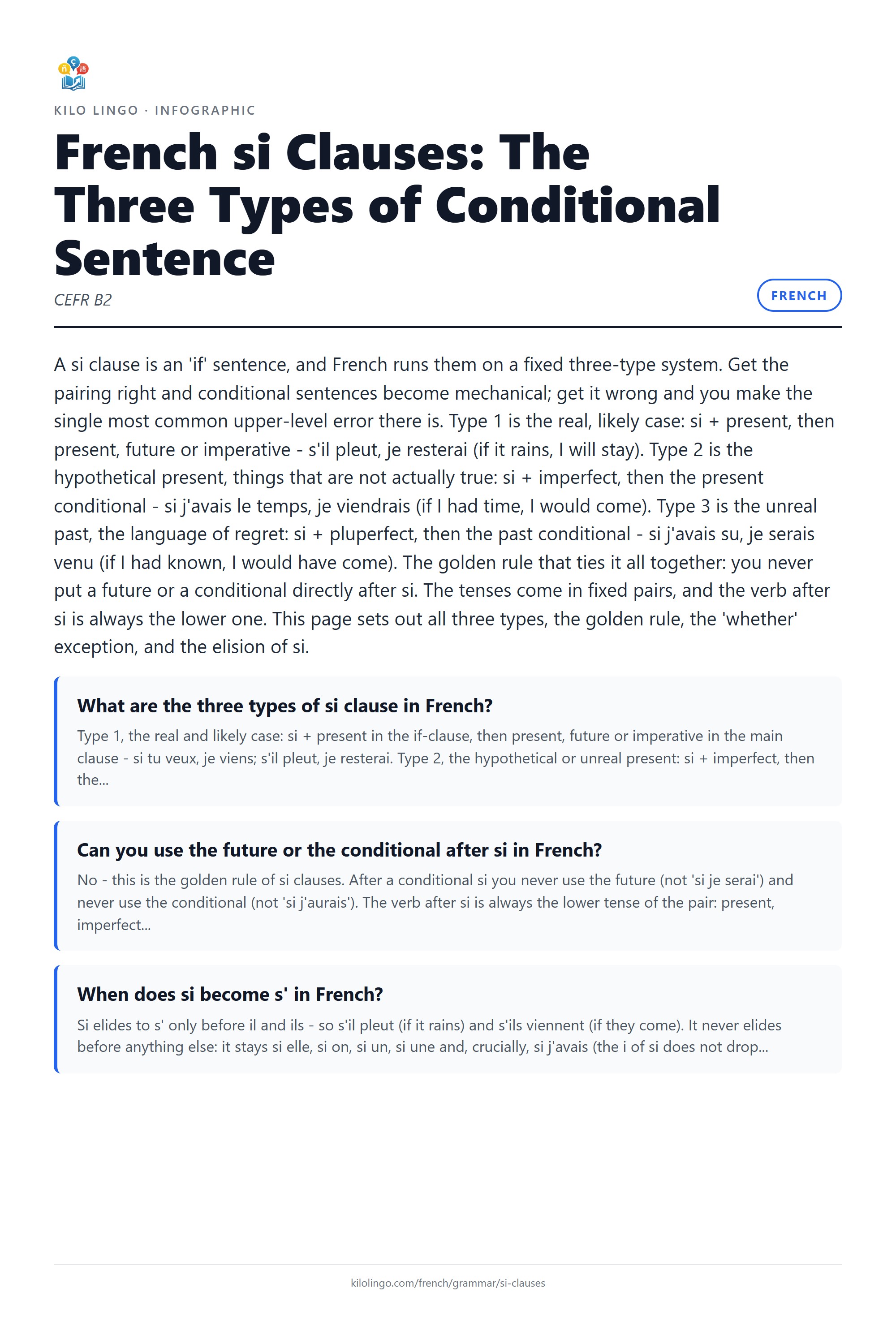
The three si types: si + present -> present/future (si tu veux, je viens); si + imperfect -> conditional (si j'avais le temps, je viendrais); si + pluperfect -> past conditional (si j'avais su, je serais venu). Never a future or conditional directly after si.
- Words 1971-1980Vocabulary
10 words · ranks 1971-1980
- Conjugation Sprint review sessionReview games
Sixty seconds on the endings of the verbs this chapter has drilled so far.
- Words 1981-1990Vocabulary
10 words · ranks 1981-1990
- Word Bubbles review sessionReview games
Pop the words you just met by matching each one to its meaning. A couple of rounds and the batch is yours.
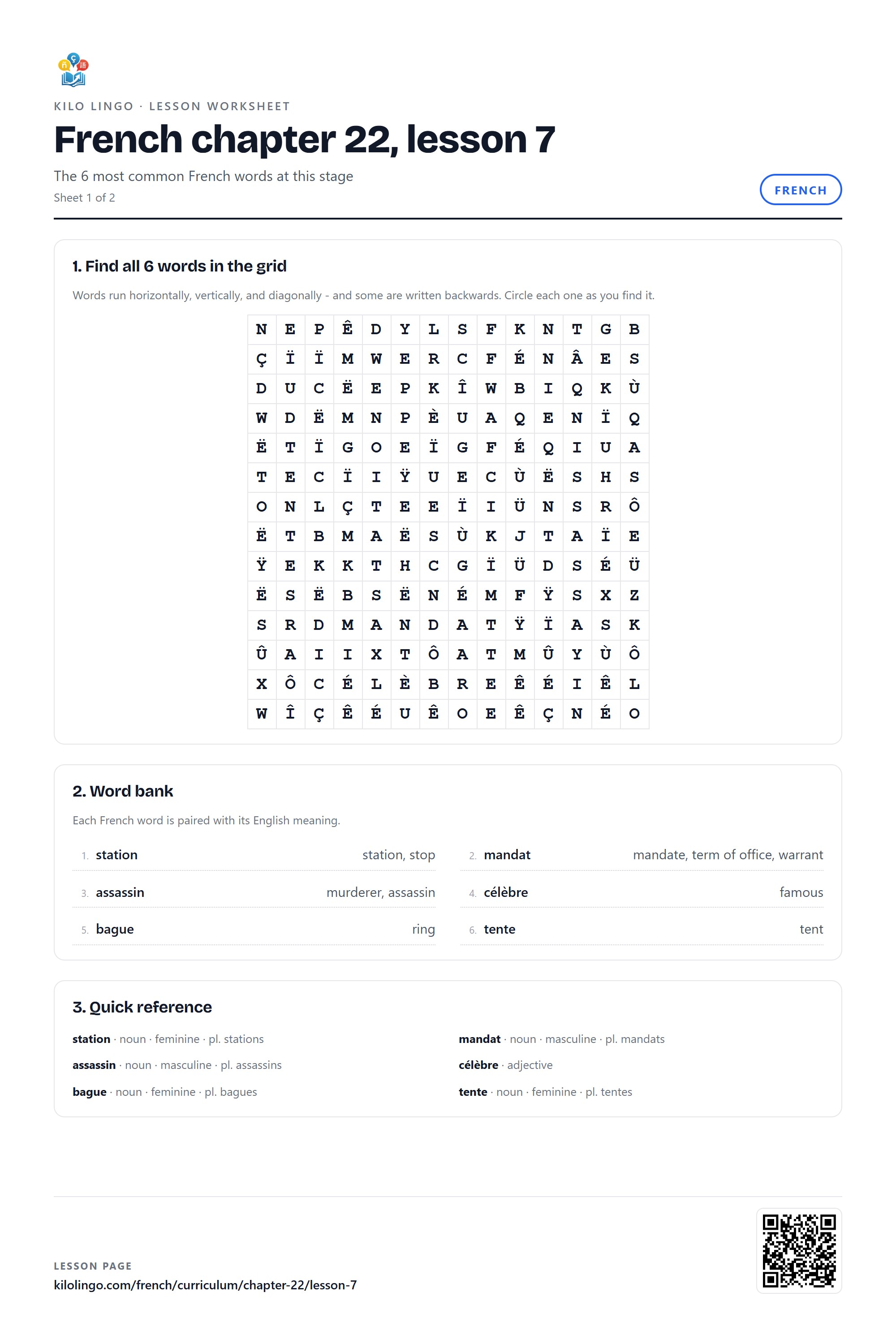
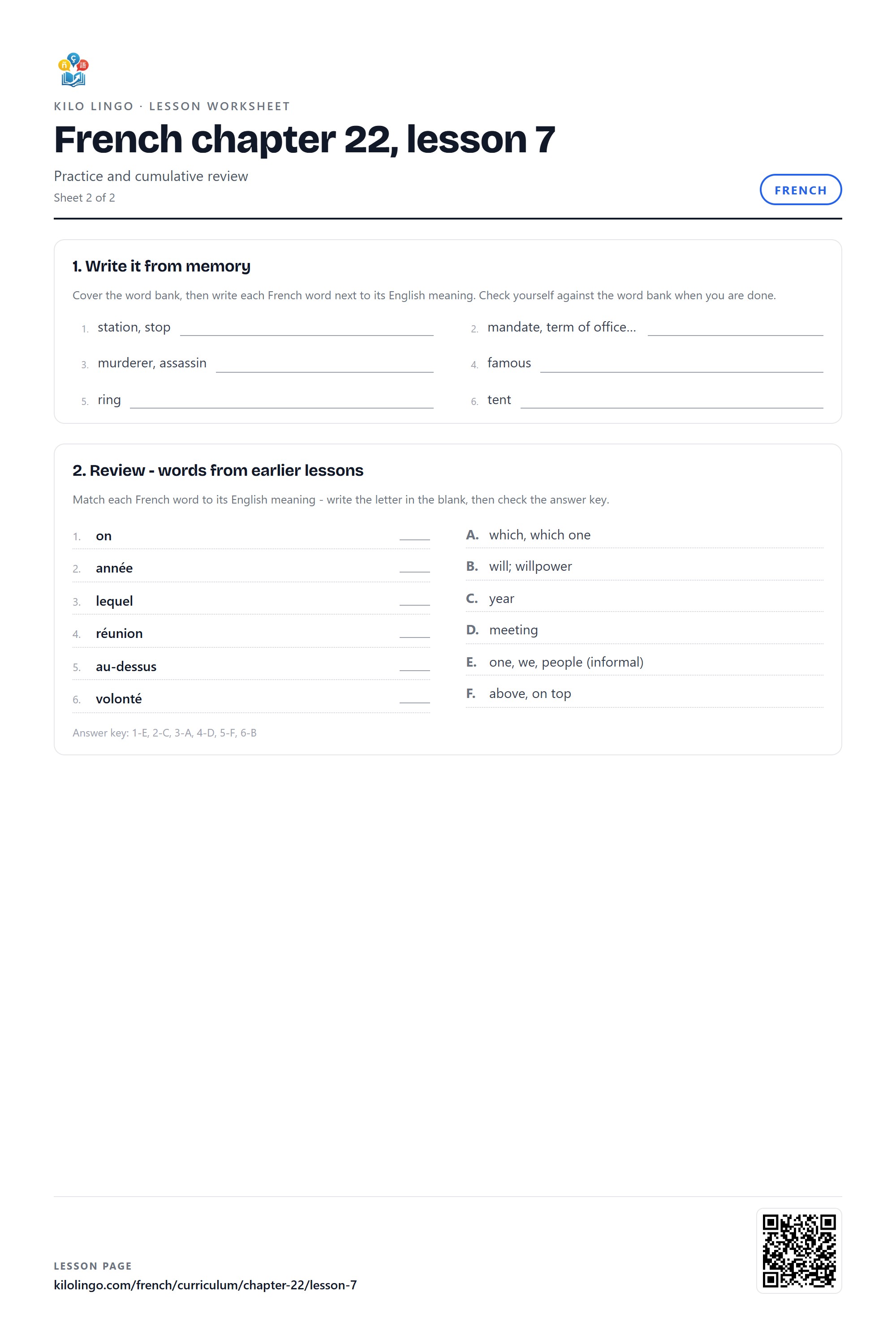
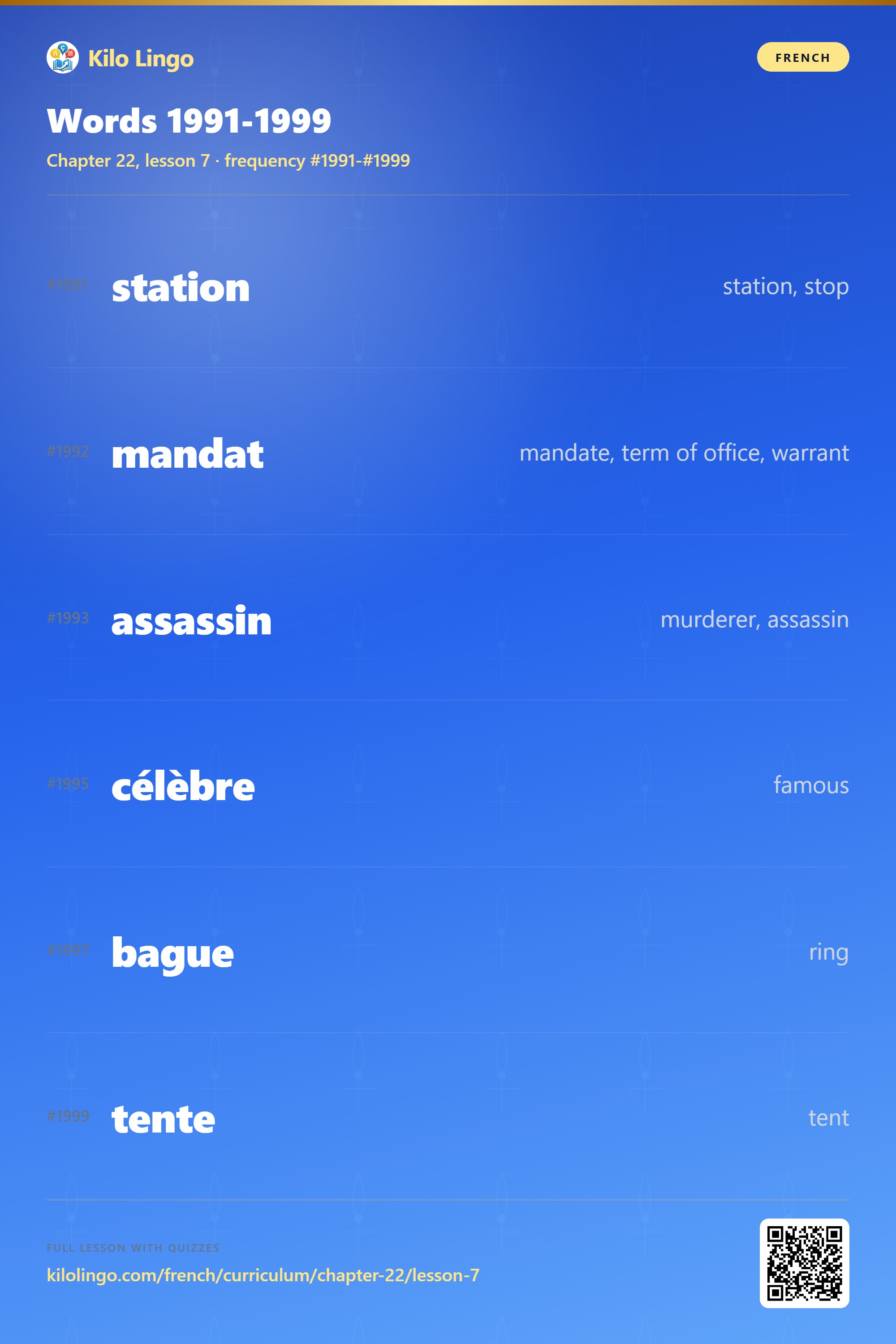
- Words 1991-2000Vocabulary
10 words · ranks 1991-2000
- Story milestone: top 2000 wordsGraded-reader story
You can read this story using only the words you've learned so far. Every content word sits at or above the rank-2000 ceiling.
- À table, l'additionThemed review
The last word on food, and the richest theme in the course - cheese, sugar, eggs and someone to bring them to you.
- Arcade reviewReview games
Replay this chapter's words as games - a different kind of repetition, and it counts.
Word printables
Per-word sheets100 words · a worksheet, infographic and listicle each


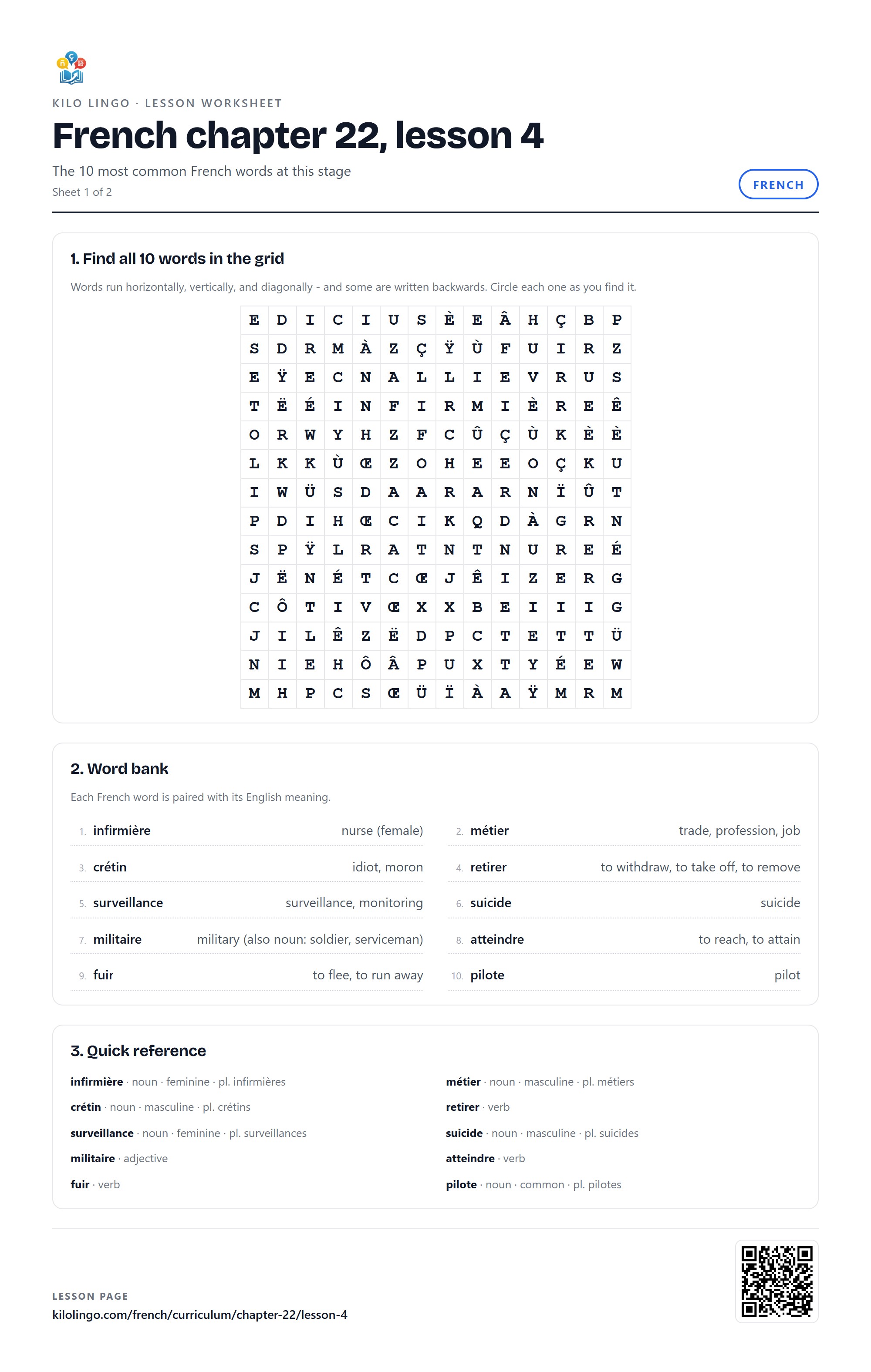
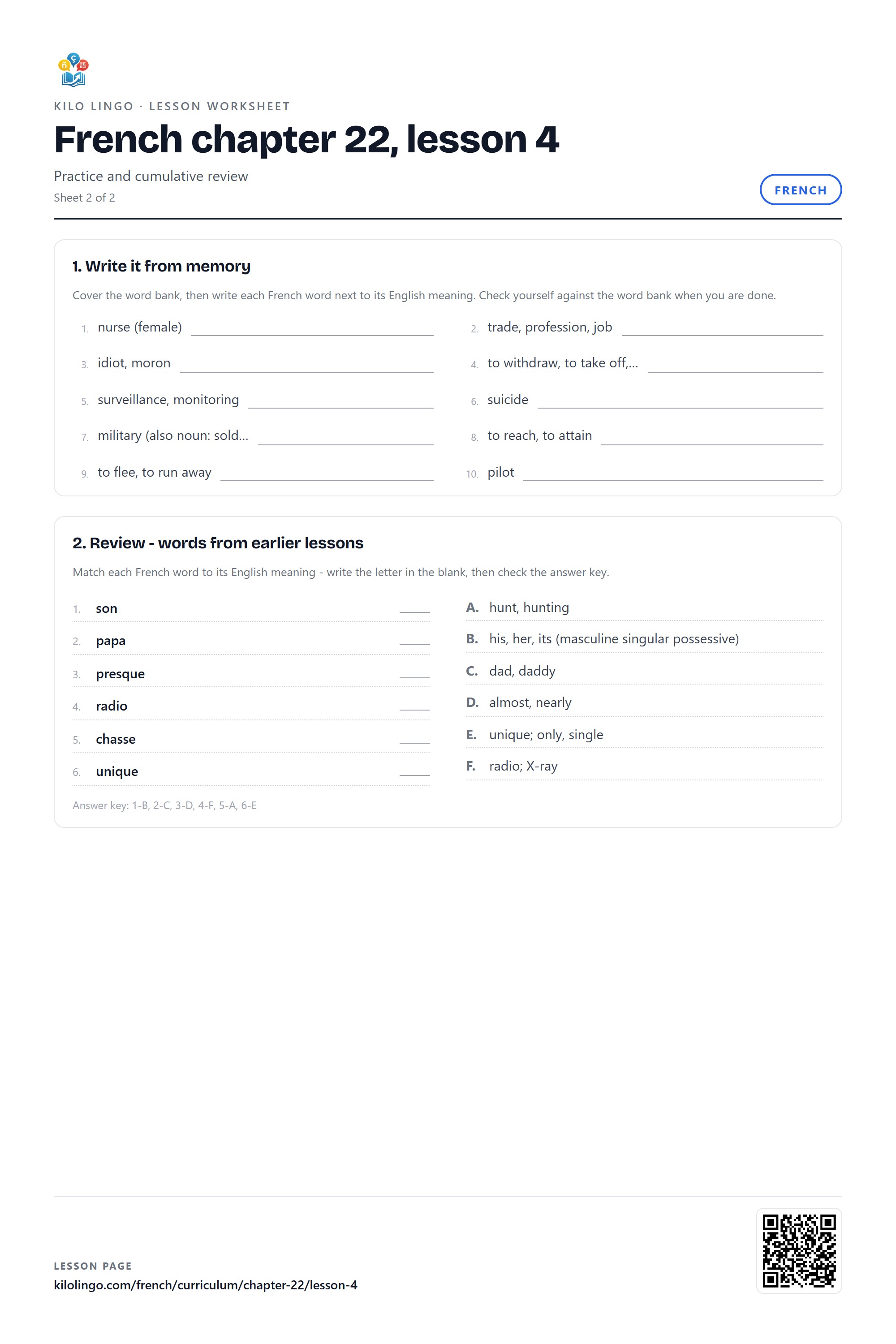

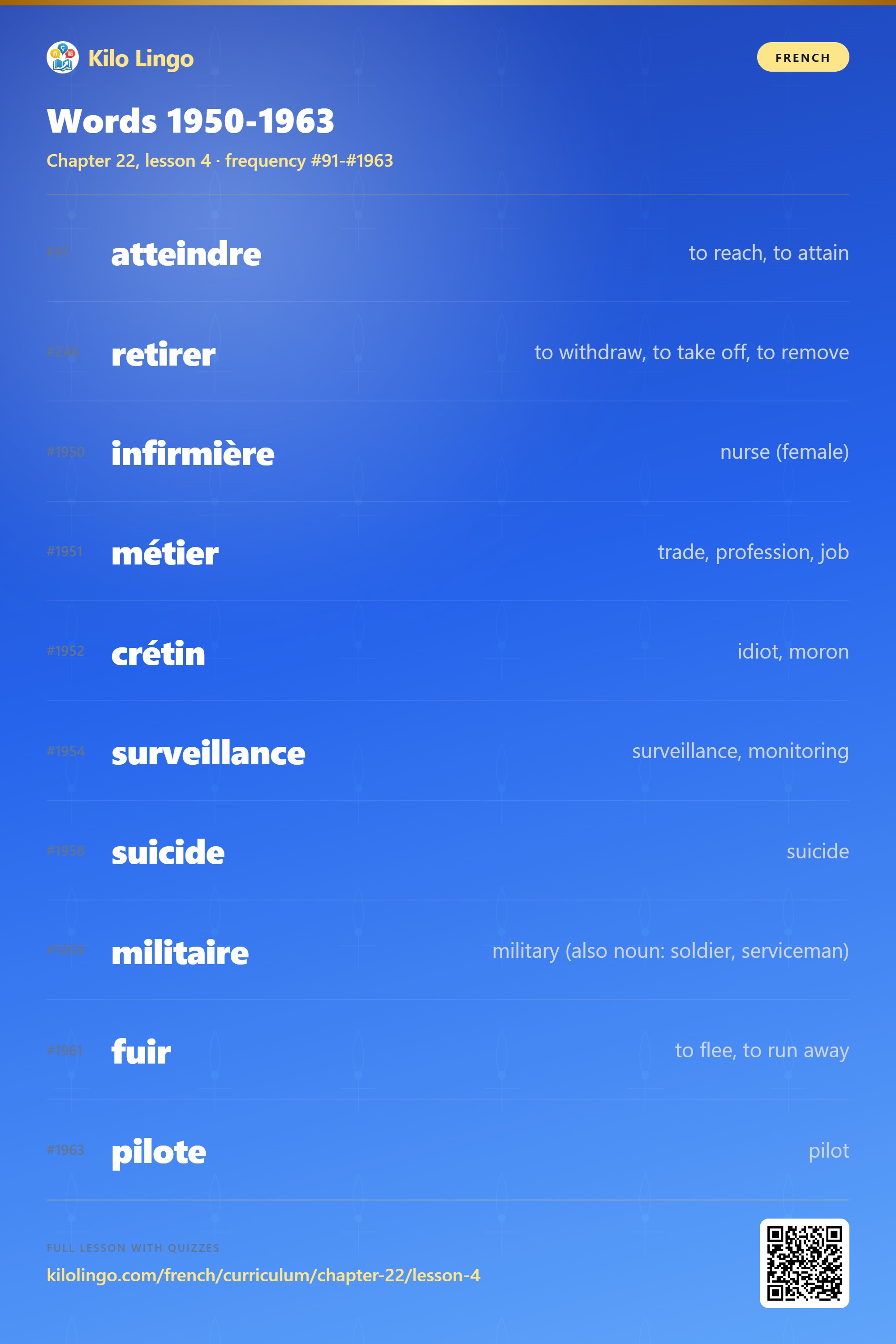

Chapter 23 · Avoiding the passive: on, se and se faire
Chapter page →- Words 2001-2010Vocabulary
10 words · ranks 2001-2010
- Crossword review sessionReview games
Cross the words you just met, clued in English. Slower than a drill, and it sticks harder.
- Words 2011-2020Vocabulary
10 words · ranks 2011-2020
- Word Bubbles review sessionReview games
Pop the words you just met by matching each one to its meaning. A couple of rounds and the batch is yours.
- Words 2021-2030Vocabulary
10 words · ranks 2021-2030
- Conjugation Sprint review sessionReview games
Sixty seconds on the endings of the verbs this chapter has drilled so far.
- Words 2031-2040Vocabulary
10 words · ranks 2031-2040
French usually dodges the passive rather than building it: on + active verb (on m'a vole mon sac), the pronominal se passive (ca ne se dit pas, le vin se boit frais), se faire + infinitive (il s'est fait voler), and the hard rule that an indirect object can never be passivised - on m'a dit, never je suis dit.
- que or dont?Mistake clinic
If the verb underneath wanted
de, the pronoun is dont. - Words 2041-2050Vocabulary
10 words · ranks 2041-2050
- Word Bubbles review sessionReview games
Pop the words you just met by matching each one to its meaning. A couple of rounds and the batch is yours.
- Words 2051-2060Vocabulary
10 words · ranks 2051-2060
- Conjugation Sprint review sessionReview games
Sixty seconds on the endings of the verbs this chapter has drilled so far.
- Words 2061-2070Vocabulary
10 words · ranks 2061-2070
The choice where the two moods compete: esperer takes the indicative but souhaiter the subjunctive, the certainty slide from il est probable que (indicative) down to il est possible que (subjunctive), il me semble vs il semble, and avant que (subjunctive) vs apres que (indicative).
- Words 2071-2080Vocabulary
10 words · ranks 2071-2080
- Word Bubbles review sessionReview games
Pop the words you just met by matching each one to its meaning. A couple of rounds and the batch is yours.
- Words 2081-2090Vocabulary
10 words · ranks 2081-2090
- Conjugation Sprint review sessionReview games
Sixty seconds on the endings of the verbs this chapter has drilled so far.
- Words 2091-2100Vocabulary
10 words · ranks 2091-2100
- Story milestone: top 2100 wordsGraded-reader story
You can read this story using only the words you've learned so far. Every content word sits at or above the rank-2100 ceiling.
- Les saisons et la meteoThemed review
The last theme of the course. Chapter 15 gave you nature broadly; this is the weather on its own, with the seasons it arrives in.
- Arcade reviewReview games
Replay this chapter's words as games - a different kind of repetition, and it counts.
Word printables
Per-word sheets100 words · a worksheet, infographic and listicle each
Chapter 24 · lequel, auquel, duquel
Chapter page →- Words 2101-2110Vocabulary
10 words · ranks 2101-2110
- Word Bubbles review sessionReview games
Pop the words you just met by matching each one to its meaning. A couple of rounds and the batch is yours.
- Words 2111-2120Vocabulary
10 words · ranks 2111-2120
- Conjugation Sprint review sessionReview games
Sixty seconds on the endings of the verbs this chapter has drilled so far.
- Words 2121-2130Vocabulary
10 words · ranks 2121-2130
- Word Bubbles review sessionReview games
Pop the words you just met by matching each one to its meaning. A couple of rounds and the batch is yours.
- Words 2131-2140Vocabulary
10 words · ranks 2131-2140
- lequel, auquel, duquelGrammar
The lequel paradigm as a relative pronoun after prepositions: la table sur laquelle, les gens avec lesquels, the a- and de-contractions (auquel, auxquelles, duquel), qui as the alternative for people, and ou as the everyday replacement for dans lequel.
- Words 2141-2150Vocabulary
10 words · ranks 2141-2150
- Conjugation Sprint review sessionReview games
Sixty seconds on the endings of the verbs this chapter has drilled so far.
- Words 2151-2160Vocabulary
10 words · ranks 2151-2160
- Word Bubbles review sessionReview games
Pop the words you just met by matching each one to its meaning. A couple of rounds and the batch is yours.
- Words 2161-2170Vocabulary
10 words · ranks 2161-2170
- Dont in depthGrammar
Everything dont does: replacing de + noun (le livre dont je parle), possessive dont (l'homme dont la fille travaille ici), numbers and subsets (trois enfants, dont deux filles), ce dont, la facon dont, and the compound prepositions that force duquel instead.
- Words 2171-2180Vocabulary
10 words · ranks 2171-2180
- Conjugation Sprint review sessionReview games
Sixty seconds on the endings of the verbs this chapter has drilled so far.
- Words 2181-2190Vocabulary
10 words · ranks 2181-2190
- Word Bubbles review sessionReview games
Pop the words you just met by matching each one to its meaning. A couple of rounds and the batch is yours.
- Words 2191-2200Vocabulary
10 words · ranks 2191-2200
- Story milestone: top 2200 wordsGraded-reader story
You can read this story using only the words you've learned so far. Every content word sits at or above the rank-2200 ceiling.
- Arcade reviewReview games
Replay this chapter's words as games - a different kind of repetition, and it counts.
Word printables
Per-word sheets100 words · a worksheet, infographic and listicle each
Chapter 25 · Sequencing past tenses
Chapter page →- Words 2201-2210Vocabulary
10 words · ranks 2201-2210
- Crossword review sessionReview games
Cross the words you just met, clued in English. Slower than a drill, and it sticks harder.
- Words 2211-2220Vocabulary
10 words · ranks 2211-2220
- Word Bubbles review sessionReview games
Pop the words you just met by matching each one to its meaning. A couple of rounds and the batch is yours.
- Words 2221-2230Vocabulary
10 words · ranks 2221-2230
- Conjugation Sprint review sessionReview games
Sixty seconds on the endings of the verbs this chapter has drilled so far.
- Words 2231-2240Vocabulary
10 words · ranks 2231-2240
- Sequencing past tensesGrammar
How the three past tenses interlock in real narration: the passe compose moves the story clock forward, the imparfait holds the scene still, and the plus-que-parfait reaches back to the past before the past - plus depuis + imparfait and venir de + imparfait for the background's own timing.
- Words 2241-2250Vocabulary
10 words · ranks 2241-2250
- Word Bubbles review sessionReview games
Pop the words you just met by matching each one to its meaning. A couple of rounds and the batch is yours.
- Words 2251-2260Vocabulary
10 words · ranks 2251-2260
- Conjugation Sprint review sessionReview games
Sixty seconds on the endings of the verbs this chapter has drilled so far.
- Words 2261-2270Vocabulary
10 words · ranks 2261-2270
When the subjects match, French demands the infinitive and forbids the subjunctive: je veux partir, never je veux que je parte; pour partir vs pour que tu partes; avant de partir vs avant qu'il parte; sans le savoir vs sans qu'il le sache.
- Words 2271-2280Vocabulary
10 words · ranks 2271-2280
- Word Bubbles review sessionReview games
Pop the words you just met by matching each one to its meaning. A couple of rounds and the batch is yours.
- Words 2281-2290Vocabulary
10 words · ranks 2281-2290
- Conjugation Sprint review sessionReview games
Sixty seconds on the endings of the verbs this chapter has drilled so far.
- Words 2291-2300Vocabulary
10 words · ranks 2291-2300
- Story milestone: top 2300 wordsGraded-reader story
You can read this story using only the words you've learned so far. Every content word sits at or above the rank-2300 ceiling.
- Arcade reviewReview games
Replay this chapter's words as games - a different kind of repetition, and it counts.
Word printables
Per-word sheets100 words · a worksheet, infographic and listicle each
Chapter 26 · Faire causatif: having things done
Chapter page →- Words 2301-2310Vocabulary
10 words · ranks 2301-2310
- Word Bubbles review sessionReview games
Pop the words you just met by matching each one to its meaning. A couple of rounds and the batch is yours.
- Words 2311-2320Vocabulary
10 words · ranks 2311-2320
- Crossword review sessionReview games
Cross the words you just met, clued in English. Slower than a drill, and it sticks harder.
- Words 2321-2330Vocabulary
10 words · ranks 2321-2330
- Word Bubbles review sessionReview games
Pop the words you just met by matching each one to its meaning. A couple of rounds and the batch is yours.
- Words 2331-2340Vocabulary
10 words · ranks 2331-2340
faire + infinitive for making someone act and having something done: je fais reparer la voiture, il me fait rire, the le/lui object split, the invariable fait (elle s'est fait couper les cheveux), and faire vs rendre.
- Words 2341-2350Vocabulary
10 words · ranks 2341-2350
- Conjugation Sprint review sessionReview games
Sixty seconds on the endings of the verbs this chapter has drilled so far.
- Words 2351-2360Vocabulary
10 words · ranks 2351-2360
- Word Bubbles review sessionReview games
Pop the words you just met by matching each one to its meaning. A couple of rounds and the batch is yours.
- Words 2361-2370Vocabulary
10 words · ranks 2361-2370
The perception and permission verbs that take a bare infinitive: je le vois venir, on entend chanter les oiseaux, laisse-moi partir - plus when the participle agrees (vue vs vu) and the laisser faire / laisser tomber idioms.
- Words 2371-2380Vocabulary
10 words · ranks 2371-2380
- Conjugation Sprint review sessionReview games
Sixty seconds on the endings of the verbs this chapter has drilled so far.
- Words 2381-2390Vocabulary
10 words · ranks 2381-2390
- Word Bubbles review sessionReview games
Pop the words you just met by matching each one to its meaning. A couple of rounds and the batch is yours.
- Words 2391-2400Vocabulary
10 words · ranks 2391-2400
- Story milestone: top 2400 wordsGraded-reader story
You can read this story using only the words you've learned so far. Every content word sits at or above the rank-2400 ceiling.
- Arcade reviewReview games
Replay this chapter's words as games - a different kind of repetition, and it counts.
Word printables
Per-word sheets100 words · a worksheet, infographic and listicle each
Chapter 27 · Verbs with a, de, or nothing before an infinitive
Chapter page →- Words 2401-2410Vocabulary
10 words · ranks 2401-2410
- Crossword review sessionReview games
Cross the words you just met, clued in English. Slower than a drill, and it sticks harder.
- Words 2411-2420Vocabulary
10 words · ranks 2411-2420
- Word Bubbles review sessionReview games
Pop the words you just met by matching each one to its meaning. A couple of rounds and the batch is yours.
- Words 2421-2430Vocabulary
10 words · ranks 2421-2430
- Conjugation Sprint review sessionReview games
Sixty seconds on the endings of the verbs this chapter has drilled so far.
- Words 2431-2440Vocabulary
10 words · ranks 2431-2440
The three lists every learner memorises: bare infinitive (vouloir, pouvoir, aller), a + infinitive (commencer a, apprendre a, reussir a), de + infinitive (decider de, essayer de, oublier de) - and the verbs whose meaning changes with the preposition.
- Words 2441-2450Vocabulary
10 words · ranks 2441-2450
- Word Bubbles review sessionReview games
Pop the words you just met by matching each one to its meaning. A couple of rounds and the batch is yours.
- Words 2451-2460Vocabulary
10 words · ranks 2451-2460
- Conjugation Sprint review sessionReview games
Sixty seconds on the endings of the verbs this chapter has drilled so far.
- Words 2461-2470Vocabulary
10 words · ranks 2461-2470
content de, fier de, pret a, le droit de, la peur de - and the flip English speakers miss: c'est facile a faire but il est facile de le faire.
- Words 2471-2480Vocabulary
10 words · ranks 2471-2480
- Word Bubbles review sessionReview games
Pop the words you just met by matching each one to its meaning. A couple of rounds and the batch is yours.
- Words 2481-2490Vocabulary
10 words · ranks 2481-2490
- Conjugation Sprint review sessionReview games
Sixty seconds on the endings of the verbs this chapter has drilled so far.
- Words 2491-2500Vocabulary
10 words · ranks 2491-2500
- Story milestone: top 2500 wordsGraded-reader story
You can read this story using only the words you've learned so far. Every content word sits at or above the rank-2500 ceiling.
- Arcade reviewReview games
Replay this chapter's words as games - a different kind of repetition, and it counts.
Word printables
Per-word sheets100 words · a worksheet, infographic and listicle each
Chapter 28 · The conditional perfect
Chapter page →- Words 2501-2510Vocabulary
10 words · ranks 2501-2510
- Word Bubbles review sessionReview games
Pop the words you just met by matching each one to its meaning. A couple of rounds and the batch is yours.
- Words 2511-2520Vocabulary
10 words · ranks 2511-2520
- Conjugation Sprint review sessionReview games
Sixty seconds on the endings of the verbs this chapter has drilled so far.
- Words 2521-2530Vocabulary
10 words · ranks 2521-2530
- Word Bubbles review sessionReview games
Pop the words you just met by matching each one to its meaning. A couple of rounds and the batch is yours.
- Words 2531-2540Vocabulary
10 words · ranks 2531-2540
- The conditional perfectGrammar
j'aurais fait, elle serait venue: the unrealised past (j'aurais aime venir), si + pluperfect conditions, journalistic distance (l'accident aurait fait trois victimes), and politeness in the past.
- Words 2541-2550Vocabulary
10 words · ranks 2541-2550
- Conjugation Sprint review sessionReview games
Sixty seconds on the endings of the verbs this chapter has drilled so far.
- Words 2551-2560Vocabulary
10 words · ranks 2551-2560
- Word Bubbles review sessionReview games
Pop the words you just met by matching each one to its meaning. A couple of rounds and the batch is yours.
- Words 2561-2570Vocabulary
10 words · ranks 2561-2570
The commonest use of the conditional perfect: devoir and pouvoir for should have and could have (j'aurais du partir, tu aurais pu me le dire), il aurait fallu, j'aurais mieux fait de - and how the person alone turns regret into reproach.
- Words 2571-2580Vocabulary
10 words · ranks 2571-2580
- Conjugation Sprint review sessionReview games
Sixty seconds on the endings of the verbs this chapter has drilled so far.
- Words 2581-2590Vocabulary
10 words · ranks 2581-2590
- Word Bubbles review sessionReview games
Pop the words you just met by matching each one to its meaning. A couple of rounds and the batch is yours.
- Words 2591-2600Vocabulary
10 words · ranks 2591-2600
- Story milestone: top 2600 wordsGraded-reader story
You can read this story using only the words you've learned so far. Every content word sits at or above the rank-2600 ceiling.
- Arcade reviewReview games
Replay this chapter's words as games - a different kind of repetition, and it counts.
Word printables
Per-word sheets100 words · a worksheet, infographic and listicle each
Chapter 29 · Reported speech and the backshift
Chapter page →- Words 2601-2610Vocabulary
10 words · ranks 2601-2610
- Conjugation Sprint review sessionReview games
Sixty seconds on the endings of the verbs this chapter has drilled so far.
- Words 2611-2620Vocabulary
10 words · ranks 2611-2620
- Word Bubbles review sessionReview games
Pop the words you just met by matching each one to its meaning. A couple of rounds and the batch is yours.
- Words 2621-2630Vocabulary
10 words · ranks 2621-2630
- Conjugation Sprint review sessionReview games
Sixty seconds on the endings of the verbs this chapter has drilled so far.
- Words 2631-2640Vocabulary
10 words · ranks 2631-2640
Direct speech quotes the words; indirect speech reports them through dire / expliquer / annoncer plus an obligatory que, and a past reporting verb slides the tense back one step: je suis fatigue becomes il a dit qu'il etait fatigue, je viendrai becomes il a dit qu'il viendrait.
- Words 2641-2650Vocabulary
10 words · ranks 2641-2650
- Word Bubbles review sessionReview games
Pop the words you just met by matching each one to its meaning. A couple of rounds and the batch is yours.
- Words 2651-2660Vocabulary
10 words · ranks 2651-2660
- Conjugation Sprint review sessionReview games
Sixty seconds on the endings of the verbs this chapter has drilled so far.
- Words 2661-2670Vocabulary
10 words · ranks 2661-2670
The other half of indirect speech: il m'a demande si je venais, elle a demande ou j'habitais, qu'est-ce que becomes ce que - est-ce que and inversion both disappear - and an order becomes de + infinitive: il m'a dit de partir.
- Words 2671-2680Vocabulary
10 words · ranks 2671-2680
- Word Bubbles review sessionReview games
Pop the words you just met by matching each one to its meaning. A couple of rounds and the batch is yours.
- Words 2681-2690Vocabulary
10 words · ranks 2681-2690
- Conjugation Sprint review sessionReview games
Sixty seconds on the endings of the verbs this chapter has drilled so far.
- Words 2691-2700Vocabulary
10 words · ranks 2691-2700
- Story milestone: top 2700 wordsGraded-reader story
You can read this story using only the words you've learned so far. Every content word sits at or above the rank-2700 ceiling.
- Arcade reviewReview games
Replay this chapter's words as games - a different kind of repetition, and it counts.
Word printables
Per-word sheets100 words · a worksheet, infographic and listicle each
Chapter 30 · The future perfect: futur anterieur
Chapter page →- Words 2701-2711Vocabulary
10 words · ranks 2701-2711
- Word Bubbles review sessionReview games
Pop the words you just met by matching each one to its meaning. A couple of rounds and the batch is yours.
- Words 2712-2721Vocabulary
10 words · ranks 2712-2721
- Crossword review sessionReview games
Cross the words you just met, clued in English. Slower than a drill, and it sticks harder.
- Words 2722-2731Vocabulary
10 words · ranks 2722-2731
- Word Bubbles review sessionReview games
Pop the words you just met by matching each one to its meaning. A couple of rounds and the batch is yours.
- Words 2732-2741Vocabulary
10 words · ranks 2732-2741
Future of avoir or etre + past participle (j'aurai fini, elle sera partie) for what will already have happened by then - avant demain, j'aurai termine - and for a guess about the past: il aura oublie, he must have forgotten.
- Words 2742-2751Vocabulary
10 words · ranks 2742-2751
- Conjugation Sprint review sessionReview games
Sixty seconds on the endings of the verbs this chapter has drilled so far.
- Words 2752-2761Vocabulary
10 words · ranks 2752-2761
- Word Bubbles review sessionReview games
Pop the words you just met by matching each one to its meaning. A couple of rounds and the batch is yours.
- Words 2762-2771Vocabulary
10 words · ranks 2762-2771
After quand, lorsque, des que, aussitot que, une fois que and tant que, French demands a future where English says a present: quand tu arriveras, appelle-moi; des que tu auras fini, on partira. And the one exception that never bends: si + present, never future.
- Words 2772-2781Vocabulary
10 words · ranks 2772-2781
- Conjugation Sprint review sessionReview games
Sixty seconds on the endings of the verbs this chapter has drilled so far.
- Words 2782-2791Vocabulary
10 words · ranks 2782-2791
- Word Bubbles review sessionReview games
Pop the words you just met by matching each one to its meaning. A couple of rounds and the batch is yours.
- Words 2792-2800Vocabulary
9 words · ranks 2792-2800
- Story milestone: top 2800 wordsGraded-reader story
You can read this story using only the words you've learned so far. Every content word sits at or above the rank-2800 ceiling.
- Arcade reviewReview games
Replay this chapter's words as games - a different kind of repetition, and it counts.
Word printables
Per-word sheets99 words · a worksheet, infographic and listicle each
Chapter 31 · The past subjunctive
Chapter page →- Words 2801-2810Vocabulary
10 words · ranks 2801-2810
- Crossword review sessionReview games
Cross the words you just met, clued in English. Slower than a drill, and it sticks harder.
- Words 2811-2820Vocabulary
10 words · ranks 2811-2820
- Word Bubbles review sessionReview games
Pop the words you just met by matching each one to its meaning. A couple of rounds and the batch is yours.
- Words 2821-2830Vocabulary
10 words · ranks 2821-2830
- Conjugation Sprint review sessionReview games
Sixty seconds on the endings of the verbs this chapter has drilled so far.
- Words 2831-2840Vocabulary
10 words · ranks 2831-2840
- The past subjunctiveGrammar
Subjunctive of avoir or etre + past participle (que j'aie fait, qu'elle soit venue): the same triggers as the present subjunctive, fired at events already complete - je suis content que tu sois venu - plus avant qu'il soit trop tard, and why French keeps only two subjunctive tenses alive.
- Words 2841-2850Vocabulary
10 words · ranks 2841-2850
- Word Bubbles review sessionReview games
Pop the words you just met by matching each one to its meaning. A couple of rounds and the batch is yours.
- Words 2851-2860Vocabulary
10 words · ranks 2851-2860
- Conjugation Sprint review sessionReview games
Sixty seconds on the endings of the verbs this chapter has drilled so far.
- Words 2861-2871Vocabulary
10 words · ranks 2861-2871
The one place the subjunctive is a choice that changes meaning: je cherche un guide qui connait la region (a specific one exists) vs qui connaisse la region (any one will do), il n'y a personne qui puisse m'aider, and the sought-but-unfound antecedent rule.
- Words 2872-2881Vocabulary
10 words · ranks 2872-2881
- Word Bubbles review sessionReview games
Pop the words you just met by matching each one to its meaning. A couple of rounds and the batch is yours.
- Words 2882-2891Vocabulary
10 words · ranks 2882-2891
- Conjugation Sprint review sessionReview games
Sixty seconds on the endings of the verbs this chapter has drilled so far.
- Words 2892-2900Vocabulary
9 words · ranks 2892-2900
- Story milestone: top 2900 wordsGraded-reader story
You can read this story using only the words you've learned so far. Every content word sits at or above the rank-2900 ceiling.
- Arcade reviewReview games
Replay this chapter's words as games - a different kind of repetition, and it counts.
Word printables
Per-word sheets99 words · a worksheet, infographic and listicle each
Chapter 32 · The subjunctive after superlatives
Chapter page →- Words 2901-2910Vocabulary
10 words · ranks 2901-2910
- Conjugation Sprint review sessionReview games
Sixty seconds on the endings of the verbs this chapter has drilled so far.
- Words 2911-2920Vocabulary
10 words · ranks 2911-2920
- Crossword review sessionReview games
Cross the words you just met, clued in English. Slower than a drill, and it sticks harder.
- Words 2921-2930Vocabulary
10 words · ranks 2921-2930
- Word Bubbles review sessionReview games
Pop the words you just met by matching each one to its meaning. A couple of rounds and the batch is yours.
- Words 2931-2940Vocabulary
10 words · ranks 2931-2940
le meilleur film que j'aie jamais vu, la seule personne qui me comprenne: superlatives and the exclusives le seul, l'unique, le premier, le dernier pull the relative clause into the subjunctive, because the claim is an opinion - and a checkable fact takes the indicative back.
- Words 2941-2950Vocabulary
10 words · ranks 2941-2950
- Conjugation Sprint review sessionReview games
Sixty seconds on the endings of the verbs this chapter has drilled so far.
- Words 2951-2960Vocabulary
10 words · ranks 2951-2960
- Word Bubbles review sessionReview games
Pop the words you just met by matching each one to its meaning. A couple of rounds and the batch is yours.
- Words 2961-2970Vocabulary
10 words · ranks 2961-2970
- Concession: whatever happensGrammar
The whatever system, all subjunctive: qu'il vienne ou non, quoi que tu fasses, ou que tu ailles, qui que vous soyez, quel que soit le prix, si difficile que ce soit - plus the quoique vs quoi que distinction.
- Words 2971-2980Vocabulary
10 words · ranks 2971-2980
- Conjugation Sprint review sessionReview games
Sixty seconds on the endings of the verbs this chapter has drilled so far.
- Words 2981-2990Vocabulary
10 words · ranks 2981-2990
- Word Bubbles review sessionReview games
Pop the words you just met by matching each one to its meaning. A couple of rounds and the batch is yours.
- Words 2991-3000Vocabulary
10 words · ranks 2991-3000
- Story milestone: top 3000 wordsGraded-reader story
You can read this story using only the words you've learned so far. Every content word sits at or above the rank-3000 ceiling.
- Arcade reviewReview games
Replay this chapter's words as games - a different kind of repetition, and it counts.
Word printables
Per-word sheets100 words · a worksheet, infographic and listicle each
Chapter 33 · Graded readers: the first 1000 words
Chapter page →- Graded readers: the first 1000 wordsIntroduction
Dix histoires courtes a lire avec seulement les 1000 mots les plus courants. The reward for the core 1000: a small library of stories to read straight through.
- The Phone CallGraded-reader story
Le coup de téléphone.
- A Rainy AfternoonGraded-reader story
Un après-midi de pluie.
- Cooking TogetherGraded-reader story
Cuisiner ensemble.
- The First Day at WorkGraded-reader story
Le premier jour de travail.
- The New NeighbourGraded-reader story
Le nouveau voisin.
Chapter 34 · Le gros mot: strong language in French
Chapter page →- Le gros mot: strong language in FrenchIntroduction
The words French speakers actually use, and how hard each one lands. This chapter is here so you can understand what you hear, not so you can say it. French swearing is not a translation of English swearing: the strongest word in English is a mild filler in French, and the commonest French one is far ruder than its English gloss suggests.
- The mild endVocabulary
3 words · Barely swearing. You will hear these on daytime television and from people who would never use anything stronger.
- Everyday swearingVocabulary
3 words · Common in ordinary speech among friends. Note that
merdeis also what you say to wish someone luck, where it is warm rather than rude. - Words aimed at a personVocabulary
4 words · Insults rather than exclamations. The difference matters everywhere, and in French it matters more: swearing at a situation is close to punctuation, swearing at a person is not.
3 words · The most common swear word in the language and the verb that shadows it. Both are literal in origin and almost never literal in use, which is exactly why learners get their strength wrong.
- Con: the word that lost its meaningVocabulary
1 words · One word, on its own, because nothing else in French behaves like it. It is literally the strongest word English has, and generations of use as a synonym for
idiothave worn it down so far thatc'est consimply meansthat is a shame. Hearing that gap is the point of this chapter. - Pas devant les clientsGraded-reader story
The whole chapter in one story. The same word is furniture in the kitchen and a fireable offence three metres away at the front desk, and the two words French will not translate for you - merde for luck, c'est con for a mild shame - do the rest. The rule is never the word. It is the room.
Word printables
Per-word sheets14 words · a worksheet, infographic and listicle each