
Ch 2 · Lesson 32French · Chapter 2 · Lesson 32 · Grammar primer
Subject pronouns: je, tu, on, vous
The nine pronouns French never drops, when turns into , and on, the everyday word for we.
The short version
Real French says on, not
.
Why?Hide
The textbook teaches ; the pavement says on . On takes a third-person singular verb and does the work of we in most spoken French. Keep for writing, and reach for on the moment you open your mouth.
The full table
| Pronoun | English | Example | English |
|---|---|---|---|
| I | . | I'm speaking. |
| you (one, casual) | . | You're speaking. |
| he, it | . | He's speaking. |
| she, it | . | She's speaking. |
| we, one, people | . | We're speaking. |
| we | . | We're speaking. |
| you (polite, pl.) | . | You're speaking. |
| they (men, mixed) | . | They're speaking. |
| they (all women) | . | They're speaking. |
and also mean "it", because every French noun has a gender. The pronoun copies the noun's:
? .- Where's the book? It's here.? .- Where's the table? It's here.
covers any mixed group, however many women are in it. is only for a group that is entirely female.
Paul Marie ? .- Paul and Marie? They're here.Marie Claire ? .- Marie and Claire? They're here.
je becomes j'
Before a vowel or a silent h, loses its e:
.- I have two brothers..- I live in..- I like bread.
This is compulsory in writing as well as speech. is the only one of the nine that elides in standard spelling. does not: you write (you have), even though casual speech says .
tu and vous
is one person you know well. is anyone you should be polite to, and any group at all.
- tu
- vous
| Speaking to... | French | English |
|---|---|---|
| your brother | ? | Are you coming? |
| a friend | ? | Do you want some bread? |
| a shopkeeper | ? | Do you have any bread? |
| your new manager | ? | Are you here tomorrow? |
| two close friends | ? | Are you coming? |
- ?
- ?
- ?
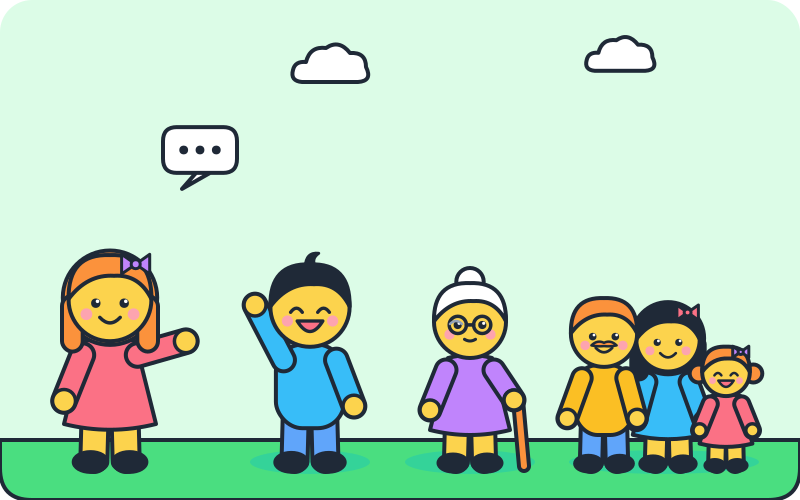
The friend her age gets tu. The older stranger gets vous, and so does the family group: vous is the only plural you.
The trap for English speakers: is not only formal. Two close friends still get , because it is the only plural "you".
French keeps longer than English speakers expect: colleagues and neighbours can stay for years. Moving to is a small event with its own verb, tutoyer:
tutoyer ?- Shall we say?
to a stranger reads as rude or presumptuous, so is the safe default.
on: the pronoun that ate nous
In spoken French, has largely replaced as the word for "we":
| Spoken | Written or formal | English |
|---|---|---|
. | . | We're going to the cinema. |
. | . | We eat here. |
means "we" but takes the form of the verb:
.- We're ready. (not).- We've finished. (not)
also keeps its older meaning, "one" or "people in general":
.- You never know.France, .- In France, people eat late.
survives in writing, formal speech and for emphasis: , . - We think it's good. The practical rule: understand , say .
Going further: Why you cannot drop them and the rest of the guide, when you want them. This lesson does not need them.
Practice
Practise this lesson
10-question session
One question at a time, mixed across the exercises in this lesson. Miss one and it comes back round before the end.
French · Free printables
Worksheets for this lesson
Worksheets with answer keys built in. Open any one to view, print or save.
Lesson 32 of 42 in this chapter