
Ch 2 · Lesson 38French · Chapter 2 · Lesson 38 · Grammar primer
The big four: être, avoir, aller, faire
The four verbs French cannot do without, and , the modals , , - and .
The short version
Four verbs do most of the work
.
Why?Hide
, , and earn their memorisation before anything else. Two of them are the auxiliaries behind every compound tense, builds the going-to future on its own, and runs half the idioms in the language. Learn those four cold and the rest of the system has something to hang on.
The big four
These four are irregular in the present and in the future, and the most useful verbs in the language.
| Person | être (to be) | avoir (to have) |
|---|---|---|
| / j' | | |
| | |
| / | | |
| | |
| | |
| / | | |
| Person | aller (to go) | faire (do, make) |
|---|---|---|
| | |
| | |
| / | | |
| | |
| | |
| / | | |
What each one buys you:
.- I ate. (builds most past tenses).- I went to. (builds the rest).- I'm going to eat. (+ infinitive: the near future).- It's cold. (does the weather, and much else)
and are two of only three forms ending in -tes rather than -ez. The third is (you say):
?- Are you here??- What are you doing?
avoir where English says be
French says you have hunger, fear or years where English says you are hungry, afraid or twenty.
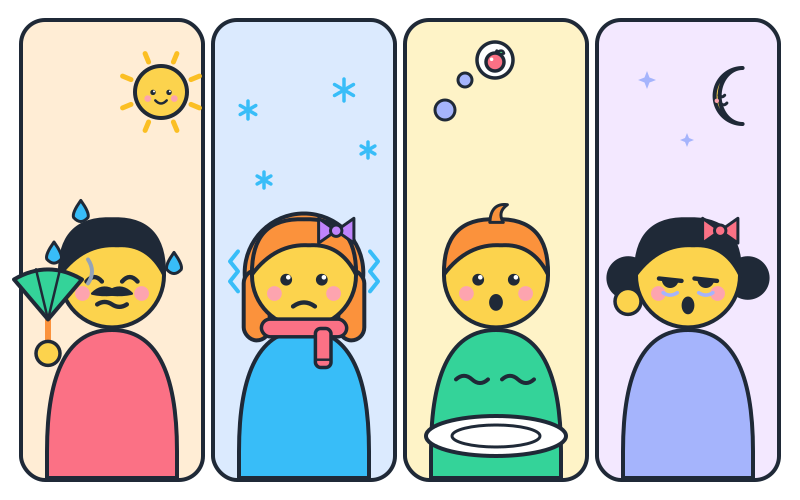
Hot, cold, hungry, sleepy: all four take avoir and a noun. Je suis chaud is not how you say you are hot.
| French | Literally | English |
|---|---|---|
. | I have hunger | I'm hungry. |
. | I have thirst | I'm thirsty. |
. | I have fear | I'm afraid. |
. | I have heat | I'm hot. |
. | I have cold | I'm cold. |
. | I have sleep | I'm sleepy. |
. | you have reason | You're right. |
. | he has wrong | He's wrong. |
. | I have twenty years | I'm twenty. |
. | I have need of water | I need water. |

- !
Age takes avoir: J'ai cinq ans, I have five years. Je suis cinq is never French. Count the candles.
Tiredness goes the other way, because is an adjective, not a noun:
.- I'm tired.
The modal group
Four verbs behave alike and usually come before an infinitive: (can), (want), (must) and (know how to).
| Person | pouvoir (can) | vouloir (want) |
|---|---|---|
| | |
| | |
| | |
| | |
| | |
| |
| Person | devoir (must) | savoir (know) |
|---|---|---|
| | |
| | |
| | |
| | |
| | |
| |
and end in -x, -x, -t in the singular; and in -s, -s, -t. The verb after a modal stays in the infinitive:
.- I can come.?- Do you want to eat?.- We have to go home..- I can swim.
What each modal means, , and against are on French modal verbs.
Going further: The core irregular verbs at a glance and the rest of the guide, when you want them. This lesson does not need them.
Practice
Practise this lesson
10-question session
One question at a time, mixed across the exercises in this lesson. Miss one and it comes back round before the end.


French · Free printables
Worksheets for this lesson
Worksheets with answer keys built in. Open any one to view, print or save.
Lesson 38 of 42 in this chapter