
French Irregular Verbs: List, Chart and the Patterns
By Michael McGettrickUpdated 11 October 2026
Around nine French verbs in ten end in -er and are regular (the -er verbs primer covers them). The irregular ones are few, but they are the verbs you need in your first week, and they fall into groups.
Quick check
Three quick questions on what you have just read. The full practice is further down.
Fill in the blank
0/3Fill the gap with the correct present-tense form.
Je anglais. (être) (the most irregular verb in the language)
Nous deux enfants. (avoir) (avoir, first person plural)
Ils au marché. (aller) (aller, third person plural)
The core irregular verbs at a glance
Three present forms (, , ) show a verb's whole shape. In most irregular verbs, and share one stem and , , another.
The everyday eight
| Verb | je | nous | ils |
|---|---|---|---|
| | | |
| | | |
| | | |
| | | |
| | | |
| | | |
| | | |
| | |
Next in line
| Verb | je | nous | ils |
|---|---|---|---|
| | | |
| | | |
| | | |
| | | |
| | | |
| | | |
| | | |
| | | |
| | |
In the "boot" verbs (, , , , , ), leaves the stem again: it goes back to the vowel ( , ; , ), or in the n ( ).
.- I can come..- We can come..- They can come.
Every verb here has its full table in the French verb conjugation tables.
The big four
These four are irregular in the present and in the future, and the most useful verbs in the language.
| Person | être (to be) | avoir (to have) |
|---|---|---|
| / j' | | |
| | |
| / | | |
| | |
| | |
| / | | |
| Person | aller (to go) | faire (do, make) |
|---|---|---|
| | |
| | |
| / | | |
| | |
| | |
| / | | |
What each one buys you:
.- I ate. (builds most past tenses).- I went to. (builds the rest).- I'm going to eat. (+ infinitive: the near future).- It's cold. (does the weather, and much else)
and are two of only three forms ending in -tes rather than -ez. The third is (you say):
?- Are you here??- What are you doing?
avoir where English says be
French says you have hunger, fear or years where English says you are hungry, afraid or twenty.
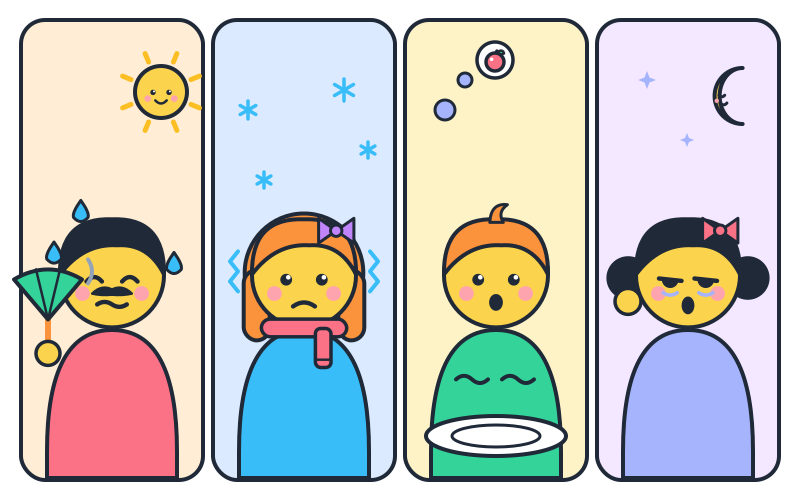
Hot, cold, hungry, sleepy: all four take avoir and a noun. Je suis chaud is not how you say you are hot.
| French | Literally | English |
|---|---|---|
. | I have hunger | I'm hungry. |
. | I have thirst | I'm thirsty. |
. | I have fear | I'm afraid. |
. | I have heat | I'm hot. |
. | I have cold | I'm cold. |
. | I have sleep | I'm sleepy. |
. | you have reason | You're right. |
. | he has wrong | He's wrong. |
. | I have twenty years | I'm twenty. |
. | I have need of water | I need water. |

- !
Age takes avoir: J'ai cinq ans, I have five years. Je suis cinq is never French. Count the candles.
Tiredness goes the other way, because is an adjective, not a noun:
.- I'm tired.
The modal group
Four verbs behave alike and usually come before an infinitive: (can), (want), (must) and (know how to).
| Person | pouvoir (can) | vouloir (want) |
|---|---|---|
| | |
| | |
| | |
| | |
| | |
| |
| Person | devoir (must) | savoir (know) |
|---|---|---|
| | |
| | |
| | |
| | |
| | |
| |
and end in -x, -x, -t in the singular; and in -s, -s, -t. The verb after a modal stays in the infinitive:
.- I can come.?- Do you want to eat?.- We have to go home..- I can swim.
What each modal means, , and against are on French modal verbs.
The -ir split
-ir is really two families wearing the same coat. The type adds -iss- in the plural; the type does not, and drops the last stem consonant in the singular.
| Person | finir (to finish) | partir (to leave) |
|---|---|---|
| | |
| | |
| | |
| | |
| |
.- We finish at five..- We're leaving tomorrow.
| Like finir | Like partir |
|---|---|
| |
| |
| |
| |
Nothing in the infinitive tells you the family, so learn it with the verb. The -ir verbs primer sorts the common ones.
The -re verbs
Regular -re verbs (, , ) end in -s, -s, nothing, -ons, -ez, -ent. The third person adds nothing at all:
.- He's selling his car.
The irregular ones come in families:
| Verb | je | nous | ils |
|---|---|---|---|
| | | |
| | | |
| | | |
| | | |
| | |
.- They're taking the train..- We drink coffee.
and follow ; follows . The -re verbs primer takes each family in full.
Irregular past participles
These have to be memorised, but they are short. They matter most in the passé composé, after or .
| Verb | Participle | Verb | Participle |
|---|---|---|---|
| | ||
| | ||
| | ||
| | ||
| | ||
| | ||
| | ||
| |
.- I saw the film..- I took the train..- She came yesterday.
keeps its circumflex only in the masculine singular, to tell it from (some):
.- He had to leave..- I'm eating some bread.
Irregular future stems
The future adds endings to the infinitive, any final e (, ), so it is nearly always regular. A dozen verbs change the stem; the endings never change.
| Verb | Future stem | je form |
|---|---|---|
| ser- | | |
| aur- | | |
| ir- | | |
| - | | |
| viendr- | | |
| pourr- | | |
| voudr- | | |
| devr- | | |
| saur- | | |
| verr- | | |
| faudr- | | |
| enverr- | |
, .- Tomorrow I'll go to..- I'll be there at eight.
The same stems build the conditional, so the table earns its keep twice:
.- I'd like a coffee.
Mistakes English speakers make
| Wrong | Right | Why |
|---|---|---|
partissons | | has no -iss- |
finons | | needs -iss- |
faisez | | -, like and |
voyé | | voir's participle is |
prendu | | prendre's participle is |
allerai | | aller's future stem is ir- |
. | . | Hunger takes |
What to do next
- Learn the everyday eight cold,
,andfirst. - Drill them on the French conjugation game.
- Then: modal verbs, avoir or être in the passé composé and the future tense.