
French Subject Pronouns Chart: je, tu, il, nous, vous, ils
By Michael McGettrickUpdated 11 October 2026
French has nine subject pronouns, one per person, and the table below holds them all. French never drops them, because most verb endings are silent, and in everyday speech stands in for .
Quick check
Three quick questions on what you have just read. The full practice is further down.
Pick the right one
0/3Choose the subject pronoun that matches the verb form.
parles très bien français.
parlons ensemble.
parlez trop vite.
The full table
| Pronoun | English | Example | English |
|---|---|---|---|
| I | . | I'm speaking. |
| you (one, casual) | . | You're speaking. |
| he, it | . | He's speaking. |
| she, it | . | She's speaking. |
| we, one, people | . | We're speaking. |
| we | . | We're speaking. |
| you (polite, pl.) | . | You're speaking. |
| they (men, mixed) | . | They're speaking. |
| they (all women) | . | They're speaking. |
and also mean "it", because every French noun has a gender. The pronoun copies the noun's:
? .- Where's the book? It's here.? .- Where's the table? It's here.
covers any mixed group, however many women are in it. is only for a group that is entirely female.
Paul Marie ? .- Paul and Marie? They're here.Marie Claire ? .- Marie and Claire? They're here.
Why you cannot drop them
Spanish drops subject pronouns because its endings are audible. French cannot, because most of its endings are written but silent:
| French | English | Said |
|---|---|---|
| I speak | "parl" |
| you speak | "parl" |
| he speaks | "parl" |
| they speak | "parl" |
Four persons, three spellings, one sound, so only the pronoun tells a listener who is speaking. . on its own is an order (speak French!), not a statement.
je becomes j'
Before a vowel or a silent h, loses its e:
.- I have two brothers..- I live in..- I like bread.
This is compulsory in writing as well as speech. is the only one of the nine that elides in standard spelling. does not: you write (you have), even though casual speech says .
tu and vous
is one person you know well. is anyone you should be polite to, and any group at all.
- tu
- vous
| Speaking to... | French | English |
|---|---|---|
| your brother | ? | Are you coming? |
| a friend | ? | Do you want some bread? |
| a shopkeeper | ? | Do you have any bread? |
| your new manager | ? | Are you here tomorrow? |
| two close friends | ? | Are you coming? |
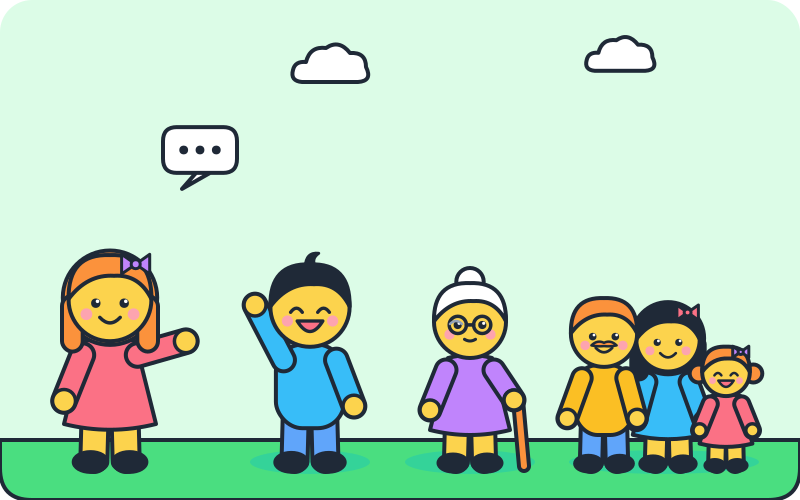
- ?
- ?
- ?
The friend her age gets tu. The older stranger gets vous, and so does the family group: vous is the only plural you.
The trap for English speakers: is not only formal. Two close friends still get , because it is the only plural "you".
French keeps longer than English speakers expect: colleagues and neighbours can stay for years. Moving to is a small event with its own verb, tutoyer:
tutoyer ?- Shall we say?
to a stranger reads as rude or presumptuous, so is the safe default.
on: the pronoun that ate nous
In spoken French, has largely replaced as the word for "we":
| Spoken | Written or formal | English |
|---|---|---|
. | . | We're going to the cinema. |
. | . | We eat here. |
means "we" but takes the form of the verb:
.- We're ready. (not).- We've finished. (not)
also keeps its older meaning, "one" or "people in general":
.- You never know.France, .- In France, people eat late.
survives in writing, formal speech and for emphasis: , . - We think it's good. The practical rule: understand , say .
When the pronoun stands alone: moi, toi
Subject pronouns are welded to their verb. Standing alone, for emphasis or after a preposition, French uses the stressed pronouns instead:
? !- Who wants bread? Me!, .- I speak French., .- You're always late..- It's him.Paul , .- Paul and I are leaving tomorrow.
English a pronoun with the voice. French cannot stress , so it adds in front: , ..., , ....
Mistakes English speakers make
| Wrong | Right | Why |
|---|---|---|
. | . | The pronoun is never dropped |
? | ? | Strangers get |
. | . | on takes the form |
| . | One man makes it |
. | . | elides before a vowel |
! (alone) | ! | Alone, it is the stressed form |
What to do next
- Clear the drill below, then say five sentences about your day with
. - Default to
with anyone you have not been invited totutoyer. - Next: object pronouns (me,
,,) and the -er verbs whose silent endings this page depends on.