
French Noun Gender: Le or La? The Endings That Tell You
By Michael McGettrickUpdated 11 October 2026
Every French noun is masculine or feminine: no neuter, no opting out. The noun rarely shows which, so the gender lives in the words around it. A few endings predict most genders, and one cheap habit, learning the article with the noun, covers the rest.
| Clue | Masculine | Feminine |
|---|---|---|
| "the" | | |
| "a" | | |
| Adjective | | |
| "it" | | |
| Typical ending | | |
Quick check
Now use it: three quick questions on the chart above. The full practice is further down.
Pick the right one
0/3Choose the word that agrees with the noun's gender. chose (thing) is feminine, temps (time) is masculine.
chose (the thing)
temps (the time)
bonne chose (a good thing)
What gender actually is
Gender is a sorting system French inherited from Latin. Every noun is in one of two classes, and the class sets the shape of the words around it.
| French | English |
|---|---|
| the thing |
| the time |
| a good thing |
| a good moment |
It says nothing about the thing itself: a table is not feminine in any real sense ( , the table), and a book is not masculine ( , the book). Treat gender as part of the word, like its spelling.
 the table
 the book
 the car
 the bread
The bad news: no Spanish-style cue
Spanish mostly marks gender on the noun: libro (book) ends in -o, casa (house) in -a. French wore those endings away. Its nouns look neutral:
Nothing in chose or tells you the class. The article does.
The good news: endings predict most genders
A handful of endings predict gender very reliably. Learn them once and thousands of nouns fall into place.
endings
| Ending | Example | English |
|---|---|---|
| -tion | | the nation |
| -sion | | the television |
| -té | | freedom |
| -ence | | science |
| -ure | | the car |
| -ette | | the |
| -ée | | the day |
endings
| Ending | Example | English |
|---|---|---|
| -age | | the cheese |
| - | | the moment |
| - | | the office |
| -isme | | the mechanism |
| -oir | | the mirror |
In a sentence: . - The television is small. . - The cheese is good.
The exceptions are short and famous. Learn them by name:
| Exception | Despite | English |
|---|---|---|
| - | the water |
| - | the skin |
| -age | the beach |
| -age | the page |
| -age | the picture |
| -té | the summer |
| -té | the side |
| -ence | the silence |
| -ée | the museum |
. - The water is cold. The feminine is the giveaway.
The core habit: learn the article WITH the noun
For nouns whose endings predict nothing, and the first hundred words of French are full of them, one strategy works: never learn, write or say a bare noun.
| Not this | But this | English |
|---|---|---|
| chose | | the thing |
| the time | |
| the book |
Say the article aloud every time you practise. After a few dozen repetitions, sounds wrong to you the way a scissors sounds wrong in English.
People-nouns: gender usually follows the person
For people, grammatical gender mostly matches the person:
étudiante- a student (man / woman)
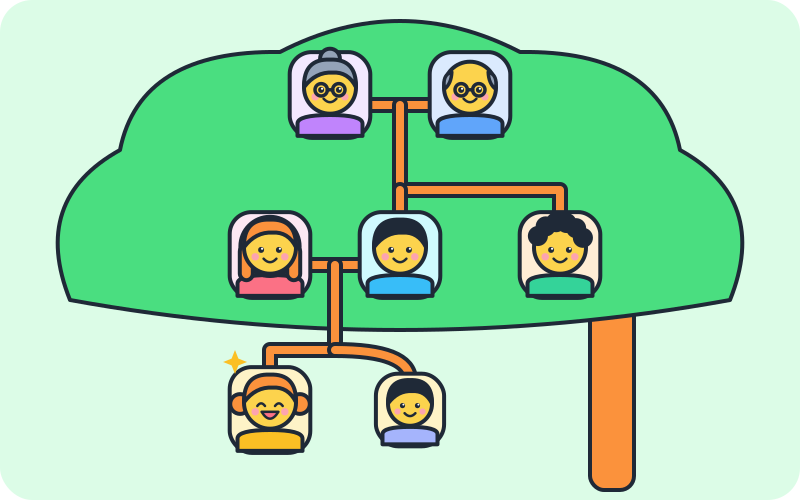
For people, the article follows the person: every woman in the tree is la, every man le. L'oncle hides it, but the uncle is masculine.
A few keep one gender whoever they describe: Paul . - Paul is a kind person. And (a baby) is masculine, even for a girl. The full pattern for jobs and roles is on feminine person nouns.
Same word, two genders, two meanings
A few nouns exist in both genders with different meanings, which proves the article is part of the word:
| Masculine | Feminine |
|---|---|
- the book | - the pound |
- the tour | - the tower |
- the job | - the post office |
- the way | - fashion |
So Eiffel is a tower, and France is a tour.
Why gender matters: everything downstream agrees
Gender is not trivia, because French copies it onto every word attached to the noun:
| Word | Masculine | Feminine |
|---|---|---|
| Article | / | / |
| Adjective | | |
| Possessive | | |
| Pronoun | . | . |
French has no separate it: and cover things too. ? . - Where's the car? It's here.
Get the gender right and all of these fall into place; get it wrong and the error echoes through the sentence. The adjective side is on French adjective agreement, the possessives on French possessive adjectives.
Mistakes English speakers make
| Wrong | Right | Why |
|---|---|---|
| | The adjective agrees too |
| | Elision, and is |
| | A famous -age |
. | . | is always |
What to do this week
- Say the article with every noun you know:
- Learn the six headline endings: -tion, -sion, -té feminine; -age, -ment, -eau masculine.
- Learn
(feminine) by name. It is the exception everyone.