Kilo Lingo

English · For teachers

Every English printable, chapter by chapter

The whole English curriculum in one place, mapped to its 32 chapters and 406 lessons. Each lesson lists its downloads inline - worksheets with answer keys, infographics and PDFs - so you can open and print any sheet for a class without hunting through the site.

Chapter 1 · Introduction to English

Chapter page →
  1. Introduction to English

    Introduction

    Start here. What this course is, who it is for, and how to learn the most common English words first so you can read and speak sooner.

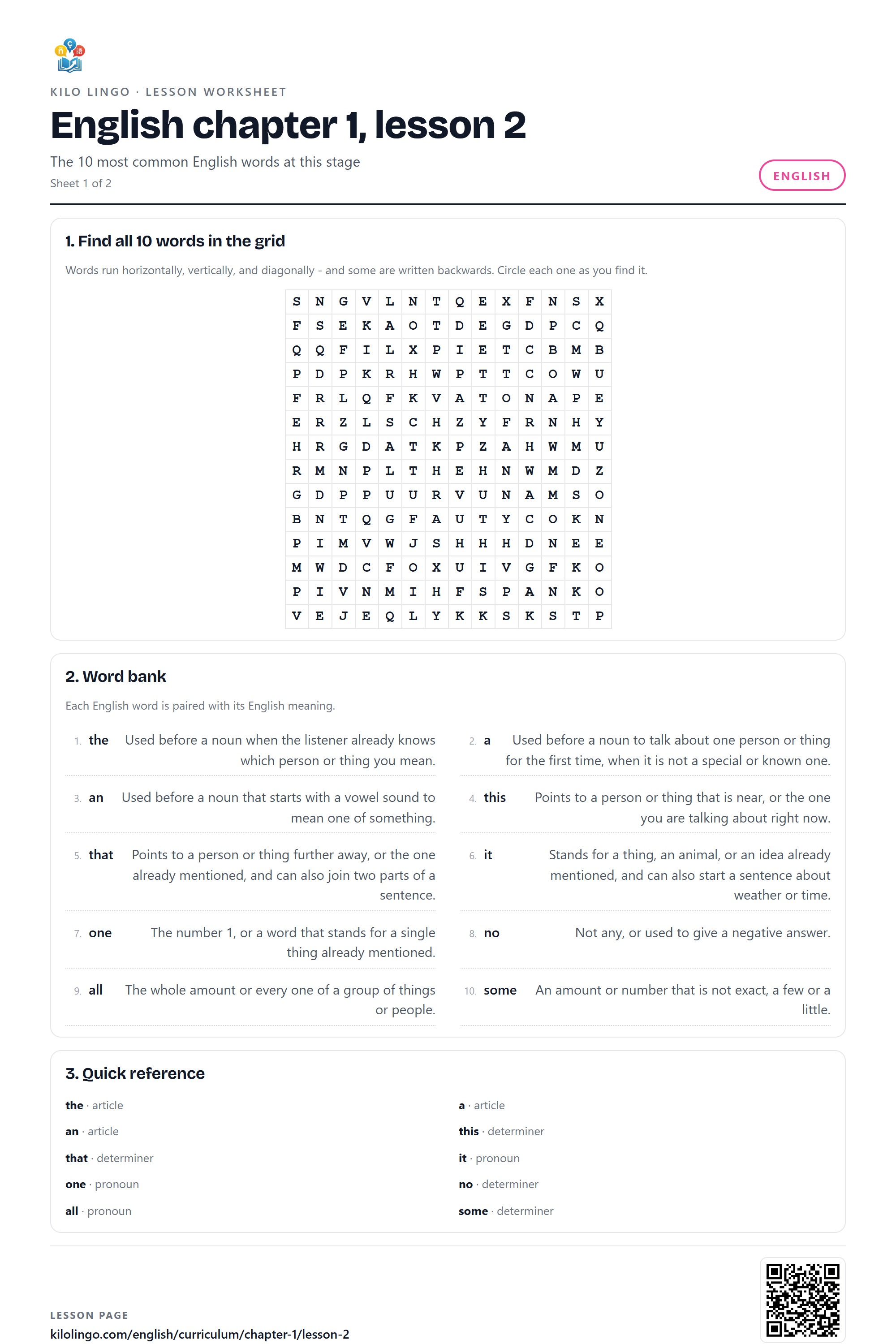
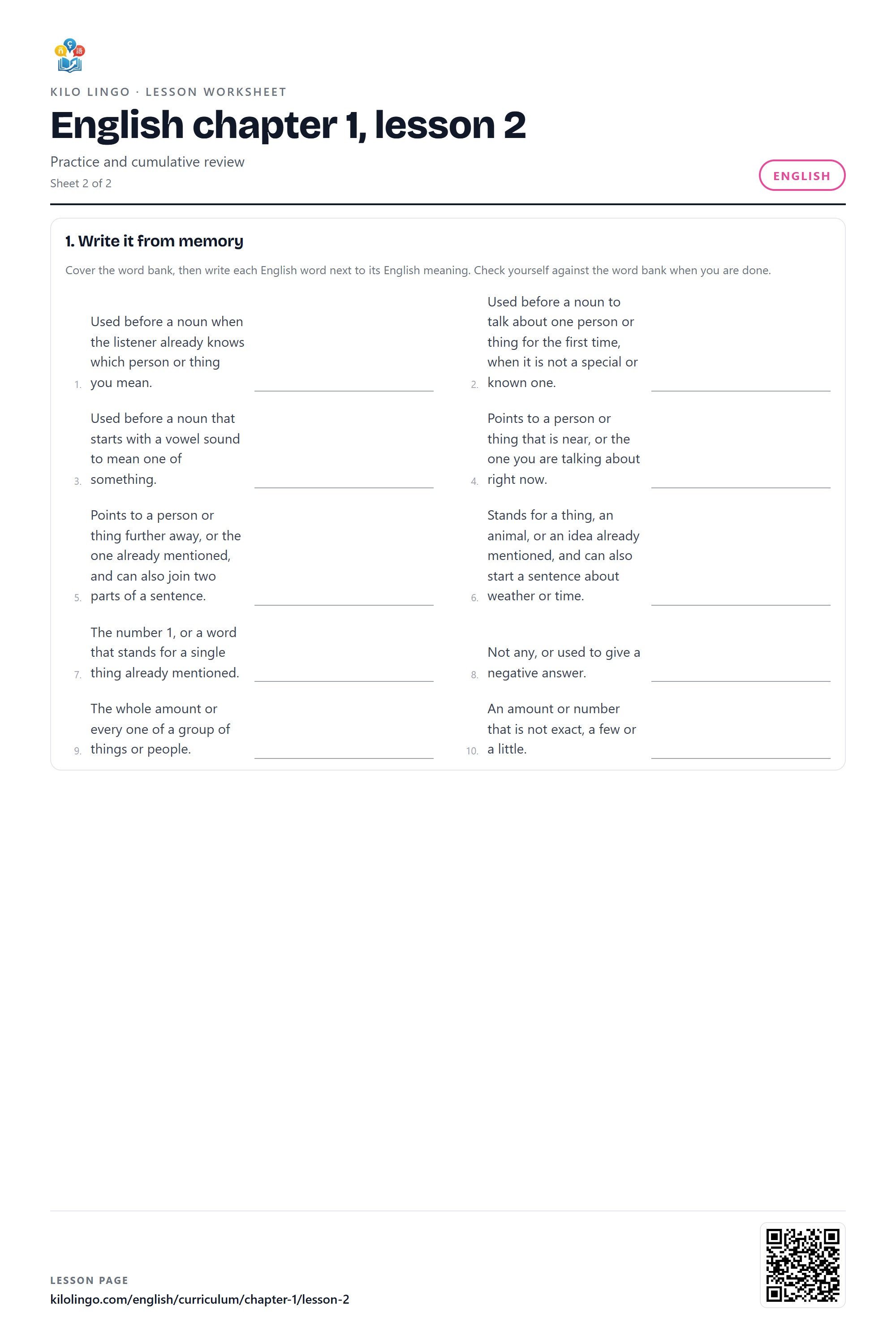
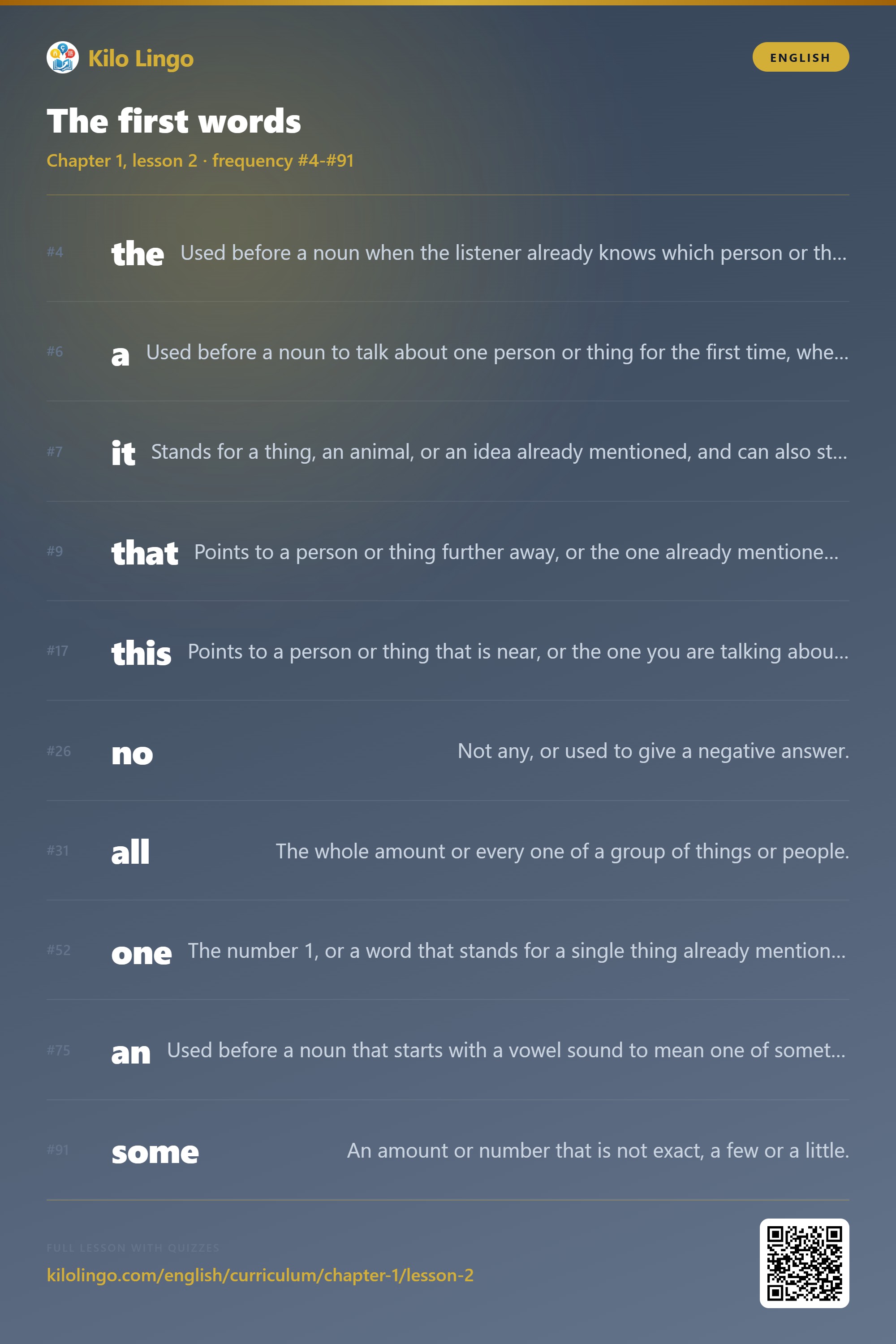
  2. The first wordsVocabulary

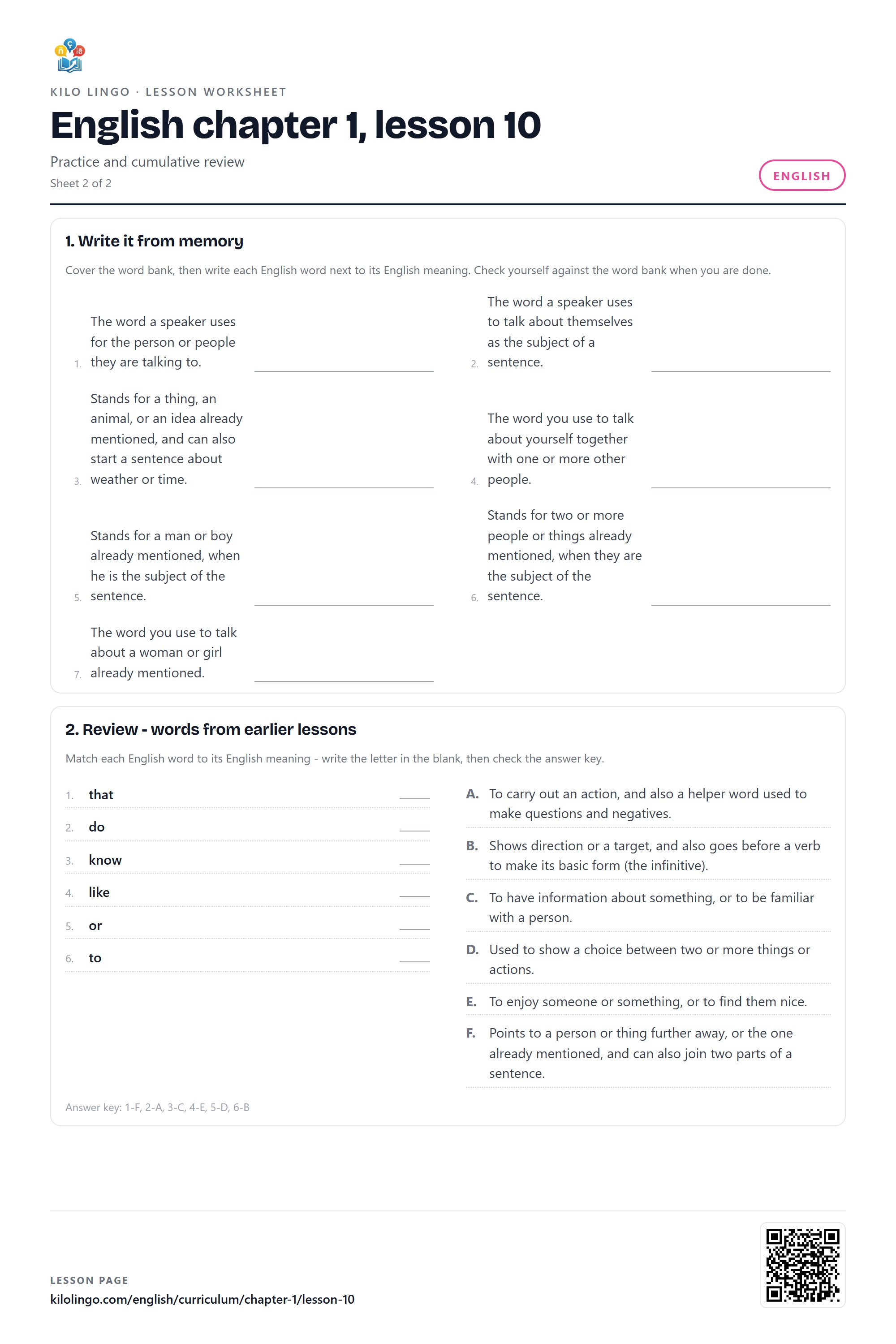
    10 words · The handful of words that appear in almost every English sentence: the articles and the words that point at things.

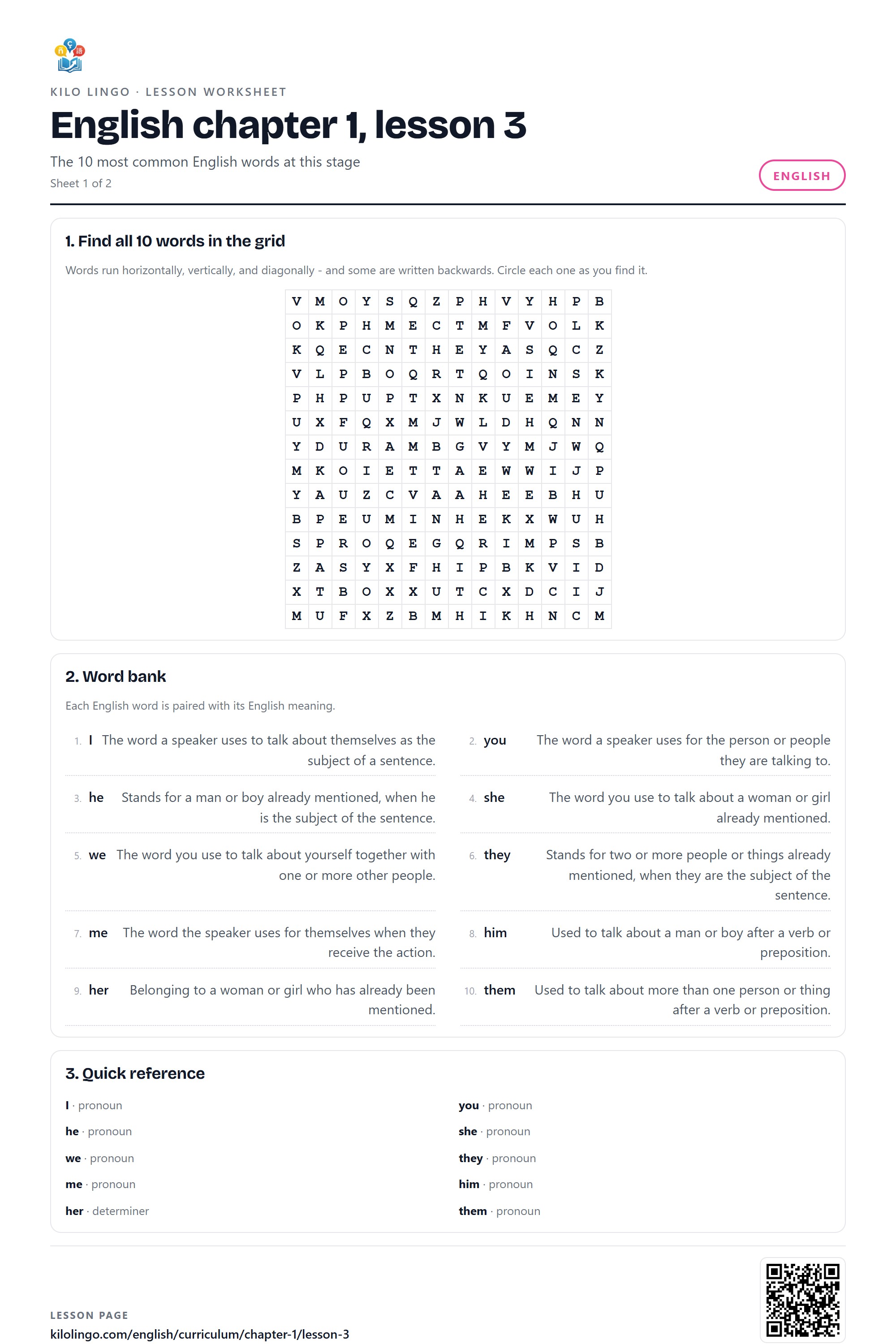
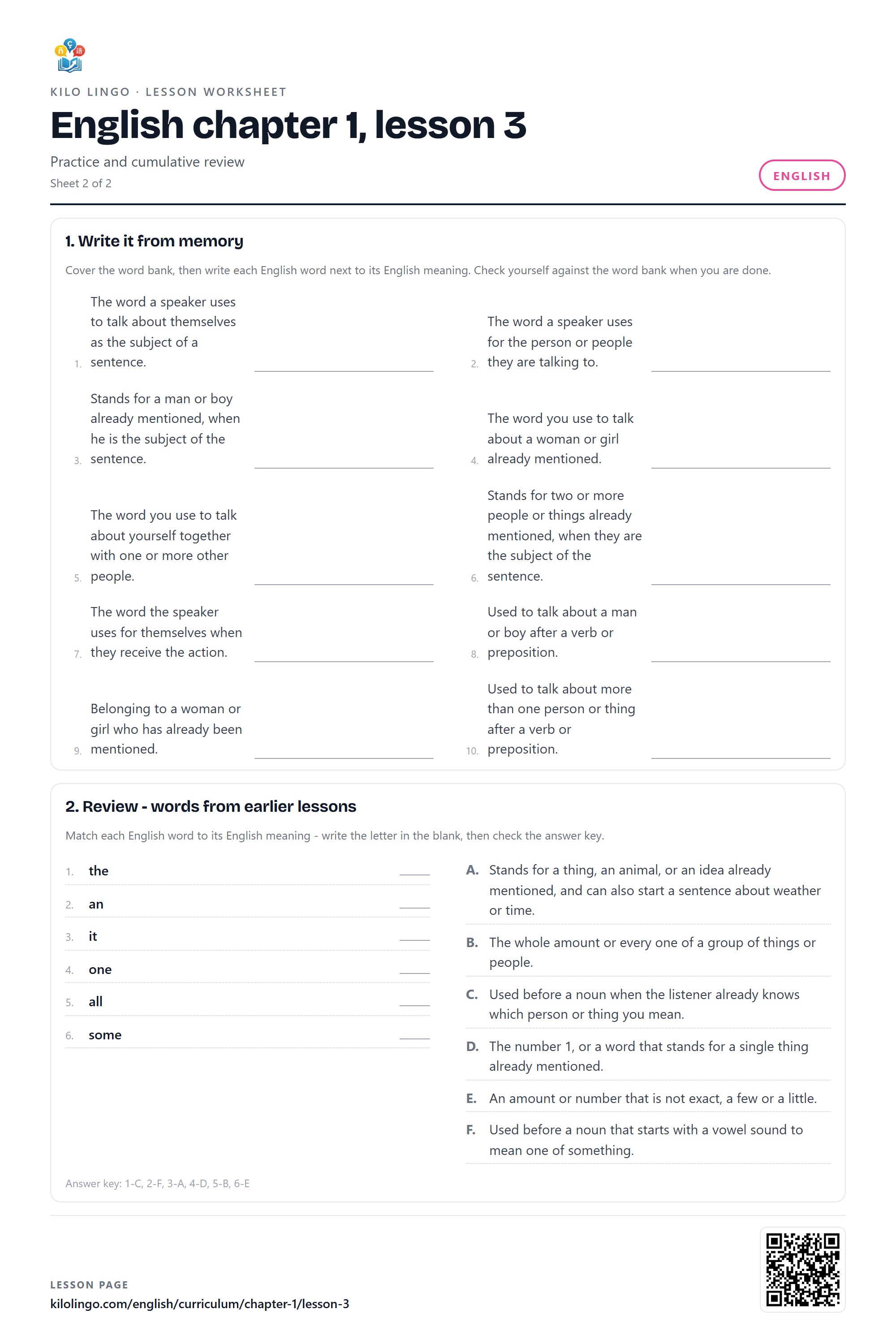
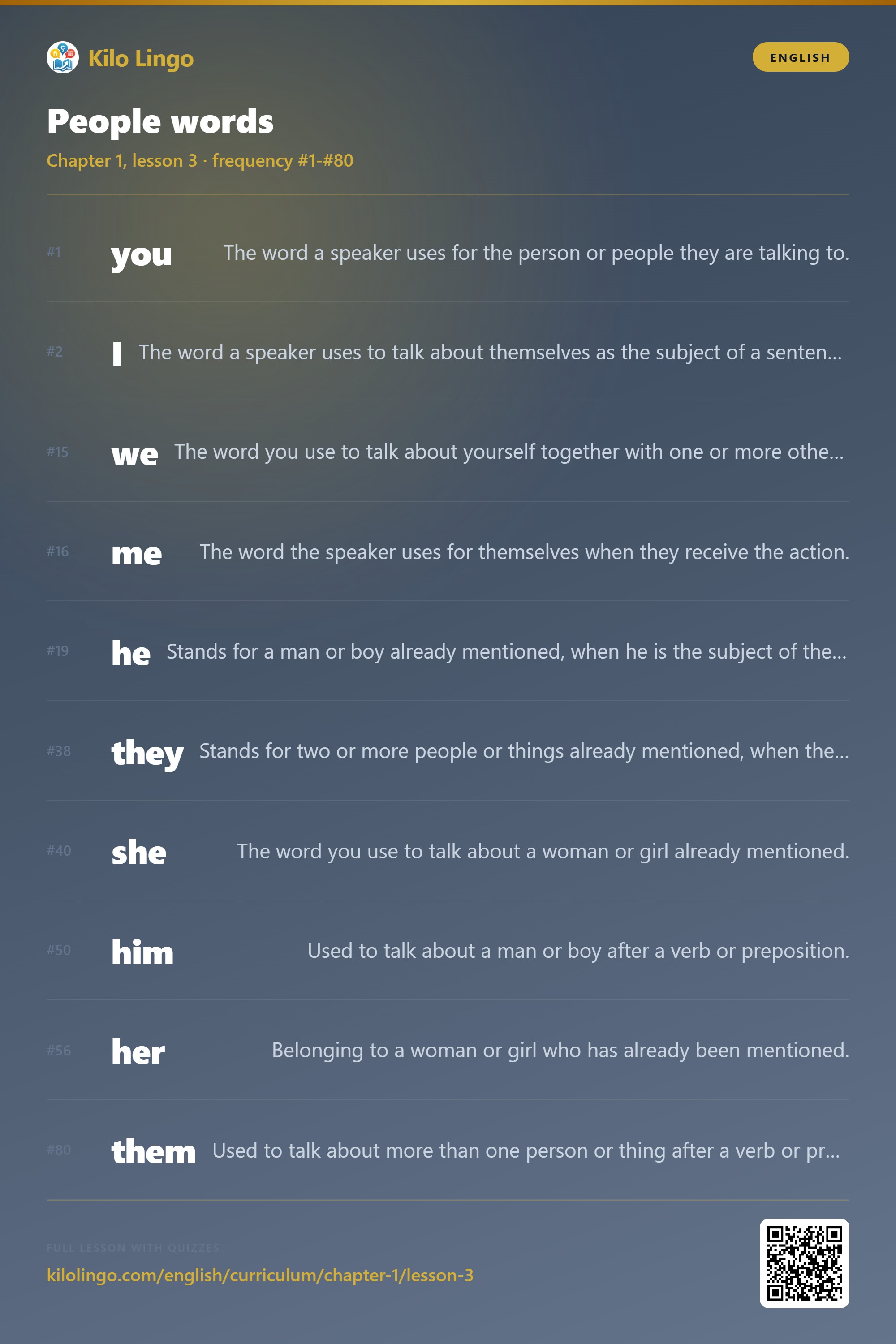
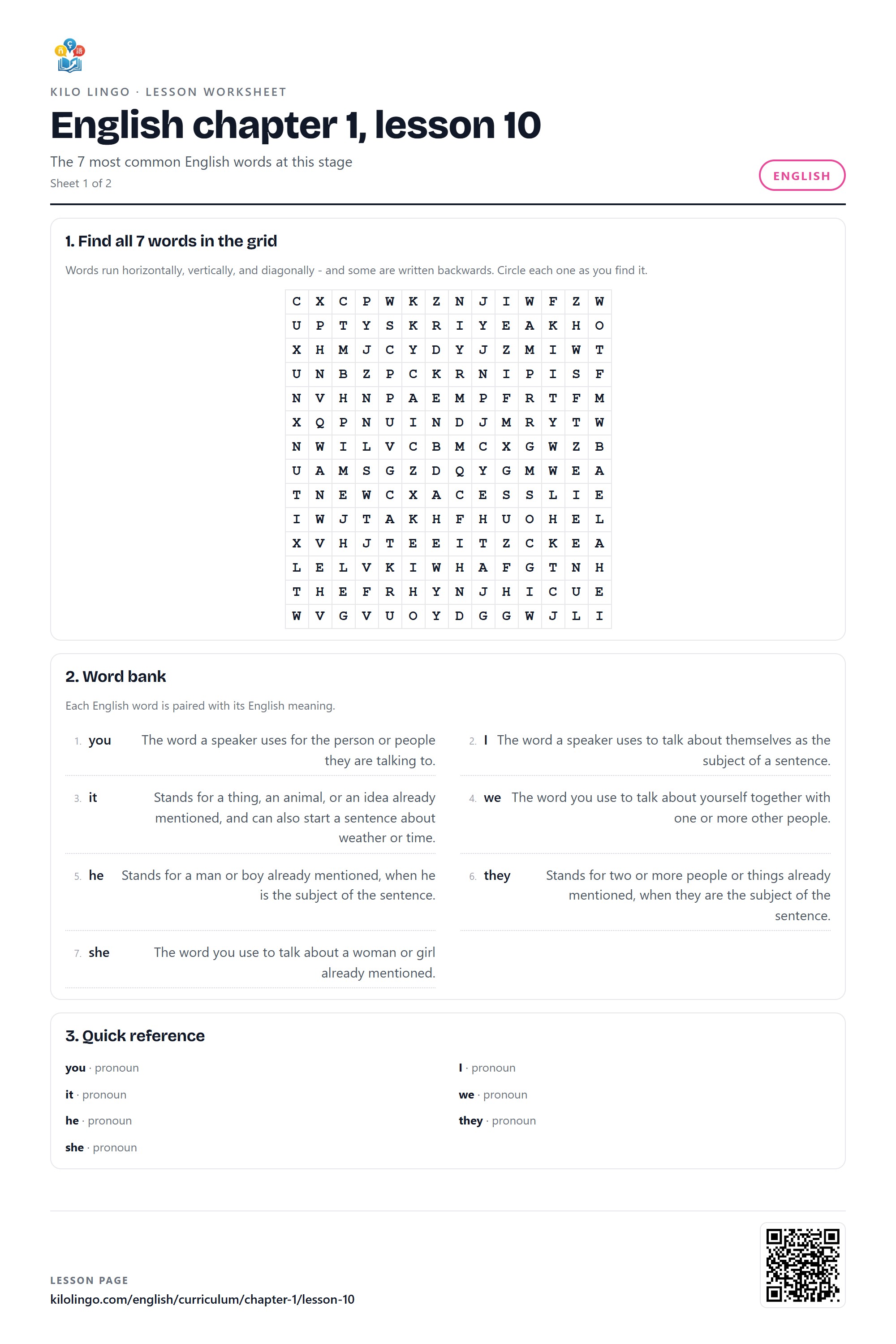
  3. People wordsVocabulary

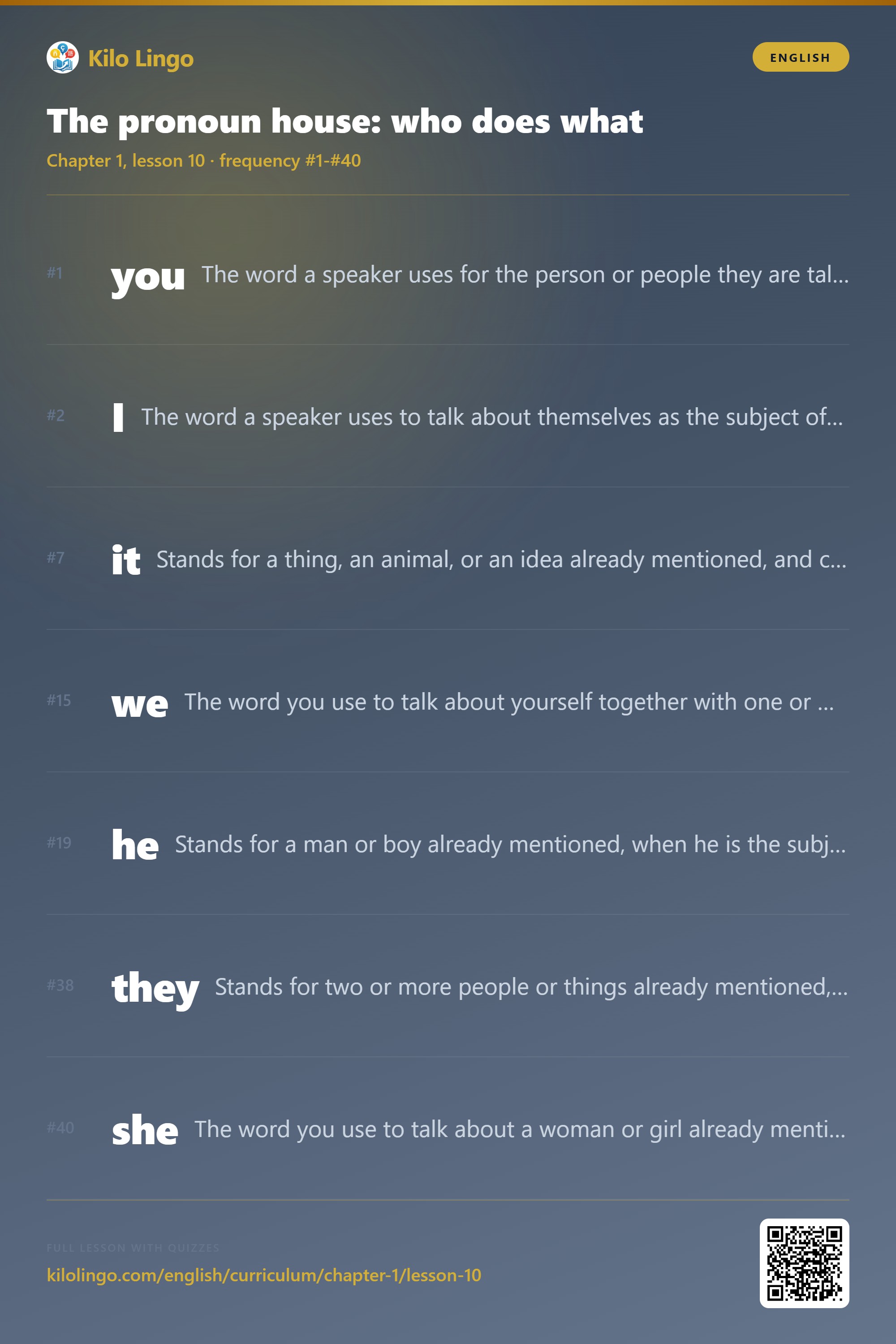
    10 words · The pronouns: how to talk about yourself, the person you speak to, and everyone else.

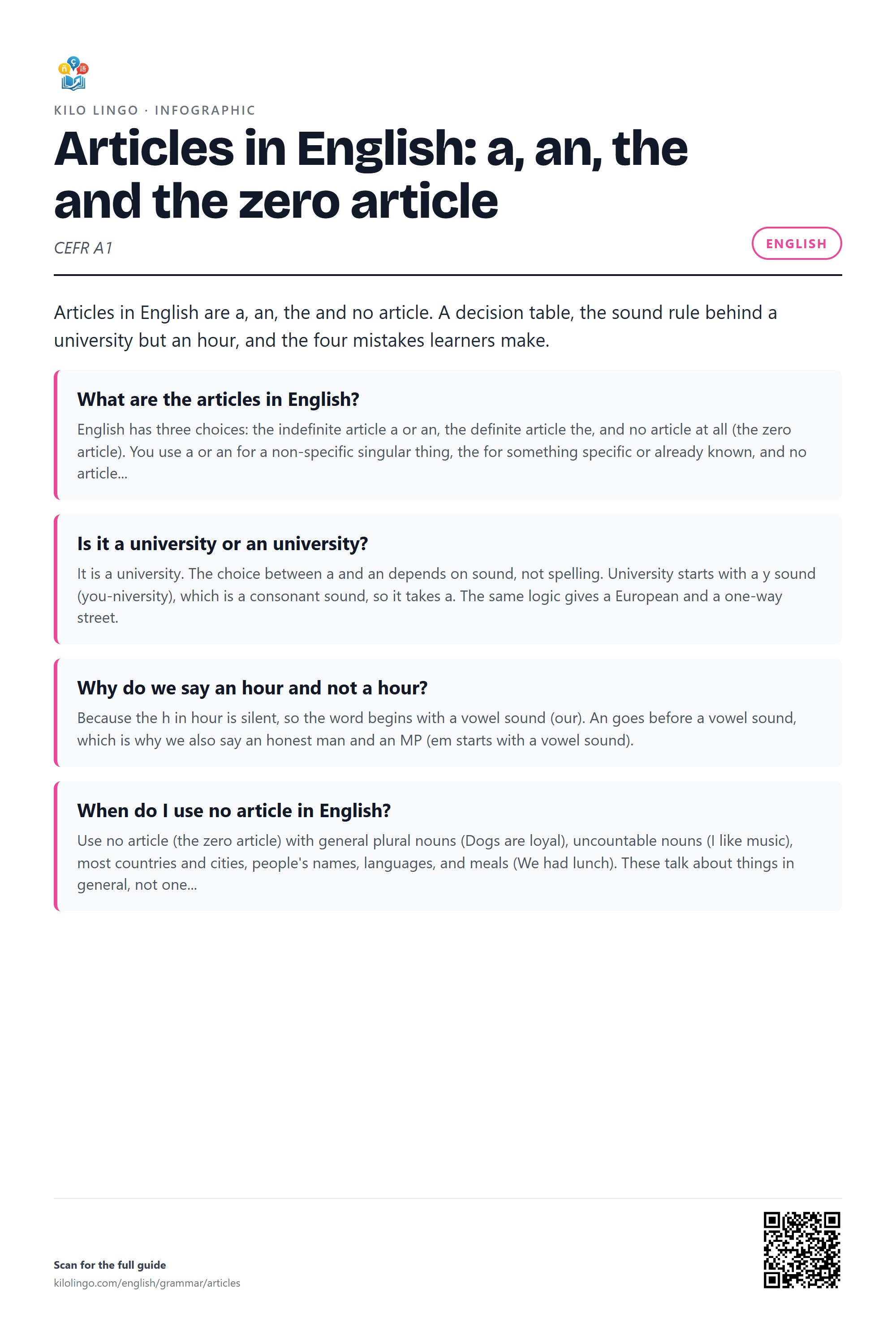
  4. When to use a, an and the - the small words English learners get wrong most often.

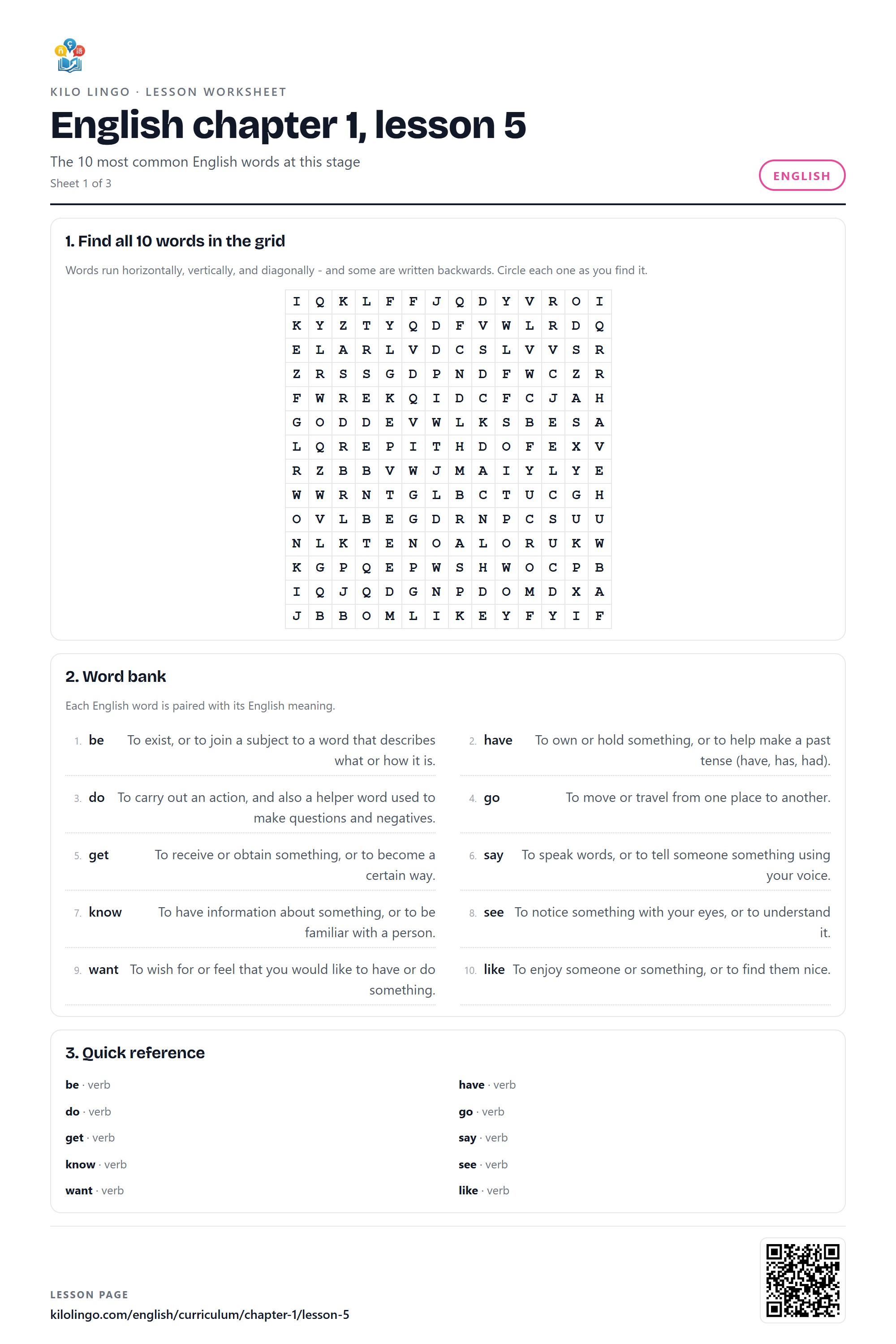
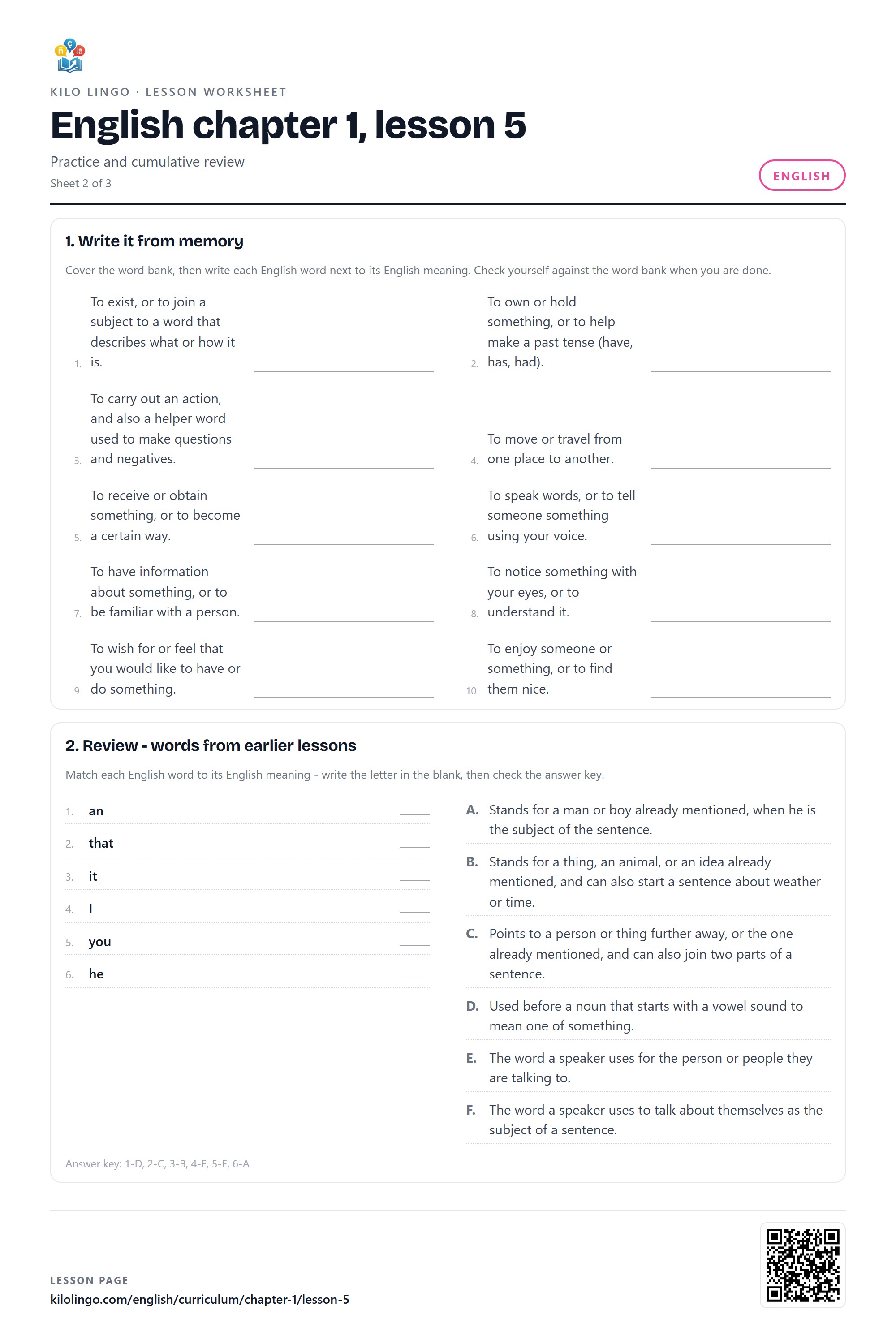
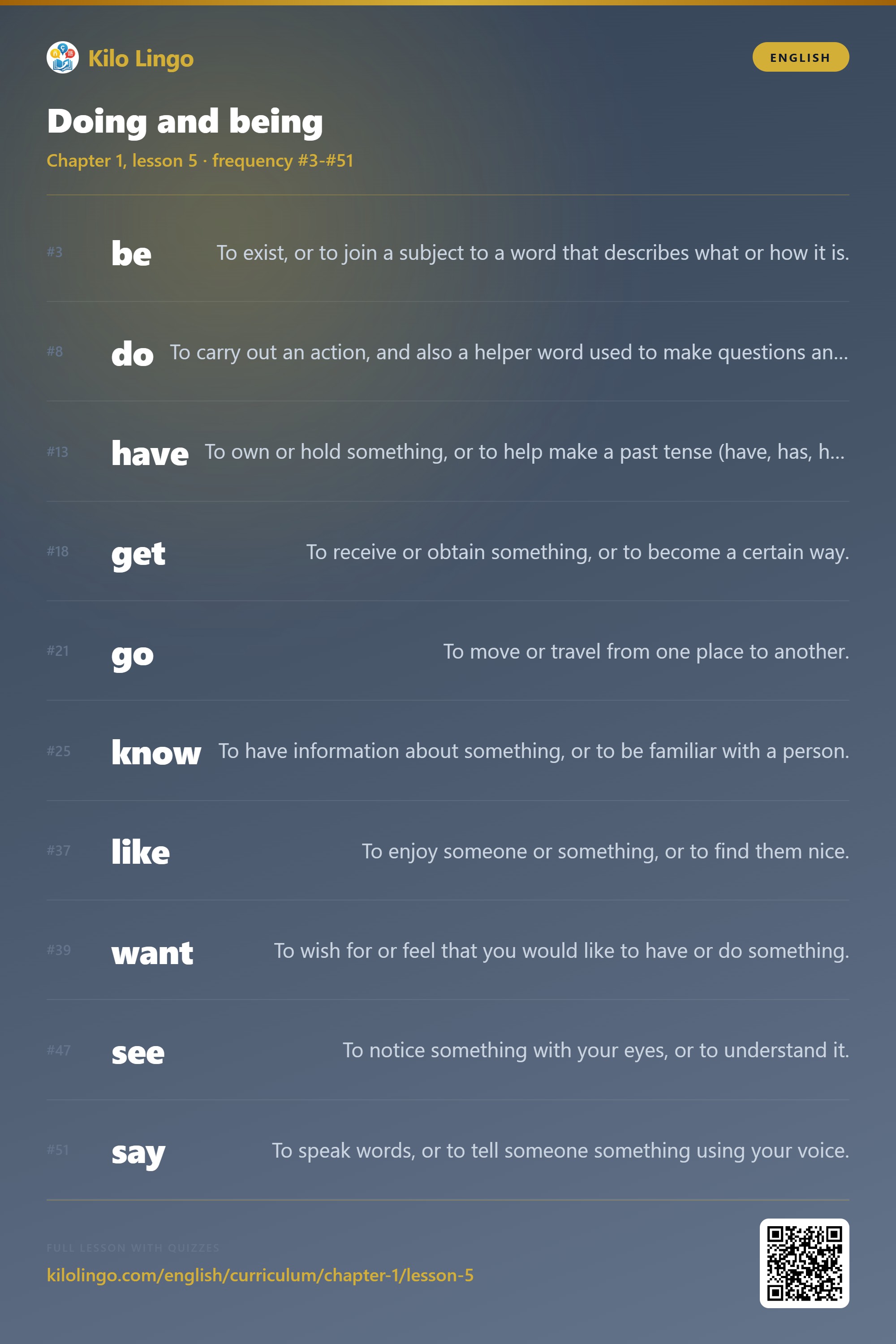
  5. Doing and beingVocabulary

    10 words · The most common verbs. With these you can already say what people do and how things are.

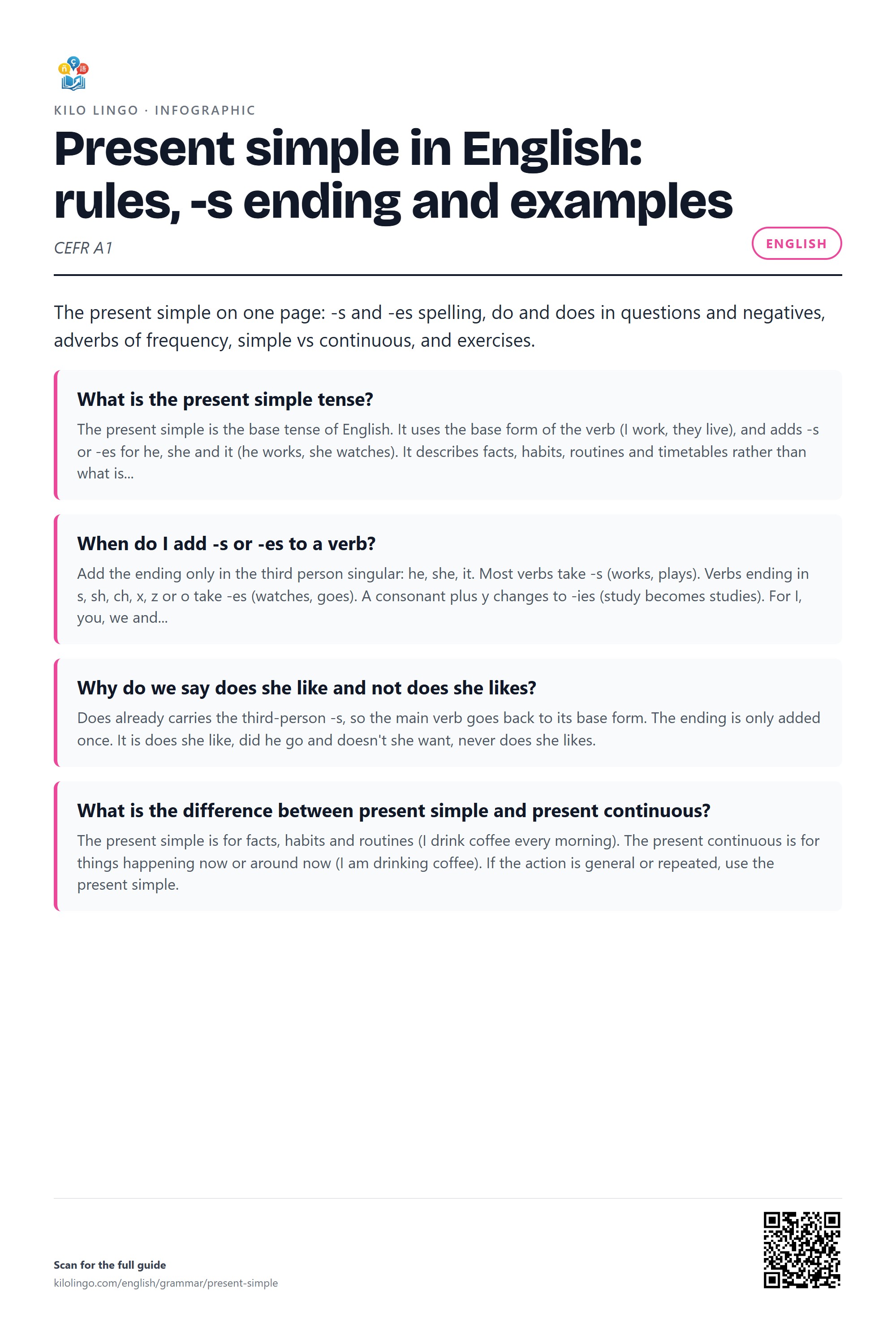
  6. How English says what is true now and what happens again and again - the everyday tense.

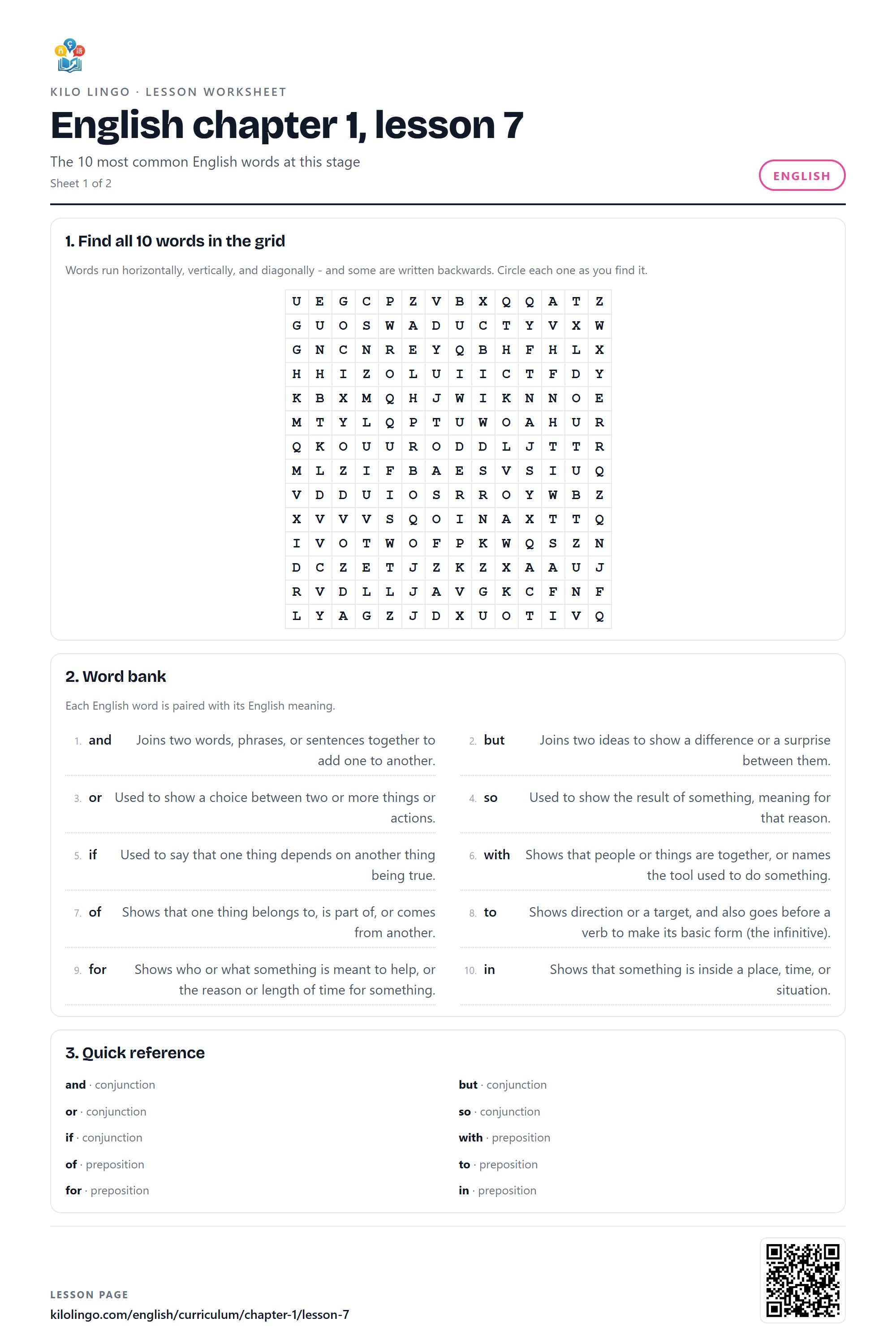
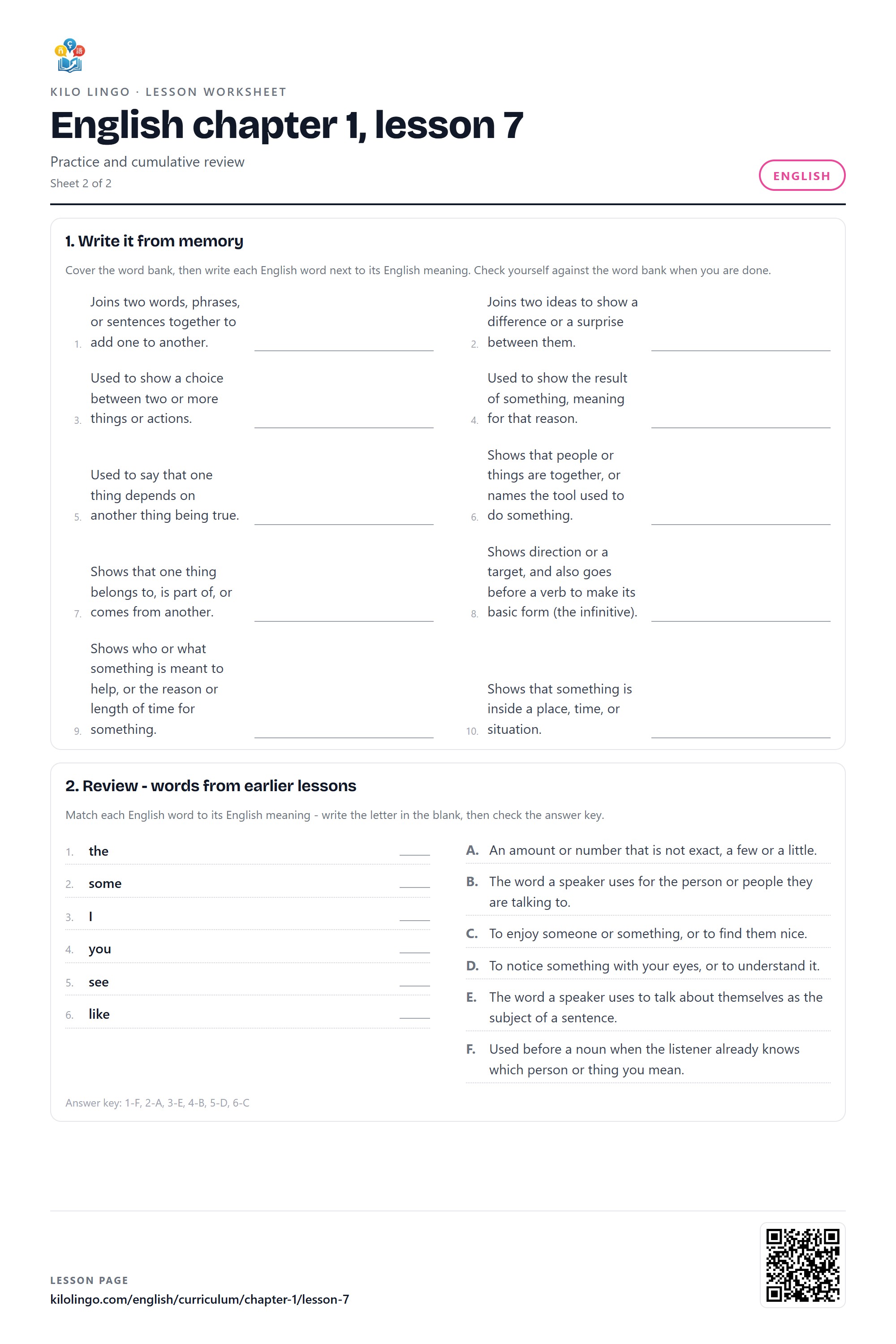
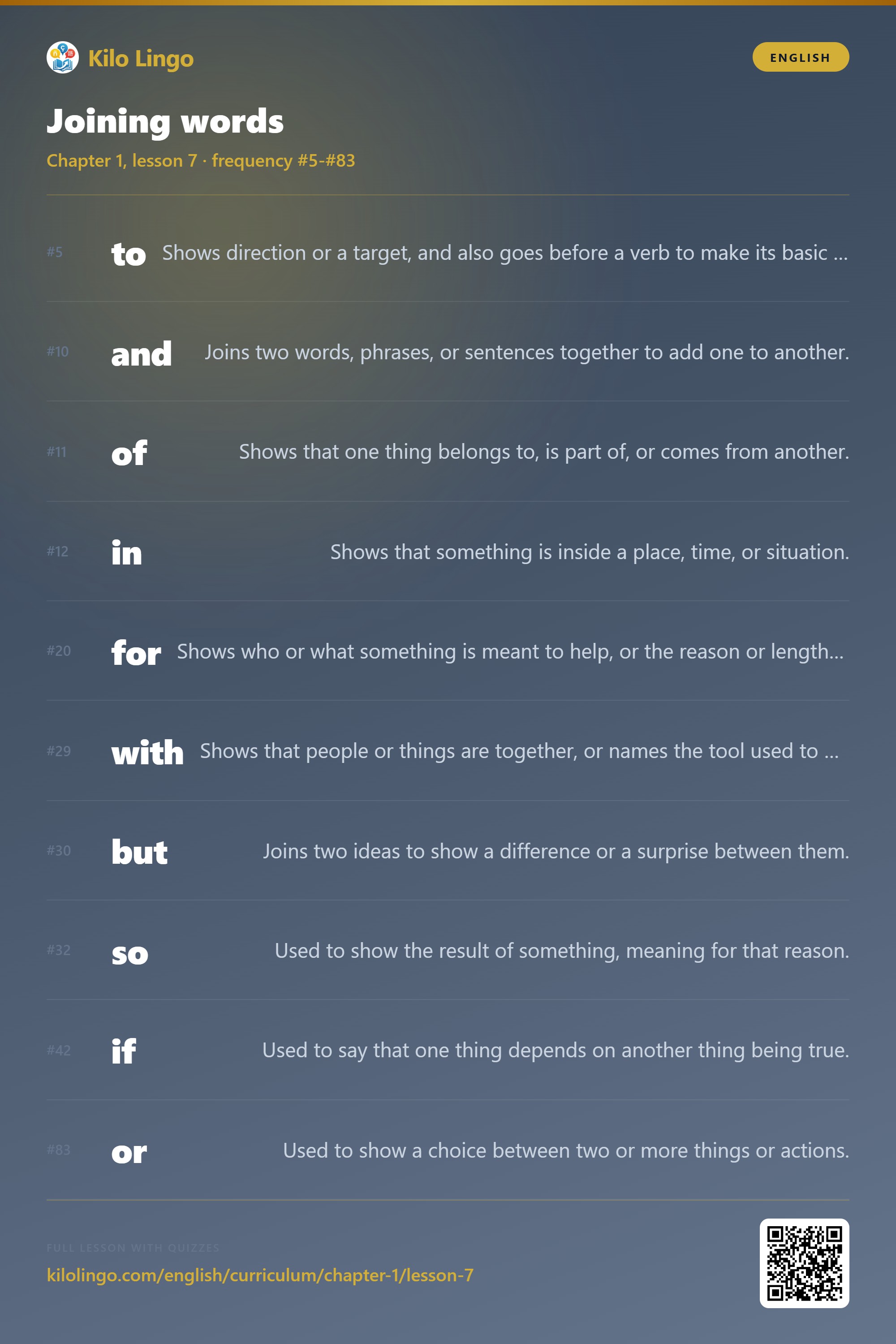
  7. Joining wordsVocabulary

    10 words · The small joining words - and, but, of, to - that hold a sentence together.

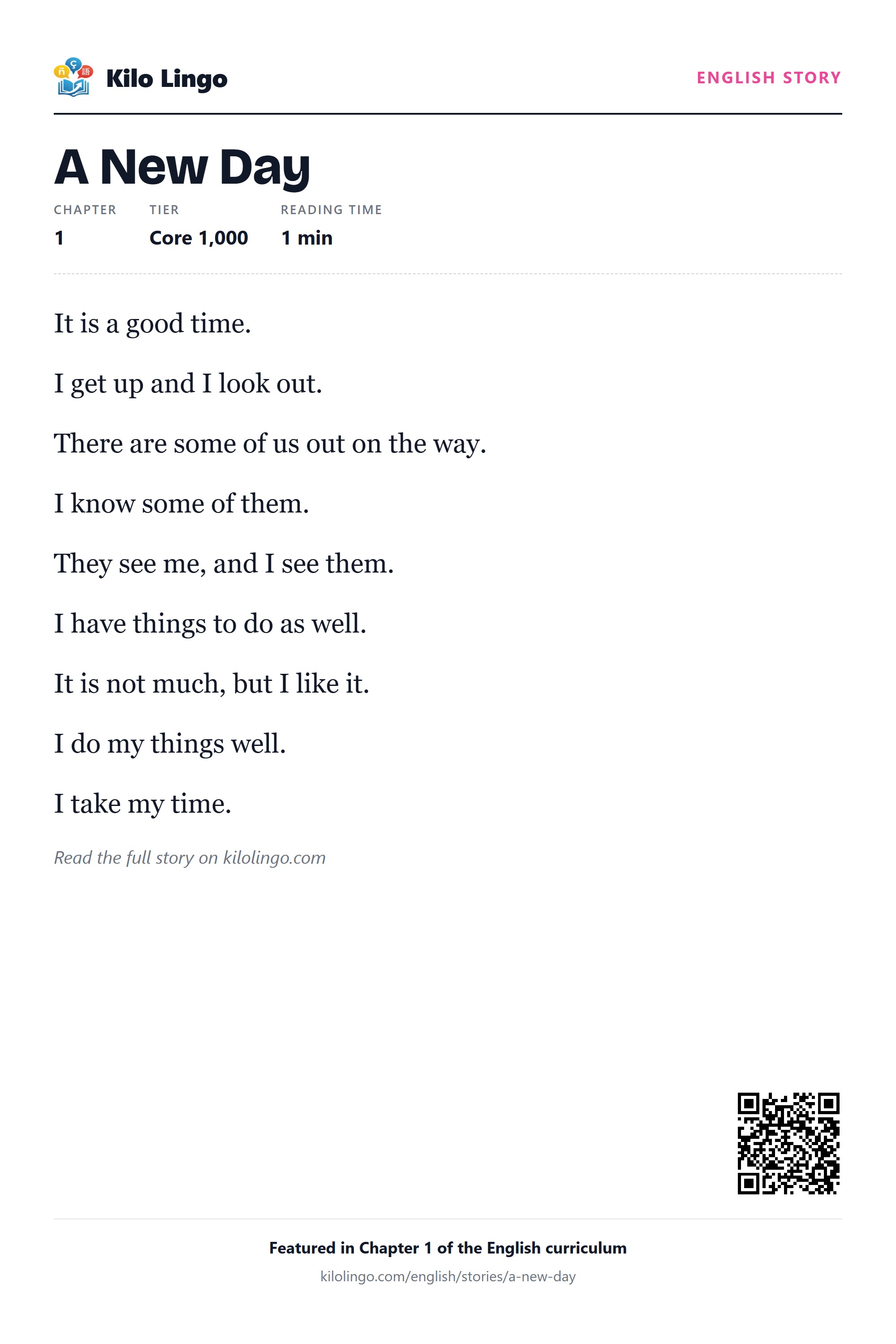
  8. Read: A New DayGraded-reader story

    Your first graded reader. Every word is one you have just met - read it through and see how much you already understand.

Chapter 2 · The present continuous

Chapter page →
  1. How English says what is happening right now - am, is or are plus a verb ending in -ing.

  2. How English talks about finished actions in the past - regular -ed endings and the common irregular verbs.

  3. You can read this story using only the words you've learned so far. Every content word sits at or below the rank-200 ceiling.

Chapter 3 · Talking about the future

Chapter page →
  1. The two everyday ways English looks ahead - 'will' for decisions and predictions, 'going to' for plans you can already see coming.

  2. How English links the past to now - 'have' or 'has' plus a past participle, for things that have happened by this moment.

  3. You can read this story using only the words you've learned so far. Every content word sits at or below the rank-300 ceiling.

Chapter 4 · Modal verbs

Chapter page →
  1. The little helper verbs that change a verb's meaning - can, could, must, should, may and might, for ability, permission and obligation.

  2. The small words that fix things in place and time - in, on, at, to, from and the rest, and how to choose the right one.

  3. You can read this story using only the words you've learned so far. Every content word sits at or below the rank-400 ceiling.

Chapter 5 · Conditional sentences

Chapter page →
  1. How English talks about 'if' - the zero, first, second and third conditionals, and which one to reach for when.

  2. The verb-plus-particle pairs that native speakers live on - get up, look after, put off - and how to tell the separable ones apart.

  3. You can read this story using only the words you've learned so far. Every content word sits at or below the rank-500 ceiling.

Chapter 6 · The gerund and the infinitive

Chapter page →
  1. When a verb follows another verb, does it take '-ing' or 'to'? Enjoy doing, want to do - the patterns that decide which one, and the verbs that take either.

  2. How English puts the spotlight on what happened rather than who did it - 'the bread is made here' - with the verb 'be' plus a past participle.

  3. You can read this story using only the words you've learned so far. Every content word sits at or below the rank-600 ceiling.

Chapter 7 · Irregular verbs

Chapter page →
  1. The common verbs that do not add '-ed' in the past - go/went, take/took, dig/dug, shake/shook - and the patterns that make them easier to remember.

  2. A map of the tenses you have met so far - past, present and future, simple and continuous - and how to choose the right one for what you mean.

  3. You can read this story using only the words you've learned so far. Every content word sits at or below the rank-700 ceiling.

Chapter 8 · Comparatives and superlatives

Chapter page →
  1. How English compares things - bigger, the biggest, more careful, the most careful - the syllable rules and the common irregulars (good, better, best).

  2. How to tell someone what another person said - 'she said she was tired' - and the way the tense shifts back one step when you report it.

  3. You can read this story using only the words you've learned so far. Every content word sits at or below the rank-800 ceiling.

Chapter 9 · Relative clauses

Chapter page →
  1. How to add information about a noun with who, which, that, whose, where and when - and when the commas go in and when they stay out.

  2. The words of amount - some, any, much, many, a lot of, a few, a little - and how the choice depends on whether a noun can be counted.

  3. You can read this story using only the words you've learned so far. Every content word sits at or below the rank-900 ceiling.

Chapter 10 · Used to and would

Chapter page →
  1. How English talks about the past that is no longer true - 'I used to live here', 'we would visit every summer' - and why 'used to' and 'would' are not always swappable.

  2. The little words of degree and result - so tall, such a day, too hot, big enough - and where each one goes in the sentence.
  3. You can read this story using only the words you've learned so far. Every content word sits at or below the rank-1000 ceiling.

Chapter 11 · Graded readers: the top 1000

Chapter page →
  1. Graded readers: the top 1000

    Introduction

    You now know the 1000 most common English words. That is enough to read. This chapter is a small library of stories built from only those words - read them straight through and feel how much you understand.

  2. The Surprise PartyGraded-reader story

    A family keeps a secret and throws a birthday surprise.

  3. Cooking TogetherGraded-reader story

    A grandmother teaches a child to cook the family meal.

  4. The First Day at WorkGraded-reader story

    Nerves, a small mistake, and pride by the end of the day.

Chapter 12 · Strong language

Chapter page →
  1. Strong language

    Introduction

    The words English speakers actually use, and how much they sting. This chapter is here so you can understand what you hear - not so you can say it. Getting the strength of a word wrong is the mistake that costs you a job, and it is very easy to make in a language that is not your own.

  2. The mild endVocabulary

    5 words · Barely swearing. You will hear these on daytime television and from people who would never use anything stronger.

  3. 6 words · Common in ordinary speech among friends. Still not for a meeting, an exam, or anyone's grandmother.

  4. 7 words · Insults rather than exclamations. The difference matters: swearing at a situation is forgiven far more easily than swearing at a person.

  5. 3 words · These name parts of the body, but that is almost never why they are being said. Understand them as insults.

  6. Sexual registerVocabulary

    3 words · Not insults, so nobody takes offence at being near them, but not neutral either. Each of these changes how a room hears you.

  7. The strong onesVocabulary

    5 words · The words that end conversations. Extremely common between friends and completely unacceptable almost everywhere else, which is exactly what makes them hard for a learner.

  8. 4 words · These are not simply strong, they are aimed. Each one attacks a woman for being a woman, and using one marks the speaker far more than the target.

  9. 1 words · One word, on its own, because it sits far above everything else. It is also the clearest example of how much geography matters: in Britain and Australia it is very strong, and in the United States it is close to unusable.

  10. Not in Front of ThemGraded-reader story

    The whole chapter in one story. The same words that are warm between friends end a working relationship in front of the wrong person, and nobody explains the rule out loud - which is exactly how it works in real life.

Chapter 13 · The past continuous

Chapter page →
  1. The tense that sets the scene - 'it was raining', 'I was waiting' - and how it works with the past simple rather than against it.

  2. 'Had' plus a past participle, for the thing that happened before the thing you are already talking about - and the honest news that you need it less often than you think.

  3. You can read this story using only the words you've learned so far. Every content word sits at or below the rank-1100 ceiling.

Chapter 14 · Time clauses

Chapter page →
  1. When, while, as soon as, until, before, after - and the rule that catches everyone: English uses a present tense after them, even about the future.

  2. 'I'll be working' and 'I'll have finished' - the ongoing future and the deadline future, and how to tell which one a sentence needs.

  3. You can read this story using only the words you've learned so far. Every content word sits at or below the rank-1200 ceiling.

Chapter 15 · Countable and uncountable nouns

Chapter page →
  1. Why 'an advice' and 'some informations' are wrong - which nouns English refuses to count, and the containers you use instead.

  2. The zero article, 'the' with names and places, and the difference between going to school and going to the school.

  3. You can read this story using only the words you've learned so far. Every content word sits at or below the rank-1300 ceiling.

Chapter 16 · The present perfect continuous

Chapter page →
  1. 'I have been waiting' - the form for an activity still running, and the three places where the choice between it and the simple actually matters.

  2. Which word the sentence wants and, harder, where it goes - including the one worth the money: 'still' moves in front of the auxiliary in negatives.

  3. You can read this story using only the words you've learned so far. Every content word sits at or below the rank-1400 ceiling.

Chapter 17 · Modals of deduction

Chapter page →
  1. How English guesses out loud - must be, might be, could be, can't be - and why 'mustn't be' is not the opposite of 'must be'.

  2. Should have, could have, must have, might have - regret, missed chances and deductions about things that are already over.

  3. You can read this story using only the words you've learned so far. Every content word sits at or below the rank-1500 ceiling.

Chapter 18 · Mixed conditionals

Chapter page →
  1. What happens when the 'if' and the result sit in different times - a past cause with a present result, and the other way round.

  2. Wish + past for now, wish + past perfect for regret, wish + would for other people's habits - and why 'I wish I would' is wrong.

  3. You can read this story using only the words you've learned so far. Every content word sits at or below the rank-1600 ceiling.

Chapter 19 · Causative have and get

Chapter page →
  1. 'I had the roof fixed' - how English says you arranged something rather than did it, and the same form used for bad news you did not arrange at all.

  2. The get-passive, 'it is said that', and what to do with a verb that has two objects - the passive beyond the textbook version.

  3. You can read this story using only the words you've learned so far. Every content word sits at or below the rank-1700 ceiling.

Chapter 20 · Participle clauses

Chapter page →
  1. The -ing and -ed clauses that compress two sentences into one, and the dangling participle that makes the result accidentally funny.

  2. However, although, despite, whereas, therefore - what each one joins, and the split that trips everyone: 'despite' takes a noun, 'although' takes a clause.
  3. You can read this story using only the words you've learned so far. Every content word sits at or below the rank-1800 ceiling.

Chapter 21 · Inversion and word order

Chapter page →
  1. The subject-verb-object spine English almost never breaks, where adverbs go, and the handful of places the order genuinely flips.

  2. 'It was Nadia who called', 'what I need is a map' - how English emphasises a word it cannot simply move.

  3. You can read this story using only the words you've learned so far. Every content word sits at or below the rank-1900 ceiling.

Chapter 22 · Question tags

Chapter page →
  1. The mirror rule, the irregulars nobody warns you about - aren't I, shall we, will you - and how intonation turns one tag into two different questions.

  2. 'Could you tell me where the station is' - the polite wrapper, the word order that comes with it, and the do/does/did that disappears.

  3. You can read this story using only the words you've learned so far. Every content word sits at or below the rank-2000 ceiling.

Chapter 23 · Adjective order

Chapter page →
  1. Why it is a lovely little old French knife and never a French old little one - the rule every native obeys and none of them knows.

  2. Where always, just, still and only actually go, and why moving them changes what you said.

  3. You can read this story using only the words you've learned so far. Every content word sits at or below the rank-2100 ceiling.

Chapter 24 · Compound nouns

Chapter page →
  1. How English stacks nouns into new units - car park, coffee cup - why the thing always comes last, and why GREENhouse is not green HOUSE.

  2. One prefix buys a family of words - un-, in- and dis- for not, re- for again, over- and under- for degree, mis- for wrongly.

  3. You can read this story using only the words you've learned so far. Every content word sits at or below the rank-2200 ceiling.

Chapter 25 · Word formation with suffixes

Chapter page →
  1. How -ness, -ment and -tion build nouns, -ful, -less and -able build adjectives, and the ending gives away the job a word does before you know what it means.

  2. Myself, yourself and themselves - when English actually needs them, why I washed beats I washed myself, and each other versus themselves.

  3. You can read this story using only the words you've learned so far. Every content word sits at or below the rank-2300 ceiling.

Chapter 26 · Both, either and neither

Chapter page →
  1. The two-of-something words - both...and, either...or, neither...nor - which verb they take, and why me neither works but me either does not.

  2. It's raining, there's a problem - why English refuses to leave the subject seat empty, and how to choose between it and there.

  3. You can read this story using only the words you've learned so far. Every content word sits at or below the rank-2400 ceiling.

Chapter 27 · Gradable and ungradable adjectives

Chapter page →
  1. Why very furious is wrong: cold takes very, freezing takes absolutely, and quite plays for both sides.

  2. As vs likeGrammar

    Like a fish, as a waiter: one word compares, the other appoints. Like I said is fine to say and wrong to write.

  3. You can read this story using only the words you've learned so far. Every content word sits at or below the rank-2500 ceiling.

Chapter 28 · Future in the past

Chapter page →
  1. Was going to, would, was about to - how English looks forward from inside the past, mostly at plans that did not work out.

  2. He promised to pay, she denied taking it - beyond say and tell, the verbs that carry the speaker's attitude, and the grammar pattern welded to each one.
  3. You can read this story using only the words you've learned so far. Every content word sits at or below the rank-2600 ceiling.

Chapter 29 · Verb patterns with objects

Chapter page →
  1. Want somebody to do, make somebody do, see somebody doing - the verb decides the pattern, and no rule will save you from learning which.

  2. I DO like it, she did call - how English adds force with do, own and the very, and how to push back without raising your voice.

  3. You can read this story using only the words you've learned so far. Every content word sits at or below the rank-2700 ceiling.

Chapter 30 · Discourse markers

Chapter page →
  1. Well, anyway, actually, mind you and by the way - the little words that steer a conversation and warn you what is coming next.

  2. Sort of, a bit, -ish, stuff and or so - how English speakers avoid sounding too certain, and why the vagueness is deliberate.

  3. You can read this story using only the words you've learned so far. Every content word sits at or below the rank-2800 ceiling.

Chapter 31 · Ellipsis and substitution

Chapter page →
  1. I think so, neither do I - the words English leaves out on purpose, and the small words that stand in for whole clauses.

  2. Arrive becomes arrival, decide becomes decision - why written English turns actions into things, and when you should do the same.

  3. You can read this story using only the words you've learned so far. Every content word sits at or below the rank-2900 ceiling.

Chapter 32 · The subjunctive and the unreal past

Chapter page →
  1. I suggest he go, if I were you, it's time we left - the ghost of the subjunctive, and why forms that look wrong are right.

  2. Have got against have, gotten, the team are - the grammar rather than the spelling that splits the Atlantic, and which side this course takes.
  3. You can read this story using only the words you've learned so far. Every content word sits at or below the rank-3000 ceiling.