
Ch 1 · Lesson 9English · Chapter 1 · Lesson 9 · Grammar primer
To be: am, is and are
I am, you are, she is. The most common verb in English, with not and with questions: Are you okay? Yes, I am.
The short version
English needs a verb: I am happy, not I happy
. .
Why?Hide
Many languages can say he teacher or I happy with no verb. English cannot. Every sentence needs a verb, and for names, age, jobs, feelings and places that verb is be: am, is or are.
Your age uses be, not have
.
Why?Hide
In English you are an age; you do not have it. Say I'm twenty, or I'm twenty years old. I have twenty years sounds wrong to every native speaker.
Am, is and are are the verb be now. It is the first verb you need in English: for your name, your age, your job, how you feel and where you are. I am Sam. She is a teacher. We are at home.
The chart: am, is, are
Look at the word before the verb. It tells you the form. Each form has its own colour all page long.
| Who | Be | Example |
|---|---|---|
| Ana. | |
| . | |
| / / | | . |
| . | |
| () | | . |
| . |
Only three forms. I has its own form, am. One person or thing takes is. You, and more than one, take are. A name or a noun works like he, she or it:
Tom .(Tom = he, one person)Tom Ana .(two people = they).(the house = it).(one person, but you always takes are)
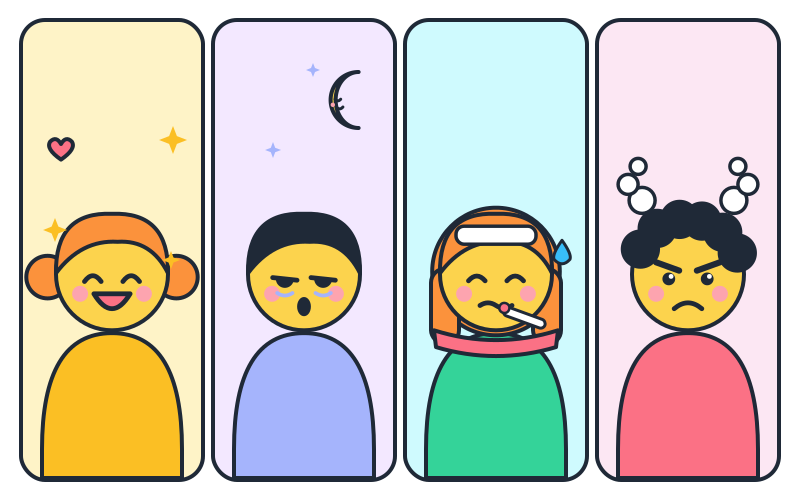
- .
- .
- .
- .
One person, so is: she is, he is.
Short forms: I'm, you're, he's
When we speak, we join the two words. The apostrophe (') shows where a letter is missing.
| Long form | Short form | Example |
|---|---|---|
| Sam. | |
| . | |
| . | |
| . | |
| . | |
| . | |
| . |
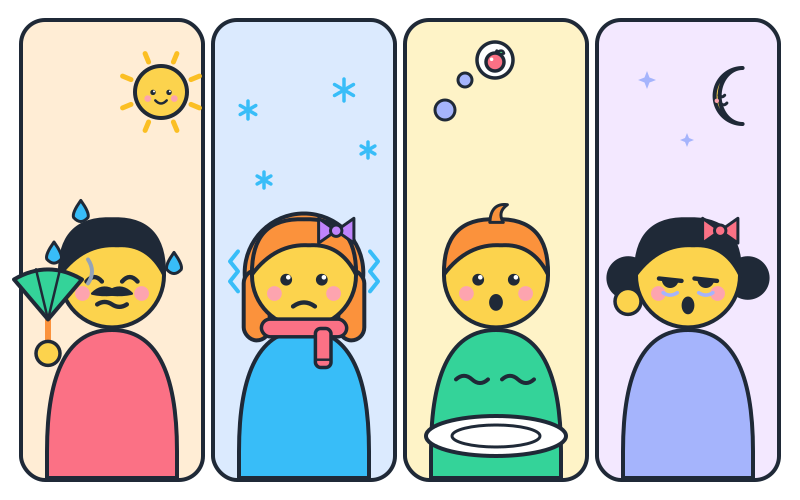
- .
- .
- .
- .
English uses be for these: he's hungry, never he has hunger.
Short forms are normal in speech, messages and emails: I'm here! (a text to a friend). Long forms are for careful writing, or to make a word strong: I am ready! (said with force: really ready).
Negatives: not
Put not after am, is or are: I am not tired. (I am fine, not tired.)
| Long form | Short form |
|---|---|
| |
or | |
or | |
or | |
or |
.(I am fine.)Tom .(Tom is in another place.).(They are out.)
Standard English has no short form amn't (you may hear it in Scotland and Ireland). Say I'm not: I'm not late.
Questions and short answers
For a question, put the verb first. The verb jumps in front of the person.
| Statement | Question |
|---|---|
. | ? |
Tom . | Tom ? |
. | ? |
Answer with yes or no and a short answer: the person and the verb, with nothing after them.
| Question | Yes | No |
|---|---|---|
? | , . | , . |
? | , . | , . |
? | , . | , . |
? | , . | , . |
With a question word, the question word goes first, then the verb: Where are you? (asking about a place) How are you? (asking how someone feels) Who is that? (asking about a person).
Going further: Five jobs for be and the rest of the guide, when you want them. This lesson does not need them.
Practice
Practise this lesson
10-question session
One question at a time, mixed across the exercises in this lesson. Miss one and it comes back round before the end.
New words in this lesson

English · Free printables
Worksheets for this lesson
Worksheets with answer keys built in. Open any one to view, print or save.
Lesson 9 of 44 in this chapter