
Ch 1 · Lesson 3French · Chapter 1 · Lesson 3 · Grammar primer
Say something today: greetings and courtesies
A dozen fixed everyday phrases - , , - so you can greet a real French speaker before you have learned any grammar.
The short version
, . , .
Why?Hide
In France you say before you ask for anything: in a shop, at a counter, to a bus driver. Skipping it and going straight to the question sounds rude, even if the rest is perfect French. After dark it becomes , and with friends does the job.
for strangers, for friends
, ?
Why?Hide
Please has two forms in French. is the one for anyone you would call : shop staff, strangers, older people, or a group. is for a friend, a child or family. When in doubt, use : nobody minds being treated politely.
You can hold your first French conversation before you have conjugated a single verb. Greetings and courtesies are fixed phrases: learn the ones below as whole things to say, the way you learned thank you as a child, and you can walk into a bakery or a this afternoon and take part.
| Situation | French | English |
|---|---|---|
| Arriving | , . | Hello (to a woman) |
| With a friend | ! | Hi! / Bye! |
| Leaving | ! | Goodbye! |
| How are you? | ? | How are you? (casual) |
| The answer | , . | I'm fine, thanks. |
| Your name | Marie. | My name is Marie. |
| Asking for | , . | A coffee, please. |
| Thanking | ! | Thank you very much! |
| The reply | . | You're welcome. |
| A real apology | . | I'm sorry. |
| Lost | . | I don't understand. |
So today, these are just things to say.
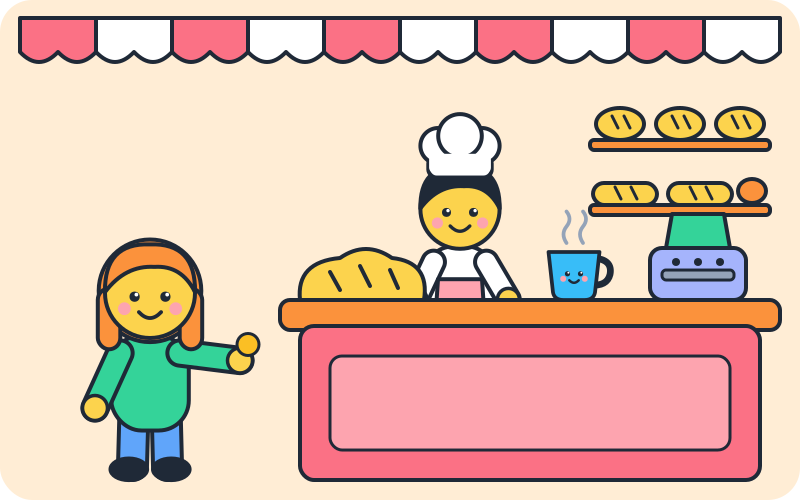
- ! , .
- , .
Walking into a French bakery: bonjour first, then what you want, with s'il vous plaît. The baker greets her back.
Greetings
Three words open and close almost every French exchange. Learn first: walking into a French shop without it is genuinely rude.
| French | English | When |
|---|---|---|
| Hello, good day | Anyone, any time until evening |
| Good evening | Arriving after dark |
| Hi, or bye | Friends, people your own age |
| Goodbye | Leaving, with anyone |
| Good night | Going to bed, never as a hello |
| See you soon | Leaving someone you will see again |
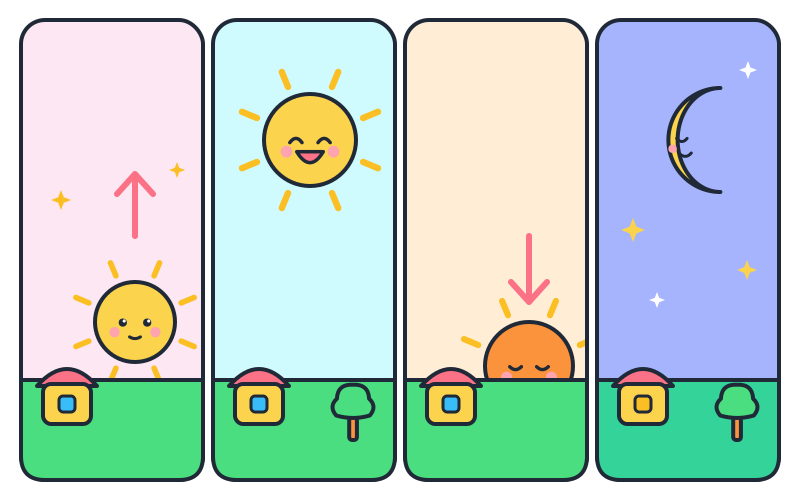
Bonjour covers the whole day; bonsoir is the hello once it gets dark; bonne nuit is only for bedtime, never a greeting.
With a stranger, add or . A bare is fine; the title makes it warmer.
, .- Hello. (to a woman), .- Good evening. (to a man), !- Hi,!
is literally until the seeing-again. as a casual bye on the way out: , ! - Bye, see you soon!
Getting by
French has two words for you: for a friend, a child or a fellow student, and for a stranger, an official or anyone you would call madame or . Several phrases come in both forms, so this page colours them.
| You ask | To a friend | To a stranger |
|---|---|---|
| How are you? | ? | ? |
| What's your name? | ? | - ? |
| Please | | |
When in doubt, use the form: nobody was ever offended by too much politeness. The full story is on French subject pronouns.
The answers barely change. Only the and you? follows the or of the question:
, .- I'm fine, thank you., . ?- Very well, thanks. And you?Marie. ?- My name's Marie. And you?
Put your own name after and you have introduced yourself. Literally it is I call myself.
- Ça va ?
- Comment ça va ?
- Comment allez-vous ?
Courtesies
These keep every exchange friendly. The trap is the apology: is the quick social sorry, and is the real one.
| French | English | Use it for |
|---|---|---|
| Thank you | Anything at all |
| Thank you very much | When you mean it |
| You're welcome | The reply to |
| Excuse me, sorry | Squeezing past, bumping, not hearing |
| Excuse me | Catching a stranger's attention |
| I'm sorry | A real apology |
| Yes / No | Everything else |
Two examples of the difference:
, .- Excuse me. (squeezing past her on the bus), .- I'm sorry, I'm late.
A woman writes , with an extra e you cannot hear: . - I'm sorry.
And the most useful sentence a beginner owns, because it keeps a conversation alive:
.- I don't understand.? .- Sorry? I don't understand.
Going further: Mistakes English speakers make and the rest of the guide, when you want them. This lesson does not need them.
Practice
Practise this lesson
10-question session
One question at a time, mixed across the exercises in this lesson. Miss one and it comes back round before the end. There are 26 in all: practise more afterwards if you want them.


French · Free printables
Worksheets for this lesson
Worksheets with answer keys built in. Open any one to view, print or save.
Lesson 3 of 14 in this chapter