
English · Chapter 8 · Lesson 22 · Themed review
Numbers and amounts
Counting, and the words for how much. Most of these arrived in the first four chapters - here they are in order at last.
Practise this lesson
18-word session
A quick mix of exercises - recognise, recall, type and build each word. Miss one and it comes back round until it sticks.
Worth knowing
hundred does not take an s after a number
This rule catches almost every learner once.
After a number, , and never take an s:
- two hundred people
- five thousand years
- three million pounds
Never two hundreds.
But when you do not give a number, you must add the s and the word of:
- people
- thousands years
- millions pounds
This means a large but unknown amount. So two hundred people is exact, and hundreds of people is a guess.
many and much
Both mean a large amount. Which one you use depends on the noun.
goes with things you can count: many books, many people, many days. goes with things you cannot count: much water, much money, much time.
In positive sentences, most people say instead. "I have a lot of work." Much sounds formal there. But in questions and negatives, much is normal: "How much does it cost?"
few and a few
These look almost the same and mean different things.
means some. It is positive. "I have a few friends here." That is good. means not many. It is negative. "I have few friends here." That is sad.
One small word changes the whole feeling of the sentence. The same is true of a little and little.
first and last
and are not numbers, but they behave like them. They take the: the first day, the last week.
Last has two meanings. can mean the week before now, or the final week of something. Only the sentence around it tells you which.
Words in this theme
 number/ˈnʌmbə/A word or symbol, like one, two, or three, that tells you how many.
 count/kaʊnt/To say numbers in order, or to find how many things there are.
 one/wʌn/The number 1, or a word that stands for a single thing already mentioned.
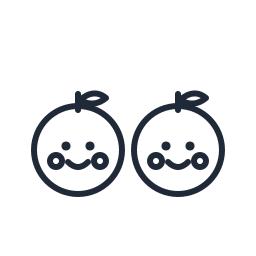 two/tuː/The number 2, one more than one.
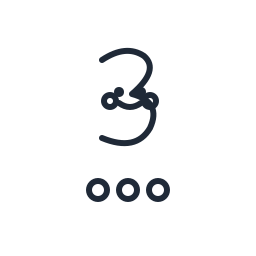 three/θriː/The number 3, one more than two.
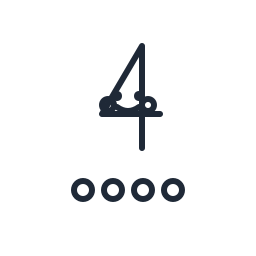 four/fɔː/The number 4, one more than three.
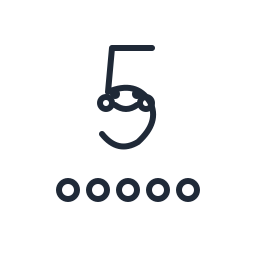 five/faɪv/The number 5, one more than four.
 six/sɪks/The number 6, one more than five.
 seven/ˈsev.ən/The number 7, one more than six.
 ten/ten/The number 10, one more than nine.
 hundred/ˈhʌn.drəd/The number 100, ten times ten.
 thousand/ˈθaʊ.zənd/The number 1000, ten hundreds.
 million/ˈmɪl.jən/The number 1,000,000, a thousand thousands.
 half/hɑːf/One of the two equal parts that make up a whole thing.
 first/fɜːst/Coming before all others in time, order, or position; number 1 in a list.
 last/lɑːst/Coming after all the others, or most recent before now.
 many/ˈmeni/A large number of things that can be counted.
 few/fjuː/A small number of things or people; not many.