
English · Chapter 9 · Lesson 22 · Themed review
How you feel
Feelings, and the things people do when they have them - laugh, cry, smile.
Practise this lesson
18-word session
A quick mix of exercises - recognise, recall, type and build each word. Miss one and it comes back round until it sticks.
Worth knowing
In English you ARE afraid, you do not HAVE fear
In Spanish you have fear. In French you have fear. In English you afraid.
- I afraid.
- I hungry.
- I tired.
- I happy.
The pattern is be plus an adjective, and English uses it for nearly every feeling and body state. If your language uses have here, this is worth practising until it feels automatic, because it is one of the most common learner mistakes.
There is one group that does use have: , , . These are nouns, not adjectives, so they need a different verb.
bored and boring
This pair is difficult and important.
-ed describes how a person feels. "I am ." -ing describes the thing that causes the feeling. "The film is ."
If you say I am boring, you are saying that other people find you dull. That is not what you meant.
The same pattern works for many words: interested and interesting, tired and tiring, worried and worrying, excited and exciting.
afraid and scared
and mean the same thing. Scared is more common in speech. Afraid is a little more formal.
Both take : "I am afraid dogs."
sorry does three jobs
can mean:
- I apologise. "Sorry, that was my fault."
- I feel sad for you. "I am sorry about your father."
- Please repeat that. "Sorry?"
The third one is very common in British English. If someone says sorry? with a rising voice, they did not hear you.
Words in this theme
 feel/fiːl/To have an emotion or a sense in your body, or to touch something to learn about it.
 happy/ˈhæp.i/Feeling glad and pleased.
 sad/sæd/Feeling unhappy, often wanting to cry.
 angry/ˈæŋ.ɡri/Feeling very cross because something is wrong or unfair.
 afraid/əˈfreɪd/Feeling that something bad or dangerous may happen; scared.
 fear/fɪə/The feeling of being afraid.
 worry/ˈwʌri/To feel unhappy and afraid because you think something bad may happen.
 calm/kɑːm/Quiet and relaxed; not angry, worried, or excited.
 love/lʌv/To like someone or something very much, deep in your heart.
 hate/heɪt/To dislike someone or something very strongly.
 hope/həʊp/To want something to happen and feel that it might.
 enjoy/ɪnˈdʒɔɪ/To get pleasure from something, or to have a good time doing it.
 glad/ɡlæd/Happy and pleased about something that has happened.
 proud/praʊd/Feeling glad and pleased about something good you or someone close has done.
 sorry/ˈsɒr.i/Feeling sad about something you did wrong or about something bad that happened.
 laugh/lɑːf/To make happy sounds with your voice when something is funny.
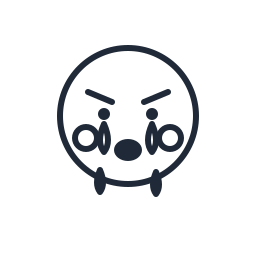 cry/kraɪ/To let water fall from your eyes when you are sad or hurt.
 smile/smaɪl/To turn up the corners of your mouth to show you are happy or friendly.