
German · Chapter 1 · Lesson 23 · Themed review
Und, aber, oder
The words that join German sentences together. They are the commonest in the language and the ones a dictionary explains worst, so they get a session of their own.
Practise this lesson
16-word session
A quick mix of exercises - recognise, recall, type and build each word. Miss one and it comes back round until it sticks.
Worth knowing
The little German words that hold sentences together
A German dictionary will tell you that means but, however, yet, still, nevertheless, after all. That is six glosses pointing in several directions at once, and it is not the dictionary's fault. does not translate. It signals.
These small words are the commonest in the language, and a learner meets them in the first week and is still slightly unsure of them years later. Worth taking properly.
The joiners
is and, and carries more traffic than any other word on this list. is or. is but, and marks a contrast you can hear coming.
and both mean because, and they are not interchangeable in the way English speakers assume. sends the verb to the end of its clause; does not touch the word order at all. A German who wants to keep a sentence simple reaches for .
The shapers
introduces a reported thought and pushes its verb to the end. covers both if and when, which means German is sometimes ambiguous where English is not, and speakers live with it.
means so that, and it is the one on this list that most often catches a learner out, because it looks like it should mean with that. Sometimes it does. Context decides.
The particles, which are the real difficulty
, , , , , . These are the modal particles, and they are what makes German sound German. They carry no dictionary meaning worth the name. What they do is tell the listener how to take the sentence: as a correction, as an expectation confirmed, as impatience, as reassurance.
in particular is untranslatable and indispensable: it is how you contradict a negative statement, which English cannot do in one word at all. If someone says you did not do it and you did, English needs a sentence. German needs .
You will not learn these from a list. You learn them by hearing them often enough that the wrong one starts to sound wrong, which is a slower and more reliable process than memorising glosses that were never accurate.
Words in this theme
 undʊntand
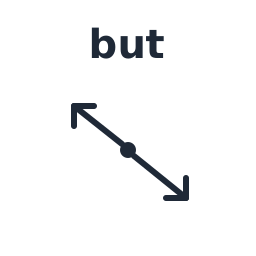 aberˈaːbɐbut; really (particle)
 oderˈoːdɐor; is it not? (tag question)
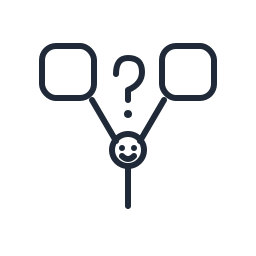 wennvɛnif; when, whenever
 dassdasthat (conjunction)
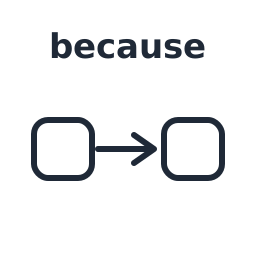 weilvaɪ̯lbecause
 denndɛnbecause, for; then (in questions)
 alsalswhen (single past event); than; as
 damitdaˈmɪtso that, in order that; with it, with that
 dochdɔxbut, however; yes I do (contradicting a negative); do (urging particle)
 nochnɔxstill; yet; another
 nurnuːɐ̯only, just
 schonʃoːnalready; yet; all right (reassuring)
 auchaʊ̯xalso, too, as well; even
 jajaːyes; indeed, you know (particle)
 neinnaɪ̯nno