
Spanish Noun Gender: The -o/-a Rule and Its Exceptions
By Michael McGettrick and Sergio Linares-HernandesUpdated 11 October 2026
Every Spanish noun is masculine or feminine, and the ending gives it away far more often than learners fear: (the book) is masculine, (the house) feminine. One rule, a few endings and one short exception list cover almost everything a beginner meets.
| Ending | Gender | Example | English |
|---|---|---|---|
| -o | masculine | | the book |
| -a | feminine | | the house |
| -ción, -sión | feminine | | the song |
| -dad, -tad, -tud | feminine | | the truth |
| -ma (Greek) | masculine | | the problem |
| exceptions | learn them | , | day, hand |
Quick check
Now use it: three quick questions on the chart above. The full practice is further down.
Spot the mistake
0/3Each phrase has one gender mistake. Tap it.
What gender actually is
Gender is a filing system for words, not a description of things. A house is not feminine in any real sense; the word is filed as feminine, and the article shows the file.
There is no logic to find for objects, which is good news: nothing needs understanding, only storing. Store each noun with its article welded on, rather than , and the gender comes free every time you use the word.
The baseline rule: -o masculine, -a feminine
Nouns ending in -o are masculine and nouns ending in -a are feminine, well over nine times in ten, and more often still among common words.
| Spanish | English | Gender |
|---|---|---|
| the year | masculine |
| the time | masculine |
| the thing | feminine |
| life | feminine |
When you meet a new noun in -o or -a and nobody says otherwise, bet on the rule:
.- It's a good year..- It's a good thing.
Nouns ending in -e or another consonant give no clue: (the car) but (the night). Learn those with the article.
The near-certain feminine endings
Four ending families are feminine with almost no exceptions.
| Ending | Spanish | English |
|---|---|---|
| -ción, -sión | | television |
| -dad, -tad | | the city |
| -tud | | attitude |
| -umbre | | custom |
They matter because English -tion and -ty words map onto them again and again:
The Greek -ma group: masculine despite the -a
A group of nouns in -ma came into Spanish from Greek, and they are masculine. They include some of the most common nouns in the language.
| Spanish | English |
|---|---|
| problem |
| topic |
| system |
| language |
| programme |
The adjective follows the masculine article:
.- It's a big problem.
Not every noun in -ma is Greek. Everyday words follow the normal rule: (the bed) is feminine. Abstract or technical -ma words are the ones to suspect.
The famous exceptions
The genuinely irregular cases fit in one table. Learn it early and the rules become safe everywhere else.
| Spanish | English | Why it surprises |
|---|---|---|
| the day | -a, but masculine |
| the hand | -o, but feminine |
| the photo | short for |
| the motorbike | short for |
| the map | -a, but masculine |
| the planet | -a, but masculine |
| the sofa | -a, but masculine |
| the radio | short for radiodifusión |
 the day
 the hand
 the map
 the motorbike
 the sofa
 the photo
The short words keep the gender of the long word they were cut from. In much of Latin America the radio set is .
is the one that matters most, because you say it from day one. The adjective in the greeting is masculine to match:
Feminine nouns that take el
(the water) looks masculine and is not. A feminine noun that starts with a stressed a- sound takes in the singular, but its adjective stays feminine:
That small group has its own page: el agua and the feminine nouns that take el.
Why gender matters: the agreement cascade
Gender does not stay inside the noun. It decides the article, every adjective and the pronoun that replaces the noun.
| What agrees | Masculine | Feminine |
|---|---|---|
| the | | |
| a | | |
| adjective | | |
| pronoun | (the dog) | (the house) |
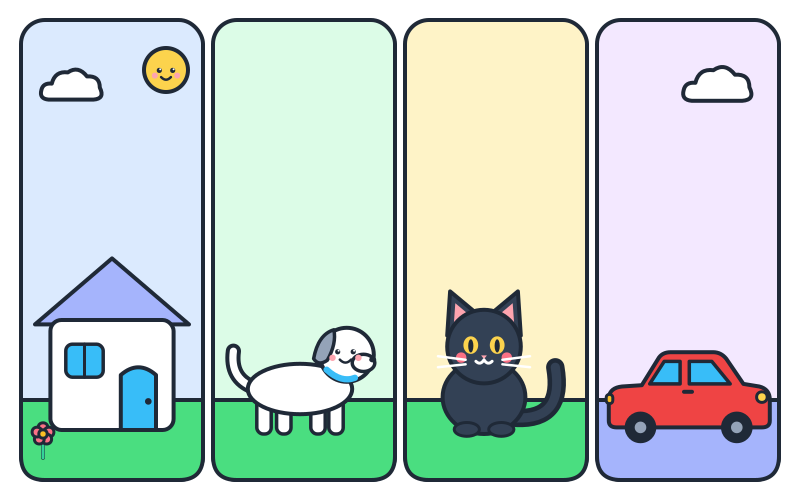
The house and the dog are the same white, but casa is feminine and perro masculine, so the colour ends in -a for one and -o for the other.
One decision, four places it shows up, all in one sentence:
. .- The dog is white. I can see it.. .- The house is white. I can see it.
That is why a gender slip is so : in , two of three words are wrong. The adjective agreement page has the full set of adjective endings.
Nouns for people
For people, the word usually follows the person. There are three patterns.
| Pattern | Masculine | Feminine |
|---|---|---|
| -o becomes -a | (son) | (daughter) |
| -or adds -a | (Mr) | (Mrs) |
| one form, -ista, -e | | |
.- My sister is a student..- The (male) artist and the (female) artist.
A few nouns keep one gender whoever they describe. is always feminine, so a man can be one, adjectives and all:
Juan .- Juan is a good person.
Mistakes English speakers make
| Wrong | Right | Why |
|---|---|---|
| is masculine | |
| is feminine | |
| Greek -ma nouns are masculine | |
| the article and adjective both agree | |
| is feminine despite | |
| is always feminine |
What to do next
- Learn every new noun with its article:
- Copy the exceptions table onto a card.
- Then noun plurals:
See also
- Spanish articles:
,,,and when to use them. - El agua: feminine nouns that take
. - Adjective agreement: the endings gender feeds into.