
Spanish Reported Questions and Commands: me preguntó si
By Michael McGettrick and Sergio Linares-HernandesUpdated 12 October 2026
Report a yes/no question with , an open question with its question word, and a command with plus the imperfect subjunctive:
Quick check
Three quick questions on what you have just read. The full practice is further down.
Spot the mistake
0/3Each sentence has one mistake. Tap it.
.- He/She asked me if I was hungry..- He/She asked me where I lived..- He/She told me to come.
Reported questions and commands on one screen
| Direct | Reported | English |
|---|---|---|
¿ ? | . | ... asked if I was hungry. |
¿ ? | . | ... asked where the train was. |
¡! | . | ... told me to come. |
. | . | ... told me not to go out. |
After a past reporting verb the tenses step back, as in reported speech: becomes , becomes . The question marks go, because the sentence now states what was asked.
Reported yes/no questions: si
A question you can answer with yes or no is reported with :
| Direct | Reported | English |
|---|---|---|
¿ ? | . | ... asked if I wanted coffee. |
¿ ? | . | ... asked if I had finished. |
¿ ? | . | ... asked if I'd come tomorrow. |
The tense steps back only after a past reporting verb. After a present one, it stays:
.- He/She is asking me if I want coffee.
This si means whether
This is not the of if-sentences. It means whether, so it can take the future or the conditional, which the if- does not take in standard Spanish:
.- I don't know whether he/she will come., .- If you come, I'll help you.
Reported open questions: keep the question word
An open question keeps its question word, and the word keeps its written accent:

Me preguntó... - he/she asked me who he was, where it was, when it started, how much it cost.
| Direct | Reported | English |
|---|---|---|
¿ ? | . | ... asked what I wanted. |
¿ ? | . | ... asked when it started. |
¿ ? | . | ... asked why I was crying. |
¿ ? | . | ... asked how much it cost. |
The accent marks a question, with or without question marks. Where there is no question, there is no accent:
.- He/She asked me where I worked..- I live where I work.
In speech you will often hear before the question word: . That is correct Spanish and commonest in speech; careful writing usually leaves the out.
The verb comes straight after the question word
English moves the subject forward: "where the train was". Spanish normally keeps the order of the direct question, with the verb straight after the question word:
.- He/She asked me where the train was..- He/She asked me when the film started.
is the loose one: the subject may come before the verb, as in Ana . (He/She asked me why Ana didn't come.)
Reported commands: que + imperfect subjunctive
A command cannot be reported in the imperative. Spanish turns it into plus the imperfect subjunctive:
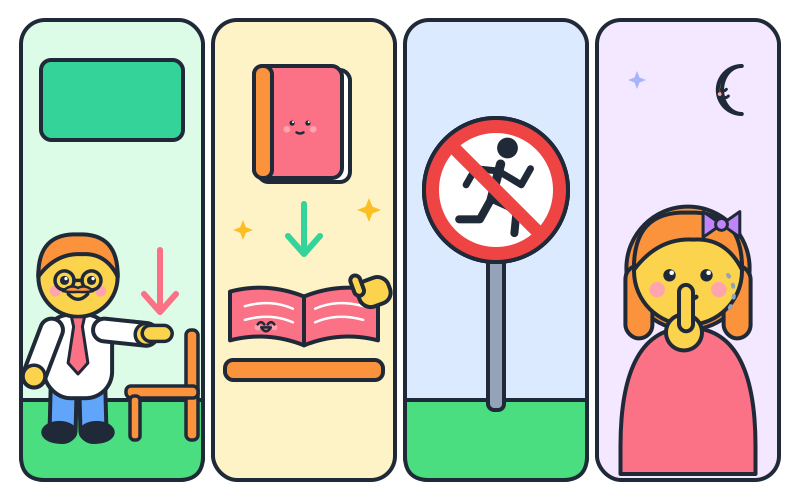
Me dijo... - he/she told me to sit down, to open the book, not to run, to be quiet.
| Direct | Reported | English |
|---|---|---|
¡! | . | ... told me to come. |
¡! | . | ... told me to sit down. |
. | . | ... asked me to shut the door. |
. | . | ... told me not to go out. |
. | . | ... told me not to worry. |
The no stays, and the pronoun follows the person: (you) becomes me when I report it about myself.
After a present reporting verb, the subjunctive stays present:
.- He/She tells me to come..- He/She told me to come.
Asked, told, ordered: the reporting verb
The reporting verb says how strongly it was put:
- me pidió que (asked)
- me dijo que (told)
- me ordenó que (ordered)
| Verb | Example | English |
|---|---|---|
| . | He/She asked me to wait. |
| . | He/She told me to wait. |
| . | He/She ordered me to wait. |
only reports questions. A request is , never .
Dijo que: said, or told to?
reports statements and commands alike. The mood shows which:
.- He/She said he/she was coming. (a statement: indicative).- He/She told me to come. (a command: subjunctive)
Mistakes English speakers make
The wrong column shows only the part that goes wrong:
| Wrong | Right | Why |
|---|---|---|
. | a yes/no question takes | |
. | the question word keeps its accent | |
. | the verb comes first | |
. | no imperative in a report | |
. | a request is |
After a past verb you will also hear . when the order still stands. . is always right.
What to do next
- Report three questions someone asked you today, one with .
- Do the sort and story drills below.
- Then the passive with ser.