
The imperative in English: sit down, don't touch, let's go
By Michael McGettrickUpdated 11 October 2026
The imperative tells someone what to do. It is the easiest form in English: just the base verb, with no you and no ending. Sit down. (I want you to sit.)
| What you want | Pattern | Example |
|---|---|---|
| verb | . | |
| + verb | ! | |
. | ||
| + verb | . |
Quick check
Now use it: three quick questions on the chart above. The full practice is further down.
Pick the right one
0/3Pick the right negative.
Touch the cat.
Be sad.
Go out.
The base verb, nothing else
Start the sentence with the base verb. That is all.
| Base verb | Imperative | What it says |
|---|---|---|
. | ||
. | ||
. | ||
. | ||
! | ||
. |
- .
- .
- .
- .
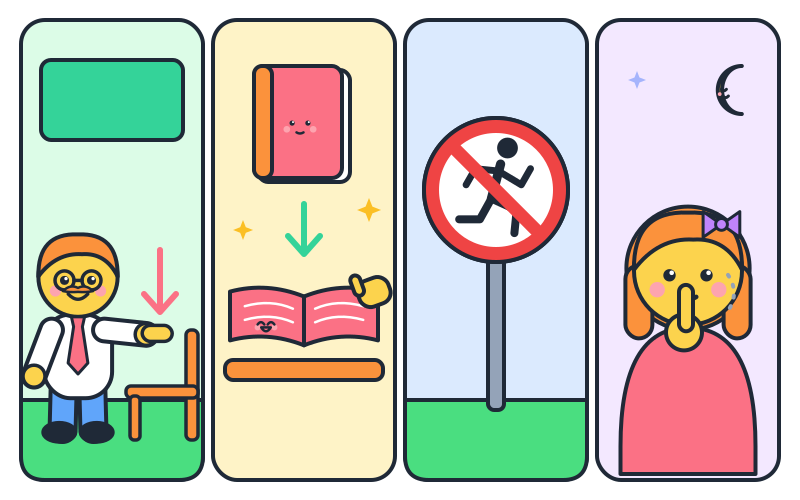
Classroom orders: the base verb, nothing else. For not, put don't first.
The form is the same for one person or many:
, Tom.(one person), .(the whole room)
There is no -s, no -ing and no to:
A name can go at the start or the end: Tom, come here. Come here, Tom. (the same command, said to Tom).
Don't for a negative
To tell someone not to do something, put don't before the base verb.
| Positive | Negative |
|---|---|
. | . |
. | . |
. | . |
. | . |
It is always don't, for everyone:
, Tom!(not Doesn't run).(not Not be late)
On signs you often see the long form: Do not enter. (you cannot go in). Never makes a strong rule: Never open this door. (not one time, ever).
Please makes it polite
A bare imperative can sound strong, like an order. Please makes it softer. It can go at the start or the end:
.(polite), .(also polite)
- Wait.
- Please wait.
- Could you wait, please?
How you say it matters too. Sit down with a smile is friendly. Sit down! in a loud voice is an order.
| Strong | Softer |
|---|---|
. | , ? |
. | , ? |
With friends and family, a short imperative is normal: Pass the salt. (at dinner, no problem). With people you do not know, add please or ask with Could you...?
Let's: an idea for you and me
Let's is short for let us. It means "I have an idea for us": you and the speaker together.
| Let's + base verb | What it says |
|---|---|
. | . ? |
. | |
Ana. | Ana |
For a negative, say let's not:
.(we do not wait).(we stay at home)
Don't let's also exists in informal British English, but it is rare and a little old-fashioned. A short answer to Let's go! is Yes, let's! or Okay!
Where you hear it: instructions, signs and directions
The imperative is short and clear, so it is perfect for instructions.
| Place | Example |
|---|---|
| recipe | Cut the onion. Add the salt. |
| Push. Pull. Keep left. | |
| Turn left. Go straight on. | |
| Open your books. Listen. | |
| app | Click here. Enter your name. |
These are not rude. A recipe or a sign is not an order from a person, so it usually has no please: Push. (on a door: push it to open).
Common mistakes
| Wrong | Right | Why |
|---|---|---|
| Not touch! | Don't touch! | . |
| Don't to go. | Don't go. | . |
| Doesn't run! | Don't run! | . |
| Let's to go. | Let's go. | . |
| Sits down. | Sit down. | -s. |
| You sit down. | Sit down, please. | . |
The last one needs care. You sit down is possible English, and kind in an offer: You sit down, I'll make the tea. But as a bare order it can sound angry, like You, sit down now! Leave out you and add please.
What to do next
- Give three orders to an imaginary class: Sit down. Open your books. Don't talk.
- Do the drills below. Next: the present simple, where the base verb gets its -s (she sits).