
(zhǎi) - narrow in Mandarin
zhǎiTraditional: 窄
Translation
narrow
Stroke order

窄
Examples
。
This road is very narrow.
。
The room's door is a little narrow.
陡。
The staircase is narrow and steep.
袖。
This shirt's sleeves are too narrow.
,。
The lane is too narrow for the car to get through.
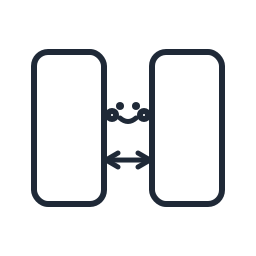
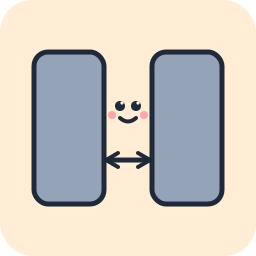
窄 (zhǎi) means "narrow", describing anything short on width: a road, a doorway, a pair of sleeves, a gap between two buildings. It sits as an ordinary stative adjective in Mandarin, needing no separate verb "to be": 这条路很窄 (zhè tiáo lù hěn zhǎi), "this road is very narrow", with 很 (hěn) doing duty as a mild intensifier rather than "very" in the English sense.
Its natural opposite is 宽 (kuān, "wide, broad"), and the pair 宽窄 (kuān zhǎi) together can mean "width" as an abstract noun, the same trick English uses when it turns "wide" and "narrow" into a single measurable quality.
Be careful not to reach for 窄 (zhǎi) when you mean cramped or tight in a general sense - 挤 (jǐ, "crowded, squeezed") is the better word for a packed room or a crowded bus. 窄 (zhǎi) is specifically about width, not lack of space overall.
Where this fits
Used in
Grammar articles
(1)Add to review queue
Track this word in your spaced-repetition queue and be tested on it at the right interval.
Go to my review queueMandarin · Free printables
窄: worksheet, infographic and listicle
Free printable study downloads for the Mandarin word "窄" (narrow): a worksheet with the answer key built in, an infographic, and a sentence listicle. Open any one to view, print or save.
Free for members
The printable worksheets, infographics and PDFs are free with an account. Start a free week and download as many as you like.
Start your free weekThis word is part of lesson 109.