
Этот and Тот: This and That in Russian, Plus Это
By Michael McGettrickUpdated 11 October 2026
means this and means that, and both agree with their noun like an adjective. Then there is , which means this is or that is and never changes. Most beginner mistakes in this corner of Russian come from mixing those two jobs up.
Quick check
Three quick questions on what you have just read. The full practice is further down.
Spot the mistake
0/3Tap the mistake.
The whole system on one screen
The endings are coloured by gender, the same colours as Russian noun gender:
| this | that | |
|---|---|---|
| masculine | | |
| feminine | | |
| neuter | | |
| plural | | |
| this is | | - |
The first four rows sit in front of a noun and agree with it. The last row is a different word that happens to look like the neuter:
).- This is a book. (never changes)
Этот, эта, это, эти: this
Pick the form by the noun's gender, exactly as with , , , :
| Russian | English | Why |
|---|---|---|
| this house | is masculine |
| this brother | a man is masculine |
| this book | is feminine |
| this cat | is feminine |
| this window | is neuter |
| this word | is neuter |
| these books | any plural |
| these friends | any plural |
goes by the noun's grammar, not its ending. ends in -а but names a man:
Like any adjective, also changes with the case of its noun. You will meet the prepositional very early; recognise it for now:
.- We live in this house.
Тот, та, то, те: that
works in exactly the same way, with shorter forms:
The two often appear side by side, and that pairing is where feels most natural. Here this is coloured as one side of the contrast and that as the other:
, .- This house is new and that one is old., .- Not this cat, that one.
The noun drops out once it is clear: is and that one. English needs the word one; Russian does not.
has one everyday job that English does with a different word altogether. means the wrong one:
.- This is the wrong house..- That is not the right word.
Это: this is, that is, these are
On its own at the start of a sentence, is a pointing word. It means this is, that is, it is, these are or those are, and it never agrees with anything:
| Russian | English |
|---|---|
. | This is my brother. |
. | This is my sister. |
. | That is my letter. |
. | These are my friends. |
? | What is this? What is that? |
? | Who is that? |
Russian has no verb to be in the present, so carries the whole of this is on its own. The two patterns below differ by two letters and split the sentence in different places:
This is my brother. This brother is mine.
.- This is my brother. (introducing him).- This brother is mine. (as opposed to another one)
The second is rarer. When you are introducing someone or naming a thing, you almost always want the invariable .
Этот or тот: near and far
English splits this and that by distance. Russian does not, or not as strictly. covers a lot of what English calls that:
.- That film was good. (the one we saw last night)?- What's that? (about something on a distant hill)
is mostly kept for three jobs:
| Job | Example | English |
|---|---|---|
| contrast | , . | This one's mine, that one's yours. |
| the wrong one | . | This is the wrong house. |
| mentioned before | . | That man was here. |
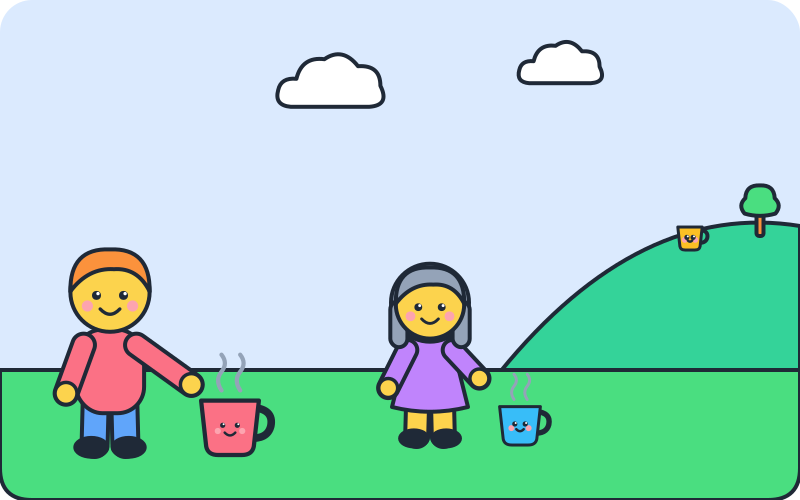
Эта чашка моя, а та твоя: this cup is mine, and that one is yours. Тот is for the contrast, so the cup far away on the hill is та чашка too.
So the rule of thumb runs the other way from English. Start with , and reach for when you are setting two things against each other, or picking out the one you meant from the one you got.
Mistakes English speakers make
| Wrong | Right | Why |
|---|---|---|
. | . | introducing: the invariable |
| | is feminine |
| | is neuter |
| | the noun goes plural too |
? | ? | this and that are both here |
. | . | never changes; the noun does |
What to do next
- Point at five things around you and say what they are:
- Then describe them with
: - Do the drill below, then see мой, твой, наш, which agree the same way.