
Russian Impersonal Sentences: мне холодно, мне надо, мне нравится
By Michael McGettrickUpdated 12 October 2026
Russian does not say I am cold. It says , to me it is cold: the person goes in the dative, and there is no I am at all. The same frame says I need, I may, I'm twenty and I like. Learn it once and a whole family of everyday sentences opens up.
Quick check
Three quick questions on what you have just read. The full practice is further down.
Pick the right one
0/3Which form of I fills the gap?
холодно. (I'm cold.)
люблю кофе. (I love coffee.)
двадцать лет. (I'm twenty.)
The whole system on one screen
Colour marks the dative:
| Russian | English | What it says |
|---|---|---|
. | I'm cold. | how you feel |
. | I have to go. | need |
. | You're not allowed. | permission |
. | I need help. | needing a thing |
. | I'm twenty. | age |
. | I like tea. | liking |
One pattern: the person in the dative, then what is happening to them. Swap for or , and it is happening to someone else. The pronouns are on the dative case page.
Мне холодно: how you feel
Colour marks the dative:
A word in -о describes the state, and the person it happens to goes in the dative. In the present there is no verb:
| Russian | English |
|---|---|
. | I'm cold. |
. | I'm hot. |
. | I'm bored. |
. | I'm scared. |
. | He finds it hard. |
. | It hurts her. |
. | I'm interested. |
? | Are you feeling unwell? |
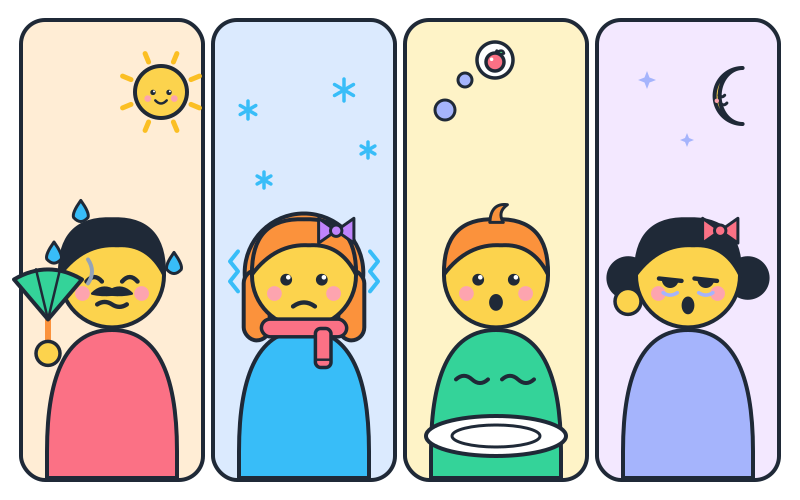
- .
- .
- .
Ему жарко, he's hot. Ей холодно, she's cold. Ей хочется спать, she's sleepy (she feels like sleeping).
Swap the pronoun to change who is cold; swap the -о word to change what is happening.
Было, будет: the past and the future
Colour marks the dative; the box marks the verb:
The past adds and the future . Neither agrees with the person, because the person is not the subject:
| Tense | Russian | English |
|---|---|---|
| present | . | I'm cold. |
| past | . | I was cold. |
| future | . | I'll be cold. |
.- She was bored..- We found it interesting.
A man and a woman both say . There is no / choice to make.
Мне надо, мне можно, мне нельзя: need and permission
Colour marks the dative:
Four words say what someone has to, may or must not do, with a verb after them:
| Word | Example | English |
|---|---|---|
| . | I have to go. |
| . | I have to work. |
| ? | May I? |
| . | You're not allowed. |
and mean the same with a verb. on its own is the everyday way to ask permission: ?, may I?, as you reach for the last biscuit.
Мне нужен врач: needing a thing
Colour marks the dative and the agreement ending:
With a noun, need is , which agrees with the thing needed, not with the person:
| Thing | Example | English |
|---|---|---|
| masculine | . | I need a doctor. |
| feminine | . | I need help. |
| neuter | . | I need time. |
| plural | . | I need money. |
is feminine, so ; is always plural, so . The thing is the subject here, in the nominative.
Мне двадцать лет: your age
Colour marks the dative:
Your age is also something that happens to you: to me twenty years.
.- I'm twenty.?- How old are you?.- He's five.

- .
Ему пять лет: he's five. Count the candles.
The word for years follows the last digit of the number, the Russian numbers rule:
| Number ends in | Years | Example |
|---|---|---|
| 1 (not 11) | | . |
| 2-4 (not 12-14) | | . |
| 5-9, 0, 11-14 | | . |
Мне нравится: liking, turned inside out
Colour marks the dative; the plural ending is marked:
means to be pleasing. The thing you like is the subject, and you, the person pleased, are in the dative:
.- I like music. (music is pleasing to me)?- Do you like the book?.- I like books.
The verb goes plural because the books are the subject. English speakers want it to agree with I, and it never does.
also means to like or love, and it works the English way round, with the thing in the accusative: . is the milder word, and the usual one for a particular thing or a first impression ( ); is stronger: what you love in general ( ) and the people you love.
Mistakes English speakers make
| Wrong | Right | Why |
|---|---|---|
. | . | the person who feels: dative |
. | . | age takes the dative |
. | . | the verb agrees with the books |
. | . | no subject: neuter |
. | . | is feminine |
What to do next
- Say
- Say how old everyone in your family is.
- Do the drill below.