
English · Chapter 7 · Lesson 22 · Themed review
The body
Parts of the body, and the words for when something is wrong with one.
Practise this lesson
19-word session
A quick mix of exercises - recognise, recall, type and build each word. Miss one and it comes back round until it sticks.
Worth knowing
English says my head, not the head
In English you say , not the head hurts.
This is different from Spanish, French, Italian and many other languages. Those languages use the, because it is already clear whose head it is. English does not do this. English wants to know whose body part it is, every time.
- I washed hands.
- He broke arm.
- She closed eyes.
If you say I washed the hands, people will understand you, but it sounds wrong.
Two words that change strangely
- one foot, two
- one tooth, two
These are the same old pattern you saw with man and men. The sound inside the word changes.
hair is usually one thing
on your head is not counted in English. You say my hair is long, never my hairs are long.
You can count single hairs, but only when you mean one at a time: "There is a hair in my soup."
This is called an uncountable noun. Water, bread and money work the same way.
hurt, pain and sick
is a verb. "My leg hurts." is a noun. "I have a pain in my leg." and are adjectives. "I am sick."
In British English, sick often means you want to vomit. Ill is the safer word for a general illness. In American English, sick means ill and nothing more.
tired
means you need to sleep. Sleepy is close but softer. They are not the same as bored, which means nothing interesting is happening.
Words in this theme
 body/ˈbɒdi/The whole physical part of a person or animal.
 head/hed/The part of your body above your neck, with your eyes, ears, mouth, and brain.
 face/feɪs/The front part of your head, with your eyes, nose, and mouth.
 eye/aɪ/One of the two parts of your face that you use to see.
 mouth/maʊθ/The part of your face that you use to eat and to speak.
 hair/heə/The soft threads that grow on your head and on your body.
 hand/hænd/The part of your body at the end of your arm, with fingers and a thumb.
 arm/ɑːm/The long part of your body between your shoulder and your hand.
 leg/leɡ/One of the two long parts of your body that you use to stand and walk.
 foot/fʊt/The part of your body at the end of your leg that you stand on.
 heart/hɑːt/The part inside your body that pushes blood around and keeps you alive.
 blood/blʌd/The red liquid that moves round inside the body of a person or animal.
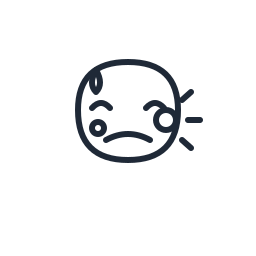 pain/peɪn/The bad feeling in your body when you are hurt or ill.
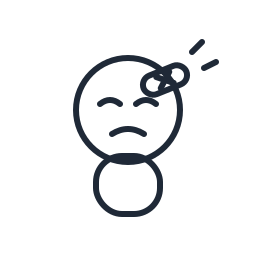 hurt/hɜːt/To cause pain to someone, or to feel pain.
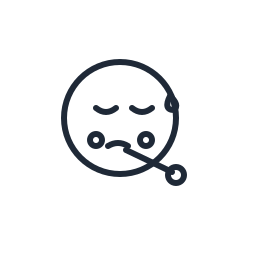 sick/sɪk/Not well in your body.
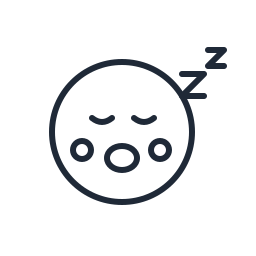 tired/ˈtaɪəd/Needing to rest or sleep because you have used a lot of energy.
 sleep/sliːp/To rest with your eyes closed and your mind not awake, the way you do at night.
 doctor/ˈdɒktə/A person whose job is to help sick people get well.
 hospital/ˈhɒspɪtl/A building where doctors and nurses look after people who are ill or hurt.