

Meaning
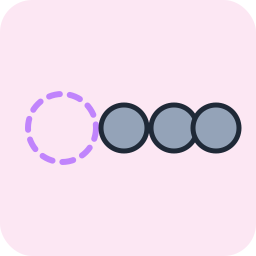
Not one and not any of a group of people or things.
Test yourself on none
Three quick questions. No account needed.
Know this word? Create a free account to track it.
Word origin
From Old English nan, a joining of ne (not) and an (one).
- Origin
- Old English
- Root
- nan
- English cognates
- no, nothing
Examples
, .
"None" means not one of them.
.
We say "none of" before a group of people or things.
, .
"None" is the opposite of "all".
Where this fits
Used in
Stories
(1)Grammar articles
(7)Advanced English articles: zero article and the with places
Both, either and neither in English: rules and examples
Discourse Markers in English: well, anyway, actually
Phrasal-prepositional verbs in English: 16 with examples
Phrasal verbs with look in English: 12 meanings, examples
Phrasal Verbs in English: Meaning, Rules and Examples
Quantifiers in English: some, any, much, many, few, little
Add to review queue
Track this word in your spaced-repetition queue and be tested on it at the right interval.
Meet this word in a story
Every course has graded stories written only with words you have been taught, plus grammar drills, a games arcade and printable worksheets. Chapters 1 and 2 are free.
Chapters 1 and 2 free, forever. Plus: 7 days free, then $5 a month for all eleven languages.
English · Free printables
none: worksheet, infographic and listicle
Free printable study downloads for the English word "none" (Not one and not any of a group of people or things.): a worksheet with the answer key built in, an infographic, and a sentence listicle. Open any one to view, print or save.
Free for members
The printable worksheets, infographics and PDFs are free with an account. Start a free week and download as many as you like.
Start your free weekThis word is taught in chapter 7, lesson 7: none, prove, wedding and 7 more words.