
一…就 (yī…jiù) in Mandarin: As Soon As and Whenever
By Michael McGettrickUpdated 12 October 2026
(yī)… (jiù) glues two events together with no gap. Put (yī) before the first action and (jiù) before the second: as soon as one happens, the other follows. Without a (le) at the end, the same frame states a habit: whenever the first happens, so does the second.
Quick check
Three quick questions on what you have just read. The full practice is further down.
Pick the right one
0/3Tap the sentence with every part in the right place.
As soon as I get home, I eat.
The moment he comes, we leave.
She laughed as soon as she heard it.
The whole pattern on one screen
The colours stay the same all page long:
| Reading | Hanzi | Pinyin | English |
|---|---|---|---|
| One event | 。 | Tā yì huí jiā jiù shuì le | He went to sleep as soon as he got home |
| A habit | 。 | Wǒ yí lèi jiù xiǎng huí jiā | Whenever I'm tired, I want to go home |
| Two people | ,。 | Tā yì lái, wǒmen jiù zǒu | The moment he comes, we leave |
The pattern: 一 (yī) + action, 就 (jiù) + result
Each word sits right before its own verb, after its own subject:
| Hanzi | Pinyin | English |
|---|---|---|
。 | Wǒ yì huí jiā jiù chī fàn. | As soon as I get home, I eat |
,。 | Tā yì lái, wǒmen jiù zǒu. | The moment he comes, we leave |
。 | Tā yì tīng jiù xiào le. | She laughed as soon as she heard it |
Three rules hold it together:
- The subject comes before (yī):
, never. - A different second subject comes before (jiù):
(wǒmen jiù zǒu), never. - Keep (jiù).
is broken. "As soon as" needs both halves.
(yī) changes tone as it does everywhere: yí before a fourth tone, yì before any other.
| Hanzi | Pinyin | Why |
|---|---|---|
| yí kàn | (kàn) is 4th tone | |
| yì tīng | (tīng) is 1st tone | |
| yì huí jiā | (huí) is 2nd tone | |
| yì zǒu | (zǒu) is 3rd tone |
As soon as: one event straight after another
For one event that has happened, (le) goes at the very end, in the (jiù) half, not after the first verb:
| Hanzi | Pinyin | English |
|---|---|---|
。 | Tā yì huí jiā jiù shuì le. | He went to sleep as soon as he got home |
。 | Wǒ yí kàn jiù míngbai le. | I understood at a glance |
。 | Tā yí dào Zhōngguó jiù gěi wǒ dǎ diànhuà le. | He rang me the moment he got to China |
。 | Míngtiān wǒ yí dào jiù gěi nǐ dǎ diànhuà. | Tomorrow I'll ring you the moment I arrive |
The last row is one event in the future: no (le), because nothing has happened yet. The time word (míngtiān) tells you it is a single event, not a habit.
Whenever: habits and reactions
Leave the (le) off and the same frame states a rule: every time the first thing happens, the second follows.
| Hanzi | Pinyin | English |
|---|---|---|
。 | Wǒ yí lèi jiù xiǎng huí jiā. | Whenever I'm tired, I want to go home |
,。 | Háizi yì kū, māma jiù lái. | Whenever the child cries, Mum comes |
。 | Tā yì hē jiǔ jiù liǎn hóng. | Whenever he drinks, his face goes red |
。 | Tā yì yǒu shíjiān jiù kàn shū. | Whenever he has time, he reads |
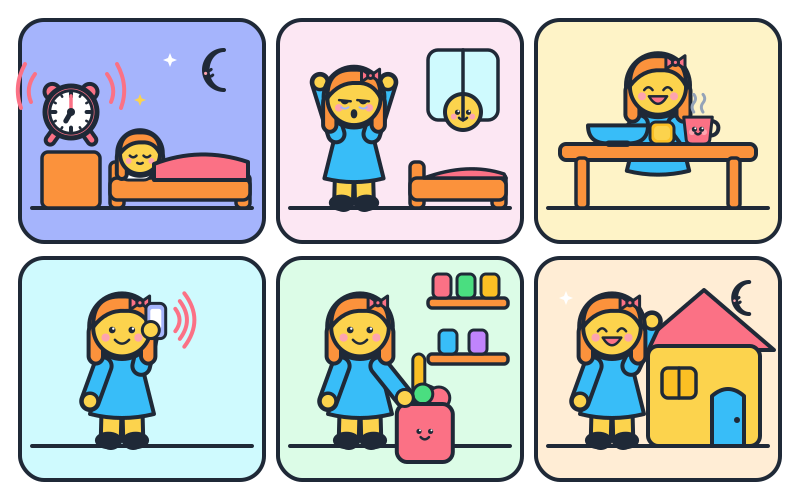
她一起床就吃早饭 tā yì qǐchuáng jiù chī zǎofàn: as soon as she gets up, she has breakfast (every day).
So (le) is the switch between the two readings:
| Signal | Reading | Example |
|---|---|---|
| (le) at the end | one event, past | |
| no (le) | a habit | |
| time word, no (le) | one event, future | |
Not the same as 以后 (yǐhòu)
(yǐhòu) means "after", with any gap. It also sits in a different place: after the whole first clause, not before its verb.
| Hanzi | Pinyin | English |
|---|---|---|
。 | Tā dào Zhōngguó yǐhòu gěi wǒ dǎ le diànhuà. | He rang me after he got to China |
。 | Tā yí dào Zhōngguó jiù gěi wǒ dǎ diànhuà le. | He rang me the moment he got there |
The first could mean a week later. The second means the plane had barely landed. If the speed is the point, … (yī… jiù) is the one that says it.
Mistakes English speakers make
| Wrong | Right | Why |
|---|---|---|
。 | 。 | the subject comes before (yī) |
,。 | ,。 | the second subject comes before (jiù) |
。 | 。 | keep (jiù) |
。 | 。 | (le) goes at the very end |
。 | 。 | pick (yī)… (jiù) or (yǐhòu), not both |
Most of these come from translating "as soon as" as one word at the front. Mandarin splits it in two, and each half sits right before its own verb.
… (yī… jiù) is on the AQA GCSE Chinese specification at Higher tier.
What to do next
- Do the drill below, saying each
(yī) with its right tone. - Say three things you do the moment you get home:
… (wǒ yì huí jiā jiù…). - Turn one into a past event by adding
(le) at the end.