
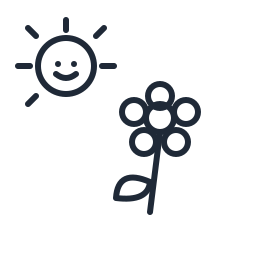
(chūn tiān) - spring in Mandarin
chūntiānTraditional: 春天

Translation
spring
Stroke order

春

天
Examples
,。
Spring has arrived, and the flowers have all bloomed.
。
I like spring weather the best.
?
Is spring the shortest season of the year?
。
Spring here is both warm and rainy.
燕。
The swallows fly back every spring.
春天 (chūn tiān) means spring, the first of the four seasons in the Mandarin calendar. It combines 春 (chūn, "spring") with 天 (tiān), which by itself means "day" or "sky" but here functions as a season suffix, matching the pattern of 夏天 (xià tiān, "summer"), 秋天 (qiū tiān, "autumn") and 冬天 (dōng tiān, "winter").
In everyday speech 春天 (chūn tiān) carries the same associations it does in English: new growth, warmer weather, and the start of the farming year. It is also the setting for 春节 (chūn jié), "Spring Festival", the formal name for Chinese New Year, even though the festival itself usually falls in what English speakers would still call winter.
The bare character 春 (chūn) turns up alone in plenty of compounds worth knowing, such as 青春 (qīng chūn, "youth") and 春节 (chūn jié, "Spring Festival, Chinese New Year").
Where this fits
Used in
Grammar articles
(1)Add to review queue
Track this word in your spaced-repetition queue and be tested on it at the right interval.
Go to my review queueMandarin · Free printables
春天: worksheet, infographic and listicle
Free printable study downloads for the Mandarin word "春天" (spring): a worksheet with the answer key built in, an infographic, and a sentence listicle. Open any one to view, print or save.
Free for members
The printable worksheets, infographics and PDFs are free with an account. Start a free week and download as many as you like.
Start your free weekThis word is part of lesson 62.