
(shòu) - thin, skinny in Mandarin
shòuTraditional: 瘦
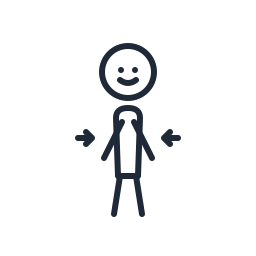

Translation
thin, skinny
Stroke order

瘦
Examples
。
He has got a lot thinner recently.
,。
The doctor said he's too thin and should eat more.
,。
These trousers are a bit tight, I can't get them on.
。
She's noticeably thinner than before.
。
That cat is thin and small.
瘦 (shòu) means "thin, skinny", the ordinary word for a person or animal with little body fat: 他很瘦 (tā hěn shòu), "he's thin". Like most Mandarin adjectives it needs no linking verb, only the mild intensifier 很 (hěn) to sound natural in a plain statement.
Context decides whether 瘦 (shòu) is a compliment or a worry. Saying 你瘦了 (nǐ shòu le), "you've got thinner", to someone is common and usually welcome, while a doctor or a worried relative saying 你太瘦了 (nǐ tài shòu le), "you're too thin", flags the opposite concern - being underweight rather than trim.
瘦 (shòu) also describes clothes cut close to the body: 这条裤子很瘦 (zhè tiáo kùzi hěn shòu), "these trousers are slim-fit / tight", the same idea English borrows into "skinny jeans". Its natural opposite for people is 胖 (pàng, "fat"), and for clothes is 肥 (féi) or 宽松 (kuānsōng, "loose-fitting").
Where this fits
Add to review queue
Track this word in your spaced-repetition queue and be tested on it at the right interval.
Go to my review queueMandarin · Free printables
瘦: worksheet, infographic and listicle
Free printable study downloads for the Mandarin word "瘦" (thin, skinny): a worksheet with the answer key built in, an infographic, and a sentence listicle. Open any one to view, print or save.
Free for members
The printable worksheets, infographics and PDFs are free with an account. Start a free week and download as many as you like.
Start your free weekThis word is part of lesson 109.