
Ch 2 · Lesson 3Russian · Chapter 2 · Lesson 3 · Grammar primer
Мой, моя, моё: my, your, our
agrees with the thing owned, not the owner: a woman says , a man says . And , and never change at all.
(my) agrees with the thing owned, like an adjective: , . His, her and their never change at all. That is the whole idea; the rest of this page is the forms and the traps.
The whole set on one page
| English | Russian | Say it | Behaves |
|---|---|---|---|
| my | | moy | agrees |
| your () | | tvoy | agrees |
| his, its | | yi-VO | never changes |
| her | | yi-YO | never changes |
| our | | nash | agrees |
| your () | | vash | agrees |
| their | | ikh | never changes |
| one's own | | svoy | agrees |
The г in is said as a , as in the adjective ending -ого:
.(yi-VO brat DO-ma) - His brother is at home.
My, your, our: agreement with the thing owned
agrees with the thing owned, not with the owner. The ending is coloured by the owned noun's gender:
| Goes with | my | your (ты) |
|---|---|---|
| masculine | | |
| feminine | | |
| neuter | | |
| plural | | |
| Goes with | our | your (вы) |
|---|---|---|
| masculine | | |
| feminine | | |
| neuter | | |
| plural | | |
| Russian | Say it | English |
|---|---|---|
| moy brat | my brother |
| ma-YA MA-ma | my mum |
| ma-YO I-mya | my name |
| ma-I druz-YA | my friends |
The speaker's gender is irrelevant. A woman talking about her brother and a man talking about his mother:
.- This is my brother. (a woman speaking).- This is my mum. (a man speaking)
The ending follows grammatical gender, which is not always the obvious one. and end in -а and -я but name men, so they are masculine:
.- This is my dad..- My uncle lives here.
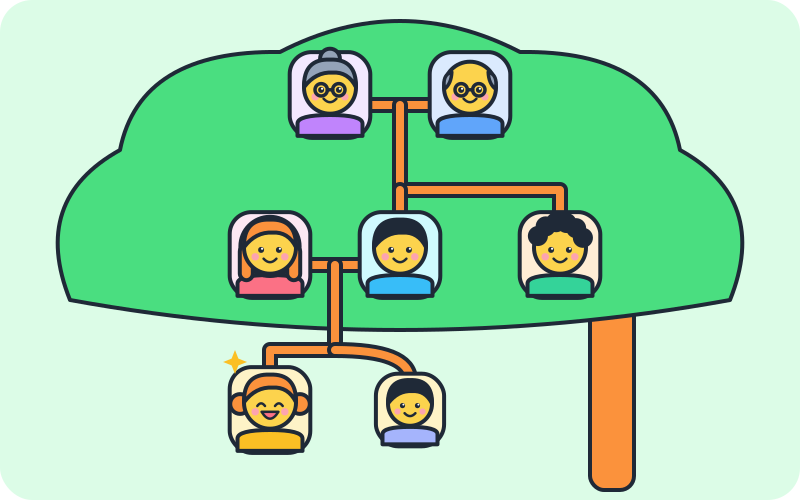
The girl at the bottom is speaking. Every man takes мой, even дедушка, папа and дядя, which end in -а and -я; every woman takes моя.
and split like and . is for one person you know well; is for a group, or for one person you would call :
?- Where's your phone? (to a friend)?- Is this your phone? (to a stranger)
His, her, their: the three that never change
, and do not agree with the noun at all, in gender, number or case:
| Russian | English |
|---|---|
| his brother |
| his mum |
| his friends |
| her house |
| their car |
The reason explains everything: they are the genitive forms of , and . is literally the brother of him, and a genitive does not agree with the noun it hangs off. Only the noun changes case:
.- I can see his mum. (changes;does not).- I'm talking to his mum.

Её собака, её машина, её зонтик: her dog, her car, her umbrella. Собака and машина are feminine and зонтик masculine, but её stays её.
Because they reflect only the owner, , and work exactly like English his, her and their. For once, the English instinct is right.
Going further: Through the cases and the rest of the guide, when you want them. This lesson does not need them.
Practice
Practise this lesson
10-question session
One question at a time, mixed across the exercises in this lesson. Miss one and it comes back round before the end.





Russian · Free printables
Worksheets for this lesson
Worksheets with answer keys built in. Open any one to view, print or save.
Lesson 3 of 35 in this chapter