
Esperanto -us and -u: Conditional and Imperative
By Michael McGettrickUpdated 12 October 2026
-us says what would happen; -u says what somebody wants to happen. Neither ending changes for person or tense, and both go on the verb root like any other ending.
| Ending | Esperanto | English |
|---|---|---|
-us: would | , . | If I could, I would come. |
-us: polite | ? | Could you help me? |
-u: command | ! | Come! |
-u: let us | . | Let us go. |
-u: after ke | , . | I want you to come. |
Quick check
Now use it: three quick questions on the chart above. The full practice is further down.
Pick the right one
0/3Open or unreal? Pick the Esperanto that says the English.
If you come, I will be at home. (you may well come)
If I were king, I would give you everything. (I am not)
If he works, he gets money. (a plain fact)
-us goes on both halves
English marks an unreal sentence twice, with two different tools: a past tense in the if half and would in the other. Esperanto uses one ending, twice:
| Half | English | Esperanto |
|---|---|---|
| the if | if I had time | |
| the result | I would help you | |
, .- If I had time, I would help you., .- If I were king, I would give you everything.
Do not copy the English past into the if half. is a real past: whenever I had time, back then.
, .- If (whenever) I had time, I read.
kvazaŭ: as if
introduces something imagined, so it normally takes -us as well:
, .- He talks as if he knew everything., .- She looked at me as if she did not know me.
Open conditions keep their tense
-us is for a condition that is contrary to fact or unlikely. One that may well come true takes the ordinary tense, in both halves:
- se vi venosyou may well come
- se vi venusyou probably will not
- se mi estus reĝoI am not
| Reading | Esperanto | English |
|---|---|---|
| open | , . | If you come, I will be at home. |
| unreal | , . | If you came, I would be happy. |
| general truth | , . | If he works, he gets paid. |
The first row is the one to notice. English says if you come, present, about the future; Esperanto says , because the coming is in the future. The third row is a plain general truth, so it takes the present.
-us has no tense
There is no past conditional ending. The same sentence covers now and then:
, .- If I knew, I would tell you. / If I had known, I would have told you.
Context settles it, or an adverb such as (then):
, .- If I had known then, I would have told you.
When the past must be explicit, plus an -inta participle does it: , I would have told you. It is correct and heavy; compound tenses has the full set.
-u: the command
The calls -u the imperative ( ). Many later grammars call it the volitive (from , to want), because it marks any action somebody wants to happen, not only an order. The plain command is the commonest case:
| Kind | Esperanto | English |
|---|---|---|
| one person or many | ! | Come! |
| negative | . | Do not be afraid. |
| , . | You stay here, I will go. |
There is no do to add in a negative command: goes in front and that is all. The bare form is the neutral command; stating points a finger.
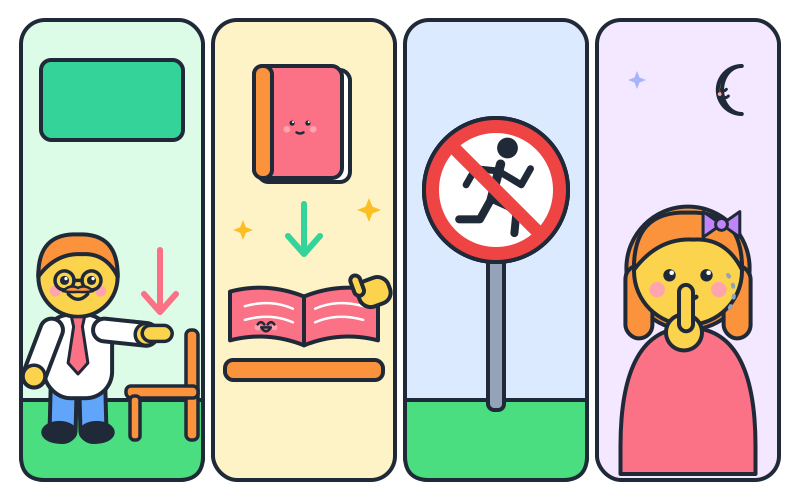
- !
- !
- !
- !
Sidiĝu! Sit down! Malfermu la libron! Open the book! Ne kuru! Do not run! Silentu! Be quiet! Every one is the root plus -u.
Ni iru, li venu, kion mi faru?
-u works with every person, which gives Esperanto one form for what English does with let, should and shall:
| Who | Esperanto | English |
|---|---|---|
| . | Let us go home. |
| . | Let him come at once. |
| ? | What should I do? |
| ? | Shall I open the window? |
| . | Everyone should do their own work. |
| a wish | ! | Long live the king! |
? asks what you are wanted to do. ? (what must I do?) is also correct, but it asks what is obligatory, which is a slightly different question.
From blunt to polite
A request can be a bare command, a , or a polite -us question. The strip runs from blunt to soft:
- Donu al mi akvon!give me water!
- Donu al mi akvon, mi petas.give me water, please
- Bonvolu doni al mi akvon.please give me water
- Ĉu vi povus doni al mi akvon?could you give me water?
| Form | Esperanto | English |
|---|---|---|
-i | . | Please sit down. |
| . | I would like to speak to you. |
| ? | Could you help me? |
is itself a -u form: is to be so kind as to, and the infinitive follows it. is not rude, but it lands like I want a word; is d like a word.
After ke: -u for what someone wants
When the main verb wants, asks, orders, permits or requires something, and someone new is to do it, the clause takes -u:
| Main verb | Esperanto | English |
|---|---|---|
| , . | I want you to come. |
| , . | He asked me to stay. |
| , . | The father told the children to sleep. |
| , . | We must leave at once. |
English uses an infinitive with its own subject (you to come), which is why learners write . That is not Esperanto. Some verbs of asking and ordering also allow the person plus an infinitive:
.- He asked me to stay.
never does: I want you to come is always the clause.
Three more points:
-uhas no tense:, .- I wanted him to come.-u:, .- I work so that my children learn.- With the same subject,
takes the infinitive:.- I work to live.
Report or demand?
-u follows verbs of wanting, not verbs of saying or knowing. A report keeps the real tense. can do either job, so the ending alone tells you which:
| Job | Esperanto | English |
|---|---|---|
| report: know | , . | I know you are coming. |
| report: think | , . | I thought she was there. |
| report: say | , . | He said I would come. |
| demand: say | , . | He told me to come. |
The clause keeps the tense of what was true at the moment of the main verb: when she was thought to be there, she is there, so . Reported speech has the whole rule.
When English would is not -us
English would also reports a future from a past moment: he said he would come. Esperanto uses -os there, because at the moment of saying, the coming was still ahead:
, .- He said he would come., , .- He said he would come if he could.
Mistakes English speakers make
| Wrong | Right | Why |
|---|---|---|
| | you have none, so unreal: -us in both halves |
! | ! | a command takes -u |
| | a new subject after -u |
| , | |
| | he said : a reported future keeps -os |
What to do next
- Say three things you would do if you had a free day, with
-usin both halves. - Turn each into a request with
. - Then read subordinate clauses for the rest of what
does.
See also
- Verb tenses -
-usand-ualongside-as,-isand-os. - Subordinate clauses -
clauses, where the choice between-uand a tense is made. - Reported speech - why he said he would come is
,. - Compound tenses -
- Letter writing and register -