
Esperanto Verb Tenses and Conjugation: -as, -is, -os
By Michael McGettrickUpdated 11 October 2026
Drop the -i from the infinitive and add one of five endings. The ending never changes for the person, and no verb is irregular. That is the entire Esperanto verb system.
Quick check
Three quick questions on what you have just read. The full practice is further down.
Fill in the blank
0/3Put the verb into the tense the English asks for. Add the ending to the root.
Mi vid vin nun. (I see you now) (Present tense.)
Accents optional - cx, gx, ux work for ĉ, ĝ, ŭ
Ŝi ven kun li. (She came with him) (Past tense.)
Accents optional - cx, gx, ux work for ĉ, ĝ, ŭ
Ni parol pri tio. (We will speak about that) (Future tense.)
Accents optional - cx, gx, ux work for ĉ, ĝ, ŭ
The whole system on one screen
| Ending | Use | | English |
|---|---|---|---|
-i | infinitive | | to be |
-as | present | | am, is, are |
-is | past | | was, were |
-os | future | | will be |
-us | conditional | | would be |
-u | command | | be! |
The root est- never changes. Watch one verb go through every tense:
Each tense in a sentence:
.- I see him now..- I saw him..- I will see him., .- I would see him, if I could.!- Look! (literally: see!)

- .
- .
- .
Yesterday, today, tomorrow: the root stays put and only the ending moves, -is, -as, -os.
One form for every person
The ending is the same whoever does the action:
| Pronoun | Esperanto | English |
|---|---|---|
| I am | |
| you are | |
| / / | | he / she / it is |
| we are | |
| they are |
English needs am, is and are for this column; French needs six forms, irregularly. In Esperanto the pronoun already says who, so the verb does not repeat it.
Because the verb does not say who, the subject pronoun stays in the sentence: . is I am there, and on its own does not say who is. Two kinds of sentence have no subject to say:
.- It is raining. (weather has no it)!- Come! (theis understood)
No irregular verbs, not even to be
To be is irregular in almost every language. English be has eight shapes: be, am, is, are, was, were, being, been. Esperanto's has six forms, and each is the root plus the ending you would have predicted. Every other verb works the same way:
| Verb | Present | Past | Future |
|---|---|---|---|
| | | |
| | | |
| | | |
| | | |
| | | |
| Verb | Would | Command | English |
|---|---|---|---|
| | | to have |
| | | to see |
| | | to speak |
| | | to go |
| | | to know |
You could have generated every cell yourself. That is the point. ( looks odd with its double i, but the root is sci-: , she knows.)
One present, one past: no continuous to learn
-as covers both English presents, and -is both pasts:
.- I speak. / I am speaking..- She read. / She was reading.
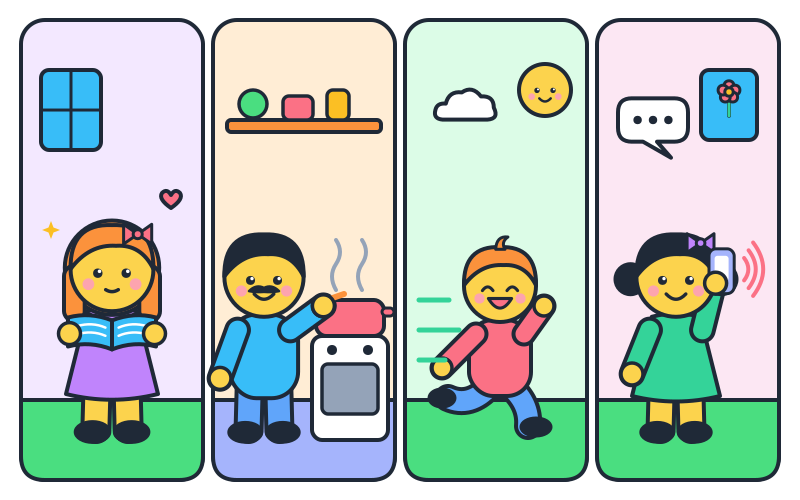
- .
- .
- .
- .
Each of them is doing it right now, and plain -as says so: she is reading, he is cooking, he is running, she is on the phone.
There is no am speaking form to build. is not Esperanto, and the participle forms ( ) are rare and heavy: plain -as and -is are the natural choice.
When to use -u
-u has no single English counterpart. It does three jobs:
| Job | Esperanto | English |
|---|---|---|
| a command | ! | Come! |
| a suggestion | . | Let us go. |
| a wish, after | | that you come |
The third catches English speakers. After , when someone wants a new subject to do something, the verb takes -u:
, .- I want you to come..- I want to come.
With no new subject, as in the second line, the infinitive -i stays. The full story is in the conditional and commands.
When to use -us
-us is the would ending, and it goes on both halves of an if-sentence:
, .- If I could, I would do that.
English changes the verb in one half (could) and adds a helper in the other (would do). Esperanto puts -us on both.
Mistakes English speakers make
| Wrong | Right | Why |
|---|---|---|
. | . | not wrong, but heavy: -as is am -ing |
| | a new subject after -u |
| | after , -us in both halves |
. (he is) | . | the does not say who |
What to do next
- Take one verb you know and say all six forms aloud.
- Write three sentences about yesterday, today and tomorrow with the same verb.
- Then read the accusative: the
-nthat marks the object.
See also
- Word endings - the
-o,-a,-eand-ithat come first. - The conditional and commands -
-usand-uin full. - Participles - the
--,--,--forms that carry tense into adjectives. - Compound tenses - what
plus a participle adds, and why you rarely need it.