
Esperanto Letter Writing: Register and Politeness
By Michael McGettrickUpdated 12 October 2026
Esperanto has one , for a friend, a stranger and a crowd. Politeness moved to three other places: how you open a letter, how you close it, and how you ask.
| Layer | Friendly | Formal |
|---|---|---|
| Opening | Maria, | , |
| Closing | , | , |
| Request | . | ? |
| Group | , | , |
Quick check
Now use it: three quick questions on the chart above. The full practice is further down.
Pick the right one
0/3Which opening fits the reader?
(a group of friends)
(a woman you have never met, formal)
(a ceremonial open letter to a congress president)
There is little of a posh second vocabulary to climb into either: Esperanto has where English has start and commence. Register lives mostly in the construction, not the words.
One vi for everyone
French makes you choose tu or vous, German or Sie. Esperanto has , for one person or many, close or distant:
.- You are my best friend., ?- Would you kindly reply, madam?
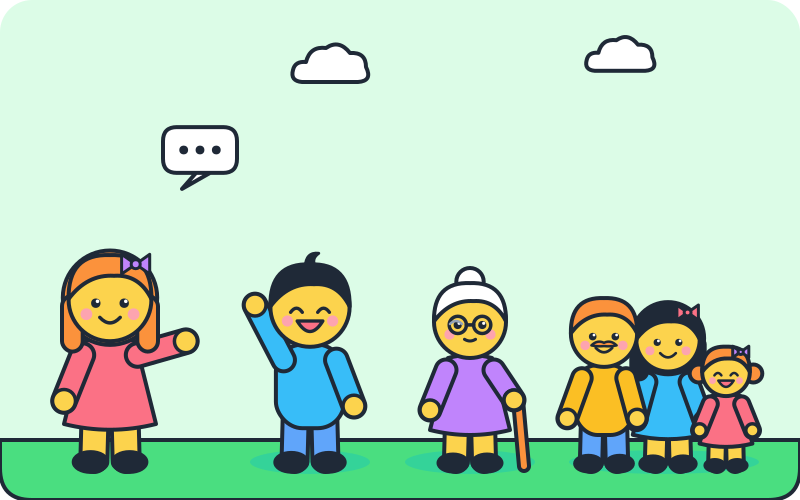
Mi (I), the woman speaking; vi (you) to her friend; vi to the older stranger; vi to the family. One word for all three.
The Fundamento's dictionary also has , a familiar singular thou, with as the object and for thy. Almost nobody uses it: Zamenhof himself wrote to everyone, and usage followed him. You will meet in some translated novels and in . Recognise it, and write .
The salutation ladder
The opening places you on a ladder from warm to ceremonial:
- Kara Maria,a friend
- Saluton!neutral, email
- Estimata sinjoro,a stranger, an official
- Altestimata sinjoro,ceremony
| Opening | For |
|---|---|
Maria, | a friend; also usual between Esperantists |
! | most emails: friendly, claims no rung |
, | a stranger, an official, a complaint |
, | a head of state, a ceremonial open letter |
(dear) and (esteemed) are adjectives, so they agree with a plural:
,- Dear friends,,- Dear ladies and gentlemen (to a mixed group),
(highly esteemed) is for real ceremony; to an ordinary reader it can sound ironic. Between Esperantists you will also meet (dear fellow Esperantist, literally same-idea person), friendly and a little old-fashioned.
The closings
Three of the closings are adverbs: a root plus -e, as in adverbs.
| Closing | English | For |
|---|---|---|
, | in friendship | friends, fellow learners |
, | warmly, cordially | warm, not intimate |
, | sincerely | the safe middle |
, | with esteem | formal letters |
! | see you soon | short, friendly notes |
Match the ends. The opening and the closing sit on the same rung:
| Opens with | Closes with |
|---|---|
| |
| |
! | ! |
A letter that opens with and ends with ! reads as a joke.
A letter, top to bottom
The same message in two registers, line by line:
| Part | Formal | Friendly |
|---|---|---|
| Opening | , | Maria, |
| Thanks | . | ! |
| Request | . | ! |
| Closing | , | , |
| Name | Petro Smith | Petro |
A formal letter may carry a date line, place first: Londono, 5- 2026. The day usually takes the time -n, though 5-a is also seen; see time expressions. Most emails leave it out.
Asking in a letter
The request is where register does most of its work. The forms are in conditional and commands; in a letter they line up like this:
- Skribu al mi.write to me
- Skribu al mi, mi petas.write to me, please
- Bonvolu skribi al mi.please write to me
- Ĉu vi povus skribi al mi?could you write to me?
- Ĉu vi bonvolus skribi al mi?would you kindly write?
| Use it for | Esperanto | English |
|---|---|---|
| friends | . | Write to me. |
| anyone | . | Please write to me. |
| a favour | ? | Could you write to me? |
| a polite wish | . | I would like to know your name. |
is itself a -u form: is to be so kind as to, and an infinitive follows it. If you learn one form from this page, learn that one.
Korespondado: letters kept the language going
For much of its first century, many Esperantists used the language largely by post. Zamenhof's printed o, whose first series appeared in 1889-1890, listed the names and addresses of people who had learned the language, so that they could find each other and write.
Japanio.- I correspond with a friend in Japan.
That is why a language with few native speakers has such a settled letter etiquette. Today the same habits run by email, and the default rung is low: first names at once, ! even from officials. When unsure, be one notch warmer than you would be at home.
Mistakes English speakers make
| Wrong | Right | Why |
|---|---|---|
oj, | oj, | -j |
| | |
? | ? | -us on |
What to do next
- Write a five-line email to a club you would like to join:
!, one question with. - Rewrite it for a stranger:
,, - Then read Esperanto hodiaŭ for where the correspondents are now.
See also
- Conditional and commands - the
-uand-usendings behind every request. - Adverbs - why
,andend in-e. - Personal pronouns -
, and the rarely used. - Time expressions - the date line,
5-. - La Kongreso -
ojand the etiquette in person.