
Esperanto Personal Pronouns: mi, vi, li, ŝi and mia
By Michael McGettrickUpdated 11 October 2026
has eight personal pronouns, and two endings you already know do the rest: -n for the object and -a for the possessive. No irregular forms, no verb agreement, no polite you.
Quick check
Three quick questions on what you have just read. The full practice is further down.
Pick the right one
0/3Subject or object? The English tells you who is doing what. The object takes -n.
Mi vidas . (I see him)
vidas min. (he sees me)
Ni rigardas . (we are looking at her)
The whole system on one screen
Read across: the object adds -n, the possessive adds -a.
| English | Subject | Object | Possessive |
|---|---|---|---|
| I | | | |
| you | | | |
| he | | | |
| she | | | |
| it | | | ĝia |
| we | | | |
| they | | | |
English I, me, my and she, her, her have to be learned one by one. Here the table is a pattern, not a list.
Subject pronouns
The verb never changes, so the pronoun does all the work of saying who:
.- I am a person..- You speak well..- They came with us.
Three points the table cannot show, each with an example:
| Pronoun | What to know | Example |
|---|---|---|
| one person or several; no formal form | . All of you came. |
| things and animals, not adults | . It is big. |
| any group: men, women, things | . They are there. |
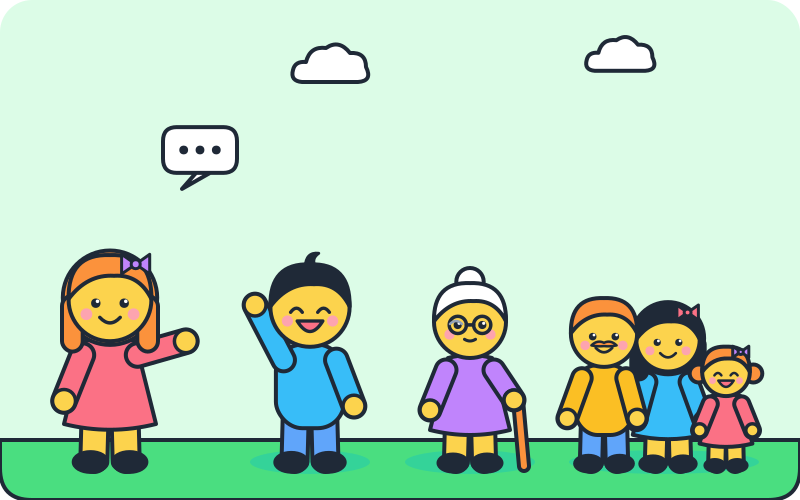
The woman speaking says vi to her friend, to the older stranger and to the whole group: one you, with no polite or plural form to choose.
Esperanto does not normally drop a personal subject, as Spanish and Italian do:
.- She is good.
on its own does not say who is good. (Two rarer pronouns exist: , an old intimate thou almost nobody uses, and ri, a newer gender-neutral he or she that some speakers use and others reject.)
The object: add -n
When the pronoun is the one being seen, heard or looked at, it takes the accusative -n, exactly as a noun does:
| Esperanto | English |
|---|---|
. | He sees me. |
. | I see him. |
. | She is looking at us. |
. | We see them. |
Because the ending marks the object, the words can move without changing who does what:
.- He sees me. (stress on me)
In everyday speech the plain order is the usual one: subject, verb, object.
Possessives: add -a
-a is the adjective ending, so is literally me-ish: belonging to me. That has one consequence. A possessive agrees with its noun like any adjective, taking -j for several and -n for the object:
| Subject | Object | |
|---|---|---|
| one | | |
| several | | |
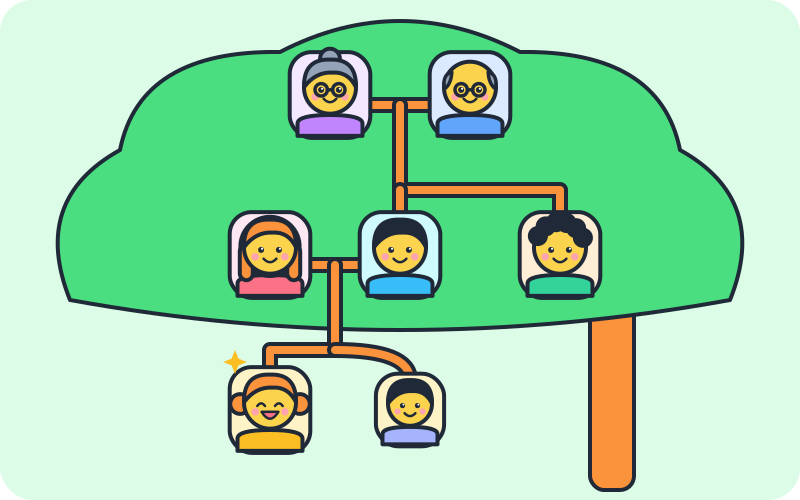
The girl at the bottom is speaking: everyone else in the tree is mia, my.
.- My book is there.?- Do you see my books?
The possessive agrees with the thing owned, not the owner. has -j because there are several books; there is still only one of me. No is needed either:
.- Our day was good.
Oni: people in general
is the vague subject English spreads across one, you, they and people:
, .- People say she will come..- You cannot know.
It is almost always the subject, and it never says who exactly. The full story, including how it replaces many English passives, is in impersonal sentences.
Si and sia: his own, her own
English he sees his book cannot tell you whose book it is. Esperanto can. In the third person, points back at the subject; , and point at someone else.
| Esperanto | English |
|---|---|
. | He sees his own house. |
. | He sees another s house. |
. | She sees her own house. |
agrees like any possessive, and has the object form :
.- They see their own books..- He washes himself.
Two limits. It is third person only, because and are never ambiguous:
.- I see my book.
And it never goes inside the subject:
.- His book is good. (never
The full treatment is in the reflexive.
Mistakes English speakers make
| Wrong | Right | Why |
|---|---|---|
. | . | the object takes -n |
| | no -n after |
| | the possessive agrees in number |
| | and in case |
(own) | | his own book, after |
. (he) | . | the subject is not dropped |
What to do next
- Say the table aloud row by row:
, ,, then, ,. - Make three sentences about people you know with
,and. - Then read demonstratives, which take the same
-jand-n.