
Esperanto Demonstratives: Tiu, Tio and ĉi for This
By Michael McGettrickUpdated 11 October 2026
Esperanto points with two words: (that one) and (that thing). takes -j and -n like an adjective; takes -n only. For this, add . That is every this, that, these and those English asks of you.
| Subject | Object | |
|---|---|---|
| that one | | |
| those ones | | |
| that thing | | |
| this one | | |
| this thing | | |
Quick check
Now use it: three quick questions on the chart above. The full practice is further down.
Pick the right one
0/3Pick the right form of tiu. The English in brackets says how many, and whether it is the subject or the object.
homo parolas. (that person is speaking - one, subject)
homoj parolas. (those people are speaking - several, subject)
Mi vidas homon. (I see that person - one, object)
Tiu: that one
picks a specific individual out of a set. It sits before a noun, or stands alone when the noun is understood:
.- That person is speaking..- That one came first.
The test: could you answer which one? If so, it is .
Tio: that thing
points at something you are not naming: an unidentified object, a situation, or a whole previous sentence.
| Points at | Esperanto | English |
|---|---|---|
| an unknown thing | ? | What is that? |
| a situation | ! | That is not possible! |
| what was said | . | That is the truth. |
You cannot put a noun after . The same split runs through the whole correlative table: -u words pick individuals, -o words gesture at things.
One word, two jobs: adjective or pronoun
Before a noun, is an adjective: it describes the noun and copies its -j and -n, exactly as would:
.- I see those people..- I see good people.
Standing alone, the same word is a pronoun: it replaces the noun.
.- Those (people) came.
only ever does the second job, so is simply not Esperanto.
English hides the same split. In that book is mine, that is an adjective; in that is mine, it is a pronoun:
.- That book is mine..- That is mine.
ĉi: pulling that into this
There is no separate word for this. The particle drags a pointing word towards the speaker:
| Far | Near |
|---|---|
| this one |
| this |
| here |
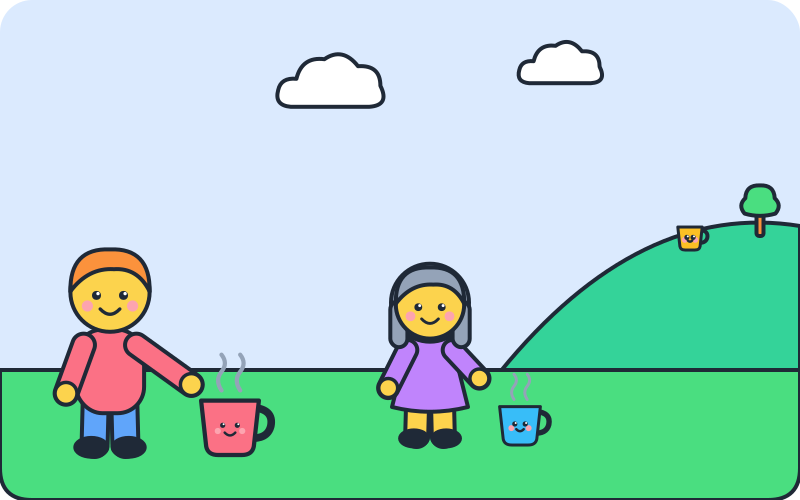
Two steps, not three: ĉi tiu for the cup by the speaker, plain tiu for the cup by the listener and the one on the hill alike.
can stand on either side. Both of these are correct:
.- This book is good..- This book is good.
on its own before a noun ( ) does turn up, but it is widely judged best avoided outside poetry. Give it its : .
Number and case: the part English does not prepare you for
takes the plural -j and the accusative -n, together when both apply. takes -n but never -j:
| Form | Esperanto | English |
|---|---|---|
| . | Those gentlemen speak. |
| . | I see that gentleman. |
| . | I see those gentlemen. |
| . | I did not say that. |
The endings free the word order. Front the object for emphasis and the -n still says who sees whom:
.- I see that person..- THAT person is the one I see.
The rest of the ti- family
and are two cells of a column. The other common ones point at a place, a time, a manner or a kind:
| Word | Esperanto | English |
|---|---|---|
| . | He is there. |
| . | Then I came. |
| ! | Do not talk like that! |
| . | I have never seen such a person. |
All nine are in the correlative table.
Mistakes English speakers make
| Wrong | Right | Why |
|---|---|---|
| | a noun follows: |
. | . | the object takes -n on both |
| | several: -j on both |
tioj | | -j |
| | bare |
What to do next
- Point at five things around you and say
with each noun. - Make three of them objects:
. - Read correlatives for the whole table this column belongs to.