
Esperanto Particles: ĉi tiu, ju...des, ajn and mem
By Michael McGettrickUpdated 12 October 2026
Five small words that only work in company. makes a pointing word near, makes a question word mean no matter which, and build the more ..., the more ..., and stresses the word in front of it.
| Particle | Example | English |
|---|---|---|
| | this book |
| | whoever comes |
... | , . | The earlier, the better. |
... | , . | Now he laughs, now he cries. |
| . | I did it myself. |
Quick check
Now use it: three quick questions on the chart above. The full practice is further down.
Pick the right one
0/3Tap the words that say the English.
Mi legis libron. (this book)
Ni atendos vin . (here)
venos, mi restos hejme. (whoever comes)
ĉi: near, not a word for this
goes with a ti- word and brings it close to the speaker:
| Far | Near | English (near) |
|---|---|---|
| | this one |
| | this |
| | here |
| | this kind |
It can stand before or after the ti- word, with no difference in meaning:
.- This book is mine..- This book is mine.
never takes an ending. The -j and -n go on the correlative:
.- I read this book..- These people are my friends.
It needs the ti- word: is not standard. Say .
ĉi- as a prefix: ĉi-vespere
Joined to a root with a hyphen, makes one word meaning this, the present one:
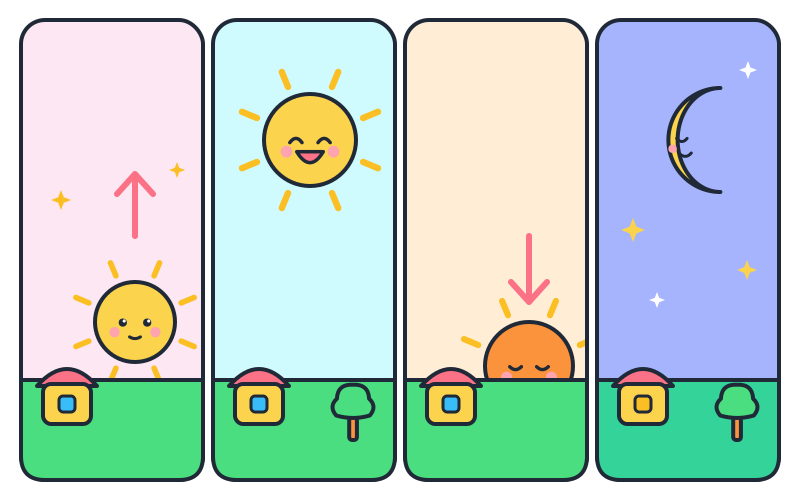
- -
- -
- -
Ĉi-matene, this morning (the sun rising); ĉi-vespere, this evening (the sun setting); ĉi-nokte, tonight (the moon).
| Word | English |
|---|---|
- | this evening |
- | this year |
- | this time |
- | above (in this text) |
- .- This evening I will read.
is also correct, and longer.
ajn: no matter which
follows a ki- or i- correlative and opens it up to any answer:
| Plain | With | English |
|---|---|---|
| | whoever, whichever |
| | whatever |
| | wherever |
| | whenever |
| | however much |
| | anyone at all |
| | anything at all |
A ki- word with opens a clause, like English -ever:
, .- Whoever comes, I will stay., .- Whatever you say, I will not believe it.
With an i- word it removes any limit:
.- Say anything at all.
never takes an ending; the correlative keeps its own:
.- Take whichever book you like.
It does not go with the ti- words: points at one known thing, so there is nothing to open up. After a neni- word it adds emphasis:
.- I saw nobody at all.
ju ... des: both halves
The more ..., the more ... is in the first half and in the second, each followed by or , with a comma between:
, .- The more I learn, the more I understand., .- The less you sleep, the more mistakes you make., .- The longer the road, the more tired the horse.
The halves need no verb: , . - The earlier, the better.
can stand alone, meaning all the more, after a reason already given. cannot:
, .- If you come, all the better.
jen ... jen, and ĉiam pli
On its own, presents something: . - Here is the book. Doubled, it swings between two states:
, .- One minute he laughs, the next he cries.
More and more is , or, more neatly, :
.- The days are getting longer and longer..- The days are getting ever longer.
mem: right after its word
stresses the word just before it:
.- I did it myself (nobody else did)..- The king himself came..- The book itself is good.
Keep it next to its word. is common in speech and usually understood the same way, but after the can also read as that very thing; leaves no doubt.
is not the reflexive. English -self does both jobs; Esperanto uses for the reflexive:
| Esperanto | English |
|---|---|
. | He washed himself. |
. | He washed him himself (another man). |
. | He saw himself (and nobody else). |
For each other, say ; takes the -n as the object:
.- They love each other.
The reflexive article has and each other in full.
Mistakes English speakers make
| Wrong | Right | Why |
|---|---|---|
| | ti- word |
| | the -n goes on |
| | |
..., | ..., | the second half is |
| | English the here is not |
(himself) | | the reflexive is |
| | |
What to do next
- Write five sentences with
- Write three -ever sentences with
- Then read correlatives in the wild: the table joining clauses.
See also
- The correlatives table - the grid
andwork on. - Correlatives in the wild - the same grid joining one clause to the next.
- Comparisons -
,,, and the first sighting of.... - The reflexive si - the word
keeps getting mistaken for. - Word order and style -
,and, which attach forwards whereattaches backwards.