
Esperanto Comparisons: pli, plej, ol and kiel
By Michael McGettrickUpdated 12 October 2026
Put in front for more and for most; than is . The adjective never changes shape, and there are no irregular forms.
| Esperanto | English |
|---|---|
| big |
| bigger than me |
| less big |
| the biggest |
| as big as me |
Quick check
Now use it: three quick questions on the chart above. The full practice is further down.
Pick the right one
0/3Ol or kiel? Ol goes with pli and malpli, kiel with tiel.
Li estas pli forta mi.
Ŝi estas tiel juna vi.
La ĉambro estas malpli granda la domo.
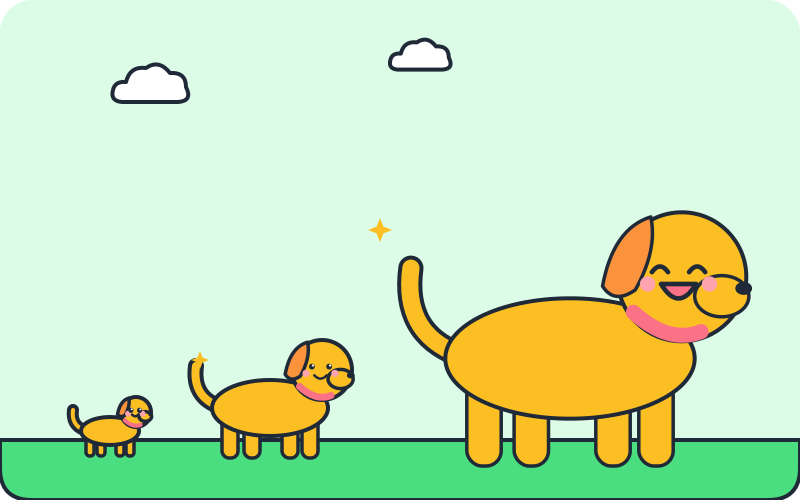
Malgranda hundo, a small dog; pli granda hundo, a bigger dog; la plej granda hundo, the biggest dog.
pli and plej
The adjective stays as it is. makes the comparative, the superlative:
| Plain | More | Most |
|---|---|---|
| | |
| | |
| | |
English has bigger against more beautiful and good, better, best. Esperanto has , , , and that is the whole system.
Adverbs work the same way, usually without :
.- He runs faster..- She runs fastest.
ol: than
brings in the thing you compare with. In a comparison it comes after or :
.- He is taller than me..- Nothing is more important than the truth.
The superlative names its group with or , never :
.- She is the youngest of the children.
has a few fixed partners outside comparison too: (other than), (before). It never means as.
tiel ... kiel: as ... as
For equality, the pair is ... ; for amounts, ... (with before a noun):
.- She is as strong as her father..- I work as fast as he does..- I have as many books as you.
, not : the father is the subject of a shortened clause of his own (as her father is), so cannot point back to .
The pairs never cross:
| Comparison | First word | Then |
|---|---|---|
| more, less | | |
| as ... as | | |
| as much as | | |
Less: malpli, and what mal- does here
is less, and it takes like :
.- This book is less interesting than that one.
- can also go on the adjective. Both places are correct, and they are not quite the same claim:
| Form | Literally | The claim |
|---|---|---|
| less big | ranks it lower on size |
| smaller | the everyday choice |
| less good | it may still be decent |
| worse | tends to suggest it is bad |
With size the difference is small. With goodness it is real: the first is the diplomatic one, the second the blunt one.
The least is , and - is also common:
.- That is the least important matter..- That is the least important matter.
Very is not most
English most does two jobs: the most beautiful house ranks it, a most agreeable evening just means very. does only the first.
- belabeautiful
- tre belavery beautiful
- belegagorgeous
- treege belaextremely beautiful
.- She is very beautiful..- She is gorgeous..- She is the most beautiful (of them).
Set phrases such as (with the greatest pleasure) drop the , but still means most there.
ju pli ... des pli
The more ..., the more ... is ..., .... exists only for this; also turns up in , all the better.
, .- The more I learn, the more I understand., .- The longer the road, the more tired the horse.
Any pair works: ..., ... is the less ..., the more ....
-n after ol
What follows takes the case it would have in the full sentence. That settles an ambiguity English cannot:
.- He loves me more than you (love me)..- He loves me more than (he loves) you.
is a subject, so it is the other lover; is an object, so it is the other one loved. English he loves me more than you is permanently ambiguous; Esperanto settles it in one letter.
Mistakes English speakers make
| Wrong | Right | Why |
|---|---|---|
| | |
| | |
| | the group takes |
| | meaning very: |
| | |
What to do next
- Compare three people you know:
- Rank three things with
- Read correlatives:
,,andall come from the table.
See also
- Correlatives -
,,andcome from the table. - Word building -
-and--, the two affixes that change what comparison means here. - Adverbs -