
Esperanto Affixes: The Full List of Prefixes and Suffixes
By Michael McGettrickUpdated 11 October 2026
An affix bolts onto a root and changes its meaning in a fixed way, on any root where the meaning makes sense. You have already met and : they are and with a piece added. Learn seven pieces and every root you know multiplies.
| Affix | Job | Example |
|---|---|---|
- | exact opposite | |
-- | female | |
- | both sexes together | |
- | again, back | |
-- | the place for it | |
-- | the professional | |
--, -- | smaller, bigger | |
Prefixes go before the root; suffixes go between the root and the ending, which keeps its usual job:
mal- reverses everything
Put - on the front and the meaning flips to its exact opposite:
| Root you know | With - | Meaning |
|---|---|---|
| , good | | bad |
| , big | | small |
| , new | | old |
| , strong | | weak |
| , fast | | slow |
| , long | | short |
| , to love | | to hate |
| , to help | | to hinder |
 big
big small
small warm
warm cold
cold
.- The house is small..- They hate winter.
Good and bad, big and small share nothing in English: two words to learn each time. In Esperanto every pair costs one root plus a prefix you learn once.
-in- makes it female
-- sits between the root and the -o:
| Root | With -- | Meaning |
|---|---|---|
| , man | | woman |
| , father | | mother |
| , sir | | madam |
| , king | | queen |
.- My mother is good.
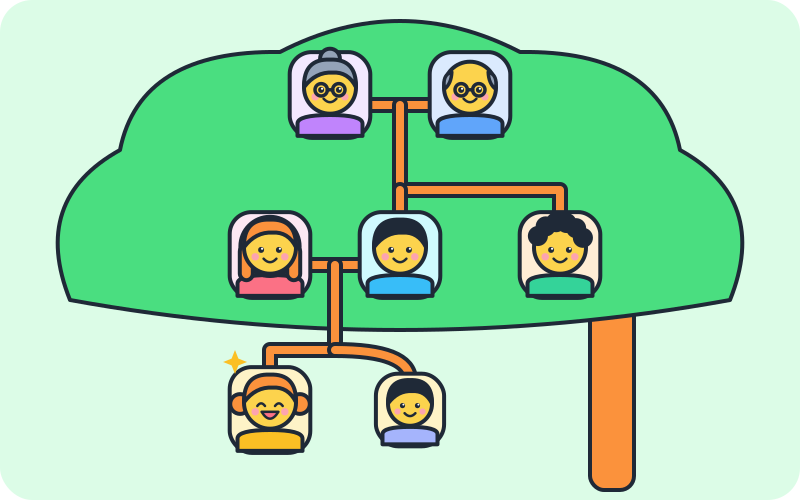
Every woman in the tree is the man’s word plus -in-: avino, patrino, fratino.
- on the front takes both sexes together, so the word is usually plural:
| Pair | With - | Meaning |
|---|---|---|
| + | | parents |
| + | | ladies and gentlemen |
Parizo.- My parents live in.
The place, the person, the repeat
Three more that carry a lot of traffic:
| Affix | Root | Built | Meaning |
|---|---|---|---|
-- | , to learn | | school |
-- | , to work | | workplace |
-- | , to cook | | kitchen |
-- | , to teach | | teacher |
-- | , to work | | worker |
-- | | speaker | |
- | , to come | | to come back |
- | , to give | | to give back |
- | , to see | | to see again |
In sentences:
.- The children go to school..- She is a teacher..- I will come back tomorrow.
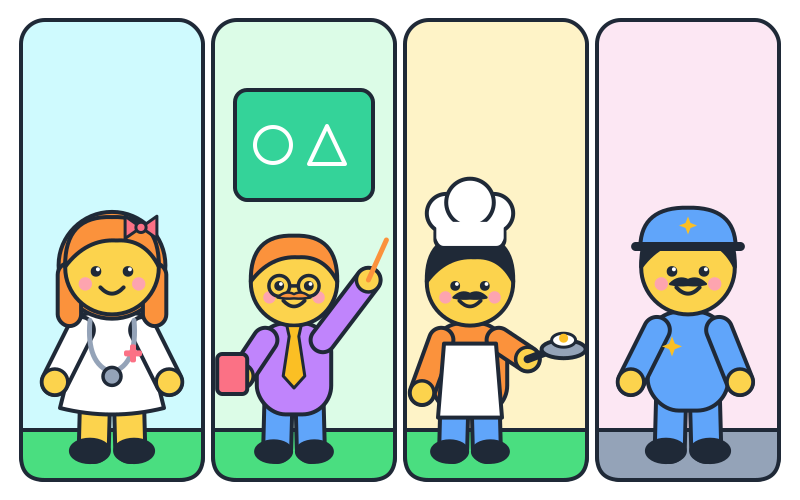
Three jobs, one suffix: the root says what the work is, -ist- makes the person who does it. The doctor is a woman, so -in- follows: kuracistino.
-- is the person who does something as a job, or an adherent of something. A learner is , not a professional learner.
Some built words mean one particular thing and are worth learning whole: o is a kitchen, not any place where cooking happens.
-et- and -eg-: the volume knob
A matched pair that turns the root down or up, whatever its part of speech:
| Smaller | Root | Bigger |
|---|---|---|
| , house | |
grandeta biggish | , big | |
 a cottage
 a house
- big
 enormous
.- They live in a cottage.
The size pair, and --, -- and -- for people, have their own article: Esperanto suffixes for size and people.
The full list of official Esperanto affixes
There are 41 official affixes, in PMEG's count: in the or accepted by the . All of them work on any root where the meaning makes sense.
The ten prefixes
| Prefix | Job | Example |
|---|---|---|
- | related by marriage | o, father-in-law |
ĉef- | chief, main | |
- | in different directions | i, to hand out |
- | sudden or starting action | i, to fall asleep |
- | former | o, ex-husband |
- | both sexes together | |
- | exact opposite | |
- | wrongly, by mistake | i, misunderstand |
- | primordial, great- (family) | o, great-grandfather |
- | again, back | |
Many textbooks list - (o, a scoundrel) too. The has only as an exclamation, and PMEG treats it as one used like a prefix; the unofficial affixes article has the detail.
Suffixes for people and living things
| Suffix | Job | Example |
|---|---|---|
-- | member, inhabitant | o, club member |
-- | leader | o, mayor |
-- | offspring | o, kitten |
-- | female | |
-- | professional, adherent | |
-- | person characterised by | |
Suffixes for things, places and groups
| Suffix | Job | Example |
|---|---|---|
-- | concrete thing | o, food |
-- | collection | |
-- | place for | |
-- | single unit of a mass | o, snowflake |
-- | tool | o, knife |
-- | holder for one item | o, candlestick |
-- | container | o, purse |
-- | doctrine, system | |
Suffixes for size, quality and attitude
| Suffix | Job | Example |
|---|---|---|
-- | poor quality, contempt | o, a hovel |
-- | abstract quality | |
-- | bigger, more intense | o, mansion |
-- | smaller, less intense | |
-- | tendency | a, hard-working |
Suffixes for actions and possibility
| Suffix | Job | Example |
|---|---|---|
-- | ongoing or repeated action | |
-- | can be done | a, edible |
-- | must be done | a, payable, due |
-- | worth doing | a, worth seeing |
-- | make, cause to be | i, to clean |
-- | become, get | |
Suffixes for numbers, and the wildcard
| Suffix | Job | Example |
|---|---|---|
-- | multiple | a, double |
-- | fraction | |
-- | in a group of | e, in twos |
-- | no fixed meaning | o, collar |
That is 29 suffixes. The other two are the affectionate name endings -- and --:
- dad- mum
Where to read more:
- The participle endings (
--,--and friends) are grammar rather than word building: participles. --and--: their own page.--: the -um article.- Affixes beyond the official list: the unofficial affixes.
This is why 200 roots is not 200 words
Take one root, bon-, and apply the endings and affixes:
| Word | Built from | Meaning |
|---|---|---|
| root + -a | good |
| root + -e | well |
| root + -o | a good thing |
| - | bad |
| - + -e | badly |
| -- | excellent |
| -- | fairly good |
| -- | to improve |
| - + -- | a wicked person, a villain |
Nine words from one root, with pieces that work the same on every other root you hold. That is the defensible form of the claim that Esperanto is faster: the vocabulary compounds, because the word-building system is regular and nobody has to approve a new combination.
Some built words narrow to one meaning, and those you learn by name:
o- a hospital (literally a place for sick people)o- a prison (literally a place of unfreedom)
Mistakes English speakers make
| Wrong | Right | Why |
|---|---|---|
o | | the affix goes before the ending |
o | | - is opposite, not female |
o | | -- is a professional; a learner is |
What to do next
- Take five adjectives you know and say their
-opposites aloud. - Build the female and the
-form of three people words:,,. - Read affixes for size and people for
--,--,--and--.