
Gender in Esperanto: -in-, ge-, and the Reform That Waits
By Michael McGettrickUpdated 12 October 2026
has no grammatical gender: one article, no agreement, and most nouns are neutral. What it has is a short list of male roots, the suffix -- to make the female, and the prefix - for both sexes together. Around that sits a live about ri and -iĉ-.
| Form | Means | Status |
|---|---|---|
| a doctor, any sex | neutral: most roots |
| a father | a male root |
| a mother | standard |
| a bull | standard |
| parents, mother and father | standard |
| one parent, any sex | newer, spreading |
ri | he or she, any person | unofficial |
kuracistiĉo | a male doctor | unofficial |
Quick check
Now use it: three quick questions on the chart above. The full practice is further down.
Spot the mistake
0/3Each sentence has one wrong word. Tap it.
No grammatical gender
There are no masculine and feminine nouns, and adjectives do not change for sex. The article is always :
A French or German learner spends years on noun gender. An Esperanto learner spends an afternoon on a word list, and -- never spreads to the rest of the sentence: , never a.
Neutral roots and male roots
Most roots are sex-neutral. PMEG says the neutral group is , without doubt the largest. It holds , and , and the profession nouns.
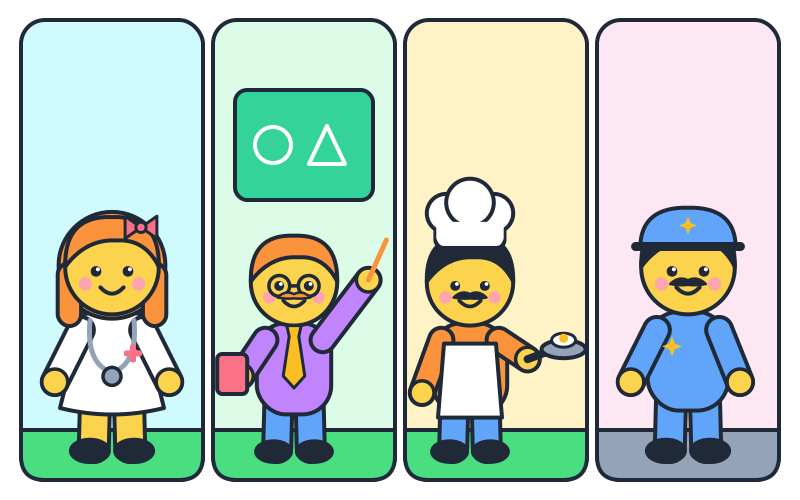
A doctor (here a woman), a teacher and a cook (here men): kuracisto, instruisto, kuiristo. Profession nouns say nothing about sex.
.- She is a doctor..- He is a doctor.
A short list of roots is male. PMEG calls this group much smaller and , more closed, and ends each group with k.a., and others:
| Group | Male roots |
|---|---|
| General | masklo |
| Family | |
| Family | vidvo |
| Titles | |
| on | |
| Animals | taŭro, and a few more male-animal roots |
The trap is assuming the list is longer: and are not on it. A handful of roots are female in themselves (, a lady), and they take no --.
-in- and vir-
-- makes the female of a male root. One suffix, no exceptions, no change to the root:
| Male | Female | English |
|---|---|---|
| | father, mother |
| | brother, sister |
| | king, queen |
| | Mr, Mrs |
| | boy, girl |
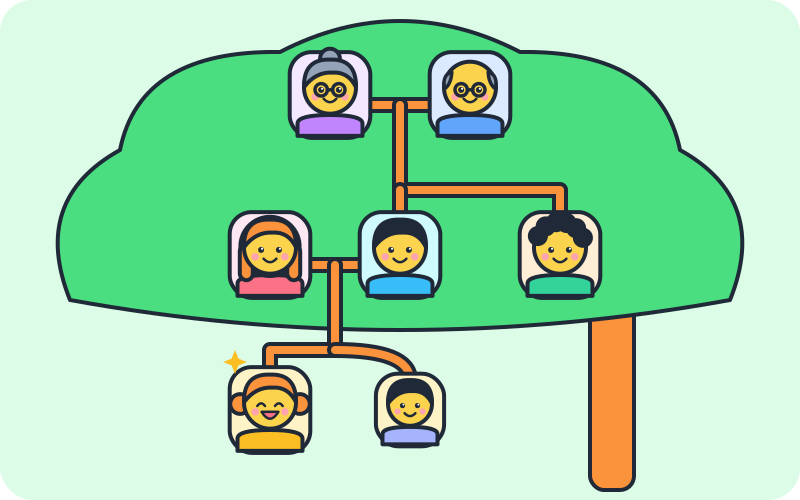
avino, avo: grandmother, grandfather; patrino, patro: mother, father; onklo: uncle; fratino, frato: sister, brother.
-- can also specify the female of a neutral root. PMEG calls this optional, though traditionally speakers add it routinely when they mean a woman or a female animal:
- a cow (, a bovine of either sex)- a female dog- a woman doctor (correct, and says more than)
Going the other way, the root - in front marks a male:
- a bull- a male dog
-- is also a word, as most affixes are: is a female, is female as an adjective.
Ge-: both sexes together
- means both sexes. Traditionally the word it makes is plural, and these plurals are everyday words:
| Word | English |
|---|---|
| parents (mother + father) |
| brothers and sisters |
| sons and daughters |
| a married couple |
| ladies and gentlemen |
Parizo.- My parents live in.oj!- Ladies and gentlemen!
- also goes on neutral roots when you want to stress that both sexes are there: oj, pupils of both sexes. Normally plain does the job. PMEG advises against the singular o and o, since and are neutral already.
The newer use is the singular. PMEG states the tradition, that a - word with -o can only be plural, then records an experimental singular meaning any sex that has grown over the last few decades:
.- Every parent wants to help.
PMEG also names the cost. If - can mean any sex, then can mean a decision by one parent rather than by both. Both readings are in use; the plural one is understood by everyone.
The criticism, both ways
The argument is a century old because both sides have a point:
| Point | For change | The reply |
|---|---|---|
| Marking | | the male list is short and closed |
| Male suffix | none: | -- is one regular suffix |
| Pronouns | | |
Traditionally covers a person of unknown sex. PMEG notes that this can be seen as discrimination and offers , or instead:
, .- If anyone wants to come, they can come.
Ri, -iĉ- and the other proposals
Riismo usually means using ri; the word also covers wider programmes. None of these forms is official, and some speakers use them every day:
| Proposal | What it does | Standing |
|---|---|---|
ri | he or she: one person, any sex | the most used; unofficial |
kuracistiĉo | a male suffix to mirror -- | used by some; unofficial |
ŝli | a blend of | a rival; less used than ri |
| the pronoun for things | a few use it; it can sound objectifying |
People use ri in three ways: for a person whose sex is unknown, only for non-binary people, or for everyone instead of and . PMEG says riismo is , , fairly widespread, especially among young people, and that some strongly oppose it as an unacceptable .
, ri .- My friend said that they would come.
-Iĉ- is modelled on --, the male pet-name suffix, just as -- pairs with --. Its main use is on neutral roots, where it does the job of -: kuracistiĉo, a male doctor; boviĉo, a bull. PMEG calls it by far the most popular proposal of its kind, though most speakers still use or -. Some go further and put it on the male roots too, so that would mean parent and patriĉo father. PMEG calls that a real of common, deep-rooted words, and so hard to achieve.
What the Akademio said
1976earliest known proposal of ri, in print
2021the Akademio declines to decide
2031earliest return to the question
In March 2021 the Esperanto published this declaration:
Esperanto,uzindeco-(riŝli),i .The
Esperanto declares that it does not at present take a position on the usability of unofficial sex-neutral pronouns (such as ri or ŝli), and has decided not to take up the subject for at least ten years.
That is neither approval nor a ban. It is how the language usually changes: usage first, ratification afterwards, if at all. The Fundamento and Akademio article explains why.
What to write today
- patrino-in-
- gepatrojge-, plural
- gepatronewer singular
- riwidely recognised
- kuracistiĉoused by some
- Use
--where tradition puts it:,,. - Use
-for a mixed group:,oj,oj. - Leave profession nouns bare unless sex is your point:
. - Reach for
andwhen sex is beside the point. - Recognise
riand-iĉ-, and use the pronoun a person asks you to use.
Words about sexuality
Ordinary dictionary words, given here once because learner material rarely does:
| Word | English |
|---|---|
| sex (male, female) |
| a gay man |
| gay |
| attracted to the same sex |
| heterosexual |
| bisexual |
Both families are in everyday use: and are short and informal, and is the plain descriptive word.
Mistakes English speakers make
| Wrong | Right | Why |
|---|---|---|
a | | adjectives do not agree for sex |
o | | -- is already there |
. | . | |
oj | oj | - already includes the women |
What to do next
- Write five family words with
--and five with-. - Describe three people by profession with no
--. - Then read affixes for size and people for
--,--and--.
See also
- Who decides what is correct Esperanto? - the
, theand the 2021 decision. - Affixes for size and people -
--,--and--, the person-building suffixes. - Word building - the affix system
--and-belong to. - Affixes as words in their own right - why
is a noun and-a prefix. - Nouns and adjectives - the agreement system with no gender in it.
- Personal pronouns -
,and. - Personal names -
--and--, the other pair of sexed suffixes.