
Personal Names in Esperanto: Johano, John or Ĝon?
By Michael McGettrickUpdated 12 October 2026
A name in can be written three ways, and the accepts all three. Fully Esperantised with an -o, respelt in Esperanto letters with no ending, or left exactly as its owner writes it.
| System | Example | What happens |
|---|---|---|
| full | Konfuceo, Nov-Jorko | Esperanto letters and -o |
| partial | Zamenhof, Ban Ki-mun | letters, no ending |
| original | Kálmán Kalocsay | as its owner writes it |
Quick check
Now use it: three quick questions on the chart above. The full practice is further down.
Pick the right one
0/3Choose the accusative form that PMEG allows.
Ĉu vi konas ? (Anna: the name ends in a vowel)
Ĉu vi konas ? (Elisabeth: it ends in a consonant)
Mi vidis . (Johano: a fully Esperantised name)
These are the Akademio's own examples, from its 2013 recommendation.
Nov-Jorko.- I lived in New York.Kalocsay.- I am reading a book by Kalocsay.
What Zamenhof did
The people in the Fundamento's o all have Esperanto names ending in -o:
| Ekzercaro | Names |
|---|---|
| §5 to §10 | Teodoro, Johano, Ludoviko, Aleksandro, Ernesto |
| §18 to §22 | Petro, Stefano, Nikodemo, Jozefo |
| §36 to §39 | Anno, Elizabeto, Mario, Klaro, Sofio, Berto |
Johano Petro .- Johano and Petro are friends.
Women's names take -o too. In the , Mary is Mario. Today you also meet Maria, Sofia and Berta. PMEG says the Fundamento's -o is the model, but -a women's names are very widespread and must be tolerated; an -a is entirely fine when the national form already ends in -a, because the name then counts as not Esperantised. For Mary it lists three options:
| Form | What it is |
|---|---|
Mario | the Fundamento's form |
o | -- added, since Mario is also a man |
Maria | not Esperantised |
Zamenhof stopped halfway with surnames. In §12 George Washington is Georgo Vaŝington: the given name Esperantised, the surname respelt with no ending. He wrote his own name the same way, Zamenhof, with no -o.
Three systems, and no single rule
The Akademio's ( 22, 10 October 2013) replaced its 1989 recommendations. It names the three systems, and then declines to choose:
... an ....it is not possible now to recommend one single method, always to be used, for treating different proper names in Esperanto.
Esperanto, 2013
It does lean one way, with modern examples: Vindozo (Windows), Linukso (Linux), Guglo (Google).
i .It is worth continuing to cultivate and support the habit of fully Esperantising frequently used proper names.
Esperanto, 2013
And it settles the question learners ask first:
kiuforme .Every Esperantist may decide for themselves in what form to use their name in an Esperanto setting.
Esperanto, 2013
A footnote on Zamenhof and Vaŝington. The 1974 Eighth Official Addition had read these two spellings as full names with the ending silently dropped. In 2013 the annulled that reading: they are simply partly Esperantised.
Who gets which
Usage leans by who the person is:
| Who | Usual form | Example |
|---|---|---|
| a historical figure | full | Cezaro |
| a name in daily use | full, encouraged | Guglo, Vindozo |
| an | their own choice | Mikaelo or Michael |
| a surname | often left e | Kalocsay |
Mikaelo.- My name is Mikaelo.
Often only the given name is Esperantised and the surname kept: PMEG's example is Christeno Pedersen.
Esperanto has no compulsory rules for capitals (PMEG: majuskloj minuskloj ), so a surname printed in capitals, as in Kálmán KALOCSAY on a congress list or badge, is a convention for showing which name is the family name, not a rule. Capital letters has the rest.
The accusative on a foreign name
An Esperantised name ends in -o, so it takes -n like any noun:
Johanon.- I know Johano.
A name in its original spelling has no -o to hang the -n on. PMEG gives four ways out:
| The name | What to do | Example |
|---|---|---|
| ends in a vowel | add -n | Annan? |
| ends otherwise | add -, often hyphenated | Elisabeth-? |
| clear from order | leave it off | Elizabeto Peter. |
| has a title | the title takes -n | Vigdís |
Annan?- Do you know Anna?Bertan.- I saw Berta.Elizabeto Peter.- Elizabeto saw Peter.
Leaving it off works when the other name shows the roles. Elizabeto is fully Esperantised and has no -n, so it can only be the subject, and Peter must be the object:
Names in two parts
Every Esperanto -o word in a name takes the -n; a part left in its original spelling does not:
| Name | As an object | Why |
|---|---|---|
Jesuo Kristo | Jesuon Kriston | both parts end in -o |
Christeno Pedersen | Christenon Pedersen | only the given name |
Jozefo Wasniewski | Jozefon Wasniewski | the surname stays as it is |
Christenon Pedersen.- I met Christeno Pedersen.
PMEG adds that Christenon Pedersen rather than Christenon Pedersenon is a habit, not a rule.
Joĉjo and Manjo: pet names
Two suffixes make pet names: -- for a man and -- for a woman. The says they go after the first one to five letters of the given name. The Fundamento's §38 works through a family:
| Name | Pet names |
|---|---|
Johano | Johanĉjo, Joĉjo |
Nikolao | Nikolĉjo, Niĉjo |
Vilhelmo | Vilĉjo, Viĉjo |
Mario | Manjo, Marinjo |
Klaro | Klanjo |
Sofio | Sonjo, Sofinjo |
Manjo.- Her parents call her Manjo.
How far you cut is taste: the gives several forms and does not rank them.
The same suffixes work on family words. PMEG lists these:
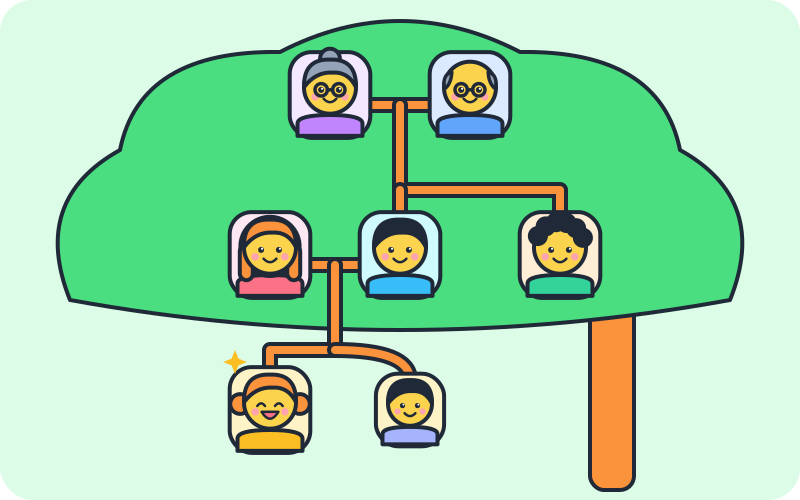
- avoĉjo
- oĉjo
Avoĉjo (grandad), panjo (mum), paĉjo (dad) and oĉjo (uncle): -ĉj- for each man, -nj- for the woman.
| Word | Pet form | English |
|---|---|---|
| | dad |
| | mum |
| oĉjo | uncle |
| onjo | auntie |
| fraĉjo | brother |
| franjo | sister |
is short, so PMEG adds -- to the whole word: o.
Mistakes English speakers make
| Wrong | Right | Why |
|---|---|---|
Johano. | Johanon. | an -o name takes -n |
Elisabethn | Elisabeth- | after a consonant: - |
Vigdíson | Vigdís | the title takes it |
Maĉjo (for Mario) | Manjo | -- for a woman |
What to do next
- Decide what you will call yourself in Esperanto, and use it.
- Build a pet name for three people you know, with the right suffix.
- Read the accusative again with names in mind.
See also
- The accusative - what the
-nis for in the first place. - Apposition -
Parizon, and when the-nrepeats. - Countries and peoples - the same question for places.
- Letter writing and register -
Maria, and where a name sits in a letter. - Affixes for size and people - the other suffixes that build a person.
- Who decides what is correct Esperanto? - the
and what its recommendations are worth. - Capital letters - capitalisation habits, all of them optional.
- Gender in Esperanto -
--, and why--and--are the other sexed pair.