
Esperanto Suffixes -et-, -eg-, -ul-, -ist- and -an-
By Michael McGettrickUpdated 12 October 2026
Two of these suffixes turn a dial and three make a person. -- makes a root smaller, -- bigger. --, -- and -- each turn a root into someone, and each answers a different question.
| Suffix | Job | Example |
|---|---|---|
-- | smaller, gentler | |
-- | bigger, stronger | |
-- | someone who is like that | |
-- | someone who does it as work | |
-- | someone who belongs to it | |
Quick check
Now use it: three quick questions on the chart above. The full practice is further down.
Pick the right one
0/3Which person suffix does each description need?
Someone who lives in the village.
Someone who cures people for a living.
Someone who is old.
The volume knob: -- and --
-- turns the root down: smaller, milder, gentler. -- turns it up: bigger, stronger, fiercer.

- hundeto
Hundeto, a little dog; hundo, a dog; hundego, a huge dog.
| Root | With -- | With -- |
|---|---|---|
| , house | | |
| , door | pordeto small door | |
| , wind | venteto breeze | |
| , rain | pluveto drizzle | |
.- They live in a cottage.
Not just nouns
The root can be any part of speech. On a verb or adjective the dial still turns:
| Root | With -- | With -- |
|---|---|---|
| , to laugh | | |
| , warm | | |
| , beautiful | | |
.- She smiled at me..- The coffee is lukewarm.
They stand alone too
Give either suffix an ending and it is a word of its own:
- tiny:- extremely:
Three ways to make a person
Three suffixes turn a root into a human being, and they are not interchangeable. Each answers its own question:
| Question | Suffix | Example |
|---|---|---|
| Like what? | -- | |
| Doing what? | -- | |
| Belonging to what? | -- | |
-ul-: what they are like
-- takes a quality and gives you someone who has it. It mostly sits on adjectives:
| Root | Person | English |
|---|---|---|
| , young | | a young person |
| , old | | an old person |
| , foreign | | a stranger |
| , rich | | a rich person |
| , wise | | a wise person |
.- The old person is sitting by the door.
It is not limited to adjectives: , a companion, is (with) plus --, a with-person.
-ist-: what they do
-- marks a job, a profession, or a practice kept up long enough to define someone:
| Root | Person | English |
|---|---|---|
| , to teach | | teacher |
| , to treat | | doctor |
| , sea | | sailor |
| , to cook | | cook |
|
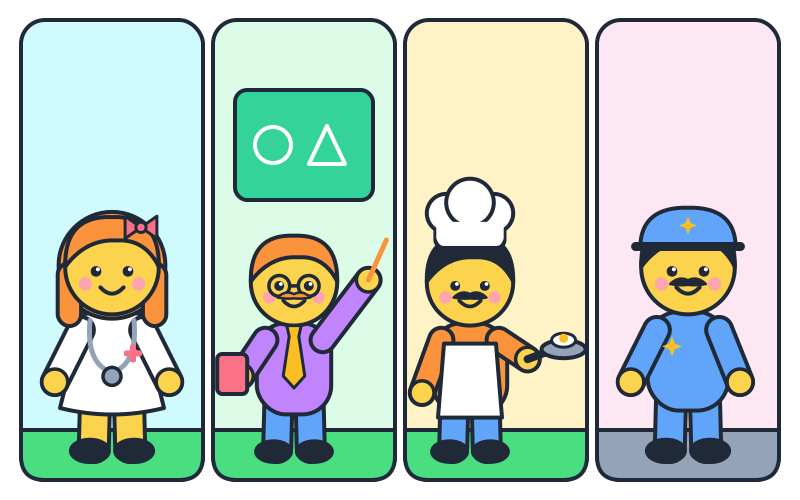
Kuracistino, a doctor (a woman); instruisto, a teacher; kuiristo, a cook.
-- is not the participle --. is whoever is teaching at this moment; is a teacher by trade:
.- My father is a teacher.
-an-: what they belong to
-- means a member, an inhabitant, a participant. It sits on places, groups and causes:
| Root | Person | English |
|---|---|---|
| , town | | townsperson |
| , village | | villager |
| , family | | family member |
| , congress | | congress-goer |
.- She is a villager.
Alone it is , a member. And , the word Esperantists use for each other, is sam- (same) + - (idea) + --: a member of the same idea.
The test, on one subject
Three people on the same ship, three different questions:
| Word | It says | English |
|---|---|---|
| the sea is their job | a sailor |
ŝipano | they belong to that ship | a crew member |
kuraĝulo | that is what they are like | a brave person |
Ask which question the English is really asking, and the suffix picks itself.
Is -ul- male?
By definition, no: -- is a person of any sex. Add -- for a woman:
- a young person- a young woman
In practice the bare form is often heard as male, much as English chairman is. Where sex is beside the point, (a young person) sidesteps the question.
Words that look built and are not
| Word | Looks like | Really |
|---|---|---|
| someone who rules | a rule ( |
| Rom- + -- | usually a novel, one root |
| - + -- | a German: one plain root |
| a plain root | a tool: the suffix -- alone |
The test is mechanical: strip the supposed suffix, and check that the root plus the suffix really gives the meaning.
Mistakes English speakers make
| You mean | Wrong | Right | Why |
|---|---|---|---|
| a young person | o | | young is a quality: -- |
| a teacher by e | | | |
| a ruler | | | |
| a huge house | | o | -- can |
What to do next
- Turn three nouns you know up and down:
--and--. - Name five people you know with
--,--or--. - Read word building for the other official affixes.
See also
- Word building -
-,--,--and the full affix list. - Participles -
--, the person doing it right now, against--. - Comparisons -
,andagainst--.