
Esperanto Participles as Nouns: parolanto, venkinto
By Michael McGettrickUpdated 12 October 2026
Put -o on a participle and you get a person, and the person carries a tense. is speaking now, has spoken, is about to. English speaker and winner say nothing about when.
| Ending | Means | Example | English |
|---|---|---|---|
-anto | doing it now | | the speaker |
-into | has done it | | the winner |
-onto | about to do it | | the groom-to-be |
- | a e | | a teacher |
- | a thing | | a drink |
-onta | coming | | next week |
Quick check
Now use it: three quick questions on the chart above. The full practice is further down.
Spot the mistake
0/3Each sentence has one wrong form. Tap it.
The grid of --, -- and -- is in participles. This page takes the -o forms, the suffixes they compete with, and the time phrases.
People who carry a tense
One root gives three people, one per tense:
| Form | English |
|---|---|
| the person speaking, a speaker |
| the person who has spoken |
| the next speaker, still to speak |
| a reader |
| a beginner |
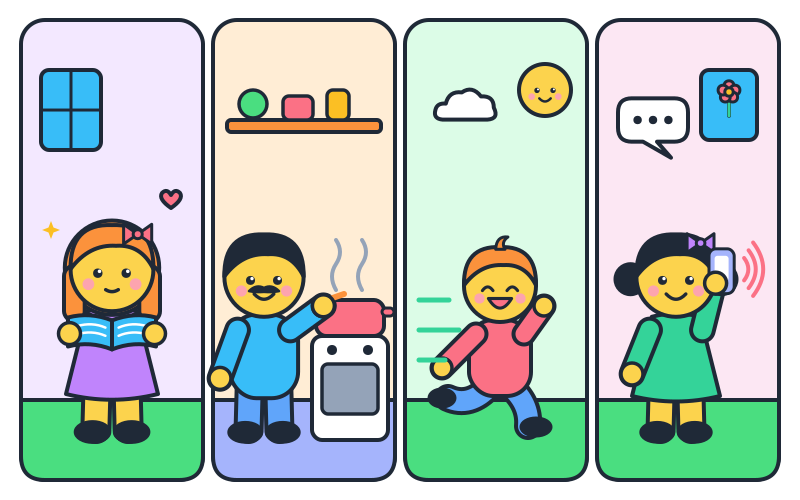
Legantino, a woman reading; kuiranto, a man cooking; kuranto, a boy running; parolantino, a girl talking. Each is in the middle of it, so -ant-.
From there they are ordinary nouns. They take -j, -n, -- and the article:
.- I listened to the speakers..- The (woman) speaker is my sister.
The -- people say in one word what English needs a phrase for: is the man about to marry, the people about to arrive.
venkinto, not venkanto
English winner has no tense, so English speakers reach for -- and get the wrong moment:
.- The winner received the. (The race is over.).- The one who is winning is running ahead of everyone. (The race is still on, though in a race people more often just say
Both are real words; they make different claims. The same choice runs through the vocabulary:
| Still going | English | Done | English |
|---|---|---|---|
| a dying person | | the deceased |
| people leaving | | people who have left |
| the one winning | | the winner |
Ask where the action has got to at the moment you are talking about, and the vowel follows.
Role, trade or member
Four suffixes make people, and each makes a different claim:
| Suffix | Claim | Example | English |
|---|---|---|---|
-- | doing it, while it lasts | | whoever is teaching |
-- | does it as a e | | a teacher |
-- | belongs to it | | a club member |
-- | is marked by it | | a young person |
against is the sharpest pair. An teaches for a living, even on holiday; an is whoever is teaching now, trade or no trade:
.- She is a teacher.Petro.- Today the one teaching is Petro.
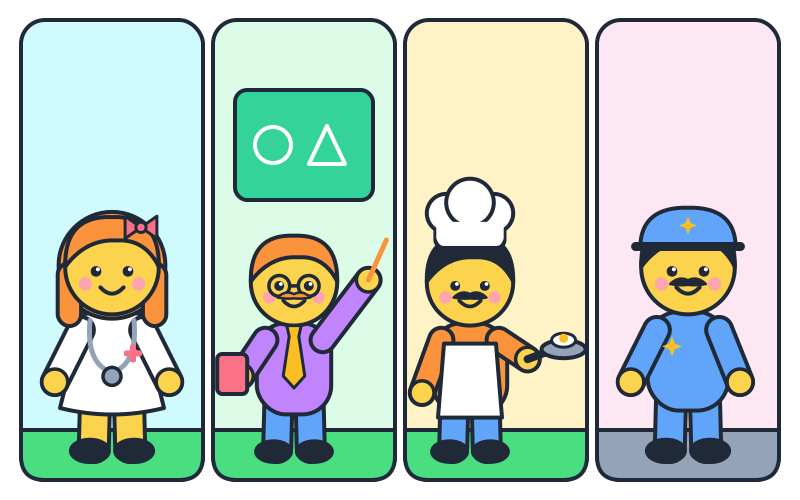
Kuracistino, a (woman) doctor; instruisto, a teacher; kuiristo, a cook. Each one's job, so -ist-. The teacher at the board is also an instruanto, for as long as he is teaching.
That is why a beginner is : beginning is a phase you grow out of, not a trade, so nobody is a o. is the usual word for a pupil or a learner on a course, and a university student is a .
-aĵ-: a thing, not a person
Put -- on the bare root instead and you get a concrete thing, not a person:
| Root | Thing | English |
|---|---|---|
| | a drink |
| | food |
| | a building |
| | a e of news |
on?- Would you like a drink?
The participle can go inside too: o is something that has been drunk. It is grammatical and heavier. Build on the bare root by default, and keep the participle form for when the finished action is really the point.
Next week, last year
The -a forms are adjectives, and two of them give the time phrases you need every week:
| Esperanto | English |
|---|---|
| next week |
| next month |
| last week |
| last year |
| this year |
la pasinta semajno (gone by)
ĉi tiu semajno
la venonta semajno (still to come)
Timeline from past to future, with now marked.
They agree like any adjective, including the -n of a time phrase:
.- I will see you next week.
usually means final in a series:
It can also mean most recent ( , the latest news), so is not wrong for last week, but it can be read as the final one. For the week just gone, is the unambiguous choice. And (current) is not a participle at all: it is (now) plus the adjective ending.
estonteco and pasinteco
-- makes a quality or state. On a participle it gives two everyday nouns:
- the future (the state of being about to be).- the past..- In the future we will live in another town.
The adjective has two near neighbours: (coming, next) picks out the next in a sequence, while (future, to-be) is what someone or something will become. So a wife-to-be is ; would be his next wife.
Mistakes English speakers make
| Avoid | Better | Why |
|---|---|---|
| | after the race, it is over: -- |
| | the participle agrees, -n included |
o | | beginning is a phase, not a e |
o | o | a drink: build on the bare root |
What to do next
- Build the three people from
,and, and say who each is. - Write one sentence each with
- Then read the passive for the
-ata,-itaand-otaforms.
See also
- Participles - the
--,--,--grid this page stands on. - The passive -
-ata,-ita,-ota, and the participle insideo. - Affixes for size and people -
--,--and--in full. - Word building - the affix system
--and--belong to. - Time expressions - the rest of the calendar these phrases sit in.