
The Esperanto Article la: When to Use It and When Not
By Michael McGettrickUpdated 11 October 2026
Esperanto has one article, (the), and no word at all for a. never changes form, and a bare noun already means a: is a dog. So every choice on this page is the same choice: , or nothing?
| Situation | Article | Example | English |
|---|---|---|---|
| first mention | none | . | I saw a dog. |
| already mentioned | | . | The dog barked. |
| only one exists | | | the sun |
| pointed at | | . | Close the door. |
| a whole concept | | . | Life is beautiful. |
| a profession | none | . | He is a teacher. |
| a plain name | none | Parizo . | is beautiful. |
Quick check
Now use it: three quick questions on the chart above. The full practice is further down.
Pick the right one
0/3La or nothing? Pick 'la' if both speakers know which one is meant; pick 'nothing' if the noun should stand bare.
Mi vidis hundon sur la strato. (a dog - first mention)
hundo estis tre granda. (the dog we just mentioned)
Ŝi fermis okulojn. (she closed her eyes)
does not change for number or case. Only the noun does:
| Esperanto | English |
|---|---|
| the dog |
| the dogs |
. | I saw the dog. |
. | I saw the dogs. |
There is no word for a, and nothing stands in for one. and are not articles: each says more than a does.
| Esperanto | English | What it adds |
|---|---|---|
. | I saw a dog. | nothing: this is a |
. | I saw one dog. | a count |
. | I saw some dog or other. | vagueness |
The core rule: known to both of us
Use when both you and your listener already know which one is meant. Everything else on this page is that rule meeting a particular situation.
A thing becomes known to both of you in three everyday ways:
| Trigger | Esperanto | English |
|---|---|---|
| just mentioned | . . | I saw a dog. The dog barked. |
| only one | . | The sun is shining. |
| only one | | the president of the club |
| situation-obvious | , . | Close the door, please. |
First mention, bare noun: your listener does not yet know which dog. Second mention, : now you both do.
.- I bought a book. (Which one? A fair question: no.).- Give me the book. (The one on the table:.)
Where English instincts mislead you
English and Esperanto agree on most article decisions, which makes the rest dangerous. Three disagreements do most of the damage.
Big concepts often take la
When a noun names a whole concept, English drops the article. Esperanto may keep it, treating the concept as one known thing, and in sayings about big abstract nouns it very often does:
.- Life is beautiful..- Money does not bring happiness..- Time flies.
French and Spanish speakers will recognise the habit ( vie est belle, es bella). But it is an option, not a rule: plain general statements are at least as often bare, and is not wrong.
.- Water boils at a hundred degrees..- They felt love. (some of it, not love in general)
Body parts take la, not a possessive
Where English says my hands or her eyes, Esperanto very often says , because whose they are is not in doubt:
.- I washed my hands..- She closed her eyes..- He shook his head.
is also correct; it says a little more than it needs to. Keep the possessive for when the owner matters:
.- The doctor examined MY hands.
Professions after estas take nothing
.- He is a teacher..- She became a doctor..- He is THE teacher (the one we meant).
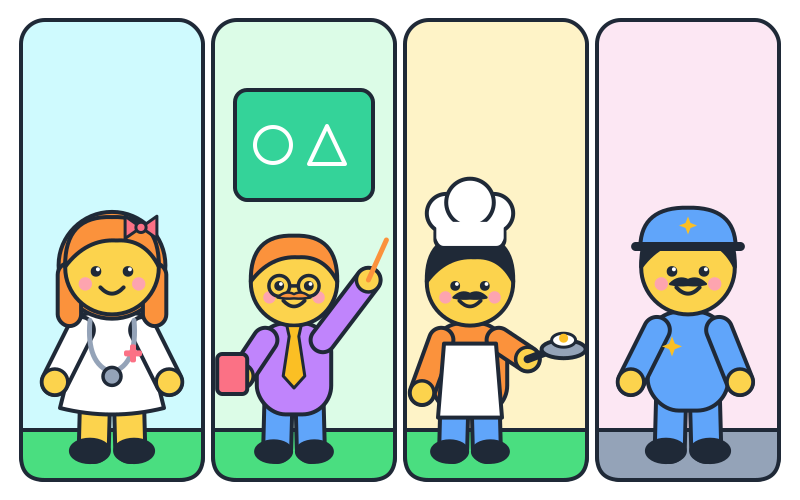
- .
- .
- .
A doctor, a teacher, a cook: after estas the job stands bare, with no word for a.
English inserts a; Esperanto does not, because the noun describes him rather than picking out one person. Adding is not a fix: it changes the meaning.
Mistakes English speakers make
| Wrong | Right | Why |
|---|---|---|
. | . | meaning a dog: |
. | . | first mention: nobody knows which dog |
. | . | meaning a driver: professions stand bare |
Parizo . | Parizo . | plain names take no |
Speakers of article-less languages (Russian, Polish, Chinese) make the opposite slip and drop where it is needed:
. .- I saw a dog. A dog barked. (Which dog? It sounds like a second one.)
A missing costs a little precision. A wrong promises your listener they know which one, and they do not. If you must err, err towards leaving it out.
Proper names: no la, except when the la belongs to the name
Plain names take no article, as in English:
Parizo .-is big.Maria .- Maria came..- I speak Esperanto.
Geography is where English misleads. A one-word name stands bare even where English says the; plural names and names built from ordinary words take :
| Kind | Esperanto | English |
|---|---|---|
| one-word name | Atlantiko, Mediteraneo | the Atlantic |
| plural name | Alpoj | the Alps |
| from common words | | the Red Sea |
| name after a noun | Tamizo | the River Thames |
Atlantiko is common in practice, but PMEG counts it as a slip it tolerates, not the .
A title built from common nouns keeps its , because the article is doing its ordinary job inside the name:
And a name earns a when you narrow it to one version of itself:
Zamenhof- the young Zamenhof (oneof him out of several)Parizo- theof my youth
Zamenhof's own advice: when in doubt, leave it out
The Fundamento's own grammar says the article is used as in other languages, and then adds that people who find it difficult may at first simply not use it.
That is a remarkable thing for a language's founding document to say, and it is worth taking at face value. Aim for the rule (known to both means ), but when a sentence leaves you torn, omit:
.- I drank (some / the) coffee. Understood either way; at worst a little vague.
What to do next
- Read a short Esperanto text and, at each
, name its trigger: mentioned, only one, situation, concept or body part. - Say five sentences about your morning with body parts and
: - Then read nouns and adjectives: the four forms every noun after
can take.
See also
- Word endings - why
is the one word in the noun phrase that never agrees with anything. - Demonstratives -
and - Correlatives -
and, the words that do some of the work articles do elsewhere. - Negation - the other precision tool: where
goes changes what the sentence denies.