
Esperanto Grammar on One Page: All 16 Rules
By Michael McGettrickUpdated 12 October 2026
Esperanto's whole official grammar is sixteen numbered rules, the , fixed in 1905. Here they are in Zamenhof's order, each with an example and a link to the article that covers it in full. Rules 1 to 8 are the parts of speech; rules 9 to 16 are general rules.
| Rule | Says | Example |
|---|---|---|
| 1 | one article, | |
| 2 | nouns end -o, plus -j, -n | |
| 3 | adjectives end -a; than = ol | |
| 4 | numerals never change | |
| 5 | pronouns; -a makes them "my" | |
| 6 | one form for every person | , |
| 7 | adverbs end -e | |
| 8 | prepositions take the plain form | |
Quick check
Now use it: three quick questions on the chart above. The full practice is further down.
Pick the right one
0/3Which rule of the Fundamento is doing the work in each of these?
Mi iras en la ĝardenon.
Neniu venis.
de l' mondo
| Rule | Says | Example |
|---|---|---|
| 9 | read every letter as written | |
| 10 | stress the second-last syllable | |
| 11 | compounds: the main root last | |
| 12 | one negative per clause | . |
| 13 | direction takes -n | |
| 14 | | |
| 15 | international words keep their shape | |
| 16 | -o may lose a vowel | |
What the Fundamenta Gramatiko is
It is one of the four parts of the , beside a preface, the o (exercises) and the (about 2,600 roots).
| Fact | The grammar |
|---|---|
| First printed | 1887, in the first textbook |
| Made binding | August 1905, by the first |
| Languages | French, English, German, Russian, Polish |
| Layout | the alphabet, then rules 1-8, then rules 9-16 |
| Spelling | o: an apostrophe marks root and ending |
The quotations below are from the English column. Read straight through the apostrophe spelling: it was for elementary works only.
Rules 1-4: article, nouns, adjectives, numerals
Rule 1: the article
"There is no indefinite, and only one definite, article,
, for all genders, numbers, and cases."
- a person: no word for "a"
When to use is not in the rule: the article la covers it.
Rule 2: nouns
"Substantives are formed by adding o to the root. For the plural, the letter j must be added to the singular."
The object, the rule goes on, "adds an n after the o". Every other case is a preposition: for of, for to, for with.

Unu pomo, tri pomoj: one apple, three apples. The -j is the whole plural.
.- I see the house..- I see the houses.
More: word endings, nouns and adjectives, the accusative.
Rule 3: adjectives
"Adjectives are formed by adding a to the root. The numbers and cases are the same as in substantives."
So an adjective takes the -j and -n of its noun. Comparison uses (more) and (most), and "the word 'than' is rendered by ".
.- I see the beautiful houses.
More: comparisons.
Rule 4: numerals
"The cardinal numerals do not change their forms for the different cases."
The rule lists twelve: . Bigger numbers are joined, as in its own example , 533. The derived numbers are endings and suffixes:
| Piece | Example | English |
|---|---|---|
-a (order) | | first |
-- | | threefold |
-- | | a half |
-- | | four together |
| | five each |
-e (adverb) | | firstly |
More: numbers, fractions and multiples.
Rules 5-8: pronouns, verbs, adverbs, prepositions
Rule 5: pronouns
"Possessive pronouns are formed by suffixing to the required personal, the adjectival termination."
The list is . Add -a for the possessive and -n for the object, as on a noun:
.- He sees me.
More: personal pronouns, the reflexive si, oni.
Rule 6: verbs
"The verb does not change its form for numbers or persons"
| Ending | What it is | Example |
|---|---|---|
-as | present | |
-is | past | |
-os | future | |
-us | conditional | |
-u | command | ! |
-i | infinitive | |
The English column calls -us the subjunctive ("she may do"); Esperanto grammars call it the conditional. The rule then gives six participles (-- -- --, -- -- --) and the passive, plus a passive participle, with for "by":
.- She is loved by everyone (the Fundamento's example).
What -- against -- means in the past was argued over for decades; in 1967 the Esperanto declared the aspect reading (-- finished) the one that matches Zamenhof. More: verb tenses, participles, the passive.
Rule 7: adverbs
"Adverbs are formed by adding e to the root."
Comparison works as for adjectives:
.- My brother sings better than I do (the Fundamento's example).
More: adverbs.
Rule 8: prepositions
"All prepositions govern the nominative case."
The nominative is the plain form, without -n:
.- I am talking with the friend..- That is for the children.
When -n does follow a preposition, Rule 13 is at work, not the preposition. More: prepositions.
Rules 9-16: the general rules
Rule 9: pronunciation
"Every word is to be read exactly as written, there are no silent letters."
Each of the 28 letters has one sound: is CHEE-oo. Where hats cannot be printed, the allows an h instead (ch for ĉ). More: pronunciation, typing Esperanto.
Rule 10: stress
"The accent falls on the last syllable but one, (penultimate)."
- a--ko
The twist is Rule 16: a word that drops its -o keeps its stress, so (from ) is one stressed syllable. More: poetic Esperanto.
Rule 11: compounds
"Compound words are formed by the simple junction of roots, (the principal word standing last)"
- a steamship:++-o, the ship last.
More: compounding.
Rule 12: negation
"If there be one negative in a clause, a second is not admissible."
.- Nobody came. (Not.- I never saw him.
More: negation.
Rule 13: direction
"In phrases answering the question "where?" (meaning direction), the words take the termination of the objective case"
The rule's own examples are ? (where are you going?) and for "home".
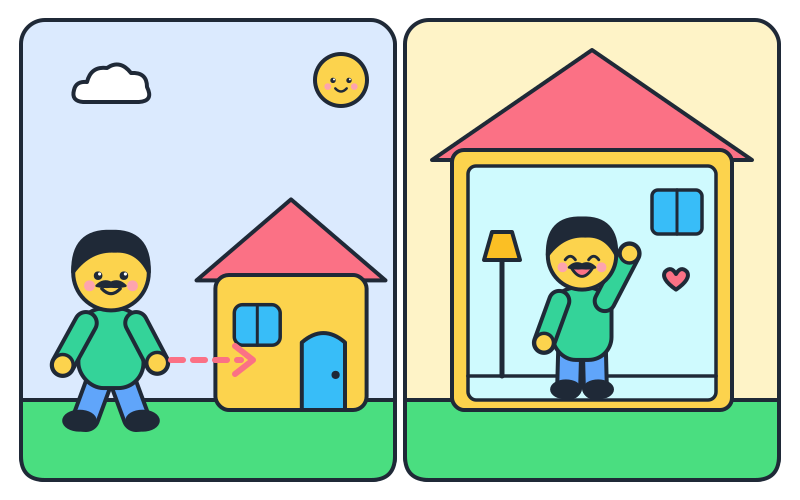
- .
- .
Li iras hejmen: he is going home. Li estas hejme: he is at home. Only the -n differs.
.- I am going into the house..- I am walking about in the house.
More: the accusative.
Rule 14: fixed meanings, and je
"Every preposition in the international language has a definite fixed meaning."
Where no preposition is clearly right, the rule says to use , "which has no definite meaning". It adds: "Instead of , the objective without a preposition may be used, when no confusion is to be feared."
.- I will come on Monday (the-nin place of a preposition).
More: tricky prepositions.
Rule 15: international words
"The so-called "foreign" words ... undergo no change in the international language, beyond conforming to its system of orthography."
The rule borrows the root and builds the rest: its example is , theatre, but , theatrical, not a borrowed teatricala. More: false friends, the letter ĥ.
Rule 16: elision
"The a of the article, and final o of substantives, may be sometimes dropped euphoniae gratia"
An apostrophe takes the vowel's place:
- for, heart
The rule allows nothing else: not the -o of or , not an adjective's -a. It lives in poetry and song. More: poetic Esperanto.
Mistakes English speakers make
| Wrong | Right | Why |
|---|---|---|
| | Rule 8: plain form |
. | . | Rule 12: for nobody came, one negative |
. | . | Rule 13: going home, so -n |
| | Rule 3: than is |
. | . | Rule 7: adverb -e |
| | Rule 3: the adjective agrees |
What the sixteen rules do not say
The rules hold every ending in the language. They do not hold the language. None of these is in them:
| Not in the rules | Example | Settled by |
|---|---|---|
| the correlatives | | the |
questions with | ? | the |
| the affixes | | the |
-- and -- | | the , and usage |
| transitivity | . | the o, and usage |
| word order | . | usage |
| capital letters | | usage |
A note on four of them:
- Affixes. PMEG counts ten official prefixes:
- ĉef- - - - - - - - -. Many textbooks add-(o, a scoundrel), which thehas only as an exclamation. See word building. - Correlatives. All forty-five come from one grid: correlatives.
- Word order.
.- The dog saw the cat: the-n, not the position, marks the object. See word order. - Capitals. The
writeswith a capital, and PMEG still recommends it; many now write. See capital letters.
The rules never grew
The Esperanto adds words and gives advice. It cannot touch the sixteen rules, and in more than a century nothing has:
| Since 1905 | What happened |
|---|---|
| ten, the latest in 2023: new words | |
| 1967 | -- / --: the aspect reading |
| 1974 | country names in - are correct |
| 2007 | the h-system first, without hats |
| the sixteen rules | unchanged |
.- The house was built (finished: the 1967 reading).Francioando- France: both in use, and theaccepted-in 1974. See countries and peoples.
For a learner the consequence is simple: the grammar you have learned is the grammar, and there is no second edition.
What to do next
- For each rule, name a sentence you said this week.
- Go deep on the rule you hesitate over: usually the accusative or negation.
- Then read where to go from here.
See also
- The Fundamento and the Akademio - who decides, and why the rules cannot move.
- Word endings -
-o,-a,-e,-i: Rules 2, 3, 6 and 7 in one place. - The accusative - Rule 2's
-nand Rule 13's. - Correlatives - the forty-five-word table that is not one of the sixteen rules.
- Word building - the half of the language the rules leave open.
- Where to go from here - you have the grammar and three thousand roots. What now.