
Esperanto Prepositions: The Full List, With Examples
By Michael McGettrickUpdated 12 October 2026
Each preposition has one meaning, and none of them changes the noun after it. , , : the noun stays plain. Five rules cover the whole system:
| Rule | Example | English |
|---|---|---|
| one meaning each | | with friends |
| one meaning each | | with a |
| no case after it | | on the table |
-n only for motion | | into the house |
nothing fits: | | at three o'clock |
a clause: , | , | because he was tired |
Quick check
Now use it: three quick questions on the chart above. The full practice is further down.
Spot the mistake
0/3Each sentence has one wrong word. Tap it.
Where: place and movement
Six of the commonest, round one box:
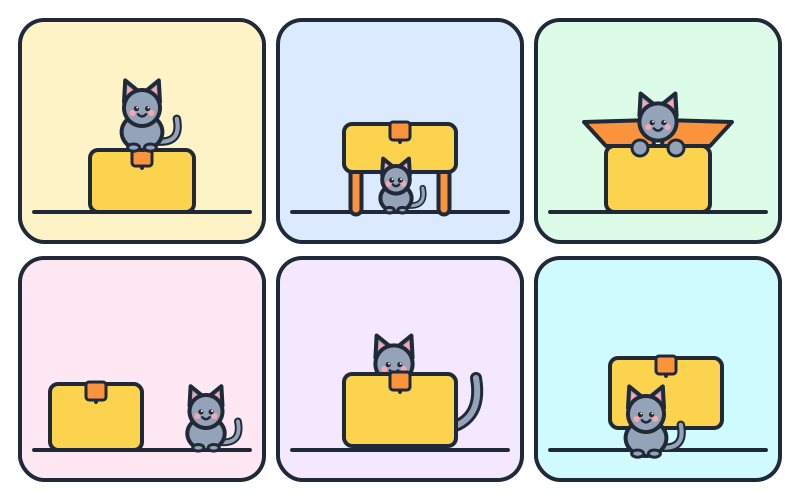
Sur la skatolo, on the box; sub, under it; en, in it; apud, beside it; malantaŭ, behind it; antaŭ, in front of it.
The rest of the place words:
| Preposition | Example | English |
|---|---|---|
| | above the table |
| | at my friend's |
| | between the trees |
| | around the house |
| | outside the town |
| | across the river |
touches, does not: the book is , the lamp hangs .
And the movement words:
| Preposition | Example | English |
|---|---|---|
| | to the town |
| | out of the house |
| | from the town |
| | as far as the sea |
| | through the park |
| | along the river |
| | past the church |
When
, , and work for place and for time; only for time:
| Preposition | Example | English |
|---|---|---|
| | before the lesson |
| | after the lesson |
| | during the night |
| | until tomorrow |
| | at about three |
.- We will eat after the film.
The rest: with, for, about
| Preposition | Example | English |
|---|---|---|
| | with friends |
| | by train |
| | for you |
| | because of the weather |
| | about the film |
| | without money |
| | against the wind |
| | according to my father |
| | a glass of water |
| | instead of coffee |
| | everyone except him |
| | despite the rain |
| | two each |
| | at three |
English with hides two words. is company; is the tool:
.- I eat with friends..- I eat with a.
No case after a preposition, except direction
A noun after a preposition stays plain, even when the verb lands on it: . (I talked about the film), never .
The one exception is movement. After a place word, -n turns where it is into where it goes:
| Position | English | Movement | English |
|---|---|---|---|
| in the house | | into the house |
| on the table | | onto the table |
| under the bed | | (going) under the bed |
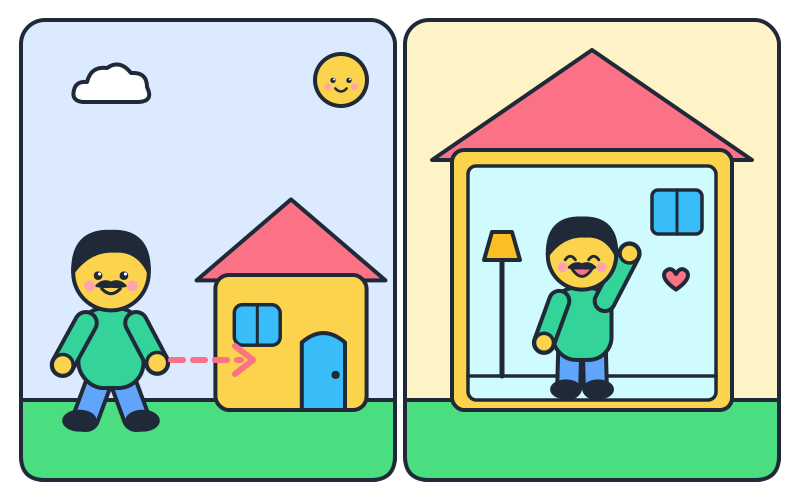
- .
- .
Li iras en la domon, he goes into the house: movement, so -n. Li estas en la domo, he is in the house: no movement, no -n.
and already mean movement, so they never take it: . (I am going to the town). The accusative has the full set of jobs for -n.
je: when nothing else fits
The 14th rule of the gives every preposition a fixed meaning and adds for when none of them fits. means nothing by itself. Usage has settled it on a few jobs:
| Use | Example | English |
|---|---|---|
| clock time | | at three o'clock |
| a few verbs | . | I believe in you. |
| set phrases | | to my surprise |
The same rule lets a bare accusative replace where the meaning survives: also means at three o'clock. Not everywhere: is I believe in you, while believing what someone says is , a different claim. Use sparingly; a preposition with a meaning is usually clearer. The tricky prepositions has the rest of , and .
da or de
follows a quantity and joins it to the stuff measured. does the rest: whose, and where from.
| Esperanto | English | Why |
|---|---|---|
| a glass of water | how much: |
| a lot of people | how much: |
| my father's house | whose: |
| a letter from my brother | from: |
No after : for many of the people say . Quantity has the minimal pairs.
anstataŭ, krom, malgraŭ
These three need more than a table row.
(instead of) can take an infinitive straight away, like and :
, .- Instead of working, he slept.
(despite) takes a noun:
, .- Despite the night, we walked.
means both except and besides. The rest of the sentence decides:
| Signal | Esperanto | English |
|---|---|---|
| . | Everyone came except him. |
| , . | Besides him, she came too. |
When it must be unmistakable, is always except him.
A clause after a preposition: tio, ke
A preposition takes a noun, not a clause. To hang a clause on one, put in the noun's place and the clause after :
, , .- Because we had no money, we stayed at home., .- We talked about the fact that he had left.
A few pairs have become conjunctions of their own and take directly:
| Conjunction | Example | English |
|---|---|---|
| , . | I came so you would not be e. |
| , . | He left without our seeing him. |
| , . | She worked, although she was tired. |
The long form with is just as correct. and are not standard: say , , and , or simply (because).
Mistakes English speakers make
| Wrong | Right | Why |
|---|---|---|
| | |
| | no -n after a preposition, bar motion |
| | a tool is |
| , | |
| | no |
What to do next
- Describe your room with six place prepositions.
- Say three things you did with a tool (
) and three with a person (). - Then read the tricky prepositions for
and the rest of.
See also
- The tricky prepositions -
,, and - The accusative - every job of
-n, direction included. - Quantity -
,and the quantity words. - Subordinate clauses -
and the other clause words.