
Tricky Esperanto Prepositions: je, po and Direction -n
By Michael McGettrickUpdated 12 October 2026
Four corners of the preposition system need a closer look. has no meaning of its own, shares out a number, and can leave unclear whose role they replace, and -n after a place word means movement.
| Corner | Example | English |
|---|---|---|
| | at three o'clock |
| | two apples each |
-n | | instead of me (object) |
| | everyone except him |
direction -n | | into the house |
Quick check
Now use it: three quick questions on the chart above. The full practice is further down.
Pick the right one
0/3je, po or al? The English decides.
Ni komencos la tria horo. (at three o'clock)
La tri infanoj ricevis du pomoj. (two apples each)
Mi donis la libron mia patrino. (to my mother)
je: the preposition with no meaning
Rule 14 of the gives every preposition one fixed meaning, then adds for when none of them fits. means nothing by itself; usage has settled it on a short list:
| Use | Example | English |
|---|---|---|
| clock time | | at three o'clock |
| a body part held | . | He caught me by the arm. |
| belief in | . | I believe in God. |
| a difference | | younger by two years |
| set phrases | | to your health |
| set phrases | | to my surprise |
My arm is the part caught, so . His arm, the tool he caught me with, takes : . - He caught me with his arm.
The same rule lets a bare -n replace where the meaning survives. It is common for times and measures:
Not every can go. is I believe in you; is a different claim, I believe you (what you say).
po: so many each
shares a number out: the number applies to each member of a group, not to the group as a whole.
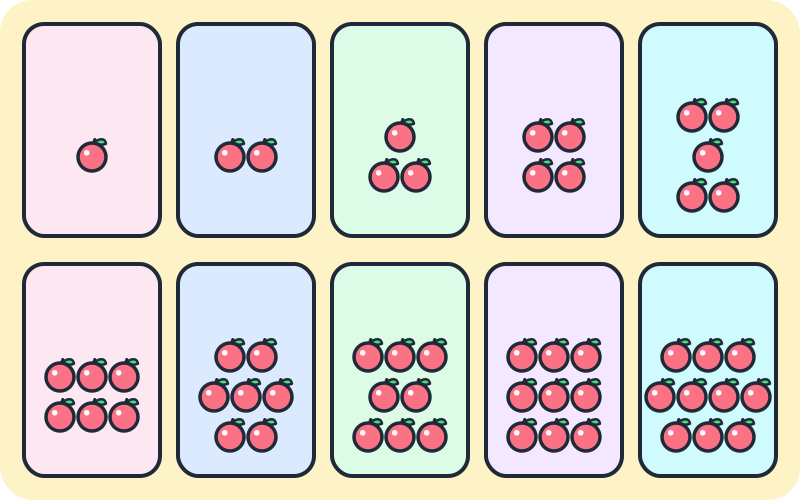
Tri infanoj ricevis po du pomoj: two apples each, six apples in all.
.- Three children got two apples (two in all)..- Three children got two apples each (six in all).
goes straight before the number or other amount ( , ), never before the unit:
| Wrong | Right | Why |
|---|---|---|
| | |
| | the ten is what repeats |
The second is the classic slip: English ten dollars a puts its distributive word before . In Esperanto the repeated amount takes , and the unit usually takes , or another fitting word such as .
.- I will read ten pages a day.
The -n after po
Does the noun after take -n when it is the object? The movement has never agreed:
| As a preposition | As an adverb |
|---|---|
blocks -n | the object keeps -n |
| |
PMEG says both uses are correct. This site writes , and marks nobody wrong for the other.
anstataŭ: whose place?
(instead of) says that something else took the role, but not which role. With a subject and an object both in play, -n can show that the replaced person was the object:
.- He wrote the letter instead of me (I would have written it)..- She invited him instead of me (I would have been invited).
Zamenhof's own pair, quoted in PMEG:
Petro Paŭlon Vilhelmo.- Petro, not Vilhelmo, hit Paŭlo.Petro Paŭlon Vilhelmon.- Petro hit Paŭlo, not Vilhelmo.
Another preposition can do the same job: . - He did it for her sake instead of mine. Where nothing is unclear, plain is all you need: , .
krom: except or besides
means both except and besides. The rest of the sentence decides:
| Signal | Example | Reading |
|---|---|---|
| . | except: he did not come |
| a negative | . | except: only she knows |
| , . | besides: both came |
When it must be unmistakable, use the long forms: is only except him, only besides him.
A -n after is possible for an object ( ), but PMEG calls it practically always superfluous, though not wrong: context almost never leaves doubt.
Direction -n: into, onto
After a place preposition, -n turns where it is into where it goes:
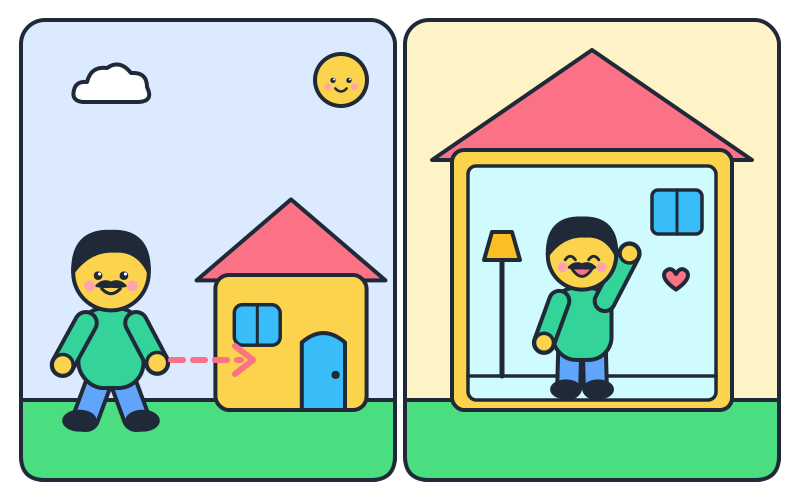
- .
- .
Li iras en la domon, he goes into the house: movement, so -n. Li estas en la domo, he is in the house: no -n.
| Position | Movement | English |
|---|---|---|
| | into the house |
| | onto the table |
| | to under the bed |
and already mean direction, so they never take it: . The accusative has the full set of jobs for -n.
Mistakes English speakers make
| Wrong | Right | Why |
|---|---|---|
| | no -n after |
| | |
. | . | he would be a subject: no -n |
| | |
What to do next
- Say what time you get up, eat and go to bed, with
. - Share out something in your house with
. - Then read prepositions again: every other one has a single meaning.
See also
- Prepositions - the full system,
and, and the,pattern. - The accusative - every job of
-n, direction included. - Adverbs -
and, built from the same-n. - Time expressions -