
Esperanto Numbers: Counting With Nine Roots, No Exceptions
By Michael McGettrickUpdated 11 October 2026
Learn nine roots plus , and , and one spelling rule joins them into every number in Esperanto. Tens and hundreds join (, twenty); everything else stays apart ( , twelve). Nothing is irregular.
Quick check
Three quick questions on what you have just read. The full practice is further down.
Fill in the blank
0/3Write the number in Esperanto. Watch the join rule: tens and hundreds join up, everything else stays apart.
12 = (10 plus 2: dek stands alone, so two words.)
Accents optional - cx, gx, ux work for ĉ, ĝ, ŭ
40 = (4 tens, so one word.)
Accents optional - cx, gx, ux work for ĉ, ĝ, ŭ
44 = (One joined ten, then a separate unit.)
Accents optional - cx, gx, ux work for ĉ, ĝ, ŭ
Ninety-seven is , nine-ten seven, where French needs quatre-vingt-dix-sept and English hides the ten inside eleven and twelve.
The whole vocabulary
| Number | Word | Number | Word |
|---|---|---|---|
| 0 | | 6 | |
| 1 | | 7 | |
| 2 | | 8 | |
| 3 | | 9 | |
| 4 | | 10 | |
| 5 | | 100 | |
| 1000 | |
 one
one two
two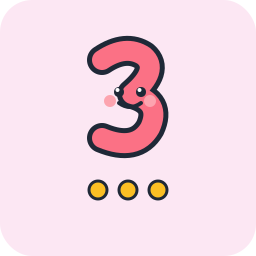 three
three four
four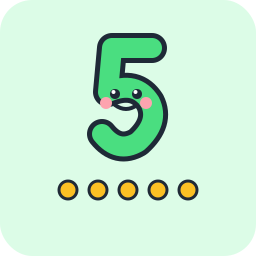 five
five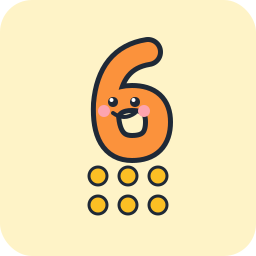 six
six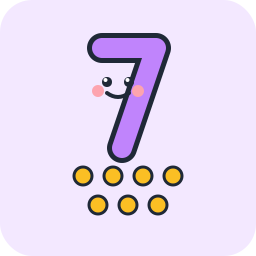 seven
seven eight
eight nine
nine ten
ten
That is the list. Every number up to 999,999 is built from these:
.- I have two books.aĝa.- She is ten years old.
Zero
is the numeral; is the noun, for zero as a thing:
.- The temperature is below zero.
Saying them
Esperanto spelling is phonetic, so the only traps are letters English reads differently:
| Word | Say it | The trap |
|---|---|---|
| tsent | c is always ts, never the coin |
| | a real k then a real v, not kw |
| now | one syllable: ŭ is a w glide |
| | stress falls on the second-to-last |
The join rule
Two operations, two spellings:
| Number | Esperanto | Working |
|---|---|---|
| 12 | | 10 + 2 |
| 20 | | 2 x 10 |
| 22 | | 2 x 10 + 2 |
| 90 | | 9 x 10 |
| 101 | | 100 + 1 |
| 123 | | 100 + 20 + 3 |
| 200 | | 2 x 100 |
| 250 | | 200 + 50 |
| 999 | | 900 + 90 + 9 |
is a joined ten and a separate unit in one breath; after that, the number line writes itself. In a sentence:
.- She is twenty-two. (literally: has twenty-two years)
The join happens only with and . always stays a separate word, because almost anything can stand in front of it ( , 333,000):
as a misspelling)
The popular shortcut, "multiplication joins, addition stays apart", is right everywhere except here.
The number line from 11 to 1,000
Every ten and hundred, written out. Each one is the join rule applied once.
The teens and the tens
| Number | Esperanto | Number | Esperanto |
|---|---|---|---|
| 11 | | 20 | |
| 12 | | 30 | |
| 13 | | 40 | |
| 14 | | 50 | |
| 15 | | 60 | |
| 16 | | 70 | |
| 17 | | 80 | |
| 18 | | 90 | |
| 19 | | 100 | |
The hundreds
| Number | Esperanto | Number | Esperanto |
|---|---|---|---|
| 100 | | 600 | |
| 200 | | 700 | |
| 300 | | 800 | |
| 400 | | 900 | |
| 500 | | 1000 | |
They do not decline
Cardinals take no -j and no -n. The noun takes both; the number sits still:
.- I see three books.
If your first language puts endings on numbers, this is the habit to drop, and nothing replaces it. The one exception is as a pronoun rather than a count:
unuj- the ones and the others
Words built from numbers do decline, because they are no longer numbers. An ordinal is an adjective; is a noun:
Thousands, millions and billions
is a numeral like : no ending, no . Unlike , it stays apart from the number in front of it:
| Number | Esperanto |
|---|---|
| 1,000 | |
| 2,000 | |
| 10,000 | |
| 100,000 | |
| 1987 | |
| 2026 | |
Above that the words are nouns ending in -o: (a million) and (a billion). Like any noun they take the plural and object endings, and they link to what they count with :
.- They sold three million books.
The -n goes on , the object. stays plain, because is a preposition and shields the noun behind it. A big number mixes both systems:
Ordinals: add -a
Any number plus the adjective ending -a is an ordinal:
| Number | Ordinal | English |
|---|---|---|
| | first |
| | second |
| | third |
| - | twelfth |
| - | twenty-first |
A compound is usually joined with a hyphen so the -a clearly covers the whole number; written apart is also correct. Ordinals agree like adjectives and tell the time:
.- At three o'clock.
Swap -a for -e and you get the adverb:
, .- Firstly, I do not know.
Fractions, multiples and groups are built the same way, with suffixes: see fractions, multiples and groups.
Numbers and da
A bare numeral is complete on its own: , never . Only a number noun links with :
The full rule, with and , is in quantity.
Mistakes English speakers make
| Wrong | Right | Why |
|---|---|---|
| | addition stays apart |
| | |
| | tens and hundreds join up |
trin | | numerals take no endings |
| | no |
| | |
biliono (billion) | | biliono is a trillion |
(a book) | | no indefinite article |
What to do next
- Read your phone number aloud in Esperanto, digit by digit.
- Say this year and the year you were born.
- Then read fractions, multiples and groups.
See also
- Fractions, multiples and groups -
,a,eand. - Quantity -
,,and therule in full. - Time expressions - numbers at work in clock times and dates.