
The Esperanto Calendar: Zamenhofa Tago and Other Festivals
By Michael McGettrickUpdated 12 October 2026
The year has two dates of its own: 15 December, Zamenhof's birthday, and 26 July, when the first textbook was cleared for sale in 1887. Around them sit the ordinary feasts, whose names you build from parts, and the wishes, which all end in -n.
| When | Name | What it marks |
|---|---|---|
| 15 December | Zamenhofa | Zamenhof's birthday, 1859 |
| 26 July | | the first textbook, 1887 |
| July or August | | the world congress, a week |
| 25 December | | Christmas |
| 1 January | | New Year's Day |
Quick check
Now use it: three quick questions on the chart above. The full practice is further down.
Spot the mistake
0/3Tap the word that is wrong.
!- Have a happy festival!
Zamenhofa Tago: 15 December
Zamenhof was born on 15 December 1859, and his birthday is the one date the whole movement keeps, with club meetings, talks and readings. The custom dates from the 1920s; the writers Baghy and Nikolao Nekrasov were among those who proposed it.
15- .- The club meets on 15 December.
The -n on the date means on, so no preposition is needed. Time expressions has the rule.
One footnote: the Russian Empire still used the calendar, so the records of his birth read 3 December. The 15th is the Gregorian date.
A book as a present
The day is also called -, the Day of the Esperanto Book. People exchange presents, preferably books written in Esperanto, and the reason is practical: the date falls ten days before Christmas. It is a custom, not a rule.
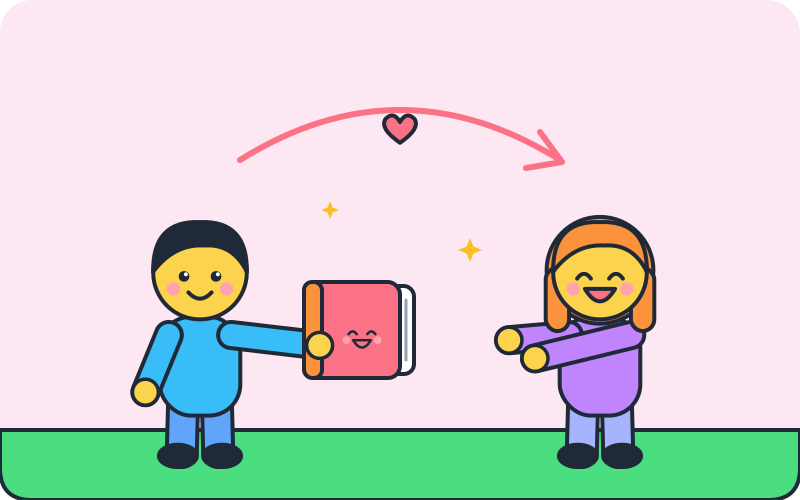
Mi donas libron al vi: I give you a book. Mi (I) gives, libron (a book) is the thing given, al vi (to you) receives it.
.- I am giving you a book.
Esperanto Day: 26 July, or 2 June
The first textbook, the , passed the Russian censor twice in 1887: once to be printed, once to be distributed.
| Date (Gregorian) | The censor allowed | Kept by |
|---|---|---|
| 2 June 1887 | printing | the Civito |
| 26 July 1887 | distribution | the UEA, as |
The UEA keeps 26 July (14 July by the calendar). The Civito, a separate Esperanto organisation, keeps 2 June, which it calls the only certain date.
1887.- The book came out in July 1887.
The history of Esperanto tells the story of the book, and la kongreso covers the summer congress.
Naming the feasts
Most feast names are compounds. The last root says what the thing is; the first says which one. Take them apart and they read themselves.
| Word | Pieces | English |
|---|---|---|
| Christ + | Christmas: Christ's birth |
| | New Year's Day |
| | a birthday |
| | an anniversary |
| one root | Easter, and also Passover |
.- We will travel home for Christmas.
Capitals
Feast names take a capital, like other names; weekdays do not. Months are the disputed case: the writes , and PMEG recommends the capital, but lower-case is very common, and it is what this site writes.
| Kind | Example | Capital? |
|---|---|---|
| feast | | yes |
| weekday | | no |
| month | | both are met |
-.- Easter is in April this year.
PMEG adds that no capitalisation rule in Esperanto is binding: these are conventions. Capital letters has the whole picture.
Festo or ferio?
English holiday covers two Esperanto words. A is the celebration; a is a day off work.
| Word | Means | Example |
|---|---|---|
| a celebration, party | . |
| a day free of work | . |
| the holidays, a break | ? |
The verb and adjective come from the same root:
.- We celebrated his birthday..- She wore a party dress.
Birthdays: naskiĝtago and datreveno
A is a birthday, the day somebody was born. A is any anniversary: the date coming round again.
| Word | Use it for | Example |
|---|---|---|
| a person | . |
| an event, a society | |
A birthday is one kind of anniversary, but the notes that is the better-understood word for it. To a person, say .
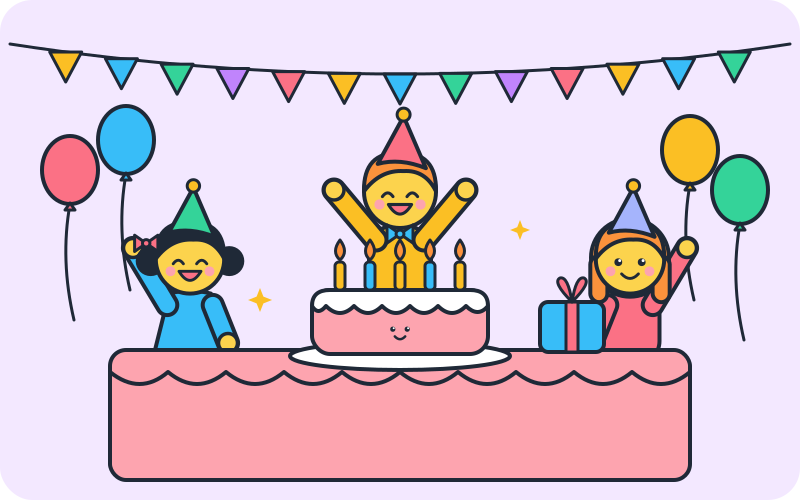
A naskiĝtago: the knabo (boy) has his birthday, the kuko (cake) has five candles, an amikino (friend, a girl) is at the party, and there is a donaco (present).
.- He is five today.
The wishes, and why they end in -n
Every wish is a sentence with the verb left out, and the full sentence is hardly ever said. PMEG explains it this way: ! is short for !, I wish you a good morning. The wish is the object of , so the adjective and the noun both take -n.
| Wish | When |
|---|---|
! | any festival |
! | Christmas |
! | the new year |
! | a birthday |
! | a departure |
The pattern is open: any adjective and noun, both with -n, make a wish, whether or not anyone has said it before.
!- Have a good weekend!!- Have a nice holiday!
Thanks and greetings work the same way with a different verb left out. PMEG gives ! as short for !, I give you thanks, and ! as !.
Mistakes English speakers make
| Wrong | Right | Why |
|---|---|---|
! | ! | the adjective takes -n too |
! | ! | the noun takes -n too |
15-a. | 15-. | -n makes the date mean on |
What to do next
- Write three wishes of your own, each an adjective and a noun with
-n. - Put 15 December and 26 July in your calendar.
- Read la kongreso, the summer event.
See also
- The Esperanto congress - the
- The history of Esperanto - the
- Capital letters - capitalisation gathered in one place, months included.
- Time expressions -
15-, and the-nof time. - Compounding - how
andare put together. - Esperanto and the religions - the faiths whose feasts these are, and the movement's neutrality.
- Letter writing and register -
against, and how to close.