
Esperanto Question Words: Kiu, Kio, Kie and the Ki- Table
By Michael McGettrickUpdated 11 October 2026
Esperanto's question words are one column of the correlative table: every one starts with ki-, and the ending says what is being asked. Put the word first, leave the rest of the sentence alone, and you have a question.
| Word | Asks about | English |
|---|---|---|
| individual | which one, who |
| thing | what |
| kind | what sort of |
| place | where |
| time | when |
| manner | how |
| reason | why |
| quantity | how much, how many |
| owner | whose |
Quick check
Now use it: three quick questions on the chart above. The full practice is further down.
Pick the right one
0/3Read the English in brackets, then pick the ki- word that asks for it.
homo venis? (which person came?)
estas tio? (what is that?)
estas via domo? (where is your house?)

- ?
- ?
- ?
- ?
Who, where, when, how much: the same ki- every time, and only the ending says what you are asking about.
Each at work:
| Word | Esperanto | English |
|---|---|---|
| ? | Who came? |
| ? | What happened? |
| ? | What kind of person is he? |
| ? | Where are you? |
| ? | When did you come? |
| ? | How are you? |
| ? | Why are you afraid? |
| ? | How much does it cost? |
| ? | Whose book is that? |
Swap ki- for ti- and every question becomes its own answer:
? .- Where are you? I am there.? .- When did you come? I came then.
Kiu against kio
picks an individual out of a set: which, and most of who. asks about an unnamed thing: what.
| Word | Esperanto | English |
|---|---|---|
| ? | Which of the children is speaking? |
| ? | Which person came? |
| ? | What is in your hand? |
counts, so it takes -j for several. never does:
?- Who came? (several people)?- Which people came?
The accusative: kiun and kion
When the ki- word is the object of the verb, it takes the accusative -n:
| Role | Esperanto | English |
|---|---|---|
| subject | ? | Who saw you? |
| object | ? | Whom did you see? |
| subject | ? | What happened? |
| object | ? | What did you say? |
English shows this split only in the fossil who/whom. Esperanto applies it every time. stacks both endings:
?- Which ones did you see?
A ki- word in front of a noun agrees with it, like any adjective:
?- Which friend did you help?
Kia, kiom and kies: three that behave differently
is an adjective, so it agrees with its noun:
?- What kind of books do you read?
asks about quality; asks which individual:
| Word | Esperanto | Wants as an answer |
|---|---|---|
| ? | a big old one |
| ? | that one on the corner |
asks how much or how many. A noun after it takes :
?- How much coffee do you drink??- How many children came?
never changes. When the thing owned is the object, the noun takes the -n:
?- Whose book did you take?
Kie and kien: where, and where to
The -n ending also marks direction. asks where something is; asks where it is going:
| Word | Esperanto | English |
|---|---|---|
| ? | Where do you live? |
| ? | Where are you going (to)? |
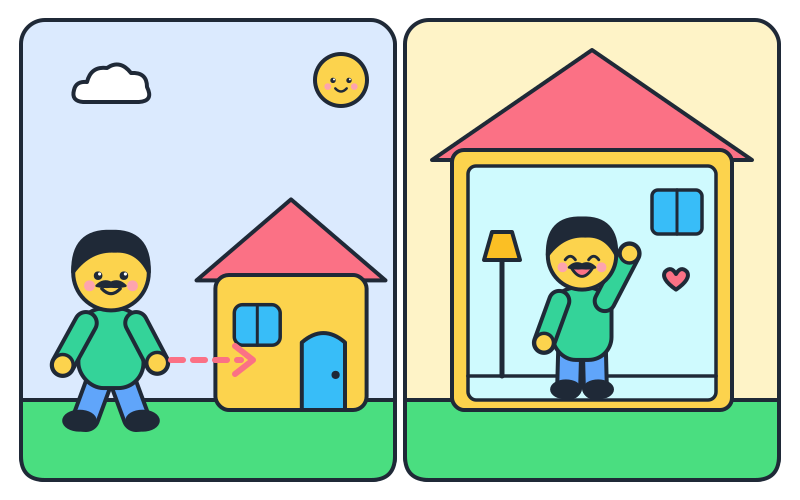
- ? .
- ? .
On his way in, he is going kien, into the house, with -n; once inside he is kie, in the house, with none.
English lost this split with whither. ? for where are you going? marks an English speaker at once.
With a preposition
A preposition goes in front of the question word, never stranded at the end:
| Esperanto | English |
|---|---|
? | Who are you talking to? |
? | What are you talking about? |
? | Who did you come with? |
After a preposition the ki- word normally takes no -n ( , not ): the preposition already shows its role. The one exception is direction after a place preposition such as or :
?- Which room do you sleep in??- Which room are you going into?
The prepositions page has the list.
Where the question word goes
To the front, and nothing else moves. No inversion, no do:
.- You came.?- When did you come?
Yes/no questions use instead of a ki- word ( ?, did you come?); that has its own article.
The same words without a question
The ki- words also open relative clauses and indirect questions, with the same endings and the same -n:
| Use | Esperanto | English |
|---|---|---|
| relative: who | , , . | The man who came is my brother. |
| relative: which | , , . | The book I am reading is long. |
| indirect question | , . | I do not know where he lives. |
How these clauses attach, and where the commas go, is in subordinate clauses.
Mistakes English speakers make
| Wrong | Right | Why |
|---|---|---|
? | ? | the object takes -n |
? | ? | going somewhere is |
? | ? | the preposition goes first |
? | ? | a ki- word already asks; drop |
Kioj ? | ? | -j |
What to do next
- Ask yourself one question with each of the nine words about your day.
- Turn three of them round into object questions:
? - Read correlatives: the same endings with four other beginnings.