

Translation
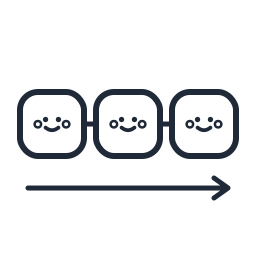
succession; sequential order
Test yourself on sinsekvo
Three quick questions. No account needed.
Know this word? Create a free account to track it.
Word origin
Built inside Esperanto from sin, the accusative of the reflexive pronoun si, and sekvo, a following, from sekvi. A sinsekvo is literally a following-of-itself.
- Origin
- Esperanto
- Root
- sin + sekvo
Examples
.
The succession of events matters.
.
He told the events in the right order.
.
I see no order in that succession.
Sin is the reflexive pronoun in the accusative, itself; is a following, built from . So a is a following-of-itself: a run of things in which each one comes after the last. That is an odd picture in English and an entirely ordinary one in Esperanto.
It belongs to a small family worth learning as a set. is sin + , a self-holding, which is your attitude or your bearing. Sindona is self-giving, devoted. In every one of them the reflexive is doing the same job, naming a thing the subject does to itself, and once you spot the pattern the whole group stops looking like separate vocabulary.
Three near neighbours, kept apart: a is a set of similar items, a is a queue or a row you could point at, and a is the ordering itself, the abstraction rather than the things ordered.
Where this fits
Used in
Stories
(1)Add to review queue
Track this word in your spaced-repetition queue and be tested on it at the right interval.
Meet this word in a story
Every course has graded stories written only with words you have been taught, plus grammar drills, a games arcade and printable worksheets. Chapters 1 and 2 are free.
Chapters 1 and 2 free, forever. Plus: 7 days free, then $5 a month for all eleven languages.
Esperanto · Free printables
sinsekvo: worksheet, infographic and listicle
Free printable study downloads for the Esperanto word "sinsekvo" (succession; sequential order): a worksheet with the answer key built in, an infographic, and a sentence listicle. Open any one to view, print or save.
Free for members
The printable worksheets, infographics and PDFs are free with an account. Start a free week and download as many as you like.
Start your free weekThis word is taught in chapter 25, lesson 6: sinsekvo, strio, galaksio and 7 more words.