

Translation
pavement, footway
Test yourself on trotuaro
Three quick questions. No account needed.
Know this word? Create a free account to track it.
Word origin
From French trottoir, the place where you trot, built on trotter. Esperanto took the Paris word for the Paris invention, and so did most of Europe.
- Origin
- French
- Root
- trottoir
- English cognates
- trot
Examples
.
The children played on the pavement in front of the house.
.
A bicycle should not ride on the pavement.
.
We walked along the pavement as far as the corner of the street.
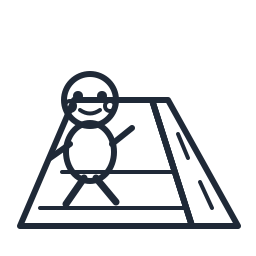
British pavement, American sidewalk, one word. A is the
raised strip beside the strato where people walk and
vehicles do not. English cannot say that in a word both halves of the Atlantic
agree on. Esperanto can, and it did it by taking the French trottoir, which
means roughly the trotting-place.
One trap for British speakers. Pavement in British English also names the
paved surface itself, and Esperanto has a separate word for that: pavimo is
the paving, the made-up surface of a road or a yard, whether or not anybody
walks on it. So a road can have pavimo and no at all. Keep
for the footway and you will not go wrong.
The street furniture around it. Strato at 362 is
the street as a whole, vojo at 202 is the road or the
way, and vojkruciĝo is a junction. You go on the trotuaro, ride a
biciklo on the road, and cross where the paint is:
zebrostrio, the zebra crossing, which is as vivid in Esperanto as it is in
English.
Where this fits
Add to review queue
Track this word in your spaced-repetition queue and be tested on it at the right interval.
Meet this word in a story
Every course has graded stories written only with words you have been taught, plus grammar drills, a games arcade and printable worksheets. Chapters 1 and 2 are free.
Chapters 1 and 2 free, forever. Plus: 7 days free, then $5 a month for all eleven languages.
Esperanto · Free printables
trotuaro: worksheet, infographic and listicle
Free printable study downloads for the Esperanto word "trotuaro" (pavement, footway): a worksheet with the answer key built in, an infographic, and a sentence listicle. Open any one to view, print or save.
Free for members
The printable worksheets, infographics and PDFs are free with an account. Start a free week and download as many as you like.
Start your free weekThis word is taught in chapter 28, lesson 11: trotuaro, bovido, masto and 7 more words.