
Reported Questions and Commands in French: si, ce que, de
By Michael McGettrickUpdated 12 October 2026
Reporting a question deletes its machinery: the question mark, and inversion all go. A yes/no question takes , a question word stays, becomes , and an order becomes plus an infinitive.
| Said | Direct | Reported |
|---|---|---|
| yes or no | ? | . |
| question word | - ? | . |
| what (object) | ? | . |
| what (subject) | ? | . |
| an order | ! | . |
Quick check
Now use it: three quick questions on the chart above. The full practice is further down.
Spot the mistake
0/3Tap the mistake.
The glosses: He asked me if I was coming, where I lived, what I was doing, what was happening. He told me to come.
The tenses shift exactly as they do for statements, which the reported speech page sets out: became above because the reporting verb is past.
Yes/no questions: si
French has three ways to ask a yes/no question and one way to report it.
??- ?->.- He asked me if I was coming.?->.- She asked me if I had finished.
shortens only before and : . - He asked me if he could come in.
This means whether, so the si clauses golden rule does not reach it. A future or a conditional after it is correct:
.- I don't know whether she will come..- He asked me whether I would come.
Question words stay, inversion goes
The question word comes through untouched. What goes is the inversion and any : the subject comes back in front of the verb.

Il m'a demandé qui c'était, où c'était, quand c'était, combien ça coûtait: he asked me who it was, where it was, when it was, how much it cost. Subject, then verb.
- ?->.- He asked me where I lived.?->.- She asked me when the train left.-t- ?->.- I wonder why she said that.?->.- He asked me what time it was.
With a pronoun subject the order is never inverted: , never où habitais-je. With a short noun subject, the verb may come first for rhythm: . - I wonder where the station is.
Qu'est-ce que becomes ce que
Take the out of and a bare is left, which at the head of a clause would read as that. French reaches for instead.
| Direct | Reported | The what is... |
|---|---|---|
| | the object: someone does it |
| | the subject: it does the verb |
| | a person: no change |
?->.- He asked me what I was doing.?->.- He asked me what I wanted.?->.- He asked me what it was.
Qu'est-ce qui becomes ce qui; qui stays
When the what does the verb, the report takes . It is the same subject-or-object test as for relative pronouns.
?->.- He asked me what was happening.?->.- She asked me what I had liked.
asking about a person is already a good connector, so it stays, as subject or object:
?->.- He asked who was there.?->.- He asked me who I had seen.
Orders: de + infinitive
A reported order leaves the tenses altogether: the imperative becomes plus an infinitive.
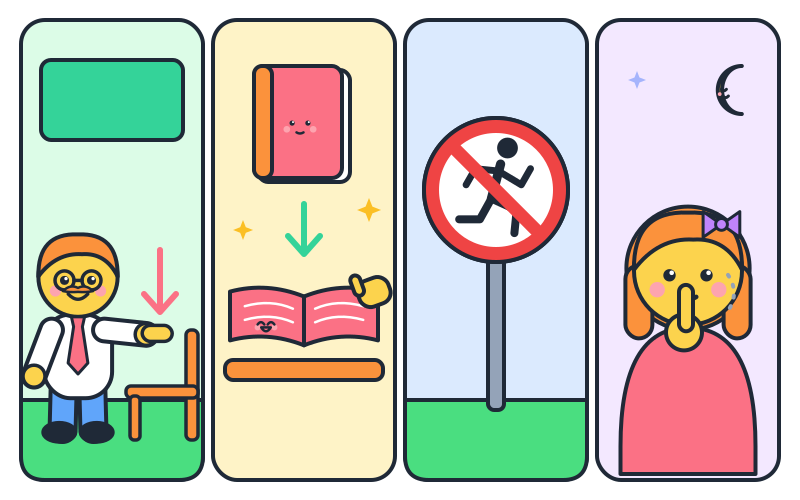
Classroom orders, reported: on nous a dit de nous asseoir, d’ouvrir le livre, de ne pas courir, de nous taire. We were told to sit down, to open the book, not to run, to be quiet.
!->.- He told me to come..->.- He told me to wait five minutes..->.- She told us to close the door.
The verb names who got the order with , usually as a pronoun in front (', , , ):
| Verb | Example | English |
|---|---|---|
| à... | . | He told me to leave. |
| à... | . | She asked us to stay. |
| à... | . | I advised him/her to sleep. |
| à... | Paul . | I forbade Paul to go out. |
and each do two jobs, and the connector is the whole difference:
| Verb | Report | English |
|---|---|---|
. | He told me he was leaving. | |
. | He told me to leave. | |
. | He asked me if I was leaving. | |
. | He asked me to leave. |
Negative orders: ne pas stays together
In front of an infinitive, both halves of the negative sit together, as the advanced negation page shows.
!->.- She asked us not to leave..->.- He told them not to make any noise..->.- She told me never to forget that.
Pronouns stuck on the end of an imperative move in front of the infinitive, and shift to the new speaker:
-.->.- She told me to sit down..->.- He asked me to tell him the truth.
Mistakes English speakers make
| Wrong | Right | Why |
|---|---|---|
| | is for asking |
| | no inversion in a report |
| | the what is the subject |
| | an order takes + infinitive |
| | sits before the infinitive |
What to do next
- Report three questions a stranger asked you, with
- Report one
- Report two orders from a teacher, one of them negative, with
.