
German Colours: rot, blau, grün and Welche Farbe hat...?
By Michael McGettrickUpdated 11 October 2026
German colours are adjectives, and the first good news in German grammar: after a colour never changes. , , . To ask, German says what colour a thing has: ?
Quick check
Three quick questions on what you have just read. The full practice is further down.
Spot the mistake
0/3Each sentence has one mistake. Tap it.
The whole system on one screen
| You want to say | German | English |
|---|---|---|
| a colour | . | The car is red. |
| the question | ? | What colour is the car? |
| the answer | . | It red. |
| light, dark | hellblau, dunkelblau | light blue, dark blue |
| before a noun | | a red car |
| the colour name | . | I like red. |
Every row below is one line of that table, taken apart.
The twelve colours
Learn them with a sentence, not a list. Each one sits after in its plain dictionary form.
| German | English | Example |
|---|---|---|
| red | . |
| blue | . |
| green | . |
| yellow | . |
| black | . |
| white | . |
| grey | . |
| brown | . |
| pink | . |
| purple | . |
| orange | . |
| colourful | . |
 red
 blue
 green
 yellow
 black
 white
 grey
 brown
 pink
 purple
 orange
One spelling and one sound to watch. has the ß in Germany and Austria; Switzerland, which does not use ß, writes . And keeps a French-style sound, roughly o-RONG-zhuh, often clipped to o-RONSH in everyday speech.
After ist: no ending, ever
The colour after or is the bare form, whatever the noun's gender and however many there are:
.- The dog is brown..- The cat is brown..- The car is brown..- The cars are brown.
Four nouns, four genders and numbers, one word. That makes colours the easiest adjectives in the language to use on day one.
Welche Farbe hat...?
is colour. The question uses , not : German asks which colour a thing has.
?- What colour is the car??- What colour is the door?Lieblingsfarbe?- What'syour favourite colour?Lieblingsfarbe .- My favourite colour is green.
? copies the English pattern. You will hear it in casual speech, but is the standard question and the one to learn.
Er, sie or es: the noun decides
When you answer with it, German picks the pronoun by the noun's gender, not by whether it is alive. The colour of the pronoun matches the colour of the article.
| The thing | Answer | English |
|---|---|---|
| . | It brown. |
| . | It blue. |
| . | It green. |
| . | It red. |
So ? . but ? . Calling everything is the commonest slip here; German personal pronouns has the full set.
Light and dark: hell- and dunkel-
(light) and (dark) join the colour to make one word, small and with no hyphen:
| German | English | Example |
|---|---|---|
hellblau | light blue | hellblau. |
dunkelblau | dark blue | dunkelblau. |
hellgrün | light green | hellgrün. |
dunkelrot | dark red | dunkelrot. |
They behave exactly like the plain colour: no ending after .
In front of a noun: an ending appears
Move the colour in front of the noun and it takes an ending. Compare:
| After ist | Before the noun | English |
|---|---|---|
. | | the red house |
. | | the blue door |
. | | a red car |
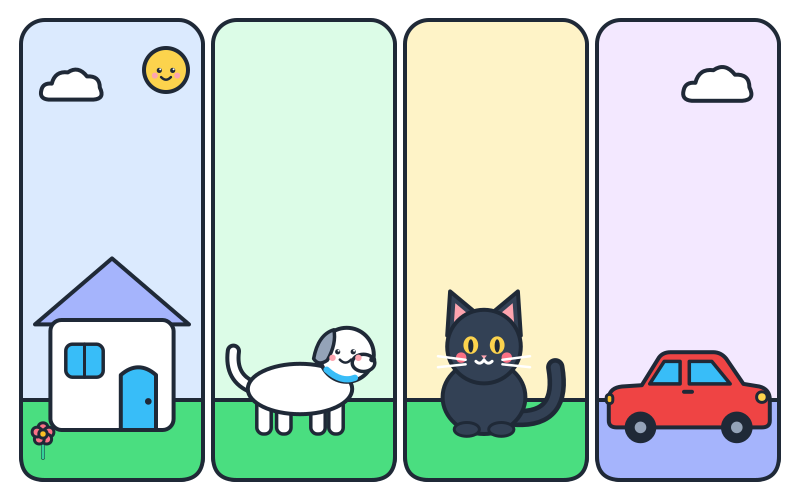
The same weiß takes two endings: ein weißes Haus (das Haus), ein weißer Hund (der Hund). The noun's gender picks the ending, not the colour.
Which ending, and why, is the subject of German adjective endings, an A2 topic. For now, learn these three as set phrases, or put the colour after . and stay bare even here in careful German: - a pink dress.
The colour as a noun
The name of the colour itself is a noun, so it takes a capital:
.- I like red..- Blue is nice.
As an adjective it is small again: .
Mistakes English speakers make
| Wrong | Right | Why |
|---|---|---|
. | . | no ending after |
? | ? | colour asks |
? . | ? . | die is feminine: |
| hellblau | one word |
. | . | the colour name is a noun |
What to do next
- Name the colour of five things in the room:
. - Ask and answer once with each pronoun:
...,...,... - Come back for adjective endings when