
Ordering in German: Ich hätte gern, Was kostet das?, Zahlen, bitte
By Michael McGettrickUpdated 12 October 2026
Order with ... and the thing you want: . Ask the price with ?, and pay with , ! Three phrases, and every , bakery and till in the German-speaking world is open to you.
Quick check
Three quick questions on what you have just read. The full practice is further down.
Pick the right one
0/3You are in a German café. Tap what you would say.
I'd like a coffee, please. (politely)
How much is that?
The bill, please. (to pay)
The whole exchange on one screen
| You want to | German | Note |
|---|---|---|
| order (polite) | . | the standard |
| order (also) | . | just as polite |
| order (short) | , . | fine at a counter |
| ask the price | ? | how much is it? |
| hear the price | . | 3,50 € |
| hear the total | . | that comes to |
| ask for the bill | , ! | let pay |
| pay together | , . | one bill |
| pay separately | , . | each pays |
| tip | . | keep the change |
Ich hätte gern: the polite way to ask
German has four common ways to ask for something, and they are not interchangeable.
- Ich will
- Ich nehme
- Ich möchte
- Ich hätte gern
| Sounds | German | English |
|---|---|---|
| demanding | . | I want a coffee. |
| decided, fine | . | I'll have a coffee. |
| polite | . | I'd like a coffee. |
| polite, standard | . | I'd like a coffee. |
is literally "I would have gladly". Learn it as one chunk: nobody stops to parse it at a counter. at the end makes any of the polite forms : , .
The thing you order is accusative
What you ask for is the object of the sentence, so a masculine noun takes . Feminine, neuter and plural do not change.
| Gender | German | English |
|---|---|---|
| masculine | | a coffee |
| feminine | | a soup |
| neuter | | a water |
| plural | | two rolls |
.- I'd like a tea..- I'd like a loaf.
A cup or glass of something needs no "of": (a cup of coffee), (a glass of water), (a piece of cake).
Asking for more
, .- The menu, please.?- Do you have tea?, .- Another coffee, please., .- Another water, please.
is "one more". English "another" can also mean a different one; for that, German says : . - I'd like a different table.
At the Bäckerei
The bakery is where most visitors first use German, and it runs on the same three phrases. The assistant speaks first.
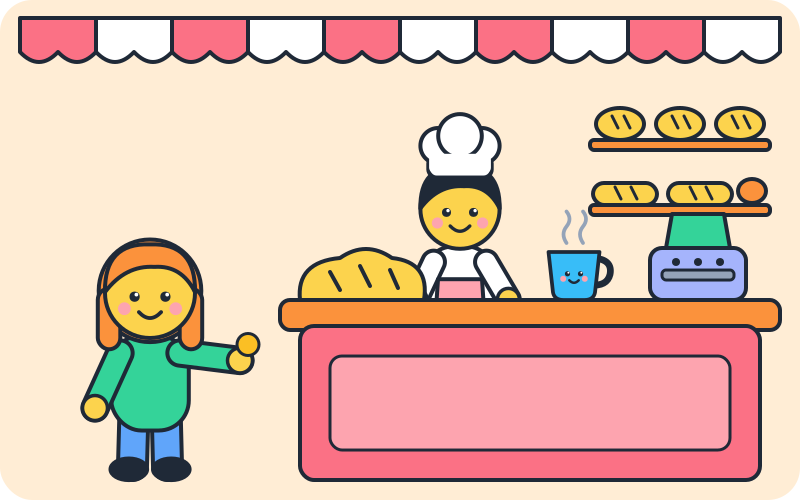
- .
- ?
The baker asks Was darf es sein? (what can I get you?), the customer answers Ich hätte gern zwei Brötchen (I'd like two rolls), and the bread (das Brot), the coffee (der Kaffee) and the till (die Kasse) wait on the counter.
| Who | German | English |
|---|---|---|
| assistant | ? | What can I get you? |
| you | . | I'd like two rolls. |
| assistant | ? | Anything else? |
| you | , . . | A loaf, please. That all. |
| assistant | ? | To take away? |
is the German breakfast roll, and many regions have their own name for it. The word above is understood everywhere. A Brezel (a pretzel) is the other bakery classic in the south.
Food and drink to start with
Learn each word with its article: the colour is the gender.
| Drinks | Food | Things |
|---|---|---|
| | |
| | |
| | |
| | |
| | |
| | |
(potato) and (banana) are feminine too, so , .
Was kostet das? Prices
Two questions, both everyday:
?- How much is that??- How much is the coffee?
For two things or more, the verb goes plural: ? - How much are the apples? The answer is ... or, for a total, ...: . - That comes to ten euros.
Euro and Cent
| Written | Said | Note |
|---|---|---|
| 1,00 € | | , not |
| 3,50 € | | in the middle |
| 10,00 € | | no plural -s |
| 0,50 € | | no plural -s |
| 12,90 € | | at a till: |
Germany writes a comma where English writes a decimal point, and the euro sign usually goes after the number. is expensive and cheap:
.- That'stoo expensive..- The coffee is cheap.
Paying: Zahlen, bitte!
In a German or restaurant the waiter does not bring the bill until you ask. Catch their eye and say , ! or . ( means the same: .) Then comes the question English speakers are not ready for.
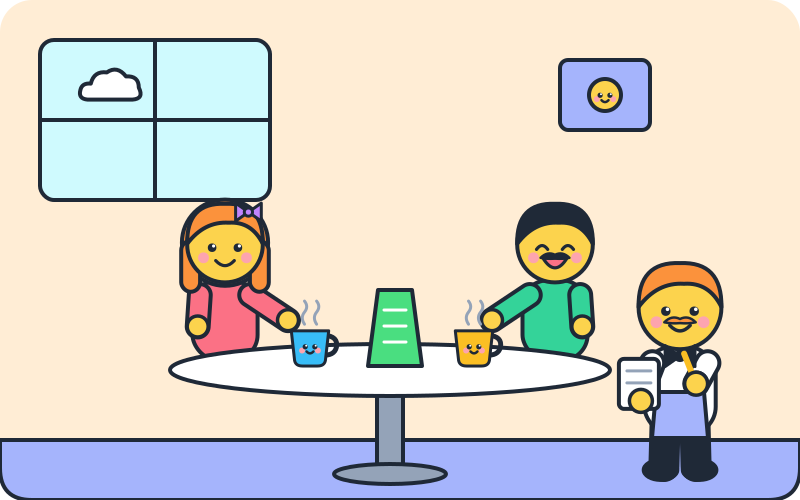
- , !
- , .
- ?
She asks for the bill (Zahlen, bitte!), the waiter asks Zusammen oder getrennt? (together or separately?), and he answers Getrennt, bitte (separately, please).
?- Together or separately?, .- One bill, please., .- Separately, please.
Splitting the bill to the cent is completely normal in Germany. means each person pays for exactly what they had, at the table.
Card or cash
Cash is still more common in Germany than in Britain, and smaller and bakeries may not take cards. Ask first:
?- Can I pay by card?.- I'll pay cash.
The tip: Stimmt so
Germans tip by rounding up, usually five to ten per cent, and they say the total as they pay. Leaving coins on the table is much less usual.
| The bill | You hand over | You say |
|---|---|---|
| 18,40 € | 20 € | . |
| 18,40 € | 50 € | , . |
| 18,40 € | a card | , . |
means "that's right as it is": keep the change. With a big note, say the total you want to pay, and the waiter gives you the rest back.
At the Kasse
In shops, supermarkets and the (the chemist's) you pay at the , the till. The cashier says the total and may offer the receipt:
.- That'seleven euros twenty.Bon?- Do you want the receipt?, .- No, thank you.
A café exchange, start to finish
Two friends, one bill:
| Who | German | English |
|---|---|---|
| waiter | ? | What would you like? |
| you | . | I'd like a coffee with milk. |
| friend | , . | A tea for me, please. |
| waiter | . ? | Of course. Anything else? |
| you | , . | No, thank you. |
| you | , ! | The bill, please! |
| waiter | ? | Together or separately? |
| you | . ? | Together. What the total? |
| waiter | . | Six eighty. |
| you | . . | Seven . Keep the change. |
Common mistakes English speakers make
| Wrong | Right | Why |
|---|---|---|
| will (to order) | | will sounds demanding |
| is masculine | |
| no "of" | |
| no plural in prices | |
| die | | plural thing, plural verb |
What to do next
- Order your next coffee in your head in German:
... - Read three prices aloud from a receipt, with
in the middle. - Do the drill below, then try the
exchange aloud.